




BRISBANE—Good news for the poor exists, and his name is Jesus, Tim Costello, executive director of Micah Australia, told a July 9 symposium on aid, immediately prior to the Baptist World Congress.
“Yes, we worship Jesus, but Jesus didn’t say, ‘Worship me.’ He said, ‘Follow me.’ … You cannot follow Jesus without being profoundly concerned for the poor,” Costello told the symposium sponsored by the Baptist Forum on Aid and Development.
In his “signature sermon” in Nazareth at the beginning of his public ministry, Jesus proclaimed “good news for the poor,” Costello said.
When Jesus told his disciples “the poor you will have with you always,” he was not telling them there was no point in trying to alleviate poverty, he stressed. Rather, he asserted, Jesus was emphasizing his disciples’ continuing responsibility to the poor.
“There is no escaping the claims of the poor,” Costello said. “This isn’t an option. … This is fundamental to following Jesus.”
Need to ‘prioritize the poor’
A world that “is retribalizing fast” needs Christians who are not focused on the greatness of any single nation but upon the greatness of the mission of following Jesus by embodying good news for the poor, he insisted.
“It’s not about seizing power. It’s about being a witness,” Costello said.
Jesus has called his followers to “prioritize the poor” in a world that seeks to disregard them, he asserted.
“In a retribalizing, populist, post-truth, polarizing world, is there good news? Yes, there is. The answer is Jesus. He is the good news,” Costello said.
Sign up for our weekly edition and get all our headlines in your inbox on Thursdays
‘This is a humanitarian disaster’
Costello described what he witnessed one week earlier, spending eight days on the Thai-Burma border among the Chin, Kachin, Karen and other persecuted ethnic minority groups.
“Please, in their moment of Gethsemane, do not forget the Baptists of Burma,” Costello urged.
Talking with Chin leaders, he heard about 60 churches that had been bombed.
“Sadly, with the cessation of USAID, the TB, malaria, HIV treatments and emergency health care is no longer getting into the ethnic areas,” he said.
A Baptist doctor with whom he spoke wondered how the hospital where she serves could continue running without USAID funds.
“The nine refugee camps on the Thai-Burmese border—mainly with Karen refugees, mainly Baptist—will all close at the end of this month. Why? Because the $1 million to feed them from USAID has ceased,” Costello said.
Other governments also have cut their aid budgets, leaving the camps without resources.
“This is a humanitarian disaster. … The churches in the ethnic areas of Burma are literally the only humanitarian centers left. There is really no aid getting in,” he reported.
“It’s the churches alone, even with churches being bombed and under attack, who are trying to feed some 1.6 million Karen internally displaced people in their state.”
Direct action, advocacy and generosity
Costello described the Australian “Safer World for All” campaign to mobilize Christians to direct action, advocacy and generous giving to help the poor.
Christians who have a passion for the world’s poor not only are contrary to society at large that sees empathy as a “fundamental weakness,” but also are at odds with some evangelicals who talk about “the sin of empathy,” he noted.
“I want to say that because it has been so profoundly influenced by the story of the Good Samaritan, the fundamental strength of western civilization is empathy,” Costello said. “It’s good news for the poor.”
In a panel discussion, Irene Gallegos with Texas Baptists’ Christian Life Commission emphasized the importance of working not only at the “macro level” through large-scale organizations and international efforts, but also at the “micro level” through personal ministry to neighbors.
A vision of shalom
Johnathan Hemmings with the Jamaica Baptist Union focused on the need to serve the poor, stand with the poor and walk alongside the poor.
Missional engagement must be informed by a vision of shalom—biblical peace and wholeness, he asserted.
Hemmings described how the “haves” and the “have nots” perceive peace differently. Those who have abundance may be willing to practice charity but not be open to transformational initiatives because they benefit from the status quo, he observed.
“Charity never transforms systems and structures. It requires justice, mercy and humility,” he said.
Wissam Nasrallah, chief operations officer for Thimar, a Christian nonoprofit based in Lebanon, decried any form of the gospel that is focused exclusively on improving one’s own life, rather than doing good for everyone.
“What the gospel does, first and foremost, is that it destroys self-centeredness,” he said. “This is the source of our ills. We are too self-centered.”
Move beyond charity
Amanda Khozi Mukwashi, United Nations resident coordinator in Lesotho, not only participated in the panel discussion, but also as keynote speaker at a luncheon sponsored by Baptist World Aid.
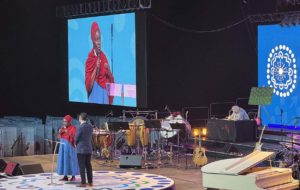
“I think we have become too comfortable,” Mukwashi said, challenging churches to move beyond charity and instead pursue freedom and justice for the poor by seeking to dismantle unjust systems and structures.
“We live in a turbulent and volatile world. … It is a world where poverty, war and injustice persist,” she said. “But it is a world where the church is called to respond not just with charity, but with prophetic clarity and moral courage and fortitude,” she said.
She drew a sharp contrast between allegiance to the empires of this world and the kingdom of God.
The church too often mirrors the unjust systems and structures of empire, but it is called to disrupt and dismantle them, she stressed.
“It involves breaking free from both external domination and internalized oppression, from inherited injustice and distorted images of God, self and others,” Mukwashi said. “It means calling out the gospel of Caesar masquerading as the gospel of Christ.”
Deliverance from the grip of empire
The Exodus story not only was the central event of God’s people in the Old Covenant, but also informs how the church should view liberation today, she emphasized.
Exodus focused on “God delivering his people from the grip of empire not only physically but spiritually,” she said.
“Pharaoh and empire did not see the Israelites as people or as neighbors. It saw them as threats, laborers and problems to manage and to solve. Their identity was stripped. Their worth was reduced to simply economy. I hope that sounds familiar,” Mukwashi said.
“Many of our churches and institutions have inherited theologies shaped by empire—prioritizing hierarchy over service, order over justice, control over compassion, and charity over restoration—and God help us if we mention the word ‘reparations.’”
‘Are we preaching a gospel of freedom?’
Even humanitarian aid to the poor can become an instrument of manipulation and oppression, she noted.
“When humanitarian efforts treat people as problems instead of partners, they unintentionally mirror Pharaoh’s mindset. Aid is offered, but voice is silenced. Needs are met, yet dependency is perpetuated,” she said.
“The church must ask itself, ‘Are we empowering communities, or are we replicating Egypt draped in religious language?’”
The people of God are called to a reimagined world and to create community “where dignity is restored and the image of God is recognized in every one of us,” she said.
“Are we preaching a gospel that liberates or one that domesticates? … Are we preaching a gospel of freedom?” she asked.
“Are our churches places of refuge or replicas of Pharaoh’s palace? Have we accepted theologies and structures that mimic empire more than the kingdom of God?”
Christians are called to challenge empire—including empire within the church, she said.








We seek to connect God’s story and God’s people around the world. To learn more about God’s story, click here.
Send comments and feedback to Eric Black, our editor. For comments to be published, please specify “letter to the editor.” Maximum length for publication is 300 words.