





BRISBANE—Ralph West, founding pastor of The Church Without Walls in Houston, challenged global Baptists to embrace a “theology of reconciliation.”
He was among more than 50 speakers representing about 30 countries who presented Bible studies in 10 languages—with each presenter teaching the same passage each day—during the Baptist World Congress, July 10-12.
In a study of 2 Corinthians 5:18-21, West encouraged Baptists to recognize they worship a God who is reconciling his creation to himself.
“God’s ultimate act of reconciliation was to send his only Son,” he said. “All reconciliation comes through Christ.”
Through the incarnation, God reconciled himself to humanity by taking on humanity, he noted.
“People need a Jesus who they can identify with and a Jesus who can identify with them,” West said.
Baptists and other Christians need to answer the call to be “ambassadors for Christ,” he said, recognizing an ambassador’s role is not to make policy but to represent faithfully the policy of the one who is sovereign.
“We are not given authority to change the message,” West said.
Rather, Christians are to proclaim “a message of peace and a message of freedom” as presented in Scripture and to “set the message loose in the world,” he said.
Disruptive good news
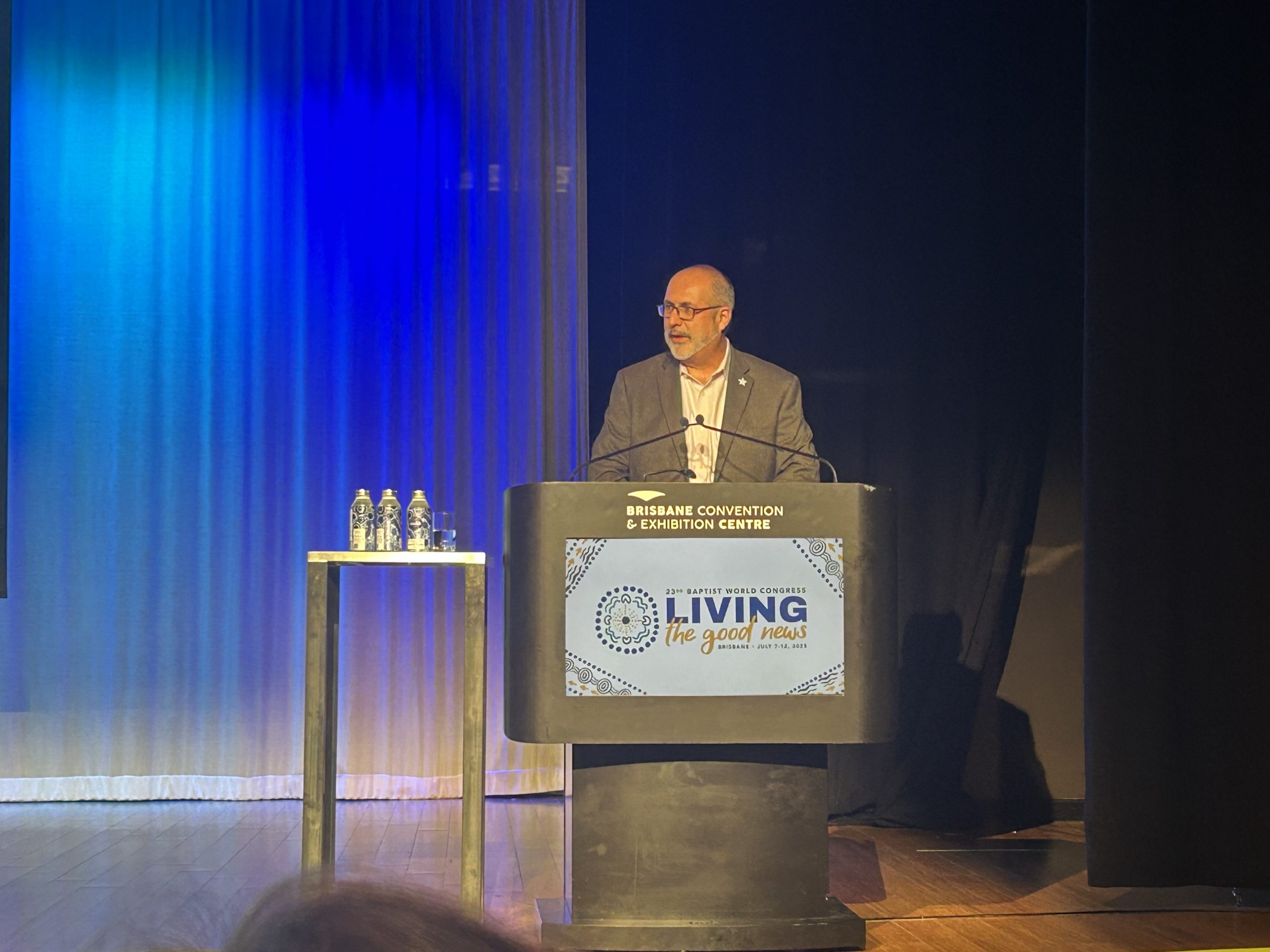
Julio Guarneri, executive director of Texas Baptists also taught on 2 Corinthians 5:17-6:2. He focused on the disruptive nature of the good news.
Recalling a series of disruptive events from his own history—beginning with his parents’ coming to Texas from Mexico as missionaries to Spanish-speaking people in his teen years—Guarneri asserted surrender to God’s direction moved him to a deeper plane, no matter how imperfect his surrender may have been.
In the passage, Jesus sets his kingdom agenda of reconciliation—an agenda that is clear: “through his perfect work on the cross, he proclaims good news to the poor, freedom for the captive,” sight to the blind, healing for the sick and the beginning a new era of the Lord’s favor.
“Our agenda ought to reflect Jesus’… the metric for success ought to be the same as that of Jesus,” Guarneri noted.
Jesus’ agenda is comprehensive, including proclamation, healing and liberation. “It is physical, it is spiritual, and it’s emotional,” he said.
“The nature of the gospel requires us to be holistic in our approach,” Guarneri noted, continuing, “Our ministry is about words and about works … It is about loving, and it’s about living the good news.”
Paul reminded the Corinthian Christians they are partners with God, he said.
God’s coworkers cannot be mere recipients of God’s redemption, but also must be reconcilers, Guarneri asserted.
God’s heart has always been for the nations, but the Holy Spirit’s power took an ethnocentric understanding of God and “reframed it to be inclusive of all people.”
When God sends the disciples, it starts a global movement that extends to the ends of the earth.
Guarneri noted 60 percent of the world’s Christians today can be found in the Global South where Christianity is growing rapidly.
So, “the church, the academy and the mission” are at a pivotal moment.
“To be disruptible disciples in the rest of the world is to change our paradigm from simply thinking that we send from the West to the rest of the world, to coming alongside the Global South to send from everywhere to everywhere.”
Godly fasting
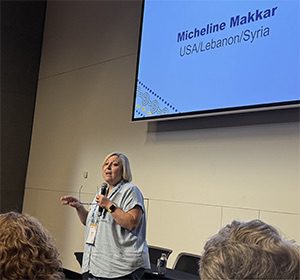
God wants his people to fast—not to deprive themselves of needed nourishment but to meet the needs of others, said Micheline Makkar from Damascus, Syria.
“True fasting is doing good and loving justice,” Makkar said, focusing on Isaiah 58:6-12. “A godly fast is not about afflicting oneself but about liberating others.”
When a devastating 7.8 magnitude earthquake rocked Aleppo in 2023, no international humanitarian aid was able to reach the affected people because of sanctions imposed on Syria, she recalled.
Many members of the Baptist Church of Damascus struggled to feed their own families and had experienced deprivation themselves due to war.
However, leaders of the congregation encouraged church members to share what little food and other resources they had with the people of Aleppo.
“Our church gave 1,000 bags of blessing to Aleppo—from the poor to the poor,” Makkar said. “Our church learned fasting.”
God honors acts of “costly compassion” as expressions of worship, she said.
“God answers those who answer the needs of others,” Makkar said. “God responds to human mercy with divine favor.”
Acts of kindness and pursuit of justice are never in vain, even if their results are not immediately apparent, because they plant “the seeds for generational renewal,” she said.
Makkar urged global Baptists to ask: “What legacy of justice am I leaving?”
With additional reporting by Calli Keener.






We seek to connect God’s story and God’s people around the world. To learn more about God’s story, click here.
Send comments and feedback to Eric Black, our editor. For comments to be published, please specify “letter to the editor.” Maximum length for publication is 300 words.