Beth Moore to end Living Proof events in 2027

Bible teacher and bestselling author Beth Moore announced Thursday, March 5, her ministry will stop holding large-scale Living Proof events in 2027.

The decision to end Living Proof Ministries events, which feature Moore’s Bible teaching and worship music, will coincide with her 70th birthday. She plans to continue speaking and writing but will no longer host events.

“Though it may sound like retirement, unless the Lord wills it, it’s meant to actually delay retirement, making the best use of my remaining energies in the last chapter of ministry,” Moore, the founder of Living Proof Ministries in Houston, said in a video announcement.

For decades, Moore taught at stadiums and megachurches and sold millions of Bible studies and books, in a remarkable career that started when she began teaching a Bible study at a church in Houston. 

One of her studies, A Woman’s Heart: God’s Dwelling Place, wound up in the hands of an editor at Lifeway, the Southern Baptist Convention publishing arm, which led to a publishing deal that lasted for decades and made her a household name among evangelicals.

Though not seminary trained, Moore became a serious student of the Bible, investing hundreds of hours of research into her studies and seeking out the best scholars to sharpen her understanding.

The election of President Donald Trump upended Moore’s world. Her criticism of Trump’s behavior, which she has said fell short of the morality she learned about in the Bible, alienated evangelicals who supported Trump. Some stopped buying her books or going to her events, and to some pro-Trump evangelicals, she became a pariah.

Moore left the SBC in 2021 and cut ties with Lifeway, with her ministry taking over her events. She would later retell the story of her own experience of abuse as a child and how the church and Jesus had saved her in her 2023 memoir, All My Knotted-Up Life, and how she found a new church home after leaving the SBC.

“Never underestimate the power of a welcome,” she told RNS in a 2023 interview.

This year, the ministry will run a pair of sold-out events in Asheville, N.C., in April, a cruise to Alaska in July, and an event at a Lutheran church in Iowa in September, followed by church events in Massachusetts and Seattle. A final event is set for April 2027, in Nashville, Tenn.

In her announcement, Moore said planning for the future of Living Proof started when she turned 65. She said she prayed for a year before presenting a plan to the ministry’s board of directors. She also gave thanks to God and to the staff at the ministry.

“I work with the most wonderful people on earth,” she wrote. “I adore them. I love what I get to do and hope to keep serving Jesus to my last breath.”


Report challenges U.S. support for international religious freedom

WASHINGTON, D.C. (BP)—The 2026 annual report by the U.S. Commission on International Religious Freedom commends the Trump Administration for designating Nigeria, among others, as a Country of Particular Concern while lamenting the dramatic impact of budget cuts toward groups like the U.S. Aid for International Development.

The report stated conditions in Nigeria as “abysmal.” Nearly 53,000 citizens have been killed since 2009, and around 21,000 over the last five years.

Violence has forced millions to flee their homes and communities, seeking safe shelter in camps and other locales.

“The unfolding catastrophe is the outcome of a lethal confluence of trends: religiously motivated extremist violence; economic and ethnic tensions, long left to fester; corrosive, state-level blasphemy laws; and years of both inadequate response and pervasive corruption from the Nigerian government,” the report said.

Countries remaining on the Countries of Particular Concern list from previous years are Burma, China, Cuba, Eritrea, Iran, Nicaragua, Nigeria, North Korea, Pakistan, Russia, Saudi Arabia, Tajikistan, and Turkmenistan.

They are joined this year by Afghanistan, India, Libya, Syria, and Vietnam, the last two moving up from the Special Watch List.

Algeria and Azerbaijan remain on the Special Watch List. Those recommended for the list in the latest report are Egypt, Indonesia, Iraq, Kazakhstan, Kyrgyzstan, Malaysia, Qatar, Turkey, and Uzbekistan.

A press conference held March 4 to present the report expressed particular concern for religious groups in Iran.

“Whatever the outcome of the current conflict, USCIRF will continue to advocate for freedom of religion or belief in Iran,” said Vicky Hartzler, USCIRF chair.

Tim Mackall, policy associate with the Southern Baptist Convention’s Ethics & Religious Liberty Commission, said the report sheds light on the “disturbing rise” of violence and religious oppression around the world.

“From the slaughter of thousands of Nigerian Christians, to the crackdown of online religious services and house churches in China, and the enforcement of strict anti-Christian blasphemy laws across much of the Middle East, Central Asia, and South Asia, the work needed to advance religious freedom is abundantly clear,” Mackall told Baptist Press.

Fear for our souls

“There is fear. We fear for our souls,” said one Muslim farmer to BBC News in October on the threat of violence from Boko Haram militants.

An Entity of Particular Concern, Boko Haram has driven the violence in Nigeria through mass school abductions, kidnapping, and long-term captivity of women and children, beheadings of Christians, and depopulating farming communities through threats of violence.

Based in northeast Nigeria, the group’s activities have spread into Cameroon, Chad, and Niger.

The report noted the U.S. government’s commitment to religious freedom, including President Trump’s comments in July to “expand and strengthen America’s efforts to defend religious freedom around the world.”

In September, while addressing the United Nations General Assembly, he said, “Let us protect religious liberty.”

USCIRF repeatedly called the Biden administration to add Nigeria, Afghanistan, India, and Vietnam to the Countries of Particular Concern list before their inclusion.

Other entities on the Entities of Particular Concern list include the Houthis in Yemen and Islamic State groups in the Greater Sahara and West Africa.

Added to the list is Rapid Support Forces, a paramilitary group formerly under the Sudanese Armed Forces before splitting and engaging in hostilities with their former leaders in April 2023.

Downstream from funding cuts

A desire for efficiency led to Trump’s January 2025 executive order that paused all foreign assistance in January 2025.

“In March, Secretary Rubio announced cuts to 5,200 USAID programs—representing 83 percent of all USAID programs, including 85 percent of human rights and rule of law programs,” the report said. “In July, USAID ceased to implement foreign assistance and certain functions of USAID were realigned under the State Department.”

Programs eliminated included those to challenge blasphemy laws, early-warning systems for attacks in Nigeria’s Middle Belt, interfaith dialogue efforts, and documentation of atrocities and religious freedom violations, including genocide and crimes against humanity.

Mackall said the ERLC is grateful for USCIRF’s efforts and urges lawmakers to consider the report’s recommendations.

“Religious freedom has been and must continue to be a pillar of U.S. foreign policy, ensuring that we continue to stand upon the Southern Baptist ideal of ‘a free church in a free state,’ which makes room for the freeing power of the gospel to be proclaimed among every people, nation, tribe, and tongue,” Mackall said.

Other findings

The report also noted conflict zones in Syria, Sudan, the Democratic Republic of Congo, and wider Africa. A Christian church bombing in Syria killed dozens of worshippers.

Islamic State affiliates continue to operate in central and east Africa, killing Christians and attacking mosques.

China remains active in severing avenues to worship freely.

Authorities meet those goals through a combination of “an extensive web of laws, regulations, and policies that do not conform to international human rights standards.”

The “sinicization of religion” policy also continues to inject Chinese Communist Party political ideology into every aspect of religious life.

Cuba, Nicaragua, and Venezuela were cited for political repression through targeted harassment, surveillance, and detention of clergy and religious communities throughout Latin America.

The 96-page report can be viewed and downloaded on the USCIRF website.


Violence in Nigeria sparks debate on religion

NAIROBI, Kenya (RNS)—When gunmen stormed villages near Makurdi in Nigeria’s Benue state last year, Pastor Emmanuel Ochefu said the attack felt personal.

“They came at night, shouting and burning homes,” said Ochefu, who leads a small Pentecostal church outside the city and spoke with RNS by phone.

“Most of the people killed were Christians. We cannot pretend that our faith is not part of why we are targeted.”

Nigeria was the first country mentioned in the introduction of the U.S. Commission on International Religious Freedom’s annual report released on Wednesday, March 4 describing its “terrifying crisis of religious violence” and connecting it to the politics of the country.

“Nigeria’s religious freedom environment is contextually unique in terms of its violent and complex perfect storm of religious, political, social, and economic factors, but it is representative of the alarming persistence of freedom of religion or belief (FoRB) violations that continue to plague millions of people across the globe,” reads the report from the independent bipartisan agency.

The report details the sacrifices of many thousands of “innocents on the altar of religious bigotry” and mass abductions that have devastated religious communities in the north and central regions of the country.

In addition to extremist violence the commission says is religiously motivated, it also points to “corrosive” blasphemy laws at state levels and “pervasive corruption” in the government of Nigeria.

For many Christians in Nigeria’s Middle Belt and northern regions, experiences like the attack on Makurdi have reinforced a deeply held belief they are being persecuted because of their religion.

Yet security analysts, government officials, and Muslim leaders say the reality behind Nigeria’s violence is far more complex—rooted less in religious ideology than in a volatile mix of criminality, competition over land and resources, climate pressures, and decades of weak governance.

The debate reflects a broader struggle to understand one of Africa’s longest-running security crises, which, according to the USCIRF report, has killed almost 53,000 Nigerian civilians due to “targeted violence” since 2009, the year the commission first recommended it be labeled a “country of particular concern.”

In 2020, Nigeria was designated by the State Department with that label, marking it as one of the most egregious violators of religious freedom.

The designation was removed in 2021, but President Donald Trump announced in October Nigeria had received it again.

Additionally, the crisis has displaced millions over the past 15 years.

Nigeria, Africa’s most populous country, with more than 200 million people, is broadly divided between a predominantly Muslim north and a largely Christian south. Much of the violence has been concentrated in the northeast, where Islamist insurgents such as Boko Haram and its splinter groups have waged a deadly rebellion since 2009.

But attacks also occur in central states such as Benue and Plateau, where disputes between farming communities, often Christian, and mostly Muslim nomadic herders have escalated into cycles of revenge killings.

Security analyst Peter Akachukwu, based in Lagos, said reducing the violence to a simple religious narrative risks obscuring its underlying drivers.

“What we are seeing is not purely religious persecution,” Akachukwu told RNS in a phone interview.

“Yes, identity plays a role in who is attacked and how communities interpret the violence. But fundamentally, this is about competition for land, poverty, weak law enforcement, and organized criminal networks exploiting those divisions.”

He said armed groups often target vulnerable communities regardless of faith, driven by economic motives such as cattle rustling, ransom kidnappings, and territorial control.

“Religion becomes a marker,” he said. “It is not always the root cause.”

Rising death toll fuels persecution narrative

Still, data from advocacy groups shows why many Nigerian Christians view the crisis through a religious lens.

According to Open Doors, a global Christian watchdog organization, more Christians are killed for their faith in Nigeria than anywhere else in the world.

In its 2025 World Watch List, the organization reported at least 3,490 Christians were killed in Nigeria in their latest reporting period—accounting for the vast majority of Christian deaths recorded globally that year.

The group says violence by jihadist insurgents, including Boko Haram and Islamic State West Africa Province, as well as attacks by armed militants in central Nigeria have disproportionately affected Christian communities.

Over a longer period, estimates vary widely, but some advocacy and monitoring groups report tens of thousands of Christians have been killed since the insurgency began more than a decade ago, with thousands abducted and churches destroyed.

At the same time, United Nations data underscores the overall conflict is far broader. The insurgency in northeastern Nigeria alone has killed nearly 350,000 people, including deaths linked to violence, displacement, and humanitarian crises.

Analysts say the figures illustrate the complexity of the crisis.

“The numbers show that Christians are heavily affected,” Akachukwu said. “But they also show this is a massive national security breakdown impacting all communities.”

For many Christian leaders, however, the pattern of attacks on predominantly Christian villages reinforces a sense of deliberate targeting.

Pastor Moses Mashat, who leads an evangelical church in central Nigeria, said repeated assaults have created deep fear among believers.

“When churches are burned and Christian communities are attacked again and again, people cannot ignore that,” Mashat said by phone. “For many Christians, this feels like persecution, even if the government calls it something else.”

Church leaders say the psychological impact has been profound, fueling displacement, mistrust, and trauma.

Ochefu said his congregation has shrunk as families flee to safer areas.

“People are afraid to gather,” he said.

Government and Muslim leaders reject genocide claims

Nigerian officials have consistently rejected claims Christians are being singled out for extermination.

Kimiebi Imomotimi Ebienfa, a spokesperson for Nigeria’s Ministry of Foreign Affairs, said in recent interviews, while the country faces serious security challenges, the violence affects all religious communities.

“There is no Christian genocide in Nigeria,” Ebienfa said in a November 2025 interview. “Muslims are being killed. Traditional worshippers are being killed. The violence is not restricted to one group.”

Information Minister Mohammed Idris has similarly argued the insecurity is driven primarily by banditry, terrorism, and criminal activity rather than religious ideology.

Muslim clerics in northern Nigeria say their communities have also suffered heavily.

Bashir Modu, a Muslim religious leader, said armed groups have devastated both Muslim and Christian populations.

“People are being slaughtered regardless of religion,” he said. “We must stop seeing this only through a religious lens and focus on protecting all communities.”

Modu warned framing the conflict solely as a Christian-Muslim struggle risks deepening divisions and undermining peace efforts.

Despite tensions, political and religious leaders on both sides say faith communities also play a crucial role in peacebuilding.

“(Nigeria’s) two largest religious communities, Christians and Muslims, have long shared their lives with each other, with followers of traditional African religions, and with many others—and yet they now face an existential struggle and dangerous confluence of armed conflict, nonstate violence, state restrictions, and societal challenges,” reads the USCIRF report.

Interfaith groups in several states have organized dialogue forums, early warning systems, and joint humanitarian relief efforts for displaced families.

As Nigeria’s insecurity continues, experts say the debate over whether the violence constitutes religious persecution may miss the broader reality.

“It is both identity and structural failure,” Akachukwu said. “Communities experience attacks through religious identity, but the root causes go far deeper.”

For Pastor Ochefu, the distinction matters less than the human cost.

“People just want to live without fear,” he said.

Adelle M. Banks contributed to this report.


Celebrating Churches: Dorrell retiring from Church Under the Bridge

After 1,736 Sundays—more than 33 years—Jimmy Dorrell has announced his retirement as pastor of Church Under the Bridge, effective the week after Easter. Dorrell and his wife, Janet, shared the news with the congregation March 1. The couple will remain members of the church following Holy Week but will step away from day-to-day leadership. “God birthed a unique congregation of more than 225 friends—blacks, whites, and browns, rich and poor, educated in the streets, and in the university, all serving the same God, who created us all,” Dorrell stated. In retirement, the Dorrells plan to expand their global service, making additional trips to serve impoverished and unreached communities in Haiti, Mexico City, and South Asia. He will continue teaching select classes at Baylor University, Truett Theological Seminary, and other churches, while Janet looks forward to pursuing additional art projects.


Save Ukraine rescues 1,169 children from Russian occupation

CAUTION: This report contains references to sexual and physical violence.

ZAPORIZHZHIA REGION, Russia—Russian soldiers didn’t believe 17-year-old Maxim Trebushnyi was deaf. Invading Maxim’s home and raping his deaf mother, soldiers would abduct him for weeks at a time, beating him in unsuccessful attempts to make him speak.

Maxim’s mother died within months of being raped, and he struggled to care for his disabled grandmother as Russian soldiers controlling his village would release him, but periodically return to his home in efforts to make him speak and fight on Russia’s behalf.

Maxim, now being cared for by the humanitarian group Save Ukraine, is just one of 1,169 abducted and persecuted children Save Ukraine has rescued at great risk from Russia and Russian occupied territories of Ukraine since 2022, in addition to around 500 rescued from war zones.

“In captivity, Maxim says he was not properly fed. He was beaten and humiliated because the soldiers did not believe he was Deaf. They accused him of pretending,” Save Ukraine recounts Maxim’s ordeal. 

“The cruelty was so cynical that at one point, during threats and intimidation, they told him they would send him to fight for the Russian army—against his own country.”

Roughly 20,000 children kidnapped by Russia

With the war in its fifth year, humanitarian groups have documented at least 20,000 children kidnapped by Russia, with researchers and advocates saying the actual number is thousands more. 

Also brutalized are the 1.6 million children in Russian-occupied territories, including areas controlled since the 2014 invasion. For the youngest children, Russian occupation is all they know.

The numbers only give a glimpse into Russia’s efforts to erase the identity of Ukraine’s children, prepare them to fight for Russia, brainwash them to believe Russian propaganda and lies taught in Russian-controlled schools, and indoctrinate them to hate their own families and Ukrainian identity.

Anastasiia Dovbnia, Save Ukraine’s government relations manager, described life for children and families in Russian-occupied territories of Ukraine.

“The system Russia installed is designed to take a child from the family as soon as possible, to disrupt all connection with family as soon as possible, and to change their identity,” Dovbnia told Baptist Press. “And parents are forced to register kids who are newly born in occupied territories under the Russian law.”

Once children are registered, Russia uses any perceived infraction to end parental rights of birth mothers and fathers, confiscating children as young as newborns.

Rescue missions are complex

Save Ukraine Founder Mykola Kubela, who served from 2014 to 2021 as Ukraine’s presidential commissioner for children’s rights, said the humanitarian group works amid great danger to rescue children, aided by employees, volunteers, and other supporters.

“These are highly complex rescue missions we [conduct] every day,” Kubela told Baptist Press. “First, we have to search for these children. Each case requires careful preparation and coordination with the children’s relatives, lawyers, volunteers, and different partners.

“Most of the children were forcibly taken from occupied territories and transferred deep into Russia or Russian-controlled areas, to Crimea for example, or Donbas, and placed in Russian facilities or with Russian families,” he said. “That’s why it’s very important for us to save children in time.”

Kidnapped children are told propaganda such as Russia has liberated them from Ukrainian Nazis, NATO is Russia’s enemy, Ukrainian and NATO soldiers will rape and kill them, and they should be trained as Russian soldiers in the name of Jesus to destroy the United States.

Russia blocks communication channels and, at any time, might confiscate phones of volunteers and arrest them if certain evidence is discovered, Kubela said. Five volunteers have been searched.

As Save Ukraine rescues children, the organization works to reunite them with families and provide humanitarian aid, psychological counseling, and chaplaincy support. Aiding Save Ukraine are numerous partners including Samaritan’s Purse, the Texas-based Buckner International, World Relief, and others.

Some children forced to endure Russian propaganda and abuse have lost all hope.

“What we’re seeing is they’re coming in a state of survival and emotional exhaustion,” Dovbnia said. “Some of the kids, especially adolescents, have huge feelings of guilt,” she said, because they can’t understand why they are free while other children are still in captivity. 

“Also, kids who we are rescuing are coming with a fragmented identity and confusion about who they are, after months of being told they are Russians, that they should be happy Russia has saved them and liberated their territory, meaning Ukrainian territories.”

Save Ukraine aids thousands

In its 2025 report, Save Ukraine records having helped 2,971 people—including 1,242 children—evacuate to safer locations; receiving and processing 2,637 hotline requests; providing temporary shelter to 2,068 people in Hope and Healing Centers; providing 8,513 psychological counseling sessions; providing rehabilitation services to 4,113 children with disabilities; facilitating visits to 18 aid centers across Ukraine from more than 101,000 Ukrainians; and aiding more than 300 families through early intervention services.

God sustains Kubela in his work, Kubela told Baptist Press.

“It’s very important to build our work on God’s principles,” he said. “We’re praying and we’re [working]. We work with the local churches of Ukraine and we’re providing support in our church-based services, [and] we work with the evangelical churches all over Ukraine.

“Our mission is simple,” he continued. “It’s to rescue children, rescue families, and to protect faith and freedom. And we believe when the church stands together, darkness does not win.”


Texans on Mission Israel feeding team on standby

Texans on Mission is on standby with a feeding team after the United States and Israel conducted military strikes on Iran.

A Texans on Mission Facebook post read: “Israel feeding team on standby to serve after overnight attacks between Israel and Iran.”

Aimee Freston, director of communications for Texans on Mission, said the organization has been in contact with partners in Israel since the start of the conflict and is preparing to help provide meals for civilians affected by the fighting.

“We have been in contact with our partners in Israel, and they have been asked to provide 25,000 meals for civilians who are trapped in shelters or homes due to the fighting,” Freston said.

“They also expect the situation to escalate as time goes on. We have sent some funds to help with the meals. But for right now, our feeding teams remain on alert to serve.”

Texans on Mission will continue to monitor the situation and communicate with partners to assess needs, Freston added.

A sudden escalation of military conflict began Friday as the U.S. and Israel carried out coordinated airstrikes on Iran’s leadership and strategic targets in Tehran.

The war with Iran began Feb. 28 when U.S. and Israeli forces targeted Iranian military facilities and command centers, killing Iran’s Supreme Leader Ayatollah Ali Khamenei.

The Trump administration has not provided a timeline for the conflict, repeating the strike was intended to degrade Iran’s missile capabilities and reduce its nuclear ambitions.


Less than half of Americans say religion is ‘very important’

President Donald Trump has repeatedly encouraged more religion in the public square. “We’re bringing back religion in our country, and we’re bringing it back quickly and strongly,” Trump said at a National Day of Prayer event last year.

Many federal departments have held prayer services or Bible studies. Trump created a task force to eradicate anti-Christian bias, and his Supreme Court appointees continue to deliver for Christian conservatives and their allies.

But according to a new Gallup Poll, there’s been no significant change in the importance of religion to Americans, and church attendance continues to decline.

The percentage of Americans who say religion is “very important” in their lives has leveled off at 47 percent in 2025. (It has been up or down 1 percentage point since 2021.)

Religious service attendance reveals a picture of steady decline. A majority of U.S. residents—57 percent—say they rarely or never attend religious services. (By comparison, in 1992, only 42 percent said they rarely or never attend services.)

No religious revival evident 

“I think this is another piece of evidence about how there is no religious revival happening in America,” said Ryan Burge, a political scientist who is professor of the practice at the John C. Danforth Center on Religion and Politics at Washington University in St. Louis. 

“There’s nothing here that would represent any sort of major reversal or significant change in the trajectory of religion in America,” Burge said. 

Most polled groups have experienced declines in the percentage who say religion is “very important” in their lives. Among the biggest declines was the percentage of Black Americans who say religion is “very important” in their lives. 

Between 2001 and 2005, 85 percent of U.S. Blacks said religion was very important, compared with 63 percent in 2021 to 2025, a whopping 22 percentage point drop over two decades.

Republicans experience little decline

Among the groups that experienced virtually no decline were Republicans—66 percent said religion was very important to them 20 years ago and 64 percent of Republicans said the same last year. (Democrats fell from 60 percent to 37 percent over the past two decades.)

But Burge said although Republicans continue to say religion is “very important” in their lives, their self-reported church attendance has dropped.

“They like the idea of religion—that hasn’t changed—but they don’t actually go as much,” Burge said. “So, it’s sort of like a symbolic religion.”

The number of men who said religion was “very important” in their lives fell from 51 percent over the past 20 years to 43 percent, an 8-percentage-point drop. Even more significant, the number of women who say religion is “very important” fell from 66 percent to 51 percent over the past two decades, a 15-percentage-point drop.

Gender gap closing 

That suggests the gender gap is closing. Women are still more religious than men, but the importance of religion is falling fast among females, suggesting the gender gap may eventually disappear, if trends continue.

The question about the importance of religion was based on telephone interviews conducted between May and December 2025, with a random sample of 2,019 adults, aged 18 and older, living in all 50 states. That question had a margin of error of plus or minus 3 percentage points.

The finding on religious service attendance was also based on telephone interviews, this one of a far larger sample of 13,454 U.S. adults. It showed weekly attendance at religious services dropped to 31 percent, down from 44 percent in 1992.

Young adults are particularly less likely to participate in religious services, with 61 percent seldom or never going.

That presages a particularly gloomy prospect for religious institutions. Gallup suggested generational replacement may lead to a long-term trajectory of decline.

According to the report: “Younger adults are both less likely to identify with a religion and less likely to attend services, reshaping the nation’s religious landscape as they constitute a growing share of the population.”


On the Move: Pierce, Turner, Vaught

Tim Pierce to First Baptist Church in Angleton as senior pastor, from Wayland Baptist University, where his last day as dean and professor in the School of Christian Studies will be March 31.

Kassidy Turner to Sugar Land Baptist Church in Sugar Land as student minister, from Valley Ranch Baptist Church in Coppell, where she was the student ministry associate.

Trey Vaught to First Baptist Church in Coldspring as pastor, from Holly Springs Baptist Church in Jasper, where he was pastor.

On the Move

Update us with your staff changes


Texas and Southern Baptists one year into new agreement

Texas Baptists and Southern Baptists are one year into a revised church planting agreement. The new agreement between the Baptist General Convention of Texas and the Southern Baptist Convention’s North American Mission Board took shape in response to questions about funding Texas Baptist church plants.

New partnership process

Under the new agreement, when a BGCT-affiliated church begins the church starting process, it must indicate its desire to partner solely with the BGCT or with the BGCT and NAMB, what is being referred to as the Texas Baptists + NAMB Partnership Pathway.

The Texas Baptists + NAMB pathway is an eight-step process. “The steps include an initial inquiry, beginning the process, discernment and development, assessment, funding approval, entry into the funding process, funding flow, and ongoing development,” Texas Baptists’ Director of Communications Kalie Lowrie said. 

“[The process] can take from three to 18 months from interest to funding approval, and a church will receive funding from both Texas Baptists [BGCT] and NAMB,” she said. 

“Some planters are already on the path, and the [Texas Baptists] church starting team continues refining the structure to serve Texas Baptists well and fully implement this collaboration,” she continued. 

Half a dozen churches are in the initial stages of the Texas Baptists + NAMB Partnership Pathway, Lowrie said. “We will know more after churches have been planted and begin meeting,” she added.

In 2025, Texas Baptists had 101 churches in the Texas Baptists church planting process, including those involved in the Texas Baptists + NAMB pathway. 

Funding strategies

“Texas Baptists have modified funding strategies to mirror the NAMB strategy, regardless of the church planting pathway a planter and their sponsoring church choose to pursue,” Lowrie said. 

When asked how Texas Baptists have mirrored these funding strategies, Lowrie said a fourth year of funding for the Texas Baptists’ track was added, in addition to a digital inquiry form.

Texas Baptists also made additional investments in the church starting program, Lowrie explained. In 2025, Texas Baptists invested $2.8 million in church starting efforts, with an additional $1.1 million given through donor-designated funds and $660,000 through the Mary Hill Davis Offering, for a total of $4,560,000.

Additionally in 2025, BGCT churches sent NAMB $3 million through the Annie Armstrong offering and $2 million through the SBC Cooperative Program, which designates a percentage to NAMB. 

In total, BGCT churches invested $9.56 million in the church starting program in 2025, as confirmed by Texas Baptists’ CFO Ward Hayes.

In September 2024, the BGCT Executive Board passed a recommendation from the Missions Funding Council to increase the maximum amount that may be approved for any new church start from $75,000 to $125,000 to further resource new BGCT-sponsored church starts. 

The agreement between the BGCT and NAMB extends an annual $300,000 grant that supplements the BGCT’s annual investment in church planting. This grant has been in place for almost 15 years. Previously, it included $200,000 for church plants and $100,000 for evangelism. Under the new agreement, all $300,000 are exclusive to church planting.

How church plants are funded

“Texas Baptists provides monthly financial support to church plants for up to four years. The total support a church may receive can range up to $125,000 over that period,” Clay Jacobson, Texas Baptists’ director of church starting, said. “Support is provided monthly for up to 48 months,” he added.

“The exact amount varies by church plant based on its vetted and approved planting plan … rather than a uniform decreasing annual formula,” Jacobson said.

“Texas Baptists Church Starting staff recommends funding amounts for each church plant” to the Mission Funding Council, Jacobson explained. The council has independent oversight and “consists of lay leaders and Texas Baptist ministers, all approved by the Executive Board.”

The council determines and approves the specific annual amount each church plant will receive, and the amount “may vary by church plant,” Jacobson said.

Texas Baptists Church Starting staff reviews and renews the approved amount quarterly over those 48 months. “Any changes to the overall funding of any church plant must go before the Mission Funding Council for approval,” he said.

“Whether BGCT only or BGCT + NAMB, a church plant has access to the same funding levels,” Jacobson said. “These pathways do not determine a church plant’s monthly funding amount. The plant’s strategy determines that amount.”

For church plants supported by Texas Baptists and NAMB, “funding is shared equally” upon approval by both organizations, which includes approval by the Missions Funding Council.

All funds allocated in the 2025 budget for church starts went toward approved church starts, and “all of these projects and churches in 2025 were uniquely BGCT,” Jacobson said.

Training materials available 

“NAMB has provided Texas Baptists with funding strategies, criteria, building blocks, and training in addition to the resources already developed by Texas Baptists,” Lowrie said.

NAMB’s Training Map 3.0 church planting materials and training resources are part of Send Network resources and are made available at no cost under the new agreement between NAMB and the BGCT.

“Currently, the entire Texas Baptists church starting team is certified to deliver” this training, Lowrie said.

Reason for new agreement

The BGCT and NAMB developed this new agreement after a set of comments and discussions about the nature of their church-planting relationship.

During the May 2024 meeting of the BGCT Executive Board, BGCT Executive Director Julio Guarneri explained NAMB would only fund church starts “in Texas who are affiliated with [Southern Baptists of Texas Convention] either singly or dually.”

Guarneri said the reason NAMB gave him was “the BGCT has not adopted the Baptist Faith and Message 2000.”

During the 2024 SBC annual meeting in June, Dustin Slaton, pastor of First Baptist Church in Round Rock, said his church wants to start Southern Baptist churches in Texas in partnership with the BGCT and asked if his church’s financial investment in NAMB would be reciprocated.

In response, NAMB President Kevin Ezell confirmed Guarneri’s earlier comments: “We can partner with your church to plant a church anywhere in North America outside of Texas, because those states do affirm the Baptist Faith and Message 2000.”

“My question has always been back the other way,” Ezell continued. “I would love for you to consider and for your state convention to adopt the Baptist Faith and Message 2000.”

During the 2024 BGCT annual meeting in November, Jeff Williams, pastor of First Baptist Church in Denton, made a motion to “affirm the Baptist Faith and Message 2000. The motion failed.

Through subsequent conversation, a new church planting agreement between the BGCT and NAMB was developed. The BGCT Executive Board approved the agreement in February 2025.

Grateful for continued partnership 

Clay Jacobson, Texas Baptists director of church starting, expressed his gratitude in maintaining a partnership with NAMB: “We are grateful for our partnership … and for the resources they have provided to help strengthen this agreement,” he said. 

“It is encouraging to see churches already moving through the pipeline, and we are committed to working together to plant churches and see lives transformed by the gospel of Jesus Christ,” Jacobson continued.

“Across Texas, every gospel-centered convention and network must rise to the urgency of this moment to reach the more than 16 million people who do not yet know Christ. The greatest missionary moment in Texas is now, and the opportunity before us is too great to ignore,” Jacobson said.

For more information about Texas Baptists Church Starting, visit www.txb.org/churchstarting.


Wayne Bray 2027 Pastors’ Conference president nominee

ORLANDO, FL. (BP)—Florida pastor Ted Traylor announced March 3 his intention to nominate South Carolina pastor Wayne Bray to serve as president of the 2027 Southern Baptist Convention Pastors’ Conference in Indianapolis.

“It is with great joy I announce my intention to nominate Wayne Bray for the president’s role of the SBC Pastors’ Conference in June,” Traylor told Baptist Press.

“Wayne has pastored First Baptist Church of Simpsonville/Upstate Church in South Carolina since 2015. He is a man who preaches the word, develops young pastors, and is heart-deep in commitment to his state convention and the SBC.”

Bray has served as lead pastor of First Baptist Simpsonville/Upstate Church since 2015.

In that time, the church has grown from 1,700 to nearly 5,000 in worship.

Bray has also become known for mentoring and developing younger pastors and has built a pipeline of dozens of preachers and teaching pastors who rotate preaching at 23 different services across 10 Upstate Church locations each week.

“Wayne is a pastor with a dedication to training the next generation of pastors,” Traylor said.

“He is both a teacher and a practitioner when it comes to training younger pastors. He would serve us well in leading the Pastors’ Conference.”

According to church profile data, Upstate Church saw around 4,600 average attendees last year.

In 2024, the church took in $10,417,535 in undesignated receipts and forwarded $305,000 (2.93 percent) through the Cooperative Program.

Upstate Church gave $40,100 to the Lottie Moon Christmas Offering and $33,795 to the Annie Armstrong Easter Offering in 2024.

Bray has long been active in Southern Baptist life, serving as president of the South Carolina Baptist Convention in 2021-2022 as well as president of the Georgia Baptist Pastors’ Conference in 2011, and as first vice president of the Georgia Baptist Convention in 2007-2008.

He is also an adjunct professor at Anderson University in South Carolina and at New Orleans Baptist Theological Seminary.

Bray earned a Doctor of Ministry degree at Southern Baptist Theological Seminary, master’s degrees at both Liberty Baptist Theological Seminary and Columbia International University, and a bachelor’s degree at Leavell College.

He has been married to his wife Amy for 30 years, and they have five children and one grandchild.

The 2026 SBC Pastors’ Conference will be June 7-8 at the Orange County Convention Center in Orlando, Fla.

If elected, Bray would serve as president for the following year’s conference.


Charles Wade urges ‘holy behavior’

“In classic [T.B.] Maston style, I would urge us to see the both-and. We are to be committed to personal, individual, righteous, and holy behavior. We are not only called to believe. We’re called to behave,” Charles Wade said during the T.B. Maston Foundation Awards Dinner.

Wade, pastor emeritus of First Baptist Church in Arlington, where he was pastor for 23 years, served as executive director of the Baptist General Convention of Texas from 2000 to 2008.

Maston emphasized grace and forgiveness are at the heart of God’s work, Wade, who took the last class Maston taught, said.

“Dr. Maston would insist [ethical] questions are best asked in the context of a person reading the Bible, being taught by faithful teachers and preachers, and praying regularly for God’s will to be done in their life. And though we may not always succeed, there is grace and forgiveness in the heart of God as he shepherds us into Christian maturity,” Wade said.

Maston believed Christians are called not only to personal holiness, but also to social sensitivity “in which a believer seeks to right wrongs and advocate for those who are marginalized, left out, or left behind,” Charles added.

“The church is the continuing incarnation of Christ. We are the body of Christ in this town. Christ is the head, and we are members of his body. We should be doing what he did—worship God, evangelize, disciple believers, minister to the needy, and create a fellowship where all are welcome.”

Maston addressed racism

Maston was urged to address racism because of his faith, Wade said.

“One of his favorite verses was Micah 6:8: ‘What does the Lord require of you? To do justice, and to love kindness, and to walk humbly with your God,’” Wade noted.

“He felt that perhaps his greatest contribution as a Christian ethics professor was in shining a light on racism in our culture. He first addressed the topic in 1927 and wrote about it through the 1930s, when there was still serious conversation about whether Black people were actually human,” Wade said.

“Clearly, it still took a long time—1995—before Southern Baptists finally passed a resolution admitting and repenting our complicity in racism,” Wade continued.

Wade also emphasized religious liberty, urging listeners not to allow the church to be manipulated by the government for persecution or harassment.

“To claim we are a Christian nation, founded as such, … Christians in Europe have been down that road before, and it did not end well,” he said. “Churches began to persecute using the levers of government to punish, harass, drive out, and even kill dissenters, heretics, and infidels, all to the glory of God. It cost them their credibility.”

Wades and Perryman receive ethics awards

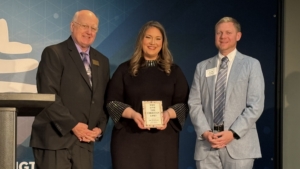
The T.B. Maston Foundation recognized Rosemary and Charles Wade and Skye Perryman for their work in Christian ethics. The recognition was part of the Maston Foundation’s Awards Dinner on Feb. 26 at First Baptist Church in Arlington.

David Morgan, executive director of the T.B. Maston Foundation, Skye Perryman, and T.B. Maston Foundation board member Kyle Tubbs. (Photo/Kendall Lyons)

The Wades, who served churches in Oklahoma, Germany, and Texas, received the inaugural T.B. Maston Legacy Award. Perryman received the T.B. Maston Christian Ethics Award.

Rosemary taught piano, elementary school, and Sunday school, as well as ministering alongside Charles and raising a family. She also served on the T.B. Maston Foundation board.

Perryman, CEO of Democracy Forward, is a Waco native and graduated from Baylor University. She holds a law degree from Georgetown University Law Center. Democracy Forward is a nonpartisan organization promoting democracy in the judicial, legislative, and educational arenas.

Time Magazine named Perryman one of their 100 Most Influential People of 2025.

“We have to remember that the fight for democracy, while it seems global and has global implications, has always been a local fight,” Perryman told dinner guests.

The Maston Foundation promotes the ethical instruction of T.B. Maston, longtime ethics professor at Southwestern Baptist Theological Seminary, through scholarships to graduate students majoring in Christian ethics and undergraduate retreats such as Young Maston Scholars.


Around the State: HPU names faculty member of the month

Howard Payne University’s Lajeana Long, assistant professor of nursing, was selected as faculty member of the month. Long has served HPU for three years and teaches juniors and seniors in HPU’s nursing program. She is grateful for the way HPU allows her to teach nursing students through the lens of faith. Long’s goal is to teach her students how to treat the whole patient. She wants her students not only to care about their patient’s physical health, but their emotional and spiritual health as well.

Wayland Baptist University has been selected to participate in the Texas Work-Based Learning Consortium, a competitive statewide initiative designed to expand career-focused learning opportunities for college students while strengthening connections between higher education and employers across Texas. Wayland joins a select group of peer colleges and universities in the state chosen for their commitment to preparing students for meaningful careers through innovative academic experiences. The three-year consortium initiative integrates work-based learning projects directly into college coursework, allowing students to collaborate with industry partners, gain professional experience, and build career networks while completing their degrees without delaying time to graduation. The consortium is supported by the Trellis Foundation and the Greater Texas Foundation and represents a growing statewide effort to connect higher education more closely with workforce needs while expanding equitable access to high-impact learning experiences for students across Texas.

East Texas Baptist University recently concluded its annual Spiritual Renewal event, held on campus Feb. 23-25. The three-day emphasis featured guest speaker Josiah Jones, a 2006 graduate of ETBU, and centered on the theme “No Filter: Getting Real about Faith, Hurt, and Hope.” Throughout the week, students, faculty, and staff gathered in Rogers Spiritual Life Center for morning chapel, with additional evening worship services on Monday and Tuesday. Over three days, Jones shared both biblical teaching and personal testimony. Raised in Fort Worth, he was deeply invested in sports and pursued success in every arena he could find, only to discover it left him empty. As a college student-athlete, he surrendered his life to Christ, an experience that reshaped his purpose and direction. By sharing personal experiences and pointing to Scripture, Jones emphasized the importance of being authentic and surrounding yourself with other believers.

The spiritual life team at Houston Christian University gathered students, faculty, staff, and administrators for Spring Ignite, a time of spiritual growth and fellowship centered around the theme “Fully Alive Together.” This year’s event addressed foundational topics critical to the Christian walk, including sexuality, singleness, marriage, and friendship, offering a holistic perspective on how to live faithfully in community. The event included preaching and worship sessions led by Seven Mile Road Church, creating an atmosphere of connection and reflection. Students had the opportunity to engage with peers and faculty in discussions on living “fully alive” together—embracing God’s design for relationships, intimacy, and community.