Trump administration fights TX, FL challenges to abortion pill

WASHINGTON—The U.S. Justice Department is fighting Florida and Texas challenges to the safety of the abortion pill mifepristone, compounding the Trump administration’s resistance to pro-life challenges by at least four other states.

In the Trump administration’s filings, the Justice Department asked a Texas federal district court on March 13 to either stay or dismiss Florida and Texas challenges to mifepristone, arguing the Food and Drug Administration is reviewing the drug’s safety. 

The federal filing follows the administration’s active attempts to stay or dismiss similar challenges to mifepristone in Louisiana, Missouri, Idaho, and Kansas.

“Given this widespread debate over the safety of mifepristone, FDA has concluded that the best path forward is for the agency to undertake a new review based on the evidence before the agency,” the Justice Department said in its March 13 filing in the U.S. District Court for the Northern District of Texas. 

“At this time, ‘FDA continues to work on the collection of the robust and timely data that is necessary for a well-controlled study with adequate statistical power.”

The Southern Baptist Ethics & Religious Commission said the federal government should allow the state action to proceed.

“Once again, the Trump administration has moved to counter efforts to protect moms and uphold the sanctity of life. This was a disappointing move—the third time it has happened this year,” said Katy Roberts, ERLC senior policy manager. “The DOJ should allow these lawsuits to progress even while the FDA’s safety review is outstanding.”

“Unfortunately, even though an abundance of clear safety data already abounds, the FDA has yet to complete the so-called ‘necessary’ safety review it promised to complete within the year. Whether due to bureaucratic inefficiency or some other reason, staying or dismissing the lawsuit are not conscionable options,” Roberts said. 

The ERLC has long advocated for life, following the will of Southern Baptists.

“Southern Baptists believe that from the moment of conception, every human life is valuable and worthy of protection. It is out of this conviction that we seek to advance the pro-life cause in every possible arena: legislative, administrative, and judicial,” Roberts said. 

“We urge the Trump administration to not turn a blind eye to the precious lives at stake and to allow efforts to protect life to proceed through the courts instead of blocking them,” she continued.

The Justice Department argued in its court filing that the states “suffer no sovereign injury” because they are still free to enforce pro-life policies, and the Justice Department is not preventing the states from enforcing abortion laws against out-of-state prescribers of mifepristone.

Additionally, granting a stay would not inconvenience the states, the Justice Department said, since states have already “waited 25 years to challenge the approval of mifepristone, nearly 10 years to challenge FDA’s 2016 action, seven years to challenge approval of the first generic equivalent, and nearly three years to challenge the elimination of the in-person dispensing requirement.”

“Having delayed so long,” the Justice Department said of the states, they “cannot seriously claim prejudice from the additional time necessary for FDA to complete its ongoing review.”

The complete report is available here.


Around the State: Bounce awarded by Texas governor

David Scott, director of Bounce, speaking during a Baptist General Convention of Texas Executive Board meeting. (Texas Baptists photo / Neil Williams)

Texas Baptists’ Bounce Student Disaster Recovery has been named a recipient of the 42nd Annual Governor’s Volunteer Awards, one of the State of Texas’ highest honors recognizing exemplary volunteer service. Bounce received the Rebuild Texas Disaster Impact Award, which recognizes organizations that do an exceptional job of utilizing volunteers to meet the needs of Texas communities during all phases of disaster. Presented in collaboration with OneStar Foundation, the Governor’s Volunteer Awards celebrate Texans whose service demonstrates the power of volunteering to bring people together, address pressing community needs, and create lasting change. “From the inception of Bounce, it has been our joy to have mobilized thousands of students to restore hope, rebuild communities, and reflect Christ. Mobilizing students for hands-on construction service not only improves the quality of life for the residents we serve, but also changes the lives of the students we mobilize,” said Bounce Director David Scott. Award recipients are celebrated during National Volunteer Month in April at a special reception hosted at the Texas Governor’s Mansion, honoring their service and the ripple effect it creates throughout Texas communities.

Wayland Baptist University will host high school choir students from across the South Plains on Saturday, April 18, for a day of music and learning during the Clay and Freada Warren Memorial Music Symposium. The day will begin with Catalyst, a choral clinic led by Christian singer-songwriter and pianist Ken Medema, who will work with students and directors from area high schools. Hosted by Wayland’s School of Creative Arts, the Warren Symposium brings together students, directors, and Wayland choirs for a shared experience focused on musical growth and inspiration. “Catalyst gives students and directors a chance to step away from the pressures of contests and performances and simply focus on the joy of making music together,” said Stephanie Burton, interim director of choral activities at Wayland. “Students grow as musicians while also being inspired by someone who has dedicated his life to sharing music with others.” Students participating in the clinic will also be involved in a concert at 7 p.m. that evening in Harral Memorial Auditorium, where Medema will perform alongside Wayland choirs and the visiting high school singers. The evening concert is free and open to the public.

Houston Christian University students Olivia Brown and Karessa Shaw were awarded two of the three Don Smith Scholarships awarded at the Christian Counselors of Texas Conference in Pflugerville. To receive this $5,000 scholarship, a student must be a member of CCT, pursuing a master’s or doctoral degree, and working toward licensure in a counseling program that integrates a faith-based framework. Both Brown and Shaw are pursuing Master of Arts in Clinical Mental Health Counseling at HCU. 

University of Mary Hardin-Baylor hosted the 27th annual spring revival, a three-day student-directed event. Hundreds of students gathered inside a large white tent at the heart of campus. This year’s theme was “The Potter and The Clay,” and Shane Pruitt, the North American Mission Board’s National Next Gen Director, was the featured speaker. Crescent City Worship, a collaborative team of students, staff, and alumni of New Orleans Baptist Theological Seminary, led worship for the event.

Hardin-Simmons University hosted its first LiveSent trip March 8-11. Students, faculty, and staff served at Mission Arlington and in the Texas Hill Country. Teams in Arlington helped with outreach and backyard Bible clubs, while others in the Hill Country assisted with flood relief efforts, repairing homes, clearing debris, and supporting families as they rebuild. LiveSent is a new HSU initiative inviting the campus community to live as ambassadors of Christ through service. 

Creekside Community Village, a 4-year-old project of Mission Waco to provide long-term support for Waco’s unhoused community, is celebrating 28 churches—26 local, one in another city, and one out of state—have given $982,221, or almost 10 percent of the total estimated cost of Phase 1, to build 25 of 35 “tiny homes,” plus donations for infrastructure, above-ground needs, and/or for a few undesignated needs. In addition, there is a $750,000 matching grant for the project’s Welcome Home Center. Creekside Community Village is scheduled to open the third week of April 2026. All 35 homes have vetted residents awaiting their completion.


West Bank persecution not systematic, says Messianic Jew

The shrinking Christian population in the Holy Land extends beyond Israel and has been declining for decades, undermining claims of systematic Israeli persecution of Christians, according to Stuart Rothberg, a licensed professional counselor, former missionary and U.S. Army chaplain, and Jewish follower of Jesus.

Rothberg has served as a pastor in churches in Illinois, Ohio, and Louisiana. He has led more than 30 tours of Israel and has engaged extensively with a wide range of people groups in the Holy Land, including Jews, Arabs, Palestinians, Druze, and Messianic Jews.

Rothberg was unsettled by a report Baptist Standard published in February regarding the persecution of Palestinian Christians by Israeli settlers in the West Bank. 

“The decline [in the Middle East] is not solely due to Israel’s presence in the land since 1948,” Rothberg said. “[It] is due to instability in the area. It’s due to economic hardship. … In fact, the Christian population inside Israel has grown since Israel came back into the land in 1948.”

According to data on Jewish News Syndicate, the Christian population in Israel has grown slightly in recent years, reaching roughly 180,000 to 185,000 people (around 1.8 to 1.9 percent of the population.)

Most Christians in Israel are Arab Christians who are Israeli citizens, comprising roughly 75 to 80 percent of the Christian population. Although the Christian population has increased modestly in absolute numbers, Christians make up a small and relatively stable minority of Israel’s population. 

In contrast, Christian populations across much of the broader Middle East have declined in recent decades due to factors such as war, economic instability, and religious persecution by extremist groups. 2020 statistics indicate the Middle Eastern Christian population diminished to 4.2 percent, with an estimated decline to 3.6 percent projected by 2050. 

Not settlers, but rightful inhabitants

Rothberg explained how he does not view Israeli settlers as people in a foreign land. Rather, he believes they can inhabit the land under the Law of Return, a law passed by the Knesset, Israel’s house of representatives, in 1950. The law grants every Jew the right to return to Israel and is based on scriptural interpretations of Jewish repatriation.  

“The term ‘settler’ is a little objectionable to me because it implies temporariness, intransigence … as someone who doesn’t belong there, [like] we’ve just settled on another’s land,” Rothberg said. 

He approaches the movement from a biblical perspective, beginning with the Abrahamic covenant (Genesis 12:1–3; 15:18; 17:7–8). In his online blog, Rothberg describes this covenant as unconditional and everlasting. 

“From a biblical perspective, God gave the land to the descendants of Abraham, Isaac, and Jacob. So, they are not settlers or occupiers there. They are people [being] brought back to the land,” he said. 

“So, the land right, if you want to call it a ‘right,’ is given by divine sovereignty,” he continued. 

He acknowledged how this occupation results in the displacement of native populations: “When you say: ‘Wait a second. There have been people in the land already,’ … that is a big [issue.] Anyone who has a heart can’t move too quickly over that,” he continued. 

Palestinian Christians living in the West Bank are referred to as Living Stones, representing the oldest continuous Christian population in the region, with roots tracing back 2,000 years to Pentecost.

“Archaeology proves the Jewish presence in the land way before [1948],” Rothberg said. He cited the Sifting Project, an effort to excavate the remains of the first and second temples. 

“Since starting this, they have found half a million artifacts dating back to the Second Temple Period. … So, this idea of coming into a land that is not yours is not only disputed by the Bible, but by almost daily archaeological finds,” Rothberg asserted.

Acknowledging the violence

According to data provided by the Israeli Defense Force, the number of attacks by extremist Jewish settlers against Palestinians and Israeli security forces in the West Bank rose by 27 percent in 2025. Officials at the IDF’s Central Command said they felt a sense of failure for their inability to mitigate the increasing violence.

“I do want to validate the very burdensome and oppressive circumstances under which many Palestinians live. I do not want to deny that and act like it’s unimportant for us,” Rothberg said.

Despite these instances of persecution, Rothberg doubts whether they are linked to systematic Israeli government interference: “There’s sporadic persecution of Christians by extremists, for sure, but this is definitely not government-supported policy,” he said. 

“In Israel, there’s a church on every corner. … You can construct an eight-foot-high cross. Individuals may harass you, but the government will protect your freedom of religion,” he continued. 

Though Israel is considered a Jewish state, the Knesset and Israel’s Declaration of Independence ensure the free practice of religion for all, regardless of religious affiliation.

According to the 2023 International Religious Freedom Report, Israel’s basic laws form a constitutional framework recognizing Judaism, Christianity, Islam, the Baha’i Faith, and the Druze religion. 

The Institute on Religion and Public Policy notes how political unrest in the region has resulted in the distrust of those who do not follow Jewish Orthodoxy and the government sponsored preference of Orthodoxy. The Israeli Supreme Court is addressing these issues. 

One such example is the 2024 reversal of the Haredi exemption, which prevented ultra-Orthodox men from being drafted into the military. 

Dehumanizing checkpoints 

Military checkpoints and barriers erected by the Israeli Defense Force have been a major source of contention. The checkpoints exist to control the movement of Palestinian people and goods within the occupied West Bank. 

Rothberg views these checkpoints as dehumanizing and degrading. “They put enormous pressure on the Palestinian people,” he said. 

Despite this pressure, Rothberg is unsure of an alternative: “Tell me what the alternative is,” he said.

The wall, also called the West Bank Barrier or Separation Barrier, began construction in 2002 in response to suicide bombings and security concerns during the Second Intifada

“Since it went up, terrorist attacks on Israeli children and innocent civilians have gone down. Doesn’t the government have a responsibility?” Rothberg said.

“Even though these security measures make life for Palestinians oppressive and burdensome, they’re necessitated in order to protect the citizenry from terrorism,” he said.

The bottom line 

Rothberg acknowledged there are things in the Old Testament God commanded related to how the Israelites were to treat the inhabitants of Canaan “that don’t make a lot of sense to me. And I think one part of what he proclaimed is that [the] land belongs to Israel,” he continued.

“I don’t have the answers,” Rothberg said. “I don’t think there is a solution until Jesus returns.”

“As a Christian, I would commiserate with hurting Palestinians. I would pray with and for them, I would try to help and provide for them, and I would sympathize with them. I wouldn’t propose to have a solution, but I would want to open my hand and heart and offer Jesus. That’s the best I could do as a Christian,” he continued.

“As Christians, we cannot be a primarily political people, and we cannot show favoritism to one people group. As a Jew going to Israel, I don’t show favoritism to Jews in the land. [I] visit with and minister to all kinds of people groups. … We are not political. I am not going to be pro-Israel to the extent of being anti-Palestinian.”

Baptist Standard spent several weeks seeking comment from Messianic Jews living in Israel and along or in the West Bank. No responses were received from those efforts.


Parents, Islamic schools sue over Texas voucher program

Three Texas Islamic schools and a group of parents are suing state Attorney General Ken Paxton and Comptroller Kelly Hancock, marking the second legal challenge this month alleging schools for Muslim students have been excluded from the new state voucher program. 

The second lawsuit, filed on Wednesday, March 11, in the U.S. District Court for the Southern District of Texas, says state officials and the voucher program director, Mary Katherine Stout, have been “unlawfully refusing to approve otherwise qualified Islamic schools for participation” in the school funding program and that it constitutes religious discrimination.

The Texas Education Freedom Accounts program, introduced by the state’s Legislature in 2025, created a $1 billion fund for private school financial aid. 

An online platform for parents to start applying opened on Feb. 4 (open through March 17), but none of the state’s accredited private Islamic schools have been listed as eligible for reimbursement through the program.

Exclusion raises concerns

Farhana Querishi, a plaintiff whose children attend Houston Quran Academy, said in a news release the comptroller’s decision to exclude Islamic schools from the program sent a “troubling message” that the state’s Muslim children and communities had fewer rights than other residents.

“No parent should have to choose between accessing a public education program and raising their child in accordance with their faith,” she said.

The dispute over the program comes amid growing hostility from Republican elected officials in Texas toward the state’s Muslim residents and community leaders, which became a focal point in the state’s Republican primaries.

Last week, Mehdi Cherkaoui, a lawyer and Muslim father whose children’s school is excluded from TEFA, also filed a lawsuit against Paxton and Hancock alleging religious discrimination. 

Though Hancock hasn’t commented publicly on the Islamic schools’ exclusion from the program, their absence and past comments he made expressing intentions to exclude them “supports an inference that the School Plaintiffs have been excluded because of their Islamic religious identity,” according to the plaintiffs. 

“While defendants’ silence is formally unexplained, the current posture suggests alignment with recent rhetoric linking all Islamic organizations to ‘terrorism,’” the complaint reads.

Abbott designates CAIR terrorist organization

In December, after Texas Gov. Greg Abbott designated the Council on American-Islamic Relations, a major Muslim civil rights group, a “foreign terrorist organization” and a “transnational criminal organization,” Hancock sent a letter to Paxton, posted on X, inquiring about the legality of excluding schools with ties to “foreign terrorist organizations” and “transnational criminal organizations.” 

The comptroller raised concerns that a private school that had hosted a CAIR event might benefit from the voucher program. He also expressed alarm over the possible inclusion of schools with ties to the communist Chinese government.

The attorney general responded that Hancock’s office had “full, exclusive statutory authority” to prohibit schools from participation in the school voucher program. And both made comments on social media about wanting to ensure the program would not fund schools with ties to Islamic terrorist organizations.

In reaction to a Washington Post story published March 11 about the schools’ exclusion, Abbott commented: “That’s right. We don’t want school choice funds going to radical Islamic indoctrination with historic connections to terrorism.”

Neither Paxton nor Hancock returned RNS’ requests for comments.

The lawsuit argues the comptroller’s decision to bar such schools from applying violates the First Amendment’s free exercise and establishment clauses and the 14th Amendment’s equal protection and due process clauses. Plaintiffs are seeking a ruling halting the exclusion of the schools before the program’s deadline March 17.  

Islamic schools not in application portal

Some parents whose children are enrolled in Islamic schools have entered the program by selecting other schools, while others have refrained from registering, refusing to select a school other than their children’s, the complaints note. After the deadline, the parents who failed to register won’t be considered in TEFA’s lottery, which determines who benefits from the funding. 

“They have created a system where Muslim families cannot even select their schools in the application portal, while thousands of non-Islamic private schools remain approved and eligible,” the complaint reads.

The three school plaintiffs, Bayaan Academy, the Islamic Services Foundation, and the Eagle Institute Excellence Academy, have not received explanation from the comptroller’s office regarding their exclusion, they said in the lawsuit.

The children of plaintiffs Layla Daoudi, Muna Hamadah, and Farhana Querishi are enrolled, respectively, at the Houston Quran Academy, the Islamic Services Foundation, and the Eagle Institute Excellence Academy.

Bayaan Academy, a 1,200-student virtual school headquartered in Galveston County, was initially approved for the program after filling out a Google form put out by the comptroller’s office in December. 

However, it was removed from the list of eligible schools following a news report highlighting it was one of the few Islamic schools included, according to the suit.

In his lawsuit filed on March 1, Cherkaoui, whose children are enrolled at the Houston Quran Academy, also argued the comptroller’s decision violates the First Amendment’s free exercise, establishment, and equal protection clauses as well as the 14th Amendment’s due process clause. 

His lawsuit also seeks a temporary restraining order to prevent religious discrimination before the March 17 deadline.


On the Move: Berry, Burleson

Nathan Berry to First Baptist Church in Cotton Center as pastor, from First Baptist Church of Alta Loma in Santa Fe, where he was associate pastor.

Nic Burleson to First Baptist Church in Plano as interim pastor. Burleson is the founding pastor of Timber Ridge Church in Stephenville, and is now Texas Baptists’ church starting strategist for North Texas.


John Perkins, civil rights leader and Bible teacher, dies at 95

John M. Perkins, an influential Baptist author, Bible teacher, and longtime racial reconciliation advocate, died Friday, March 13. He was 95. 

Perkins died surrounded by his wife and family, they announced on social media. On March 4, his daughters, Priscilla and Elizabeth Perkins, co-presidents of the John & Vera Mae Perkins Foundation based in Jackson, Miss., said he was under hospice care.

“To the world, he was Dr. John M. Perkins, a voice for justice, reconciliation, and the gospel of Jesus Christ,” his daughter, Elizabeth, wrote in announcing his death on Instagram. “He received 19 honorary doctorate degrees, but most importantly, he was the devoted husband of his bride, Vera Mae Perkins, for 74 years, and together they were blessed with 8 children.”

A civil rights veteran, minister, and co-founder of the Christian Community Development Association, Perkins was known for his dedication to a collaborative approach to ministry.

“John Perkins is probably one of the true unsung heroes in America—not in Black America, not in the church community, but in America,” said the Rev. Barbara Williams-Skinner, co-founder of the Skinner Leadership Institute, a Black church civic engagement group, who knew Perkins for decades, in a 2023 interview.

 “He’s really done more to break down racial barriers and walls than almost any other person we know. We hear of Dr. King, we hear of others like John Lewis, but he lived the gospel of loving your neighbor as yourself. He lived the gospel of the Good Samaritan,” Williams-Skinner said.

A farewell tour

In recent years, Perkins had been on a bit of a farewell tour, realizing that in his 90s, he might have limited time to share his wisdom with younger generations who have embraced his 3 Rs—relocation, redistribution, reconciliation—through which he sought to address systemic racism with social action.

Perkins’ ministry approach in his later years also included a weekly Zoom Bible study that carried his name but featured more than 200 people, some of whom took turns leading it.

“I’m learning from them because they are doing really good research,” said Perkins, then 92, of his co-leaders, who have included Shane Claiborne, co-founder of Red Letter Christians, and megachurch co-founder Rick Warren, as well as civil rights attorney Bryan Stevenson. 

“We want our Bible class to be a model of what the influential pastor or the influential leader can do back in their own hometown.”

In 2021, shortly after surgery for colon cancer, Perkins traveled from Mississippi to Missouri to attend the meeting of the CCDA, the community development organization he had helped organize decades before. It was worth the journey from Mississippi to Missouri, he said, to see his friends and to continue to motivate them while he could.

“Really to pass on, in my own way, this mission we have arrived at together,” he said in a phone interview. “I just came to encourage and to say goodbye.”

Overcoming loss and violence

Perkins’ life was accentuated by loss and violence, as he overcame the deaths of loved ones and his own hatred of white people, specifically police who took his brother’s life and, years later, nearly took his. Once one of the few Black leaders in predominantly white evangelical circles, Perkins credited particular white people for introducing him to the Christian faith, caring for his wounds, and comforting him when he was mourning.

His mother died of starvation in 1930, the same year he was born in Mississippi. While a teenager, his brother was killed by a police chief after the young man grabbed the blackjack the officer had used to strike him.

Perkins fled to California in the 1940s, after his brother’s death, and started a union of foundry workers in that state a decade later. He later was drafted by the U.S. Armed Forces and served three years in Okinawa, Japan, after the start of the Korean War. Returning to the United States, he became a Christian and was ordained a Baptist minister.

In 1960, he returned to his native state of Mississippi and started a ministry in Mendenhall, providing youth programs, day care, cooperative farming, and health care.

An activist who registered Black voters and boycotted white retailers, Perkins visited college students who had been arrested after a 1970 protest. He was tortured and “beaten almost to death,” he said in his 2021 book, Count It All Joy: The Ridiculous Paradox of Suffering.

“He was beaten for just attempting to be a human in Mississippi,” Williams-Skinner said. “But instead of being bitter, he became a better human and taught us to be better humans.”

After Perkins recovered, he continued to support college students, and, in 1976, published Let Justice Roll Down, which codified his “3 Rs.” In 2006, Christianity Today placed it at No. 14 on its list of the top 50 books that shaped evangelicals over the previous five decades.

“Justice is an economic issue,” Perkins told Religion News Service in 2021. “It’s the management and stewardship of God’s resources on the Earth.”

Perkins had extensive ministry influence

Ron Sider, former president of Evangelicals for Social Action (now Christians for Social Action), who died in 2022, told RNS in a 2021 interview Perkins had “phenomenal” influence, cultivating—possibly more than “any single American”—holistic ministries meeting both physical and spiritual needs of people in rural and urban settings.

His efforts on racial reconciliation, Sider said, also contributed to a more diverse “evangelical center,” to the point that the National Association of Evangelicals—on whose board Perkins served in the 1980s—chose an African American board chair, an Asian American president, and a woman vice chair in 2019.

Perkins encouraged “collective prosperity,” where wealth is distributed equitably, and living in neighborhoods close to the poor, something he had done in the West and in the South.

“I’d say a lot of white suburban folks like me were deeply challenged by his call to justice and to the three Rs of his ministry,” Jo Kadlecek said. She was inspired by Let Justice Roll Down and later co-authored a book with Perkins after he sought her out. 

“‘You know, Jesus didn’t commute from heaven,’ he’d say frequently,” she said in 2021, referring to urban ministers’ belief Christians who help poor and underserved communities should consider residing near them.

Founding ministries

In the 1980s, Perkins returned to California, and his family founded the Harambee Christian Family Center, now Harambee Ministries, in a high-crime area of Pasadena, offering teen and after-school programs and providing urban missions training to visiting church groups.

“You win the trust of parents, you win the trust of community leaders because you’re proving, day by day, that you want to develop children and young people,” Rudy Carrasco, who served as the center’s executive director, told RNS in 2021. “I learned that from John Perkins.”

In the 1990s, after returning to Jackson, Perkins founded the Spencer Perkins Center, named for his son who died in 1998, to continue his longtime focus on affordable housing, evangelism, and helping poor children and families.

During the last two decades, Perkins has been honored by institutions of higher learning, including Calvin University, which hosts a fellows program named for him, and historically Black Jackson State University, which named a scholarship after Perkins and his wife, Vera Mae.

In 2023, his family honored Perkins and his wife with a gala dinner for their 63 years dedicated to reconciliation, Christian development, and justice.

“They say ‘a prophet is not recognized in his own home,’” Priscilla Perkins said, according to a report from Jackson Advocate news service. “That can be said of my father, but we will fight on for justice for the voiceless and make our community a place where children can thrive.”

When he was feted in 2022 as a Black Christian “elder” at a Museum of the Bible gala, Perkins continued to preach about the need for love.

“The only way we can go forward now is with ‘love one another,’” he said at the Washington, D.C., ceremony, quoting the New Testament as he spoke about elevating the church as a whole over congregations attended by Black or white people. “‘He that loves knoweth God. He that loveth not knoweth not God.’”


Over 100 Latino Christians reprove Trump adviser’s reach

More than 100 Latino Christian leaders signed a statement saying the Rev. Samuel Rodriguez, an evangelical adviser to President Donald Trump and a go-to voice for Hispanic evangelical perspectives, and news media have exaggerated the size of Rodriguez’s reach as president of the National Hispanic Christian Leadership Conference. 

In the statement released Tuesday, March 10, the signers said they were prompted to speak out because of the damage the Trump administration’s immigration policies have done to Latino communities.

Rodriguez and the Rev. Tony Suarez, vice president of the NHCLC, are among a handful of Hispanic evangelical pastors advising the president. 

In recent months, they have lamented that the Trump administration’s immigration enforcement has not focused on deporting criminals, and they have continued to advocate for immigration reform through the Dignity Act, a bipartisan immigration bill.

Several signers of the letter, titled “We are not a monolith, we are a multitude,” said while Rodriguez represents some Latino evangelicals, he should not be the sole public representative.

“It’s not just a misrepresentation but how that misrepresentation is impacting the communities we serve,” said the Rev. Gabriel Salguero, president of the National Latino Evangelical Coalition and a letter signer. “Our people are hurting, and our people are not going to stand for apologists for this kind of immigration action.”

Jesse Rincones signed the letter as an individual, not in his role as executive director of the Hispanic Baptist Convention of Texas and pastor of Alliance Baptist Church and One Accord Church in Lubbock. 

He stated concerns that “some Latino voices, especially those on the president’s Faith Advisory Council, have not publicly pressed the president to follow through on what they say were commitments regarding detention practices affecting our communities.”

Op-ed increased tension

Building on years of simmering frustration with Rodriguez among some Latino evangelicals, letter signers interviewed by Religion News Service said the catalyst for the letter was an op-ed by Rodriguez published in Christianity Today late last month. 

In it, he wrote the Latino church “is hemorrhaging” due to immigration enforcement. A week later, Rodriguez posted photos of himself and other pastors praying over Trump.

“Reverend Rodriguez hasn’t had a change of heart,” said the Rev. Carlos Malavé, president of the Latino Christian National Network, of his interpretation of the op-ed. “I believe that the reason he is doing that is because he’s starting to feel a strong pushback.”

Rodriguez’s biography at the bottom of the piece claims that, through the NHCLC, he “represents millions of Christians worldwide.” 

Republican Rep. María Elvira Salazar’s office cited the NHCLC as representing more than 42,000 churches as recently as last fall. However, the Tuesday letter alleges both estimates are inaccurate and implausible given the numbers of Hispanic churches in key denominations. 

“This demonstrates the need for media outlets to verify claims and accurately reflect the diversity and complexity of Latino Christian institutions in the United States,” the letter reads. 

Reached by phone shortly after the letter was released Tuesday afternoon, Rodriguez said his group doesn’t “claim at all” regarding public membership figures and accused the letter writers of “bearing false witness.” 

Though he acknowledged some spokespeople might reference certain numbers, Rodriguez said, “After COVID, there has never been an articulation on our end in order to protect our constituents” from harassment related to policy positions the NHCLC takes.

“We’re not about the number of churches, and we’re not about the number of millions of people. We are about serving our community,” he said.

NHCLC website shows error message

The Internet Archive shows the NHCLC’s website claimed a membership of more than 40,000 churches as late as October 2020, and a press release from last fall said the NHCLC represents “tens of thousands” of Hispanic evangelical churches worldwide.

On Tuesday evening and on Wednesday, the NHCLC’s website showed error messages and was inaccessible. An NHCLC spokesperson did not immediately respond to an RNS question about what caused the website outage.

Asked about letter writers’ claims Christianity Today published an unverified figure, president and CEO Nicole Martin told RNS Rodriguez provided the biography to the publication. She said it had been edited in an identical process used for all opinion writers.

Martin said she checked with Rodriguez about the statement’s accuracy after receiving RNS’ request for comment, and she forwarded two statements from the NHCLC to RNS.

One statement said the biography was accurate. “While it is impossible to know exactly how many Hispanic Evangelicals share our Biblical perspectives, we are confident that we represent the views of most of the 7 to 9 million Hispanic Evangelicals in the United States,” the NHCLC wrote, according to Martin.

Assessing the precise views of Hispanic evangelicals can be difficult, but surveys indicate their political alignment has shifted over time. 

Surveys affirm disagreement over immigration policies

A 2024 polling analysis from PRRI found the share of Hispanic Protestants who identified as Republicans nearly doubled from 2013 to 2024, rising from 17 percent to 31 percent. Meanwhile, the percentage who identify as Democrats declined from 31 percent to 23 percent. 

Even so, Hispanic Protestants have voiced strong disagreement with Trump’s immigration policies. A PRRI survey conducted last August and September found that 64 percent of Hispanic Protestants said they have little or no confidence in Immigration and Customs Enforcement, and 57 percent agreed increases to the agency’s funding have gone too far. 

Similarly, a Pew Research survey conducted around the same time found that 55 percent of adult Latino evangelical Protestants said they strongly or somewhat disagreed with the president’s overall approach to immigration.

The NHCLC sent RNS a statement that read: “The integrity of our representation is thoroughly verified. The number of churches affiliated through our denominational partners, networks, and chapters is formally certified through a rigorous internal process overseen by Mat Staver, Chief Legal Counsel, former Dean of Liberty University School of Law, and President and CEO of Liberty Counsel.” 

A spokesperson did not provide an approximate membership number when asked by RNS on multiple occasions.

The coalition letter criticizing media representation of Rodriguez was signed by Latino leaders across the U.S. and denominational backgrounds, including some from the Assemblies of God, the denomination in which Rodriguez first became a pastor. Other leaders or individual pastors who signed on come from the Reformed Church in America, Evangelical Covenant Church, Church of God of Prophecy, American Baptist Churches USA, Christian Church (Disciples of Christ), the United Methodist Church, nondenominational Pentecostal churches and several seminaries, including Gordon-Conwell Theological Seminary.

Other leaders who signed on come from the Reformed Church in America, Evangelical Covenant Church, Church of God of Prophecy, American Baptist Churches USA, Christian Church (Disciples of Christ), the United Methodist Church, nondenominational Pentecostal churches, and several seminaries, including Gordon-Conwell Theological Seminary.

The group of letter signers also includes some who have longer histories with Rodriguez, like the Rev. Elizabeth Rios, founder of the Passion2Plant Network for church planting. Reviewing her book in 2013, Rodriguez called her “one of the most anointed and gifted leaders in the kingdom today.” 

Rios said she’s asked journalists why they overrepresent his voice, and they say their editors required them to speak with him. “It’s not about him per se,” Rios said. “We’re just tired of people always pivoting to him as the unverified person that’s representing millions of people.”

“We just don’t think that he’s a credible witness,” she added—a feeling that’s been growing over the last decade. “Nobody in the Latino community wanted to call him out because we never want to throw our own under the bus.”

But, she said, “We have to say that journalists are helping to hurt our community by not verifying the sources that they use.”

Rodriguez responds

Rodriguez said he had not read the letter yet on Tuesday afternoon but that criticisms of him were motivated by personal animus and jealousy. “I’ve never claimed to represent the woke evangelical left,” Rodriguez said. “It’s just a family conversation taking place which shouldn’t take place publicly.”

Despite the disagreement, he said he would follow the biblical command to “love and forgive and bless your enemies,” explaining, “If they believe the Nicene Creed, these are my brothers and sisters who I will see in heaven.”

Multiple Latino leaders who signed the letter told RNS they attempted to address their concerns in private with Rodriguez in recent years and that they had asked journalists to broaden their coverage of Hispanic Christians.

Rodriguez also said he supported diverse voices being represented in the media and that meeting with Trump while criticizing his administration’s policies is “a challenge.” 

“I walk into these corridors of office with humility, and I ask God to just give me the right words that will help change hearts and minds—for the political leaders to appreciate this blessed community, the Latino community overall, the Hispanic community, the immigrant community, as a blessing and not a burden,” Rodriguez said.

He said Trump has doubled down on deporting criminals and finding “a solution for the good people,” referring to immigrants. “Even in the past 48, 72 hours, he’s talked about the fact that these people are good people, [and] we need to find a solution,” Rodriguez said of Trump. 

Daniel Montañez, executive director for the Center for Public Theology and Migration and a post-doctoral associate at Boston University, said he’s witnessing “seismic shifts” within U.S. Latinos.

“I hope we’re able to assume our agency and autonomy within larger public narratives about our community,” said Montañez, who signed the letter. “That we’re able to come together in this moment and make a statement like this is something that is very significant.”

RNS National Reporter Jack Jenkins contributed to this report. This story has been updated to remove an incorrect explanation of Pew Research Center data and to clarify that the pastors who signed the letter do not necessarily represent their denominations.

Additional reporting by Faith Pratt of Baptist Standard


Arab Baptist seminary sheltering Christians and others

Christians and others fleeing the war zone in southern Lebanon are finding refuge at Arab Baptist Theological Seminary near Beirut, its president Wissam Nasrallah told Baptist Press, as Israel’s fight against Iran ally Hezbollah intensifies.

Housing about 170 internally displaced persons among an estimated 800,000 who have fled southern Lebanon in the past 10 days, the seminary founded decades ago by Southern Baptist missionaries has learned to be present, visible, and active when war strikes.

“What good is salt if it stays in the salt container? It will become sticky and full of humidity,” Nasrallah told Baptist Press. “Salt needs to be outside the salt container. Human tendency is self-preservation and self-protection, but God had to teach us that he has work for us to do, and he wants us to be tools in his hands that he can use.”

At least 687 have been killed and 1,774 injured in Israeli strikes on southern Lebanon since March 2, Lebanon’s public health ministry reported March 12.

Large portion of the population displaced

About a fifth of Lebanon’s 4 million people are displaced, including members of The Baptist Church in Deir Mimas near the Lebanon and Israeli border, Nasrallah said, as well as Christians from other congregations. 

Lebanon enjoys religious freedom, with Christians comprising about 30 percent of the population, or 1.2 million people. Evangelicals number about 1 percent of the population, he said, or about 40,000 people.

Nasrallah would like American Christians to know there are Christians in the region living out their faith.

“There is a story of Christian believers who, despite the surrounding darkness, are making a difference and are living out their faith so the name of Christ might be acknowledged and glorified,” Nasrallah said. 

“That’s a story you don’t hear in America, but that’s the story of Arab Christians, Arab Baptists, Arab Evangelicals that live in the Middle East.”

Lebanon President Joseph Aoun has called for a new ceasefire agreement with Israel and Israeli support to help the Lebanese military disarm Hezbollah.

Aoun accused the terrorists of wanting to “buy the fall of the Lebanese state … at the price of destroying dozens of our villages and the fall of tens of thousands of our people for the sake of the Iranian regime’s calculations,” MSN reported.

As the war intensifies, ABTS is located in a heavily Christian area still considered safe, Nasrallah said.

Seminary continues education during war

The seminary is continuing its education of 250 enrolled students through online courses, Nasrallah said, while providing shelter, food, and other basic needs to refugees, and offering gospel encouragement to Christians and non-believers through community chapel services. Nasrallah has served as ABTS president since October 2025.

“As a seminary, our goal is leadership formation for the Arab world. We have to manage the short-term emergency without abandoning the enduring, faithful task of forming leaders over the long term,” Nasrallah said. 

“Just managing these two realities is difficult, and just the stress on our staff, who worry about their own safety and their own families. We’re asking more of them to serve, to love, to care, on top of the regular work of continuing the programs online.”

Southern Baptists continue to support ABTS in its mission, Nasrallah said, while the seminary remains a ministry of THIMAR, nonprofit Lebanese Society for Educational and Social Development.

“We were founded as an organization and as a seminary by Southern Baptist missionaries in the late 1950s. So, we stand on the legacy of our founding fathers that came from this country and really started a Baptist movement which endures today, and has become fully indigenous, fully local,” Nasrallah said March 12 as he ended a two-week stay in the U.S. and prepared to return to Lebanon. 

“We are grateful for our Baptist forefathers who sacrificed a lot. They came when there was nothing in terms of Baptist churches or presence,” Nasrallah continued.

He requested prayers for the faithfulness, boldness, and endurance of Christians in the Middle East, and also encouraged Southern Baptists to visit the seminary for short-term missions work during peace times.

The seminary has trusted God to provide necessary resources for those fleeing the war, Nasrallah said.

“We do what we’re called to do,” he said, “and we rely on the Lord and on our friends for the rest.”


Ascent Summit speakers issue call to hope, joy

The second and third days of the Ascent Summit featured keynote speakers declaring the importance of joy and hope in the Lord within ministry and everyday living. Amid a full schedule of plenary sessions, forums, breakout session, and affinity roundtable discussions, Ascent also celebrated and honored ministers.

‘All of God’s people are called’

Ed Stetzer, dean at Biola University’s Talbot School of Theology, gave a four-part missiological framework based on John 20:21—multiplication in the way of Jesus, “declergification” as the people of God, diversification in the vision of Revelation, and mobilization for demonstration and proclamation.

“In the same manner that God has sent Jesus, Jesus has sent us into the world. So, this is the call. This is the mission. This is the moment that we have. In the midst of this unique time of tumult and turbulence, it’s a wonderful time for gospel openness,” Stetzer said.

“Putting down markers that say that all of God’s people are called to the ministry, all of God’s people are sent on mission, makes such a difference. … That’ll shape and frame how you do so many things,” Stetzer said.

The unlikely ones

Charlie Dates, senior pastor of Progressive Baptist Church of Chicago and Salem Baptist Church of Chicago, preaching from Luke 10:25-37, challenged listeners to respond, like the good Samaritan, to the needs of others. Jesus often uses the unlikely ones in our world to make a difference, he said.

“I warn you, that Jesus is a sophisticated storyteller. The delicate nuances of his argument are as sophisticated and exquisite as structural Hebrew narratives will allow. He argues that it may be the most unlikely among us who emerge as the heroes and sheroes that save us,” Dates continued.

“This passage promptly and urgently reminds us it is not the people who did the best in seminary, or the people who win the awards, or even the people who lead our highest and best institutions, that are actually the candidates—that emerge as the most likely to save us—but it’s the unlikely people. It’s the forgotten people. It’s the people who do not earn commendation anywhere else,” Dates said.

Joy cultivated

Mia Chang, founder and lead pastor of NextGen Church in Princeton Junction, N.J., told summit gatherers joy must be cultivated during times of solitude spent with Jesus and being led by the Holy Spirit.

Joy is also found amid adversity, Chang added.

“God is nearer to us at such times, as the psalmist says. He is close to the brokenhearted and saves those who are crushed in spirit. To rejoice always is not an idealistic, optimistic yearning. But it’s a posture, purpose, and pursuit of those whose life is surrendered to Christ Jesus,” Chang continued.

“Our time in the lonely places is to tap into the river of joy below the surface. This is a lonely place that Jesus often visited. Jesus intentionally pulled himself away from the crowd, … but God invites us to be still and simply know that God is God,” she said.

‘We’ over ‘me’

Jorge Acevedo, retired pastor of Grace Church in southwest Florida, emphasized community as part of cultivating joy.

“I’ve discovered in my 48th year of apprenticeship to Jesus that his invitation to formation is almost always in the plural. It’s an invitation to communal spirituality,” Acevedo said.

“Much of what passes for spiritual formation in these days is … a very privatized, individualized experience,” he said.

Raphael Anzenberger, president of France Evangelization, CEO of the Global Evangelists Forum, and general secretary of the French-speaking Baptist Union, said regarding John 4:27-35, the disciples were challenged with Jesus’ break from cultural norms.

After finding Jesus talking to a Samaritan woman, the disciples lost their sense of value, lost their sense of time, and lost their sense of people, Anzenberger said.

When the disciples told Jesus to eat something, Jesus told them his food was “to do the will of him who sent me and to finish his work” (John 4:34). “Which sandwich feeds you—the bread from above, or the sandwich from below?” Anzenberger asked.

Saying there are two stories in John 4—one being Jesus and the Samaritan woman, two being the disciples’ reaction—Anzenberger asked his listeners which story would be theirs.

Scope of Ascent Movement

More than 500 people participated in person or via the livestream in the inaugural Ascent Summit.

Ascent is a collaborative movement to evangelize North America. The Ascent Movement partners with churches, associations and networks of churches, mission agencies, financial ministries, resource and support organizations, seminaries and theological schools, and other ministries from Baptist, Wesleyan, Pentecostal, Anglican, Anabaptist, and other evangelical faith traditions.

Churches and ministries across the 48 contiguous United States, Alaska, Canada, and Cuba partner in Ascent.

Offerings

Two new offerings were introduced during the Ascent Summit. The 2026 Pentecost Offering received April 6 through May 24 will support church planting and pioneering mission in North America. There will also be an Advent offering to support global missions.

Ministry honors

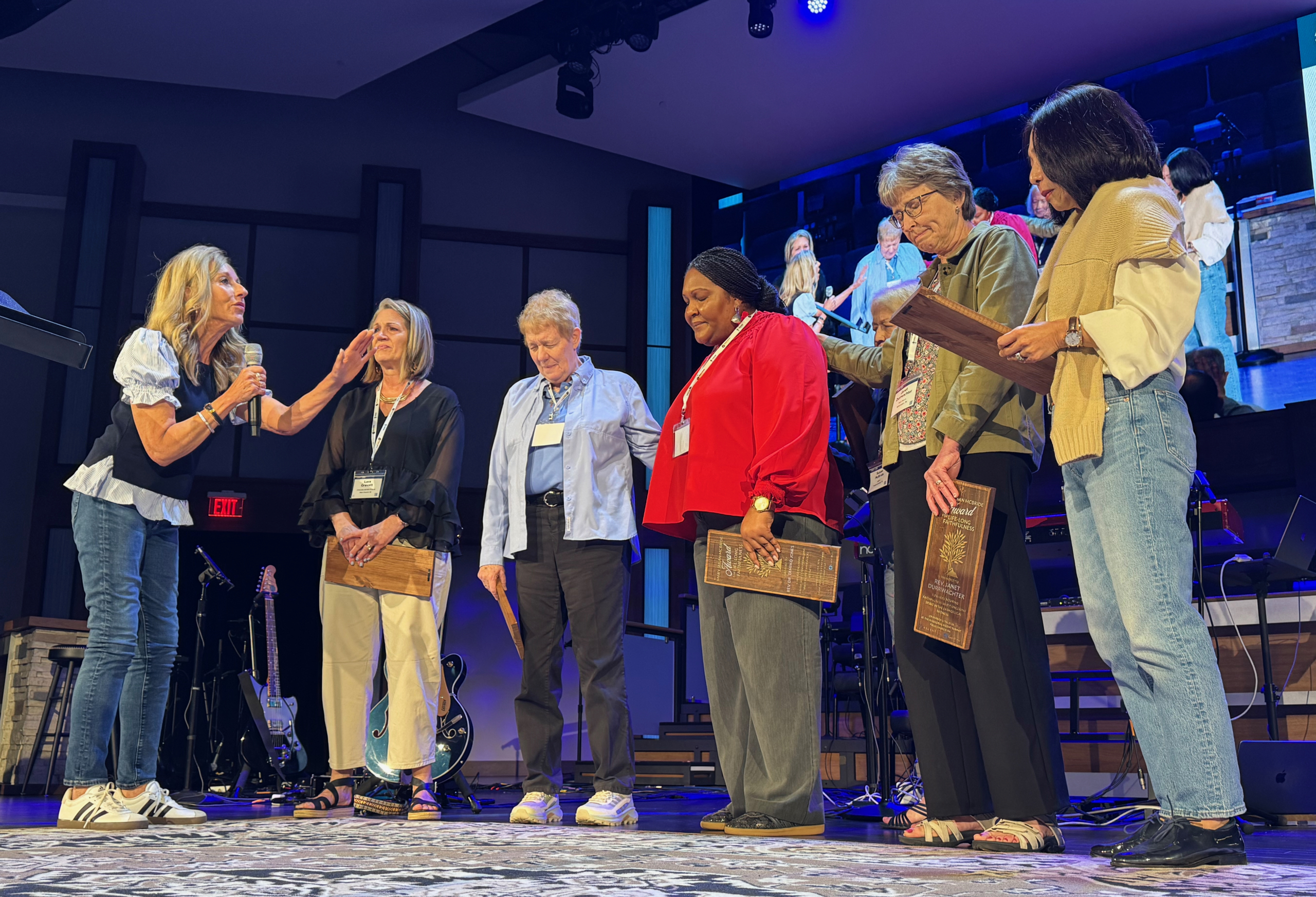
Beth Moore prays over the first recipients of the new Rev. Dr. Mary Susan McBride Scholarship during the inaugural Ascent Summit, March 10-12, 2026, at Columbia Church, Falls Church, Va. (Kendall Lyons photo)

Ascent inaugurated two ministry awards during the Ascent Summit. The Lifetime Fruitfulness Award was given to Rev. Dr. Mary Susan McBride for her four-plus decades of ministry. The Rev. Dr. Mary Susan McBride Scholarship Fund was established in her honor.

Inaugural scholarship recipients are Rev. Dr. Tamiko Jones, Rev. Dr. Patti Duckworth, Rev. Janet Durwachter, Rev. Dr. Mia Chang, and Rev. Lora Gravatt.

Guillermo and Andrea Nuñez received the Perseverance Award for their work in Cuba.

Pastors from three of Ascent’s founding churches, left to right: Robert Turner, St. John Baptist Church, Columbia, Md.; Bruce Webb, The Woodlands First Baptist Church, The Woodlands, Texas; Dennis Wiles, First Baptist Church, Arlington, Texas. (Cindy Wiles photo)

The founding churches of the Ascent Movement were also honored: First Baptist Church in Arlington, Texas; The Woodlands First Baptist Church in The Woodlands, Texas; Saint John Baptist Church in Columbia, Md.; and Columbia Church in Falls Church, Va. Columbia Church hosted the Ascent Summit.

Financial awards

Ascent awarded microgrants to eight recipients and learning stipends to five recipients during the Ascent Summit.

Microgrants of $500 each are awarded “to help churches pilot an idea, launch an initiative, or invest in resources to move toward engagement in Ascent.” Learning stipends of $200 each are awarded “to help individuals participate in training, tools, or leaning experiences through Ascent.

Microgrant recipients are:

  • Haowen Ge, International Student Services Association Inc., Cleveland, Ohio.
  • Ginger Lynch, Living Hope Church, Livingston, Mont.
  • Bobbie Bagley, The Blueprint Ministries, Londonderry, N.H.
  • Deanna Harvey, Columbia Church, Falls Church, Va.
  • Noel Tsoukalas, Sea Change Church, La Jolla, Calif.
  • Kendall Ellis, First Baptist Church, Muncie, Ind.
  • Brian Miller, Florence Carlton Community Church, Florence, Mont.
  • Rachel Jones, First Baptist Church, Plano, Texas.

Learning stipend recipients are:

  • Michael Glazier, First Church Williamsport, Williamsport, Penn.
  • Edmund Lilley, Colonial Beach Baptist Church, Colonial Beach, Va.
  • Anna Machan, Dunwoody Baptist Church, Dunwoody, Ga.
  • Tyler Hartford, Evana Network, Goshen, Ind.
  • Brad McMullen, Timberlake Church, Lynchburg, Va.

In addition, EverBless Foundation—formerly Virginia Baptist Foundation—awarded five scholarships to undergraduate and graduate students. Scholarship recipients are Anna Machan, Peachtree Corners, Ga.; Luke Stehr, Arlington, Texas; Aaron Kilbourn, Sioux Falls, S.D.; Nikisha Diggs, Louisa, Va.; Aaron Miller, Washington, D.C.

CORRECTION: The last paragraph was corrected to clarify scholarships awarded at the Ascent Summit were not limited to students from churches affiliated with BGAV or that are EverBless clients.


Celebrating Churches: Purvey launches Full Life Church

Robert Purvey, Texas Baptists NextGen strategist, launched Full Life Church, a new church plant in northern Grand Prairie. Purvey said the church’s journey began with a clear sense of divine timing. “The Lord told me to take nine months to birth the church,” he explained. During that period, the team focused on Tuesday night Bible studies, leadership development, and building a core launch team. The congregation also hosted three preview services in the fall—on the first Sundays of October, November, and December—drawing a combined attendance of around 500 people. By January, a committed group of 52 individuals had joined the launch team. Purvey said the church’s mission centers on supporting families and helping them grow spiritually and practically. Rather than purchasing its own building, Full Life Church has formed a unique partnership with Marshall Drive Baptist Church, a long-established congregation in Grand Prairie. The church now shares the facility with Marshall Drive Baptist and another congregation,Community Fellowship Church, meeting at 717 E. Marshall Drive.


Christian influencers read Bible to wake up ‘apathetic church’

NASHVILLE, Tenn.—Bunni Pounds, a political fundraiser-turned-activist from Texas who lost a 2018 bid for U.S. Congress, was visiting the Museum of the Bible in Washington when she says God spoke to her. 

At the time, Pounds told attendees at a recent National Religious Broadcasters convention in Nashville, she’d been thinking about Ezra, the biblical prophet who read the law of Moses aloud to the Israelites as they returned to Jerusalem from exile in Babylon and began rebuilding the city’s walls. 

“I had an encounter with the Lord about Ezra, and it has never left me,” she said. What’s more, Pounds said, the United States needs the same kind of spiritual rebuilding as the ancient Israelites.

That idea led her to organize a week of public Bible reading in the nation’s capital. 

“Wouldn’t it be awesome if our national leaders from all spheres of influence, demographics, and denominations would humble themselves in front of the American people and tell them their dependence is in the Bible?” she said. “And then call the American people back to discipleship and Bible reading.”

Leaders across America set to pray

This spring, from April 18 to 25, a group of pastors, politicians, authors, and other Christian leaders—nearly 500 in all—will read the Bible aloud from cover to cover. Fittingly, the Museum of the Bible will host the readings from 9 in the morning till 9 at night, all of which will be livestreamed. Each reader will recite Scripture for about 10 minutes.

Pounds said it took about a year to recruit readers and assign them Bible passages. Organizers tried to match readers to passages that fit their ministry goals, she said. The project cost about $2.5 million to pull off.

Franklin Graham, head of Samaritan’s Purse, a Christian humanitarian group, will read the story of the Good Samaritan. Leaders from Prison Fellowship will read from the Book of Exodus. 

Mike Huckabee, ambassador to Israel, will read from Genesis 12, which includes a passage about Israel often cited by Christian Zionists: “I will bless those who bless you, and whoever curses you I will curse.”

Secretary of Agriculture Brook Rollins and former Secretary of State Mike Pompeo are also scheduled to read.

Senator Ted Cruz and his father, Rafael Cruz, an evangelical pastor, will read from the Book of Ezra, while leaders from Turning Point USA, whose co-founder Charlie Kirk was assassinated last year, will read the Book of Job.

“We’re trying to have really cool people read parts of the Bible that people think are uncool,” she said. “And we want to inspire them that every word of God is precious, and we can’t just cut out these sections of Scripture and not interact with it.”

Among the 475 readers, all of whom will use an easy-read edition of the King James Bible, are Govs. Greg Abbott of Texas, Jim Pillen of Nebraska, Kevin Stitt of Oklahoma, and Sarah Huckabee Sanders of Arkansas, along with former Wisconsin Gov. Scott Walker and Micah Beckwith, the current lieutenant governor of Indiana, who is also a pastor. 

Three U.S. senators—Cruz, James Lankford, and Jim Banks—and 16 current and former U.S. representatives are also scheduled to take part.

Other readers include Troy Miller, president of the National Religious Broadcasters; author David Barton; pastor and author Mark Batterson; Joel Berry of the conservative Christian satire site Babylon Bee; former U.S. Ambassador Sam Brownback; Carlos Campo, the CEO of the Museum of the Bible; megachurch pastor Matt Chandler; Christian musician John Cooper of Skillet; former Trump lawyer Jenna Ellis; and the Rev. Samuel Rodriguez of the National Hispanic Christian Leadership Conference.

The event will kick off with a service at Washington’s National Community Church, where Batterson is pastor.

Encouraging others to read Bible, get involved 

Pounds, who will read her favorite chapters of the Gospel of John (16 and 17, she said), hopes the event will encourage Americans to pick up the Bible. Pounds also said she hopes to wake up what she called an “apathetic church.” She believes too few Christians pay attention to the Bible outside of church services.

“We’re binge-watching Netflix and Amazon Prime and playing games all the time and not living our calling,” she said.

About 1 in 4 Americans read the Bible at least once a week, according to a 2025 report from the American Bible Society, while 41 percent read the Bible at least three or four times a year. More than half read the Bible twice a year or less, including 39 percent who say they never read the Bible.

Still, Bible sales are booming, with more than 18 million copies sold last year. 

After her failed campaign for Congress, Pounds founded Christians Engaged, a nonprofit that seeks to advocate for “biblical civil responsibility,” according to the group’s website. 

She told the religious broadcasters in February she was tired of pastors and ministry leaders complaining that not enough Christians were voting in primaries and local elections. The organization asks followers to “pray, vote, and engage.”

The nonprofit has already mobilized a million Christian votes, according to Pounds, who hopes to reach 2 million in 2026. The group produces podcasts and video classes to encourage Christians to get involved in politics and brings young leaders to Washington for training events. “We even have a full campaign school for every Christian to run for office,” she told attendees.

The daughter of a Seventh-day Adventist pastor, Pounds said she had a spiritual awakening as a teenager while attending a concert given by the famed Christian singer Carman, and that she once hoped to be a missionary. Now she sees her calling as helping others to use their faith to impact society. And that includes voting.

“We vote because it’s a powerful and tangible way to love our neighbors,” she told the NRB convention. “We vote in every election to advocate for laws and leaders that will create greater freedom and flourishing for our neighbors and society.”


Gaza ministry offers support amid war 

Hanna Massad, former pastor of Gaza Baptist Church and founding president of the Christian Mission to Gaza, an evangelistic and humanitarian outreach to Christians, refugees, orphans, and widows, shared updates from the region and a recent story of healing. 

In an email update, Massad described the situation in the West Bank as growing in intensity due to the present conflict in Iran.

 “Rockets are frequently flying overhead toward different areas in Israel, which has created a constant sense of anxiety among the population. Fuel and gas are limited, and schools have been closed in many areas. People are waiting and wondering what the coming days will bring,” the email stated. 

Life in Gaza remains difficult. Though Gaza has not been directly involved in the fighting against Israel, goods have become more expensive, and certain items more difficult to find. Reports suggest aid will soon enter the area.

Christian Mission to Gaza is working with families in the region who are seeking places to rent during this time. 

A story of healing 

In an additional update, Massad shared news of the healing of a 39-year-old father named Wissam, who endured stomach pain and breathing issues for years. His illness limited his ability to care for his wife, a native to Gaza, and their three children. 

Doctors finally discovered the cause of his pain: a serious hiatal hernia requiring surgery as a lasting solution. Christian Mission to Gaza helped cover the cost of Wissam’s life-changing surgery with the support of generous donors. 

“We are deeply grateful for the faithful support of Christian Mission to Gaza who continue to be the hands and feet of Christ,” Massad said in the email. 

“As always, we welcome your prayers, messages, and continued connection with our ministry.”