Review: Rediscovering Christian Realism
Rediscovering Christian Realism: A Common-Sense Approach to Contemporary Christian Living
By James Haskell (Resource Publications)
Polarization isn’t just political; it’s religious, too. James Hassell, pastor of Westoak Woods Baptist Church in Austin, seeks a way past this division and toward bold Christian living in the church and the world. His proposed solution is to elevate Christian Realism.
 Hassell introduces Christian Realism by defining reality as “what is,” contrary to Rene Descartes and Immanuel Kant, both of whose influential philosophies developed out of profound suspicion of reality. Hassell also differentiates between legalistic and relativistic branches of American Christianity, placing Southern conservatives in the former and Northern liberals in the latter.
Breaking free of this polarization may require a reorientation, Hassell contends. Reorientation is a two-phase process. The first phase is to reject henotheism, or what might be likened to an open marriage with God. The second phase involves “The Four Rs:” God’s revelation to us, relationships with unbelievers, the most responsible action in keeping with the commands to love God and love others, and a “robust Kingdom understanding”—seeking first the realm of God’s reign.
The remainder of the book suggests a rubric for putting the two phases into action, extracting oneself from the either/or polarity of legalism and humanism. Here, Hassell calls for a both/and, two-step “balanced approach” based on being in the world and also not of it.
Step one of the balanced approach involves humility, or coming to terms with one’s sin and limitations, as well as the necessity of God’s grace. Hassell leans on Reinhold Niebuhr and Emil Brunner for this discussion. The explanation of step two—removing oneself from conservative and liberal camps—comes off as theoretical, in large part because Hassell’s argument relies on Peter Berger, Paul Tillich, Neibuhr and Leslie Newbigin.
The theoretical nature of the argument is mitigated to some extent by the closing chapter, in which Hassell suggests how to enact the balanced approach, with focus on the local church. For those disenchanted with both legalist and humanist churches’ tendency to bend to culture, Hassell gives much to think about in differentiating them from a Christian Realist stance.
Hassell contends “Christian Realism is one of the most viable solutions” for overcoming the cultural divide between idealism and nihilism. Christian Realism is predicated on what H. Richard Niebuhr termed “radical monotheism”—complete loyalty to God and nothing else. Becoming a radical monotheist, however, is not for the faint of heart.
Rediscovering Christian Realism, though very short, is not a book for casual readers. Hassell’s explanation of “common sense” relies on the technical arguments of intellectuals not likely to show up on the average person’s reading list. His argument requires readers to have some background in fields the average person and quite a few pastors do not have. Even so, Hassell offers much food for thought.
Eric Black, executive director/publisher/editor
Baptist Standard
 Signs and Wonders is an eight-week curriculum designed with the whole church in mind. Alongside the book, Pawelek makes available a full set of resources for sermons and group studies, downloadable from his website—
 Haddis grew up in Addis Ababa, Ethiopia, and immigrated to the United States to attend college and pursue ministry. Alongside her Ethiopian and African roots, she was introduced to Western culture and Western Christianity at a young age. Short-term and paternalistic missions are a key feature of that Christianity.
 Lament is not always silent, and the response to it cannot be silent always. Natasha Sistrunk Robinson makes that point powerfully clear in her introduction. She likens the more than two dozen writers—all women of color—to the “most skillful” of the “wailing women” the Lord called for through the prophet Jeremiah (Jeremiah 9:17-18). These women know lament so thoroughly that they are instructed to teach the younger women “how to wail” and lament.
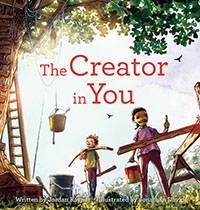 Beautiful illustrations span the inside covers and stretch to the edges of each two-page spread. Rhyming poetry delivers a gently powerful sermon-story that not only is God the creator in us, he made us to be creators with him. Bright colliding stars and lights accompany the words, “He grabbed a big brush and painted the stars and dressed up the sky with Saturn and Mars.” As two children look over buildings, water, birds and clouds, the message is clear. In six days, God “created a lot, there are so many things that He simply did not—like bridges and baseballs, sandcastles and s’mores.” So “God asked us to create and fill the planet with more.”
 As a foundational principle, Jamieson and Wittman begin with this statement: “Holy Scripture presupposes and fosters readers whose end is the vision of Christ’s glory, and therein eternal life. Biblical reasoning must be ordered to this same end” (p. 3). From that starting point, the authors identify six additional principles with which few—if any—historically orthodox Christians could disagree. Based on those seven principles, they present 10 helpful rules to guide the reading and interpretation of Scripture. Along the way, they illustrate the principles and rules as they exegete specific biblical passages.
 Clearly meant to be absorbed one at a time, each devotional begins with an encouraging Scripture before personal stories, illustrations, examples and reflections apply the passage to the daily world of women. Simple yet thought-provoking questions follow, and each two-page entry closes with a comforting prayer. In the narratives, the wife and mother of three honestly shares her own struggles and how God has given her “fighting words” from the Bible at every turn. Additionally, she recommends committing the verses to memory.
 Miller lays out his intent with the book from the beginning: “This is a book about the historical development, key beliefs, and political, cultural, and theological implications of Christian nationalism.” His research, with excellent documentation, delves deeply into the various aspects of Christian nationalism. Miller approaches the topic fairly, by allowing the words and writings of those who support the concept of Christian nationalism to help define the meaning of the term and movement.
 In The Good and Beautiful You: Discovering the Person Jesus Created You to Be, James Bryan Smith helps us to see how these two truths shape our self-understanding.
 David C. Cramer, managing editor at the Institute of Mennonite Studies, and Myles Werntz, director of Baptist studies at Abilene Christian University, identify eight approaches to Christian nonviolence, along with various writers and activists who have exemplified them.
 First-time author Murchison provides a simple but profound Bible study about the dreams and visions promised when God poured out his Holy Spirit on the church. The dreams and visions he describes are not esoteric experiences for a handful of mystics. Rather, they are unselfish goals that stretch the faith of Christ’s followers but do not strain the Holy Spirit’s ability to turn hope into something tangible that will bring honor and glory to God.
 Ace Collins combines his zeal for nurturing Christians in practicing their faith and his passion for vintage automobiles in Geared-Up Faith for Classic Car Buffs: Devotions to Help You Reflect, Recharge, and Restore. Although an ideal gift for Father’s Day, the book appeals to men and women of all ages who simply love history or who feel nostalgic when hearing stories of great-great-grandad’s first car or watching movies like Bullitt and Steve McQueen’s Ford Mustang car-chase or viewing photographs of early World War II Jeeps. Collins covers them all, adding exquisite color images and a twist of faith.