Review: Tempered Resilience
Tempered Resilience: How Leaders are Formed in the Crucible of Change
By Tod Bolsinger (InterVarsity Press)
Written during a year of considerable social, political and economic strain, Tod Bolsinger’s second book on adaptive leadership, Tempered Resilience, is a gift to those leaders who have faced significant resistance and/or sabotage over the last year, and who are ready and willing to be formed for longer-lasting ministry.
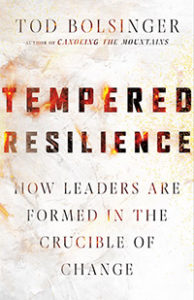 To depict resilience, Bolsinger turns to the metaphor of forging steel. Anyone who has seen the History Channel’s “Forged in Fire”—or who has forged their own metal tools or art—will appreciate how Bolsinger aligns the formation of a leader with the shaping of metal. Comparing leadership formation to the heating, holding, hammering and hewing of the forging process is an evocative picture of the leader’s life. Key to this metaphor is the leader remembering he or she becomes a leader in the midst of leading.
Bolsinger’s second book on leadership follows his well-received debut, Canoeing the Mountains: Christian Leadership in Uncharted Territory. Rather than technical solutions to technical problems, both books focus on the internal work leaders need to do to overcome the anxiety of uncertainty, leaning heavily on The Practice of Adaptive Leadership by Ronald Heifetz, Marty Linsky and Alexander Grashow.
Tempered Resilience builds on Edwin Friedman’s Failure of Nerve and Rabbi Jonathan Sacks’ Lessons in Leadership. Friedman’s phrase “failure of nerve” diagnoses a person’s anxious response to others. To that failure, Bolsinger adds “failure of heart,” which is a burned-out leader’s coldness toward others. To avoid these failures when change efforts are met with resistance or sabotage, a leader must become resilient, able to get back up when knocked down.
With all that is good about Tempered Resilience, one section in Chapter Seven needs further development. In light of the intensified racial tension in our country, communities and churches during 2020, the personal example of managing reactivity is too short. It easily could have been a case study for the entire chapter.
Eric Black, executive director, publisher and editor
Baptist Standard
 In time, she responded to a sense of calling to minister among those who lived on society’s margins and to speak on their behalf. As she tells it, she felt drawn to ministry among the unhoused not because she had something to offer or wanted to provide all the answers to their problems. Rather, she writes: “I was drawn there because I had something to receive, something to learn. I was drawn there because that is where I found God moving most tangibly.”
 Money matters, and money especially matters in helping children learn balance and the importance of giving and saving. To help instill a healthy Christian view in young readers, Art Rainer has created the Secret Slide Money Club series of chapter books for children in grades 1-4. The second in the series, The Mad Cash Dash, builds on lessons in
  Ironically, Gorrell endured these family tragedies just as she began studying joy and teaching about a life worth living at Yale University. When she was supposed to be at the top of the mountain, she found herself in the depths of hell. While leading a regular Bible study group for women in prison, Gorrell discovered joy, but not without more pain. As she ministered to and with incarcerated women, she learned of lives loaded with suffering.
 Memes and websites frequently make much of strange or controversial verses in the Bible, leading many to view Christianity and its adherents as unbelievable. Kimball seeks to engage people unfamiliar with the Bible, to take them seriously, and to help them read the Bible more accurately. How (Not) to Read the Bible encapsulates that effort.
 The volume’s inspiration comes from a trip to Tuscany she shared with grown daughters Amanda and Melissa. Everywhere she looked and everything she learned led her thoughts to vines in the Bible. Although the Living Proof Ministries founder wrote Chasing Vines before the pandemic, Moore’s chosen Scriptures, illustrations and information about the vineyard, the vinedresser, the vine, the fruit and the harvest provide greater meaning today. That’s particularly true in her writing on the death of stability in the sections on soil and roots: “We just want some semblance of our old lives back. The hard truth is, there’s no real going back. But once we get up again, there can be going forward.”
 Christianity has declined in Europe and North America—from where centuries of missions and theological and biblical study has come. By contrast, Christianity has grown significantly in Africa, Asia and Latin America—the three continents containing the majority of the world’s population. Unfortunately, the vibrancy of theology in the so-called Majority World has been largely overlooked in Europe and North America. Majority World Theology is a response to that oversight.
 Editors at WaterBrook Publishing have given Christian readers a wonderful gift for the new year by compiling nine sermons Eugene Peterson, beloved translator of The Message, preached at Christ Our King Presbyterian Church in Bel Air, Md. Subtitled “How the End of What We Were Reveals Who We Can Be,” this insightful book focuses on the New Testament book of Revelation.
 African American Readings of Paul answers those questions through a scholarly examination of how Paul and his writings have been received and interpreted by African American readers of Scripture. As such, it is the first study of its kind. Other authors have considered Black readings and interpretations of Scripture as a whole, but none has focused on the African American reception, understanding and use of Paul.
 In fewer than 200 pages, Goheen and Bartholomew provide an easily accessible overview of Scripture as the story of the King and his kingdom, structured in six acts with an intertestamental interlude halfway through the drama. They use as their outline a half-dozen themes: creation, fall, restoration initiated, restoration accomplished, the mission of the church and restoration completed.
 This clearer understanding doesn’t come from some kind of secret knowledge, like a newly discovered Gnostic gospel. It comes from reading the Bible as its first readers would have read it, with all the taken-for-granted culture in mind. Two thousand years later and at least one culture apart, we need a new prescription to be able to see all the Bible has to offer. E. Randolph Richards and Richard James have written that new prescription, if we will take up and read.
 Kimberly D. Hill, assistant professor of history at the University of Texas at Dallas, examines the reach of W.E.B. Du Bois and Booker T. Washington’s academic dispute beyond African American communities in the United States. She shows how, within the context of Christian missions, their differing educational philosophies were implemented among some of the most vulnerable people in Central Africa.