Review: The Coming Race Wars
The Coming Race Wars: A Cry for Justice from Civil Rights to Black Lives Matter
By William Pannell (InterVarsity Press)
William Pannell, professor emeritus of preaching at Fuller Seminary, levels a scathing indictment of white evangelicals in The Coming Race Wars.
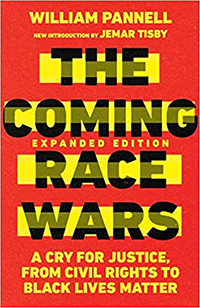 The book first was published in 1993 following the unrest in Los Angeles in response to the acquittal of four white police officers who beat Rodney King mercilessly. This new edition contains a foreword by Jemar Tisby—bestselling author of The Color of Compromise—and an afterword by Pannell, in which he reflects on the nearly 30 years between editions. The body of the new edition is adapted minimally from the 1993 edition.
Some readers might assume Pannell holds to a liberal theology simply by virtue of his being Black and willing to speak his mind so unflinchingly. They might be more comfortable if that were true.
In reality, he affirms evangelical commitments—such as the importance of evangelism and discipleship—and expects conservative white evangelicals to be as interested in “apply[ing] what the Bible teaches” as so many are obsessed with the inerrancy of Scripture (p. 40). Should any continue to doubt his convictions, Chapter 7 should make abundantly clear where Pannell stands as he lays out what evangelicals—white and Black—must address.
From the beginning, Pannell makes clear he is speaking his mind without apology. Indeed, no apology is given as he lays into everything from Republican embraces of racism during the Reagan and Bush administrations, to the Archie Bunkers “who produce so-called Christian contemporary music” (p. 55), to white Democrats he sees as using Blacks to stay in power.
He spares no contempt for efforts to recast racism as cultural conflict, including attempts by intellectuals unfriendly to Christian faith that evangelicals nevertheless find attractive. If any restraint can be found, it is in Pannell’s description of suburban churches, who he describes as abandoning urban churches.
Reading Pannell’s assessment of American politics in the 1980s and early 1990s is like watching Star Wars episodes 1 through 3 after watching episode 5. We know where this is going, because we’ve already been there.
Though specific details are dated—such as demographics and socioeconomic indicators—Pannell is prescient, seemingly foretelling the events of summer 2020 in response to the police killing of George Floyd.
At the center of Pannell’s critique is the assertion that American refusal “to invest in ways to enable the powerless to acquire the power [education, capital, agency] they need to overcome violence and self-destructiveness and to take control of their lives” (p. 115) sets the fuse for societal explosions like that in Los Angeles in 1992 and, by extension, that in Ferguson in 2014 and 2015, as well as global protest during summer 2020.
The Coming Race Wars doesn’t read as one might expect a book written by a professor of preaching to read, unless one understands how much lived experience informs Black preaching. And the lived experience of many Black people in America doesn’t read like we might want a book on preaching to read—sanguine and saccharine. But then, not all preaching is to comfort.
Eric Black, executive director, publisher, editor
Baptist Standard
 The book follows a simple, easy-to-use format. Each chapter begins with a truth from Scripture, followed by an engaging and down-to-earth examination of it, generally based on Wade’s personal experience. Next, readers are invited to read and reflect on Bible verses related to the truth for the week. A daily study guide follows.
 Words matter, whether they’re spoken to us, we utter them to others, or we whisper them to ourselves. In When Words Matter Most: Speaking Truth with Grace to Those You Love, long-time friends and experienced counselors Cheryl Marshall and Caroline Newheiser move beyond everyday dialogue to intentional, Scripture-based conversation that takes words to a higher plane.
 Shonn Keels has a passion for personal evangelism, and he is appalled by how few American evangelicals present the gospel to anyone. More specifically, when Keels recognized young adults at Putnam City Baptist Church—a conservative Southern Baptist congregation in Oklahoma City, where he is associate pastor—fail to prioritize sharing their faith with others, he determined to do something about it. So, Keels devoted more than two and a half years to researching personal evangelism and developing a plan a local church can use to motivate and train its members to become faithful witnesses for Christ.
 “If someone experiences incongruence between their gender and their biological sex, which one determines who they are—and why?” Sprinkle asks a version of this question throughout the first half of the book. In answer, he differentiates between biological sex and gender, returning throughout the book to the distinction. In response to the conflation of gender with male and female biology, Sprinkle asserts gender is culturally dependent; anatomy is not. He expresses particular concern for the weight given to a person’s degree of conformity to gender stereotypes as a measure of one’s maleness or femaleness.
 If a friend tells you she enjoyed reading White Too Long, you know she was just turning pages and not paying attention. If a friend tells you she was captivated and convicted by White Too Long and suggests you read it, follow her advice.
 In eight segments, the author juxtaposes six female pairs from the Old Testament and two from the New Testament onto themes such as “Tamar and Ruth: Outsiders” and “Esther and Rahab: Unexpected Heroes of Faith.” The final “Jesus and the Women” chapter profiles women accused and women in need, financially or physically. A plethora of Scripture references infuse the text and serve as the basis for the author’s comments about what the “key players in [God’s] unfolding plan” might have felt or thought. Each segment closes with study questions, and an extensive index details people, places and subjects.
 In The Preacher as Sermon, Norman outlines 10 ways of being that preachers need to remember and embody for their sermon preparation to reach its mark in the hearer’s heart. He begins with the biblical definition of a preacher.
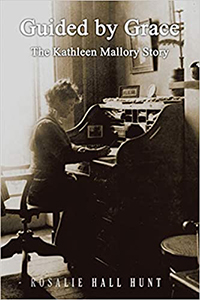 Biographers face the daunting task of highlighting a subject’s achievements while offering a compelling narrative that reveals the individual’s humanity with all its tragedies and triumphs, failures and successes, joys and regrets. The challenge becomes even more profound when the person’s story begins in Alabama in the period following the Civil War and ends in the decade after World War II.
 These and other words from Luke were the first to be presented in 1300 draft versions to representatives of more than 30 tribes all over North America, who provided feedback on such things as readability, cultural issues and names of persons and places in what would become the First Nations Version of the New Testament.
 Like many in Southern Baptist life, 2016 and 2017 were a turning point for her. In 2016, a video surfaced in which presidential candidate Donald Trump bragged about sexually assaulting women. His evangelical supporters—Baptists in Texas among them—explained it away. Evangelical support for Trump troubled Barr, as it did Beth Moore, because of its relation to complementarian theology.
 In Reparations: A Christian Call for Repentance and Repair, Duke Kwon and Gregory Thompson respond to a masterful letter written by Jourdan Anderson in 1865 to his “Old Master.” The former slave owner wanted Anderson to return, promising he would treat him well. Anderson wrote back that the proof of the promise would be in the payment for past service. “If you fail to pay us for faithful labors in the past, we can have little faith in your promises in the future,” Anderson wrote.