Review: W.G.: The Opium-addicted Pistol Toting Preacher Who Raised the First Federal African American Union Troops

W.G.: The Opium-addicted Pistol Toting Preacher Who Raised the First Federal African American Troops

By Donna Burtch and William Burtch (Sunbury Press)

The subtitle seems to say it all, but William Gould Raymond was even more multi-faceted. His abolitionist beliefs led Raymond to volunteer with Company H in the 86th New York Infantry, better known as the Steuben Rangers. He commanded the Provost Guard, where he carried out orders to contain the high-stakes gambling, liquor trafficking and prostitution that plagued the District of Columbia and corrupted the military personnel stationed there. He also was chaplain of the hospitals in Washington, D.C.

Sibling authors Donna and William Burtch give most attention to the role of their great-great-great grandfather—alongside fellow chaplain J.D. Turner—in recruiting and serving as initial commanding officers of the First District of Columbia Colored Volunteers. When Secretary of War Edwin Stanton issued the order that established the Bureau of Colored Troops, the unit Reynolds and Turner had mustered at their own expense and with President Abraham Lincoln’s authorization became the heart of the First U.S. Colored Troops. The authors carefully document those contributions through public notices in Washington newspapers of the time and Lincoln’s presidential papers. However, the House Committee on War Claims denied an $843 invoice for reimbursement, and Reynold’s grave marker in Arlington Cemetery identifies his rank as 1st Lieutenant—the rank he held in the 86th New York Infantry—rather than the rank of Lieutenant Colonel he was granted when Lincoln appointed him as a commanding officer of the African American recruits.

Later in life, Reynolds was a Baptist missionary to Kansas but fell into “worldly pursuits,” such as railroad expansion projects and trafficking in racehorses, and he believed his failure to give full attention to his calling resulted in health problems. Pain caused by ulcers, heart disease, and liver and kidney ailments led a doctor to prescribe opium, and he became addicted to the narcotic. Even after he returned to Washington, he confessed to seeking “diversion in worldly amusements,” such as playing dominoes, croquet and checkers, and in attending theater productions with friends and “even horse shows at fairs.” Filled with guilt, he experienced a mystical vision and spiritual renewal in the woods of Rock Creek near Washington. He spent his final years as a faith healer, first in the Baptist churches he had served for decades and eventually in nondenominational congregations.

W.G. is a work of military history, religious history and family history. More than that, it offers an intriguing portrait of a complex and fallible—but dedicated—man of God.

Ken Camp, Managing Editor

Baptist Standard 
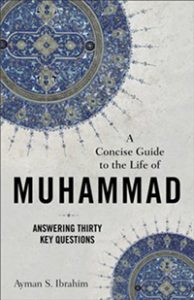


Review: A Concise Guide to the Life of Muhammad

A Concise Guide to the Life of Muhammad

By Ayman S. Ibrahim (Baker Academic)

This companion to Ayman S. Ibrahim’s earlier book, A Concise Guide to the Quran, shares many of the same characteristics. Both are written to answer 30 key questions. Both offer a respectful and nuanced picture of Islamic belief. Both approach their subjects with the keen eye and rigorous investigation of a diligent scholar.

In this book, Ibrahim—director of the Center for Christian Understanding of Islam at Southern Baptist Theological Seminary—offers a succinct but incisive exploration of Muhammad’s history and his teachings. In one important section, he makes a distinction between three Muhammads—the legendary mythic figure of folk Islam, the prophet revered by observant Muslims and the historical individual known primarily for his military exploits.
Ibrahim also carefully examines the primary source of information about Muhammad—the hadiths (sayings or teachings) attributed to him. He points out none of the collections of sayings are from the time of Muhammad or the generation immediately following his death. In fact, none are from the first two centuries of Islamic history. He notes Sunni and Shiite Muslims recognize different hadiths as authoritative. He also acknowledges militant groups hold tenaciously to some hadiths that progressive and moderate Muslims do not take literally.

Ibrahim begins the book with a helpful timeline of key dates in the life of Muhammad, and he concludes it with a handy glossary of terms.

Both in terms of the information he provides and the critical-but-respectful approach he takes in handling primary sources, Ibrahim offers valuable insights and a good example for Christians to follow as they seek to talk about matters of faith with their Muslim neighbors. There’s something to be said for both “grace and truth.”

Ken Camp, managing editor

Baptist Standard


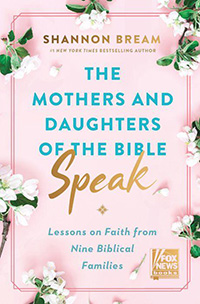
Review: The Mothers and Daughters of the Bible Speak

The Mothers and Daughters of the Bible Speak: Lessons on Faith from Nine Biblical Families

By Shannon Bream (Fox News Books, an imprint of HarperCollins, 2021)

In time for Mother’s Day giving and summer reading, New York Times bestselling author, lawyer and media personality Shannon Bream has released The Mothers and Daughters of the Bible Speak: Lessons on Faith from Nine Biblical Families. The main title might lead the reader to mistakenly believe the Liberty University alumna teaches only about relationships between mothers and their daughters. Instead, the book thoughtfully and thoroughly examines faith in the Scriptural stories of women through their roles as mothers and daughters, some simultaneously. As a bonus, she weaves in her own personal story.
The engaging Bible study breaks naturally into three main sections. “Mothers and Daughters” explores Jochebed and Miriam, Ruth and Naomi, and Elizabeth and Mary. “Mothers and Sons” probes the relationships of Rebekah, Bathsheba and Mary the mother of Jesus. “Daughters and Fathers” considers Dinah, Esther and Michal. The brief closing “Miracles for Mothers and Daughters, Too” includes the uplifting faith details of mostly unnamed women. Scripture and biblical references dust the pages, and thought-provoking study questions and a beautiful prayer close each chapter. Shannon Bream’s expressive voice and personal style create a special touch for audiobook listeners. An extensive index completes the volume.

The Mothers and Daughters of the Bible Speak deserves to be another bestseller as the author adds thoughtful layers to each story and expertly applies lessons to today while remaining true to the Old or New Testament period. Shannon Bream gives the gift of bringing each mother and daughter to life through scripture, faith lessons and a woman’s point of view. For example, readers uniquely experience Bathsheba’s story through her eyes. Some may feel the writer goes too far, but the technique deepens the knowledge of believers while engaging non-Christians in biblical narrative. But beware, Bream doesn’t whitewash the truth, so use care with younger teens and pre-teens.

Kathy Robinson Hillman, former president

Texas WMU and Baptist General Convention of Texas

Waco


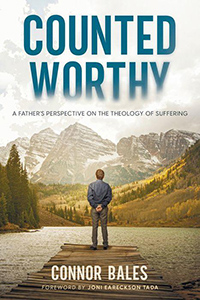
Review: Counted Worthy

Counted Worthy: A Father’s Perspective on the Theology of Suffering

By Connor Bales, foreword by Joni Eareckson Tada (Vide Press)

In the weeks leading up to Easter, hearts contemplate Christ’s suffering. For the Christian, when tragedy strikes, suffering calls out to ask why and how God could let this happen. Connor Bales, pastor of the Prestonwood Baptist Church north campus in Prosper, and his wife Mary faced those heartbreaking questions following the births of two daughters with profound special needs. In Counted Worthy: A Father’s Perspective on the Theology of Suffering, the minister offers a father’s personal perspective while also including the heavenly Father’s.

In a brief introduction, Connor likens the Bales’ journey to navigating icy roads, spinning out, occasionally in the ditch, and then going “Crash” as he shares Hannah’s near-fatal medical crisis in 2018. Using descriptive chapter titles all beginning with the letter C, the loving daddy then goes back in time to share his and Mary’s story.
In October 2008, after having had two healthy children—Kathryn and Coleman, Libby enters their “Charmed” lives with a severe chromosome abnormality. The native Texan tells how he and Mary were “Called” to ministry and how Libby “Changed” their family and “Confused” their assumptions. Nevertheless, they settle into a “Calm” but challenging routine. Three years later after being assured it wouldn’t happen again, Hannah arrives with identical Trisomy 16p.

Connor weaves Scripture, wise words from others who’ve suffered, and the way God has “Counted Worthy” the couple, their family, their friends and the churches in Longview and Dallas they’ve served to embrace these precious girls who can do nothing for themselves but express pure love. He explains how God brings “Clarity” to his and Mary’s call to comfort others and to help individuals and churches know how to minister to those with special needs and their loved ones. But the Texas Tech graduate doesn’t pull any punches, particularly in the chapter telling how “Cruel” people can be.

In “Complete,” Connor shares the Bales family dinner-time game of “Pit and Peak.” With youngest daughter Campbell leading, they tell the worst part and the best part of their day. The compassion-filled chapter closes with pits and peaks in the journey with Libby and Hannah written by Mary, Kathryn, Coleman, Campbell, Sallye “Granny” Bales and Mary’s mother Ellen “Mimi” Pollard. Finally, readers find themselves “Challenged” to be counted worthy by God as an athlete is challenged for a contest.

Sometimes readers choose a book. Sometimes a book chooses a reader or rather God does. A Christmas note from a long-time friend recommended her son’s recent publication based on personal experience. Having watched the family grow through his mom’s annual cards, two special needs girls regularly appeared. In the most heart-felt, heart-wrenching, heart-warming way, the volume reveals their story and their profound effect on their father and those the heavenly Father counts worthy to love them.

Let Connor Bales’ book Counted Worthy choose you. If you do, you’ll shed tears, share smiles and be a better minister, counselor, teacher, parent, friend and neighbor.

Kathy Robinson Hillman, former president

Texas WMU and Baptist General Convention of Texas

Waco


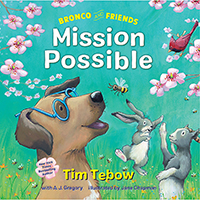
Review: Mission Possible

Bronco and Friends: Mission Possible

By Tim Tebow with A.J. Gregory, illustrated by David Hohn (WaterBrook)

Just in time for Easter baskets, Heisman Trophy winner and best-selling author Tim Tebow offers the second adventure of his bespeckled dog Bronco and an unlikely menagerie of friends. Written with frequent collaborator A.J. Gregory and award-winning illustrator Jane Chapman, Bronco and Friends: Mission Possible encourages boys and girls to “Do what’s right, not what’s easy.”

The story opens with Bronco and three canine friends snacking on honey cake, at least until any picnic’s most unwelcome visitors spoil the fun. But Bronco’s greatest fear isn’t ants but bees. A bee touches his tail buzzing, “Help me!”
Persuaded by Alexis the goat, Bronco finally listens to Phoebe. Someone has stolen their hive from the beekeeper, and only she escaped. Could Bronco help her find her family and get them home?

The dog doesn’t think so. After all, he doesn’t know the bees, and “they’ve never done anything for me.” Then he remembers a poem his mother often read to him and answers the call. Realizing he needs a bigger team, Bronco drafts Chelsie the rabbit and Ethan the robin.

Soon they hear a lawnmower which isn’t a lawnmower at all but the buzzing bee box still in the back of the thief’s truck. All seems well as the hive prepares to fly home, but Miss Queen’s too afraid. Shored up by Bronco and friends, the impossible mission becomes possible, and she courageously leads her family to safety.

The appealing animals and charming tale beautifully illustrate Philippians 2:4 and urge children to answer God’s call to help others even if “it might be easier to do nothing at all.” Jane Chapman’s colorful art reveals each character’s personality and adds urgency to the bees’ plight. Tim Tebow’s Bronco and Friends: Mission Possible provides an engaging way not only to teach biblical truth, but also the importance of teamwork. The volume makes a great addition to any child’s bookshelf or any church’s library.

Kathy Robinson Hillman, former president

Texas WMU and Baptist General Convention of Texas

Waco


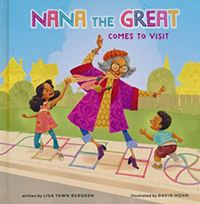
Review: Nana the Great Comes to Visit

Nana the Great Comes to Visit

Written by Lisa Tawn Bergren, illustrated by David Hohn (WaterBrook)

In this new release, author of the God Gave Us series Lisa Tawn Bergren and award-winning illustrator David Hohn team to create an engaging nod to grandmothers everywhere. In the story, a lively girl lets slip what happens when Nana the Great Comes to Visit her and her not-so-great little brother.

Her Nana builds the best forts but “never lets me win” at checkers, so someday I’ll beat her “fair and square,” the girl says. She “hates poopy diapers” because she’s already changed 10,453 and “can’t face one more.” Nana sugars tomatoes, sneaks cookies before dinner and allows trying on makeup. She uses “twenty different bottles of polish” on fingers and toes and lets “me make my own choice” when it comes to clothes. Nana’s great at “ginormous” hopscotch games, playing in sprinklers and urging climbing high in the sky.

She shows me how to talk to God “any way you wish”—kneeling or standing with eyes closed or staring at stars. Her favorite way is dancing, “praising him for everything and everyone.” She adds bubbles to baths and stashes adventures under her bed. When Nana leaves “I start to feel sad” until she assures that “while we’re apart … my heart is always with you.”

Although available as an audiobook, don’t miss the hardback’s bright, emotion and motion filled pages. Girls and boys will love the story and pictures. Adults will chuckle at mom’s peeks around doors and dad’s furtive backward glances because Nana’s a little bit naughty “in the best sort of way.” Bergren’s and Hohn’s Nana the Great Comes to Visit is a keeper or makes a great gift for a precious child or special “Nana the Great.”

Kathy Robinson Hillman, former president

Texas WMU and Baptist General Convention of Texas

Waco


Review: Charlotte Atlee White Rowe

Charlotte Atlee White Rowe: The Story of America’s First Appointed Woman Missionary

By Reid S. Trulson (Mercer University Press)

Reading the words “Charlotte” and “Woman Missionary” brings to mind Charlotte Moon, namesake of the Lottie Moon Christmas Offering, who served in China from 1873 to 1912. However, few could name the first female “officially appointed … by any denomination or mission agency.”

In Charlotte Atlee White Rowe: The Story of America’s First Appointed Woman Missionary, Reid Trulson, retired executive director of American Baptist International Ministries, chronicles the other Charlotte, whose service and controversial appointment in 1815 have been largely overlooked and “written out of history.”

Charlotte Hazen Atlee was born July 13, 1782, the 11th and final child of Pennsylvania Supreme Court justice, who was Episcopalian. Sadly, Charlotte’s mother passed away before her 8th birthday, and three years later, her father died from yellow fever. Although much of her early life is a mystery, Charlotte probably lived with her oldest sister and was well educated.

In 1803, she married Nathaniel Hazen White, a Congregationalist. Her happiness was short-lived when Nathanial died on Christmas Day 1804, and their baby boy followed five months later.

The 22-year-old widow searched Scripture and joined Haverhill Baptist Church. Over time, she answered God’s call to missions. Missionary wives like Ann Judson were considered “assistant missionaries,” and both in Britain and the United States, single female volunteers were expected to marry.

Charlotte White’s appointment by the newly formed Baptist Board of Foreign Missions in Philadelphia was miraculous, scandalous and ultimately reversed. Nevertheless, at her own expense, she sailed with Phebe and George Hough for India in 1815, a year before a resolution passed that no more single women would be appointed.

Once in India, Charlotte fell in love with British missionary Joshua Rowe, a widower with three sons. The two married in Calcutta in June 1816. Intelligent and a gifted linguist, “educational missionary” Charlotte learned Hindi, taught, wrote and cared for her family. American Baptist records show she resigned in 1816, although her correspondence indicates she did not. Her status with the British Society was never clear, but she continued to serve.

She bore twin daughters and a son. Joshua died at age 41 in October 1823, leaving his widow to continue mission work and care for six children ages seven months to 17 years. Three years later, without support, Charlotte made arrangements in India for Joshua’s sons and sailed for England at her own expense.

She hoped to be appointed by the British Missionary Society, but in spite of strong recommendations, they would not engage a woman. Instead, they provided one-time payments of £45 for her children and £100 for her. She had to raise funds to travel back to America, where she supported her family as a teacher and actively participated in female missionary societies.

Charlotte Rowe died on Christmas Day 1863 at age 82 and was buried two days later in an unmarked grave. However, she left her mark through those she taught in India and with her Hindi spelling book that long outlived her, as did her articles and children’s books shedding light on the practices of widows throwing themselves on funeral pyres and putting the elderly out to die. The stepsons she raised left their own fingerprints on the country.

Because of gender-bias, Charlotte didn’t walk through open doors herself, but she left the door ajar for appointment of missionary wives, funding for widows and official appointment of all women, married and single. Thankfully, Reid Trulson’s meticulous research and engaging narrative help write Charlotte Atlee White Rowe back into missions history where she belongs.

Kathy Robinson Hillman, former president

Texas WMU and Baptist General Convention of Texas

Waco


Review: When Did Sin Begin?

When Did Sin Begin: Human Evolution and the Doctrine of Original Sin

By Loren Haarsma (Baker Academic)

Is evolution true, and if so, what does that mean for Adam and Eve and sin?

Loren Haarsma, associate professor of physics at Calvin University, does not question the validity of evolution. He does wonder, however, about traditional Western readings of Scripture such as Augustine’s position on the creation and fall story. He considers alternatives, focusing on four scenarios for how the orthodox biblical understanding of sin and its origin might square—or “harmonize”—with evolution.
Concerned readers ought to know upfront: Haarsma holds to the orthodox Western view of “the unity of Scripture;” Scripture’s inspiration by God; God as Creator; sin as rebellion against God, the consequence of which is separation from God; and God’s atonement for sin through Jesus Christ.

While seeking harmony between Scripture and evolutionary science, Haarsma is clear: “science and theology are [not] equally authoritative.” “Science doesn’t decide how we interpret Scripture. Theology decides,” he asserts. The Christian, then, can learn from science without conceding core doctrines of the faith. To this end, he includes a brief historical survey of how new scientific knowledge has shaped our reading of Scripture without changing doctrine.

Haarsma puts four scenarios to the test, posing challenges to each based on the orthodox Western reading of Scripture. In the end, Haarsma does not put both feet down on any one scenario, but he does put both feet down on Jesus Christ as “God’s ultimate answer” to sin.

One who holds to a literal seven-day creation, and Adam and Eve as the first humans and the first to sin, might wonder: “Why read the book, then, if he ends up noncommittal except on what we all agree on already? Why confuse myself with scenarios I discount in advance on the grounds I don’t believe in evolution?”

A simple answer is increasing numbers of people you may care about do not take a literal seven-day creation account at face value and have serious questions about God, sin and salvation. Taking them seriously warrants some study of their questions.

Eric Black, executive director/publisher/editor
Baptist Standard


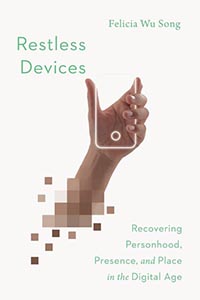
Review: Restless Devices

Restless Devices: Recovering Personhood, Presence, and Place in the Digital Age

By Felicia Wu Song (IVP Academic)

In Exodus 4:2, the Lord asks Moses, “What is that in your hand?” In Restless Devices, Felicia Wu Song responds to that same question today. Noting the average person checks his or her phone at least 150 times a day, the Westmont College professor asks questions: “Do we own our smart phones or do they own us?” “What does our digital footprint replace?” And do we “sneak a peek” because something better might be happening?

Song fills the pages with Scripture, personal confession, examples gleaned from students in her “Internet and Society” course and academic research. Throughout the book, the cultural sociologist of media and digital technologies inserts exercises titled “The Freedom Project: Experiments in Praxis.” The practices, many of which she uses with students, include a goal, digital experiment, actions and reflections designed to help understand device impact.

In casting a vision for spiritual formation and faith communities, Song saturates the volume’s second part with the good news: Individuals can choose communion over connection; God’s faithful presence continues; and sacred spaces should be treasured. The volume concludes with 10 practical “Commitments to Ordered Digital Life” that can be adopted over time.

If Restless Devices were fiction, readers might skip to the last chapter to see how the narrative ends. Unfortunately, the story persists, as technology continually encroaches on the space of individuals, families, churches and society. Fortunately, Song offers guidance in fostering healthy relationships with our devices, devoting ourselves to being fully present with God and loved ones, and imagining a hoped-for future and the challenging steps to get there.

Kathy Robinson Hillman, former president

Texas WMU and Baptist General Convention of Texas

Waco 


Review: Letters to My Daughters

Letters to My Daughters: Seven Truths Every Woman Should Know

By Brenna McLennan (Electric Moon)

If each of us could choose seven truths to leave with our daughters or those who are like daughters, what would we pick? How could we craft the thoughts into letters they would read, ponder and remember? Brenna McLennan, native Texan and children’s minister at Calvary Baptist Church in Vernon, answers that question in Letters to My Daughters: Seven Truths Every Woman Should Know.

The mother of four girls explains, “Like any parent, I assume, I struggle—always questioning whether I am doing enough, teaching enough, laying enough of a foundation for these precious gifts.” McLennan, a former second grade teacher, lays that foundation in seven “Dear Daughters” chapters, all written with love, wisdom, practical advice, solid research and most of all, Scripture and biblical truth.

McLennan skillfully manages to make the letters both personal and universal with sincere honesty and natural candor, particularly when she broaches marital advice. Other themes include: “You are oh so special, but you are not enough,” “Biblical Christianity doesn’t mean you are less than a man in God’s plan,” “Being a woman doesn’t mean your emotions overrun your intelligence,” and “Jesus is everything?”

The slim, 100-page paperback might easily be overlooked among the myriads of Christian titles targeted to women and older teens. However, Brenna McLennan infuses her volume with hope—not just the hope that her “Dear Daughters” would receive Christ, but that they would know him, walk with him and bring him “all the glory he is due” every day of life. The book would make an excellent birthday or graduation gift, Mother’s Day present or just-because surprise for any woman or girl, but men can learn from the letters, too.

Kathy Robinson Hillman, former president

Baptist General Convention of Texas

Waco 


Review: More Witnesses to the Baptist Heritage

More Witnesses to the Baptist Heritage: Twenty-four More Baptists Every Christian Should Know

Edited by Michael E. Williams Sr. (Mercer University Press)

Mike Williams, professor of history at Dallas Baptist University, has edited a worthy companion to his 2015 book, Witnesses to the Baptist Heritage: Thirty Baptists Every Christian Should Know.

The latest book follows the same format as its predecessor. It features two dozen essays about Baptists, ranging from 17th century religious liberty champion Obadiah Holmes to 20th century ethicist and peacemaker Glenn H. Stassen. Most are about 10 pages in length—short enough to read in a brief time but long enough to provide engaging anecdotes from lives well-lived.
Williams wrote two biographical sketches in this edition. Karen O’Dell Bullock, distinguished professor of Christian heritage with the B.H. Carroll Theological Institute, and David W. Music, professor emeritus in the School of Music at Baylor University, each contributed two profiles.

Writers of the remaining 18 essays include a significant number of scholars with Texas Baptist ties, including Larry Ashlock of the Baptist Center for Global Concerns in Arlington; Jack Goodyear, Michelle Henry and Philip Irving Mitchell from Dallas Baptist University; David Holcomb at the University of Mary Hardin-Baylor; Mandy McMichael and T. Laine Scales of Baylor University; and Kelly Pigott of Hardin-Simmons University.

More Witnesses to the Baptist Heritage offers greater diversity than its predecessor. Ten of the 24 individuals profiled in the latest volume are women, compared to only four out of 30 in the first book. It includes profiles dealing with key figures related to religious liberty, theology, missions, worship, ministry, social justice, education and ethics.

Witnesses to the Baptist Heritage is substantive enough to be required reading for a church history or Christian studies class in college. But the essays in it also are accessible and inspiring enough to be enjoyed as part of a daily devotional. Read this book to gain a greater appreciation for Baptists who have made a difference.

Ken Camp, managing editor

Baptist Standard 


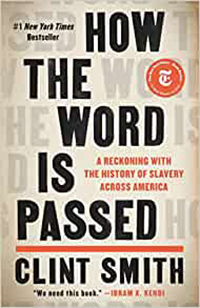
Review: How the Word Is Passed

How the Word Is Passed: A Reckoning with the History of Slavery Across America

By Clint Smith (Little, Brown and Company)

I forgot how I stumbled across this book. I long have known what little I really knew about slavery in America was largely a distorted history told by white writers to cover the realities of this barbaric institution. That reality has been pushed into the legislative battles around the nation about resources of telling the history of enslavement in America. Politicians seem to be afraid of the truth, which caused me to ask, “Why?”

After reading How the Word is Passed, I can say, “I better understand the fear.”

Clint Smith tells the history of slavery by visiting certain sites and places beginning with Thomas Jefferson’s Monticello plantation. Odd place to begin, one might think, until realizing the author of the Declaration of Independence was a slave-owner. In fact, he enslaved his own children, born to Jefferson through his common-law wife, Sally Hemings. In fact, Monticello gives a glimpse of the tortured positions of most of the slave-owning founding fathers.

From Monticello, Smith takes us to the Whitney Plantation, then Angola Prison, then Blandford Cemetery, then Galveston Island, and, oddly, New York City before ending with Goree Island, Senegal, West Africa. Each step along the way is a calculated part of unraveling the full picture of slavery in America and the banking system which supported it.

Smith, an African American writer at The Atlantic, is amazingly engaging but not angry. His prose is easy to read in some respects but hard to read in others, because as a careful historian, he writes of what he documents and experiences.

If white pastors want to get a sense of the gaps in their “education about enslaved peoples, the Civil War, Reconstruction, the Jim Crow era, the financial underpinnings for slavery and finally, where it all started,” this book can be very helpful. It will not be “easy” reading, but it will help you see with fresh eyes the toxic foundation of this nation, which continues to pour its poison into our public life and communities today.

Michael R. Chancellor 

Round Rock