




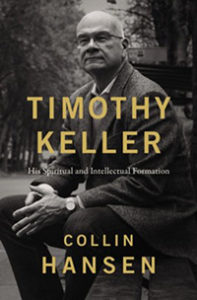
Timothy Keller: His Spiritual and Intellectual Formation
By Collin Hansen (Zondervan)
Timothy Keller is one of the most influential Christian leaders alive today. Through his best-selling books, prominent pastorate and The Gospel Coalition, Keller has influenced millions around the world. Collin Hansen, vice president for content and editor in chief of The Gospel Coalition and longtime colleague of Keller’s, dives into the influences behind the influencer.
 The product of German Protestant and Italian Catholic families, Keller was curious, skeptical, incisive, bookish and socially awkward. He blossomed during his time with InterVarsity at Bucknell University, where his preaching and Bible reading were shaped. The lay-led structure of InterVarsity later influenced the shape of Redeemer Presbyterian Church—the church Keller planted in New York City—as much as Young Life formed the liturgy and discipleship of that church.
During his time at Gordon-Conwell Theological Seminary, Keller left behind his Arminian commitments in favor of neo-Calvinism. Hansen contends most of Keller’s theological positions were formed by the time he graduated from Gordon-Conwell in 1975. Even so, Keller continued to study and learn throughout his ministry, right up until he retired from Redeemer Church in 2017.
Keller always seemed to be near the heart of evangelicalism, especially its Calvinist expression. R.C. Sproul was not only a significant influence, but he also performed the Kellers’ wedding. Elisabeth Elliot—widow of famed missionary-martyr Jim Elliott—was key to Tim and Kathy’s formation at Gordon-Conwell. Other influences include Francis Schaeffer and his L’Abri model, Martin Lloyd-Jones, Jonathan Edwards, John Stott and C.S. Lewis, with whom Kathy Keller—Tim’s wife—had an interesting relationship.
Hansen claims Timothy Keller is not intentionally biographic, but his thorough account of Keller’s influences reveals a considerable amount of his subject’s biography. He assembled his narrative from first-person interviews with Keller and his family, as well as with free access to Keller’s personal notes.
Though the book is divided into four parts respective to periods of time, the narrative’s chronology is not as clear cut. Hansen’s account often reads like a stream of consciousness. A reader expecting a strict chronology may feel bounced around and find the jumping back and forth in time distracting.
Though they already may know many of the influences behind the influencer—since he’s not particularly secretive about them—Timothy Keller fans will appreciate Hansen’s efforts. Those who aren’t as familiar with Keller will want to read the book to gain insight into who is shaping so many young Christians.
This forthcoming book from Zondervan is due out Feb. 7.
Eric Black, executive director/publisher/editor
Baptist Standard
Sign up for our weekly edition and get all our headlines in your inbox on Thursdays










We seek to connect God’s story and God’s people around the world. To learn more about God’s story, click here.
Send comments and feedback to Eric Black, our editor. For comments to be published, please specify “letter to the editor.” Maximum length for publication is 300 words.