Review: The Coming Race Wars
The Coming Race Wars: A Cry for Justice from Civil Rights to Black Lives Matter
By William Pannell (InterVarsity Press)
William Pannell, professor emeritus of preaching at Fuller Seminary, levels a scathing indictment of white evangelicals in The Coming Race Wars.
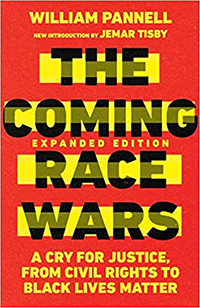 The book first was published in 1993 following the unrest in Los Angeles in response to the acquittal of four white police officers who beat Rodney King mercilessly. This new edition contains a foreword by Jemar Tisby—bestselling author of The Color of Compromise—and an afterword by Pannell, in which he reflects on the nearly 30 years between editions. The body of the new edition is adapted minimally from the 1993 edition.
Some readers might assume Pannell holds to a liberal theology simply by virtue of his being Black and willing to speak his mind so unflinchingly. They might be more comfortable if that were true.
In reality, he affirms evangelical commitments—such as the importance of evangelism and discipleship—and expects conservative white evangelicals to be as interested in “apply[ing] what the Bible teaches” as so many are obsessed with the inerrancy of Scripture (p. 40). Should any continue to doubt his convictions, Chapter 7 should make abundantly clear where Pannell stands as he lays out what evangelicals—white and Black—must address.
From the beginning, Pannell makes clear he is speaking his mind without apology. Indeed, no apology is given as he lays into everything from Republican embraces of racism during the Reagan and Bush administrations, to the Archie Bunkers “who produce so-called Christian contemporary music” (p. 55), to white Democrats he sees as using Blacks to stay in power.
He spares no contempt for efforts to recast racism as cultural conflict, including attempts by intellectuals unfriendly to Christian faith that evangelicals nevertheless find attractive. If any restraint can be found, it is in Pannell’s description of suburban churches, who he describes as abandoning urban churches.
Reading Pannell’s assessment of American politics in the 1980s and early 1990s is like watching Star Wars episodes 1 through 3 after watching episode 5. We know where this is going, because we’ve already been there.
Though specific details are dated—such as demographics and socioeconomic indicators—Pannell is prescient, seemingly foretelling the events of summer 2020 in response to the police killing of George Floyd.
At the center of Pannell’s critique is the assertion that American refusal “to invest in ways to enable the powerless to acquire the power [education, capital, agency] they need to overcome violence and self-destructiveness and to take control of their lives” (p. 115) sets the fuse for societal explosions like that in Los Angeles in 1992 and, by extension, that in Ferguson in 2014 and 2015, as well as global protest during summer 2020.
The Coming Race Wars doesn’t read as one might expect a book written by a professor of preaching to read, unless one understands how much lived experience informs Black preaching. And the lived experience of many Black people in America doesn’t read like we might want a book on preaching to read—sanguine and saccharine. But then, not all preaching is to comfort.
Eric Black, executive director, publisher, editor
Baptist Standard