Explore the Bible: King?

• The Explore the Bible lesson for June 26 focuses on 1 Samuel 8.

Here we go again (1 Samuel 8:1-3)

One of the things that sets biblical faith apart from other religions is the belief that history does not move in cycles. Many Eastern religions hold some form of this view, and many of the ancient Greek and Roman philosophers believed and taught some version of the idea history endlessly repeats itself. Scripture is clear: History is not a circle. The beginning and the “end” are acts of God, and he continues to act in history.

That being said, it is easy to understand why looking at Israel in the period of the judges might make you doubt that history wasn’t an endlessly repeating circle. The book of Judges records a pattern of idolatry, oppression, repentance and deliverance. Similarly, the opening chapters of 1 Samuel record a pattern of a faithful father having unfaithful sons. Eli was a faithful priest whose sons disgraced the priesthood. Samuel had been a faithful judge for a generation, and his sons disgraced the role of judge. The one-sentence summary of their lives could not be more damning for the role they were given and the heritage they received. As in Eli’s day, the failure of the next generation sparks a national crisis. Yet instead of turning to Yahweh, as Israel has done in the better parts of their pattern, they turned instead in a new direction. 

Losing the plot (1 Samuel 8:4-9)

Israel faced an uncertain future. The three conversation partners in this chapter—the elders of Israel, Samuel and Yahweh—all looked in different directions to understand their situation and determine what to do next.

The elders looked around them at the other nations. They saw the nations had entrusted their future to a king. The elders provided no other explanation at this point, beyond the fact that “all the other nations” have one. You can almost hear the echo of children and teenagers saying, “Everyone else is doing it!” But the complaint was not voiced by the youth of Israel, but by elders who were old enough to know better. Most of us know the stereotypical parental response to the “everyone else is doing it” appeal: “And if everyone was jumping off a cliff, would you do that, too?” As we will see, Israel received a version of this question and gave a definite answer.

Samuel looked to Yahweh. He alone among the elders relied on prayer in the face of an uncertain future. Samuel offered no objection to the elders’ critique of his sons. Their actions were indefensible. The request for a king displeased him, though again no specific reason was given. Samuel had been consistently portrayed as seeking Yahweh’s will, however, and the most likely reason for his disapproval was he knew already this was not Yahweh’s desire for Israel.

In his communication with Samuel, Yahweh looked to the past and saw the pattern of idolatry and forsaking that Israel had engaged in. Yahweh unequivocally said he had been rejected as king— and that was nothing new! From the day he first rescued them from slavery, this had been their go-to sin. Yahweh likely had in mind the incident of the golden calf, and the grumbling in the desert by Israel that perhaps Egypt wasn’t so bad after all. The last time Israel had a king, it was Pharaoh.

Interestingly, Yahweh told Samuel to “listen to them, but warn them.” Yahweh recognized the pattern from the past, but wanted them to reckon with the future. Yahweh’s call back to the exodus was also a direct critique of the only reason given so far for Israel wanting a king. Yahweh chose and saved Israel specifically so they would not be like the other nations. They would be distinct in worship and in the exercise of justice. Their national identity would be covenantal, not based on the royal family. Israel was rejecting Yahweh as king, and so rejecting the very thing for which Yahweh had called and delivered them.    

All take and no give (1 Samuel 8:10-18)

Walter Brueggemann points out that the most common word used in Samuel’s warning to describe the actions of the potential king of Israel is “take.” The list is exhaustive and explicit. The king will take their sons in a military draft, take their daughters to be household servants in his palace, take a tenth of all their produce and livestock for his entourage and accumulation of personal wealth, and finally take the Israelites themselves to be slaves. Whoever the new king is, whatever dynasty rules them,  the Israel will ultimately find themselves in the same place as with the old king —Pharaoh. Most alarmingly, Yahweh informs them when that day comes and they cry out for deliverance like they did against Pharaoh, this time Yahweh will not answer. This prophecy was fulfilled at the terrible time of Israel’s exile. Although there occasionally will be good kings over Israel, this is a decisive step in Israel’s history toward chronic and entrenched unfaithfulness to Yahweh and therefore toward exile. It will be Israel’s kings who perpetually lead them toward idolatry and away from justice.

Misplaced trust (1 Samuel 8:19-22)

Faced with Yahweh’s version of “If everyone was jumping off a cliff, would you do that, too?” the elders of Israel respond with their version of an enthusiastic “Yes!” They repeat the desire to be like the other nations, but now expand their reasoning. They seem not to have heard or acknowledged all the things the king will “take,” and instead imagine the king will “lead,” “go out before us” and “fight.” In this way, they have forgotten their history with Yahweh and disregarded his command for the future. “When you go to war against your enemies and see horses and chariots and an army greater than yours, do not be afraid of them, because the LORD your God, who brought you up out of Egypt, will be with you” (Deuteronomy 20:1).

With this response from the elders, Samuel again turns to Yahweh. Yahweh does not repeat his warning but gives permission without approval. Samuel abruptly sends everyone home, with no other word about what happens next. From Israel’s perspective, the future is just as uncertain as it ever had been. The choice of a king seems to have been left to Samuel, but later chapters make clear that Yahweh will, of course, continue to be involved in his people’s lives and history—even when they have rejected him (1 Samuel 9:15-17).      

In case you have been hiding under a rock the past year, it is election season. Presidents are not kings (thank God), but the people of God continually must wrestle with where we place our trust during times when the future is uncertain. We serve a God who has acted decisively in history and established his Son as King of kings and Lord of lords. We must not fall victim to idolatry, turn away from justice, and lose the plot of God’s work in past and his goals for the future.



Explore the Bible: Worthy!

• The Explore the Bible lesson for June 19 focuses on 1 Samuel 5-6.

The adventures of the ark of the covenant

“The glory has departed from Israel.” This was the judgment of the high priest Phineas’ wife as she reacted to the news of Phineas’ and his brother Hophni’s death in battle with the Philistines, as well as the death of their father, Eli the priest, and the capture of the ark of the covenant by the Philistines. These were also her last words given to name her child as she died in childbirth, rendered in Hebrew as “Ichabod.” “The glory has departed” would commemorate this moment of national disaster (1 Samuel 4:21-22).

Imagine it: The armies of Israel defeated, the high priests of Israel slain, and their most precious symbol of the presence of God, the object that symbolized for them God’s presence bringing them out of Egypt and into the land of promise, captured by an opposing army. It must have seemed like this could only be the precursor to some even greater disaster—the opening salvo of the end of everything the Israelites held dear. In the ancient world, when armies fought, it was presumed their respective gods fought in the heavens as well. The defeat and capture of the ark would have meant the defeat of Yahweh.      

Certainly, the Philistines interpreted their victory in this way. The ark was brought into Ashdod, one of the five fortified city-states of the Philistines, and placed into the temple of Dagon. Dagon was the primary god of Philistines, a god of fertility, grain and fish. All of those roles amounted to Dagon being the giver and sustainer of life for a people who lived in the coastal plains. Placing the ark beside Dagon’s image represented Yahweh’s new role as subservient to Dagon, who was the victor in the battle between the deities. The day must have been filled with ceremony and celebration befitting the victory in battle and the installation new furniture in the temple, especially given the terror the ark inspired when it first appeared on the battlefield (1 Samuel 4:6-9).

The narrator vividly displayed the scene in which the Philistines discovered strange things had been happening in the night. “There was Dagon, fallen on his face … .” The Philistines apparently were not bothered by the irony of having to prop up their god. The next morning, Yahweh provided further symbolic instruction, as Dagon’s head and hands were broken off by another fall. Whatever authority or power the Philistines believed Dagon to have was proved an illusion. Yahweh’s hand proves powerful, or rather “heavy,” as Ashdod suffers a plague of tumors. Dagon had no power over his own image or the ability to preserve the health and life of his people. Had the Philistines been able to open the ark and live, they could have read from the tablets of stone inside “You shall have no other gods before me” (Deuteronomy 10:5). The people of Ashdod then decided to share the ark with the people of Gath, who suffered the same tumors and a collective panic attack before they generously shared the ark with the city of Ekron.

The ark’s “victory” tour of the Philistine territory came to a close after seven months with a conference of Philistine priests and magicians tasked with determining what to do with their “prize.” Their solution was partially a test to determine Yahweh’s ability to get the ark where he wanted it to go by placing it on an unguided cart pulled by newly yoked cows who had just calved new calves, pointed in the general direction of the closest Israelite town, Beth Shemesh. Their solution also was an act of deference, as they sent a guilt offering of golden tumors and rats with the ark. This unusual gift likely was an attempt at “sympathetic magic.” By sending the symbolic tumors and rats to Israel, they hoped to send them out of Philistine territory.

The last act of the Philistines with the ark displayed the same error that they displayed in their first act. The Philistines still assumed Yahweh’s influence and power could be controlled. Dagon’s statue and the plagues they endured proved Yahweh could not be subjugated. Now, they were acting under the belief Yahweh’s power and influence can be gotten rid of. They believed that if they got Yahweh far enough away, he could be safely ignored.    

Homemade homecoming

The people of Beth Shemesh likely always kept a weather eye out to the west, for any sign of a Philistine raiding party coming up into the hill country from the plains. On this day, they saw the glory returning to Israel. The return of the ark sparked rejoicing and a vibrant description of the spontaneous sacrifice of the very cart and cows that brought the ark. (It must also have sparked confusion at the discovery of the golden offerings: “It’s gold! It’s … a lot of rats. And five…uh…tumors?”) The local Levites came out and found the closest available makeshift altar for the ark and the golden offerings—a large rock in the field of a man named Joshua. The scene was part picnic and part worship service, but this time the worship was directed to the one true Lord.

Did the Israelites know anything about the adventures of the ark during its seven-month exile? In one of the darkest periods of the life of Israel, Yahweh had continued to act in astonishing ways, likely just out of sight. Walter Brueggemann notes the remarkable fact that Yahweh never speaks in these chapters: “In our text Yahweh has said nothing, decreed, asserted, required nothing. Yahweh has moved in total, astonishing silence. There is no doubt however, either for Israel or for the Philistines, that the sovereign will of Yahweh dominates the story.”

Most of us will be able to locate ourselves at one or the other place in the story. We easily can find ourselves with the Philistines in assuming Yahweh can be made to serve our idols, whatever things that we assume give us life apart from God. We are wrong, and every idol must finally fall broken in the presence of the only true Lord and only true giver of life.

We can find ourselves with the Israelites, saying, “The glory has departed.” Yet Yahweh remains at work, even in enemy territory. The ark of covenant, then and now, remains an object of fascination. But its entire meaning is summed up in understanding that the LORD Almighty is present with his people, even in the darkest times.


Reviews: They Say We Are Infidels and The Myth of the Non-Christian

They Say We Are Infidels

By Mindy Belz (Tyndale, 2016)

Infidels 200“Enlightening” and “heart-breaking” describe Mindy Belz’s They Say We Are Infidels, as she details her decade-long coverage of the Middle East. The subtitle, On the Run from ISIS with Persecuted Christians, depicts ISIS’ history and the terrifying plight of Christians she encounters, primarily in Iraq.
Well-written, well-researched and well-documented, the World Magazine editor relates disturbing stories of persecuted Christians, both locals and Americans. She meets most, not in what they once called home, but in places of escape. Some become friends like American teacher Jeremiah Small, who opens his home and heart to Belz and her son. A Muslim-turned-Christian friend had warned Small to be careful. He was, but one of his 18-year-old students in the Classical School of the Medes shot him as he taught his second period class and then committed suicide.

Story after story of threats, kidnappings, ransoms, rapes, beatings, suicide bombings and murders fill the pages. Long-time Muslim neighbors point ISIS to Christian homes. The Syriac archbishop of Mosul is among the last to leave as he watches ISIS militants barrel down the road barely 300 yards away. Yet he says, “They take everything from us, but they cannot take the God from our hearts—they cannot.”

The reporter-author shares each experience, each encounter with detached observation and Christian compassion. The result is a terrifying, inspiring story of those who choose Christ, no matter the cost.

Kathy Robinson Hillman, immediate past president

Baptist General Convention of Texas

Waco

The Myth of the Non-Christian

By Luke Cawley (IVP Books)

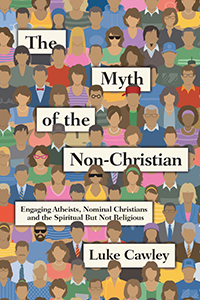
Non-Christians don’t exist. So says Luke Cawley, director of Chrysolis, the United Kingdom-based evangelism and apologetics ministry.

Myth 200No, Cawley is not saying everyone has a relationship with Jesus. On the contrary, his book’s premise is that there is no one-size-fits-all category of those who are without a relationship with Christ. They have a variety of needs, longings and interests. Most people don’t think of themselves in terms of being “non-Christian.”
Those who are spiritually lost may self-identify in many different ways, such as atheist, agnostic, Buddhist, secular or “spiritual but not religious.” They may even be considered “nominal Christians.” However, as followers of Jesus, we often make the mistake of putting people into one category—“non-Christian.” When we do so, it hinders us from contextualizing the gospel, sharing it in such a way that begins with the person’s own experiences and worldview.

Packed with true stories, practical suggestions, encouragement and a smattering of apologetic points, Cawley’s volume is a welcome resource for individuals or groups desiring to grow deeper in sharing the message of Jesus with those who need to “cross from death to life” (John 5:24).

Greg Bowman, pastor

Brock Baptist Church

BrockS


Explore the Bible: Called

• The Explore the Bible lesson for June 12 focuses on 1 Samuel 3.

A voice in the night

“In those days, the word of the Lord was rare; there were not many visions.” After a summary description of Samuel’s ongoing training for priestly service, this is the devastating survey of the spiritual landscape of Israel in 1 Samuel 3:1. The description of the unfaithfulness of Eli’s sons in chapter 2:12-25 helps explain the situation to some degree. Those whose role was to serve as mediators between God and his people were consumed with selfish desire. They were not even listening, should God even attempt to speak to them.

There are others, however, who heard God’s voice at rare times, such as the anonymous “man of God” in 1 Samuel 2:27. The message he delivered was one of judgment against Eli’s household. Message received and message delivered, but this man had no ongoing role in the leadership of Israel. The rarity of the word of the Lord heightens the drama of a time of expectation. In days of intertribal fighting and unrepentant sinfulness in the God’s own tabernacle, many in Israel must have wondered: When will God speak? How and to whom will he speak? And what will God say?    

The answers all come in chapter 3. God speaks to a boy being trained in priesthood, sleeping by the light of the golden lampstand. His mentor’s eyes are dimming, and it takes three repetitions of mistaken identity for Eli to realize what must be going on.

1 Samuel 3:7 declares that Samuel “did not yet know the Lord.” Samuel must certainly have known about Yahweh. As he assisted with whatever the duties of tabernacle that would have been appropriate for his age, he must have heard the stories and asked the meaning of the daily rituals and sacrifices, as well as the annual feasts. When his mother brought him a new garment each year, she must have retold him the story of how she had prayed for him. He knew about Yahweh, but did not know Yahweh in a personal way.

1 Samuel 3:10 records that the LORD “stood there” and this time called Samuel’s name twice. The story is amazingly reminiscent of the escalation of methods a parent might use to rouse and motivate a sleeping child. Perhaps if Samuel had not responded this time, he might have found his covers yanked off. Samuel does respond, echoing Eli’s instructed response (1 Samuel 3:9), except for Yahweh’s name, whether omitted from caution, shock or unfamiliarity, we do not know. Samuel has met Yahweh, and the word of the Lord now comes to him.          

Fall and rise

The word Samuel receives is a prophecy, both in the sense of our common perception of a future prediction, but also in the more accurate biblical sense of a statement from God meant to be delivered to humanity. Samuel’s first prophetic message is a word of judgment against his mentor and father figure Eli, his sons, and his “house”—that is, any future generations of Eli’s family. No wonder Samuel was afraid to report the vision. But with his report to Eli (under the threat of a curse, according to 1 Samuel 3:17) he officially takes on the role of prophet.

Even when the word of the Lord has been given, it is not much use if it is not shared with its intended recipients. We do not know precisely why Samuel was afraid. He clearly expected a negative reaction from Eli. Was he worried about Eli’s grief or his anger? Samuel’s willingness to deliver the message and accept the consequences marks him out from the false prophets of Israel’s history (and our own), who suppress uncomfortable and challenging truths and tell people what they want to hear.  

The judgment on Eli and his house can be understood in different ways. At the personal level, it seems Eli is judged for bad parenting. Yet Eli also has been the de facto parent for Samuel and will continue in that role until Samuel reaches maturity. It is the conventional wisdom that good parents raise good children, and bad parents raise bad children, but experience reveals there are exceptions to both. Eli stands in the strange position of having had his own sons become unfaithful, and his semi-adopted son becoming faithful. The judgment on Eli and his house is more a judgment on poor parenting; it is a judgment on a failure to ensure the purity of Israel’s worship. This was supposed to be the role and duty of the priest, after all.  

Samuel stands in a wholly unique and pivotal role in the history of Israel. He was trained as a priest, a role to which his mother dedicated him and which Eli taught him. He served as judge (1 Samuel 7:15), a role he likely was called upon to perform by the people of Israel. And he was called as a prophet, a role given to him by God.

Yet Samuel’s role was not to secure a legacy for himself. His children did not inherit all of these jobs. Part of his faithfulness to God involved him anointing others to serve in other roles for the future God intended. His anointing of Saul and then David ensured he would be the last judge of Israel. He presided over the end of an era and the beginning a new work God would do among his people.

Samuel’s call as a prophet and the judgment against Eli and his sons serve as yet another introduction to a theme that will persist through 1 and 2 Samuel. The only sure way to secure a legacy is through faithfulness to God. The priesthood was supposed to be hereditary, passed on through the family. But God is ultimately the one who establishes the priesthood. The monarchy was supposed to be hereditary, passed on through the family. But God is ultimately the one who establishes the monarchy. When the priests become unfaithful, God acts in a new way. When the king becomes unfaithful, God acts in a new way. God is the only one who secures a future for Israel, and he acts so that the future is built by those who will serve him faithfully.  


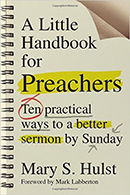
Book Review: A Little Handbook for Preachers

A Little Handbook for Preachers: Ten Practical Ways to a Better Sermon by Sunday

By Mary S. Hulst (Intervarsity Press)

HulstBook 130This is not “your father’s preaching manual.” This is not a step-by-step approach on how to put a sermon together. Instead, Mary Hulst covers crucial, and often overlooked, ingredients needed to create good sermons. These ingredients can be mixed as one chooses and is able, but clearly all are important contributors to the best sermons.

Ingredients include the basics of preaching, like reaching people with crucial issues of content, interpretation and delivery. Hulst’s ingredients also cover the importance of a pastor’s lifestyle—including personal spiritual discipline, relationships with church members, the link between ministry and preaching, and getting sermon feedback from church members.

Ingredients often ignored in other preaching handbooks include “incidentals,” like the importance of dressing, grooming and gesturing. Hulst even addresses problem areas, such as when preachers take on the continual role of “parent,” scolding people about what they shouldn’t be doing. Or when preachers constantly focus on themselves with personal stories, leaving the audience impressed by the preacher but with no knowledge or memory about what was taught from the Scripture that day.

To fully cover each topic, Hulst adds ample amounts of real-life preaching challenges, illustrations, sermon outlines and Scripture analyses. While it is an enjoyable book to read, it is clear that to master her points, one would need to review and practice the material intently and often.

I do not know anything about the author, or the college where she serves as chaplain (Calvin College) or the seminary where she served as professor of preaching (Calvin Theological Seminary). But after reading this book, I know she would easily fit in as “our type” of Christian. She is a devoted follower of Jesus, takes a high view of Scripture, loves the local church, and her theology is trustworthy.

The book states it is for new or experienced preachers, and I’d agree. But it also says it is for the listening audience in the pews. That makes me a little uneasy. If the listeners read this book, it will inform them just how off-the-mark so many sermons are today.

I’m not sure how experienced preachers would feel about getting this book as a Christmas gift, even if they need it.

Karl Fickling is director of interim church services for the Baptist General Convention of Texas, based in Dallas.


Explore the Bible: Answered!

• The Explore the Bible lesson for June 5 focuses on 1 Samuel 1.

Beginning an epic

“Once there were four children whose names were Peter, Susan, Edmund and Lucy.” “In a hole in the ground there lived a hobbit.” “It was the best of times; it was the worst of times…” “All happy families are alike; each unhappy family is unhappy in its own way.”

These sentences are examples of how noted authors began their epics—in order, C.S. Lewis’ The Chronicles of Narnia, J.R.R. Tolkien’s The Hobbit, Charles Dickens’ A Tale of Two Cities and Leo Tolstoy’s Anna Karenina. The anonymous narrator of the epic that makes up the Old Testament books of 1 and 2 Samuel—the two books were one scroll in ancient times—begins with “a certain man from Ramathaim,” although the focus of the first chapter quickly will shift to his wife Hannah.

The narrator could have begun with a version of Tolstoy’s line about unhappy families. In fact, the narrator could have begun a number of ways. Someone reading straight through Israel’s history would just have come from the dark period at the end of Judges. God’s people have been under constant threat, and their loose coalition of tribes has been stuck in a cycle of idolatry and deliverance, long tribulation and brief triumph. They are politically weak and religiously suspect. Bright spots like the redemptive story of Ruth stand out like points of light in a dark and dangerous time.

By the end of 2 Samuel, the lives of the Israelites will have changed drastically. The loose coalition of tribes will be united under the dynasty of David, a figure who receives the most extensive narrative in all of Scripture. The political and religious life of Israel will be focused on Jerusalem, its king and its temple—or the lack of a temple—from the end of 2 Samuel on into the present day.

But the epic begins with an unhappy family and makes its dramatic turn with a heartfelt prayer.    

Barren, bitter, bold

The circumstances of Hannah’s story would seem familiar to readers of Israel’s history so far. Its problem of barrenness echoes the patriarchal stories of Abraham, Sarah and Hagar, as well as Jacob, Leah and Rachel. Tension builds between the wife with children and the wife without. Polygamous marriage strikes our society as strange in a way that it did not in tribal societies, then and now. It is interesting to note, however, that there is not one instance of polygamous marriage in Scripture that does not create major—and usually ongoing—trouble in the family.

The expression used of Hannah in 1 Samuel 1:5, “the Lord had closed her womb,” is an expression of the ancient narrators’ belief that all events beyond the power of humans to control specifically were ordained by God. It is one perspective available to humans who faced questions for which they did not have an answer. No reason or motivation is given for this closing of the womb by God, and it would be irresponsible to guess at one—such as an unnamed sin of Hannah’s—in this narrative. It also would be uncompassionate, to say the least, to guess at such reasons for others in similar situations today. All we know is what Hannah knew—she had a problem she could not solve on her own, and it grieved her greatly.

Her solution is prayer, and her prayer is direct. It takes the form of an “if … then” formula. If you, Yahweh—anytime “LORD” appears in an English translation with all capital letters, it is a translation of the name Yahweh—will look and remember, Hannah says, then her son will be dedicated to Yahweh’s service for his life.

The Jewish scholar Robert Alter suggests in the relatively sparse narratives of Scripture, where only a few verses are used to represent very real and complex people, people’s actions and their words are intended to carry a great deal of weight in revealing their character, especially their first actions and words. Hannah’s first action is grief and fasting, while others are worshipping and feasting. Her first words are not to her husband or her rival, Peninah, in the face of her provocation, but directly to Yahweh. Her boldness is an act of trust—an act of faith.

Eli the priest is not especially helpful in this encounter. He takes her prayer to be drunkenness, and he does not inquire about her anguish and grief when he finds out the truth. The most he offers is his prayer for God to grant her request.

Heard by God

Yahweh answers her prayer, and Hannah in due course fulfills her vow. Hannah was faithful in the sense of trusting God with her grief and with her prayer. God was faithful in his answer, and Hannah then was faithful in keeping her promise. She—and not Elkanah, as would have been the normal convention—names her son Samuel, “God hears.”

Two incidents highlight the challenge it must have been to Hannah to dedicate her child to God’s service. She skips the annual pilgrimage to worship at Shiloh when Samuel is a newborn. She didn’t miss this trip any of the years of her grief, but she misses in the year of her celebration and nursing her firstborn. After he is weaned, she and her husband make a special trip to Shiloh to worship and present Samuel to be raised in the tabernacle. The second incident actually is an ongoing habit recorded in 2 Samuel 2:19, in which we find out that each year during the annual trip, Hannah presents a new linen robe she had made for her son. No record of these reunions between Hannah and Samuel is recorded—we are left to imagine their greetings, their embraces, Hannah’s “Look how big you’ve gotten,” and “Are you eating enough?,” Samuel’s emotions and questions, and her telling and re-telling the story each year to her son of how God answered her prayer and how she—and he—must be faithful to her vow.

Old Testament scholar Walter Brueggemann writes of this intimate beginning to the epic story of the rise of the kingdom of Israel: “The narrative of Elkanah-Hannah-Samuel stands as our entry point into Israel’s astonished waiting. Chapter 1 functions as a paradigm for the entire drama: It begins in a problem and ends in a resolution of worship. That dramatic movement from hopelessness to gift has as its proper subjects those who are, like Hannah, barren and bereft. It has as its unmistakable agent Yahweh, the one who can turn barrenness to birth, vexation to praise, isolation to worship. This first chapter is a narrative of Yahweh’s power and will to begin again, to create newness in history precisely out of despair.”


Explore the Bible: Extraordinary

• The Explore the Bible lesson for May 29 focuses on Acts 12:1-10.

Too Many Herods: Acts 12:1-5

The Herodian dynasty spanned a century and half, from 47 B.C. to 100 A.D. During that time, a member of the dynasty ruled over some or all of the lands once known as the kingdom of Israel. This dynasty coincided with the rise of the Roman Empire. The Herodian rulers attempted to walk a tightrope, seeking to prove their allegiance to Rome while desiring to be perceived by the Jewish people as their legitimate rulers. Those two themes lie underneath all the actions of the Herods who appear in the Gospels and Acts.

Herod the Great rebuilt the Jerusalem Temple into one of the most beautiful structures of the ancient world (and whose outer walls still stand), as well as the fortresses of Masada and Herodium, the city of Caesarea Maritima and a series of magnificent palaces for himself. He deftly switched allegiances from Marc Antony and Cleopatra to Augustus during the course of the Roman civil war, and so secured his place as client king of Judea. In the Matthew’s Gospel, this Herod hosts the magi and seeks to destroy the infant Jesus.

Herod Antipas, Herod the Great’s son, ordered the death of John the Baptist—a popular preacher/prophet who sharply criticized him. Herod Antipas questioned Jesus and then sent him to the Roman governor Pilate for trial.

Herod Agrippa, Herod the Great’s grandson and nephew of Herod Antipas, features prominently in Acts 12. Herod Agrippa was born Marcus Julius Agrippa and raised in Rome. (How’s that for proving your allegiance?) Agrippa displayed the same skill as his grandfather at picking sides and picking battles. He was a close friend of the Emperor Claudius. Whereas Herod the Great’s children had ruled only a quarter of the kingdom after his death, Agrippa managed to become the sole client king over Judea. He opposed the Emperor Caligula’s plan to place an image of himself in the Jerusalem Temple, which must have earned him major points with the Jewish people. The Jewish Encyclopedia describes him both as one who “honored the Law,” but also “made many considerable concessions to heathen manners and customs.” So it goes with the Herods.

The previous incidents in Acts of persecution of the early church, and of the apostles in particular, happened at the instigation of the Sanhedrin. Acts 12 does not record the motivation of Herod Agrippa for arresting members of the church and persecuting them, but it is never hard to discover the motivations of the Herods. The former leader of this group had been crucified as a revolutionary and a blasphemer a decade or so before, an act which (1) proved allegiance to Rome and (2) curried the favor of the Jewish religious leaders. As in several other places in the Gospels, and especially throughout the Gospel of John, we mentally should translate “the Jews” and “the Jewish people” (Acts 12:3, 12:11) as “the Jewish leaders and those following their agenda.” With a few notable exceptions (the Ethiopian, Cornelius, those in Antioch), all of the early church at this time were Jews. All of this had happened at Passover, when a large crowd would be present, so Herod Agrippa puts on a repeat performance for everyone to get the two-edged message: (1) Don’t mess with Rome; (2) Good old Herod’s on our side. The apostle James, brother of John, is the first of the Twelve to suffer martyrdom. By all appearances, Peter is next.          

Kicked by an Angel: Acts 12:6-10

The Holy Spirit has been busy throughout Acts, empowering preaching, inspiring the community of the disciples to live as an extended family of faith, healing, and leading disciples in a variety of ways. Here the Spirit organizes a prison break. I long have been curious as to why the angel of the Lord felt it necessary to strike Peter to wake him up. Maybe Peter was a heavy sleeper. This is not the first story in Scripture to raise that possibility. Peter, James and John’s dozing in the Garden of Gethsemane has that distinction. The angel does have to walk Peter through the process of getting dressed in specific detail. The curious methods of a surly angel aside, though, the image undeniably is dramatic. In the most secure place the powers-that-be could hold Peter, chained between two Roman soldiers and with more standing guard, God reveals himself as the Power that Is. The will of kings, the strength of soldiers, walls, chains and iron gates are not enough to stop God’s purposes. The repeat performance Herod had attempted to echo Jesus’ death is upstaged by God’s repeat performance, which echoes Jesus’ resurrection.

Situational Comedy: Acts 12:11-17

After the drama of James’ death, Peter’s awaiting execution and his amazing deliverance is a comedy of errors that could not have been scripted any better than what happened. The Jerusalem church, gathered in one of their members’ homes, is praying earnestly to God for the deliverance of a man standing at their door. The servant who knows he is there is so excited to share the news, she leaves a fugitive from justice standing on the front step. Peter has to keep knocking as Rhoda and the church argue about whether she is crazy or not. Breaking out of jail was a lot easier than getting into prayer meeting!

When Peter finally enters and explains, he leaves them instructions to tell James, Jesus’ half-brother (Mark 6:3), and then heads for a safer location. From this point, James serves as the de facto leader of the Jerusalem church.  

The World’s One Trick: Acts 12:18-19

The sad epilogue to Peter’s rescue is the execution of the guards responsible for guarding Peter. Herod’s order of execution reveals a confession of impotence in the face of the work of God. The powers of this world only have one trick—death and destruction. Herod’s plan to inflict death on Peter was subverted by God, and his only recourse is to inflict death on someone else. Of course, that was not his only option. He could have seen the hand of God at work and humbled himself in response to it. The rest of Acts 12 records Herod’s embrace of blasphemy and his death as a result.

Luke does not ask and therefore does not answer the question that occurs to us: Why save Peter but not James? That question is simply a specific way of asking why evil occurs in the first place. Scripture does not give an easy answer to that question, but over and over gives us the unqualified answer that God stands opposed to evil and the powers of the this world. Standing opposite the world whose one trick is to destroy is the God who raised Jesus from the dead, who sent his Spirit to empower a people to proclaim that good news and to be the foretaste of a kingdom without end. His kingdom is the kingdom of life, peace, healing, salvation and freedom. The rest of Acts records the spread of this good news and the growth of the communities of those who live by it. Let us commit ourselves to continuing to be his witnesses.


Explore the Bible: Accepting

• The Explore the Bible lesson for May 22 focuses on Acts 10:9-48.

The Buffet of Heaven

The Apostle Peter always is mentioned first in the lists of apostles in the New Testament. His place as the presumptive leader of the Twelve in the Gospels is made explicit in Acts. The former fisherman was the first to answer: “What about you? Who do you say that I am?” (Luke 9:20). He was the only disciple to volunteer to walk with Jesus on the sea, the only one to take a swing at one of the crowd arresting Jesus, and he was the first apostle to be faced with the prospect of Gentile believers. (Philip the evangelist already had baptized the Ethiopian eunuch, but Peter’s situation was the one that brought the issue to the forefront of the church.)

The particular object lesson Peter’s Lord used to get his attention is, at least to this minister, equal parts powerful and comical. Conventional wisdom says don’t go grocery shopping when you are hungry, because you will end up buying more than you need. Peter, at least, discovered if he prayed while he was hungry, he was going to get more from the Lord than he bargained for. Instead of manna, the heavenly meal offered to the hungry apostle was a knapsack full of a menagerie. Peter was hungry, and Jesus opened the zoo, and Peter was invited to get to butchering.

Our grocery store culture is a far cry from the agricultural world of the ancients, or even our grandparents, for whom the slaughter and preparation of an animal was commonplace. Peter, however, likely faced in his vision animals he wouldn’t even have known where or how to begin to clean. Leviticus 11 and Deuteronomy 14 provide extensive lists of the animals declared “unclean” for the Jewish people. They include predatory birds, ostriches, bats, moles, mice, geckos, crocodiles, camels, rock badgers, rabbits and, most famously, pigs. Some or all of those creatures would have been in that sheet.

The vision, of course, is a parable about the new covenant. God is at work in a new way, not to devalue what went before (the Law), but to fulfill its purpose through Christ and the Spirit (to lead the nations to God). Peter was thoroughly aware of the new work God had done in and through Jesus and the Holy Spirit. Even then, however, years after the resurrection, years after the gospel had been spread, the Holy Spirit called Peter and the rest of the church to reckon with the idea that there was even more God had in mind.        

Many Voices, One Message

It is fascinating the way God brought together the players of the drama in Acts 10. An angel approached Cornelius, a God-fearing Roman centurion stationed at the major port city of Caesarea. God called to the military man with a messenger of his own heavenly army, with orders to dispatch and transport personnel. Cornelius organized a detail of two servants and soldier to follow the orders to the letter. God met Peter through a vision and the voice of the risen Christ in his trance, then through the urging of the Holy Spirit while awake (Acts 10:19). How willing would Peter have been to accept an invitation from a Roman centurion without that preparation?

Peter brought some fellow brethren from Joppa along with him to the meeting, a testament of the Spirit at work in the community. Cornelius called a crowd to his house of friends and relatives to receive Peter and hear his message. After Peter’s message, the Spirit was given to this crowd of new believers, who spoke in other languages. It seems clear this instance of speaking in tongues was intended once more to make the meaning of Peter’s vision unmistakable. In the same way that Peter, the Twelve and the rest who were present in the Upper Room received and manifested the presence of the Holy Spirit, so also these Gentiles had done the same. Through an angel, a vision, the voice of Jesus, the urging of the Spirit, preaching and testifying about Jesus, God orchestrated the meeting, and through the power of the Spirit, God confirmed Peter’s closing statement, “Everyone who believes in him receives forgiveness of sins through his name” (Acts 10:43).    

Ongoing Testimony

It would be pleasant to say all the believers universally rejoiced at this new movement of God’s Spirit. Instead, we find in Acts 11, Peter had to defend his actions against criticism (Acts 11:2-3), and so he told the whole story again, invoking the witness of the other believers who were present for confirmation before the church rejoiced in what had happened. In Acts 15, when the church gathered to discuss the Gentile question, Peter summarized the story again, Paul and Barnabas spoke about their experiences, and James, Jesus’ half-brother, turned to Scripture for guidance. Change is hard. Including those we had grown used to keeping out, or at arm’s length, is hard. But salvation in Christ is offered to all who will believe and receive forgiveness in his name.

Think of the differences between Peter and Cornelius. A Galilean fisherman turned apostle and a Roman centurion! Across racial boundaries, national allegiances, wealth, power, influence and more, the Spirit drew them together so the lost could be saved and a new community, a new family, formed from those who had been divided.

The message of the gospel is the same now as then—salvation in the name of the crucified and risen Lord. The Spirit still is at work to break down barriers and bring together those who from the world’s perspective have every reason to stay separate. Where is the Spirit at work in your community in this way? Will we be willing first of all to answer the Spirit’s call to draw together in this way, and then to continue to testify to this work wherever it is resisted?


Book Review: Strong and Weak

Strong and Weak: Embracing a Life of Love, Risk and True Flourishing

By Andy Crouch (InterVarsity Press)

Strong and Weak 200Everyone lives, but not everyone flourishes—and the key to flourishing is not found where many suspect. This is the straightforward thought behind Andy Crouch’s accessible volume. While most people assume a successful, meaningful life is achieved by attaining authority and minimizing vulnerability, Crouch contends the gospel proclaims a powerful paradox: You flourish when you possess both authority and vulnerability, strength and weakness.

Using a simple 2-inch by 2-inch chart, Crouch persuasively argues that how much authority and vulnerability anyone possesses determines whether he or she is suffering, exploiting, withdrawing or flourishing. Each chapter explains the temptations and merits of authority and vulnerability before ultimately concluding followers of Christ must possess both in order to flourish.

A book whose entire message can be summed up in a 2-inch by 2-inch chart at first may seem overly simplistic and unworthy of its 186 pages, but Crouch effectively digs beyond the surface of his message. He rewards readers with helpful insights into how Christians can flourish by acknowledging vulnerability instead of suppressing it. Both the pastor and the layperson will walk away from Strong and Weak with a fresh outlook on how God’s power is perfected in weakness.

Daniel Camp, pastor

Shiloh Baptist Church, Crawford


Explore the Bible: Bold

• The Explore the Bible lesson for May 15 focuses on Acts 9:36-43.

The Fallen Servant

The lives of several people are summarized in Scripture by one or two sentences. Many kings of Israel and Judah receive the terrible summary: “He did evil in the eyes of the Lord, as his fathers had done” (2 Kings 15:9, etc.) These were rulers of the people of God, many with reigns lasting a generation, and their lives are abridged by the chronicler into the dates of their reign and a failing grade. Consider in contrast Tabitha, whom Acts 9:36 summarizes as a disciple “who was always doing good and helping the poor.” She, like many Jews of the day, went by both a Hebrew and Greek name. Her location in a port city would have brought her into contact with many cultures that shared Greek as a language of commerce and civic life. Upon her death, her fellow disciples in the coastal city of Joppa dispensed with normal burial practice of Jewish people of that day and laid her in state, as though she were a queen. Fellow believers and the widows who were the beneficiaries of her generosity and labor were not ready to part with her without spending time in her presence.

This circumstance of keeping her body close at hand and not-yet-entombed coincided with the apostle Peter’s visit to the region. Although Peter and the rest of the apostles still used Jerusalem as a home base, he—and likely the others—went further afield when new groups of disciples formed in new regions (Acts 8:14). The early church depended on the eyewitness testimony of the apostles and others who had been with Jesus to teach and explain the events of Jesus’ life and the truth of his teachings. We see a repeated pattern in Acts—when the gospel came into new areas, miraculous signs testified to its truthfulness. This, too, followed Jesus’ pattern of announcing God’s kingdom and implementing it through healing, exorcisms and, occasionally, by raising the dead.

The disciples of Joppa heard there was an apostle in the area, and they treated Tabitha’s death like a medical emergency and Peter like first responder. Tabitha already was dead, but Peter needed to hurry! Her fellow believers didn’t want that state of affairs to go on any longer than it already had. Peter hustles to Joppa and is greeted by tangible reminders of Tabitha’s work—the robes and clothing she had made. In the ancient world, clothing was not the sort of consumable good it is in our mostly affluent society. A well-made piece of clothing was an investment and was made to last. Having a wide variety of clothes to wear was a sign of significant wealth. (Think of Jacob’s gift of a coat to Joseph). The clothing made and apparently given away by Tabitha to these widows was another example of the early church’s commitment to provide for one another.

The Risen Servant

Peter sent the rest of the disciples out of the room. It is entirely possible he reflected on how similar these circumstances were to the raising of Jairus’ daughter (Mark 5:21-43). Peter stood in the place of his Lord, facing down the same ultimate enemy of death. Perhaps he heard the echo of his Lord’s command “Talitha koum—Little girl, get up,” in his own command to the woman, “Tabitha, get up.” The difference is that the power over death was not in Peter but in his Lord. Peter began this encounter with prayer (Acts 9:40).  

It is striking how many descriptions of a physical nature are included in the story of Tabitha’s healing. Peter got on his knees, she opened her eyes, sat up, he took her hand, and she stood. This miracle was not, technically speaking, resurrection. Unlike the resurrected and transformed body of Jesus, but like Lazarus, Jairus’ daughter and others, Tabitha would die again. More precisely, she was revived, or re-vivified. This miracle served as a sign, however, God’s salvation offered in Christ is not merely for the ‘soul’ or ‘spirit’ but for the whole person. God intended his creation to be physical and spiritual, not in opposition but in harmony. Jesus’ resurrection represents that ultimate victory over death and the promise that those who follow him will share in the life of the new creation. Tabitha’s return to life is a preview of even greater things to come. For that moment, her eyes that had looked on the poor with compassion, her hands that served, and her feet that brought the good news to the poor each get a moment in the spotlight, restored and ready to get back to work. This sign exactly met its purpose. Peter and Tabitha did not become spectacles in and of themselves. Instead, “many people believed in the Lord” (Acts 9:42). A new and growing congregation was born out of this outworking of the creative power of God, and Peter stayed around to guide and teach them.

The miraculous draws our attention, and we long for that kind of outworking of God’s power in our midst. It is important to remember, however, the miracles recorded in the Gospels and Acts are not guaranteed to the believers. Stephen was not raised after his martyrdom, nor will the apostle James after his death in Acts 12. When God works in miraculous ways, it is always in service of his larger purposes, often the spread of the gospel to places it had not been known previously. If we highlight the miraculous over the everyday, we risk missing the power that comes from having lived a life like Tabitha’s, always doing good and helping the poor. No Christian can claim to have raised the dead or healed the sick. Every instance of such power comes from God alone and serves God alone. All Christians can strive to have the summary of Tabitha’s life apply to them, as well.  


Explore the Bible: Converted

• The Explore the Bible lesson for May 8 focuses on Acts 9:3-20.

I Saw the Light

Saul of Tarsus, the man who eventually would write a majority of the books that make up the New Testament, first appears in Acts guarding the robes—possibly the priestly robes—of the men who stoned Stephen to death. He was in “hearty agreement” with this act of mob justice (Acts 7:58-8:1). He reappears as an agent of the high priest, speaking of murder and deputized to arrest disciples in the synagogues of Damascus.

What motivated Saul to agree with Stephen’s murder and to pursue the scattered disciples? Saul later records he was a Pharisee in his stance to the Mosaic Law, and his zeal led him to persecute the church (Philippians 3:5-6). His “zeal” was passionate devotion. Like other Pharisees, Saul of Tarsus believed that the future of God’s people hinged on their rigorous keeping of the Law. That is, the promises of God to restore the fortunes of Israel in a new and dramatic way depended on their obedience, and that promised future would continue to be delayed as long as Israel remained unfaithful.

So, when a fringe group appeared with questionable devotion to the Temple, to the Law, and worst of all with devotion to a crucified man as the Messiah, this was for Saul and many other zealous Jews a recipe for disaster. It was blasphemy for them to declare someone holy (“seated at the right hand of God!”) who according to the law was cursed (Deuteronomoy 21:23 by way of Galatians 3:13). Disobedience, blasphemy and more than a dash of idolatry—this was how Saul of Tarsus viewed “The Way,” as the still young movement had begun to be known.

On the way to Damascus, Saul meets the last person he would have expected. Light shines from heaven, and the resurrected and exalted Christ asks him a personal and pointed question. Saul later will classify himself as a witness to the resurrection, one to whom Christ appeared, though his timing was badly off (1 Corinthians 15:3-8). Without knowing his identity, Saul recognizes the mode of communication as belonging to one to whom he owes allegiance. “Who are you Lord?”

Jesus’ initial question and his answer reveal the depth of his identification with his followers. He takes their suffering personally. “Why do you persecute me? I am Jesus whom you are persecuting.” Saul’s later letters to the churches are full of the teaching of Jesus’ followers’ identification with him. They share in his death, his sufferings, his righteousness, his eternal life and his resurrection. Could it be that the seed of these truths was Jesus’ introduction to Saul?

Saul is left blind after the encounter, and the man who planned to scour the Damascus synagogues for blasphemers must be led helpless into the city. For three days, he does not eat or drink. What was he doing? We discover later in the chapter he was praying, and that in that time he had a vision. Beyond that, he must have been rethinking everything. He must have recalled every scrap of Scripture he could remember and tried to place it in this new paradigm, this new work of God in which a crucified and humiliated man is risen from the dead and reigns as Lord of the world. He must have rethought over and over every piece of the story of Israel—his people’s story, his story, from Adam to Abraham to Moses to David to Isaiah to Jeremiah, in the new light that had shined on him and left him in darkness.

“Brother Saul”

God, of course, did not intend to leave Saul in the dark. Jesus appears to a Damascene disciple named Ananias in a vision. Saul himself will later describe Ananias (to a group of zealous Jews) as “a devout observer of the law and highly respected by all the Jews living there” (Acts 22:12). Although the circumstances of Paul’s description need to borne in mind, there is no reason to believe that was not true of Ananias. In fact, a devout law-keeping Jew who worshipped Jesus as Lord would have been the perfect bridge person for Saul of Tarsus to help him move from who he was to who he had now been called to be. Jesus gives Ananias specific instructions, including names and an address! Jesus recruits him for a miraculous healing. Ananias doesn’t have any questions about the directions or the command to heal a blind man, but he does want to clarify his identity. That Saul, the one who has harming your people and came here to do the same? Jesus answers with “Go!” Ananias becomes the first to hear of Christ’s new life plan for Saul. The man who caused suffering to those who professed Jesus will himself suffer for Jesus’ name. The man who was so passionate about Law-keeping will be the chosen vessel to carry the good news to the lawless Gentiles.

With this instruction, Ananias goes to the house and speaks two of the most powerful words in the New Testament—“Brother Saul.” Jesus has chosen Saul, and that’s good enough for Ananias. Whatever his original intention in coming to Damascus, Jesus has changed his identity. The enemy has become a brother. Ananias fulfills his mission, and Saul’s sight is restored. Before even eating after his extreme fast, Saul is baptized. First things first. His new life begins with his identification with Jesus’ death and resurrection. Saul regains his strength and eventually makes it to the synagogues of Damascus. Now, however, he is the agent of different authority. Saul the former Pharisee likely was welcomed as a sort of guest preacher and delivered a message that must have shocked everyone—“Jesus is the Son of God.”

The powerful story of Saul’s conversion is a testimony of the truth that encountering Christ will permanently change a person’s life. As Saul later moved through the Greek-speaking world he began to be called by the Greek name “Paul,” his new name a sign of his new vocation as apostle to the Gentiles. It was his allegiance, however, that changed. His identity now was bound up with Jesus, and Saul would serve as a bridge person. His encyclopedic knowledge of Israel’s Scriptures is revealed in his letters, as he tells Gentile believers that in Christ, God’s story is their story, with no distinction between Jew or Greek, slave or free, male or female, but that they are all one in Christ Jesus (Galatians 3:28).


Book Review: Crumbs from the Cookie Jar

Crumbs from the Cookie Jar

By David Rhew (Westbow Press)

When that last delicious cookie has been devoured, tasty crumbs remain to be savored. In Crumbs from the Cookie Jar, David Rhew invites readers to enjoy delightful bits and pieces from his life and calling.

crumbs 200Born in 1941 and weighing under four pounds, Rhew grew up in Corpus Christi with cerebral palsy. He also grew up with heavy braces and a heavy heart. However, in the era before mainstreaming, David’s parents determined their son should attend public school with nonhandicapped children. Encouraged by a Christian first-grade teacher, he thrived.

David accepted Christ at age 8 and began an imaginary pastorate and radio ministry. After graduating from high school, he entered the University of Corpus Christi, a local Baptist college. He especially enjoyed Baptist Student Union and worked in the campus library. That job led to a library degree and positions at Tarleton State University and the Texas State Library. In Austin, he preached his first two “real” sermons.

Rhew clearly felt God’s call to work with students. Although encouraged to earn a master of divinity degree at Southwestern Baptist Theological Seminary, he didn’t get a BSU job “because they did not want me to be frustrated.” Instead, over the next 30 years, God opened doors in Baptist colleges and seminary libraries, in teaching theological courses, in earning a doctor of ministry degree, and in serving part-time on church staffs, as an interim ministry or as a supply preacher.

Through each experience, the author shares inspiring Crumbs from the Cookie Jar. In so doing, Rhew demonstrates how a life dedicated to God and bathed in prayer can be victorious, no matter what.

Kathy Robinson Hillman, immediate past president

Baptist General Convention of Texas

Waco