Review: The Lost Diary of Mary Magdalene
The Lost Diary of Mary Magdalene
By Johnny Teague (Histria Books)
The foreman on an archaeological dig near the Sea of Galilee discovers a clay pot interesting enough to take back to his room and carefully open. What he finds inside leads him to weeks of translation. This is no Gnostic gospel. These are the brittle parchment pages of a diary, the notes and recollections of a woman profoundly changed by Jesus—Mary Magdalene.
 Mary Magdalene is depicted early in the story as a licentious and demon-possessed daughter of a tax collector. Her life before Jesus freed her of demons is difficult to read. Mercifully, her emancipation happens early in the story.
The largest portion of the story follows Mary’s life-changing encounter with Jesus. She reports witnessing firsthand and hearing secondhand about Jesus’ teaching and miracles and processes all of it with what she knows about Israel’s messianic tradition. This is where the story really comes alive.
Johnny Teague humanizes what for many has become little more than the religious text of the Gospels. He contextualizes the text of the Gospels in a way that makes it even more relatable to everyday human experience by describing how a contemporary of Jesus was experiencing his ministry throughout her own life.
As is the case with historical fiction, readers must remember this is a fictional account of actual history. Teague is careful to explain in an epilogue that what he has written is not Scripture. And there is a considerable amount of Scripture seamlessly woven into this fictional diary.
Teague also presents readers with theological considerations worthy of further study beyond the book. These arise as natural implications of various conversations and Mary’s thoughts. Readers do well to remember such theological points are Teague’s perspective and not necessarily gospel.
Teague tells the story with infectious joy, marvel and wonder. He imagines Mary navigating the implications of forgiveness and new life given to her by a person she comes to believe is the long-awaited Messiah—Jesus.
Eric Black, executive director/publisher/editor
Baptist Standard
 God’s message to us in Revelation—which English advises should be read in one sitting—touches on everything we know about ourselves: our gift of free will, our sin and the limited influence of Satan, our work subduing the earth, our business dealings, warfare, power struggles with other nations, famine and pestilence, death and final judgement.
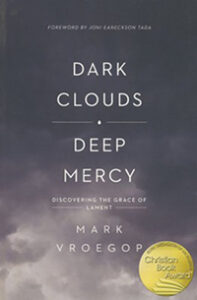 Dark Clouds, Deep Mercy holds a timeless offering, demonstrating “how you live between the poles of a hard life and trusting in God’s sovereignty” (p.36) and showing the real grace found in lament.
 With a title like Your/Our Identity during a time when controversies over sexual, gender, ethnic and other identities are swirling, readers might expect the book to begin, end and focus on those issues. But they barely make an appearance. Instead, they place a distant second, third or even fourth to the primacy of Christ as the source of our identity.
 The Gospels present Mary Magdalene both as one whom Jesus delivered from demonic oppression, and also as one who supported Jesus’ ministry financially and was numbered among his followers. However, that is not the image most Christians have of her.