Review: An exploration of the women of Easter and a novel for young readers

The Women of Easter

By Liz Curtis Higgs (WaterBrook)

Women of EasterIn her latest book, writer, speaker, conference leader and media personality Liz Curtis Higgs encounters The Women of Easter, just as she previously examined The Women of Christmas. While Jesus’ mother appears in both titles, Mary of Bethany and Mary Magdalene play prominent roles in the Easter story.

Higgs’ informal informational style and feminine perception combine with solid biblical and practical research to lead the reader from the death of Lazarus to the resurrection of Christ. The author manages to tell these important stories from the perspective of the women closest to the Savior and in so doing, affirms their roles and testimonies.

The eight chapters begin with an Easter poem or song. As each story unfolds, Higgs presents Scripture, personal anecdotes and insights that make the reader feel she is both observer and participant in the Lord’s final week on earth. A study guide and notes close the volume, which could be used in any season.

In The Women of Easter, Liz Curtis Higgs invites women “to be joyful, hopeful, faithful” in God’s clear call to “go, tell.” She closes with encouragement to “be Easter women every day of the year, living in the freedom of his resurrection and singing out with all our hearts, ‘He lives! He lives!’” However, that call and her book aren’t just for women but for all Christians.

Kathy Robinson Hillman, past president

Baptist General Convention of Texas

Waco


Lost Island Smugglers

By Max Elliot Anderson (Elk Lake)

Lost Island SmugglersAuthor Max Elliot Anderson does a wonderful job creating three lively characters in his novel, Lost Island Smugglers. Sam Cooper, an 11-year old Christian boy, often relocates because of his dad’s job. The latest move lands the family in Florida. Sam makes two new friends at church—Tony, an instigator, and Tyler, a follower. Young readers will identify easily with the peer pressure challenges the boy’s face.

After the three finish scuba diving lessons, they sneak out for an ocean adventure. Lost Island is their destination. But the dream of scuba diving quickly changes when a huge storm rips their boat apart and throws the trio on shore of a deserted island. The team must work together to secure shelter and food. However, they soon learn they aren’t alone on the island and fear for their lives.

Lost Island Smugglers proves to be a page-turning novel. Biblical principles are woven throughout the story, as the author takes the three young boys on a journey of suspense and mystery. It’s enjoyable and sure to capture the hearts of many younger readers.

Bobbie Brown

Nederland, Colo.


Explore the Bible: Worship God above all else

Years ago, our family traveled to Wyoming on vacation. Other than Yellowstone for the very first time, we also wanted to see the Grand Tetons. We’d driven across the state and came in from the east. As we rounded a bend in the road, across some 40 miles of flat prairie, the Grand Tetons broke into view. Even at that distance, the jagged peaks were breathtaking.

It was all I could do to quickly pull off the road and stop the car. I literally could not keep driving until I took the time to soak in the beauty and magnificence of God’s creation. I found myself wondering aloud, “How could anyone see the beauty and magnificence of creation not believe in God?”

Over time, a part of the answer to that question has made itself known. Eventually, we believe in what we worship most, or not. If what we worship is something other than the Creator of all that exists, we will believe in God less and less. A false god is anyone or anything we worship other than Holy God. A false god can be another person or something material or even a way of thinking.

The late Malcom Muggeridge, a British philosopher and theologian, was an atheist who set out to prove there was no God. In the process, his research instead led him faith in Christ. In A Twentieth Century Christian Testimony, he wrote, “Every happening, great and small, is a parable whereby God speaks to us, and the art of life is to get the message.”

Every time I see the stars or the ocean or any part of creation, I marvel at the beauty of it all, and it always leads me to think of the sovereignty of Holy God. Even when I look into the eyes of my Golden Retriever, I see the handiwork and presence of God in my life.

It was in that same spirit that the Psalmist wrote: “For the Lord is a great God, and a great king above all god. In his hand are the depths of the earth, the heights of the mountains are his also. The sea is his, for he made it, and the dry land, which his hands have formed.”

There are times I don’t want to go to church. I may be tired from a busy week, or emotionally exhausted, or both. My natural inclination in those moments may be to pull the covers up and sleep longer. I’ve learned that, among other things, genuine worship requires discipline of heart and mind. Again, the Psalmist doesn’t suggest we worship because it’s what we feel like doing. Worship should be intentional. We should worship God because he is God, whether we feel like it or not.

The Psalmist invites us to celebrate God actively and joyfully, even physically. His is not an invitation to feel a certain way or to simply dialogue the finer details of theology. It is an invitation to pour out our hearts—indeed, our entire being—in the act of worshipping God.

Bowing and kneeling (v. 6) are sometimes the only way to express adequately what we’ve come to believe about God. Just as pulling off the road was a spontaneous response to seeing the incredible beauty of the Tetons, bowing or kneeling can be a spontaneous response to the holiness and presence of God. Sometimes, when we enter into genuine worship, it’s all but impossible not to give physical expression to what we believe in our hearts.

As the Apostle Paul wrote in his letter to Roman Christians, “I appeal to you therefore, by the mercies of God, to present your bodies as a living sacrifice, holy and acceptable to God, which is your spiritual worship,” (Romans 12:1). We, too, easily think of the physical and the spiritual as distinct from each other. We do so at great peril to both. If worship doesn’t, in some way, involve our whole being, then it is not genuine worship.

To Paul, every act of our bodies should be carried out as acts of holy worship. Whether in private or public, how we spend our time, our money and how we treat others should be done with the presence, the holiness and the sovereignty of Holy God in mind. Otherwise, we will drift into unholy living and, perhaps, come to the place where we are indifferent to God if we still believe in him at all.

In his elderly years, Muggeridge also wrote, “When I look back on my life nowadays, what strikes me most forcibly about it is that what seemed at the time most significant and seductive now seems now most futile and absurd. For instance, success in all its various guises; being known and being praised, ostensible pleasures, like acquiring money or seducing women, or travelling, going to and fro in the world and up and down in it like Satan. In retrospect, all of these exercises in self-gratification seem pure fantasy, what Pascal called ‘licking the earth.’ They are diversions designed to distract our attention from the true purpose of our existence in this world, which is, quite simply, to look for God, and, in looking, to find him, and having found him, to love him, thereby establishing a harmonious relationship with his purposes for his creation.”

Quoting the prophet Isaiah, Paul wrote, “‘As surely as I live,’ says the Lord, ‘every knee shall bow to me; every tongue shall give praise to God,’” (Romans 14:11). As surely as the Grand Tetons took my breath away, I can only imagine the view of Holy God from heaven’s vantage point.


Reviews: Books on Baptist heritage, Jerusalem and Millennials

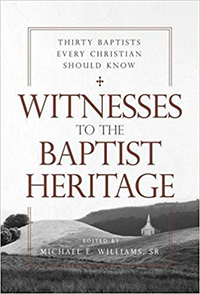
Witnesses to the Baptist Heritage

Edited by Michael E. Williams (Mercer University Press)

Michael Williams, professor at Dallas Baptist University, has compiled and edited the ideal Baptist history book for people who don’t think they are interested in Baptist history. He and 25 other historians have crafted concise—typically about seven-pages—and compelling biographical sketches of “Thirty Baptists Every Christian Should Know,” in the words of the book’s subtitle.

Witnesses Baptist Heritage 200Many of the writers—such as Karen O’Dell Bullock from B.H. Carroll Theological Institute, David Holcomb from the University of Mary Hardin-Baylor, Melody Maxwell from Howard Payne University, Kelly Pigott from Hardin-Simmons University and Doug Weaver from Baylor University—will be familiar to Texas Baptists. So will some of their subjects, such as George W. Truett, T.B. Maston and Herschel Hobbs, along with William Carey, Adoniram Judson and Lottie Moon. Expect to gain new insights about and appreciation for some of these well-known Baptist figures.
Also prepare to learn about other significant Baptists even long-ago graduates of Baptist Training Union may not know well. Get acquainted with women like Anne Dutton, Helen Barrett Montgomery and Nannie Helen Burroughs. If you don’t know them yet, meet Johann Gerhard Oncken, a 19th century European church planting catalyst, and Benjamin Keach, who made congregational hymn-singing a key part of Baptist worship in the 17th century.

Worried you’ll be bored by dry dates and dull doctrine? Don’t be. Well-told stories of compelling characters will capture your attention. Read one biographical sketch a day, and begin the next month with a greater appreciation for Baptist history, heritage and distinctive Baptist principles.

Ken Camp, managing editor

Baptist Standard

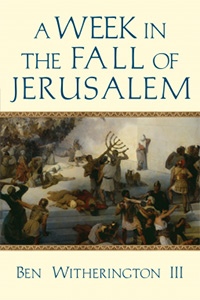
A Week in the Fall of Jerusalem

By Ben Witherington (IVP Academic)

Fall Jerusalem 200Ben Witherington’s A Week in the Fall of Jerusalem is a cross between a New Testament textbook and a novel. The book presents a fictional account of various biblical and extra-biblical characters fleeing Jerusalem during the destruction of the city by the Roman army in A.D. 70. The story is largely incidental, serving as a means to orient readers to the world of the first Christians. Frequent set-apart boxes provide historical and cultural details about Palestine in the first century, often with accompanying pictures.
Witherington’s purpose clearly is to teach about the background of the New Testament in a way that may be more accessible than a traditional history book. This method didn’t quite work for me, but I read very little fiction and am already familiar with the subject matter. For those who are interested in the background of the New Testament but intimidated by the often technical and sometimes difficult books of the subject, A Week in the Fall of Jerusalem will be an accessible introduction.

Jake Raabe, student

Truett Theological Seminary

Waco

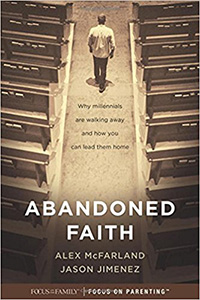
Abandoned Faith:

Why Millennials are Walking Away and How You Can Lead Them Home

By Alex McFarland and Jason Jimenez (Focus on the Family)

Apologetics author, speaker and writer Alex McFarland and Stand Strong Ministries founder, pastor and apologist Jason Jimenez collaborated in writing this book for the Focus on the Family parenting series. The book explores reasons why Millennials—young people born between 1980 and 2000—are leaving the church and provides suggestions about how to get them back to worship and fellowship.

Abandoned Faith 200Abandoned Faith is exhaustive and highly researched. It begins with “From Christianity to Atheism” and concludes with “Jesus is the Key.” The authors move from “What Went Wrong?” and “Forces Shaping Our Sons and Daughters” to “Steps to Mend and Move Forward” and “Winning Back Your Millennial Child.” 

The book explores how the church is failing in its attempts to reach Millennials. It deals with the struggles Millennials face and how parents can strengthen their relationship in stressful times.

Abandoned Faith closes by emphasizing prayer and a foundation for biblical truth. This book is applicable both for the church and parents, but it also would be a great read for Millennials.

Skip Holman, minister of discipleship

Northeast Baptist Church

San Antonio


Explore the Bible: His Presence

• The Explore the Bible lesson for July 2 focuses on Psalm 84:1-12.

We were having a great time, as we might say at church, “fellowshipping.” The only problem was that our fellowship was taking place right in the middle of the Sunday morning worship service. 

I was seated right in the middle of a pew, packed in like sardines with my fellow junior high school buddies. We were telling stories and laughing, enjoying life. That’s when I heard a loud “Snap!” off to my right. I looked up just in time to see my father, leaning across three or four of my friends, having snapped his fingers at me, pointing in my direction. 

“You be quiet!” he said in an unquestionably firm tone. He’d walked all the way down the aisle, in front of everyone, during the offertory to extend his discipline my way.

It was humiliating, among other things. Nothing worse happens to a teenager than to be disciplined in front of his friends. Humiliation turned to anger as I plotted what to say to my dad on the way home from church. Oddly, once we all got in the car, he didn’t say another word about the event. He knew he’d made his point.

I didn’t hear a word the preacher said that morning. But I never forgot the point that finally came to me with time. I learned my father wasn’t simply concerned about the distraction to others by the noise we were making. He also was concerned I learn a fundamental truth.

Sacred times, sacred space

There are some places and times that, by their nature, represent the most sacred values of our lives. There is a time to speak, as the writer of Ecclesiastes tells us (Ecclesiastes 3). There is correspondingly a time to keep silent. All of which is measured out by more sacred truths and places and times.

The psalmist starts this lesson’s text with these words: “How lovely is your dwelling place, O Lord of hosts!  My soul longs, indeed it faints for the courts of the Lord; my heart and my flesh sing for joy to the living God (vv. 1-2). To this psalmist, there was no higher place than the place in which we worship the Eternal God. (Is there a place we shouldn’t? See Romans 12:1-2.)

It’s important to balance out two important issues at this point. First, if there are no sacred places, or words or times, then all of life loses its sacredness.

Perhaps we’ve all felt this at one time or another. If I miss a Sunday at church for any reason, the rest of the week seems off kilter. Sunday is not the end of the week, it is the beginning of a new one. The whole week’s clock gets reset on Sunday. If I miss a Sunday at church in a community of worship, I often can’t keep track of which day of the week it is the rest of the week.

That’s why we are commanded not to worship anyone other than Holy God nor to take the Lord’s name in vain (Genesis 20:3, 7). At the outset of their history, the Israelites were being given the moral guideposts by which their entire journey through history should be guided. If God’s name is not sacred, what else possibly could be?

The devaluation of all human life and relationships, all human abuse, is grounded in a failure to honor God as God even in the way we use God’s name.

The people, not the building

The second great issue that must be kept in balance is what the New Testament teaches us about the true nature of the church. The church, the physical building, is not sacred. To be sacred means to be exclusively holy. Only One is sacred, the Lord God. 

The church is the body of Christ. Jesus initiated this teaching at the Lord’s Supper (Luke 22:19). Paul extended this teaching into the foundation of the original church. “Do you not know that you are God’s temple and that God’s spirit dwells in you?  For God’s temple is holy and you are God’s temple” (1 Corinthians 3:16-17).

The present-day church never gets in more trouble than when it equates the physical building with the spiritual dwelling place of God in the hearts of people. How many churches have suffered their demise because of fights over the value of the physical place in which souls gather to worship, while forgetting God is the object of our worship, not the place in which we do it? Some churches never move forward because they refuse to leave behind a building that no longer is useful and drains more than its share of the budget.

That said, the psalmist praised God with these words: “Happy are those who live in your house, ever singing your praise” (Ps. 84:4).

We should gather to worship in community. It keeps us accountable. It keeps us connected to life’s sacred truths. Yet, the true character of those who gather to worship will be seen in how they relate, in now they relate to each other in Christian kindness and mercy. It also will be seen in how they share the generosity of God they have experienced in God’s house with those who only pass in the shadow of the steeple outside, even as the bells of worship are rung within.

Glen Schmucker is a hospice chaplain in Fort Worth.


Reviews: Books on the cross, fathers and sons, and the image of God

To the Cross

By Christopher J.H. Wright (IVP)

“Preaching about the cross of Christ is one of the greatest privileges and responsibilities any preacher can have,” Christopher J.H. Wright writes in the preface to this book. Yet for the veteran preacher—and the veteran congregant—it can begin to seem like you’ve already heard everything there is to say on the subject.

To the Cross 200As if in response to that conundrum, To the Cross offers fresh, biblical insights into familiar stories. Each chapter is a sermon Wright preached to his congregation at All Souls Church in London, beginning with the Last Supper and concluding with Jesus’ final words from the cross.
Particularly enlightening is the way Wright connects Old Testament passages to the events of the cross. In doing so, he eloquently depicts the cross as the fulfillment of a plan for salvation that stretched back long before Bethlehem.

Preachers and teachers also may be interested in the appendix, where he briefly describes his process in preparing each sermon. But whether pastor or layperson, any Christian will find something to appreciate in this slim book—and perhaps even learn something new about a story so familiar.

Daniel Camp, pastor

Shiloh Baptist Church

Crawford

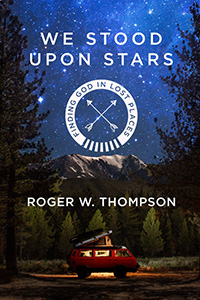
We Stood Upon Stars

By Roger W. Thompson (Waterbrook)

We Stood upon Stars 200Fishing and camping outdoors in the national parks of western America is the backdrop for We Stood Upon Stars, a collection of essays that reads like pithy prose poems. Written by Roger W. Thompson, a successful entrepreneur and adventurer, it is a memoir of a father of pre-teen sons who attempts to implant in them his Christian faith, along with his love, understanding and reverence for nature’s magnificence.  

Thompson’s poetical style appeals to the senses. He describes mountains standing “as pinnacles tickling the feet of heaven.” He engages all the senses, writing how the “silence of crisp winds gave way to roosters and birds.” Along the way, he drops in philosophical observations, such as: “A boy’s dream is for himself. A man’s dream is for others” (p. 67). Theological statements pepper the essays: “Death is a road best ridden with no regrets and with relationships restored. With an understanding of who our God is and a peace that we know him.” Love, loss, joys, fears and accomplishments are expressed through generational stories told with humor and wisdom.

We Stood Upon Stars leads the reader to say with Thompson, “This is what lasts forever: character and faith passed from generation to generation.”

Alice Stone Thomas

Conroe

Killing Us Softly: Reborn in the Upside-Down Image of God

By Efrem Smith (Navpress)

Efrem Smith, teaching pastor at Bayside Midtown Church in Sacramento, Calif., and president of World Impact, an urban-missions and church-planting organization, pens this work about how to have an upright image of God and the gospel message.

Killing Us Softly 200Comparing the lack of a relationship with Christ to being in the upside-down image and world, Smith guides readers through the correct steps to get to the right-side-up world and relationship.
A right-side-up remnant occupies the upside-down world, Smith notes. The world’s upside-down status can be corrected only by the remnant bringing the rest of the world to faith and helping them grow in Christ.

However, the individual has to die to self, hence the title, Killing Us Softly. Smith goes on to explain Christian maturity and love are the only forces that advance the kingdom of God.

The book is bathed in urban culture. It is a wonderful tool to see how anyone in an upside-down relationship and world can enter the right-side-up relationship and world.

Skip Holman, minister of discipleship

Northeast Baptist Church

San Antonio


Explore the Bible: Our response

The Explore the Bible lesson for June 25 focuses on Psalm 138:1-8.

As the pastor stood at the front of the sanctuary to receive any who responded to the invitation, a young lady stepped out and made her way down the aisle. When the pastor received her, he asked what had prompted her to make her profession of faith that particular morning. The young lady said, “Last night, as I was standing over my sleeping baby’s crib, I realized that I had to have someone to thank.” (Thanks to Fred Craddock.)

Perhaps more would make professions of faith in Christ if it were presented as the ultimate way to both sing God’s praise and thank God for his wonderful blessings. True thankfulness is more than a grateful heart; it is also a grateful way of living, of acting out with all that we are what we claim to believe.

David begins this psalm by giving thanks to the One who most ultimately deserves it. All of life’s good gifts ultimately find their source in God and God alone. 

God is faithful, even when we are not

It is in that spirit that David begins this psalm of thanksgiving. As we all eventually discover, even when we are not faithful, that in no way alters the faithfulness of God toward us. David praises God, first, for his “steadfast love and … faithfulness” (v. 2).

This certainly was on the Apostle Paul’s heart when he wrote Romans 8:28: “We know that all things work together for good for those who love God, who are called according to his purpose.” Paul was not saying all things that happen are God’s will. He was not saying all things that happen are good. He was saying that in all things, good or bad, we can count on God’s faithfulness and commitment to us.

For many of us, this is not an easy concept to embrace. We have been told so often we should be committed to God, and well we should be. However, if our commitment to God is not founded in our trust of and gratitude for God’s commitment to us, it will always be off-center, bent more toward legalism than grace.

Paul doubles down on this idea of the faithfulness of God to us in Romans 8:31-32: “What then are we to say about these things? If God is for us, who is against us?He who did not withhold his own Son, but gave him up for all of us, will he not with him also give us everything else?”

In the end, from our salvation to even the smallest of good gifts, we are, or should be, grateful to God for God’s faithfulness to us. “Every generous act of giving, with every perfect gift, is from above, coming down from the Father of lights, with whom there is no variation or shadow due to change” (James 1:17).

You can’t pay for some things—nor should you

When my youngest son was about 6 years old, I gave him his weekly allowance one day. He peeled off the top dollar and gave it back to me. I asked him what the dollar was for. Looking up at me, he said, “That’s for taking care of me.” I kneeled down to his level and said: “Son, this dollar is my gift to you. You could never repay me for taking care of you. I do that because I love you, and I always will.”

Sometimes, when I feel distant from God, I’m reminded of that event as an example of how God feels about and deals with me. David sings God’s praise, for God’s character that leads to redemptive action, writing, “Though the Lord is high, he regards the lowly” (v. 6). 

In the incarnation of God in Christ, we see the ultimate witness of the “high” regarding “the lowly.” In Christ, God kneeled to us where we are in order to redeem us. God will never fail to remain faithful to those he loves.

In David’s psalm, we see these two examples of thanksgiving. There is praising God for God’s character. Then, there is thanking God for the good things God’s character delivers to us, even when it seems God is absent.

David could not have summed it up better than with these words from verse 8: “TheLord will fulfill his purpose for me; your steadfast love, OLord, endures forever.”  The goodness and righteousness of God is ultimately shown in the good and right ways God deals with us. For who God is and what God does, the only appropriate response is our praise and gratitude.

After all, we all need someone to thank!

Glen Schmucker is a hospice chaplain in Fort Worth.


Reviews: Books by Eric Metaxas and Walter Brown

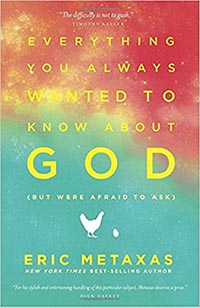
Everything You Always Wanted To Know About God (but were afraid to ask)

By Eric Metaxas (WaterBrook)

I jotted down some basic questions before I began reading. I wanted to see if author Eric Metaxas would address my concerns.

Metaxas 200He did more than answer all my questions. He inspired me to rethink how I answer the uncomfortable questions. And he reminded me of the profound mystery that all questions don’t have an answer.

Metaxas’ style, utilizing a question-and-answer format, is easy for readers to follow. The author’s humor draws readers into the story as the questioner pushes for deeper meaning. The dialogue continues until the answer is clear. Readers come away with a better understanding of who God is and who he isn’t.

Metaxas makes clear just how serious he considers the topic of this book: “From where I stand, no subject under the sun is more important than the truth, but the subject of truth, especially as it concerns God, has fallen on hard times in our culture.”

Topics from creation to the cross are covered in this inspiring book, as the author writes about common subjects including miracles, prayer, angels, demons and the afterlife. Metaxas also addresses difficult subjects—Islam, hell, gays, the role of women and the spiritual realm.

The author does a wonderful job engaging readers with thought-provoking questions. The book is divided into 20 chapters, each focusing on important issues, such as: “Why would a loving God allow suffering? How can you prove God’s existence?”

Metaxas’ blend of theology and biblical history supports his answers and reinforces the central event of the Christian faith—Jesus’ death on the cross. The author’s message is clearly threaded through out the pages of the book: It is Jesus’ grace toward us that allows us to go to heaven, and this grace is available to everyone.

Bobbie Bomar Brown

Estes Park, Colo.

Holding Forth the Word of Life

By Walter Brown (Page Publishing)

Word of life 200Walter Brown was at the Naval Air Station in Jacksonville, Fla., when a pastor from his hometown of New Orleans introduced him to Christ as his Savior during a long-distance phone call. After completing his service in the U.S. Navy, Brown became an insurance agent/broker and a Bible teacher.

Holding Forth the Word of Life, written by Brown and edited by his wife, Kathy, is a compilation of concise devotionals. Each begins with a title and Scripture, which serves as the topic of that particular devotional.

Holding Forth the Word of Life would be great for individual quiet-time devotionals or simply as inspirational reading. Brown’s assortment of devotionals does justice to its purpose, as referenced in 2 Timothy 3:16-17 and captured in the book’s title.

Skip Holman, minister of discipleship

Northeast Baptist Church

San Antonio


Explore the Bible: The Shepherd

The Explore the Bible lesson for June 18 focuses on Psalm 23:1-6.

It would be hard to prove any Scripture in the entire Bible has offered greater comfort to believers over the millennia than David’s 23rd Psalm. There is probably no Scripture more frequently read at gravesides or in moments of great personal trial than this one. Sometimes, it is read simply because, like the Lord’s Prayer, there is no situation in life in which its great promises don’t guide and comfort.

As a hospice chaplain, I’ve read this text at the bedside of the dying more than any other. In all honesty, I often read it to the dying because, when death comes close, I feel it too and need the reassurance.

There are good reasons many find this Psalm comforting and reassuring.

David talked about his personal experience with the Good Shepherd

For one, it is written as David’s confession in the first person. He is not speaking for anyone but himself. Not that he is being self-centered. He simply is doing the only thing any of us ever can do—give the confession that is ours and ours alone. 

In the early days of my youth, it was always tempting to mimic the great confessions I heard from speakers at youth meetings or summer camps. It wasn’t until my adulthood I realized the most powerful witness of my experience with God is the one that is uniquely my own.

The metaphorical reference to God as a Shepherd tells us David experienced God as his strong protector, his everlasting provider, his lifelong guide. At one time or another, all of us feel vulnerable, at the end of our resources and lost along the way, not knowing which way to turn. In those times, we often experience God more closely and personally than any other.

Years ago, a very dear friend of mine found himself in one of those giant grocery super marts. He had just been released from a rehab unit and had only begun his road to recovery from alcoholism. He was feeling very alone and lost.

Suddenly, over the intercom, the background music stopped playing, and a mother’s voice came over the speakers. Her little girl had gotten separated from her mother and was lost somewhere in the cavernous place. The manager of the store graciously gave the mother control of the microphone, and this is what the mother said, knowing her little girl would recognize her voice above all others: “Honey, I know you are lost and you can’t find Mommy. If you will just sit down wherever you are, I will come and find you.” 

My friend, still feeling very lost himself, heard the mother’s words as God’s words to him. He’d been running from God and then trying to find God on his own and was not succeeding. That’s when he heard God making the same promise to him the mother was making to her child.

“The Lord is my shepherd,” he heard God say to him. The same shepherd who leaves the 99 and goes seeking the one lost sheep (Matthew 18) was promising my friend not to leave him abandoned, no matter how or why he’d gotten lost. 

David knew that Shepherd personally. His report of the searching and protecting Shepherd was his first-person account of salvation.

God is faithful when we are not

All that sets in relief the second great promise of this psalm—the faithfulness of God in spite of our unfaithfulness. David, as much as anyone, had broken every rule in the book.  He was an adulterer and a murderer, among other things. Yet, David discovered nothing, not one thing, ever alters the faithfulness of God to God’s children. 

David could have easily written the words to the great hymn, “Great Is Thy Faithfulness.”  “Morning by morning, new mercies I see,” (Thomas O. Chisolm, 1923). Even the rising of the morning sun is yet one more promise that God is the God of second and third and fourth chances. God has not and will not give up on God’s creation, because goodness and mercy are the very heartbeats of holy God. 

We do not face death alone

Then, as life’s natural end draws closer and closer, we are not promised the avoidance of physical death. What we are promised by the same God who sent Jesus is that we will not walk through death alone.

From this vantage point, when a person’s eyes close in death, those of us who are left behind feel profound loss and loneliness. Even though our loved one, now deceased, may have trusted God and God alone for salvation, we wonder about their well-being in death.

There is no greater promise in all of Scripture than this: “Yea, though I walk through the valley of the shadow of death, I will fear no evil: for thou art with me” (v. 4). We will all walk through death’s deep, dark valley. We simply will not walk there alone. Even though those who love us most will not be able to accompany us, the God who gave us life will walk with us all the way home to that holy, sacred, forever home where “death will be no more; mourning and crying and pain will be no more” (Revelation 21:4).

That is not only David’s witness. It is the witness of every person who ever has lived or ever will live who calls upon Holy God to be their personal shepherd.

Glen Schmucker is a hospice chaplain in Fort Worth


Review: Not Born Gay and the Zebra Effect Illusion

Not Born Gay and the Zebra Effect Illusion

By Iter Tracy Green (Westbow Press)

Writing under the pseudonym “Iter Tracy Green,” the author’s true identity is not revealed “as to not reveal the names and places of the persons involved.” It may be that anonymity protects the author, too, for this book certainly will not be well-received within the current cultural tidal wave in support of same-sex relationships. The book will be appreciated by those affirming Texas Baptists’ official stance on this topic. 

Not Born Gay 200The author covers three main areas.

First, the book tries to counter the official positions of psychological organizations that find no fault in having been “born gay.” Not Born Gay insists those organizations did not base their decisions on science or medicine. Instead, they made their decisions with no proof, due to political pressure for those wanting acceptance all sorts of nontraditional sexual relations, the author says.

Second, the book’s alternative explanation for the origins of same-sex attraction is found exclusively in family and social-environmental factors. The author cites many personal experiences and encounters that fall under that premise.

Finally, the author surveys biblical support for heterosexual marriage and prohibitions of same-sex marriages and relationships. 

While I don’t disagree with the author’s traditional position, I want to caution readers this book is not an in-depth treatment of this subject, and it is not likely to change anyone’s position. It relies heavily on the author’s testimonial evidence, so do not look for an exploration of the more challenging debates regarding same-sex attraction. Think of it as a primer to see if you want to read further on the subject.

Karl Fickling, coordinator

Interim Church Services

Baptist General Convention of Texas


Reviews: Raising children with disabilities and ‘disruptive’ discipleship

Raising the Perfectly Imperfect Child

By Boris Vujicic (Waterbrook/Multnomah)

Perfectly Imperfect Child 200Boris and Dushka Vujicic’s first child, Nick, was born with no arms and no legs—a medical condition known as phocomelia. This is book is Nick’s story—the challenges he faced growing up, finding a school and getting married. Today, he is an internationally known motivational speaker who leads Attitude is Altitude, where his father is chief systems and financial officer.
It also is the story of his Yugoslavian-born parents, who have started two churches, and how their experience with Nick tested and ultimately strengthened their Christian faith.

This book is not for the faint of heart. It deals honestly with Nick’s physical disabilities and the difficulties his parents faced, but it is written from a distinctively Christian perspective.

The book is filled with photos of Nick and his family at different stages of his life. Each chapter ends with “Takeaway Thoughts,” provoked by the message of that chapter. The book’s foreword, written by Nick to his father, is particularly moving.

If you know someone who has a child with disabilities, this book is not only well worth the read; it’s a must-read.

Skip Holman, minister of discipleship

Northeast Baptist Church

San Antonio

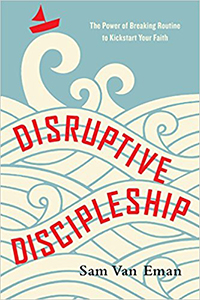
Disruptive Discipleship

By Sam Van Eman (IVP)

Disruptive Discipleship 200Sam Van Eman of Coalition for Christian Outreach wrote Disruptive Discipleship hoping it leaves readers “with more patient faith, more resilient hope and more selfless love for our neighbors.”

Citing examples from family life and contemporary culture, Van Eman tackles the distractions that keep us from involvement in a discipleship group. He also explains how, in the midst of interruptions, Christians make disciples as we go.

Most of the work deals with getting “unstuck,” and Van Eman challenges readers to consider the “how” behind Christ’s command to “go and make disciples of all nations.”

Don’t stop reading when you get to the last chapter. The epilogue and appendices are as rich as the book.

This book is not just for those who consider themselves experienced disciple-makers. It is appropriate for every Christian.

Skip Holman, minister of discipleship

Northeast Baptist Church

San Antonio


Explore the Bible: The Past

• The Explore the Bible lesson for June 11 focuses on Psalm 78:5-8, 32-39.

In a 2014 interview of students on a major university campus, the interviewer asked basic history questions of student passersby. The first question was about who won the Civil War. One student replied to the question with two others: “You mean the one in 1965? What Civil War?”

Most of the students who were interviewed had no clue who fought the war or when it was fought, much less why or who won. These are our future leaders, in case their ignorance of basic American history isn’t frightening enough on its own.

Of course, it’s easy to judge those who know so little that is so fundamental. The question their lack of knowledge forces to the surface for us is how well informed we are about our spiritual history. 

Edward Burke (1723-1792) is the Irish statesman credited with the famous quote: “Those who don’t know history are destined to repeat it.” Those words apply not only to ill-educated college students, but also to any of us, no matter our age or station in life, who have failed to know and learn from our spiritual past.

Teach your children well

In the first part of today’s text, the psalmist reports God as commanding his children to teach their children their spiritual history, even “the children yet unborn” (v. 6). Of all the responsibilities any parent bears with regard to their children, none is more sacred than teaching them their spiritual heritage.

One reason, is so that, hopefully, they won’t stumble into sin as did some of their ancestors—that from their history, “they should set their hope in God, not forget the works of God, but keep his commandments” (v. 7). If we don’t teach our children, to whom will we relinquish that responsibility, if anyone?

Two of the most formative years of my life were my freshman and sophomore years in high school. My father helped me throw my morning paper route from his car. When we got home around 6 a.m., we’d sit down in the living room, Dad would read Scripture, we’d discuss its meaning and then pray together. 

Dad always made certain I participated fully in the life of the church. He also made certain not to relegate my spiritual development to anyone else more than himself. My father ensured my spiritual formation more than any Sunday school teacher or even college or seminary professor.

Learn from our own history

Of course, passing along the torch of spiritual formation to the next generation presumes we have learned from our own history, as well. 

For Christmas this past year, my wife gave me a kit with which my DNA can be tested. I’ve heard that my heritage is German/English but I want to know more. I want to know the roots of my heritage.

Just as much, especially as I grow older, I want to know why I think about God and people and the church the way I do. What is it in my spiritual history that makes me tick the way I do? I don’t want to spend the rest of my life simply living on automatic. My life’s story has a story behind it. I want to know as much of my history as I can, so that I may pass along what was good and hopefully stall some that is not so healthy before my children and grandchildren inherit it.

Learn from the example of others

One of the main reasons for knowing our history is that, in learning it, we don’t have to repeat it out of ignorance. It is not true that we must personally experience everything in order to learn from it.

In my peripheral vision, and too late to stop her, I once saw my 3-year-old niece stick an object into a light socket. I saw a blue light streak all the way up her arm. For just a moment, not understanding what had happened to her, she was stunned silent. In a few seconds, however, she began to wail as anyone would.

From observing her behavior, I know I don’t have to insert an object into a light socket in order to know how painful it can be. I can learn from her example. Neither do I have to commit every sin in order to know its horrible consequences.

Be faithful to God

However, having not learned from the error of their ancestor’s ways, the people of God met what is described as a terrible end—the way of death at the hands of God. There is mystery here. God doesn’t kill every sinner, praise be! What is clear is that the way of sin is the way of death.

Yet, even in their sin, the psalmist reports something remarkable. Despite their hypocrisy, insincerity, lying tongues and duplicitous lifestyles, God, “being compassionate, forgave their iniquity, and did not destroy them; often he restrained his anger and did not stir up all his wrath” (v. 38).

We should learn from our spiritual history. We should pass along those lessons to the children we’re given, and we should seek to be genuinely faithful to God. Yet, in the end, our true hope is that, even when we fail to be faithful to God, God is faithful to us. 

There is no greater lesson our spiritual history teaches than the faithfulness of God to redeem us even when we miserably fail to honor him. What amazing grace!

Glen Schmucker is a hospice chaplain in Fort Worth.


Explore the Bible: The Path

• The Explore the Bible lesson for June 4 focuses on Psalm1:1-6.

Friends, both surgeons, built a five-star cabin on the top of Casper Mountain, elevation 8,100, just south of Casper, Wyo. They built it for their families, of course, but also for ministers who need a place to get away. There is no Internet, no television and no cell service. It takes a couple of days to get accustomed to the silence. 

The tall, lodge pole aspen that cover the mountainsides, intermingled among centuries-old pine trees, have leaves that spin in the breeze, giving the appearance of being adorned in silver jewelry. My wife and I have renewed ourselves many times during summer months up on the mountain, all but certain we saw God taking a morning stroll up there among the aspen where it is a quiet as a cemetery.

No one stands alone

As we were walking through a drove of them once, our friend who built the cabin explained to us it might appear that all the aspen trees stand alone. In fact, just beneath the surface, out of sight to the human eye, each aspen is part of a huge network of roots. 

No one tree can stand on its own, nor must it do so. Each tree needs every other tree.  When the gentle breezes blow, all the aspen dance together. When strong storms blow, they stand together, leaning together, holding one another up.

The first six verses of the first chapter of Psalms serve as nothing less than an introduction to virtually everything else to be read in the entire book. As it is, it begins at the beginning of what should be, what God intended, our lives to be. Well-rooted, living in community with people who will help us stand, well-nourished on good spiritual food, minds properly set on the ways of God.

Bad company

In conversation with some elderly parents, they were expressing grief, decades old, at what had become of one of their adult children. The father made one comment, in his grief, that was very telling. He said his son had gotten in with the wrong crowd. Their influence overwhelmed him into behaving in self-destructive ways from which he’ll never recover. They held him accountable, too, but mostly for choosing people as friends who had no chance of helping him live out his faith.

Good parents care about the school their children attend, their teachers, their health and extra-curricular activities. They also pay just as much attention to whom they select as friends and pray that God will send those friends soon.

It’s a fact that never changes with age. We tend to become most like those with whom we spend the most time. No truer words ever were spoken: “Happy are those who do not follow the advice of the wicked, or take the path that sinners tread, or sit in the seat of scoffers” (v. 1). More often than not, shallow or poor character rubs off on good people long before the good rubs off the other way.

Perhaps the easiest path, the one of least resistance, is the path of those the psalmist called “scoffers.” A scoffer is a cynic. He or she most often sits off to the side, not daring to enter to make a positive difference or help carry weight. They love to cast the stones of cynicism even when inflicting terrible pain on others. If we make our seat among them, we almost certainly will become one ourselves in time.

If any misbehavior in a church deserves the discipline of the church, none should receive it more than scoffing. Scoffing is a toxic acid that can destroy a church from the inside out forever.

Nourished by God’s word

Yet, when we determine to be a good influence among friends, peers and fellow Jesus-followers, we will spend our time meditating on God’s word so our lives will be a holy resource and not a roadblock to it. That is the only way our souls can be nourished and therefore a hopeful and positive presence in the lives of others.

Without solid company to help us stand and lean into the strong winds and without holy nourishment from within, we will find ourselves standing alone in the storm. Rest assured, the storm will come, and it will blow harder than we could have imagined.

The psalmist pulls no punches as he warns each of us of one’s ultimate destiny. His warning is worthy of serious and constant reflection. If it is true that the trajectory of our lives has been set by truths listed above, when we get where our lives are now aimed, where the path we’re following this very moment is leading, where might that be?

Glen Schmucker is a hospice chaplain in Fort Worth.