Connect360: Leading by Example

Connect360: Leading by Example

  • Lesson Eleven in the Connect360 unit “Kingdom Assignment: The Relentless Pursuit of Obedience” focuses on Nehemiah 10:28-30.

Why did Nehemiah and the leaders challenge the Hebrews to sign an agreement in writing?

First, I believe it showed their commit­ment to God. They separated themselves from foreigners and joined together, “taking on themselves a curse and an oath to walk in God’s law, which was given through Moses, God’s servant, and to keep and to observe all the commandments of God our Lord, and His ordinances and His statutes” (Nehemiah 10:29).

The oath was made to be faithful to God. This verse has been misused by autocratic leaders and groups who take a curse and oath to be loyal to a leader or a group.

Nehemiah didn’t ask for loyalty to himself. The people were committing themselves to be loyal to the com­mandments and ordinances of God.

Leaders must be careful not to manipulate people into following the leaders’ own personal agendas.

Second, the document was a testimony to the nations.

Op­position had come from neighboring people attempting to pre­vent the reestablishment of Jerusalem. A strong Jerusalem was a threat to neighbors because other people bring other gods.

Many in the region believed in a plurality of gods who reigned over local areas and people groups.

Even the Hebrews wanted a god they could see. Although Yahweh God just had led them miraculously out of slav­ery, they built a golden calf.

Solomon had asked God for wisdom. At the dedication of the Tem­ple he prayed, “O Lord, the God of Israel, there is no god like you in heaven or on earth, keeping covenant and showing lovingkind­ness to your servants who walk before you with all their heart” (2 Chronicles 6:14).

Yet even after God’s blessings, he foolishly mar­ried many wives of other nations and gods, and idolatry spread throughout the land.

Third, it was a resolution for themselves. The act of signing a document proved the people’s sincerity and intention.

The New Testament act of baptism is a public confession of sin and recognition that we are buried with Christ in baptism and raised to walk in a new life.

Vows are made at a wedding ceremony and usually rings are given to express sincerity and promise faithfulness.

Similarly, the Hebrew people’s signed document was a physical document promising faithfulness to the covenant. Good intentions are strengthened by public declara­tions, providing a tangible visible memory during discouraging days.

To learn more about GC2 Press and the Connect360 Bible study series, or to order materials, click here


Review: Disciples of White Jesus

Disciples of White Jesus: The Radicalization of American Boyhood

By Angela Denker (Broadleaf Books)

Recent research on Generation Z points to a generation adrift in anxiety, moving away from the church.

But an interesting shift occurred in 2024, a growing gap between young men and women who identify with Christianity—with more young men self-identifying as Christian than young women, for the first time since tracking such trends began.

More recent studies emphasize the trend, showing an uptick in young men who report Jesus is important in their lives. Yet, both young men and young women have continued to fall in other indicators of spiritual health, including regular church attendance.

More boys may be claiming Jesus, but do they know and follow the one we meet through the Holy Spirit and Scriptures?

When white men overwhelmingly are found to be holding the gun in mass casualty shootings, and white men are the most likely to die by suicide, it begs the question: what is going on with young, white men in this country?

Journalist and Lutheran pastor Angela Denker set out on a journey to investigate that question and shed light on what influences are shaping young, male Christians in the United States.

In her new book, Disciples of White Jesus: The Radicalization of American Boyhood, Denker said she focuses on white Christian men because they still hold an outsized number of leadership positions in government and industry and because she knows them best.

Her religious background is in a majority-white denomination with mostly men in church leadership, and her sports-writing career covering hockey brought her close to mostly white athletes, though with a Canadian bent, she noted.

Her book explores what influences have played into a crisis of radicalization among young Christian men of today’s United States and questions who they truly are following.

Denker noted concerns for her own young sons and her journalistic experience and pastoral ministry to predominately white Christians fueled her willingness and expertise to tackle this topic.

Denker approaches the difficult topic by examining theological and cultural shifts related to white Christian men. She also looks at specific communities who have seen an increased presence of extremism and digs into the background of a few young men who, at least for a season, epitomized radicalization. This approach is both a strength and weakness of the book.

It is enlightening to read about white supremacist groups settling in small Midwestern towns and to learn Dylan Roof had a background in church.

It’s challenging to consider where things might have gone wrong in his life, resulting in the hate-based murders of nine Mother Emanuel AME Church members in Charleston, S.C. Denker helps her readers think about the impact of his violence on all who were impacted by it, and to wonder what might be done to prevent such attacks in the future.

Likewise, reading about a former skinhead turned pastor offers an interesting perspective on how young men can be enticed by radicalization, and still eventually see the light and leave.

And Denker doesn’t try to present easy solutions to the problem. She notes addressing such a serious concern requires solutions tailored to specific situations. Yet she offers plenty of insights and troubling observations to ponder.

The weakness, for our tradition and in this cultural moment, is Denker’s progressive perspective. Denker gives her final spotlight on U.S. men who’ve been drawn to extremism to a transexual male. This choice could be off-putting, but I’d encourage you to try not to throw the baby out with the bathwater.

There is important information in Disciples of White Jesus. To get it, it is worth the exercise of looking beyond the parts you might not like.

The discipleship questions her sources utilize will help me as a mother of young Christian boys—who, while I wish they were not, are vulnerable to extremist influences—to challenge bad ideas they might be exposed to with positive, biblical influences.

In fact, I’ve already borrowed several to open conversations with my boys. The onus is on us to inoculate or de-radicalize the young, white men of Christianity’s future. Our daughters, our neighbors of color and the young men, themselves, will thank us for it.

Calli Keener

Baptist Standard


Connect360: True Confession

  • Lesson Ten in the Connect360 unit “Kingdom Assignment: The Relentless Pursuit of Obedience” focuses on Nehemiah 9:1-3.

In the ninth chapter of Nehemiah, the people reassembled on the 24th day with fasting, in sackcloth and with dirt on them.

They separated themselves from foreigners and confessed their sins: “While they stood in their place, they read from the book of the law of the Lord their God for a fourth of the day; and for an­other fourth they confessed and worshiped the Lord their God” (9:3).

Israel responded to the mercy of God with ingratitude throughout its history. God chose them, blessed them, delivered them, restored them, yet they never failed to turn away from God after a period of contentment.

The Levites standing on the platform led them in a prayer of confession and praise summariz­ing the grace of God and their own rebellion.

The Levites’ prayer reminds us to begin with a focus on God, remembering he is our Creator and Redeemer. As we med­itate on God’s goodness, we are reminded of our own unfaithful­ness and urgent need for his forgiveness and restoration.

The Levites began the prayer with praise and adoration to the one who is above all with the recognition that God is creator: “You alone are the Lord. You have made the heavens, the heaven of heavens with all their host, the earth and allthat is on it, the seas and all that is in them. You give life to all of them and the heavenly host bows down before you” (9:6).

Too often we jump into our prayers with a reminder to God of all of the problems surrounding us. We first need to focus on him. He is bigger than our problems.

He is before all things in both time and authority. He made all of the stars, the moon and the sun. He made the earth with seas and dry land, animals of the field, birds of the air, and fish of the sea.

God created us, in his own image and likeness. God is greater than all of our needs.

The Levites’ prayer reminds us that God is a covenant God. God is not one who created the world and then abandoned it.

He remains actively involved with creation.

God chose Abram and brought him out from Ur. God gave him the name Abraham. God is righteous. And be­cause of Abraham’s faithfulness, God made a covenant with him and gave the land of Canaan to him and his descendants.

The Levites continued the prayer recounting the ways God led the Hebrews and fulfilled his promises.

While the Hebrews were slaves in Egypt, they cried out to the Lord, and God brought plagues against the Egyptians until the pharaoh set them free.

They fled Egypt but became trapped by the sea in front of them and the Egyptian army behind them.

God parted the sea, and they crossed over on dry ground. The Egyptian pursuers were hurled into the sea like a rock in raging waters.

To learn more about GC2 Press and the Connect360 Bible study series, or to order materials, click here.


Review: The Unbiased Self

The Unbiased Self: The Psychology of Overcoming Cognitive Bias

By Erin Devers (IVP)

Texans know Texas BBQ is unsurpassed. Memphis and Kansas City have their own ideas about the best BBQ. And then there’s Carolina BBQ. Each one is right in their own eyes.

Erin Devers doesn’t smoke out the best BBQ, but she does shine a light on a common human malady—the inability to know everything about everything all the time. Bias results from our human limitations.
“We want to be right and feel good about ourselves,” Devers asserts. This desire leads us to think we are more moral than we are and have more control over our lives than we do. Bias begins here.

Bias can be an incendiary word today. But this isn’t a book about racial, gender, ableist or other specific expressions of bias—though racial bias does make an appearance in the last chapter. Rather, this is a book about dealing with the log in our own eyes, Devers contends, referring to one of Jesus’ parables.

We can spot other people’s biases, but we often are blind to our own. Devers seeks to move readers from a pursuit of feeling right to a pursuit of accuracy.

Bias is part of being human, a feature of our creaturely limitations. We can’t process everything about everything. Devers explains how our minds naturally create categories for the sake of efficiency and filter new information through these mental categories.

Our biases are exploitable and used by those in the know to grab our attention and manipulate our thoughts.

Devers counters internal bias—thinking or believing better of ourselves than we actually are. She emphasizes rooting our identity in Christ and his salvation from our sin nature, rather than in our self-identification and sense of measuring up to our own ideal self and what we believe others expect of us.

She also counsels against “downward social comparisons” by which we attempt to boost our self-esteem through measuring ourselves against people—and even animals—we see as less than ourselves.

After diagnosing the problem, Devers turns to overcoming it, starting with the pursuit of accuracy. Accuracy calls for slow thinking and interrogating why we want something to be true. This and other ways of pursuing accuracy positions a person for better fast thinking. Here, Devers suggests practical ways to improve thinking, one benefit being to reduce bias.

Reducing bias is beneficial not only for ourselves. It also makes us better neighbors, something captured in the command to love our neighbors as we love ourselves.

Devers returns to a point she makes repeatedly in her chapters on reducing bias—“our position relative to God and others.” We generally are more like each other than we are like God. To combat bias, Devers encourages generosity in our thinking about others.

The Unbiased Self finishes with an examination of group identity bias, specifically in the church.

A cautionary note: Readers should be aware Chapter Six opens with some examination of the horrific school shooting in Uvalde.

Eric Black, executive director/publisher/editor
Baptist Standard


Connect360: The Joy of the Lord is Your Strength

  • Lesson Nine in the Connect360 unit “Kingdom Assignment: The Relentless Pursuit of Obedience” focuses on Nehemiah 8:9-12.


Even though Ezra doesn’t appear in the book of Nehemiah until chapter 8, he already played a key role in the restoration of the exiles returning to Jerusalem.

The books of Ezra and Nehemiah were together in the earliest Hebrew manuscript. Origen (A.D. 185–253) was the first writer known to distinguish between the two.

The book of Ezra tells of the return of the Jews, who had been in exile in Babylon, and the rebuilding of the Temple.

In Ezra 7:6, Ezra is described as a scribe skilled in the Law of Moses, and again in 7:10, “For Ezra had set his heart to study the law of the Lord and to practice it, and to teach his statutes and ordinances in Israel.”

All the people—including men, women and all who could understand—gathered in the square in front of the Water Gate. Ezra the priest read from the book of Moses from early morning until midday.

He stood at a wooden podium designed for this occasion with leaders of the people standing beside him. When he opened the book, all the people stood, obviously out of reverence for the word of the Law.

“Then Ezra blessed the Lord the great God. And all the people answered, ‘Amen, Amen!’ while lifting up their hands; then they bowed low and worshiped the Lord with their faces to the ground” (8:6).

Afterward the Levites explained the Law to the people while they remained in their places.

“They read from the book, from the law of God, translating to give the sense so that they understood the reading” (8:8). In the margin of the NASB the word “translating” also is defined as “explaining.”

What good is the reading of God’s word without understanding?

In Jesus’ final words to the disciples before his ascension, he emphasized the command to teach his word: “Go therefore and make disciples of all the nations, baptizing them in the name of the Father and the Son and the Holy Spirit, teaching them to observe all that I commanded you.

“And lo, I am with you always, even to the end of the age” (Matthew 28:19-20).

To learn more about GC2 Press and the Connect360 Bible study series, or to order materials, click here.


Connect360: Finish the Task

  • Lesson 8 in the Connect360 unit “Kingdom Assignment: The Relentless Pursuit of Obedience” focuses on Nehemiah 6:15-19

Kingdom tasks cannot be accomplished by human wisdom and energy. Only God can move the hearts of kings and reluctant people. God is who inspires human courage and provides resources thought to be unavailable.

When the task of rebuilding the wall was complete, neither the people nor the enemy said, “Great is Nehemiah,” or “Great are the people of Jerusalem.”

Rather, “They recognized that this work had been accomplished with the help of our God” (6:16).

When God brought fire down on Mount Carmel, the people didn’t say, “Great is Elijah.”

They fell on their faces and said, “The Lord, He is God; the Lord, He is God” (1 Kings 18:39).

When the persecuted church was scattered, some of them came to Antioch and began preaching the Lord Jesus. “And the hand of the Lord was with them, and a large number who believed turned to the Lord” (Acts 11:21).

The church in Jerusalem heard about the work of God and sent Barnabas to see what was happening. When he arrived, he witnessed the grace of God (11:23).

Perhaps we receive too much credit for the successes we experience because we fail to allow God to work in a way that only he can bring victory.

When Hezekiah and Isaiah prayed for deliverance from Sennacherib, king of Assyria who already had defeated the armies of all of Judah’s neighbors, God answered by sending the angel of the Lord who slew 185,000 of the enemy.

Nehemiah’s task appeared doomed from the start.

How would he ever receive favor from the king, or resources to build the gates and rebuild the walls? How was he supposed to awaken a complacent city accustomed to living in shame and defeat?

How was Nehemiah to overcome the significant opposition of local leaders?

Victory would come only by the grace of God—who put the plan in Nehemiah’s heart, provided the resources to complete the task and then received the glory.

To learn more about GC2 Press and the Connect360 Bible study series, or to order materials, click here.


Connect360: ‘Don’t Be Fooled!’

  • Lesson 7 in the Connect360 unit “Kingdom Assignment: The Relentless Pursuit of Obedience” focuses on Nehemiah 6:10-14.

All leaders face opposition. How we respond is an indication of our courage and humility. Nehemiah was not exempt. He dealt with persistent resistance throughout the entire project of rebuilding the wall around Jerusalem, ranging from criticism to personal threats.

Too often, it appears the forces of evil have more resources and energy than do the righteous. Even though the wall was nearing completion, Sanballat, Tobiah, Geshem and the rest of the enemies of Nehemiah were not ready to stop. They plotted devious schemes to disrespect, discredit or destroy Nehemiah.

Their first attempt almost appeared as concession on their part. They sent Nehemiah a message inviting him to meet with them in one of the villages of Ono.

Nehemiah was not fooled. After a long battle calling the people to “arise and build,” he set the example by working alongside them, while simultaneously fighting the enemy.

Nehemiah’s successes may have made him vulnerable. The victory was near. How nice it would have been if the enemies had been won over and ready to be colleagues. Yet Sanballat and his partners schemed together to seduce Nehemiah.

The apostle Peter, who denied Christ only moments after he had promised to die for him, later wrote, “Be of sober spirit, be on the alert. Your adversary, the devil, prowls around like a roaring lion, seeking someone to devour” (1 Peter 5:8).

Jesus warned, “Beware of the false prophets, who come to you in sheep’s clothing, but inwardly are ravenous wolves. You will know them by their fruits” (Matthew 7:15–16).

How did Nehemiah see through their scheme? Perhaps he saw their true colors by observing their previous actions. He also may have received wise counsel from friends.

While not dismissing critical evaluation and wise decision making, we also observe that Nehemiah was a man of prayer, and it was God who gave him a spirit of discernment.

To learn more about GC2 Press and the Connect360 Bible study series, or to order materials, click here.

https://gc2press.org


Connect360: What if Christ Had Not Been Raised?

  • The Easter lesson in the Connect360 unit “Kingdom Assignment: The Relentless Pursuit of Obedience” focuses on 1 Corinthians 15:1-20.

If Christ has not been raised, then our preaching is irresponsible. Paul’s message was always the same whether he spoke to Jews or Greeks, slaves or free, in Jerusalem or Athens. He reminded the Corinthians he preached the good news to them. They received it and were standing on it.

This is the hope on which they were saved. Yet some among them began saying there is no resurrection of the dead. Paul responded, if there is no resurrection of the dead, not even Christ has been raised. “And if Christ has not been raised, then our preaching is vain, your faith also is vain” (15:14). Those who proclaim such things are actually false prophets.

If Christ has not been raised, then our faith is impossible. Paul stated if Christ has not been raised from the dead our faith is in vain (15:14). “And if Christ has not been raised, your faith is worthless; you are still in your sins” (15:17).

As the time of Jesus’ crucifixion was approaching, when he was with the disciples in Caesarea Philippi, he asked, “‘Who do people say that the Son of Man is? And they said, ‘Some say John the Baptist; and others, Elijah; but still others, Jeremiah, or one of the prophets.’ He said to them, ‘But who do you say that I am?’ Simon Peter answered, ‘You are the Christ, the Son of the living God’” (Matthew 16:13–16). And Jesus blessed him, acknowledged his answer was given to him by Jesus’ Father, renamed him Peter, and promised to him the keys to the kingdom.

If Christ has not been raised, then God is inaccessible. Without Jesus’ atoning death on the cross and his resurrection, there is no freedom from sin’s terrible grip. “So then as through one transgression there resulted condemnation to all men, even so through one act of righteousness there resulted justification of life to all men” (Romans 5:18).

If Christ has not been raised, then death is irreversible. “But now Christ has been raised from the dead, the first fruits of those who are asleep” (1 Corinthians 15:20). This is the turning point of history. All that happened before, looked forward to it; and all that has transpired since reflects back on it.

This is God’s plan. “For God so loved the world, that he gave his only begotten Son, that whoever believes in him shall not perish, but have eternal life” (John 3:16).

To learn more about GC2 Press and the Connect360 Bible study series, or to order materials, click here.


Connect360: Confronting Injustice

  • Lesson 6 in the Connect360 unit “Kingdom Assignment: The Relentless Pursuit of Obedience” focuses on Nehemiah 5:6-13.

Too often, the oppressed who gain power become the oppressors. In chapter 5 of Nehemiah, the troubles of the people are not brought on by foreign enemies but by their own rulers and nobles.

Famine and overpopulation brought widespread hunger. In addition, they were forced to pay high taxes on their fields and vineyards. These conditions caused them to mortgage their property, and they even were forced to sell their children into slavery.

Greedy officials oppressing the poor is not unique to one period of time or one culture. Millions of families are displaced and scattered throughout the world today because of famine, war and ideology—especially religious beliefs. The gap between the rich and the poor is ubiquitous. Even churches too often favor the wealthy and powerful rather than the impoverished.

However, many churches do support assistance to the needy and some political leaders are advocates for the neglected. While some wealthy people create personal empires for self-indulgence, others produce meaningful jobs and foundations providing food, health care, scholarships and shelter.

Nehemiah was furious when he heard the outcry of the people. God did not allow Nehemiah to hold the position of governor for his own recognition and fulfillment but to be an advocate on behalf of the people he governed. He stood inthe tradition of prophets who called out against injustice.

The prophet Amos cried out, “Thus says the Lord, ‘For three transgressions of Judah and for four I will not revoke its punishment, because they rejected the law of the Lord and have not kept his statutes; their lies also have led them astray,those after which their fathers walked’” (Amos 2:4).

God was especially angry at the shepherds (religious leaders) who fed themselves while not feeding the flock. “‘As I live,’ declares the Lord God, ‘surely because my flock has become a prey, my flock has even become food for all the beasts of the field for lack of a shepherd, and my shepherds did not search for my flock, but rather the shepherds fed themselves and did not feed my flock’” (Ezekiel 34:8).

Jesus rebuked the religious leaders, “Woe to you, scribes and Pharisees, hypocrites! For you tithe mint and dill and cumin, and have neglected the weightier provisions of the law: justice and mercy and faithfulness; but these are the things you should have done without neglecting the others” (Matthew 23:23).

To learn more about GC2 Press and the Connect360 Bible study series, or to order materials, click here


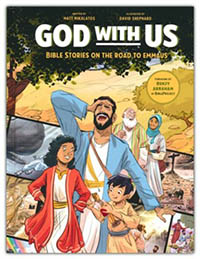
Review: God With Us: Bible Stories on the Road to Emmaus

God with Us: Bible Stories on the Road to Emmaus

By Matt Mikalatos; Illustrated by David Shephard (WaterBrook)

Cleopas and an unnamed person are walking from Jerusalem to Emmaus when Jesus joins them.

The two are talking about Jesus’ crucifixion and his rumored resurrection, trying to make sense of the rumors. They didn’t recognize their new traveling companion, nor did they expect what followed.

“Beginning with Moses and all the Prophets, Jesus explained to them what was written in all the Scriptures about himself” (Luke 24:27).

If only we knew what Jesus used from Scripture to explain about himself.

What Luke leaves out of his Gospel account, Matt Mikalatos fills in with imagination and humor.

In the form of a graphic novel, Mikalatos weaves together key moments from the Old Testament and the Gospels that, in hindsight, illuminate who Jesus was, his purpose for coming to live among us and the purpose of his dying and rising again.

The young sister and brother Rachel and Moshe are main characters in Mikalatos’ version of Luke 24:13-35.

As they walk with Cleopas and Miriam—Luke’s unnamed second person—they ask important questions and bring extra life to Jesus’ explanations.

God with Us would make a great gift for young families to read together, young readers to read alone or fans of graphic novels.

Through Mikalatos’ gift for storytelling and David Shephard’s illustrations, those who read God with Us will see not just the walk to Emmaus in a new light, but will come to appreciate what key moments throughout Scripture tell us about Jesus.

God with Us is scheduled to release April 1, in plenty of time to be read before Easter—Resurrection Sunday.

Eric Black, executive director/publisher/editor
Baptist Standard


Connect360: Overcoming the Enemy

  • Lesson 5 in the Connect360 unit “Kingdom Assignment: The Relentless Pursuit of Obedience” focuses on Nehemiah 4:1-8.

Nehemiah consistently prayed. Each time he was confronted by a problem, he first took the situation to God. Yet, he also knew the work had to be done by the people.

Soon some of the Jews began to express discouragement. Their strength was failing. They were distracted by the rubble. They heard the threats of the enemy. They said, “We ourselves are unable to rebuild the wall.”

The midway point is often the most difficult time. The excitement of the vision has faded, and attention becomes focused on the rubbish, the undoable task still lying ahead. Nehemiah faced what may have been his greatest challenge: discouragement from within. Outside opposition is expected, but when God’s people begin to complain and rebel, their discouragement is contagious.

Those living in areas near the enemies came to Nehemiah with fear and complaints 10 times (Nehemiah 4:12).Sanballat’s plan of causing a disturbance among the people appeared to be working. Courageous leadership was neededurgently, and Nehemiah didn’t disappoint. His faith did not waver, and he responded with a plan. “We will fortify the lowplaces and have families with their swords, spears and bows.”

When Nehemiah saw their fear, he “rose and spoke to the nobles, the officials and the rest of the people, ‘Do not be afraidof them; remember the Lord who is great and awesome, and fight for your brothers, your sons, your daughters, your wivesand your houses’” (4:14).

The plans of the enemy were frustrated. Half of the people carried out the work and the others held the spears, shields,bows and breastplates. Nehemiah continued to lead by example. “So neither I, my brothers, my servants, nor the men of the guard who followed me, none of us removed our clothes, each took his weapon even to the water” (4:23).

To learn more about GC2 Press and the Connect360 Bible study series, or to order materials, click here.


Review: I’ve Got Questions

I’ve Got Questions: The Spiritual Practice of Having It Out with God

By Erin Hicks Moon (Baker Publishing)

Storyteller and host of the popular Faith Adjacent podcast Erin Hicks Moon reveals her inner wrestling with faith and why deconstruction is a necessary component of the faith journey in I’ve Got Questions.

Moon breaks the deconstruction process into five segments, beginning with the origins of our faith and how worldly influences affect faith perception and concluding with the rebuilding process.

Written in a fun, conversational style, I’ve Got Questions offers readers a personal and general approach to questions about the faith. Growing up in a traditional, Southern Baptist home, Moon did not feel the need to question her faith until she was exposed to other religions and hypocrisy within her own denomination.

Moon learned to “sit Shiva,” the Jewish process of mourning a death. Learning to practice Shiva by lamenting the roots of her faith allowed her to examine where she had questions.

The writer describes experiences of feeling like an outcast in the church for questioning her faith, resulting in isolation.

A turning point came during a church service where she was told about a class helping reclaim communities for God while battling against worldliness. She began questioning the disparity between serving in love and fighting against the world. She wondered how she truly could love those she felt at war with.

Moon addresses this idea and questions Christians may have during their faith journey. She includes quotes, historical references, personal stories and testimonies to walk the reader through her deconstruction process and how it helped strengthen her faith in God.

In the chapter “What If the Wrestling Is the Point,” Moon addresses how Christians have disrupted the status quo throughout history by asking questions. She cites examples such as the Reformation to contextualize how questions in the life of faith have resulted in spiritual growth and new insights.

Moon offers a friendly hand, compelling readers to explore their faith, while acknowledging the roots that make faith unwavering.

This book is for anyone who needs to know it’s OK to ask questions, offering a safe space to lament a changing faith and make peace with the process. Moon encourages readers to think of active faith as one that recalibrates. Our spiritual inheritance involves wrestling with a God unafraid of our questions.

Faith Pratt, Baptist Standard student intern

East Texas Baptist University, Marshall