Explore the Bible: What’s the Use?

  • The Explore the Bible lesson for July 25 focuses on Ecclesiastes 1:12-15; 2:18-26.

Have you ever tried to fix or build something and not have the right tools? Some people might rush to the store to purchase the needed items or ask a friend for advice or to borrow what is required. Then there are others (like I almost always do) who try to improvise. Having the right tools and knowing how to use them is often half the battle when completing a project. I always was amazed at the number of tools my grandfather had in his “shop”—the room in the garage—when I was a boy. Even more impressive was his ability to correctly handle them. I wish more of that “fix-it” knowledge was hereditary. However, like in most situations, we need a teacher.

As we start to study the words of the “teacher” in Ecclesiastes, some background information can be helpful. Our text spans both chapters 1-2, beginning with the author announcing his place as king over Israel in Jerusalem. That makes us think this son of David must be Solomon, as he is the only king after David to rule over Israel after him. Once Solomon dies, the kingdom is split. The wisdom of Solomon definitely would be something that would spark a pursuit such as the author will take us. Nevertheless, since there is really no exact pinpoint to the time for authorship, we must allow for any number of options. John Goldingay observes the author “…both invites us to think of Solomon yet invites us not to take that idea too literally; he refrains from saying he is Solomon yet gives a testimony that could come only from the lips of someone like him.” (Proverbs, Ecclesiastes, & Song of Songs for Everyone, p. 180)

Robert Alter calls this book one of the most peculiar in all Scripture. We have a book of compiled philosophic prose, wisdom sayings and observations from a “teacher king in Jerusalem.” Traditionally, this book has been ascribed to King Solomon, but biblical scholars are in debate, which stems from the translation. The Hebrew word describing this person is “Qohelet”—coming from the Hebrew word “to assemble.” The book name, Ecclesiastes, came from early Greek translations meaning “the one who assembles”—as in one who assembles for learning, or a teacher. Goldingay calls this person “churchman,” since Ecclesiastes itself comes from the Greek ekklesia, church or community. Goldingay thus feels “churchman” is the English equivalent and notes much of what Qohelet says is very unchurchman-like. He also notes, “the questions of Ecclesiastes are not the questions of an atheist or an agnostic. They are the questions of a believer who wants to keep faith honest.”  (Proverbs, Ecclesiastes, & Song of Songs for Everyone, p. 177)

Quickly vanishing vapor or life-giving breath?

Another important Hebrew word to consider is “hebel”—meaning “breath” or “vapor.” This is the word where we find the NIV the famous “meaningless” verse: “‘Meaningless!  Meaningless!’ says the Teacher. ‘Utterly meaningless! Everything is meaningless.’” (1:2) Hebel, hebel… Everything is hebel. What is Qohelet, our churchman, trying to say? The breath that is spoke of is a different word for the lifegiving force of God, ruah, used in Genesis. Hebel is the breath that must be exhaled, as Alter describes, breath that is invisible except on a really cold day. This is a vapor that dissipates quickly into the air. It is opposite the ruah of God, the life that is given to every living creature. Therefore, life without the ruah of God is most definitely hebel and ultimately will vanish. God gives life meaning. We should live each moment as if it were a gift directly from God, lest it all be meaningless.

This is one of the four main pillars to the book. First, Qohelet has a faith in God that never waivers. Second, this faith is maintained even though God’s ways are hardly, if ever, understood. Third, for humanity, things do not always end up as tidy as we would expect. And last, death is the great equalizer of all—thus making life seem hebel. Qohelet is unlike Job’s friends, noting that life is not always predictable as one might think. Gordon D. Fee and Douglas Stuart note any struggle we might have in grasping the teachings of Ecclesiastes could stem from our desire, like that of Job’s friends, to have all of life tied up in one tidy predictable package. (How to Read the Bible Book by Book, p. 155)

Meaningful work or toilsome labor?

We are launched into this macro-level, big picture quest for meaning with this great teacher. Our text this week concludes with an Epicurean-like statement, “A person can do nothing better than to eat and drink and find satisfaction in their own toil.” (2:24) In this life, work should be seen as a gift from God. Genesis 2:15 reminds us even before the fall of man, work was a gift. “The Lord God took the man and put him in the Garden of Eden to work it and take care of it.” God has given work to his creation along with the compassionate gift of finding enjoyment in it, as well as other pleasures in life. However, if the gift takes our attention off the one who gave it, then we are left with hebel.

As we seek for purpose and meaning in this book of wisdom, may we be reminded the God of all wisdom will enlighten our hearts and minds. And while expanding our understanding and wisdom will not lengthen our lives or determine the wisdom or folly of who comes after us, we will possess a greater knowledge of the One who is the giver of life, work, pleasure, wisdom, and all good and perfect gifts. This knowledge that leads to a deeper relationship will not vanish life a vapor but will carry us into all eternity.

For a quick overview of Ecclesiastes from The Bible Project check out this YouTube video: https://www.youtube.com/watch?v=lrsQ1tc-2wk&t=20s

Davey Gibson is associate pastor of education and discipleship at Sugar Land Baptist Church in Sugar Land, Texas.


Connect360: He’s the God of Peace and Possibilities

  • Lesson 7 in the Connect360 unit “The Conquerors: Heroes of the Faith” focuses on Judges 6:22-35.

Judges 6:28-30 is a reminder that when you choose to fully follow God, you will come up against opposition. Gideon obeyed God and cut down the places of idolatry and worship to the false gods of the Canaanites. And when the people in the town saw what had happened, they called for the death of Gideon. I imagine at this point Gideon was wondering what in the world he had done. He thought he was afraid the day before of the Midianites, but now his own people were calling for him to die.

A good marker in life is that when the godless or the enemy comes up against you in opposition, you are probably living a life fully devoted to God. In John 15:18-19 Jesus said, “If the world hates you, know that it has hated me before it hated you. If you were of the world, the world would love you as its own; but because you are not of the world, but I chose you out of the world, therefore the world hates you.”

Let Baal protect Baal

Joash, Gideon’s father, stood up to protect his son. Joash came up with the perfect plan: If Baal really was a true god, then let him protect himself. Let Baal punish my son Gideon. I personally think t Joash was not only defending his son, but also beginning to turn his heart back to God. We can tell from Judges 6:13 that Gideon was raised to know the God of Israel. Gideon knew the name of God, the character of God and the works of God. At some point, Gideon was taught these things in his home.

So, on the morning after Gideon had cut down the altar to Baal and his dad Joash had told the angry townsmen that if Baal was truly a capable, living god then he could contend with Gideon on his own, Gideon was given a new name. His name was now Jerubbaal which means “let Baal contend against him.” (Judges 6:32)

Compiled by Stan Granberry, marketing coordinator for GC2 Press, formerly known as BaptistWay Press.

To learn more about GC2 Press and the Connect360 Bible study series, or to order materials, click here.


Connect360: Seeing Ourselves Through God’s Eyes

  • Lesson 6 in the Connect360 unit “The Conquerors: Heroes of the Faith” focuses on Judges 6:1-6.

It is a broken record at this point. After the great victory of Deborah, Jael and Barak, the people of God returned to their old ways. They did evil in the eyes of the Lord. Because of their disobedience, God calls up the Midianities to come and oppress Israel. The Midianites are half-brothers of the Israelites. After Sarah died, Abraham married Kahtura. Abraham was about 130 years old when he got married. Why not? He still had another 45 years to live. Abraham and Kahtura had six kids. and one of those sons was Midian.

The Midianites were ruthless; they were a vile people. So oppressive were they that the Israelites had to go and live in caves up in the mountains. When the Israelites would come down from the caves to plant crops the Midianites would devour their crops. Not only were the Israelites not able to gather enough food, but their livestock did not have enough either.

Interestingly enough, 200 years earlier, in Deuteronomy 28, God had told the Israelites these two specific things: 1) If you disobey me, I will send in foreign invaders, and they will eat the produce of your land. 2) If you disobey me, you will build a house, but you will not live in it. God was allowing his people to suffer what he had warned previous generations.

God brought up a prophet

However, this time there is a change in the pattern. Before God called up a judge, he brought up a prophet. When a prophet came, you can see God was showing grace and mercy, but usually the prophet of God had some really strong words to communicate. This unnamed prophet reminded the Israelites of the faithfulness of God.

In Judges 6:8-10, the prophet recalled and remembered with the Israelites all that God has accomplished for them. From the exodus from slavery in Egypt to the new land that God had provided in Canaan. Over and over again God showed the character of his generosity and faithfulness. But the last seven words of the prophet, speaking on behalf of God, are haunting, “But you have not obeyed my voice” (Judges 6:10).

Compiled by Stan Granberry, marketing coordinator for GC2 Press, formerly known as BaptistWay Press.

To learn more about GC2 Press and the Connect360 Bible study series, or to order materials, click here.


Explore the Bible: Dependence Declared

  • The Explore the Bible lesson for July 18 focuses on Job 42:1-11.

Americans value independence much more that dependence. I don’t know of a “dependance day” celebrated on our calendar. For a Christian, the essence of our salvation is discovering our desperate dependence upon God. As I heard a pastor offer the simple challenge, to trust in God is to simple says: “I can’t. God, you can.”

Ultimately, we learn throughout life that we are not as independent as we would like to think we are. Our lives on earth are dependent on one another—for food, protection, companionship and health. Even this fails to consider all of the needs of life are ultimately provided by our heavenly Father. As James 1:17 reminds us, “Every good and perfect gift is from above, coming down from the Father of the heavenly lights, who does not change like shifting shadows.”

In our country, we have fought for and celebrated freedom and independence. Yet, in the story of Job, we learn that earthly freedoms are fleeting. Learning to trust and be dependent upon the Lord, even in the darkest of days, will allow us to join Job in saying of God, “My ears had heard of you but now my eyes have seen you.”

Who has the last word?

I admit it, I love a good story with a happy ending. When it comes to movies and TV shows, I am always pulling for the good guys to win the day, the guy to get the girl, peace to win the day and everyone to live happily ever after. Apparently, I am not the only one as Disney has made billions creating stories that ended with that famous line.

John Goldingay writes in Job For Everyone, “…the reason why a story that has a happen ending is important—not because we are avoiding the toughness of the unhappy ending and fooling ourselves but because God is indeed one who brings stories to a happy ending.” (p. 206) He also notes the Israelites at this point in their history would not have had a theology of resurrection or life after-death. Therefore, restoration in the story of Job is vital to understand that God alone has the last word in all our trials and struggles.

It will almost be impossible for us to totally understand the big picture or the perspective that our heavenly Father possesses of our lives. That is the point God is hammering home to Job in the final chapters. We cannot have God’s understanding; therefore, we must trust in the one who does know all things. Job finally agrees with God in chapter 42—not just that God is greater or has superior firepower, as Goldingay puts it, but Job “…takes up God’s own words about his not having enough insight to hold forth concerning the issues on which he has be pontificating and he acknowledges that God is right.” (Job For Everyone, p.207)

Job and his friends end in a role reversal. As God restores Job completely to his community, there is a great banquet for all of Job’s kinfolk. The Hebrew states “brothers and sisters” but according to Robert Alter, the context suggests a broader meaning of kinship. Those who had forsaken Job now are paying honor and homage to him. Job’s friends that did not seek the Lord on his behalf at any point in the book are now in need of Job to seek the Lord on their behalf. Job’s prayer is heard, and full restoration takes place for the maligned friends as well.

Not about answered questions

One area that we might never truly come to terms with in the book of Job is answering the question “Why?”  It is the one that we have been facing since the Adversary first entered the heavenly court and God began the conversation. What is the reason given for all the suffering in Job’s life? Why do we not receive a divine “I told you so” to the Adversary in the epilogue?

Well, Fredrick Buechner concludes his chapter on Job in Peculiar Treasures: A Biblical Who’s Who by observing, “…even if God gave him one [a reason why] that made splendid sense out of all the pain and suffering that had ever been since the world began, it was no longer splendid sense that he needed because with his own eyes he had beheld, and not as a stranger, the one who in the end clothed all things, no matter how small or confused or in paid, with his own splendor. And that was more than sufficient.”

The story of Job ends much like the final words to Paul when he asked God to take away suffering (thorn in the flesh): “But he said to me, ‘My grace is sufficient for you, for my power is made perfect in weakness.’ Therefore, I will boast all the more gladly about my weaknesses, so that Christ’s power may rest on me.” (2 Corinthians 12:9) May we remember the message of Job—that his original blessings or restoration were never a direct result of Job’s piety but because of the character of Job’s God.

For a great video overview of this powerful book, check out the Bible Project video synopsis on Job: https://www.youtube.com/watch?v=xQwnH8th_fs

Davey Gibson is associate pastor of education and discipleship at Sugar Land Baptist Church in Sugar Land, Texas. 


Explore the Bible: Power Displayed

  • The Explore the Bible lesson for July 11 focuses on Job 40:1-14.

How do you picture God? There are many times throughout mainstream media and entertainment, a God-like figure is personified. From an elderly man with a beard in cartoons, to a character with a Morgan Freeman-like voice, God often is depicted as old, sage-like, gentle and somewhat removed from what is happening on earth. As believers, what do we know of God?  Our primary sources of knowing God are his word and prayer.

In this lesson, Job gets the tables turned on him. Previously, Job had taken a trial-like offensive, making accusations and demanding answers from the Almighty regarding all the affliction and suffering in his life. God now puts Job on the defensive, asserting the major differences between the divine and humanity.

God is God; we are not

I wonder how often we fall into the trap of considering Almighty God in a way that is very un-God-like. We are often tempted to make God in our own image and understanding – someone in which we can control and relate. Yes, God is one who has created us as a people with whom we can share all the beauty and joy of a close, intimate relationship. But as Job has realized, there are times that we need to realize the truth of Ecclesiastes 5:2—“Do not be quick with your mouth, do not be hasty in your heart to utter anything before God. God is in heaven and you are on earth, so let your words be few.”

To safeguard against any other foolish talk, Job like a penitent child, puts his hand over his mouth.

When considering Job in his book Peculiar Treasures: A Biblical Who’s Who, Fredrick Buechner describes this exchange between Job and God once Job and his friends end their “Where’s God in all this?” discussion. Buechner calls this passage, “The most gorgeous speech that God makes in the whole Old Testament, and it is composed almost entirely of the most gorgeous and preposterous questions that have ever been asked by God or anybody else” (p. 75) Buechner continues, “You can think about God as a great cosmic bully here if you want, but you can think of him also as a great cosmic artist…” (p. 75) If God were to sing with the full might of his voice, it would burst the eardrums of those hearing it. It would completely overwhelm and consume whatever the sound touched. Thankfully, God is God, and we are not.

Due reverence

Contemporary Christian artist, Point of Grace, made popular a song God Forbid that God has used to impress upon me the reverence and fear he is due. The song can be heard here.

Chorus: “God forbid, that I find you so familiar

That I think of you as less than who you are

God forbid, that I should speak of you at all

Without a humble reverence in my heart.”

Where do you see God most?  How has God displayed his power and majesty in your life?  Perhaps it is like Job amid tremendous suffering? Or perhaps it is in major victories or mountain-top experiences in worship and praise? Job is learning, and taking us through the journey, that God is God and we are not. God does the things that only God can do. This is the same power in the life of Christ as seen in the Gospels. Jesus goes about his human life on this earth doing things that only God can do and thus revealing his true nature as God’s Messiah, the one who will take away the sins of the world.

Davey Gibson is associate pastor of education and discipleship at Sugar Land Baptist Church in Sugar Land, Texas. 


Connect360: Living in Courage/Living in Fear

  • Lesson 5 in the Connect360 unit “The Conquerors: Heroes of the Faith” focuses on Judges 4:4-23; 5:7, 24-27.

We are introduced to Deborah in Judges 4:4-5. In these two short verses, we can learn a lot about this remarkable woman. She is called a prophetess, meaning she is especially divinely gifted by God to communicate God’s will to his people. She was married to a man by the name of Lappidoth, and we quickly see that she has been appointed to be a judge in Israel.

We see in Judges 4:5 that Deborah positioned herself under a palm tree, and she must have made that a known and predictable place, because the Bible calls it the palm of Deborah. That place of judgment and decision-making was positioned between Ramah and Bethel.

Deborah identified herself not as a warrior or general or even judge; she identified herself as a mother. In the song she sang with Barak in Judges 5, she said, “The villagers ceased in Israel; they ceased to be until I arose; I, Deborah, arose as a mother in Israel” (Judges 5:7) Deborah identified herself as a nurturing, loving mother. What a gift Deborah had to have been to Israel, a formidable lady who judged with the heart of a mother.

In the presence of God

The two cities mentioned here surely are important as well. The name Bethel means “the house of God,” and it was here that Jacob entered into covenant with God, and Jacob said of Bethel, “surely the Lord is in this place” (Genesis 28:16). The name Ramah means, “holy hill.” It is not a stretch at all to say that Deborah made sure she found herself in the presence of the Lord. If she was going to be making weighty decisions for a nation, if she was going to have influence and lead, she wanted to be in the presence of God.

Deborah must have judged with a great reputation. Deborah is the only judge about whom it is written that people came to her to have disputes decided (Judges 4:5). She was respected, she was trusted, she was wise, she was good on her word, and she lived with a good reputation. Surely, Deborah was a woman who trusted in her God.

Compiled by Stan Granberry, marketing coordinator for GC2 Press, formerly known as BaptistWay Press.

To learn more about GC2 Press and the Connect360 Bible study series, or to order materials, click here.


Connect360: An Unknown, Known by God 

  • Lesson 4 in the Connect360 unit “The Conquerors: Heroes of the Faith” focuses on Judges 3:31.

It is often in the most difficult times that God wants to use us. He wants to use us to shine light, to give truth, to offer mercy, to declare the gospel, to distribute grace, and to love all people in difficult times.

Is your family going through a tough time? That’s when God taps you to step up with courage and faith. Is your workplace demoralized? That’s when God taps you to step up with encouragement. Is your apartment, dorm room, or household in conflict? That’s when God taps you to be a maker of peace.

Excuses, excuses

We are all kings and queens of excuses when we sense that God might be calling us to action. How often do we use the excuse it’s just not a good time? Perhaps you find yourself saying, “I need to wait till I’m older” (I would have when I was young). Maybe you say: “I need to have more money,” “I really need to be wiser,” “I first need to get out of college.” Perhaps you say: “Maybe when work slows down, “Probably after I have kids,” “I’ll wait until the kids get out of the house,” or “I need to first purchase the house we want.” There always will be excuses, but Shamgar laid down his excuses and trusted the Lord.

Perhaps a life of surrender is what you need. A life that holds things loosely. The hymn Van Deventer wrote is easy to sing, but it is hard to live out. I Surrender All. Wow! That is a lot. I surrender my schedule. I surrender my gifts. I surrender my finances. I surrender my personality. I surrender all the things I have in my hand, in my heart, and in my life. But ultimately God is looking for you to surrender all of yourself to him.

Compiled by Stan Granberry, marketing coordinator for GC2 Press, formerly known as BaptistWay Press.

To learn more about GC2 Press and the Connect360 Bible study series, or to order materials, click here.


Explore the Bible: Justice Sought

  • The Explore the Bible lesson for July 4 focuses on Job 36:8-23.

Over years of ministry, I have heard many stories of individuals who were suffering from various addictions and lifestyle choices that had brought them to ruin. Even in times of great distress, people talk about knowing God was watching over them, protecting them and calling them out of the wreck and ruin. God’s promise to never leave or forsake us is kept even when we are going through struggles and trials.

Most will remember the famous poem, Footprints in the Sand. The author speaks of a dream in which he was walking along the beach with God. There are two sets of footprints. The steps on the beach become an allegory of the person’s life. When the poet noticed only one set of steps, he asked where God was during those times, which were filled with pain and sorrow. The response from the Lord: “During your times of trial and suffering, when you see only one set of footprints, it was then that I carried you.”

We all think we know what we want in life; we think things should always be fair and just. Fairness involves getting what we deserve or at least think we deserve. We associate these feelings with our view of God, insisting that God should be fair.

But our standards are not God’s standards. We base what is fair and what we deserve off our capacity of understanding. Nevertheless, as Isaiah 55:8-9 remind us, God’s view is different. God’s thoughts are not the same as ours, nor is his understanding limited like ours.

Pointing to the real reason

Elihu comes on the scene a couple of chapters earlier as a brash young man with a message he must tell. Waiting his turn for the elder friends of Job to finish their conversation with Job in his misery, Elihu seeks a different approach. Elihu is the only character in the book who will point to the real reason for Job’s affliction: God is allowing Job’s piety to be tested. (Carol A. Newsom, The New Interpreter’s Bible Commentary, Vol. III, p. 230)

Elihu will try to correct the views about God that which have dominated the conversation up to this point. He will speak of God’s superiority above all, justice, God’s redemptive concern for those who have fallen into sin. In The Expositor’s Bible Commentary: Revised Edition, Vol. IV, p.874, Elmer B. Smick writes: “It is time for Job to see the hand of God in his suffering. God uses affliction to amplify his voice and thus obtain the attention of people.”

The individuals seeking pastoral care that I mentioned earlier would often say that it took “hitting rock bottom for them to look up.” Often it is in our greatest distress that we find we have no choice to seek the Lord with all that we are. Elihu wants to point Job to this truth.

There is nothing Job can do to shake off God’s discipline. Rather, Job should continue to seek God and live—not “curse God and die,” as Job’s wife advised in Job 2:9. Elihu will give examples of people putting their faith in wealth to soften the blows of life (v. 19) or just continuing to do what is evil if God is already punishing (v.21). He also will advise Job to “listen to correction” (v. 10) and take care that “no one entices you” to “turn aside” from what the Lord will do for the promise of v. 15 will come true, “But those who suffer he delivers in their suffering; he speaks to them in their affliction.”

Paul will speak about those going through suffering, commanding Christ followers to “weep with those who weep.” (Romans 12:15) How might Job’s response been different if his friends had truly mourned with Job for the duration of his suffering? Job’s friends seem to be seeking justice, but only for themselves—wanting to justify that Job indeed has done something that deserves the “justice” he is receiving from God.

It is finally in the words Elihu we start to understand that the plans of God are not the plans of humans. That God is full of grace even in the midst of suffering, for he enters into suffering with us to sustain us and carry us. Without the Lord constantly being with Job, he would not have been able to withstand the great trials. Therefore, we can praise and thank God in the midst of the storms of like for we know that he is always with us—often carrying us through when we cannot walk on our own.

Davey Gibson is associate pastor of education and discipleship at Sugar Land Baptist Church in Sugar Land, Texas.  


Review: The Women of the Bible Speak

The Women of the Bible Speak: The Wisdom of 16 Women and Their Lessons for Today 

By Shannon Bream (Broadside Books)

In her New York Times bestseller, The Women of the Bible Speak: The Wisdom of 16 Women and Their Lessons for Today, media personality Shannon Bream retells the stories of 16 women and then adds six others who met Jesus face-to-face. Some regularly appear in sermons and Sunday school lessons, while others rarely receive mention. The Miss America finalist and Liberty University and law school graduate dedicates the volume to her grandmothers and not surprisingly opens and closes with Proverbs 31:25—“She is clothed with strength and dignity; she can laugh at the days to come.”

In eight segments, the author juxtaposes six female pairs from the Old Testament and two from the New Testament onto themes such as “Tamar and Ruth: Outsiders” and “Esther and Rahab: Unexpected Heroes of Faith.” The final “Jesus and the Women” chapter profiles women accused and women in need, financially or physically. A plethora of Scripture references infuse the text and serve as the basis for the author’s comments about what the “key players in [God’s] unfolding plan” might have felt or thought. Each segment closes with study questions, and an extensive index details people, places and subjects.
With her national audience, Shannon Bream’s Women of the Bible Speak provides a platform for both deepening the faith of believers and reaching non-Christians with the gospel. Although Bible purists may not appreciate the author putting herself and thus the reader into the hearts and minds of the women, the technique makes for an honest and engaging experience that goes below the surface. Care, however, should be taken if using the stories with youth, especially younger teens and preteens, as the journalist doesn’t gloss over gritty truth.

Kathy Robinson Hillman, former president

Texas WMU and Baptist General Convention of Texas

Waco  


Connect360: The Weak Teaching the Strong

  • Lesson 3 in the Connect360 unit “The Conquerors: Heroes of the Faith” focuses on Judges 3:12-30.

All of us have weaknesses, maybe best described as frailties, dysfunctions, disorders, short-comings, disadvantages or handicaps. Maybe for you it is a physical weakness or a lack of education. Perhaps it is a learning disorder, anxiety, deafness, autism, dyslexia or a myriad of other things. We are reminded in the life of Ehud that in our weaknesses, God gives us power and grace. Consider the power God gave Moses and his speech impediment or difficulty in Exodus 4:15 God tells Moses, “I will be with your mouth…and will teach you what to do.”

Consider the grace God gave Paul in his weakness in 2 Corinthians 12:7-9: “So to keep me from becoming conceited because of the surpassing greatness of the revelations, a thorn was given me in the flesh, a messenger of Satan to harass me, to keep me from becoming conceited. Three times I pleaded with the Lord about this, that it should leave me. But he said to me, ‘My grace is sufficient for you, for my power is made perfect in weakness.’ Therefore I will boast all the more gladly of my weaknesses, so that the power of Christ may rest upon me.”

It is also hard not to hear this story of a trumpet blasting and not consider the implications for the day when God will play his trumpet in victory. First Thessalonians 4:16-17 states: “For the Lord himself will descend from heaven with a cry of command, with the voice of an archangel, and with the sound of the trumpet of God. And the dead in Christ will rise first. Then we who are alive, who are left, will be caught up together with them in the clouds to meet the Lord in the air, and so we will always be with the Lord.”

Just as Ehud played that trumpet to announce victory, freedom and peace, so the Lord will also one day play a trumpet blast that will be heard around the world. And on that day, we will enter into an eternity of peace in the presence of our Savior, Jesus Christ.

Compiled by Stan Granberry, marketing coordinator for GC2 Press, formerly known as BaptistWay Press.

To learn more about GC2 Press and the Connect360 Bible study series, or to order materials, click here.


Explore the Bible: Wisdom Gained

  • The Explore the Bible lesson for June 27 focuses on Job 28:12-28.

As a child, I kept my hard-earned money in a small green Velcro wallet. And when I say, “hard-earned,” most of my income was the result of few chores and the annual gift-giving occasions. Right after one such occasion—my birthday—my savings swelled to $50. And then the unthinkable happened—I lost my little green Velcro wallet!  I was so very sad, looking everywhere around the house. Inside that wallet was not only my financial savings, but pictures, a few special notes and my very own library card. I was devastated. I looked and looked, but couldn’t find the wallet anywhere.

Treasure hunt

When we lose something of value, we look for it. When we know that there is something worth having that we can work hard to achieve, we often set our minds to making sure this thing becomes ours. In our text this week, Job begins with a precise question: “But where can wisdom be found? Where does understanding dwell?” (Job 12:12).

Here is Job’s theme for this beautiful and mysterious work of Hebrew poetry. In The New Interpreter’s Bible Commentary, Carol A. Newsom, calls Job 28 “one of the most exquisite poetic compositions in the entire Bible.” She goes on to say the symbolism of the precious metals and gems that are described in the poem are like the poem itself; it is beautifully crafted and full of mystery to be searched at great length.

With the theme spelled out, the poet gives us two rounds of explanation on wisdom and how one can make this precious discovery. Verses 13-19 offer the imagery of miners and metal workers seeking precious gems, jewels and minerals of great worth.

In any quest, one must know what they are looking for in order to know when they have found it. For Job, he is considering the human pursuit of two things: wisdom and understanding. When these two words are used together, they point to the greatest form of knowledge, universal knowledge “…into the nature and meaning of the cosmos.” (Newsom, The New Interpreter’s Bible Commentary, Vol. III, p. 187) Something of this magnitude is beyond human comprehension. Job knows this; yet his current situation fills his life with no answers, only questions.

Looking for answers?

Not only are the answers Job is seeking not to be found in the earth, even the personified depths of the earth respond with a resounding “No!” when given opportunity to respond. John Goldingay writes in Job for Everyone, “[S]uperhuman effort can be rewarded by the discovery of precious metals, superhuman effort does not establish the location of insight. To make things worse, the other is that insight is actually much more valuable than the precious metal in which miners invest so much effort. You can’t use it to buy insight.” (p. 134)  In verse 13, we see the blunt reality that this quest of wisdom and understanding will not be successful like the work of the miner or artesian.

No mortal comprehends its worth: “it cannot be found in the land of the living” (Job 12:13).

With all the money, jewels and wealth the world can muster, wisdom and understanding cannot simply be bought.

As the poet repeats the thesis in verse 20, we start to see the imagery getting even greater, stretching out beyond the earth. Just as verse 14 gives us “the deep” and “the sea” speaking, now we have “Abaddon” (“Destruction” in the NIV) and “death” speaking up—and their response is not much better. The ultimate physical end of life has only heard a whisper of an answer. There must be someone who can speak with authority and insight and answer this question—the one who created this world in the first place. As the one who put every living thing in its place, who set the world into motion, God alone has the answer. While a bird can see from the sky (verse 21), God sees from even greater heights.

Fear the Lord

In verse 28, we find the golden nugget at the end of the poem—the powerful message that God has declared: “The fear of the Lord—that is wisdom, and to shun evil is understanding.”

When Job describes God in vv. 25-27, we see a God who is responsible for all creation. Newsom concludes: “God’s acts are cosmos-creating acts, and God perceives and establishes wisdom in the midst of that activity. The human actions of true piety – fearing God and turning from evil – those too are acts of creation. …not as acts of physical creation but as acts of moral creation. One cannot possess wisdom; one can only embody it.” (The New Interpreter’s Bible Commentary, Vol. III, p. 190).

Therefore, “to fear the Lord” is the mindset of one who embodies wisdom. James 1:5 reminds us this too is a gift, not something we can achieve. It is God who offers this gift and like we see throughout Scripture, God is a gracious, generous gift-giver.

The final word in Job 12:28 is the exact description of Job found in the first verse of this book. The wisdom and understanding to why the world is not the way Job wants it to be is found in the character Job already embodies. Pain and suffering can come at any time and can come to anyone, even those who are considered righteous. This is not the answer Job wants, nor is it the one we expect. To gain wisdom and insight, we must start with God and our willingness to submit to him, following obediently, and turning from evil and seeking righteousness, just as Job had done from the beginning.

Davey Gibson is associate pastor of education and discipleship at Sugar Land Baptist Church in Sugar Land, Texas. 


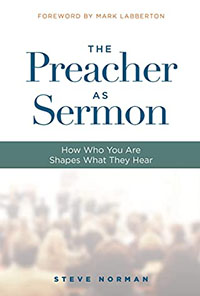
Review: The Preacher as Sermon

The Preacher as Sermon: How Who You Are Shapes What They Hear

By Steve Norman (PreachingToday.com)

Steve Norman’s struggle as a preacher is not preparing the sermon; it’s “living my life in a way that gives birth to good preaching,” that “generates life-giving preaching.” And no, that doesn’t entail a calendar full of Instagram-worthy global travel or extreme experiences.

In The Preacher as Sermon, Norman outlines 10 ways of being that preachers need to remember and embody for their sermon preparation to reach its mark in the hearer’s heart. He begins with the biblical definition of a preacher.

Norman grounds the preacher in Pauline descriptions of proclaimers, prophetic descriptions of messengers against sin and gospel descriptions of calling for repentance. He also cites biblical references to describe the preacher’s context and audience.

The remaining nine ways of being also are drawn from Scripture. Norman reminds preachers to find their identity in Christ and not in their performance in front of a critical human audience. With this identification secure, the preacher is free to proclaim God’s message for the people.

Preachers and their preaching also are shaped by what Norman calls their “social location”—what philosophers call “situatedness”—as well as their core themes and mentors. Preachers should be attentive to these things.

Other ways of being include preachers living life with their communities; engaging intimately with God; experimenting and trying new approaches with their preaching; learning from and coaching other preachers; addressing drains on joy—such as fatigue, resentment and grief; and suffering with others.

The Preacher as Sermon is the right length for a busy preacher, with each chapter broken into easily digestible sections.

Eric Black, executive director, publisher, editor
Baptist Standard