Connect360: Everything We Need

  • Lesson One in the Connect360 unit “Find Us Faithful: Standing Firm in Our Faith” focuses on 2 Peter 1:1-4

When we know Jesus as Christ, Savior and Lord, we receive all his precious promises.

As we grow in our knowledge of him, we will begin to look more like him and less like the world.

John 1:12–13 says, “But as many as received Him, to them He gave the right to become children of God, to those who believe in His name, who were born, not of blood, nor of the will of the flesh, nor of the will of a man, but of God (NASB).”

As God’s children, we share his characteristics and have escaped the world’s corruption, which is caused by our sinful nature.

Children share traits with their parents. Some are a product of nature because we are born with them.

Physically, we could look like them, or we may share certain personality traits.

Then, other characteristics come through a growing and nurturing relationship.

As we spend time with our parents, watching and listening to them, we begin walking, talking and doing things the way they do.

As God’s children, we partake in his divine nature. But the more time we spend with him listening and following him, the less we will look like the world and the more we will be like him.

“Therefore be imitators of God, as beloved children” (Ephesians 5:1) and receive the gifts the Father longs to give his children.

First Corinthians 2:12 says, “Now we have not received the spirit of the world, but the Spirit who is from God, so that we may know the things freely given to us by God.” So, take hold of his precious promise.

We gave our children gift cards in their Christmas stockings this year.

The girls spent their cards quickly. But the boys could not decide and ended up walking out of the store with the cards in their pockets and nothing in their hands.

All four thankfully received their cards, but until they purchased something with them, our gift was wasted. We paid the price for nothing.

Receiving Jesus is no different. He paid for the sins of every person in the world. Your life has already been bought. So, what will you do with his purchase? Will you live for the One who died for you? Will you claim the promises he has for those who call Jesus their Savior? He is offering you everything pertaining to life and godliness. Will you take it and use it for his good pleasure?

To learn more about GC2 Press and the Connect360 Bible study series, or to order materials, click here.


Review: Dangerous Dilemmas: Patrick Wigglesworth’s Bizarre Bible Adventure, Book 3

Dangerous Dilemmas: Patrick Wigglesworth’s Bizarre Bible Adventure, Book 3

By Liz and Jack Hagler (Tyndale Kids, 2024)

Dangerous Dilemmas not only perfectly pegs the daily decisions of preteens and early teenagers, but also defines issues Bible characters face in Psalms through Malachi. Previously, in Over My Head, Book 1 of Patrick Wigglesworth’s Bizarre Bible Adventure, the lad “got yanked into the Bible” as he humorously journeyed and journaled through Genesis to Deuteronomy guided by Moses. In Book 2, Tricky Times, Joshua led the boy from Joshua through Job.

In Book 3, Dangerous Dilemmas, David, Solomon and Daniel pull 11-year-old Patrick from Psalms to Malachi. Liz and Jack Hagler combine Jack’s imaginative melding of fiction and fact with Liz’s engaging black-and-white illustrations to create a hilarious and poignant graphic novel in the form of Patrick’s illustrated journal describing his adventures as a kid and a time traveler.

As the story begins, fifth-grader Patrick serves as student council president when all the presidential candidates who beat him drop out. That means he’s in charge of planning the carnival, barbecue and science camp and leading the morning Pledge of Allegiance although he’s often late. Then, King David tugs him into another biblical tumble.

Sure enough, Patrick becomes one of David’s sheep and makes grass angels as the shepherd snatches him from the enemy. Next, he meets King Solomon, and the two write a promo-rhyme, “Proverbs Are Like Vitamins.” Meanwhile, back at school, Patrick’s mom, little sister and her friends save the newly combined carnival/barbecue complete with a kissing booth.

Not done yet, Patrick trips through Ecclesiastes and Song of Solomon, sipping fresh pomegranate juice, illustrating a love letter, and morphing carnival kissing into a peck-on-the-cheek.

The real challenge arrives in remembering the names of 16 different prophets who wrote 17 Bible books. The task just about “fries his brain” until he discovers clever lines like “Habakkuk has your back” and “Zesty Zechariah.” Thankfully, “Daniel’s the Name, Veggies Are My Game!” steps up as his new guide. Patrick stops to help plan the sixth-grade science camp he can’t even attend. Fortunately, the science teacher makes an exception. Unfortunately, the fifth-grader has to be the gofer, mopper, bad-news teller and handle tough jobs just like the prophets.

Those camp tasks help Patrick draw often humorous prophet lessons. He writes a super hero story, “My 10-Day Adventure with Daniel Eating Only Veggies.” After reading Joel, the gofer “borrows” a jar of live locusts from the camp storeroom, but he can’t return them because the cook fries them for supper. He follows Jeremiah into the cistern, helps search for Hosea’s missing wife, and better understands Micah when his own clothes are stolen from the shower house. No, the prophets didn’t have it easy, but even Jonah got a do-over, Patrick observes.

Liz and Jack Hagler have added Bible references to help readers dig deeper since Dangerous Dilemmas isn’t a Bible storybook, although it does contain them. Instead, the graphic novel offers engaging ways for young readers to better understand scripture and apply biblical lessons to the dangerous dilemmas of life. As Patrick learns, “If you want wisdom, take a proverb, you’ll feel tip-top. And once you taste these wisdom nuggets, you’ll never want to stop.”Hopefully, Desperate Dilemmas can help girls and boys never want to stop learning about God.

Kathy Robinson Hillman, former president

Texas WMU and Baptist General Convention of Texas

Waco


Review: Lord Remember Me

Lord Remember Me

By David Vernon (Xulon Press Elite)

Author David Vernon considers Samson’s prayer as a reminder for us of God’s grace, forgiveness and power.

Samson’s prayer for the Lord to “remember me” is highlighted with the author’s commentary on Samson’s legacy, his appearance in the hall of faith, and the struggles of everyday life.

His book is best read as you review Judges 13 through 16, a study that Vernon did while traveling with the Singing Men of South Texas in Ukraine and studying the life of Samson.

Vernon offers a unique take on the story of Samson, looking at him as more than just a Nazarite with long hair, his lust for women and his dealings with Delilah and the Philistines.

Rather than seeing his prayer in Judges 16 as a “pitiful end to a sad and tragic life,” the author examines Samson’s life as he compares his faults to those who struggle to follow the Lord and his commands in the present day.

Vernon covers topics like the importance of a strong and vibrant prayer life, much like the one similar to Samson’s parents.

Other topics include the work of the Holy Spirit, the sanctity of life, honesty in relationships, love, and seeking what God desires in our lives.

Believers can take from this study that a devotion to God and a desire to live a holy life are the solutions to avoiding the pitfalls encountered by Samson.

Lord Remember Me serves as a unique reminder that the Lord can use anyone and anything for his glory and purpose. The book also serves as a reminder that everyone has a choice in living for the Lord rather than for self.

Kendall Lyons, news reporter

Baptist Standard


Connect360: Ambassadors for Christ: The Ministry of Reconciliation

  • Lesson Fourteen in the Connect360 unit “Ambassadors for Christ: The Ministry of Reconciliation” focuses on 2 Corinthians 5:11-21

In 2 Corinthians 5:14, Paul began by stating, “For Christ’s love compels us.” The phrase encapsulates the deep motivation behind the ministry of reconciliation.

The love of Christ is not just a theological idea; it is a living, breathing force that drives believers to action.

Paul’s personal testimony about the transforming power of Christ’s love was rooted in the knowledge Christ died for all people, reconciling them to God.

The apostle further explained the love of Christ compels believers to live “for him who died for them and was raised again” (2 Corinthians 5:15).

It is a sacrificial love—shown in Christ’s death and resurrection—that becomes the central push behind the Christian’s desire to share the message of reconciliation with others.

Moreover, Paul’s use of the term “compels” (Greek, sunechō) speaks to a deep inner driving force, one that controls andmotivates the believer’s every action.

The compulsion comes not from external pressure or obligation but from a heart transformed by God’s love.

The experience of God’s love is so profound, it compels believers to step into the world as ambassadors, representing Christ’s message of hope to a broken and desperate world.

The motivation is also rooted in the theological understanding that humanity is estranged from God due to sin, and the only means of reconciliation is through Jesus Christ.

Paul wrote in Romans 5:10 that “while we were God’s enemies, we were reconciled to him through the death of his Son.”

This passage (Romans 5:10–11) reinforces the reality that God’s love is not contingent upon human worthiness but is agracious initiative from God to restore the broken relationship. The Christian response to unmerited grace is a desire toshare the message of reconciliation with others, inviting them into the same restored relationship with God.

Experiencing God’s love profoundly and personally changes us forever.

Christ’s love toward us draws our response to him. Christ’s love in us spurs us to care about others. Christ love through us stirs others to know and embrace him.

 To learn more about GC2 Press and the Connect360 Bible study series, or to order materials, click here.


Review: You Have a Calling

You Have a Calling: Finding Your Vocation in the True, Good and Beautiful

By Karen Swallow Prior (Brazos Press)

Author Karen Swallow Prior offers a helpful and insightful examination of what it means to discover and live out one’s calling. Prior seamlessly weaves together biblical principles, literary examples and wisdom gained from personal experience.

She begins by distinguishing calling and vocation from work and passion. Work has inherent value, in addition to providing income and—perhaps—a sense of fulfillment, but calling has a higher purpose. Passion can provide the fuel to help us achieve some great purpose, but many individuals labor in jobs totally unrelated to their passions. They may be called to something far greater than what could be a fleeting passion.

Sometimes, specific vocations or callings may be only for a season of life, but all Christians share a common lifetime calling, Prior asserts. She makes a compelling case that every Christian is called to pursue truth, goodness and beauty, because those transcendent qualities are characteristics of God.

You Have a Calling obviously would make an excellent gift for a recent high school or college graduate who is seeking to discover his or her purpose. It can serve as a good reminder to retirees or to those who soon will retire that employment lasts for a season, but calling lasts for a lifetime. And Christians at any stage in life will resonate with Prior’s admonition to live authentic lives of wholeness and integrity before God.

Ken Camp, managing editor

Baptist Standard


Connect360: Fishing, Farming, and Families

Farming as a metaphor emphasizes the importance of patient cultivation. Just as a farmer must sow seeds and tend to them with care, disciple making involves nurturing new believers in their faith.

The work of disciple making is not instantaneous. It is a process of growth that takes time and care.

Just as a farmer cannot rush the growth of a crop, neither can a disciple maker rush the spiritual development of a believer.

The apostle Paul’s analogy highlights the collaborative nature of disciple making— different individuals may be involvedin various stages of the process, but it is God who causes the growth.

In Matthew 13:3–9, 18–23, Jesus told the Parable of the Sower, where he compared the gospel to a seed that is sown ondistinct types of soil. Some of the seeds fall on rocky ground and do not take root, while other seeds fall on good soil andproduce a great harvest.

This parable illustrates the importance of the soil—the hearts of those who hear the message of the gospel.

The work of farming, therefore, involves not only sowing the seed (the gospel) but also cultivating the soil (the hearts of the hearers) through prayer, teaching and discipleship.

In John 4:34–38, Jesus further emphasized the harvest metaphor when he spoke to his disciples about the spiritual harvest that is ready to be gathered.

He compared the labor of disciple making to the work of farming, calling his disciples to join in reaping what others have sown.

Evangelism is a cooperative task—one that involves sowing the seed of the gospel, nurturing the relationships and then reaping the fruits of God’s labor in due season.

But remember … without a season of sowing, a season of harvest is not possible.

 To learn more about GC2 Press and the Connect360 Bible study series, or to order materials, click here.


Connect360: Proclaim the Good News

  • Lesson Twelve in the Connect360 unit “Proclaim the Good News” focuses on Mark 1:1-4; Luke 4:42-44; Acts 5:42; 11:19-21

The “good news,” often referred to as the gospel, is the message of salvation through Jesus Christ. The foundational textsof Mark, Luke and Acts highlight the centrality of this proclamation in the early church and the ministry of Jesus.

In Mark 1:1–4, the gospel introduced as the “beginning of the good news of Jesus the Messiah, the Son of God,” fulfilled the prophecies of the Old Testament.

John the Baptist’s role in preparing the way for Jesus is also emphasized, as John called people to repentance in anticipation of the coming Messiah.

Similarly, in Luke 4:42–44, Jesus himself proclaimed the good news as he traveled from town to town, teaching andhealing.

Jesus’ mission was clear. He came to preach the kingdom of God, and he emphasized that his proclamation wasessential to the work of God.

In Acts 5:42, we see that the early church continued his mission: “Day after day, in the temple and from house to house,they never stopped teaching and proclaiming the good news that Jesus is the Messiah.”

This passage illustrates the ongoing commitment of the early followers of Jesus to proclaim the good news, despite opposition and persecution.

The essence of the good news, as detailed in the New Testament, is summarized in the life, death and resurrection of Jesus.

Matthew 4:23–25 and 9:35–38 recount how Jesus traveled throughout Galilee, teaching in the regional synagogues, preaching the good news of the kingdom and healing the sick of various diseases.

These acts were not only physical but also spiritual demonstrations of the good news that Jesus proclaimed: the kingdom of God had come near, and through Jesus, humanity could experience healing—both physically and spiritually.

Isaiah 53:4–6 speaks prophetically of the suffering servant who would bear the sins of the world, providing a framework for understanding why the good news is indeed “good.” Jesus’ life and sacrifice fulfilled in prophecy,showing that the suffering servant came to take away the sins of the people and reconcile them to God.

The core of the good news is Jesus came to restore humanity’s broken relationship with God, offering forgiveness and eternal life through his death and resurrection.

The good news is the message of hope and redemption. It declares that through Jesus, people can be forgiven, freed from the bondage of sin and given new life.

This message is not just for a select group but is meant to be shared with everyone, regardless of their past, their social status, or their position in society.

Jesus’ invitation to the kingdom is all-encompassing, offering a restored relationship with the Creator to all who believe in him.

To learn more about GC2 Press and the Connect360 Bible study series, or to order materials, click here.


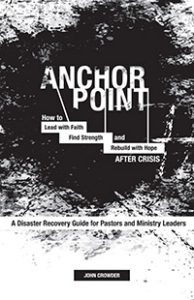
Review: Anchor Point: How to Lead with Faith, Find Strength, and Rebuild with Hope

Anchor Point: How to Lead with Faith, Find Strength, and Rebuild with Hope

By John Crowder (Invite Press)

During my 20-plus years of ministry, I’ve only recommended one book to ministers. Now, I recommend two books. The first is Marshall Shelley’s Well-Intentioned Dragons: Ministering to Problem People in the Church, republished in 2013 as Ministering to Problem People in Your Church: What to Do with Well-Intentioned Dragons.

Church conflict is interpersonal conflict. As long as ministry involves people, Shelley’s book is indispensable for the inevitable church conflict and helped me more than any other book.

Likewise, some degree of disaster will visit your church or your life. John Crowder’s Anchor Point: How to Lead with Faith, Find Strength, and Rebuild with Hope is indispensable for preparing yourself—as much as a person can be prepared for disaster.

Crowder begins by taking us back to the evening of April 17, 2013, when a fire in a fertilizer facility in the Central Texas town of West flashed into a devastating explosion heard as far away as 45 miles and felt as far away as 50 miles. Crowder’s first-person account of what followed is gripping—perhaps because I was one who heard the explosion.

In the chaos of responding to a disaster, it is easy to be overwhelmed and to neglect practical concerns. This book is designed to prepare leaders for that overwhelm, even in the first moments.

Crowder emphasizes the necessity of presence, outlining a short list of things leaders need to do in the first 24 hours. From here, he charts the path beyond disaster. And that’s where this book shines.

Chapters 4 through 9 are a master course in disaster response. Every minister and church leader should study Crowder’s counsel on taking care of themselves in order to take care of the church and larger community. They should become familiar with his description of the phases and emotions of disaster recovery. They should rehearse his advice for responding to anger, frustration and criticism, which is some of the best counsel in a book packed with excellent insight.

Not to be neglected are his two chapters on managing financial assistance and interacting with the media. In the middle of everything else needing attention during a disaster, finances and the media can turn a situation on a dime—for better or worse. Crowder’s counsel here is invaluable.

One of Crowder’s gifts is telling the story straight—with all its pain—without losing hope or discouraging the reader. Another is the fact he wasn’t an expert in all—or any—of this before April 17, 2013. Much of what he shares in Anchor Point: How to Lead with Faith, Find Strength, and Rebuild with Hope he learned while going through the disaster’s aftermath.

One more thing about Crowder’s counsel: It doesn’t just apply to major, community-wide disasters. It also applies to the disasters that strike smaller groups of people—such as a car wreck, a house fire, a cancer diagnosis. That transferability is just one reason Anchor Point is the second of two books I recommend to all ministers … and anyone else who needs to be ready for the unexpected.

Eric Black, executive director/publisher/editor
Baptist Standard


Review: Contesting the Body of Christ

Contesting the Body of Christ: Ecclesiology’s Revolutionary Century

By Myles Werntz (Baker Academic)

What do the ecumenical, holiness, charismatic, Social Gospel, lay renewal and liberationist movements have in common? Myles Werntz, director of the Baptist Studies Center at Abilene Christian University, contends they all represent ways global Christians in the 20th century wrestled with and responded to questions about what defines the church and its mission.

In Contesting the Body of Christ: Ecclesiology’s Revolutionary Century, Werntz explores how Christians around the world and in varied contexts followed diverse paths—generally in response to the Holy Spirit’s guidance, as they understood it—to live out what it means to be Christ’s church.

Since at least the fourth century A.D., Christians have confessed belief in “one, holy, catholic and apostolic church.” Werntz examines how followers of Christ in the past century worked out the meaning of each of these four marks—unity, holiness, universality and continuity. He looks not only at Roman Catholic, mainline Protestant and evangelical examples, but also at Orthodox, Pentecostal and charismatic expressions of the Holy Spirit at work in the church.

One of the greatest strengths of Contesting the Body of Christ is its international scope. Too often, American Christians tend to assume the Christian landscape as we know it surely must represent the global church, as well. Werntz offers a broad view that encompasses Christianity in Asia, Africa, Latin America and Eastern Europe, as well as in North America and Western Europe.

After Werntz provides a look back at how the marks of the church were reaffirmed in some ways and reshaped in others during the 20th century, he concludes what he calls “a modest proposal” for the 21st century church. Contesting the Body of Christ is not light and easy reading, but Baptist Standard readers can benefit from considering thoughtfully what Werntz views as reasons for hope and a Spirit-led way forward.

Ken Camp, managing editor

Baptist Standard


Connect360: Discipleship and Ministry Leadership

  • Lesson Eleven in the Connect360 unit “Discipleship and Ministry Leadership” focuses on Luke 6:12-16; 8:1; 9:1-6; 10:1-17

Jesus’ model of discipleship deliberately was structured to prepare the apostles with leadership skills necessary to establish the church.

In Luke 6:13, we read that Jesus “chose twelve of them, whom he also designated apostles.”

The term apostle signifies a commissioned leader who is sent with authority and a mission. Jesus’ investment in the apostles went beyond teaching them spiritual truths—it was a comprehensive leadership development process.

Through his ministry, he prepared them to lead the early Church by modeling leadership, teaching them how to serve and providing them with opportunities for direct ministry experience.

One of the key elements of Jesus’ leadership development strategy was his personal example.

In Luke 22:27, Jesus asked his disciples: “For who is greater, the one who is at the table or the one who serves? Is it not theone who is at the table? But I am among you as one who serves.”

Jesus’ humility and servant leadership style were core components of his discipleship process.

The apostles were not merely taught concepts; they were shown through Jesus’ example how to lead with humility, sacrifice and service.

Furthermore, in passages such as Matthew 16:18–20, Jesus emphasizes the authority he is allocating to his disciples as leaders in the kingdom of God.

He said, “I will give you the keys of the kingdom of heaven; whatever you bind on earth will be bound in heaven, and whatever you loose on earth will be loosed in heaven” (16:19).

Jesus’ declaration indicated the apostles were not merely followers of Jesus, but also future leaders of the Church, entrusted with the responsibility of guiding the early Christian community.

The transfer of kingdom leadership from Jesus to his apostles was a pivotal moment, and Jesus ensured that his disciples were thoroughly prepared for the responsibility.

To learn more about GC2 Press and the Connect360 Bible study series, or to order materials, click here.


Connect360: Dynamic Doctrines

  • Lesson Ten in the Connect360 unit “DiscipleMaking: Patterns of Discipleship and Evangelism for the Contemporary Church” focuses on 2 Thessalonians 2:13-17; Hebrews 5:11-13; Romans 16:17-18.

In 2 Thessalonians 2:13–17, the apostle Paul underscored the importance of foundational doctrines in the life of abeliever.

Paul wrote that “God chose you as the firstfruits to be saved through the sanctifying work of the Spirit and through belief in the truth” (2:13).

The truth of the gospel is central to salvation and sanctification. Believers are called to stand firm and hold fast tothe teachings they have received (2:15).

Teaching provides the foundation for spiritual growth. Through greater knowledge of God via sound doctrine, believers are sanctified, grow in holiness and are conformed to the image of Christ

In Hebrews 5:11–13, the author addressed the lack of spiritual maturity in the recipients of the letter.

The author lamented they should have progressed beyond basic teachings to deeper truths but were still in need ofelementary doctrine.

The author explained that “anyone who lives on milk, being still an infant, is not acquainted with the teaching aboutrighteousness” (5:13).

This highlights the necessity of progressing from foundational doctrines to more advanced understanding, which iscrucial for spiritual growth. To know God fully, believers must not only receive the basic tenets of the faith, but alsomature in their understanding of God’s will as revealed in Scripture.

Romans 16:17–18 warns believers against those who promote division and teach contrary to the doctrine that has been handed down.

The apostle Paul exhorted Christians to “watch out for those who cause divisions and put obstacles in your way that are contrary to the teaching you have learned” (16:17).

False teachers distort the gospel, and their influence can hinder spiritual growth.

It is essential believers be grounded in sound doctrine, so they can identify and reject teachings that are not in line with the truth of Scripture.

To learn more about GC2 Press and the Connect360 Bible study series, or to order materials, click here.


Connect360: Get in the Habit! Spiritual Disciplines and Practices

  • Lesson Nine in the Connect360 unit “DiscipleMaking: Patterns of Discipleship and Evangelism for the Contemporary Church” focuses on John 15:6-10; Hebrews 12:10; Acts 13:2-3; Colossians 4:2-4.

Foundational Habits of Discipleship

Bible study serves as the bedrock of spiritual growth. Engaging with Scripture not only deepens one’sunderstanding of God’s nature, but also fosters a personal relationship with him.

Regular study of the Bible equips individuals with knowledge and wisdom, enabling them to navigate life’s challenges. Systematic study methods encourage believers to observe, interpret and apply biblical texts actively.

This practice cultivates critical thinking and allows individuals to discover personal insights, which can lead totransformative experiences in their spiritual lives.

Prayer is another foundational habit that profoundly influences spiritual development. It is through prayer thatindividuals communicate with God, express their thoughts and feelings, and seek guidance.

Philippians 4:6 states: “Do not be anxious about anything, but in every situation, by prayer and petition, withthanksgiving, present your requests to God.”

Moreover, various forms of prayer—such as intercessory prayer, contemplative prayer and corporate prayer—enhance spiritual growth by encouraging individuals to engage with God and the community.

These practices not only strengthen one’s faith, but also foster a sense of belonging within the body of believers.

Worship is integral to spiritual disciplines, as it focuses on honoring and glorifying God. Engaging in corporate worship, as emphasized in Hebrews 10:24–25, encourages believers to “spur one another on toward love and good deeds, not giving up meeting together.”

Worship creates a communal atmosphere where individuals can experience God’s presence collectively, reinforcing their faith. Personal worship through music, art or nature can lead to profound spiritual experiences.

Engaging in worship helps believers express gratitude, reflect on God’s goodness and realign their priorities,thereby facilitating deeper spiritual growth.

Serving others embodies the principle of love and is a crucial aspect of spiritual development. Jesus exemplifiedthis through his life, teaching that “whoever wants to become great among you must be your servant” (Matthew 20:26).

By serving, individuals not only obey Christ’s command, but also experience the joy of putting others beforethemselves. Acts of service can take many forms, from leading in the congregation to volunteering in local communities to participating in global missions.

Engaging in service cultivates empathy, humility and a sense of purpose, all of which are vital components ofspiritual maturity.

To learn more about GC2 Press and the Connect360 Bible study series, or to order materials, click here.