BaptistWay Bible Series for June 22: The discipline of learning

Matthew 11:28-30; John 14:23-26; 1 Corinthians 3:1-3; Hebrews 5:11-14

There is a piece of my educational past about which I am not particularly proud. In my junior year of high school, I signed up for accelerated Algebra 2. The teacher was a very likeable fellow. He was a bit unorthodox in his methodology (at least as far as I was familiar). He laughed and joked and made up problems in his head for examples rather than following the book page for page.

Perhaps the most peculiar thing that I discovered about him was that although he assigned homework, he never took it up. As my adolescent logic kicked in, I decided that if he didn’t take it up, I wouldn’t have to bother doing any homework. It seemed like a great plan … until the tests. Then I learned a valuable lesson from a painful experience: The day-to-day learning must take place if I am going to gain an understanding and mastery of the subject. My final grade for Algebra 2 was not a passing grade. I had to repeat the course the next year. I did not, however, repeat my mistake.

The Christian life bears some striking similarities to my math class in high school. There are day-to-day assignments no one is grading. But failure to learn from the day-to-day leads to a dismal performance on the day of testing. We often have been guilty of over-simplifying what the Christian life looks like: thinking regular weekly attendance at a morning worship gathering is sufficient. Scripture paint a different picture. In each of the three passages, the concept of learning as an on-going behavior is prominent.

Jesus’ statement in Matthew “come unto me” (v. 29) is a well known offer. Many weary and burdened souls have sought respite in the words of the Savior. But in the midst of the offer to lighten the load we find the command, “learn from me.” The emphatic nature of taking a yoke is understandable, but the command to learn seems out of place to the hearers today.

Too often we hope someone learns a part of what we are teaching. Teachers constantly look for new ways to communicate in the hopes a student is paying attention. In calling an individual to discipleship—day-to-day learning—Jesus implies learning is not an option. It is something that must be done.

Now that I am in full math remembrance mode, may I share another story? One Christmas break, I was helping a friend who had fallen behind in her Geometry studies. I went over to see if I could offer any assistance. When my friend opened the book to chapter seven, she could make no sense of what the assignment was asking. In frustration, she showed me the pages of the chapter that offered no support for the expectations in the problems.

I asked a simple question: “Did you cover those concepts in the last chapter?” My friend was floored. It never had dawned on her that she was supposed to actually remember the details from previous chapters. In her mind, once the chapter was done, so were those concepts. It helped bring her into better focus on the subject of geometry.

Have you run into Christians who look at their faith in much the same way my friend looked at geometry? In John’s Gospel, we find the expectation of learning put into action.

The mark of one who is following after the Master is putting into practice all they have learned from Him. Jesus draws the line clearly: If you love me, you’ll obey me. If you do not obey me, then your love for me is suspect.

A.W. Tozer is quoted as saying: “The Bible recognizes no faith that does not lead to obedience, nor does it recognize any obedience that does not spring from faith. The two are at opposite sides of the same coin.”

The focus on the Christian life is not learning a lesson and then discarding it. It is a lifetime of continually learning from our Savior, applying his truth to every area of our lives, and allowing our lives to be marked by more



Bible Studies for Life Series for June 22: Word power made wise

• Proverbs 17:27-28; 18:20-21; 25:11-12; 26:20-22, 28Proverbs 17:27-28; 18:20-21; 25:11-12; 26:20-22, 28

What bothers me so badly about a loud mouth in a restaurant or theater having a cell phone conversation? Is it that it’s just loud? Or am I bothered by the fact that I’m hearing way more personal information than I need or want to know?

At the core of this social faux pas is the truth that some folk have no boundaries; words to them are cheap and flow effortlessly and thoughtlessly.

Your learners will connect easily to this lesson because each of us has experienced the misuse of words. Words can distance people from one another. Words can offend. Words can hurt. Words can lie. Words can damage.

But words also can do good. Words can bring people closer. Words can solidify people around ideas. Words can bring healing. Words can convey deep truth. Words can carry love, understanding and encouragement. This is the reason why Christians must carefully choose words, and sometimes censor our words rather than blurting out whatever comes to mind.

This week’s Bible reading teaches us that we are accountable for our words and that God wants us always to use our words for good. Words have real power and we should use them with wisdom.


Choose your words carefully (Proverbs 17:27-28)

Ask your learners if they’ve ever said something they regretted? By nature, humans make that mistake. Sometimes we say things in anger that hurt others, and later, we must apologize. Sometimes we say things hurriedly, and our impatience betrays us to less mature ways.

Ask your learners if they’ve ever fallen into the trap of “angry e-mail.” That’s a situation where many people have found themselves. For example, they receive an e-mail from another party that is offensive and they yield to the temptation to use words inappropriately. The reason this is a persistent problem in our culture of computers is that we are more likely to blast someone via e-mail than in person. And, like the toothpaste out of the tube, once that e-mail is out there, it can’t be retrieved.

This passage teaches that keeping silent is better than commenting on situations we don’t fully understand. It also teaches that saying things that are reactionary, rather than well thought out can lead to difficulty in relationships.

It’s best, then, to keep silent until we have chosen our words carefully. By thinking before they speak and being careful about what they say, God’s people avoid getting into trouble because of their words. Moreover, we can avoid embarrassment and trouble by carefully guarding our speech.


Respect the power of words (Proverbs 18:20-21)

We show wisdom when we understand how our words can bear fruit in others lives. The power of words is real and can be used for good effect. Proverbs 15:4 is an additional text you will want to highlight for your learners, as it points to the power of a good word, comparing it to a tree of life.

Undoubtedly, we have been hurt by the words of others, and have caused hurt in the lives of others with words. This is something we continually must examine in our spiritual lives. But we have a responsibility that goes beyond “do no harm” and extends into “do good with our words.” Christians can be life-affirming and life-giving in every social circle and have a responsibility and privilege to counter negativity, falsehood and slander with words that communicate God’s light. It is a very real and practical way in which we can be a blessing to others around us.

Perhaps the greatest use of time at this point in the lesson would be to allow for some silence and prayer asking God to reveal better ways to use their words. Consider these statements as a guided prayer for your group:

• God, reveal to me times when I have caused hurt with my words.

• God, give me insight into how I can speak words of encouragement to someone specific in my life.

• God, forgive me for using words negatively, and forgive me for times when I have failed to use words for good.

• God, give me sensitivity to know when to speak and when to remain silent.


Use good words (Proverbs 25:11-12)

Now that you have spent some time with your learners thinking about good and bad uses of words, it will be helpful to look at specific traits of good words. This proverb teaches that an aptly spoken word is like apple of gold set in silver—precious and desirable. But what makes for an “aptly spoken word?” There are many elements, but to be sure the definitions include truthfulness, gentleness and pleasantness.

We’ve been taught from a young age to always speak the truth. Proverbs 14:25 reminds us that a truthful word has the ability even to save lives, and that a mistruth can bear false witness— and even lead to death.

As your learners concentrate on using good words, truthfulness will be the primary characteristic you want to reinforce. The reality is that while we all know this teaching is the ideal, many times we fail to achieve the standard. Use of good words does not leave room for outright lies, nor lies of omission.

Speaking the truth is hard, and even more difficult is the challenge to speak truth gently. A gentle tongue can indeed turn away wrath but also can promote the ability to be truly heard by the other.

Ask your learners to remember a time when someone told them something they didn’t want to hear. Ask them to consider whether they heard that truth better or worse because of the tone of voice, the eye contact or the body language of the other. Ask them to consider ways that speaking truth gently can happen. Is it all in the words you say? Or is it how the words are delivered?


Avoid trash talk (Proverbs 26:20-22, 28)

Scripture pinpoints gossiping, constant quarreling and flattering someone insincerely as examples of especially hurtful, destructive speech. This passage points to the troubles of such speech, and also to the consequences of such speech. The bottom line? The truth comes out eventually.

By refusing to gossip or listen to gossip, we can help cool down conflict rather than heat it up. This is one of the most prevalent problems in established churches. There is a lack of focus on doing justice and mercy when gossip is the main food of the fellowship, and even listening to such talk is destructive to the church.

You can call your learners to self-examination and confession about this topic. Ask your students how they perceive the gossip/trash talking affects your congregation.


Explore the Bible Series for June 22: Philip: Consistency

When is the right time to share your faith with someone? While many believers might correctly state that anytime is the right time, in practice, most seem to connect witnessing with participation in some specifically Christian or church-related activity.

For example, most have little problem sharing faith experiences within a Sunday school class or during church visitation or while on a mission trip, but do not associate telling someone about the gospel in the ordinary activities of daily life. While some may see non-religious social occasions as inappropriate settings for sharing a personal witness, many others simply never think of these settings as opportunities to witness. Others may see such evangelizing as the special duty of the minister.

Yet nowhere does the Bible specify the “proper conditions” needed in order for a believer to share their faith. Indeed, the Great Commission in Matthew 28:19 instructs all believers to spread the gospel “as you go,” that is, at all times and in all situations.

Finally, there are believers who take Saint Francis’ admonition to “preach the gospel at all times and, when necessary, use words” as support for letting their actions speak for them. Yet while actions and behavior may set a person apart, they only serve as a witness when accompanied by verbal explanations.

As we look at the life of Philip, we can see and learn from one who understood that God calls all believers to be a consistent witness everywhere they go.


New circumstances (Acts 8:4-8)

With the stoning of Stephen, the early believers scattered beyond the area around Jerusalem in fear the authorities would come after them. Many found themselves in places they had never been before. They were confronted with people they did not know who often had unfamiliar customs and traditions.

Yet they knew the gospel they proclaimed cut across all differences and revealed truth to all hearers. Their methods for delivering the message might change as circumstances dictated, but it was the same message that spoke to people in all the situations of life.

Even though he was in the new area, fearing the authorities and not knowing if the local population would turn him in, Philip continued to speak and act in a way that attracted people and pointed them to Jesus.

Today, we may find God specifically calling on us to share our witness in circumstances that are new or in which we have never considered talking about our faith. We can fulfill this call by either verbally sharing the gospel, distributing tracts or Bibles or inviting someone to church. Whatever form our witnessing takes, we always should remember that God has sent us into the world as messengers with the task of spreading God’s message of hope in whatever circumstances we find ourselves.


Challenging conditions (Acts 8:9-13)

Although we may wish it to be different, we all know life as a witness is not always easy. People are not always drawn to our speaking about the gospel. Often, we find people are completely indifferent or even slightly hostile to our evangelistic efforts. It often is challenging and difficult to gain an audience in order to be heard.

The Bible tells us Philip entered an area where the people were attracted to the magical signs and the words of a magician. Philip’s message was quite different than Simon’s, but it was a challenge to get the people to listen and accept his truth over Simon’s impressive demonstrations. Philip, however, refused to alter his message or draw people in through sleight of hand. Instead, he consistently proclaimed the gospel, and eventually the people listened. The Bible says even Simon accepted Philip’s message.

Often when we encounter difficulties in witnessing, it can be tempting to resort to flashy productions or to soften the message. But God calls us to be consistent in unapologetically presenting the gospel even in the midst of challenging conditions.


Special situations (Acts 8:29-38)

While we are to share our faith in the ordinary activities of life, there may be times when we find ourselves in unusual situations through which we have a special opportunity to point someone to Jesus.

For Philip, this came as God led him to a place where he had the unique chance to speak to an Ethiopian who had been reading the Hebrew Scriptures. It was a case of being in the “right place at the right time” as he was able to answer this man’s questions.

For us today, this special situation may be in the aftermath of a tragedy or disaster. In those times, so many people are looking for comfort and hope. Sensitive believers have the opportunity in such times to point people to God and demonstrate his love in word and deed.

At other times, God may inspire a believer to share with a particular nonbeliever with whom there is already a close relationship. In such special situations, as the saying goes, you may be the only Bible that other person may ever read.

The story of Philip thus teaches us that God desires us to consistently witness and share our faith in whatever circumstance we may be and always be watchful for those special “divine appointments” which God leads us into in order that someone might be drawn into a closer relationship with God.


Explore the Bible Series for June 15: Stephen: Boldness

• Acts 6:8-15; 7:54-60

The dictionary defines “boldness” as “fearlessness; courageousness.” It perhaps most often is associated with those who demonstrate conspicuous bravery in the face of real physical danger. Yet we also talk of the boldness of those who confidently express their ideas and opinions in the face of possible disagreement.

Most people have little problem summoning the boldness to state their convictions in discussions of sports or politics. Yet many believers find it difficult to verbally affirm their faith in a crowd of unbelievers. Fear of rejection or ridicule is typically the reason given for their hesitancy. Yet all believers know the message of the gospel is far more important than any particular opinions concerning the best team or any specific political issue. God has commissioned all believers as heralds of great news and calls on us to do so boldly.

The book of Acts contains the stories of the leaders of the early church and their commitment to faithfully spread the message. Among those stories is that of Stephen, the first Christian martyr. Stephen stands for all time as a model of boldness in professing and defending faith in Jesus.


Bold in discussion (Acts 6:8-10)

As the early church began to spread and grow under the leadership of the apostles, it quite naturally came into conflict with the Jewish religious leaders. As they had with Jesus, these rabbis saw the believers as proclaiming a message that called for neglecting or even denying the validity of the old traditions. In addition, they noted the fact that the leaders of the new church were fishermen who had no formal religious training, and so they sought to engage them in debates in order to discredit them.

On one such occasion, Stephen, who had just been selected as one of the first deacons, faced a gathering of rabbis representing several geographical regions and ideological positions. They almost certainly disputed with him on a number of theological issues and came from different angles, yet the Bible states they could not prevail against the wisdom with which he spoke.

There is no indication Stephen ever had formally studied philosophy or theology. Acts 6:5 simply states he was filled with the Holy Spirit. It is that presence within the life of every believer that gives us boldness as witnesses. We need not feel the response of someone else because the Spirit will empower us and give us the words to say.


Bold amid hostility (Acts 6:11-15)

In response to their failure to overcome Stephen in the debate, the rabbis sought to incite the crowd against him by claiming he had blasphemed and condemned Jewish traditions. Although verse 15 indicates they saw no contempt in him, opposition began to arise against Stephen. Knowing how they had treated Jesus, Stephen perhaps began to sense they intended to silence him. Stephen faced consequences to his continued profession which were far more dire than rejection or ridicule. Yet he continued to unapologetically proclaim the gospel.

Indeed, as the hostility against him rose, he stood in the midst of the crowd and clearly explained how their own traditions had pointed to Jesus (chapter 7). At the end of his elaborate argument, Stephen boldly accused the religious leaders of being the ones who had denied the truth. They had studied their own history and knew what the ancient prophets had said, but had refused to believe it.

Such a harsh and explicit accusation to the face of the religious leadership certainly required unusual boldness on the part of Stephen. The Bible tells us the gospel message is a “stone of stumbling and a rock of offense” to those who do not believe. As we share its message, we will confront resistance. Yet while many choose to be silent at the first signs of opposition, Stephen’s story shows us it is at those times that the Spirit of God within us provides all we need to remain bold even amid hostility.


Bold to the end (Acts 7:54-60)

Having been directly confronted and accused in such a manner, the rabbis responded in anger and had Stephen stoned. Even as they were raging around him, Stephen remained calm and continued to proclaim what he saw. Perhaps as a reward for his boldness and a means of peace and reassurance, Stephen is granted a vision of Jesus standing at the right hand of God in heaven. Stephen’s boldness continued as he accepted their judgment and even asked God to forgive them as he died.

It is easy for believers today to read this story and attribute Stephen’s boldness to some special position or calling. We often can see these early believers who maintained a bold profession even to death as having some special level of commitment that is beyond us. Yet the biblical accounts of their lives seem to indicate that these were ordinary men and women, no different than believers today.

In fact, believers today have the benefit of 2,000 years of church history that clearly demonstrates God’s unfailing faithfulness in upholding those who follow him. Even today, there are tens of thousands each year who pay with their lives for simply professing faith in Jesus. Indeed, God had called all believers to boldly proclaim the Truth in word and deed and in all circumstances, whether peaceful or hostile. And we can do so fearlessly and courageously knowing God’s Spirit of boldness lives in us.


BaptistWay Bible Series for June 15: Who is Jesus?

Mark 8:27-37; Romans 6:1-4

Today, a man came to the church where I pastor to bid on some painting work that needs to be done. He expressed concern regarding the different denominations our respective churches belonged to. I decided to assure him that my goal was not making more “Baptists” but making sure that everyone had a chance to hear the gospel message—that the only way to God was through a relationship with Jesus Christ.

There. I had done my pastoral duty and inserted spiritual material into an otherwise mundane conversation. His reply caught me off guard: “Yeah. He’s quite a guy, isn’t he?” Quite a guy? This attitude is one of the greatest challenges that faces individuals who choose to follow Christ. Who is it that we are following?

Jesus queries his motley group of disciples about who people think he is. Is he “quite a guy”? Or is he something more?

The popular view of Jesus in that day shouldn’t have surprised anyone. “They replied, ‘Some say John the Baptist; others say Elijah; and still others, one of the prophets’” (Mark 8:28). Obviously a religious figure. Apparently having some significance. But when Jesus probed deeper, we find Peter’s confession “You are the Christ” (v. 29).

If Jesus is just a religious figure, then there’s no need to panic. But if Jesus is the Anointed One, the Messiah, then he has reason to call us to a commitment others simply cannot.

Call to discipleship

In Mark 8:34, the twofold call of discipleship is issued. Jesus calls his closest followers and the members of the crowd to (1) deny themselves, and (2) take up their cross. These are the two aspects of following Christ.

Dietrich Bonhoeffer, German theologian, pastor and martyr, wrote in his book, Ethics, “In a world where success is the measure and justification of all things, the figure of him who was sentenced and crucified remains a stranger.”

Jesus’ view of success was radically opposed to even first century standards. How much more in today’s world. Self-denial and acceptance of personal death were the hallmarks of Christ’s earthly ministry. We are not exempt from that call.

In Mere Christianity, C. S. Lewis writes: “Christ says, ‘Give me all. I don’t want so much of your time and so much of your money and so much of your work: I want you. I have not come to torment your natural self, but to kill it. No half-measures are any good. I don’t want to cut off a branch here and a branch there. I want to have the whole tree down. I don’t want to drill the tooth, or crown it, or stop it, but to have it out. Hand over the whole natural self, all the desires which you think are innocent as well as the ones you think are wicked—the whole outfit. I will give you a new self instead. In fact, I will give you myself: my own will shall become yours.’”

Complete surrender

Christ’s call for complete surrender and following is utterly dependent upon who he is. Our salvation is utterly dependent upon who he is. It is amazing that much of what we see today that passes for discipleship is simply a convenience-oriented lipservice.

Take away the material blessings—do you still follow? Take away the good health—do you still follow? Take away the ease of finding a place to worship (or the programs that “scratch where you itch”)—do you still follow?

Our passage this week concludes with a sobering question: “What good is it for a man to gain the whole world, yet forfeit his soul?” (Mark 8:37). I like the way The Message askes the question: “What could you ever trade your soul for?”

If Jesus is just a marginal religious figure, then don’t worry about following him. Don’t waste your time denying yourself and taking up a cross. But if Jesus really is the Messiah, then how can we offer any less than our total commitment to him?


Cartoon: Angelic delays


Book Reviews: Sacred Rhythms

Sacred Rhythms: Arranging Our Lives for Spiritual Transformation by Ruth Haley Barton (InterVarsity)


Blessed is the person who has some voice in her or his life saying what Ruth Haley Barton says. I am very aware many of the books I buy are ministry-related and even how-to ministry books. Sacred Rhythms speaks instead to a person’s spiritual life.

Barton does more than remind people not to neglect the spiritual disciplines; she guides them toward spiritual reflection and instructs through “practice” sections at the end of each chapter.

She speaks personally about her experiences on various occasions. My experience with this book is that on occasion she generalizes so far as to suppose her readers feel the same way in those circumstances—or that our longings are similar. I fully believe I experience things differently as a different gender and most especially a different personality. The things she longs for, her experiences in solitude, and then her service preferences are not normative for each Christian.

Still, Sacred Rhythms is a book I have treasured. Our church even used the process described as Lectio Divina—sacred writing—in a reflection about Good Friday. The Baptist seminary classes of another day did not expose me to the literature of historical Christian reflection. I am probably more able to appreciate it now, anyway. I find Barton’s work helpful, integrating some of those processes for personal devotional reflection.books

Trey Turner, pastor

Canyon Creek Baptist Church

Temple


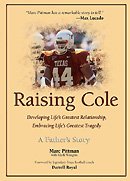
Raising Cole: Developing Life’s Greatest Relationship, Embracing Life’s Greatest Tragedy by Marc Pittman with Mark Wangrin (Health Communications)

Raising Cole is the true account of a father’s love for his sons and the tragedy of losing one of them early in life. Pittman is the owner of a construction firm, and by his own account is a huge man. Likewise, his sons grew to be big, strong men, but they never allowed their masculinity to stop them from openly showing affection for one another.


Pittman’s story, however, doesn’t start with his role as a father but as a son. His father was anything but affectionate, and early in his son’s life, he followed that same path. Raising Cole recounts his walk toward an open and extremely deep, loving relationship with his sons.

His son whose name rests in the title, Cole, was a lineman at the University of Texas. Cole had a bright and promising future when he fell asleep on his way back to campus from home and died in an automobile accident.

The book’s more poignant moments are Pittman’s response to his son’s birth and death.

My favorite chapter was “God Shows Up.” Pittman admits it is the presence of God—not his own strength—that has allowed him to continue these years following Cole’s death.

Pittman also states that though years have passed, he still grieves for his son. His grief finds solace in ways I admit I don’t fully understand, but then I’ve never lost a son.

While this book may be of help to those who have lost a child, I think it may hold more value for those whose children are still with them, especially men who may be reluctant to be open with their affection.

George Henson, staff writer

Baptist Standard

Dallas


Bible Studies for Life Series for June 15: How to storm-proof your home

• Proverbs 23:22–24:4 

This week’s lesson is indeed fitting for Father’s Day weekend, as your learners most likely will be thinking about family life. While no home or family is invulnerable to the storms of life, the principles from this week’s lesson will help fathers, mothers and children to build a home more resistant to life’s storms. Some of those storms are external to the home and some are internal, but both kinds can disrupt and destroy a family’s stability. This week’s look at Proverbs 23:22-22:4 will provide strength for shelter from the storms.


Stay true (Proverbs 23:22-25)

In this opening passage, the son is being advised to listen to and treasure the upbringing his parents provided him. Parents always rejoice when their children turn out well in life, and parents do the best they can to raise children well. The greatest credit a child can pay to his or her parents is to hold onto the truth, wisdom, instruction and understanding passed on to them and to build on those great gifts.

This passage is part of a collection of 30 sayings known as “Words of the Wise.” These are practical pieces of advice that would have been part of a Jewish child’s instruction. This is the wisdom of a father to his son.

Ask your learners to consider the advantages of life they experience because of such gifts from their parents. Values acquired in childhood make all the difference in later life. A strong work ethic, a love for education and knowledge, an appreciation of the fine arts are all examples of values we receive as children. Much of secular society endorses the transmission of these values, but the Christian home that passes along godly wisdom and faith add more. This home provides a spiritual worldview that pursues justice, lives faithfully and, in the long run, a happier, more peaceful life.

Christians, then, are called to be true to the godly teachings of their childhood, to honor their parents with right-living, as well as with deeds of respect and kindness.

You also may want to acknowledge that not everyone has experienced a Christian upbringing. This is something to be lamented, but also provides a framework for contrast of adult living to the childhood ways that should be left behind.


Application ideas

• We show wisdom and demonstrate we are committed to live right when we respect our parents throughout their lives and stay true to the godly heritage they passed on to us. Ask your learners to identify values they gained from their home life as a child. Ask them to consider what values they have passed on to their children/grandchildren, and how they can continue to pass along these values.

• We not only please God but also delight our Christian parents when they see us living in accordance with God’s wisdom, instruction and understanding. Ask your learners to consider what values they learned but have lost or failed to live out. A good cultural reference is the country song “Where’d You Learn to Talk Like That?” by Rodney Atkins. Consider this: Obtain a recording of this song and play it for your learners as they gather. Here's the lyrics.


Stay pure (Proverbs 23:26-28)

In this section of Scripture, the son is urged to follow his father’s example and to avoid being lured into sexual impurity. There is hardly a more culturally relevant passage of Scripture for today than this one. We know sexual temptation is available virtually everywhere we turn, and the proliferation of pornography via the Internet has pushed things to an extreme level. The Internet is not the only vehicle, however. Just a few weeks ago, I had to explain the purpose of Viagra to my 10-year-old son after he’d been watching television at seven in the evening.

The effects of media on human sexuality can be corrosive and ultimately damaging. Media supplants the home and church in providing good sexual shaping of young people, and pathetic is the church or home that doesn’t address these matters openly and from a biblically based perspective.

The adulterous woman of this passage of Scripture provides a lure and a trap for the abuse of the God-given gift of sexuality. Unless men and women are equipped by the teachings of Scripture on how to properly celebrate their sexuality, sexual impurity will diminish lives and steal something precious from family relationships.

So then, storm proofing your home with Godly wisdom will include many things. Here are a few practical ideas to offer your learners.


Application ideas

• We can better resist sexual temptation in today’s immoral climate by discovering and emulating role models of sexual purity and marital faithfulness. Ask your learners to make a commitment to model sexual purity and marital faithfulness in their own lives.

• Christian parents should never underestimate the influence they have on their children’s futures by being role models of sexual purity and marital faithfulness. Ask your learners to think about how their home and church life can be more open to discuss human sexuality in meaningful ways that will provide young adults, teens and children with answer to their natural questions, as well as the consequences of wrong sexual activity.

• Both men and women can be lured into sexual temptation—note to your learners that the old-school notions about a woman’s disinterest in sex are false ones. Discussion about sexually temptation cannot be simply limited to a “boys will be boys” framework.


Stay clear (Proverbs 23:29-35)

Scripture warns of the seductive yet devastating effects of beverage alcohol—effects that include a variety of sorrows and troubles as well as one’s loss of control resulting from drunkenness and the potential of one’s becoming tragically addicted. Seemingly everyone has been touched by the troubles of alcoholism or drug addiction. We can avoid many personal troubles and damage to our family by simply refusing to drink alcohol. This is not a condemnation of all drinking, but it is a good way to avoid problems of addiction in your family.

While one may argue the Bible’s view on the use of alcohol, the dangers of its abuse are clear—addiction of all types can be damaging to families.


Application ideas

Ask your learners to discuss their experiences with alcoholism or drug addiction. Ask whether they would say these experiences have had positive or negative outcomes.


Stay wise (Proverbs 24:1-4)

This passage of Scripture takes a turn to talk now about envy. This passage teaches God’s people never to envy those who do evil; instead God’s people are to build their homes with godly wisdom, understanding and knowledge. This is a difficult challenge when we see families that seem more prosperous or have more “toys” and possessions.

By outward standards, homes that gain material goods but live lives of evil may seem to be happy. But the writer of Proverbs reminds the opposite actually is true. What they do is wrong and hurtful to others and to God.


Application ideas

• We are wise to build our lives and homes not on things acquired by evil means but on enduring qualities we gain from knowing and understanding God’s ways. Ask your learners to consider the parable of the houses built on shifting sand versus the stone. A good song to go with this point is Gordon Lightfoot’s “The House You Live In” (sung recently by Kate Campbell, well worth a listen). Here's the lyrics.


Explore the Bible Series for June 8: Empowered to help

Acts 4:5-10, 12-13, 18-20, 32-35

God is concerned deeply for the practical needs of people. Whether the need is caused by a physical limitation or handicap or some type of social, economic or political circumstances, God makes the resources available for the meeting of that need so the individual may experience fulfillment in life. God places those resources in the hands of those who profess belief in him and calls them to use them to make a practical difference in the lives of others.

Yet for most people, helping others is not a natural instinct. Some may even have the attitude that “God helps those who help themselves.” They may feel the church should spend its resources on those things that will improve directly the proclamation of the gospel, which most often means improving the worship services or promotional materials to attract visitors.

Reaching out to the community in social ministry can be seen as unnecessary in light of the many other state and local agencies which exist for that purpose. Yet as one reads the Bible, one cannot avoid the conclusion that God expects his people to be his hands in meeting needs.

From the Old Testament laws which protected the weak within society to the ministry of Jesus who continuously sought to cure physical problems and raise the position of the outcasts, God’s people are called to meet real needs. As the story of Peter and John in Acts 4 teaches, God not only calls us and supplies us with the resources to help, through the Spirit, he also empowers us to help.


Meeting physical needs (Acts 4:5-10)

Peter and John knew they had a story to share with everyone that would allow them to experience the abundant life which Jesus promised. Yet as they met a crippled beggar on the road, they saw that God wanted to change this man’s daily life in practical ways and provide him with an even greater testimony. They knew that for many, including the man himself, this person’s life was defined by his physical need and that need could serve to inhibit his reception of their message.

It often is truthfully said that you cannot tell someone about the bread of life when they are hungry for physical bread. Similarly, it is true that those who daily face real needs do not care how much you know until they know how much you care. A sensitivity to an individual’s physical need can often provide an opportunity to address the person’s spiritual need.

As already mentioned, Jesus provided us with the model of always seeking to meet physical needs. In helping the cripple overcome his limitation, Peter and John simply were following the example they had witnessed many times. God desires that his people never hesitate to do whatever we can through the power of his Spirit to be his hands in meeting physical needs.


Presenting salvation (Acts 4:12-13, 18-20)

While meeting the physical needs of people is important, as believers, we should always do so with the objective of sharing the plan of salvation with that person. This is what distinguishes the church from other social agencies. We have a message for the world which satisfies the deepest needs and longings of the human heart. In all of our ministering, we should make it clear that we do so in the name of Jesus the Messiah who offers peace, hope and real life in the midst of our world of chaos to all people.

This is often the most difficult (or at least most neglected) element for many individuals. Occasionally it is omitted out of pride and a desire to look philanthropic. Often it is missing due to fear or uncertainty. Sometimes it is simply overlooked. Yet if we neglect to present God’s plan for salvation, we miss out on meeting the most significant need in the person’s life. And there is no need to feel inadequate or complicate the matter.

As Peter and John told their accusers, we simply have to share what we personally have seen and heard. Every believer has a story of how they came to know the truth of the gospel and how it has changed their life for the better. People can debate over theological arguments, but they cannot deny the experienced reality of our story.


Sharing financial resources (Acts 4:32-35)

While every believer is called to be a minister and witness, no one person can be aware of or physically meet every need within the community. Because of this, it is important to provide financial resources to help those we may not be aware of. These verses describe such an arrangement as those who had the financial means, brought money to the disciples so that they could distribute it as they saw fit. Some do not think that the church should be so concerned about money. Such a topic may seem to be too “worldly.”

Yet the majority of Jesus’ parables dealt in some way with money and the overall message of the Bible is that the stewardship of our financial resources in indeed a spiritual issue.

For others the matter of sharing financially is easy. In fact they gladly give above what is expected and see that as substituting for being actively involved in ministering to practical needs. This perspective or attitude equally is flawed. We need to come to understand that as a believer we are called to share financially, witness verbally, and minister practically. Only as we do each of these can we claim to be fulfilling our call. And God wants every believer to know that as we step out to accomplish each of these, we go filled with his Spirit who empowers us to help others.


Bible Studies for Life Series for June 8: Three rules for working smart

Proverbs 6:1-15

Our identity is defined by a wide range of sources, but most commonly by our vocation. What we do for a living is perhaps the greatest source of self-esteem, feelings of accomplishment and dignity. Work also provides purpose and meaning to life, helping people to sense their usefulness in life—and for the greater good of humankind. But work also can be a source of stress:

• As young people, we worry about what we’re going to do with our lives in the future.

• As middle-agers, we wonder “what am I going to do when I grow up?” and consider unrealized goals and dreams.

• Senior adults ponder retirement and what our purpose will be after our career.

Wherever your learners may be on the spectrum of their career/vocation, they will have some touch points in this week’s lesson. This passage from Proverbs will encourage your learners that God wants them to have a fulfilling work life and will provide them with a model to faithfully pursue pleasing God through their work. Use this week’s study time to explore some of these principles given to help your learners have a better work life.

This passage teaches general life principles rather than specific commands about work and work relationships. The ideas in this week’s passage apply to the question “Ho can I have a better work life?” Biblical wisdom teaches God’s people to be wary of foolish entanglements, to work diligently and to avoid dealing wickedly with others.


Be wary of foolish entanglements (Proverbs 6:1-5)

While this passage does not provide exemption from making commitments to help the poor or support the church, this passage does caution against getting involved in shady business deals or foolish financial entanglements. The wise father is urging his son to free himself quickly and honestly through humility from agreements that put the son’s assets at risk.

This passage also speaks to the foolish entanglements that come from bad vocational decisions. Encourage your learners to consider this passage before accepting an offer from a potential employer. Challenge your learners to consider the ethical implications of their employment.

If your learners already are in an employment or business ownership position that compromises their values and beliefs as a Christian, offer prayer and counsel about how they might discern God’s leadership in making professional changes. These verses warn against putting business or financial well-being at risk to people or circumstances beyond your control.


Application idea

This is a good passage to explore how bad/unwise debt such as credit cards can be a bad financial decision that gives away control of your learner’s finances. It is likely that 50 percent or more of your learners will have burdensome credit card debt, so this passage should be an encouragement to discharge that debt as quickly and honestly as possible. Offer a few resources that can offer positive support to Christians dealing with this very real burden. Good Cents group study, Financial Peace University and other such programs offer Christian concepts of money management that will help families struggling with debt.


Be wise in your work ethic (Proverbs 6:6-11)

This passage warns slackers to adopt the ant’s diligent work habits lest they fall into poverty as a result of laziness. Not all who are unemployed are lazy. And not all who work hard are paid fairly. But diligence—or a lack thereof—is tied to poverty and want in many situations. The ant saves food in preparation for the coming winter, and by example teaches us that diligence in work now prepares for hard seasons of life to come.

Scripture also teaches the wisdom and command of God to rest from work regularly for renewal— physical, spiritual and emotional—by way of Sabbath keeping. But rest is to be a part of the rhythm of life that includes regular work. Work—tending creation—was given to humans before the fall of Adam and Eve, and it is a part of the created order of God. God’s people are to take seriously their work responsibilities, laboring diligently to provide life’s necessities and pleasures.

Work also is God’s way of blessing the future. Like the ant which saves food for winter, we are called to apply a diligent work ethic to save up for seasons of scarcity. We are wise to lay in store for future needs even as we provide for present needs. Work provides meaning and purpose in human existence.


Application idea

Talk with your students about the difference between meaningful work versus working to get a paycheck or working simply for the acquisition of things.

You may find a helpful alternative teaching tool in the contemporary song “Ants Go Marching” by Dave Matthews Band. It offers a negative example of people who spend life working without meaning, simply going through motions out of routine, rather than working with purpose for God. It is a “G-rated” song with a poetic structure that is Dylan-esque, so if you choose to play this song for your learners, be sure to provide printed lyrics.


Be warned about wicked dealings (Proverbs 6:12-15)

Of the behaviors most frequently condemned by Israel’s prophets, evil dealings—especially at cost to the poor—are considered among the sins most despised. And in the last third of this week’s passage, the troublemakers are warned they eventually bring calamity on themselves as a result of their wickedness, dishonesty and evil plots.

The Bible teaches that dealing wickedly and dishonestly with others invites judgment and disaster on the one who does such things. This passage may have been present in Paul’s mind when he penned: “Do not be deceived: God cannot be mocked. A man reaps what he sows. The one who sows to please his sinful nature, from that nature will reap destruction; the one who sows to please the Spirit, from the Spirit will reap eternal life” (Galatians 6:7-8).

Whether in business dealings or at home, Christian people are called to act honestly and avoid plots that aim at stealing or taking advantage of others. In addition, God’s people are to avoid things that stir up trouble. In a precautious mode, believers also should be alert to the possibility that some business people or coworkers may not be honest.


Application idea

Point to some contemporary businesses that have behave illegally or unethically for financial gain. Enron and Martha Stewart are a few of the most recent and public examples. You also might share a personal story of how wicked dealings affected you negatively in the work place. Ask your learners to cite examples of their own.


BaptistWay Bible Series for June 8: Receive God’s gifts with unbounded joy

Acts 9:10-19, 26-28; Romans 12:4-5; Hebrews 10:24-25

In the February 25, 2008, edition of USA Today, there was an article detailing a Pew Forum study on a survey about the Religious Landscape of the United States. The study concluded that people in the United States are “constantly shifting amid religious choices” and are “unaware or unconcerned with doctrinal distinctions.” They also noted that 44 percent of the 35,556 adults surveyed claimed they had abandoned the religious upbringing of their childhood.

One of the authors of the study, John Green, comments that, “It will become increasingly difficult to find people who share a love for a distinct doctrine.” Our culture does not value what believers absolutely must have: encouragement and accountability from other believers.

The necessity of “togetherness” is sometimes touted as a reason to avoid church: “I can worship God by myself on the lake, at the golf course, in the mountains …” We’ve heard it all before.

If you look at the passage in Hebrews, you find an admonition to stay together. Scripture tells us we are to “spur one another on toward love and good deeds” (Hebrews 10:24).

Spurs

The first time I rode a horse, my cowboy friend helped my put my spurs on—small nubs of metal strapped to the back of my boots. As I began having trouble directing the horse, my friend told me to (his words) “jab that spur in her side—otherwise she won’t pay attention to you.” As much as I was afraid of hurting the animal (I didn’t ), it was necessary to give a good nudge to keep her headed in the right direction. The same is true of believers. We need to help (sometimes with more than a nudge) keep each other headed in the right direction.

The other part of the Hebrews passage helps solidify the necessity of staying in the company of believers. We live in a world today that seems to encourage the attitude of staunch individualism. God has not designed us as Christians to live lives independent of one another.

In the miniseries “Spartacus,” viewers were transported to 72 B.C. and allowed to follow the life of a former slave who led an army of freed slaves against the Roman Empire. In one scene, Spartacus is attempting to lead his army in an attack, but selfishness and insecurity sweep the ranks. Spartacus calls one strong man forward and asks him to break one arrow, which the soldier does easily. Then he hands the soldier a bundle of arrows and asks him to break them all at once. The soldier fails and throws the arrows down in disgust. “We are like the arrows,” Spartacus says. “Separately we're weak, but together we're invincible.”

Our strength as believers in Christ is multiplied as we hold together in the local body.

Embers

When I was much younger, I remember going on camping trips with my church’s Royal Ambassador group. I continue to marvel at the patience shown by our sponsors. At some point during the camping trip, we would gather around the campfire waiting to eat cobbler while one of the sponsors would share a biblical lesson.

At one of these talks, our sponsor nonchalantly kicked a glowing ember from the fire pit. He then proceeded to talk to us about needing one another in our Christian walk. It wasn’t really impacting us that much until he reached down and picked up the now cool ember. He showed us the piece of wood that was once glowing hot had now cooled off—because it had been removed from its encouraging surroundings. He then tossed the ember back into the fire. It wasn’t very long before it began to glow again.

A poignant reminder that Christians are not called to live a solitary existence. We need one another to keep us encouraged, teachable and accountable.


Explore the Bible Series for June 1: Empowered to witness

• Acts 1:4-8; 2:1-6, 37-41 

As Christian believers, we have great news to share and a commission from God to share it with everyone. It is the news that there is hope and deep meaning and purpose in life through surrendering our life to the lordship of Jesus. It is the only message anyone could hear which has eternal significance.

Yet while most believers can willingly, or even eagerly, tell others about what is going on at their church, many simply find it very difficult to share the Good News of salvation with their friends and neighbors who do not attend church. There are perhaps a number of reasons for this, such as fear, uncertainty or insecurity. Yet whether it is a lack of motivation or a lack of knowledge, the solution would seem to be a supernatural intervention to empower us to be a vocal witness to what Jesus has done for us.

As we begin a new series on the book of Acts, we will see such divine assistance is indeed available. The early believers certainly had reason to keep their new faith a secret. State and temple officials could have had them imprisoned or executed. Yet with the power they received through the Holy Spirit, they boldly proclaimed the gospel and forever set the model for divinely empowered witnessing.


We need power (Acts 1:4-8)

It had been 40 days since Jesus had been raised from the dead, and the disciples perhaps had begun to expect he always would be with them. Jesus, however, knew he would be returning to heaven, leaving them (and us) with the task of spreading the message and building God’s church. He also knew the fear and uncertainty which the mission would create. He therefore gathered them together before he ascended in order to reassure them that divine help would come.

As they gathered, the expectations and insecurities of the disciples were apparent in their anxious questioning of Jesus. Concern over Roman reaction led them to ask if Jesus would finally establish his kingdom on earth. Although he did not give the answer they likely had hoped for, Jesus did address their need for divine help.

Today as well, many focus much of their mental strength concerned about whether today is the day Christ will return, perhaps because of feelings of fear or inadequacy for the mission. God wants us to know we can rest knowing he understands and has the answer for our need for power.


We can have power (Acts 2:1-4)

Just as they had following the crucifixion, the disciples gathered together in a private place. It seems they were both hiding and waiting for something to happen. Jesus said help would come, but they were unsure what form that assistance would take.

Suddenly they heard the sound of a mighty rushing wind. It was such an overwhelming sound it seemed to fill the house. They then saw what they could only describe as tongues of fire which divided and settled on each person present. Immediately they sensed the power of the Holy Spirit and began to boldly proclaim the gospel. Notice the Spirit not only motivated them to leave the house and go into the streets of the city with the message despite any possible reactions, it was also the Spirit which gave them the words to say. The promised help had arrived. This same Spirit which descended at Pentacost, is promised to every believer throughout all generations.

If we wrestle with fear, the Spirit will embolden us. If we question our ability to proclaim the message, the Spirit will give us the words to say. It is indeed part of the message we proclaim; whatever the need, we can have the power to overcome it.


We can use power (Acts 2:5-6)

Having received the empowering presence of the Holy Spirit, the disciples went into the streets of Jerusalem sharing the gospel with everyone they encountered. As they did so, the full measure of the Spirit’s power was revealed.

Due to the religious festival of Pentacost, the city was full of Jews from all over the Roman Empire, representing many different nationalities and languages. Yet as the disciples began to share, each person heard the gospel in his or her own language. The Spirit not only gave them the courage and power to be witnesses, he also did through them something beyond their own abilities; something for which only God could get credit. But it only happened as they took their new-found power and put it to use.

Today, we also have access to this power. The same Spirit lives in us to make us effective witnesses. But it only happens when we allow that power to flow throughout our lives and use it by sharing the Good News. When we tap into that power supply, we will find God truly does exceedingly more than we can imagine (Ephesians 3:20).


We can see power at work (Acts 2:37-41)

As word spread of this miraculous event, a crowd began to gather around the disciples. As it did, the Spirit again moved and prompted Peter, the man who had once denied even knowing Jesus, to stand and preach the first “Christian” sermon. For some of the other disciples, the sight of Peter boldly proclaiming the Jesus to such a large mixed crowd may have been evidence in itself of the work of the Spirit.

If that was not evidence, what happened next was clear visible proof of the supernatural work of God as 3,000 people became new believers. Although we face a variety of emotions as we seek to live as faithful followers of Christ, God has promised he will never leave us to face them alone. As we each seek to be witnesses of what we have experienced, we can access an infinite supply of power for the task. As we release it by stepping out and sharing the gospel, we are allowed to witness what boundless power can do. And that experience then becomes another part of our testimony to the power of God.