Connect 360: The Promised Birth of a Prophet

  • Lesson One in the Connect360 unit “God Fulfills His Promises” focuses on Luke 1:5-17

Throughout Scripture, angelic beings function as a bridge between God and his people on earth.

Angels bring messages of calling, of warning and of comfort.

At almost all recorded angelic encounters, we find the first response by the one receiving the message is fear.

Even with Zechariah, a priest in the temple, husband to a daughter of Aaron, living an upright and holy life, the encounter with the angel of the Lord, Gabriel, terrified him.

Why would Zechariah be surprised? He was performing his priestly duty in the sanctuary of God.

Did he not expect God to send an answer to his prayer?

Had he prayed for so long all hope was lost for a response from the Lord?

God often will speak to us from the midst of everyday moments in life.

We should always be ready to hear from the Lord.

Can even Sunday worship in our sanctuaries and worship centers become so mundane and routine that we don’t look for the Lord?

Zechariah was in the right place and at the right time. Gabriel came to deliver his message.

As we further examine the angel’s words, we can identify several multifaceted themes including both an identity for the child and a call of vocation, who he will be and what he will do for Israel, for his family, and for the Lord.

First, Gabriel declared a child was coming. Not just any child, but a son.

This was a special child, and his name would point to his special calling. The name John means “YHWH is gracious.”

And God has indeed shown his great favor on Zechariah and Elizabeth and on all of Israel, as John’s coming would signal the great end of all the waiting and hoping that God would give decisive action to redeem his people.

John would be a joy and a delight to both his parents and all of Israel.

He would be “great in the sight of the Lord.”

Even the Lord Jesus, John’s cousin, affirmed this greatness in Matthew 11:11.

John’s greatness was not a greatness of status, but of calling and purpose from the Lord.

Gabriel continued that John must not drink alcohol or any intoxicating drink.

His message was reminiscent of a Nazarite vow (Numbers 6); however, no other requirements were mentioned.

Knowing the child would be filled with the Spirit even before birth prepares Luke’s readers for the response of Elizabeth when Mary came to visit.

Like the coming of the Holy Spirit in the first of Acts, Luke would highlight the role of the Spirit at each step of the beginning of his gospel as well.

To learn more about GC2 Press and the Connect360 Bible study series, or to order materials, click here.


Connect360: More Like Jesus

  • Lesson Thirteen in the Connect360 unit “Find Us Faithful: Standing Firm in Our Faith” focuses on 2 Peter 3:10-18

I played basketball in high school and had a teammate named Johnny.

Johnny had great athletic talent but lived in the coach’s doghouse.

He was late to practice. He was not eligible to play for several weeks due to poor grades.

Every time Johnny found trouble, his teammates would warn him that the coach would eventually kick him off the team.

Johnny just smiled as he showed off his basketball skills to the rest of us.

One day, we arrived at practice and did not see Johnny. Coach walked in and informed us that Johnny was no longer on our team.

One of my teammates said, “I wish he would have listened to us.”

Even though Christ’s return might be delayed due to God’s love, patience and hope that every person will repent and come to have a saving relationship through Christ, God’s patience will not last forever.

Jesus Christ will return as a thief in the night, suddenly and without warning.

There will be a day when it will be too late to come to Christ, a day where the only comment one might make is, “I wish he/she would have listened to God when the Spirit of the Lord was knocking at the door of his/her soul.”

On more than one occasion, I have told the congregation that we can trust God with our present because we can see God in our past.

Peter proclaims that the opposite is true, too.

We trust God with our present (no matter the questions, no matter the hurt, no matter the pain) because we know what is true for our future.

Knowing and expecting Christ’s return stimulates Christ’s followers to live holy lives.

There ought to be a connection between belief and behavior.

The great truth of Christ’s return gives the church its purpose and passion.

People who believe there is nothing after this life or that God is distant and not active in his creation can live with no sense of mission.

There are three likely conclusions for a life lived in this manner.

A person can seek pleasure, be indifferent, or live in depression. However, the good news of Christianity is history is moving in a certain direction.

God, Creator of all, has not only come into his world once but promises to come again, and this changes everything.

There will be a new heaven, a new earth and a new home for those in Christ.

To learn more about GC2 Press and the Connect360 Bible study series, or to order materials, click here.


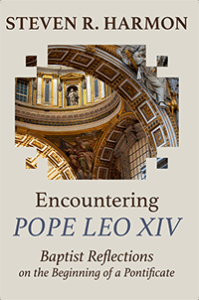
Review: Encountering Pope Leo XIV

Encountering Pope Leo XIV: Baptist Reflections on the Beginning of a Pontificate

By Steven R. Harmon (Nurturing Faith)

Be honest. Even the least liturgical Baptist among us must confess to a certain curiosity about the College of Cardinals and fascination with the process of selecting a new pope.

Steven Harmon, a historical theologian with Texas Baptist roots, helps unpack that process for non-Catholics and pull back the curtain—at least a little bit—on the Conclave. In the process, he offers insights into the first American-born pontiff, Pope Leo XIV.

Harmon, who has represented the Baptist World Alliance in dialogue with both the Catholic Church and the Anglican Communion, journeyed to Rome to report and reflect on the election of a successor to Pope Francis.

In an engaging and accessible style, Harmon offers a day-by-day recounting of his time at the Holy See Press Office. Along the way, he provides non-Catholics a useful introduction to relatively unfamiliar concepts such as synodality—a major emphasis introduced by Pope Francis on listening to God’s voice by hearing all voices within the church. On a practical level, he also helps identify the various religious orders and decipher the abbreviations that identify them.

In dramatic fashion, Harmon recalls the second day of the Conclave, when puffs of white smoke rising from the chimney atop the Sistine Chapel signaled to onlookers the College of Cardinals had reached a decision. Cardinal Robert Prevost—a dual citizen of the United States and Peru—was the choice, and he assumed the title Pope Leo XIV.

Harmon explains the likely historical significance of the title the new pope selected, given the role of Pope Leo XIII as originator of modern Catholic social teaching. He provides first impressions of Pope Leo XIV, along with reflections on the pope’s early public addresses and admiration for his talent as a communicator. As a sign of the times, he also notes the fake memes that proliferated on social media, attributing spurious quotes to the new pope—usually along political lines.

Encountering Pope Leo XIV builds bridges of understanding. In divisive days, Baptist and other non-Catholic readers would benefit from the insights it offers.

Ken Camp, managing editor

Baptist Standard


Connect360: The Attributes of God

  • Lesson Twelve in the Connect360 unit “Find Us Faithful: Standing Firm in Our Faith” focuses on 2 Peter 3:8-9

Every time I agree to officiate a wedding, I ask the couple to fill out an assessment and to meet with me a couple of times.

The assessment asks both the potential bride and groom about their family history, their expectations and the way each of them envisions this upcoming marriage relationship.

Together, the three of us spend time looking at the unique characteristics about each of them.

Every time I meet with a couple, I tell them, “Don’t forget these things about each other, for this is who God made you to be.”

As Peter continued his letter, he urged the church not to forget specific attributes of their God.

In 2 Peter 3:8, Peter continued to argue against the scoffers who claim God is not active in the world since Christ has not returned.

However, Peter asserted time is not the same for God as it is for a human.

God is eternal.

Peter’s words about a day being like a thousand years are a reference to Psalm 90:4. Some have interpreted this verse to mean there will be a literal 1,000-year reign of God at the end of time.

However, there are two reasons why this is not the best way to interpret this text.

First, Peter did not say one day equals a thousand years, but it is like a thousand years.

Secondly, it ignores the context of Peter’s entire message in the chapter.

Peter was not giving a human timeline of events at the end of time, but is telling us something about God’s character, God’s personality.

God is infinite.

Time is not the same for God as it is for humans.

What man and woman consider a very long time is a mere breath for God, the Creator, who stands outside of time and is sovereign over time.

Therefore, those Peter addresses should realize Christ’s coming is not being delayed. God just does not have the same perspective of time as we do.

Moreover, God not only views time with a different perspective than a human, but God also sees time with a different potency.

If one day with the Lord is like a thousand years, men and women ought to live their lives like any day might be the day Christ returns.

For Christ himself told his disciples: “But about that day or hour no one knows, not even the angels in heaven, nor the Son, but only the Father. Be on guard! Be alert! You do not know when that time will come” (Mark 13:32–33).

To learn more about GC2 Press and the Connect360 Bible study series, or to order materials, click here.


Connect360: The Return of Christ

  • Lesson Eleven in the Connect360 unit “Find Us Faithful: Standing Firm in Our Faith” focuses on 2 Peter 3:1-7

In college, I took a class in logic where we studied syllogisms.

The class taught deductive reasoning, where general principles were used to form a logical conclusion.

The scoffers in 2 Peter would have benefited from such a class.

Our author reminds the church God created the heavens and the earth when the Spirit of God hovered over the waters (Genesis 1:1–2).

In doing so, he separated the dry land from the sea (Genesis 1:9–10.)

However, the same world God created when separating land and water, God also destroyed with water in the days of Noah.

My logic class continues to come to the forefront in my thinking when reading 2 Peter 3.

God acts in and out of history to fulfill his purposes, and it only makes sense that God will do it in the future.

God has done it in the past through creation and the flood … and many were eating and drinking and going on with their daily business without giving it any thought (Matthew 24:38–39).

God worked in history when he chose to put on flesh and blood in the person of Jesus.

Prophet after prophet spoke of the day the Messiah would arrive, and almost all in Bethlehem missed it that night.

God defeated death when Christ died on the cross, and it was a Centurian guard who declared Jesus was the Son of God (Mark 15:39).

One day in the future, God will act again.

Our present world will give way for God to create a new heaven and new earth (Revelation 21:1).

By closely examining history and how God has worked in his world in the past, the only logical conclusion for any human being is to prepare oneself for Christ’s second coming.

As Noah and his family prepared for the flood years before it took place, the church must be preparing for Christ’s return.

As Mary was ready to respond when the angel Gabriel arrived in Nazareth, a Christian never asks, “Will Christ come again?”

The question is always: “Will you be prepared and ready when Christ does come again?”

To learn more about GC2 Press and the Connect360 Bible study series, or to order materials, click here.


Connect360: Sick Dogs and Slimy Hogs

  • Lesson Ten in the Connect360 unit “Find Us Faithful: Standing Firm in Our Faith” focuses on 2 Peter 2:17-22

Peter’s focus in these verses stays with the fake Christians but is mainly pointing out the fake leaders in the Christian church.

These fake Christian leaders are like springs without water, or wells without water as some translations say.

Back in that time, most people traveled on foot, and in the heat of the day they would look for wells or springs where they could stop and get water.

Dry springs or wells were disheartening. They would lead people in only to show they had no substance to give back.

The promises they gave for healing and refreshment always were broken, for no water was available for the weary traveler.

False leaders are no different than dry wells.

They make empty promises to people. They pull earnest Christians in who believe what they are saying is true.

But when those promises are examined up close, they are as empty as a dry well.

What they are doing will not go unnoticed by God.

He will not let their sin of leading his own astray go without punishment.

The last part of verse 17 speaks to their end: “blackest darkness is reserved for them.”

God has reserved a special place in hell for those who willingly lead his children astray.

God will not spare them for their sin.

The way they lead people astray is not much different today than it was in Peter’s time.

These fake leaders are smooth talkers, and they know exactly what to say to make people want to follow them.

They promise fame, wealth, sex and almost anything they need to promise to get people to follow them.

Once people are brought in, they realize too late they will never get anything they were promised.

Leaders in churches today can learn from wolves.

They need to know when and where they can best serve the church body.

Service is never self-service like a fake leader would do. It is always service to the benefit of the body.

There will be times that a good leader leads the church from the front, giving direction and showing a clear vision.

There will be times the leader leads from the back, looking over the church, identifying those who need help, and those who could be potential leaders.

Then there are those times when the leader will come up and lead from the middle, encouraging the church, and lifting them up when spirits are low.

Good leaders lead from every direction, not for themselves, but for the benefit of the church body.

To learn more about GC2 Press and the Connect360 Bible study series, or to order materials, click here.


Connect360: All That Glitters Isn’t Gold

  • Lesson Nine in the Connect360 unit “Find Us Faithful: Standing Firm in Our Faith” focuses on 2 Peter 2:10-16

Verses 13 and 14 are a stern warning to all fake Christians; their behavior and lifestyle will not go unpunished.

They are living their lives without shame; their deeds are carried out in daylight.

This means they are not worried about hiding their sins under a blanket of darkness. Instead, they choose to flaunt their sinful lives in front of everyone they meet.

They will cheat and rob others to build their own wealth. They do it in Jesus’ name, but they do not know Jesus.

These fake Christians end up on the evening news as the fallen church leaders who stole from the church, had affairs outside of their marriage, or ended up with a drug problem.

Be careful and keep a vigilant watch for these fake Christians, because they will take you down with them, seek to destroy everything you have and feel no guilt while they do it.

This verse calls them what they are, blots and blemishes in our church body.

But remember that all the harm they bring about will be brought back on them by God himself.

I was part of a church where a staff member stole money from the church. They would come in early Monday morning and take cash from the offering the day before. They also had access to church credit cards and stole money.

When we discovered the problem, they had stolen close to $100,000 from the credit cards, and there was no way to know how much cash they had taken.

They ended up in jail.

The temporary pleasures gained by taking this money were short lived, but the shame and pain of being in jail, I am sure, were horrible.

Sin will catch up to you. It may be sooner, or it may be later. But when it does, there will be a high price to pay.

There is only one way to God.

People may try to tell you that many roads lead to God—the roads may all come from different directions and different religions. But in the end, all the roads will end at the same God—They are wrong.

Verse 15 refers to the straight path, the right path. Once you stray from that path, you have moved away from where God has directed you to go.

Fake Christians have no idea where God’s path leads. They have no direction; they have no roadmap to follow.

As children of God, we have several things to show us God’s direction along the path—the Bible, the Holy Spirit, and fellow believers—they all serve a way to help keep us on the straight path.

Not so for fake Christians.

To learn more about GC2 Press and the Connect360 Bible study series, or to order materials, click here.


Connect360: Search & Rescue

  • Lesson Eight in the Connect360 unit “Find Us Faithful: Standing Firm in Our Faith” focuses on 2 Peter 2:4-9

At 9:02 a.m. on April 19, 1995, our nation was shaken.

A truck with a homemade bomb was parked outside of the Alfred P. Murrah Federal Building in Oklahoma City and detonated killing 187 men, women and children.

I was living in Arlington at that time, serving in my first church, and many in my family were living just a few miles north of where the bomb detonated.

When I heard on the news what had happened, I began calling my family first and then friends I went to college with to make sure everyone was OK.

Two days after the bombing, I drove up to Edmond, Okla., to see my parents, and the next day my mom and I drove down to the bombing site.

We had to park 10 blocks away and then walk in. As we got about five blocks out, we saw broken windows on buildings, and as we got within a block from the site, we saw buildings in the area had been severely damaged.

When we walked up to the site, what we saw was beyond anything we ever thought we would see in this great country of ours.

The building looked like something from a Third World, war-torn country. Rescuers were swarming over the rubble desperately looking for anyone that might have survived the explosion and lived through the last 72 hours under the rubble of the building.

These men and women worked around the clock to save as many people as they could, and when they knew there was no one left alive, they refused to leave until they had recovered every last victim so their families could have some closure.

The rescuers knew nothing about the victims. They didn’t know if they were good or bad people. They had no idea if they deserved the effort of being saved.

All these men and women knew was there were people who need to be saved, and they did everything they could to save them.

God feels the same way about us; except he knows everything about us.

He knows we are not good people. He knows we sin, often.

He knows how we treat others. He knows we are selfish and self-serving and still he sees us worthy of being saved. He moved heaven and earth to provide a way to save us. He sent his one and only Son to die in our place so we could have an eternal relationship with him.

To learn more about GC2 Press and the Connect360 Bible study series, or to order materials, click here.


Review: Silent No More: Bible Women Speak Up, A Poetic Meditation

Silent No More: Bible Women Speak Up, A Poetic Meditation

By Christine Kohler (Resource Publications)

This brief book (only 59 pages) offers a collection of poems written from the perspectives of female Bible characters of varying fame from across the Old and New Testaments.

As the subtitle suggests, each poem invites the reader to take in a character’s perspective deliberately and contemplatively.

The book offers a welcome invitation to pause and think about these women. Their stories often seem to serve as asides, included in the biblical narrative or in sermons merely as supports for the “main characters” we’re really supposed to learn from in the Bible—the males.

Only a handful of women in the Bible could be classified as having “main character energy,” as my Gen Z kids would say. Few of those biblical women who could be described as having “main character energy” are praised.

Reading these poems the way Kohler intended them to be enjoyed—as meditations—I cannot help but conclude, we sorely have missed out by not spending more time considering the human experiences of these remarkable women.

Their place in God’s supernatural story made the women of each poem important enough to appear in Scripture. Even so, I feel like I’m meeting them for the first time in Kohler’s poems.

Silent No More is a beautiful book, well worth spending time to contemplate. Seeing biblical women with fresh eyes evokes a surprising depth of emotion, perhaps because Kohler and her poems accomplish something many women need, in Baptist life and ministry especially —a sense of community.

Hearing the once silent voices of the women of the Bible, I not only understood them better, but also felt, in a new way, the great cloud of witnesses to be found in Yahweh’s daughters before me.

Dare I say, in seeing and hearing the once silent women of the Bible, I, too, felt more heard and seen?

I’d gift this book to my sisters in the faith who are struggling or to my own sons in the hope it might help them be more attuned to voices that often go unheard.

I am certain I will come back often to the poems in Silent No More, anytime I need a reminder of God’s care for the quiet ones, the ones who didn’t assert “main character energy,” but who God saw as essential in telling his story.

Calli Keener

Amherst, N.H.


Connect360: Find Us Faithful

  • Lesson Seven in the Connect360 unit “Find Us Faithful: Standing Firm in Our Faith” focuses on 2 Peter 2:1-3

Sometimes false teachings, called heresies, are obvious because they deny basic principles of orthodox Christianity such as the virgin birth of Christ or salvation by grace alone through faith alone in Jesus Christ.

Whole religious systems have been built upon these false teachings, and many still claim to be “Christian.”

Other false teachings in the church are more subtle, because they maintain the essential aspects of the gospel but skew the Bible’s teaching on second- or third-tier beliefs.

These may not be salvation issues, but they are still doctrinal issues.

In Galatians, Paul warned against false teachers who taught holiness through keeping a set of rules after salvation was attained.

This false teaching of legalism leads to Christians feeling like failures because our own effort never was meant to be our standard of holiness.

Even after our salvation, our holiness is a work of God’s grace and power through Jesus Christ (Philippians 3:3–4).

This legalism is a foundational problem of the prosperity gospel.

This false teaching teaches God will bless you physically, relationally and monetarily if you simply have enough faith and do the right things (often including giving financially to the false teacher’s ministry).

This sets up people to expect earthly blessings the Bible never promises.

And, when someone doesn’t receive the blessing they expect, the fault falls to them for not having enough faith or performing well enough.

It’s first century legalism wrapped in modern-day packaging.

Like the false teachers Peter was writing about, these false teachers are subtle, “secretly introducing destructive heresies.”

In fact, the Greek word (pareisagō) translated “bring-in” means “smuggle.”

It shows clearly an intentional secretive undermining of the body.

Therefore, Christians today must be diligent to study the Scriptures so they can know the truth and recognize the lies.

Truth is our greatest weapon as Paul wrote in Titus 1:9: “[We] must hold firmly to the trustworthy message as it has been taught, so that [we] can encourage others by sound doctrine and refute those who oppose it.”

To learn more about GC2 Press and the Connect360 Bible study series, or to order materials, click here.


Connect360: Wonders of the Word: Part Two

  • Lesson Six in the Connect360 unit “Find Us Faithful: Standing Firm in Our Faith” focuses on 2 Peter 1:16-21

Can you imagine making a declaration of fact about events that haven’t happened yet?

That’s exactly what the Old Testament prophets did. For doing so, many of them suffered and were rejected by their own people.

Yet, they obediently declared a message from God that would be proven years or even centuries later.

In fact, the only way to know if a prophecy is true is to wait and see if it happens (Deuteronomy 18:21–22).

Thankfully, the prophecies we see in the Old Testament do, in fact, come true. Why is this important?

It is internal proof the Bible is true. Let’s look at two specific examples.

First, in Daniel 7, Daniel received and wrote down a prophetic vision that reveals “the most comprehensive and details prophecy of future events to be found anywhere in the Old Testament.”

He described in detail the rise and fall of four great empires from around 600 B.C. to around A.D. 500: Babylon, Medo-Persia, Greece and Rome, plus a fifth which represents the ultimately victorious kingdom of God in Jesus Christ.

This vision parallels Nebuchadnezzar’s dream of the giant statue from Daniel 2.

Daniel 11 spoke with such specific detail about a 200-year section of this history that some secular historians claimed it was a forgery, written years after the events occurred.

However, the style of writing and other internal clues prove it was written during the time of Daniel and the incredible accuracy of the prophecies are nothing short of miraculous.

A second example of prophetic validation comes from Psalm 22.

In this Messianic Psalm, David described things clearly present at the cross of Jesus: disjointed bones, dry mouth and tongue, pierced hands and feet, emaciated body and divided garments won by casting lots.

David wrote these words nearly 600 years before crucifixion was invented. And look at the specificity with which he mentioned them dividing up and casting lots for Jesus’ clothing.

Remarkably, these specific things happened as Jesus hung on the cross.

I point out these two prophecies for a couple of reasons.

First, the things prophesied in them happened centuries later.

We have existing manuscripts containing the prophecies dated before the events occurred, meaning the prophecies could not have been written in hindsight.

Second, these are actions outside the control of those who might want the prophecy to be fulfilled.

The disciples could not orchestrate the events of Jesus’ crucifixion to happen as they did, even if they had wanted to.

It was divinely orchestrated.

In today’s passage, Peter spoke about the prophetic word he had experienced and that his readers can experience as well.

He encourages them to “pay attention” (1:9) and look for the day when things foretold begin to come about. He uses the prophetic nature of God’s word to encourage them to trust in it and to recognize its validity for their lives.

To learn more about GC2 Press and the Connect360 Bible study series, or to order materials, click here.


Review: And There Was Light: Abraham Lincoln and the American Struggle

And There Was Light: Abraham Lincoln and the American Struggle

By Jon Meacham (Random House)

In recent weeks, I’ve lost count of how many times I’ve heard someone say, “Our country has never been so divided before,” or “We’ve never experienced violence like this.” Since I was reading this masterful biography of Abraham Lincoln at that point, I kept saying to myself, “Um, not so fast. …”

Pulitzer Prize-winning historian and presidential biographer Jon Meacham provides a much-needed corrective both to Christian nationalists who paint all respected American figures of the past as sterling evangelical believers and to secularists who deny any Christian influence on American history.

Meacham gives focused attention to the complex, evolving and sometimes contradictory faith of Lincoln. He notes Lincoln’s early upbringing in anti-slavery Baptist churches in Kentucky and Indiana. Young Abe Lincoln never professed the faith of his father Thomas or submitted to baptism—perhaps in part because of his strained relationship with his parents and undoubtedly in part because of his difficulty accepting some stern Primitive Baptist doctrines. Even so, as a child, he preached to his playmates—reciting from memory the sermons he heard on Sunday.

As Meacham notes, Lincoln continued to maintain a conflicted and somewhat-distant relationship with organized religion for much of his life. He obviously read the King James Version of the Bible regularly, and he drew deeply from its poetic phrases in his speeches.

However, Meacham points out Lincoln also read a wide variety of theological and philosophical works that helped shape his views. In particular, Lincoln was influenced by abolitionist minister Theodore Parker, whose sermons about a “moral universe” whose arc “bends toward justice” not only made an impression on Lincoln, but also—a century later—on Martin Luther King Jr.

During the Civil War years, Lincoln’s resistance to joining a church continued, but particularly after the death of his son Willie, he attended church services on a much more frequent basis and prayed regularly. He also sought the wise counsel of ministers he respected as he struggled with the burden of guiding the nation through a bloody war.

One of the most insightful sections of And There Was Light is Meacham’s treatment of Lincoln’s Gettysburg Address. He provides an almost line-by-line exposition of the text—not only mentioning its numerous scriptural allusions, but also providing the rich biblical background for the references.

For much of his life, Lincoln’s relationship with Christianity was of a man “feeling his way through the twilight.” While the precise contours of Lincoln’s faith remain a mystery, Meacham makes a strong case for the depth of his faith.

Ken Camp, managing editor

Baptist Standard