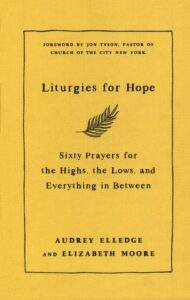
Review: Liturgies for Hope

Liturgies for Hope: Sixty Prayers for the Highs, the Lows, and Everything in Between

By Audrey Elledge and Elizabeth Moore (Waterbrook)

Life moves at a breakneck speed. In Liturgies for Hope, writers Audrey Elledge and Elizabeth Moore bring the timeless truths of Scripture to the chaos of modern life. When the pace of our days leaves us breathless, this collection of liturgies offers rich words that resonate and ring with beauty.

Liturgical prayers make space for readers to encounter God. Marked by honesty, peace and spiritual depth, the prayers in Liturgies for Hope feed the soul and encourage the spirit. This Evangelical Christian Publishers Association bestseller transforms moments—mundane and monumental—into invitations for spiritual reflection. From “A Liturgy for Paying Bills When There’s Not Enough Money” to “A Liturgy for Gardening,” Elledge and Moore demonstrate God’s presence and comfort remains ever accessible.

Liturgies for Hope contains seven sections, each with a different focus area including faith, vocation, health, relationships, wonder, mystery and confession. Each prayer contains Scripture references for further study. Both deep and accessible, the prayers offer hope, foster faith and catalyze spiritual growth.

I appreciated the authenticity that spans each page. The authors confront the darkness of our present moment head on, naming and honoring experiences of suffering. The pain of fractured friendships, the numbness from social media fatigue, and the pangs of homesickness all show up in the prayers. However, the book presents just as honestly the unshakable hope available for all through Jesus Christ.

Liturgies for Hope provides an antidote to the hurry, loneliness and anxiety of our day by reorienting the soul through prayer.

Bonnie Patterson, student

Dallas Theological Seminary


Connect360: Carry On

  • Lesson 12 in the Connect360 unit “A Cry for Freedom: Grace That Is Still Amazing” focuses on Galatians 6:1-10.

Paul reminded the Galatians that God prefers restoration over cancellation. He encouraged Christians to “restore … gently” our friends who are “caught in” sin (6:1).

Sin “catches” all of us at some point, doesn’t it? Many of us walk with God faithfully, only to find ourselves stumbling into sin and becoming trapped in its snare. We know how easy it is to make one wrong decision that leads to a horrific public consequence or a secret addiction. No one is immune from sin’s trap. It can capture any of us easily.

That is why Paul says we should be “gentle” in our restoration (6:1). We should lead with empathy rather than judgment as we help our Christian friends out of sin. Even Jesus empathizes with us in our weakness (Hebrews 4:15). Surely, we, too, can empathize with those who’ve been “caught” in sin, since we ourselves are also sinners.

Paul invites us to “restore” (6:1) the brother or sister caught in sin. Sin isolates us from both God and Christian community. Thus, we should restore them both to God and Christian community.

But the second sentence in verse one is an apt warning. We cannot properly restore a Christian brother or sister by affirming, making light of, or participating in their sin. The way to gently restore a Christian back to God and community is to “carry each other’s burdens” (6:2). That is the big command in these verses. This has tremendous implications for how we “do church” every week.

First of all, in order to carry each other’s burdens, we have to be honest about our burdens. If you’re not willing to share your sins, struggles, needs, doubts and fears, how will someone carry them for you? This takes tremendous humility and honesty.

Unfortunately, American churches often promote dishonesty. There is an expectation of decorum that requires smiles and lighthearted discussion, and resists “real” or “deep” conversations about how we are doing. What would it look like for us to find a small group of friends in which we can be fully transparent and honest about our battles? If we aren’t willing to tell others where we need help, we won’t get help.

Second, in order to carry each other’s burdens, we have to foster judgment-free communities of faith. We cannot balk in shock or anger when someone confesses sin. We can’t exclude people based on their struggles. Rather than ostracize those caught in sin, we are called to help them out of their sin.

Churches should be the safest place to seek recovery from porn or substance addiction. Christians should be the most restorative group of people in the world. We cannot judge people for being fallible; it isn’t our place to condemn sinners. But we can offer the hope of new life in Christ and create healthy avenues for believers to leave sin behind and embrace the freedom of Jesus.

To learn more about GC2 Press and the Connect360 Bible study series, or to order materials, click here.


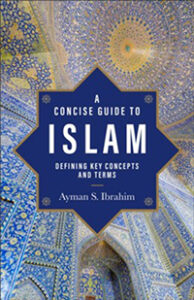
Review: A Concise Guide to Islam

A Concise Guide to Islam: Defining Key Concepts and Terms

By Ayman S. Ibrahim (Baker Academic)

Words matter. When we assign meaning to words contrary to what speakers intend them to mean, it leads to misunderstanding.

Ayman S. Ibrahim, a professor of Islamic studies at Southern Baptist Theological Seminary, believes Christians need to know the definitions of basic Islamic terms as they are understood by their Muslim neighbors. For example, Arabic-speaking Muslims, Jews and Christians all refer to the deity they worship as “Allah,” but they describe his nature and characteristics quite differently, he noted.

This concise-but-thorough book provides definitions of more than 100 words and phrases related to Islamic texts, history, belief, practices, jurisprudence and sectarian movements. The author handles both primary sources and secondary sources responsibly.

Ibrahim treats his subject with respect, while not downplaying the key differences between Islam and other faiths—or the differences between different branches of Islam. He helpfully differentiates between cultural (nominal) Muslims, practicing (devout) Muslims and radical (political) Muslims.

As Ibrahim explores the origins of Islam, he honestly acknowledges ways in which Islam appropriated aspects of pre-Islamic Arab folk religion, along with altered versions of stories from Jewish and Christian Scriptures. He does not shy away from documenting the violence and intrigue that accompanied some of the historical sectarian differences within Islam, but he avoids painting all Muslims with a broad brush.

A Concise Guide to Islam is a worthy companion to Ibrahim’s earlier books, A Concise Guide to the Quran and A Concise Guide to the Life of Muhammad. Taken together, they offer Christians a solid foundation for understanding Muslims’ beliefs.

Ken Camp, managing editor

Baptist Standard 


Connect360: Walk by the Spirit

  • Lesson 11 in the Connect360 unit “A Cry for Freedom: Grace That Is Still Amazing” focuses on Galatians 5:16-26.

It is important to walk with the Spirit. Many sins are obvious, but sometimes we have to wrestle to figure out our convictions. We seek God, read the Bible, pray and have conversations with other Christians in order to come to appropriate conclusions about what is or isn’t permissible in the Christian life.

This process is good for us. It can be taxing, and we might come to different conclusions than Christians we respect. But if we are communing in relationship with the Spirit, we can trust we will not be led astray from God’s purposes. Left alone to our devices, we judge sin poorly. But with the Spirit’s help, we discern well. The more we walk with God, the more obvious sin becomes.

Paul highlights things like sexual sin and drunkenness as works against the Spirit. But in the same sentence, he mentions jealousy, selfish ambition and multiple words that connote divisiveness in the church.

N.T. Wright says, “We may well wonder whether the Galatians (and indeed many churches today) would have realized that strife, jealousy, and the rest belonged in the same category as immorality and drunkenness.”

Paul might say to us today our gossip and prejudices are just as much “acts of the flesh” as sexual immorality or substance addiction. Our tendency to create division in church based on politics or worship style is as poisonous as debauchery. Our American ideals of building wealth and acquiring prestige lead us away from God like witchcraft.

Our flesh wants to pick out the sins we don’t struggle with and identify “those people” as anti-God. But we should fall on our knees in repentance as we see ourselves in the text. What do we struggle with? Where are we working against God’s Spirit?

The Greek grammar in his letter implies continued action over time, meaning there is a difference between struggling against sin and living continuously in sin. The Spirit will not allow us to live in constant sin without conviction. It’s our role to receive that conviction, recognize the sin we still have, and lean into the Spirit’s power to repent and walk in a different direction.

To learn more about GC2 Press and the Connect360 Bible study series, or to order materials, click here.


Review: Nobody’s Mother

Nobody’s Mother: Artemis of the Ephesians in Antiquity and the New Testament

By Sandra Glahn (IVP Academic)

In Nobody’s Mother: Artemis of the Ephesians in Antiquity and the New Testament, author Sandra Glahn persuasively argues that an understanding of Artemis, the first-century goddess of the Ephesians, unlocks the meaning of the phrase “saved through childbearing” found in 1 Timothy 2:15. Her masterful work dispels the prevailing myths about Artemis and sheds new light on the biblical interpretation of this confusing verse and those verses which precede it.

Glahn’s incorporation of autobiographical elements in the introduction adds a personal and relatable dimension to the book. She describes her struggle with infertility and her desire to teach the Bible, even though she had received teaching that women should adhere strictly to the God-ordained domestic role of mother.

For this reason, she states her primary goal as discerning whether Paul had the local situation in Ephesus on his mind when he wrote to Timothy about women, especially in the context of childbearing. She also delves into whether a woman can apply her teaching gift only in childbearing. Readers, especially women who have faced similar challenges, will resonate with Glahn’s avid pursuit of a biblical understanding of her role and calling.

Glahn’s extensive research and eloquent writing style take the reader on a journey through Scripture, ancient literature, epigraphic records, architecture and art toward a comprehensive understanding of Artemis and her cultural significance in the first century. The book consolidates information not previously available in one place, making it an invaluable resource for anyone seeking a fresh perspective on the interpretation of 1 Timothy 2:15.

Comprehending Artemis’s role in the first century not only reframes the historical context of Paul’s words, but also liberates the application of a woman’s teaching gift from the act of childbearing, Glahn asserts. This interpretation provides a life-giving view for all women, especially single or childless women.

While the book’s detailed presentation and discussion of scholarly research could overwhelm the lay reader, it offers a treasure trove of fascinating facts for those diligently seeking an in-depth study of New Testament Scripture, especially books and passages involving the city of Ephesus. The book serves to educate but also proves engaging and thought-provoking. While readers may encounter various interpretations of this verse, Glahn’s scholarly work challenges readers to grapple with her authoritative research and its implications.

Sandra Glahn’s dedication to studying first-century Artemis culminates in a book that enlightens readers about history and inspires a reevaluation of traditional scriptural interpretations. Nobody’s Mother merits the attention of anyone seeking a deeper understanding of biblical passages and the cultural context that shaped them.

Sandi Arenburg, student

Dallas Theological Seminary


Connect360: Called to Be Free

  • Lesson 10 in the Connect360 unit “A Cry for Freedom: Grace That Is Still Amazing” focuses on Galatians 5:1-15.

Growing up, one of the first rites of passage that gave personal freedom was turning 16 years old and receiving a driver’s license. The ability to drive yourself to see friends, to attend school, or obtain a job and go to work was the great mark of young adulthood.

For adolescents today, it seems like receiving your own cell phone marks the beginning of newfound freedom. The phone represents what the car keys once did. It is how friends connect, schoolwork can be completed, and even work can be done in the digital economy.

Did you ever abuse the freedom you received once you started driving? Do you know of a young person today that has abused their freedom in the online world?

Paul has spent lots of time, breath and ink showing that those who believe in Jesus are free—free from pagan pasts and also free from the claims made by the Jewish Law. It is a New Exodus—they are free because of what God has accomplished in the Messiah. But we are made free for a purpose—love. This emphasis on love—the love of God and love of neighbor—was first made by Jesus himself.

If the focus isn’t on love but on combative views, there will be “biting” and “eating”—like that of a wild animal that spends its days fighting and devouring until it ultimately is devoured.

Obviously, there was more going on in Galatia than just a minor theological disagreement. Paul was worried that if the church turned on itself, there would not be any church left, but a bloody trail where the church once stood.

So, Paul took the Galatians back to the beginning—love. He went back to the great command of the Torah, which the Jewish Christians would remember well. But it was also given by Jesus in his teaching on the greatest commands in the Bible: “Love God. Love People,” Christ said (Matthew 22:37–39, paraphrase). Freedom and love are the marks of the church.

To learn more about GC2 Press and the Connect360 Bible study series, or to order materials, click here.


Review: The Gifts of Christmas

The Gifts of Christmas: 25 Joy-Filled Devotions for Advent 

By Sheila Walsh (Baker)

Finding a fresh Christmas devotional book each December can be challenging, but Sheila Walsh has met that challenge in The Gifts of Christmas: 25 Joy-filled Devotions for Advent as she offers new ways of sensing the joy and seeing God’s gracious gifts of the season. With an introduction that sets the stage, the recording artist and television host travels from her childhood in Scotland to her adopted home in Dallas and various places in-between, evoking memories and encouraging readers “to exchange weariness for wonder and heartache for hope.”

The volume naturally divides into six parts describing God’s gifts of expectancy, wonder, joy, grace, peace and hope. The sections contain devotionals built around familiar images of that first Christmas or meaningful aspects of celebrations today such as angels, Bethlehem, the manger, Christmas crackers, candy canes and family photos. Most begin with Scripture, though others start with carols.

The best-selling author fleshes out the devotionals with biblical truths, illustrations and commentary, historical notes and personal stories ranging from humorous to bittersweet. Of particular note are gleanings from Old Testament history by Rabbi Jason Sobel and Alfred Edersheim. Each of the daily readings offers opportunities to remember past Christmases while reflecting on the present and anticipating the future. The 25 days close with “The Real Gift of Christmas,”  the author’s recollection of reading C.S. Lewis’ The Lion, the Witch and the Wardrobe for the first time, the story of Zacchaeus and the carol “Joy to the World.”

Available as an audiobook and in hardcover, each has advantages. Listening to Sheila Walsh read brings Scottish flavor while the print contains lovely illustrations of kraft-paper-wrapped packages, red striped string and gold ornaments with subtle changes in each section’s art to reinforce the theme. Consider purchasing both—one to enjoy and one to joyfully gift a friend. That’s what I did.

Kathy Robinson Hillman, former president

Texas WMU and Baptist General Convention of Texas

Waco


Review: Christian Philosophy as a Way of Life

Christian Philosophy as a Way of Life: An Invitation to Wonder

By Ross D. Inman (Baker Academic)

Ross D. Inman teaches philosophy of religion at Southeastern Baptist Theological Seminary, but he rejects any suggestion the subject belongs only to the ivory towers of academia. Instead, Inman views Christian philosophy as good for what ails us—individually and as a society. It offers remedies for moral sickness, metaphysical vertigo and distorted vision.

At one level, Christian Philosophy as a Way of Life serves as a solid introduction to the philosophy of religion. Certainly, Inman provides a good overview of how Christian philosophy relates to the classical disciplines of ethics, logic, metaphysics, aesthetics and epistemology. He helps connect the dots linking Socrates, Plato and Aristotle to Augustine, Anselm and Aquinas.

However, Inman believes Christian philosophy should not be limited to classroom study. He asserts it provides a map to help Christians find meaning and follow truth-directed practices. He insists the Christian disciplines of a philosophical life—solitude, silence, meditation, self-examination, spiritual friendships and existential rest—have therapeutic value.

Furthermore, Inman believes philosophy possesses value in and of itself, because it helps us fulfill our God-given nature as meaning-seekers. Christian philosophy provides a framework to help believers discover—or recapture—a sense of wonder. It helps Christ-followers understand and focus upon what is good, true and beautiful in light of the revelation of God in Jesus.

Inman invites readers to rekindle that sense of awe and wonder. It’s an invitation worth accepting.

Ken Camp, managing editor

Baptist Standard


Review: Mama Bear Apologetics

Mama Bear Apologetics: Empowering Your Kids to Challenge Cultural Lies

Edited by Hillary Morgan Ferrer (Harvest House Publishers)

Mama Bear Apologetics: Empowering Your Kids to Challenge Cultural Lies addresses ideologies running rampant in cultural American thought: new spirituality, pluralism, self-helpism, feminism, Marxism, relativism, naturalism, skepticism, postmodernism and emotionalism.

As American culture becomes increasingly hostile to Christianity and a biblically based worldview, our children are caught in the middle of conflicting ideologies. Mama Bear Apologetics maintains: “We need to prepare our children so they aren’t left unprotected for the future. The greatest protection we can give our kids—to equip them to face the cultural lies head-on while remaining gracious, loving, and winsome” (p 17).

This collection of essays presents each ideology’s teaching and refutes each with biblical truth. Each essay’s author provides age-appropriate tips for teaching children (preschool to high-school aged) to identify anti-scriptural teaching and how to defend against it using the Bible.

Written in a quirky, engaging style, each chapter allows the contributors’ personalities to shine as they reinforce their points with real-life examples. Introducing a thought thread woven throughout the book, editor Hillary Morgan Ferrer reminisces about eating lots of beef as a Texas native, learning at an early age to chew the meat and spit out the gristle. She equates this “chew and spit” method to sifting through the messages our kids receive in search of biblical truth, and spitting out anything that contradicts the truth of the Bible.

The book provides plenty of Scripture interwoven with relevant daily life examples. Just for fun, look for the way that a soda dispenser relates to progressive Christianity. These types of tangible images throughout the chapters help Mama Bears to take the apologetics conversations with their kids anywhere, with a concrete image that cements the topic and truth in their minds.

As an additional resource, the authors include a useful list of books for further reading that correspond to each chapter topic. Inquisitive mamas want to know as much as possible to protect and prepare their children for the ideologies they will encounter even as early as kindergarten. Mama Bear Apologetics gives parents the foundational tools they need to begin educating their children early.

Erica Bengel, student

Dallas Theological Seminary 


Connect360: The Cost of Freedom

  • Lesson 9 in the Connect360 unit “A Cry for Freedom: Grace That Is Still Amazing” focuses on Galatians 4:21-31.

Paul was teaching the Galatians if they live by the Law, even if they have trusted in Christ, they are bound in slavery. In verse 28, Paul made the remarkable statement that the Gentiles who trust in Jesus, not the Jews, following the Law, are now the people of God. Paul also identified with the Galatians as “we”—if they feel the waters had been muddied, it was not from Paul. He was the one that first preached the gospel to them.

Paul was not persecuting them through needless, law-keeping commands. He had not told them to put their faith in acts of the flesh. God through the saving work of Christ is the only One that saves, the only One that gives freedom and life. The future is secure not through their check-list legalism, but through the mercy of God. Nothing needed to be added to the gospel in order for the Galatians to grow in grace.

I remember as a teenager, I decided to do something special for my family at Christmas. Every year of my childhood, my grandmother would make homemade candy, like fudge and divinity—carefully cut into squares and placed on wax paper in a tin container for all to enjoy. The only time we were able to enjoy these small, handmade goodies was at Christmas. Once my grandmother was unable to cook due to her age, I tried my hand at this process. I had the recipe; I had watched my grandmother complete the process. How hard could it be?

I followed the recipe carefully, referring back to each step. Candy-making is time consuming, but finally my creation was ready for the big taste test. I bit into that pillowy square of goodness, only to be met with a mouthful of salt. I had made a slight misstep. I read “1 tsp of salt.” Not knowing the difference, I added “1 tbsp” of salt. The whole batch was ruined.

Paul would say that just like putting too much salt in a recipe, so adding adherence to the Law—taking on a legalistic view of salvation—ruins the result. Salvation comes from grace alone. It is not grace and the Law. Or even grace and good behavior or works.

Paul eventually instructed the church in Ephesus, “For it is by grace you have been saved, through faith—and this is not from yourselves, it is the gift of God— not by works, so that no one can boast” (Ephesians 2:8–9). This is a good verse to memorize, which will allow God’s Spirit to recall this verse and remind us anytime we start to compare ourselves to others. We all humbly must remember we are all sinners who find salvation only in God’s amazing grace.

To learn more about GC2 Press and the Connect360 Bible study series, or to order materials, click here.


Explore the Bible: Seen

EDITOR’S NOTE: We began soliciting support July 3, 2023, to continue publishing Explore the Bible lesson supplements. Each lesson has a cost of at least $50 to produce. In that time, we received only one gift of $50 designated for Bible studies. Due to lack of support, publication of Explore the Bible lesson supplements will conclude with this lesson.

  • The Explore the Bible lesson for Nov. 26 focuses on Mark 16:9-14.

Not Seen (Silence after Mark 15; Mark 16:1)

Every Sabbath of Jesus’ ministry (except for the 40 days of temptation), he spent at least part of his day with his disciples. On the Sabbath day after Jesus’ death, his followers are in agony. Shocked, consumed by guilt and fear, and exhausted, the disciples hide, knowing they are targets.

Chief priests remember Jesus’ promise to rise on the third day. Fearful his followers could steal his body and claim he rose again, they speak to Pilate. He agrees soldiers should be assigned to guard the tomb.

Mary Magdalene, Mary, the mother of James and Salome believe Jesus’ body was not properly anointed for burial on Friday. After Sabbath ends late Saturday, they buy spices.

Early Sunday morning (Mark 16:2-3)

Very early on the first day of the work week, Mary Magdalene, Mary, the mother of James and Salome gather their spices and walk to the tomb site. They are thinking: “Who will be in the garden? Might there be trouble? Who will roll the stone away?  Will we have the courage to enter and do what must be done to honor our Lord?  Who will roll the stone back in place?”

The women are shocked to discover the stone already is rolled away. They brace themselves and enter. They see a stranger, a young man in a white robe, sitting in the tomb.

Women at Jesus’ tomb see angel (Mark 16:2-8)

Who is this young man sitting in the tomb? Where is Jesus?

As they listen to the man, who is an angel, the grief process starts to reverse itself very slowly.

The angel knows to say “He has risen.” The women discount his words.

The angel continues, “See the place where they laid him.”  Yes, the women can see it. They were here on Friday. Where is his body?  What has happened?

The angel keeps talking. “Go,” he says. Their heads are spinning, processing, confused.  Who is this?  What is he saying?  “Go, tell his disciples and Peter.”  They comprehend the word “go” and begin to acknowledge the word “risen”.

The angel contiunues talking: “He is going ahead of you into Galilee. There you will see him, just as he told you.”

The angel pushes them out of the tomb by re-direction in the tone of his voice. “Go.”

They are being sent away.  The spices, which were treasures, now pass from their mind. Where are they going? Away from the tomb. Something has changed!

They are confused, but they find themselves running toward the hiding place of the disciples. The angel’s words energize them. Without consulting each other, they run on—afraid.

Note: Many Bible translations contain this disclaimer, but others do not: “The earliest manuscripts and some other ancient witnesses do not have verses 9–20.”

How could Mark conclude his gospel with no mention of Jesus’ post-resurrection words and acts? It seems unlikely that he would do that. The uncertainly about these verses extends back 1,800 years. The verses are not in Mark’s writing style. They also introduce elements—snake-handling, drinking poison— not accepted by most Christians.

Logically speaking, one of these possibilities must be true:

  • The wording in verses 9-20 is part of Mark’s original Gospel. The verses can be seen on some very old source documents. Scholars are bothered by the verses not occurring in many other very old source documents and because they do not seem to be Mark’s writing style.
  • Mark’s Gospel originally extended past 16:8 to inform about Jesus’ post-resurrection words and acts but those passages are lost forever. Copying scribes initially were unaware of the loss but guessed that it had happened. Perhaps those long-ago scribes decided Mark readers without access to the Gospels of Matthew, Luke or John need to have insight about the risen Savior. They created verses 9-20 to share critical knowledge of the resurrected Jesus appearing to people, proclaiming the Great Commission, ascending into heaven and his disciples sharing the gospel as they start the Church.
  • Mark ends his Gospel with 16:8. Scribes decide to add verses 9-20 to create a more complete gospel for those believers with no access to other gospels.

Jesus seen by many (Acts 16:9-20) 

The mystery verses tell the story of the risen Savior’s activities as believers move from grief to faith after the resurrection.

Mary Magdalene, alone, informs the disciples that Jesus is risen. Disciples are still grief-stricken and do not believe her.

A disguised Jesus on the road to nearby Emmaus explains to two companion believers how the Old Testament stories, Law and Prophets all point toward him. The men are not believed by the disciples when they tell them.

Jesus attends dinner with the disciples. He rebukes them for their lack of faith in his promise to rise from death. They believe now that they can see and touch him.

Jesus gives the Great Commission to the disciples: “Go preach the gospel everywhere. I am with you.”

Jesus ascends into heaven, promising the imminent arrival of the Holy Spirit.

Glen Funderburk has taught children’s Sunday school for many years. These lessons on the Gospel of Mark are written from the perspective of children.


Explore the Bible: Sacrificed

  • The Explore the Bible lesson for Nov. 19 focuses on Mark 15:24–39.

EDITOR’S NOTE: Bible lessons like this one have been an important part of the Baptist Standard for many years. Each has a cost of at least $50 to produce. To ensure these lessons continue to be provided the rest of 2023 and into 2024, you can make a donation in any amount by visiting our donation page. In the comments field, note your donation is toward the cost of Bible studies.

Darkest Night (Mark 14:43-52)

Interrupting Jesus’ agony in the dark Garden of Gethsemane, Judas appears with a torch-lit, armed mob sent by the Jewish religious establishment. In the dark with a few torches, the arresting party knows it is critical that they quickly identify Jesus and take him into custody.

Surprisingly, Judas acts like he is in charge: “I’ll kiss him, you arrest him and put him under guard.”  Judas approaches Jesus awkwardly, calls him “Rabbi” and kisses him. Judas sells Jesus’ freedom for money?

Peter has a sword and cuts off the ear of Malchus, a servant of the high priest.  Peter and Mark include this detail in their Gospel but do not name the swordsman. Other gospel writers do.

Jesus points out that it takes an armed group to capture him in the dark when he is in the temple every day teaching.

All the believers desert Jesus and run away.

Interrogation and trial (Mark 14:53-65)

Jesus has been arrested. The guards take him into Jerusalem to the home of the high priest. The first order of business is to find some evidence to justify a death sentence. The first witnesses tell made up stories—which reveal flaws when they are compared.  Jesus finally is asked to justify the arrest himself.

“Are you the Messiah?” came the question.

“I am. You will see me sitting at the right hand of God and coming on the clouds of heaven.” Jesus appears to be quoting from Daniel 7:13-14. The religious authorities would have been familiar with the passage.

That is enough for the high priest. Jesus presumptuously has claimed to be divine. He clearly is not, they believe.

“Blasphemy,” says the high priest. The religious leaders quickly condemn Jesus to death. They begin to attack him physically. The religious leaders trade their own Messiah for the status quo.

Peter denies Jesus (Mark 14:66-72)

 In the high priest’s courtyard, a servant girl points out Peter as an associate of Jesus. Peter “can’t understand” her reference and leaves. The rooster crows.

When she accuses him again, he begins to curse and denies knowing Jesus. Again, someone associates him with Jesus because he is a Galilean. Peter denies that. The rooster crows again, reminding Peter of Jesus’ earlier words.  Peter abandons his Savior for temporary personal safety.

Roman Governor Pilate questions Jesus (Mark 15:1-15)

Very early Friday morning, the religious establishment gives custody of Jesus to Roman governor Pilate. A Roman trial starts. His accusers are the chief priests.  Jesus says little.

A Jerusalem crowd comes to Pilate and asks for the release of the usual Passover festival prisoner. Pilate suggests Jesus. The priests encourage the crowd to ask for Barabbas, a murdering insurrectionist.

“What shall I do with Jesus?”

The crowd shouts “Crucify him.”

 Pilate releases Barabbas. He has Jesus flogged and hands him over to be crucified.  Jerusalem’s street crowd sacrifices its own Messiah in the heat of the moment. Pilate sacrifices Jesus for his career.

Roman soldiers abuse Jesus (Mark 15:16-21)

A company of Roman soldiers dress Jesus as a king with a purple robe and a crown of thorns, and they start calling him “king of the Jews.”  They hit him on his head with a staff, spit on him and bow down to him. Then they put his clothes back on him and force him to carry his cross out of town. Jesus is too weak, and he falls. Simon from Cyrene, a bystander, is forced to carry the cross. The Roman soldiers brutalize Jesus, because they can.

Golgotha Hill (Mark 15:22-41)

The procession comes to Golgotha Hill— the “place of the skull.”  At 9 a.m., soldiers nail Jesus’ body to a wooden cross and leave him there to die, as long as it takes.

Soldiers gamble for his clothing. He will not need them.  He is taunted by his earlier words that “he was going to destroy the temple and build it back in three days” and that he saved others but cannot save himself. Insults continue.

At noon, darkness comes over the whole land.  At 3 p.m., Jesus cries out in a loud voice “My God, my God, why have you forsaken me?” With a loud cry, he dies.  “God presented Christ as a sacrifice of atonement, through the shedding of his blood—to be received by faith” (Romans 3:25).

 The temple curtain that separates the Holy of Holies from the rest of the temple is split from top to bottom.

A centurion standing in front of Jesus says only, “Surely this man was the Son of God!”

Many women followers are present, watching from a distance.

The Sabbath will begin at 6 p.m. In three hours, Jesus’ lifeless body must be taken down from the cross and buried properly. Joseph of Arimathea goes to Pilate and asks for Jesus’ body. Joseph and Nicodemus wrap it in linen cloth with spices. They lay Jesus in a cave cut from the rock in a garden.

The bleak Sabbath begins.

Glen Funderburk has taught children’s Sunday school for many years. These lessons on the Gospel of Mark are written from the perspective of children.