Lesson 8 in the Connect360 unit “Kingdom Power: The Sermon on the Mount” focuses on Matthew 6:25-34.
Jesus reminded us that worry is a failure to trust God. In 6:32, he taught us that to be anxious about God’s provisions is to live like pagans (Gentiles).
The Psalmist David asked, “What is man that you take thought of him, and the son of man that you care for him?” (Psalm 8:4). When Jesus assured his listeners of God’s care for the birds, he then added, “Are you not worth much more than they?” (6:26). After His illustration of the lilies, he asked, “Will he not much more clothe you? You of little faith” (6:30)! Jesus challenged us to “seek first his kingdom and his righteousness,” and followed with the promise, “and all these things will be added to you” (6:33).
When Jesus taught us to pray, he gave us the privilege of addressing God as our Father (6:9). In Matthew 25, we learn of God’s immutable purposes of his cross, death, resurrection, ascension, return and judgment. In the great blessing of Ephesians 3:20–21, we read, “Now to him who is able to do far more abundantly beyond all that we ask or think, according to the power that works within us, to him be the glory in the church and in Christ Jesus to all generations forever and ever. Amen.”
We can be assured of God’s love for us; “In this is love, not that we loved God, but that he loved us and sent his Son to be the propitiation of our sins” (1 John 4:10).
In Romans 8:32, “He who did not spare his own Son, but delivered him over for us all, how will he not also with him freely give us all things?” Why should we allow worry to rob us of life, miss out on kingdom opportunities and shatter meaningful relationships when God promises to provide what we need?
Jesus taught us that we are to seek his kingdom and jis righteousness as our No. 1 priority in life. He promised in the Beatitudes, “Blessed are those who hunger and thirst for righteousness, for they shall be satisfied” (5:6).
To learn more about GC2 Press and the Connect360 Bible study series, or to order materials, click here.
Connect360: God or Wealth?
February 23, 2024
Connect360: God or Wealth?
Lesson 7 in the Connect360 unit “Kingdom Power: The Sermon on the Mount” focuses on Matthew 6:19-24.
In Matthew 6:19-20, Jesus used a form of the same word as both a verb “store” and noun “treasures.” Do not treasure for yourselves treasures on earth. Both verbs are in the present tense, indicating continuous action and are imperative commands. First it is stated negatively, “Do not store treasures on earth.” Then it is used positively, “But store for yourselves treasures in heaven.”
What was Jesus saying when he commanded us not to store treasures on earth? Are material things unimportant? Should we not buy houses, land, clothes or other life necessities? At the end of the Sermon on the Mount, Jesus spoke of building a house on a solid foundation. In Matthew 25, Jesus praised those who share food and clothing to those who are in need. When we feed the hungry, we are feeding Christ.
God created us as finite creatures living in a physical world that requires food, clothing and shelter. God expects us to provide for our families. The Apostle Paul wrote work is ordained by God and a parent who fails to provide for his own family is worse than an unbeliever (1 Timothy 5:8). Yet, in the very next chapter he instructed Timothy: “But those who want to get rich fall into temptation and a snare and many foolish and harmful desires which plunge men into ruin and destruction. For the love of money is a root of all sorts of evil, and some by longing for it have wandered away from the faith and pierced themselves with many griefs. But flee from these things, you man of God, and pursue righteousness, godliness, faith, love, perseverance, and gentleness” (1 Timothy 6:9–11).
Jesus’ emphasis is not on having possessions but on treasuring them. God did not give us this command to restrict us or to use this as some kind of test of allegiance. As God of all eternity, God recognizes the impermanence of physical possessions and the destruction that comes to those who spend their lives focusing on acquiring them. A sign of wealth for first century folks was clothing. Jesus addressed the obvious. How foolish it is to put your trust in something even a moth can destroy or a thief can steal.
To learn more about GC2 Press and the Connect360 Bible study series, or to order materials, click here.
Review: Forgiveness after Trauma
February 23, 2024
Forgiveness after Trauma: A Path to Find Healing and Empowerment
By Suzannah Griffith (BrazosPress)
In her upcoming book Forgiveness after Trauma, Suzannah Griffith handles this painful topic with honesty and grace. She recounts the abuse she experienced in her marriage with enough detail for the reader to understand her story without becoming immersed in it.
Her domestic violence story is not the point of the book. Rather, it provides a reference to challenge the way forgiveness often is taught and applied within the church.
Using sound Bible scholarship, Griffith builds a more trauma-informed interpretation of forgiveness than she found in the Mennonite church where she served as a pastor during the worst of her abuse. She shows a clear love for Scripture as she effectively weaves passages on anger, lament and accountability into her own journey toward forgiveness and empowerment.
Griffith’s study of forgiveness began at the suggestion of two friends who stood by her and her husband during the abuse. When Christians regularly handle care for abuse victims poorly, this positive example of support is encouraging and a key takeaway from the book.
While I would stop short of calling this book a must read, Griffith does provide a survivor’s view on a timely topic. It is a useful read for pastors and laypeople alike. We are all tasked to minister to the hurting. Forgiveness after Trauma will help us do just that.
Calli Keener, news writer Baptist Standard
Connect360: Praying Like Jesus
February 23, 2024
Lesson 6 in the Connect360 unit “Kingdom Power: The Sermon on the Mount” focuses on Matthew 6:9-15.
The invocation is a summoning of God to receive our prayer as well as an invitation from him for us to join him. We begin with the privilege of calling God our Father. What an incredible privilege.
First, we find the plural pronoun—“our.” Of course, Jesus has a special relationship with the Father since he is the only One called monogena, or only begotten Son in John 3:16. Yet, he invites us to join with the cloud of witnesses in Hebrews 12:1, including those throughout the past generations as well as all who call on him from around the world.
We all are part of the body of Christ. I do not believe in lone ranger Christians. A foot by itself is worthless. Just as a body consists of many members, this is also true of the body of Christ. All Christian believers are one in him. When we pray, we join with others from every nation, tribe and ethnicity as brothers and sisters.
Calling God “our Father” may be a privilege we take for granted since this has been our practice for a lifetime. Yet it sounded like heresy for those who first heard Jesus. “For this reason, therefore, the Jews were seeking all the more to kill him, because he not only was breaking the Sabbath, but also was calling God his own Father, making himself equal with God” (John 5:18).
In the Old Testament God was referred to as “Father” only 13 times, yet Jesus referred to God as “Father” more than 150 times. The only time Jesus prayed to God without calling him “Father” was on the cross, when Jesus cried out, “My God, My God, why have you forsaken me?” (Matthew 27:46)
Jesus said to call out, “Our Father.” The Aramaic word for father is abba. Just as a young child first cries out abba—“dada” or “daddy”—Jesus has given us the privilege of calling out to God as one who would call out to his own father.
To learn more about GC2 Press and the Connect360 Bible study series, or to order materials, click here.
Connect360: Have You Noticed My Humility?
February 23, 2024
Lesson 5 in the Connect360 unit “Kingdom Power: The Sermon on the Mount” focuses on Matthew 6:1-8, 16-18.
Even though it is important to know how to pray for those gathered on any occasion, the temptation always is there to attempt to impress those who are listening. Jesus considered that kind of piety phony. He rebuked the religious leaders who showed up in the synagogues and street corners praying to be seen by men. They have no heavenly reward, he warned.
Jesus also exposed the hypocrisy of meaningless repetitions in prayers. When the Jews repeated the Shema every morning and evening, it easily might have become trivial, ritualistic and meaningless. In 1 Kings 18, the prophets of Baal called out to their god from morning until evening, dancing around the altar, even cutting themselves with knives. Yet their god was not real and was unable to answer them. Elijah responded with a simple two sentence prayer to Yahweh, and God answered with fire from heaven.
Jesus was not rebuking persistent prayer; He spent all night in prayer on occasions. In the Garden of Gethsemane, Jesus prayed for hours and admonished the disciples for being unable to stay awake and pray. Paul wrote to the Thessalonians, “Rejoice always; pray without ceasing; in everything give thanks; for this is God’s will for you in Christ Jesus” (1 Thessalonians 5:16–18).
Was Jesus saying we should avoid praying in public? Did he advise us against using written prayers of others? Obviously not, because right after these admonitions, he prayed publicly giving us an example of a prayer we continue to use as a model prayer.
Jesus and his followers went to the temple to pray. Quoting from Isaiah 56:7, Jesus was angry at the money changers in the temple and said, “It is written, ‘My house shall be called a house of prayer; but you are making it a robbers’ den’” (Matthew 21:13). Even after the resurrection the disciples continued to pray in the temple. “Now Peter and John were going up to the temple at the ninth hour, the hour of prayer” (Acts 3:1).
To learn more about GC2 Press and the Connect360 Bible study series, or to order materials, click here.
Connect360: Blessed Are the Peacemakers
February 23, 2024
Lesson 4 in the Connect360 unit “Kingdom Power: The Sermon on the Mount” focuses on Matthew 5:33-48.
Many of Jesus’ hearers were poor. If they gave an adversary their shirt, it literally would have been the shirt off their back. They also were subject to the governing Romans ,who were their oppressors. By law, the Romans could force a Jew to carry their enemies’ load up to a mile. Why did Jesus ask a poor person to give his last shirt away, or go two miles carrying his oppressors’ bags, or even to give to those who ask him for help? This action would have been degrading and humiliating.
If a person’s goal is the accumulation of wealth, this lifestyle creates suspicions and greed causing an impulse to hold onto everything a person owns. Generosity is the opposite of greed. A symbol of our society might be a closed hand. How do we grasp all we can and hold on to it, keeping our wealth away from others who seek to seize it?
Jesus’ example is the opposite. In Philippians 2:5–11, the picture of Christ is one who gave himself away rather than grasping what was rightfully his. Instead of the symbol of grasping of the closed hand, a Christ follower must be one with an open hand, giving himself away because of a love for others.
The ultimate challenge for a peacemaker is to love his enemies. Just as our heavenly Father sends rain and causes the sun to rise on the just and the unjust, we are to love our enemies and pray for those who persecute us. Two of the countries where the church is growing most quickly are Iran and China, two nations totally opposed to religious freedom. The most powerful evangelistic tool for the church in these nations is love.
To learn more about GC2 Press and the Connect360 Bible study series, or to order materials, click here.
Connect360: Nip It in the Bud
February 23, 2024
Lesson 3 in the Connect360 unit “Kingdom Power: The Sermon on the Mount” focuses on Matthew 5:17-32.
The great theologian Barney Fife, a character played by Don Knotts on The Andy Griffith Show back in the 1960s, made famous the expression, “Nip it in the bud.” The statement means taking care of a problem in its early stages before it gets too big to manage.
The Law of Moses said, “Don’t murder.” Jesus told his followers, “Don’t even be angry with your brother.” The ancients were told, “Don’t commit adultery.” Jesus said, “Don’t even lust.”
One of the most important questions in life is, “How can we enter the kingdom of heaven?” The answer to this question has implications for our lives now and for all eternity. Jesus addressed this issue in Matthew 5:20, that is one of the key verses in the Sermon on the Mount.
Jesus said only those who are more righteous than the scribes and Pharisees will enter the kingdom of heaven. How can this be true? No one was more righteous than these religious leaders, scrupulous in their attempt to keep the Law. They actually went beyond what the Law required. In the Old Testament, we hear about one day of fasting, yet the Pharisees fasted two days a week. They tithed every leaf in their garden. How can anyone be more righteous than they were?
Jesus spoke of a kingdom grace that transforms the heart. When Moses repeated the commandments in Deuteronomy 5, the people said, “We hear what you are saying, and we will do it.” God responded, “Oh that they had such a heart in them, that they would fear me and keep all my commandments always” (Deuteronomy 5:29).
Jesus came to give them a new heart.
To learn more about GC2 Press and the Connect360 Bible study series, or to order materials, click here.
Connect360: Isolation or Impact?
February 23, 2024
Lesson 2 in the Connect360 unit “Kingdom Power: The Sermon on the Mount” focuses on Matthew 5:13-16.
Too often, there is little distinction between the church and the world. Greed, prejudice, anger and immorality are also found in the church. Congregations are tempted to turn to marketing schemes and downplaying biblical teachings and values in order to make the unchurched feel comfortable in our midst. The church cannot reach the world by becoming assimilated into the world.
If we are not to be assimilated, does this mean the church should be isolated from the world? Christian alternatives for education, recreation and social ministries may be essential to the development of strong families and for the preparation of well-grounded disciples for Christ. Yet, does this also run the risk of isolating us from the world when we are supposed to be light? Jesus demonstrates the balance of withdrawing from the world to be energized by the Holy Spirit, in order to reengage the world bringing light to places of darkness.
Christ is not calling the church to assimilation or isolation. He is calling us for transformation. If we were saved just to be protected from the evil one, Jesus would have taken us to heaven the moment we were saved. Jesus prayed, “I do not ask you to take them out of the world, but to keep them from the evil one” (John 17:15).
To learn more about GC2 Press and the Connect360 Bible study series, or to order materials, click here.
Connect360: The Be-Attitudes
February 23, 2024
Lesson 1 in the Connect360 unit “Kingdom Power: The Sermon on the Mount” focuses on Matthew 5:1-12.
“Blessed are the poor in spirit, for theirs is the kingdom of heaven” (Matthew 5:3).
Jesus began with the promise of the kingdom of heaven to those who are poor in spirit. In Luke’s account of the Beatitudes (Luke 6:20), he wrote, “Blessed are you who are poor, for yours is the kingdom of God.” Most of us have difficulty comprehending true poverty. However, many of those in the crowd listening to Jesus speak understood the challenge of finding daily food. Millions around the world and many in our own country suffer hunger and homelessness and cry out in desperation for the basic necessities of life.
Following Jesus is more than desiring an occasional moment of inspiration or a Sunday morning trip to church. Not even the legalistic Pharisees who kept the whole law were righteous enough to enter the kingdom of heaven on their own. Followers of Christ must recognize the poverty of their own righteousness and turn desperately to God’s amazing grace. To these Jesus promises the kingdom of heaven.
“Blessed are those who mourn, for they shall be comforted” (Matthew 5:4).
Almost nothing in life compares to the grief of the death of a loved one. Physical death is irreversible. Yet, Jesus reversed death by raising Lazarus, Jairus’ daughter, and by his own resurrection. Our faith is challenged in those moments when we long to know our faith is true.
“Blessed are the gentle, for they shall inherit the earth” (Matthew 5:5).
In our culture the typical picture of the one who inherits the earth is the powerful, the warrior, or the shrewd. Yet Jesus said it is the gentle who shall inherit the earth.
This Beatitude is a restatement of Psalm 37:11, “The humble will inherit the land.” In Numbers 12:3, Moses is described as the most humble man on earth. Gentleness, meekness or humility can be confused with weakness, yet, with God’s help, Moses was powerful enough to stand up to the Pharaoh, and wise enough to lead a nation of undisciplined, complaining and ungrateful people to the brink of the promised land. The gentle are those who submit themselves to the will of God.
To learn more about GC2 Press and the Connect360 Bible study series, or to order materials, click here.
Review: From the Model T to Mars
February 23, 2024
From the Model T to Mars
By Bill Sherman (1845 Books)
In writing to Christ-followers in Thessalonica, Paul maintains they had become a “model” (Greek typos, from which we derive our English word “type”) to all the believers in Macedonia and Achaia—that is, throughout the whole of Greece (1 Thessalonians 1:7).
In his beloved letter to the Philippians, the apostle reminds his Christian brothers and sisters in Philippi they have an example in Paul, Timothy and other Pauline coworkers (Philippians 3:17; compare 2 Thessalonians 3:9).
My vocation is theological education. As I approach my 30th year in seeking to carry out this call, I am altogether mindful of both how necessary and rare trustworthy ministerial models actually are.
Over the course of the past decade, therefore, it has been my pleasure and privilege to get to know better a minister I regard and respect as a model for ministers—Billy Don “Bill” Sherman.
A Fort Worth native educated at Baylor University, where he also played football, and Southwestern Baptist Theological Seminary, Rev. Dr. Sherman—who simply goes by “Bill”—served churches in Texas, Oklahoma and Tennessee for 66 years before deciding to hang up his spurs.
Bill Sherman was pastor of Woodmont Baptist Church in Nashville more than three decades.
Bill is arguably best known for his 30-year tenure as pastor at Woodmont Baptist Church in Nashville and for advocating over the years, along with—among many others—his brother Dr. Cecil Sherman, for a moderate way of being (Southern) Baptist, not least during the 1970s and 1980s when the Southern Baptist Convention was experiencing a seismic shift to the right.
During his lengthy, impactful ministry as pastor of Woodmont Baptist Church, Sherman may well have been the most well-known Christian—not just Baptist—voice in middle Tennessee, as the church’s services were broadcast on live television across the state.
During his tenure as pastor of Woodmont, he courageously led out on racial equality. He also guided the church to historic giving to and involvement in missions and tirelessly advocated for women being able to serve in any and all pastoral ministry roles in Baptist life.
As it happens, Ned McWherter, who once served as Tennessee’s governor, perceptively spoke of Bill Sherman as “the conscience of middle Tennessee.”
Given all he is and all he has done, it is no small gift that Sherman has written a “ministerial memoir” titled From the Model T to Mars, which Baylor University Press recently has published under its 1845 Books imprint.
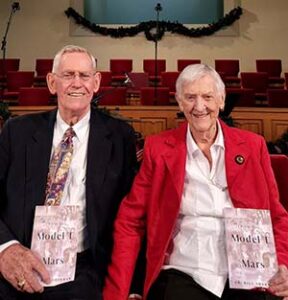
Bill and Veta Sherman participate in a book signing at Woodmont Baptist Church.
I not only was able to endorse this volume, but also was asked to write the “Foreword” to a book I have read backward and forward. I conclude my “Foreword” to this valuable volume with these words: “What one discovers in From the Model T to Mars is a role model for ministry in the words of one who was unflinchingly and indefatigably committed to ministry for life.”
As it happens, the now nearly 92-year-old Sherman, still brimming with warmth and wit, recently has held book signings at Woodmont Baptist Church and Baylor’s Truett Seminary. Accompanied by his wife Veta, his erstwhile companion in life and ministry, these events have been warmly received and well attended by friends and family who have supported and appreciated his nearly seven-decade long ministry. Those in attendance not only have left with a signed book, but they also have departed with an awareness of how uncommon a common man and committed minister like Bill Sherman actually is.
On the writing of From the Model T to Mars, Sherman states: “It has been a redemptive experience to revisit our [i.e., my] 91 years of life, remembering the faces and voices that made a difference in our lives. It is my hope that future believers will benefit from what we learned in our 66 years of ministry. It sure has been a fun ride from the Model T to Mars!”
Dean Todd Still (right) and Jon Sisk (left), director of development, welcome Bill Sherman to a book signing at Truett Seminary in Waco.
Concerning the book signings at Woodmont and Truett, the model minister remarked: “Woodmont Baptist Church and Truett Seminary mean the world to Veta and me. Over the years, Woodmont and Truett have been stalwart Baptist institutions, standing for true Baptist principles, such as priesthood of the believer, autonomy of the local church, cooperative missions, racial reconciliation, and supporting women in all ministry roles. Such commitments remain important to me, our family, and many in the congregation at Woodmont Baptist as well as the students, faculty, and administration at Truett Seminary. It is an honor to have had book signings at two of our most cherished places.”
To journey with Bill Sherman from the Model T to Mars, his insightful and autobiographical volume on life and ministry is available from Baylor University Press and Amazon.
Todd Still, Charles J. and Eleanor McLerran DeLancey Dean & William M. Hinson Professor of Christian Scriptures
Baylor University’s Truett Theological Seminary
Review: Reckoning with Power
February 23, 2024
Reckoning with Power: Why the Church Fails When It’s on the Wrong Side of Power
By David E. Fitch (Brazos Press)
Readers expecting to find a critique of the church’s complicity in covering up abuse, yielding to the temptations of Christian nationalism, or perpetuating systemic racism and patriarchy will find a dose of it in Reckoning with Power, but that’s not all. Author David Fitch, chair of evangelical theology at Northern Seminary, offers a thought-provoking examination of the nature of power itself.
Operating from a solid biblical foundation, Fitch asserts two kinds of power are at work: worldly power and God’s power. He describes worldly power as “power over” at its worst and “power with” at its best. Worldly power relies on coercion, manipulation and force. God’s power—which he refers to as “power under”—depends upon the Holy Spirit and is characterized by love and grace.
Worldly power has its limited role in a fallen world, Fitch acknowledges. Like a traffic light that keeps cars from crashing into each other, it provides some degree of order in a chaotic society, but it lacks the ability to redeem. God’s power, on the other hand, can bring about reconciliation, healing and transformation.
Fitch not only diagnoses the problem, but also offers the remedy by providing examples of what it looks like when the church lives under the power of Christ. He points to mutual submission, consensus-building through conversation, truth-telling and acknowledgement of the plurality of gifts within the body of Christ as characteristics of churches on the “right side of power.”
Readers of Reckoning with Power should prepare to be challenged.
Ken Camp, managing editor
Baptist Standard
Connect360: Christmas Lesson: Hope Has Come
February 23, 2024
The Christmas lesson included in the Connect360 unit “Kingdom Power: The Sermon on the Mount” focuses on John 1:1-14..
The baby Jesus may have been born at night. The gospel of Luke doesn’t mention the time of day, and we are only told that Mary gave birth “when the days were completed for her to give birth” (Luke 2:6). However, we do know that the announcement was given to the shepherds at night while they were tending the sheep.
Nighttime was certainly the appropriate time because the world was living in darkness. Neither Herod the king nor even the chief priests and the scribes rushed to Bethlehem to worship the newborn king. Herod was anxious to know where this king was born, not to worship him, but because of his paranoia of perceived rivals he wanted to get rid of him. Herod’s fear and rage led him to the merciless killing of the boy babies in Bethlehem.
The physical darkness where a young Jewish girl gave birth in a dark, noisy, smelly stable reflects the moral darkness of the world then and throughout history. Babies still are being killed. Children are being kidnapped and sold into slavery. Wars are waged by crazed egomaniacs, while innocent people are caught in the crossfire. The poor are exploited by the rich. Selfishness, greed, anger, lust, envy, dishonesty, jealousy and addictions continue to plague humanity. Not even schools, hospitals, workplaces, churches, mosques, synagogues, nor even homes are immune to violence. “This is the judgment, that the Light has come into the world, and men loved the darkness rather than the Light, for their deeds were evil” (John 3:19).
John testified that light has come into this world. Darkness attempts to overpower the light but is unable. Light extinguishes darkness. Just before Jesus announced he was the light of the world, he forgave a woman caught in adultery (John 8:11). Any person may claim supernatural powers and perhaps be arrogant enough to claim moral authority to forgive sins, yet Jesus proved he was the light of the world by healing a man blind from his birth (John 9:7). The One who brought light into this man’s dark world is the One who brings light to all who believe.
To learn more about GC2 Press and the Connect360 Bible study series, or to order materials, click here.
 In her upcoming book Forgiveness after Trauma, Suzannah Griffith handles this painful topic with honesty and grace. She recounts the abuse she experienced in her marriage with enough detail for the reader to understand her story without becoming immersed in it.
 In his beloved letter to the Philippians, the apostle reminds his Christian brothers and sisters in Philippi they have an example in Paul, Timothy and other Pauline coworkers (Philippians 3:17; compare 2 Thessalonians 3:9).

 Operating from a solid biblical foundation, Fitch asserts two kinds of power are at work: worldly power and God’s power. He describes worldly power as “power over” at its worst and “power with” at its best. Worldly power relies on coercion, manipulation and force. God’s power—which he refers to as “power under”—depends upon the Holy Spirit and is characterized by love and grace.