Explore: Seek him first

• The Explore the Bible lesson for May 10 focuses on Haggai 1:1-11; 2:5-9.

Introduction to Haggai

Many scholars strongly agree Haggai’s prophecy may be dated to 520 B.C. Haggai’s speeches and ministry played a tremendous role in the rebuilding of the temple after the exiled Jews returned the Jerusalem. Accordingly, Haggai would have been a contemporary of Ezra and Nehemiah (Ezra 5:1; 6:14). Haggai also specifically addressed a governor of Judah named Zerubbabel.

Zerubbabel, a descendant of King David, likely was appointed by King Darius of Persia in a politically motivated move to gain the loyalty and friendship of the returning exiles. Some scholars suggest people in Judah actually enjoyed a relatively peaceful autonomy under Persian rule. Haggai also addressed Joshua, son of Jozadak (1:1). Joshua likely functioned as the chief priest during the period.

Haggai focused his message primarily upon the holiness of God. He consequently called people of faith to obedience and to take seriously their obligation to serve the Lord. For Haggai, faith without works is dead (James 2:17). A relationship with Yahweh, therefore, is both a privilege and a responsibility. It is no wonder Haggai encouraged the people to rebuild from the ruins of the temple as a way to infuse hope and optimism again into the lifeblood of God’s people. Yet, Haggai also tempered his message with sober warnings about the failure of the people to obey the Lord. 

This lesson offers three illustrations of Haggai’s timely message concerning the holiness of God and the responsibilities of his people. For more introductory information, please refer to the introduction of the Bible books included in the front section of the resources.

Reality defined (1:1-9)

Readers may note numerous points of interest in this passage as Haggai defined the stark reality of his cultural context. First, note the terminology concerning “the word of the Lord” at various places in the passage. This is known commonly as a “word event formula” and occurs frequently in regard to God’s judgment. The formula also emphasizes the ultimate authority and omnipotence of God. 

Second, God accused “these people” of wasting time in building a temple. The term “these people” drips with reproach and sarcasm and probably was aimed more at the political and religious leaders who came on the scene immediately following the return from exile. Haggai’s words would have hit home particularly with Zerubbabel and Joshua.

Third, God posed a sharp and pointed rhetorical question. Why would the people build nice homes for themselves while allowing God’s temple to remain in ruins (v. 3)? Clearly, God challenged them to rebuild the temple through this question. In fact, God even wondered why some of the people had “paneled houses,” a reference to the interior panels used in magnificent structures of the day. What did the people’s neglect of the temple say about their relationship with God?

Fourth, Haggai introduced a slightly different but equally effective word formula in order to grab the attention of a wayward people: “Give careful thought to your ways” (vv. 5-6). In the Hebrew language, Haggai’s word formula invited the people to connect their heads with their hearts. For instance, while it seems many resources had been spent on luxurious houses, food, water, clothing and money still are in short supply. Will the people make room for God in the midst of their rather precarious situation?

Fifth, God specifically instructed the people to rebuild the temple (vv. 7-8). The temple specifically was to be reconstructed for God’s glory and honor (v. 8). The glory of God, in this context, refers to the powerful and dynamic presence of God among his worshipping people. In other words, when believers seek first the Lord and his kingdom, then we can be assured of God’s presence in real-time, so to speak. Remember the words of Jesus in his Sermon on the Mount. Our primary concern ought not to revolve around food, drink or clothing but around the kingdom of God and his righteousness. All the other things will be added in due course (Matthew 6:33).

Discipline defined (1:10-11)

Haggai boldly dealt with the touchy subject of God’s discipline in these verses. God explained he imposed a heavily impacting drought since the people had neglected the temple. In fact, a Hebrew word-play occurs with the words “ruin” and “drought” in verses 9 and 11 respectively. Both words look and sound quite similar—the implication being that if the temple remained in ruins, then God would ruin the land.

We must clarify at this point not all natural disasters should be attributed to God’s discipline. Haggai recognized, however, the strict implications of obedience and disobedience to Yahweh. Jesus offered a similar idea when speaking about a narrow and broad path (Matthew 7:13). God has given people choices which come with stated and heavy consequences. 

Glory to come (2:5-9)

God made a couple of significant promises at this pivotal point in his prophecy. First, he promised his presence. Just as God had led the Hebrews out of Egypt, God would remain in charge. Some scholars say God promised a renewal in the covenant at this point. Second, God promised to establish a place powerfully filled with his glory. Notice, however, varying views concerning the interpretation of 2:7—specifically the phrase which refers to the fulfillment of the “desire by all nations.” Some interpret this phrase to refer to the coming messiah, but this interpretation may lack contextual support. Others believe it refers to God’s ownership of the wealth of every nation. In other words, obedience to God would inspire other nations to recognize God’s sovereignty over their treasuries. Regardless of views over interpretation, the verse points to God’s promised peace, or shalom, with his covenant people.


BaptistWay: Earthly things for holy purposes

• The BaptistWay lesson for May 10 focuses on Exodus 25:1-11, 17-18, 23-24, 31-32; 26:1-2, 7-8; 27:1-2; 29:43-46.

A picture is worth a thousand words

No, really. As I sat down to write this lesson, my daughter asked about the book in my hand. “What is that book about, Daddy?” I told her it is about the tabernacle, and she wanted to know, “What is a tabernacle?” With barely an explanation given, she wanted to know if there were pictures in the book. For her, the 408 pages of I.M. Haldeman’s The Tabernacle, Priesthood and Offerings were sufficiently summarized in its eight illustrations. 

You likely will not have time in one Sunday morning to cover all the details of the tabernacle, much less to give those details the attention they deserve. That alone is frustrating. Added to that frustration is the difficulty students will have keeping up with the vast amount of information contained in Exodus 25-30. If only you could summarize those six chapters of Exodus with a great visual aid.

As it turns out, there is such a thing! You can find a download link for a free printable 3D scale model of the tabernacle here. The teachers of our young children’s class used this model a few months ago, and the children loved building it. Using this 3D model on Sunday morning is a great way for you to break the monotony. You may be surprised to see how much fun your adult learners have and how much they retain from the lesson.

The insufficiency of earthly things

Other commentators you undoubtedly are consulting will answer questions about why God instructed Moses to make a tabernacle and why God gave such detailed instructions for its construction. Rather than cataloguing the construction and furnishings of the tabernacle, I want to focus attention on the ironic insufficiency of the tabernacle.

Nancy Pearcey, in her newest book Finding Truth, states my assertion very well when she writes: “The finite cannot reach to the infinite, so the only way it is possible to know eternal truth is if God has communicated to the human race—giving his own transcendent perspective.”

Earthly things like the tabernacle, the Temple and the human body by themselves cannot transport us to God nor can they bridge the gulf sin created between God and us. These earthly things are limited and insufficient in their ability to accomplish atonement, redemption, forgiveness and salvation. Only by God’s initiation, revelation and work can these things even point us to Go

Hebrews 9 clearly explains the insufficiency of the tabernacle. In verses 8-14, we learn worship in the tabernacle could only make people outwardly clean but could do nothing for the “conscience,” or the spirit of a person. For a person to be cleansed completely—inside and out—required the union of the temporal and the eternal, the material and the Spirit, the finite and the infinite in the person of Jesus Christ. Furthermore, full and total cleansing required not the repeated sacrifice of animals but the once-and-for-all shedding of the innocent blood of Jesus Christ. Nothing about the tabernacle or done in the tabernacle could achieve what Jesus accomplished.

The wonder of earthly things

Even though earthly things such as the tabernacle, the Temple in its various manifestations and the human body are insufficient in themselves for effecting righteousness—holiness—in relationship to a holy God, it is truly a marvel this same holy God uses earthly things for holy purposes. You might even say it is beautiful.

With respect to the tabernacle, we see marvelous beauty in God’s detailed instructions for the construction and crafting of the tabernacle and all its furnishings and adornments. Exodus 25:3-7 records the various things the people of Israel were to offer for the construction—gold, silver, and bronze, blue, purple, scarlet yarn and fine linen, onyx stones and gems.

An aside: Remember the description of God’s presence in Exodus 24:10? What a marvelous visual aid the tabernacle was for the multitudes encamped around it who did not get to see God’s beautiful and glorious presence.

Walter Brueggemann, in Theology of the Old Testament: Testimony, Dispute, Advocacy, takes this list as evidence “that the tabernacle tradition is preoccupied with beauty.” He asserts, “The culmination of this elaborate preparation is the coming of ‘the glory of the Lord.’” What a marvelous thing indeed.

The most marvelous wonder of all, though, is Paul’s teaching that human beings, these earthly vessels of clay, are temples of the Holy Spirit (1 Corinthians 6:19). What a beautiful thing that God would rather dwell in us than in the most magnificent building. What wonder that we are fearfully and wonderfully made for that—with attention given even to the number of hairs on our heads.


Book Review: Shock the Wheat

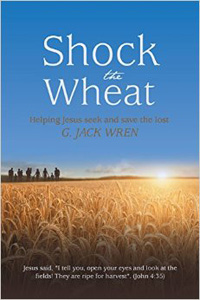
Shock the Wheat: Helping Jesus Seek and Save the Lost by G. Jack Wren (Crossbooks)

book wren200Jack Wren has written a short exhortation about evangelism using the term “shock the wheat,” a colloquialism for a worker’s specific task during harvest. The author’s inner fire burns brightly as he shares his vision to “inspire some, who perhaps are resting on the bench, to get in the race of life.”
In one particularly inspirational story, Wren recalls an event from his boyhood, when no preacher in his community would conduct his aunt’s funeral because she died from a sexually transmitted disease. Desperate, his aunt’s sister asked the “new Baptist preacher in Berea” if he would bury her sister. The pastor’s loving response made a life-long impression on Wren. The minister agreed to perform the funeral without any conditions. To this day, Wren remains committed to dealing compassionately with people in grief.

This book wonderfully reminds Christians of our mission to a lost world. As Wren writes, “All God needs to change lives on a grand scale is for his followers to faithfully tell their life stories by the way they live and what they say.” With humble sincerity, Wren “shocks the wheat.”

Mary Pat Johns

Victoria    


Life: Stick with encouragement

• The Bible Studies for Life lesson for May 3 focuses on Acts 9:26-28; 11:21-26.

William invited my husband and me to have dinner with his family and a new friend of theirs. Their friend recently had become a member of our church and had been in recovery from drug addiction just a few months. William and his family were among the first in our congregation to befriend Robert, and he was a frequent guest in their home. Sharing a meal with Robert gave my husband and me the opportunity to get to know him better.

Soon, we considered ourselves to be Robert’s friends, apart from our mutual connection with William. Robert gradually became friends with more people in the congregation. Although he once was viewed with a certain amount of uncertainty because of his former addictions, now he is a well-loved friend of many people in our church.  His acceptance largely was due to William’s encouragement and his facilitation of Robert’s relationships with other people.  

Barnabas and Saul

The Bible recounts a similar relationship between Barnabas and Saul (Paul). Before Saul met Jesus on the road to Damascus, he was an enemy of Christians, hunting them down to put them in prison. Saul approved of the stoning of Stephen, traditionally considered the first Christian martyr (Acts 6-8:3). After he accepted Jesus his Lord, Saul “tried to join the disciples, but they were all afraid of him, not believing he really was a disciple” (Acts 9:26). This fear is understandable, because Saul was an educated, powerful Pharisee with a well-deserved reputation for hating Christians.

Barnabas, however, accepted Saul as his personal friend. He introduced Saul to the apostles and affirmed Saul’s salvation experience was real. Because Barnabas mediated relationships between Saul and the apostles, Saul was able to then “(move) about freely in Jerusalem, speaking boldly in the name of the Lord” (v. 28). Consider the irony of this situation.  Saul, at whose feet people had laid their cloaks while they hurled stones at Stephen, now was preaching the gospel message of salvation in the same city where Stephen was killed. 

As Saul preached in Jerusalem, persecuted Christians scattered to nearby regions, sharing the gospel as they went. When many Greeks—Gentiles—turned to the Lord, the Jerusalem church decided to investigate. They sent the highly respected Barnabas to the emerging church at Antioch—near the modern city of Antakya, Turkey. Again,

Barnabas an encourager

Barnabas was an encourager to these new believers, just as he had been to Saul. He exhorted them to “remain true to the Lord with all their hearts” (v. 23). Then, Barnabas retrieved Saul from Tarsus and brought him to Antioch. They stayed there for a year meeting “with the church and (teaching) great numbers of people. The disciples were called Christians first at Antioch” (v. 26).

Scripture describes Barnabas as “a good man, full of the Holy Spirit and faith” (v. 24). Paul, his protégée, is considered by many to be the most influential Christian who ever has lived. When Barnabas faithfully followed the Holy Spirit’s prompting to befriend Saul, he likely had no idea he would be used by God to mentor someone whom God intended to be an incredible evangelist, church starter and the most prolific writer of the Bible. More importantly, Barnabas did not need to know how Paul’s spiritual journey would progress—he just needed to know God had saved him. Trusting Jesus’ redemptive work in Saul’s life, Barnabas could boldly befriend Paul and recommend him to others.

All of us have either needed an encouraging, Barnabas-like friend, or we have needed to be that kind of friend to someone else. The growing isolation of a culture that frequently develops “friends” through social media rather than face-to-face interaction challenges believers intentionally to nurture deep relationships with others so we function as either “Barnabases” or “Pauls” in others’ lives. This is one of the most important ways God matures believers and grows his kingdom.   


Explore: Awestruck

• The Explore the Bible lesson for May 3 focuses on Habakkuk 3:1-6, 11-13, 16-19.

Context of Habakkuk 3

Scholars and novices to Bible reading may struggle alike at times to translate Habakkuk 3 due to the ways in which scribes copied or transmitted the passage over the years. When one has difficulty with translation, however, a thorough study of the biblical and cultural contexts can help a great deal. For instance, we learned last week Habakkuk labored with his theodicy—an attempt to explain why a good and just God would allow bad things to happen. Habakkuk indeed speaks clearly and boldly for those of us who rightly wrestle with our theology. 

Habakkuk’s tone, however, is somewhat softened by chapter 3. He seems to have gone from a restless prophet to a calm servant. He moves from a tense back-and-forth conversation with God (Habakkuk 1) to an assertion of faith in the Lord. How can this be? We find no evidence Habakkuk’s mood or even his trust in the Lord wavered since the first chapter. Yet, in this case Habakkuk offered a prayer “on shigionoth” (3:1). We have some difficulty knowing for sure how to define “shigionoth.” Most likely, it is a type of musical response that means something like “to reel.” 

Consequently, what we may be reading and hearing in the given passage is Habakkuk’s use of another approach in conversing with God. That is, Habakkuk creatively and reverently pleads with the Lord yet again, but in so doing, Habakkuk not only furthers his struggle with a theodicy but also comes to realize some extremely important avenues for worshipping God in the midst of such a struggle. Habakkuk traveled these avenues well, and his confidence was bolstered by the fact that God had acted strongly on behalf of the faithful in the past. God will not disappoint this time, as well. We will turn our attention to four of these worshipful avenues in our examination of the text.

Stand in awe (3:1-2)

In the midst of his reeling, Habakkuk placed total confidence in Yahweh. Habakkuk leaned on his knowledge of God to help him through tough days. In fact, Habakkuk recounted how he had heard of God’s fame. Habakkuk not only heard God’s revelation of judgment as noted in the first two chapters, but also Habakkuk heard of God’s work among God’s people throughout history. Many scholars think Habakkuk crafted the following verses (vv. 3-15) as a poetic allusion to the Exodus. Habakkuk is a man who, although he struggled with theodicy and theology, put trust in the everlasting and omniscient God. God would continue to be in charge of governing of the world.

Accordingly, Habakkuk prayed for immediate help and assistance from the Lord. He expected the Lord to intervene and to be available to the faithful ones, just as God had rescued his people during the Exodus. Yet, Habakkuk also knew the only way one could escape the full vent of God’s wrath was to lean on the mercy of God. Habakkuk truly stood in awe and fear of the Lord.

Tremble in his splendor (3:3-6)

Habakkuk shared a theophany at this point in his message. A theophany is a report about the attributes or appearance of God. His vision began with a statement about the movement of God “from Teman” and “Mount Paran.”  Habakkuk’s poetic language asserted God not only was on the march but also would arrive in all of his splendor from the south of Judah. God would rise up to meet the challenges of the day. Consider, too, the appearance of God. God’s glory, or bright presence, would light up the sky and fill the atmosphere. Habakkuk could only liken God’s glory to the brightest known object—the sun. The rays of his brightness and omnipotence would even flash from God’s hand. God definitely is in charge.

Habakkuk further mentioned God’s control of the created order. For instance, pestilence and plague whirled around the Lord. It is likely these terms refer to the days of the Exodus. Mountains also crumbled beneath the weight of God’s might. Readers ought to take note of the awesome power of God and plan our lives accordingly.

Celebrate his victory (3:11-13)

God not only has command of creation, but also of creatures. In fact, Habakkuk pictured God striding through the earth and threshing the nations as a farmer sifts wheat or as a beast of burden threshes corn. In other words, God knows exactly how to deal with people and even nations that turn a blind eye to him. Perhaps we may do well to be reminded of the eerily similar words of Jesus: “But seek first his kingdom and his righteousness, and all these things will be given to you as well” (Matthew 6:33). Jesus recognized the challenge before all people either to go the way of egotism or to move toward the kingdom of God in the midst of our struggles with worry and earthly possessions. Jesus also had no qualms about telling his listeners the end result of disobedience and rejecting him. Will we serve the righteous king?

Rejoice in faith (3:16-19)

Habakkuk even responded physically to the impending judgment and movement of God among the nations. His words indicate his heart pounded, and he trembled uncontrollably. Yet even in his distress, Habakkuk found a reason to rejoice. He had concluded even though all may seem to go wrong around him, God’s strength and power would sustain him. How many of us are so certain of God we would dedicate ourselves to waiting on him patiently while the entire foundation of our society crumbles? Habakkuk provided a stout lesson, then, in trusting the Lord even while we question and struggle with God. God will sustain the faithful in good times and bad. We can be assured of the Lord. His strength is perfect in our weakness (2 Corinthians 12:9).


BaptistWay: Seeing God

• The BaptistWay lesson for May 3 focuses on Exodus 24.

Seeing through the smoke

Where there’s smoke, there’s fire. Where there’s fire and smoke … billowing smoke, and thunder and lightning, and a thick cloud and a very loud trumpet blast, there is God (Exodus 19:16-18). Where God is, the people tremble.

God descended to the top of the mountain and called Moses up from the bottom of the mountain. The trembling people watched as Moses climbed up to the volcanic appearance of God. They waited until Moses came back and told them not to set foot on the mountain or they would suffer God’s wrath.

When the people saw the mountain again, they trembled again at the site of God’s presence at the top of the mountain—the thunder and lightning, the smoke and the trumpet. The New International Version says “the people saw the thunder.” In trembling fear, they asked Moses to be their go-between (Exodus 20:18-19). They were terrified of God.

Rabbi Marc Gellman, who I have cited in previous lessons, paints delightful accounts about other stories in Exodus, fun stories that make me laugh and wonder. But Gellman doesn’t tell any stories about God’s terrifying presence on the mountain. Indeed, we’d much rather see terror in movies and TV shows than be terrified by God.

Then, God told Moses to bring Aaron, Nadab, Abihu and 70 elders “up to the Lord” to worship (v. 1). What could these men have been thinking as they went with Moses “up to the Lord?”

They ‘saw the God of Israel’

The last time we read a description of God’s presence on the mountain, it is the stuff of Dante’s Inferno. Then … well … then when Moses, Aaron, Nadab, Abihu and the 70 elders went up, and it simply reads, “(they) saw the God of Israel” (v. 10). Huh.

Oh, but that’s not all. “Under his feet was something like a pavement made of lapis lazuli, as bright blue as the sky” (v. 10). Lapis lazuli, an opaque blue stone, also is used to describe God’s presence in Ezekiel 1:26 and 10:1, Peter Enns points out in The NIV Application Commentary: Exodus. I wasn’t even there, and I find this absolutely remarkable. What happened to the smoke, the fire, the thunder and lightning? What happened to the terror?

Oh, but that’s not all. “But God did not raise his hand against these leaders of the Israelites” (v. 11). In case you missed it, these “leaders of the Israelites” were not to come near God (v. 2); yet, here they are, close enough God did not raise a hand against them, close enough they could see God without the smoke and fire.

That’s still not all. “(They) saw God, and they ate and drank” (v. 11). Somehow, these seventy-plus men overcame their terror of God and climbed up the mountain. They obeyed God’s call to come up the mountain and were rewarded with a sight to behold. Turns out, on the other side of all that smoke and fire and thunder and lightning was a majestic God who did not raise a hand in vengeance but in whose presence they found peace. “And they ate and drank.” I wonder what they ate and drank.

The eating and drinking in Exodus 24:11 does not refer to taking in dinner/supper. It is not a snack after a long hike. This “meal” was a customary way to seal a covenant between two parties.

The blood between

To this point, we have overlooked what took place between the smoking mountain of Exodus 19 and 20 and the majestic presence of God in Exodus 24. Between these two very different scenes, Moses built a stone altar at the foot of the mountain (v. 4). He sent “young Israelite men” to offer burnt offerings and to sacrifice “young bulls as fellowship offerings to the L” (v. 5). From the sacrifice, Moses splashed half the blood against the stone altar (v. 6) and sprinkled the other half on the people saying, “This is the blood of the covenant that the Lord has made with you in accordance with all these words” (v. 8). 

In a way seen most clearly through the lens of the New Testament, the sacrifice and the blood sprinkled on the people point forward to the sacrifice of Christ and his blood shed for the removal of sin (Matthew 26:28; Hebrews 9:11-28). In the same way the blood of the young bulls served to cover the sin of the men who went up to God, the blood of Christ serves to cover our sin, making it possible for us to go up to God.

Had the sacrifice and the blood not come between the two visions of God, I suppose we may not have the second vision, for to venture into God’s presence unclean is a dangerous proposition.

Yet, Robert Robinson in his hymn “Come Thou Fount” reminds us, “He, to rescue me from danger, interposed his precious blood.”


Life: Stick with love

• The Bible Studies for Life lesson for April 26 focuses on John 15:9-14.

A quick Internet search for “How to be Happy” yields 619 million results. Happiness eludes so many people and is so desperately craved that websites, books and businesses try to help people find it. Prevention magazine even recently reported “10 Foods to Make you Happy.”  The magazine claims people who eat lots of clams, walnuts and radishes are happier, because these foods stimulate the release of dopamine and other mood-elevating hormones.

Happiness commonly is thought of as a feeling brought about by good circumstances. Conversely, we feel sad when something “bad” happens to us. However, Jesus offers us something better—how to live a completely joyful life, regardless of circumstances. 

The kind of joy Jesus gives is deeper than happiness. It can’t be found on a website, by following 10 steps in a book or eating plenty of radishes. A believer’s joy, unlike the happiness we experience, is not based on circumstances. Rather, the source of joy for believers is Jesus’ love. 

His love is the foundation for our joy

In John 15, Jesus explains how his love is the foundation of a believer’s joy.  Jesus tells us he loves us in the same way the Father loves him. Believers who are blessed to have been reared in families with godly parents can understand the comfort, encouragement and safety a father can give his children because he loves them. On the other hand, believers who were not part of Christian homes may have difficulty understanding the kind of love God has for his children.

In whatever way you have experienced love from an earthly father, you can know God’s love is infinitely more than that, better than that. God’s love is just what you’re looking for; it can fill all the gaps in your soul. God’s love is found in Jesus.  

Discovering Jesus’ love is just the beginning. Jesus also asks us to “remain in his love” (v. 9).  The Message translates the meaning of this phrase as “Make yourselves at home in my love.” I consider home to be the place where I feel totally safe, at ease and accepted. Being home spiritually positions a believer to fully experience Jesus’ love for them.  How do we live joyfully in God’s home? By following Jesus’ commands, just like Jesus follows his Father’s commands. This does not mean we follow a set of rules so we earn our way into heaven.

Gift of grace

Note Jesus already was the Son of God, and subsequently he followed his Father’s commands. A believer’s salvation is an entirely free gift of grace from God.  Then, as we follow Jesus’ commands, we make ourselves at home in the way of life God provides for his children. Homes where the family members are bickering or even abusive toward one another are not safe places. On the other hand, God’s home is full of love and joy. We live there peacefully and ready to face the difficult circumstances of life when we keep his commands. 

What are Jesus’ commands? A religious scholar asked Jesus this very question. Jesus responded: “Love the Lord your God with all your heart and with all your soul and with all your mind. This is the first and greatest commandment. And the second is like it: ‘Love your neighbor as yourself’” (Matthew 22:36-37).  Jesus’ commands are built around love: God’s love for Jesus, Jesus’ love for you, and your love for others. In fact, Jesus reminds us the greatest love anyone can ever bestow on another person is to give his or her life for that person (v. 13).

Because Jesus loves us, he gave his life for us. By laying down his life for us, Jesus calls us friends. In turn, we keep Jesus’ commands when we love others sacrificially as well as loving God with every part of our being. The result? Complete joy.


Explore: Hard questions, harder answers

• The Explore the Bible lesson for April 26 focuses on Habakkuk 1:1-6, 12-13; 2:1-4.

Introduction to Habakkuk

“Where does it hurt?” We often must answer such a question when a medical professional treats us. Pain sends sharp reminders regarding our mortality. Habakkuk, however, dealt with more than physical pain. He struggled with attempts to reconcile God’s nature with the problem of evil in the world. Why would God allow such pervasive evil to exist and remain seemingly unchecked?

You do not have to look far in order to recognize Habakkuk’s dilemma. The daily news may leave us scratching our heads and questioning our theology. In other words, we can relate to Habakkuk rather easily. 

Scholars know little of Habakkuk’s background and even have some difficulty pinning down a date for his book. Still, it’s obvious Habakkuk was a deeply committed follower of the Lord who had a keen awareness of the Scripture. In fact, the first verses of his book have a great similarity to many of the psalms. Some scholars think Habakkuk served in some capacity in the Temple. His honesty in the face of complex theological and national challenges can be a source of tremendous comfort to his readers.

Habakkuk labored primarily with his theodicy. A theodicy is a way in which one attempts to explain why a good God would allow bad things to happen in the world. This lesson will attempt to offer some insights concerning Habakkuk’s struggle. We will examine the back-and-forth conversations between Habakkuk and God, and we will reconsider our trust in the Lord. For more introductory information, please refer to the introduction of the Bible books included in the front section of the resources.

What about evil (Habakkuk 1:1-4)

Habakkuk asked two basic questions concerning God’s nature in these verses. First, Habakkuk questioned God’s timing. The question “How long?” comes to the fore in many of the lamenting psalms and now in Habakkuk’s struggle. In other words, Habakkuk wondered at God’s silence in the face of Judah’s wickedness. In fact, he seemed utterly astonished God appeared to turn a deaf ear to the prophet’s cries for help. Why would God put up with the “violence” of the age—those people who willingly harmed others in either physical or unethical ways? 

Second, Habakkuk questioned God’s seeming acceptance of evil. It appeared to Habakkuk that God turned a blind eye to atrocities. Habakkuk even noted a few of the barbarities of his day that ought to have raised God’s ire. Habakkuk particularly noted both the destruction and injustice around him. In the Hebrew language, destruction refers to the ruin or spoiling of a society. Injustice characterizes the lawless nature of Habakkuk’s context. Consequently, Habakkuk appeared to accept the imminent rise of Babylon and destruction of Judah. Why, then, would God allow such a thing? Would God even dare to use Babylon as a toll of judgment upon Judah?

I am in control (Habakkuk 1:5-6)

Yahweh responded clearly and pointedly to Habakkuk’s questions. In fact, God answered with plural verbs in the Hebrew language and thereby replied not only to the prophet, but also to the entire nation. God’s response also seemed to underscore the truth that God’s will may not be easily grasped by human beings on every occasion of suffering. We ought to leave room to be “utterly amazed” by the will of God. Certainly, his ways are not our ways (Isaiah 55:8-9). Accordingly, God elaborated on his plan to utilize the Babylonians against the nation of Judah. God’s plan even highlights quite an important aspect of God’s nature: God has power over any nation in the creation. God called the Babylonians “ruthless and impetuous,” meaning they fiercely swept the known world without much regard to people or wise decision-making. That is, the Babylonians had no clue God was using them in his strategic plan for justice.

But God, why? (Habakkuk 1:12-13; 2:1)

Habakkuk then pressed the issue further. Keep in mind, however, Habakkuk appeared to trust implicitly the words of God. Habakkuk did not have a problem necessarily with understanding God’s plan. He needed clarity. In other words, Habakkuk trusted God was in control and would utilize even the Babylonians. He even declared God was “from everlasting,” indicating Habakkuk’s belief in the preexistent and eternal God of creation and the created order. Yet, why would God “ordain” the Babylonians to punish Judah? Why would God not be on their side?

Trust me! (Habakkuk 2:2-4)

God’s next response appeared to be forthright and reassuring yet somewhat vague. God even invited Habakkuk to “write down the revelation” on tablets for heralds of the day to dispatch quickly the latest theological news update to the people. What therefore was the news from God? “Wait for it.” In other words, God invited trust. The meaning of God’s will and use of power will come to light in time for Habakkuk and the nation. Consider, too, God knows the ones who are and are not righteous, and God shall save the righteous based on faith. The wicked will received what’s coming to them. Could it be that God must break down Judah before starting over again with the remnant? 


BaptistWay: Dealing with the details of covenant living

• The BaptistWay lesson for April 26 focuses on Exodus 21:1-2, 7-17, 22-27; 22:21-23:12.

To deal with the details of covenant living, we first need to know what “covenant” is. Furthermore, if we are going to deal with the details of covenant living using Exodus 20-23 as our guide, we need to know what “covenant” meant to ancient Hebrews. We will see a striking resemblance between the ancient Israelite conception of “covenant” and a current parallel in the Islamic world.

Gerhard von Rad, in Volume 1 of his Old Testament Theology, cites J. Begrich as providing great insight into the ancient Hebrew understanding of “covenant.” While in some instances, two parties may enter into a covenant, or binding agreement, on equal footing, the Sinai covenant is not that sort of agreement. Von Rad writes: “The ‘covenant’ is often an agreement imposed by a superior on an inferior. Complete freedom of action, and therefore the freedom to decide, that is, to take the oath or not, is in this case possessed only by the superior—the lesser partner is simply a recipient.”

The Sinai Covenant

The Sinai covenant is this type. In other words, the relationship between God and Israel established with the Sinai covenant is one of imposition. God imposed this agreement on Israel. As a result, Israel’s part wasn’t agreeing to the terms but was keeping the terms. The imposition is not all bad, though. Israel, in keeping the demands of the covenant, would receive superior protection and provision.

Understanding the relational nature of the Sinai covenant is important for putting into perspective the details of Exodus 20-23, what many call the Book of the Covenant (based on Exodus 24:7).

What are the details of the Sinai covenant?

As I read through Exodus 20:22-23:19 and count each law, I come up with a total of 84. I define a separate law as beginning with “if,” “but if,” “do not” or another imperative. Your list may differ, and in that respect we are not alone. Priests and rabbis throughout Israel’s history have made careers out of trying to determine an accurate list of laws. They have given so much time to the details of the law because they understand it as a covenant initiated by God with all the rights and obligations thereof.

Unfortunately, trying to number the laws has a tendency to obfuscate them. Speaking of obfuscation, something else that causes a lot of trouble is trying to determine which laws no longer apply and which laws are intended for all time. Take a moment to go back through Exodus 20:22-23:19, and make a list of those laws that are still in effect—remembering Jesus said he did not come to abolish the Law but to fulfill it (Matthew 5:17). And in completing this assignment, you may want to determine what Jesus meant by “fulfill.”

To this point, we still haven’t answered the question “What are the details of the Sinai covenant” but only have become bogged down in trying to determine to what details the question refers.

Consider the covenants with Noah and Abraham

At this point, it will be helpful to back away from the separate laws and consider the Sinai covenant is built upon the earlier Noahic (Genesis 9:1-17) and Abrahamic (Genesis 12:2-3; 15) covenants. God initiated these two covenants, blessing Noah with fruitfulness and promising Abraham countless posterity. God desired to reaffirm these covenants in giving the Sinai covenant to the Israelites, the fruit and posterity of Noah and Abraham.

It also will be helpful to look at the Book of the Covenant as a whole. Peter Enns in The NIV Application Commentary: Exodus follows J. Sprinkle in dividing the Book of the Covenant into the following sections:

A. Worship: Idols and Altars (20:22-26)

B. Social Responsibility (21:1-22:17)

C. Worship and Social Responsibility (22:18-23:19)

In dividing the Book of the Covenant into these three sections, Sprinkle and Enns wish to draw attention to the fact that the covenant begins and ends with worship. Ancient Israel’s legal structure begins and ends with an eye to the nature of Israel’s relationship with God, the initiator of the covenant. Israel is to worship God alone and make no other god to compete with, stand in front of or draw attention from God. Likewise, Sabbaths and festivals are to shape Israel’s worship of God.

Governed all aspects of life

All the laws governing society and social interaction are bounded by the laws establishing and governing worship. This means the social fabric of Israel was to be an expression of Israel’s relationship with God, who is the superior in the relationship. As such, there is no separation of church and state in the ancient Hebrew law as there is in contemporary American law. Our secular law is not defined by worship of God.

A contemporary parallel to the ancient Hebrew legal structure are those conservative Islamic societies headed by mullahs or other Muslim clerics. Regardless of what your particular views are of such societies, observe how they strive to order their societies in keeping with the Qu’ran and the hadith of Muhammad. Consider that these conservative Muslim societies view religion and law as a unified whole emanating from the will—the initiation—of Allah. In other words, Shari’ah is meant to be an expression of the Muslim’s relation to Allah. If you can begin to understand this undergirding principle of Muslim societies, you can begin to understand the nature of the Book of the Covenant in the context of ancient Israel.


Book Review: Anxious: Choosing Faith in a World of Worry

Anxious: Choosing Faith in a World of Worry  by Amy Simpson (IVP)

book simpson200Turn on the television, listen to talk radio or read the news for a healthy dose of worry encouragement. In Anxious: Choosing Faith in a World of Worry, Amy Simpson provides a practical but not-very-easy process for living free of anxiety. However, as the wife of a licensed certified professional counselor, she emphasizes her book is not for those who worry due to psychological or medical reasons and is not a substitute for professional help.

Simpson defines worry as the “practice of indulging in fear, clinging to it, feeding and serving it.” She then asks, “Should you be worried?” The balance of the volume outlines reasons Christians should not be anxious in a worried world. Chapter titles include: Frantic, Worry’s Many Destructive Powers, What God Says About Worry, It’s All About Perspective, The Future Belongs to God, The Fallacy of Possession and Who Do You Trust?

Simpson, the senior editor of Leadership Journal, fills the pages with strong biblical examples and scriptural references applied in appropriate ways. She emphasizes not worrying doesn’t equal failure to dream, plan or prepare. Instead, she suggests picturing the future with “God’s love, grace and care for you and the people you love.” 

Anxious provides sound advice for worriers, those who live with worriers, those who minister to worriers and those “who aren’t convinced worry is a problem in their lives,” because it is for someone they know. After all, as Christians, the future belongs to God, and worry won’t change a thing.

Kathy Robinson Hillman, president

Baptist General Convention of Texas

Waco


Life: Exalted like no other

• The Bible Studies for Life lesson for April 19  focuses on Ephesians 1:7-10; 18-23.

Forbes magazine ranks Russian President Vladimir Putin as the most powerful person in the world. United States President Barack Obama is second.

Finishing out the top 10 are: 

    • Xi Jinxing, general secretary, Communist Party, China; 
    • Pope Francis, bishop of Rome, Roman Catholic Church;
    • Angela Merkel, chancellor, Germany;
    • Janet Yellen, chair, Federal Reserve, Washington, United States;
    • Bill Gates, cofounder, Bill & Melinda Gates Foundation;
    • Mario Draghi, president, European Central Bank;
    • Sergey Brin, cofounder, director of special projects, and Larry Page, CEO, Google (tied for ninth place);
    • David Cameron, prime minister, United Kingdom.

The Forbes list is an intriguing combination of political heads of state, financial leaders, philanthropists, entrepreneurs and, of course, the extremely popular pope, known for his love of all kinds of people and humble acts of service. 

The power of Jesus

However powerful these people are, though, it is nothing compared to the power of Jesus, whom the Apostle Paul describes as the one who is “far above all rule and authority, power and dominion, and every name that is invoked, not only in the present age but also in the one to come” (Ephesians 1:21). The Message describes it this way: Jesus is “in charge of running the universe, everything from galaxies to governments, no name and no power exempt from his rule. And not just for the time being, but forever” (Ephesians 1:21).

Stocks may rise or fall in reaction to the words of Janet Yellen or Mario Draghi. Bill and Melinda Gates may substantially lower deaths from malaria due to the good work of their foundation; Pope Francis may be honored as one of the most popular leaders in the history of the Roman Catholic Church. But none is exempt from the rule of Christ. God has “placed all things under his feet and appointed him to be head over everything for the church, which is his body, the fullness of him who fills everything in every way” (vv. 22-23). 

Source of eternal riches

Jesus Christ not only is the apex of power over all creation, but he also is the source of riches, power and hope for his followers. The riches available to his church are not temporal; they are eternal. Christ’s finished work of death on the cross redeems us, or buys our freedom from slavery to sin (v. 7). We also are forgiven of our sin and are released from being haunted by the overwhelming guilt of the mistakes we have made (v. 7). Redemption and forgiveness add up to a life of joyous, eternal freedom for the believer. This is true wealth.

The power believers inherit through Christ is “the same as the mighty strength (God) exerted when he raised Christ form the dead and seated him at his right hand in the heavenly realms” (v. 23). This is the power that enabled Paul to say, “I can do all things through him who gives me strength” (Philippians 4:13). This power is not based on one’s wealth, intellect, influence or business acumen. It is a mighty strength from God that enables us, the body of Christ, to be used by him to fulfill his mission in the world.

In addition to riches and power, the exalted Christ also is the source of hope. Scripture assures us, “when the times reach their fulfillment,” God will “bring unity to all things in heaven and on earth under Christ” (v. 10).

Paul told the Christians in Ephesus he wanted them to “know the hope to which he has called you, the riches of his glorious inheritance in his holy people” (v. 18). I like to think of this kind of hope as an assurance that, no matter what the circumstances of our daily lives, we know ultimately God will bring everything into unity. In his letter to the Romans, Paul expresses this kind of hope by saying “in all things God works for the good of those who love him” (8:28).

The hope we have in Christ

If Paul were to write a new letter to the Christ’s followers today, I believe he would continue to exhort us to acknowledge the hope we have in Christ. Many times believers live defeated lives not discernibly different from the lives of non-Christians. We have, perhaps unconsciously, taken on the constrictions of the finite, fleeting power and wealth that characterizes the world apart from Jesus.

A friend of mine recently said of his generation: “Millennials don’t read the Bible anymore. They read Christians.” I wonder what people see when they read me. Do they see a joyless, fearful, defeated person or a child of God who has gained the rich inheritance of Christ’s power and hope? What do people see when they read you? Perhaps God is leading you, too, to know “his incomparably great power for us who believe” (v. 19).


Explore: A refined people

• The Explore the Bible lesson for April 19 focuses on Zechariah 13:1-9.

A.W. Tozer helps us consider the nature of God in his book, The Knowledge of the Holy. He writes: “Left to ourselves, we tend immediately to reduce God to manageable terms. … We want a God we can in some measure control.”

Tozer appears to be familiar with Zechariah’s uncontrollable God—a God who is the subject of life and salvation rather than a mere object. Consequently, we can affirm if a person has seen Jesus, then he or she has seen the Father (John 14:9). Life ought to be ordered accordingly. A person must come to Jesus by faith in order to receive forgiveness and cleansing of sin. 

Zechariah pointed directly to Jesus, even though he ministered in the sixth century B.C. This passage deals with the nature of God and points forward to the coming Christ. We find God cannot be controlled or manipulated by humankind. This true God wills people to be saved from sin and death. Zechariah crafted his preaching in order to encourage people during a tumultuous time of change. This lesson explores Zechariah’s theology and focuses on three images he utilized in communicating God’s truth to a people who desperately needed hope.

The fountain that cleanses (13:1-6)

Notice Zechariah began the chapter with three “on that day” formulas. Zechariah used the phrase at least seven other times in chapters 12 and 14. Obviously, Zechariah was concerned at this point with both the immediate and long-term future of God’s people. We can give definition to this concern by using the term “eschatology,” or the theology of last things. A person’s eschatology should be informed by a biblical view of God’s nature. Consider Zechariah’s view as we study two points of his eschatology in these verses.

First, God does and will deal with human sin. We serve a God both sovereign and graceful concerning our sin. God has the final word regarding our offenses. Zechariah consequently pictures a fountain opened in Jerusalem so believers can receive cleansing from sin and idolatry. Notice the cleansing comes from water and not by animal sacrifice. Could this be a reference to the fountain “filled with blood, drawn from Emmanuel’s veins?” Notice also the fountain is available to people beyond just the house of David. God is inclusive in his nature and will.

Second, God shows great concern for idolatry and will eradicate false prophecy. In the passage, God promises to banish the names of idols, false prophets and the spirit of impurity. If God removes the names of idols, then he obviously renders the idols useless and void of influence. What a blessing it is to anticipate a time when we will forget the names of all idols in deference to Yahweh.

We also may look forward to a time when God removes all prophets who either speak for idols or speak falsely for God and thereby take his name in vain. It is usually the latter group with whom we find ourselves greatly confused even today. We ought to consider seriously any person who claims to speak for God on a particular issue, even if the issue appears trivial or ordinary. Keep in mind God issues a death penalty for false prophets in this passage.

The strike that frees (13:7)

Zechariah shifted his focus at this point by utilizing the poetic, and Zechariah even returns to the shepherding imagery he used in chapter 11. This time, however, the image of the shepherd was slightly different. Previously, it had been used in reference to a wicked ruler. God now referred to the shepherd as “the man who is close to me.”

The reference here has been the subject of considerable debate in scholarly circles, and many favor an interpretation that equates the Messiah to the shepherd. “The man who is close to me” suggests the shepherd is on equal footing with Yahweh. If such is the case, then a mortal blow upon the shepherd would “scatter the sheep” and execute God’s judgment for sin.

The fire that refines (13:8-9)

Zechariah subsequently prophesied only a handful of the scattered population would remain as a godly remnant. This remnant would have to endure refinement, or trials. Zechariah’s original Jewish audience may have understood his language to provide encouragement and hope in the face of Babylon’s incredible wickedness. Those who were deported by Nebuchadnezzar and his henchmen could survive and find hope if they remained faithful to Yahweh.

In contemporary times, believers still endure trails by fire, so to speak. Consider the current waves of violence against Christians in the Middle East and in Europe. We often cannot fathom the reasons behind such violence other than our knowledge of the demonic, yet the gates of hell have yet to prevail against the church.

Our Good Shepherd was indeed “wounded for our transgressions,” but we have salvation by grace through faith in him. Accordingly, we can endure the refining fires of devoted and truly pious Christian living. The second century pastor, Tertullian, perhaps said it best: “The blood of the martyrs is the seed of the church.”