Review: The Rhythm of Home
The Rhythm of Home: Five Intentional Practices for a Thriving Family Culture
By Chris and Jenni Graebe (NavPress)
The word “rhythm” has evolved from primarily associated with music, dance and poetry and with the recurring processes of science to a term reminiscent of its Latin origin likened to a flowing stream. In The Rhythm of Home, the authors apply the term to a framework of flowing but structured life practices that help people purposefully grow around core values. In the case of Chris and Jenni Graebe, their home furnishes the setting for the family of seven as they strive intentionally to build a culture where each member flourishes personally and spiritually and the family thrives as a whole.
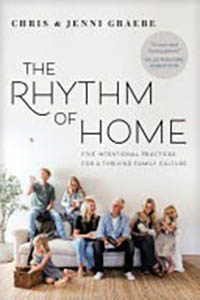 That’s a tall order, but the faith leaders in local church ministry fill the pages of The Rhythm of Home: Five Intentional Practices for a Thriving Family Culture with wisdom, truth, grace, honesty and practical ideas gleaned from their own successes and failures. Each chapter begins with a Scripture or quote, and the Graebes stress starting with a shared vision, establishing a loving home and building a strong community of support.
Jenni and Chris then explore five key core rhythms. These include the rhythm of speaking life individually and collectively, the rhythm of serving each other and then serving outside the home, the rhythm of slowing down when life gets too fast, the rhythm of seeking adventure daily, and the rhythm of staying in awe of God’s world and his creation.
The parents share illustrations with the permission of their five children. For example, the rhythm of speaking life can be as simple as each family member offering a blessing for the birthday girl or boy at dinner on their special day. Or they may be as elaborate as a rite of passage event when each turns 13 that includes male or female relatives and mentors depending on the teen’s gender and perhaps a few close friends who speak blessings and sometimes give gifts that remind them of the individual’s wonderful qualities. The stories of the two who have celebrated that milestone, their son and oldest daughter, provide ideas that can be personalized and replicated.
On another occasion, when the family continually feels too rushed, too frustrated and too crabby on Sunday mornings, they meet together, discuss the need to slow down and develop a solution that works by pre-preparing on Saturday evenings and switching to a later worship service.
The Graebes call readers to examine, evaluate, and envision unique rhythms that continue to allow their family to thrive. Some rhythms may have become ruts that should be eliminated. Others may need to be revised as children grow older. A few may have developed into cherished traditions that will endure.
Finally, the authors offer encouragement to develop a rhythm of home and no matter how hard, to “do it anyway.” The title closes with a beautiful blessing, made even more beautiful when spoken by Jenni Graebe on the audible book.
The Rhythm of Home delivers healthy hope and practical inspiration for the parenting journey. But for empty-nesters and those without children, the book subtly and not-so-subtly provides hints as to how to help and not hinder. Even if the reader or listener uses just some of the ideas, the rhythm of their home will become more loving, more joy-filled and quite simply more fun.
Kathy Robinson Hillman, former president
Texas WMU and Baptist General Convention of Texas
Waco
 In When the Church Harms God’s People, Langberg writes as one who loves the church enough to offer an honest diagnosis of its sickness in order to help restore its health. She draws upon more than 50 years of experience as an internationally recognized psychologist and trauma expert and as former chair of the board of the American Association of Christian Counselors.
 Like the additional verses to “Jesus Loves Me,” the depths of Christianity remain unknown to too many Christians. Brad East seeks to remedy this in Letters to a Future Saint.
 Some of these books are more helpful than others in reaching the audience Matthews notes most needs to hear, to understand, the reach and impact of sexism in the church—within evangelical Christianity most especially, where sexism is “baked into the cake.” That audience is men.
 The New Testament in Color is composed of 22 commentaries on the books of the New Testament written by 20 different scholars, along with five introductory chapters on biblical interpretation from five ethnic perspectives—African American, Asian American, Hispanic, Native American (Turtle Island) and Majority-Culture (Anglo)—and chapters on gender, mental health, linguistics and immigration.
 Painstakingly researched in old newspapers, oral histories, congressional records, court cases and other primary sources, Wingate interweaves historical events and real people like social reformer Kate Barnard into a novel that tells of a time when powerful men exploited or eliminated Choctaw and other tribal children to wrest control of their valuable, oil-rich land.
 American Christians’ values may mirror America more than Christ, particularly when it comes to power, enemies, money, sexuality, politics, race and suffering. Steve Bezner holds up an American view of these seven areas and compares it against Scripture. In particular, he compares the American view against what Jesus taught regarding the kingdom of heaven.