Primera Iglesia in Dallas accepts challenges after disaster
October 29, 2019
Meeting in a tent near the wreckage of their former building on Oct. 27, members of Primera Iglesia Bautista de Dallas gathered to worship and accept the challenges ahead.
A tornado that ripped through Northwest Dallas one week earlier not only caused substantial property damage affecting many families and businesses, but also destroyed the sanctuary where Primera Iglesia Bautista de Dallas had worshipped for 40 years.
Although the congregation lost a building, Pastor Ricardo Brambila called the congregation to see the loss as an opportunity to grow in their walk with God.
The natural disaster was not the first giant challenge the church faced, Brambila said. By trusting in God’s power and plan, the congregation understands this is an opportunity to see “how great is our God,” he noted.
Looking ahead
Francisco Flores went into the Primera Iglesia Bautista de Dallas building on Oct. 20 to prepare for a children’s class he planned to lead. “Everything happened in a matter of seconds,” he said. In the photo, Flore stands near the hall behind the sanctuary platform where he found refuge. (Photo / Isa Torres)
Volunteers had removed seven tons of debris in seven days, Brambila said. And in the midst of that chaos, he added, the church already is looking ahead.
The church remains in crisis management mode now, he acknowledged. But in the next 30 days, Brambila expects the congregation to develop a plan for the future, he said.
Royal Haven Baptist Church in Dallas invited Primera to meet at its missions house for worship services on Wednesdays, and Park Cities Baptist Church in Dallas offered its Ellis Chapel for Sunday services. Other temporary options also are available—including a few closer to the congregation’s property, he noted.
The disaster did little to prevent the church’s ministries from continuing, Brambila said. With the support of Dallas Baptist Association, Texas Baptist Men, Rio Grande Valley Baptist Association, Lake Pointe Church en Español in Rockwall, Park Cities Baptist Church, Royal Haven Baptist Church and the Baptist General Convention of Texas, the church has received everything it needs to continue responding to the needs of the community, he noted.
“We don’t feel alone at all,” Brambila said. “Three hundred volunteers came to help pick up debris, while our church went out to give shoes and backpacks to the community.”
Brambila, who also serves as director of Buckner International’s Family Hope Center, noted Buckner also deployed staff to help the church after the disaster and with their future plans.
Soon, Brambila announced, the church will set up a mobile office, which will serve as its headquarters. The church also will add staff so the ministries of the church continue functioning while Brambila provides pastoral ministry for the congregation affected by this natural disaster.
One more challenge in a long series
Primera Dallas has a long history of taking on challenges, enduring and pulling through them, he observed.
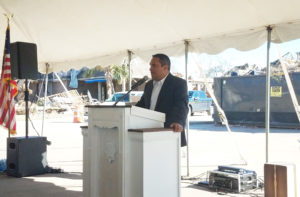
Pastor Ricardo Brambila called on members of Primera Iglesia Bautista de Dallas to mourn the loss of their sanctuary but also look ahead to what God has in store for the church. (Photo / Isa Torres)
In 1918, the year the church began, the Spanish flu began spreading through Dallas months before the church opened its doors on Nov. 3, 1918.
When the church began construction of its most recent building in 1980, the country experienced a financial recession.
“Every time the church has done something, it has been against the odds,” Brambila said. “This is one of those times, so we feel encouraged.”
As the church begins to look at reconstruction, the congregation will decide what changes are needed as they know more of their needs, Bramibila said. Primera owns its property, so the reconstruction will take place there, he added.
And while plans may not be set in motion until next month, Brambila hopes the church will have a new building in a year and a half.
In the meantime, the church plans to gather with neighborhood residents for a dinner in early November, he added.
“One thing is to lose your church, but another thing is to lose your house,” Brambila said.
While the congregation mourns its losses and reflects on the memories made in the building that was destroyed, Brambila said the church will take the opportunity to be the people God has called them to be.
Miranda leads Hispanic Baptists, among other responsibilities
October 29, 2019
CORPUS CHRISTI—When the Hispanic Baptist Convention of Texas elected Tony Miranda as president in June, they followed the adage, “If you want something done, ask a busy person to do it.”
Miranda, a husband and father of two daughters, is campus pastor at Stark College and Seminary in Corpus Christi, where he also directs the school’s graduate program and is a lecturer in Christian Scriptures. He also serves as a teaching pastor at Primera Iglesia Bautista de Robstown.
Seize opportunities
Miranda grew up in a Baptist family in Mexico in the state of Durango, and has lived in the United States 10 years. He learned early the importance of availing himself of opportunities, and he hopes Hispanic congregations likewise will seize opportunities to become all God intends for them to be.
At his home church in Mexico, Iglesia Bautista Bethel in Gomez Palacio, members and church leaders recognized his gifts and opened the space for him to join its ministries through music, teaching and preaching.
In Mexico, he received two undergraduate degrees in graphic design and marketing, as well as a Master of Business Administration degree from Universidad Autónoma de la Laguna.
After arriving in the United States, he earned an undergraduate degree in Bible and theological studies from Baptist University of the Américas. He went on to earn Master of Divinity and Doctor of Ministry degrees from Baylor University’s Truett Theological Seminary.
Now he is pursuing a Doctor of Philosophy degree in New Testament from Midwestern Baptist Theological Seminary.
He also is writing his first book on the study and interpretation of the parables of Christ, which will be published in both English and Spanish.
While volunteering and living at a kibbutz in Israel, Miranda also received a certificate of Jewish culture and context from the Israel Study Center.
Engage Hispanic Millennials
His professional experience and academic preparation have equipped Miranda for his ministry roles in Corpus Christi, Robstown and with Convención.
Inspired by the support he finds in his wife Daleth and the mentorship of his professors at BUA like David Maltsberger, Nora Lozano and Mario Ramos, Miranda hopes he will provide ministers, churches and Hispanic Millennials the support they need to grow in Christ.
“Churches have a generational divide of language and culture,” he explained. “While the Hispanic church in Texas is multigenerational and multilingual, it is still one church. So, we want to see how the local church can address the needs of different groups and not have them be independent of each other.”
Young people must become active in church, but older generations must also allow younger generations to become active, he noted.
Miranda hopes generational, cultural and language challenges instead will become opportunities for Hispanic congregations. In the process, he hopes ministers will realize people need opportunities to grow.
“There are many young adults with many talents, young educated adults, but who are not connected in a church,” Miranda said. “We need to motivate them more. And our hope is that as some of them get started, we will then see a chain reaction with more and more following.”
With that goal in mind, Miranda worked with Convención’s Young Latino Leaders in a statewide initiative focusing on projects developed by young Hispanics in local congregations while also engaging in leadership roles.
Enhance connections between pastors
Convención not only focuses on the next generations, but also on current pastors, he added.
With Conexión, the Hispanic Convention offers pastors the opportunity to connect with each other and to partner to meet the challenges they face, he noted.
Miranda also understands the challenges pastors deal with every day. For that reason, he has started personally checking on pastors—calling them and hearing what they and their congregations go through.
“Many pastors feel alone. So, I want to show them we care about them and want to be there for them,” he said. “In my role as president, I have connected with some pastors. And after listening to them, I pray with them for their needs and their congregations,”
With all of his responsibilities in his family, jobs, studies and ministry, Miranda said he find strength in the God in whom he trusts and in a supportive family.
“It is by the faithfulness of God that I am on this journey,” he said, adding, “I could not have done anything without the support of my wife and daughters.”
He particularly finds inspiration in the way God is using his wife Daleth, who also
graduated from BUA, as a conference speaker for Baptist events and ministries.
Together, the couple and their daughters, Zoe and Noa, pursue shared interests including reading and photography, as well as recording and producing Christian music.
Tornado destroys Primera Iglesia Bautista building in Dallas
October 29, 2019
When severe weather swept through North Texas Oct. 20, a tornado destroyed the Primera Iglesia Bautista de Dallas building in northwest Dallas.
A member of the congregation—Francisco Flores—was at the building Sunday evening preparing for the class he planned to teach on Wednesday when the building began falling apart, Pastor Ricardo Brambila said.
Flores found safety in an area of the sanctuary by leaning against one of the few walls that survived the storm, Brambila reported.
“We are still in shock after our 40-year-old sanctuary was gone in less than a couple of minutes,” Brambila said.
The church, which is more than a century old, had met in that building for the past 40 years, and many families have been members of the church for decades, he said.
While the church has insurance, Brambila was unsure how much of the damage to the building and other loss of property would be covered.
Documents and photos telling some of the church’s history cannot be replaced if lost, Brambila said, but he added he is thankful to God no lives were lost.
Standing on the promises of God
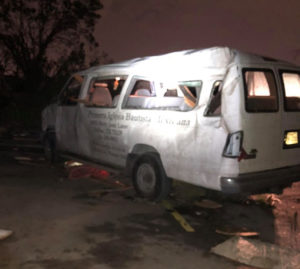
Leaders of Primera Iglesia Bautista in Dallas began early on Oct. 21 assessing damage to church property after a tornado hit the night before. (Photo courtesy of Primera Iglesia Bautista in Dallas)
Earlier in the day, Brambila preached a sermon from Numbers 14. The Old Testament passage tells about a time when Israel rebelled against Moses and God after wandering in the desert for years. Brambila pointed out how God reminded Israel of his promise and of what awaited them.
After the tornado that hit later that same day, Brambila said, he trusts the congregation also will hold to the promise of God’s fidelity.
“We know that all things work together for good for those who love God,” said Brambila as he quoted Romans 8. “We love God, and this will serve for our good.”
As Brambila and members of his church assess damage and seek to determine the path forward, he noted several other churches and Baptist leaders already had offered their support and prayers. First, he noted, his congregation will need to make decisions about where to meet for worship.
“We are thankful for churches who have shown their support,” Brambila said. “We do not know what will be next, but we’re glad others want to offer us help.”
Pastor Ricardo Brambila and his wife Janeth serve Primera Iglesia Bautista in Dallas. (Courtesy Photo)
Jesse Rincones, executive director of the Hispanic Baptist Convention of Texas, expressed the concern of Convención for the Dallas congregation.
“We’ll do whatever we can to help them continue their ministry,” he said.
He commended Brambila for his comforting and calming presence through a traumatic event.
“Ricardo’s leadership has been extraordinary at this time,” Rincones expressed.
Pastor Carlos Valencia of Iglesia Victoria en Cristo in Fort Worth, who also is coordinator of Faith Community Health, noted the need to consider the emotional needs of Primera Iglesia Bautista in Dallas and its leaders. While concerned Christians are quick to offer immediate relief in times of disaster, he noted the need for support through the long-term process of recovery.
“PIB Dallas will need others walking alongside them later on as they begin the process of healing and growing after the disaster,” Valencia said.
Historic Hispanic Texas churches persevere and adapt
October 29, 2019
Geographic distance separates three Hispanic Texas Baptist churches established in the 19th century, but a shared commitment to making necessary adjustments to reach people for Christ unites the congregations in Laredo, San Antonio and El Paso.
Churches must “move with the times without watering down the gospel,” said Dorso Maciel, pastor of Primera Iglesia Bautista de Laredo.
Beginnings of Hispanic Baptist work in Texas
His congregation was founded as Primera Iglesia Bautista Mexicana de Laredo 47 years after Texas gained its independence from Mexico in 1836.
In a document marking the church’s centennial, the Laredo congregation asserted that while the name included “Mexicana,” most of its founding members were American citizens who selected the name to show pride and recognition of “their Mexican roots.”
In the 1800s, Southern Baptist missions to Mexico also included South Texas. In 1880, the Southern Baptist Convention’s Foreign Mission Board commissioned John Westrup as a missionary. Along with his brother Thomas, the Westrups served in both Mexico and Texas.
One year after John Westrup began Baptist missionary work in Laredo, he was killed on his way to a preaching engagement in Musquiz in Coahuila, Mexico. Thomas Westrup continued the work, and Primera Iglesia Bautista de Laredo was established in 1883.
Five years later and more than 150 miles to the north, Primera Iglesia Bautista de San Antonio was established. Manuel Treviño, a former Methodist deacon, was ordained to the ministry and became the church’s pastor three months later. During his time in San Antonio, Treviño helped start several other churches including Primera Iglesia Bautista de San Angelo.
Differing accounts
Historical accounts differ regarding the beginning of Baptist work in El Paso.
In his 1981 book, A History of Mexican Baptists in Texas, Joshua Grijalva reports Alejandro Marshand—a former Catholic priest—was pastor of a Methodist mission in El Paso. However, in a Bible study with the pastor of Second Baptist Church, a black congregation, Marshand became convinced Baptist views on baptism and Lord’s Supper were true to Scripture.
Marshand preached his newfound convictions at his Methodist mission and then announced it was his last sermon as a Methodist minister. The pastor of Second Baptist Church subsequently baptized Marshand and 28 others in the Rio Grande in July 1892, and those newly baptized believers formed Primera Iglesia Bautista Mexicana de El Paso, Grijalva wrote.
Other sources refer to the church’s founding pastor as Alejandro Marchand and indicate he was Presbyterian rather than Methodist. Some question whether he ever became Baptist, and reports vary regarding how long he remained at Primera Iglesia Bautista in El Paso.
By the beginning of the 20th century, nine Hispanic Baptist churches in Texas totaled about 360 members. They ranged from El Paso to Floresville and from San Angelo to Laredo, Juan Martinez noted in his book, Los Evangelicos: Portraits of Latino Protestantism in the United States. In 1910, representatives from those churches met in San Antonio and formed the Mexican Baptist Convention of Texas, later renamed the Hispanic Baptist Convention of Texas.
Pioneering churches persevered
Although they faced social and economic challenges, Hispanic Baptist churches persevered, and by the 1940s, they started several important ministries like the Mexican Children’s Home and the Mexican Bible Institute in San Antonio, now Baptist University of the Américas.
In 1980, Leo Samaniego—then pastor of Primera Iglesia Bautista in Laredo—removed a plaque to expose a time capsule placed at the building in 1946 by Pastor Andres Cavazos. (Courtesy Photo)
The pioneering Hispanic Baptist churches in Laredo, San Antonio and El Paso bear witness to God’s work in Texas among and through Hispanics, Maciel remarked.
Out of his 60 years of experience as a pastor, Maciel has served 27 years at Primera Iglesia Bautista de Laredo.
One change he has observed is the growth in multicultural ministries. Like many other Hispanic churches, Primera in Laredo responds to the needs of younger generations who grew up in the United States and whose background is shaped by intersecting cultures.
Just as Hispanics learned to thrive in different settings, churches realized they needed to adapt to more than one culture to reach rising generations of Hispanics, he added.
People representing varied educational and economic levels—as well as language preferences—must still find a place to come together under Christ at the church, Maciel said.
He regrets the spirit of competition too-often evident among congregations that seek their own growth rather than the growth of God’s kingdom.
“They’re all after the same fish,” Maciel said.
Moving and adapting
Alfonso Flores has led Primera Iglesia Bautista Mexicana de San Antonio as pastor for 29 years. During his tenure, the church has grown and relocated in 2000 from Alamo Street to the former location of Manor Baptist Church on Meredith Drive.
When Manor Baptist faced a decline in its membership, church leaders contacted Flores, offering their property—appraised at $1.1 million—to Primera Iglesia Bautista Mexicana for $350,000.
“We saw that as a blessing from the Lord,” Flores said.
Primera offers two services weekly—one in Spanish and the other in English. Flores views bilingual ministry as essential.
“It is vital, I think. It is indispensable if you live in Texas, where the language is English,” he said. “We have to stay up to date and minister to our younger generations. Even many adults now prefer English.”
Hispanic churches also must communicate in culturally contextualized ways, he added. That requires ministers to stay up-to-date in their knowledge of societal changes and responding accordingly.
Reaching the rising generations
In the case of Primera in San Antonio, that involves seeking to connect with young Hispanics from nominal Catholic backgrounds who left their parents’ church behind.
A key way to connect is to find common ground—starting points for communication—and establishing personal relationships that allow those who have distanced themselves from religion to see Christ at work in the lives of believers, Flores noted.
Primera Iglesia Bautista de El Paso worked hard to minister in its community in the 1960s. By the 1980s and 1990s, about 500 people attended its services every Sunday. (Courtesy Photo)
Pastor Josué Trejo just arrived at Primera in El Paso this past May. Originally from Mexico, Trejo moved to Texas with his parents and grew up in the Rio Grande Valley.
In the late 1980s and early 1990s, the El Paso congregation enjoyed its golden years when membership in the church reached more than 500 people, Trejo said.
“Now the Hispanic community is strong here, but newer generations present new challenges for the Hispanic church,” Trejo said. “The ways in which younger people perceive the role of the church in the community is different.”
Hispanics constitute a majority in El Paso, and for many years, Primera was the only Hispanic Baptist church in the community, Trejo noted. Now, he said, he is glad other strong congregations like Del Sol Church are able to minister to people Primera might not be able to reach.
Like his fellow pastors in Laredo and San Antonio, Trejo believes reaching new Hispanic generations ultimately depends on preaching God’s word faithfully.
Worship styles continue changing, so a church’s identity cannot be found in style, Trejo insisted. Instead, a church must find its identity in Christ, as revealed in the Bible.
“We must create an environment where people can ask questions about the faith.” Trejo said. “People here were hungry for the word (of God), and they are now still hungry for the word.”
While remaining grounded in the Bible, ministers must never close the door to change, he added. Pastors have to be versatile, he said, because pastors are involved in the lives of all kinds of people.
“There will always be something to change, something that needs improvement,” Trejo said. “But all changes must come from God’s will first. That is the only change that will bless the church.”
Call to commitment
Looking to the future, Hispanic Texas Baptist churches need to be filled with believers who commit the entirety of their lives to serve Christ wherever they are, Trejo said.
Committed Christians must be obedient to Christ’s command to make disciples among all people, Flores added.
“Success for a church is when a church is committed to Christ and committed to fulfill the Great Commission,” Flores noted. “We are to preach this every day. The priority of our preaching should be the fulfillment of the great commission.”
Likely, the future in Texas will continue to become more and more Hispanic, Maciel remarked. For that reason, Texas churches must continue to pay attention to the needs of their communities, he added.
While meeting needs demands resources, history shows God is faithful to provide, Trejo added.
“While the church has gone through changes and difficulties, I know God still has a plan for us because we are still here,” Trejo said. “That tells me God is not done working with the Hispanic community.”
Campamento se ajusta a las necesidades de las siguientes generaciones
October 29, 2019
ALTO FRIO—Durante los pasados 26 años el Campamento Anual para Adultos Mayores se ha preparado para responder a las necesidades y preocupaciones de los adultos bautistas mayores de Texas.
El pastor Andrew Villarreal fundó el Campamento Anual para Adultos Mayores en 1993 cuando notó que pocos hispanos llegaban a los campamentos en los que predominantemente asistían adultos mayores anglos.
Ahora una segunda generación—Patty, la hija de Villarreal y quien enseña trabajo social en Baptist University of the Américas—lleva las responsabilidades de dirigir un campamento en un tiempo de transición.
Ella señala que la transición empezó mucho antes que ella tomara el cargo de presidente del campamento. Comenzó cuando Gloria Gonzales era presidente hace unos años, ella recomendó adoptar una constitución que establecería a un año el término de los oficiales del campamento.
El campamento reconoció que una nueva generación de bautistas hispanos de Texas llegaría a ser adultos mayores y que los tiempos habían cambiado también. Por lo tanto, se tenía que hablar ya de nuevos temas.
“Hay situaciones ahora que no existían 26 años atrás,” señaló González. “Ahora tenemos que hablar del suicidio, el abuso de medicamentos y de estafadores telefónicos.”
También fue cuando González servía de presidente que el fundador del Campamento para Adultos Mayores se dio cuenta que las fechas no funcionaban para todos. Igualmente debido al crecimiento Alto Frio estaba batallando para dar alojamiento a todos en las noches.
Fue cuando Andrew Villarreal empezó el Campamento Maranatha en el 2003 para proveer una fecha diferente a otros adultos mayores hispanos.
Presidente Patty Villarreal (derecha) participó varias veces en el campamento desde que su padre, Andrew, fundó el campamento. Aquí ella se encuentra junto a otros presidentes (de izquierda a derecha) Gloria González, Marcos Castro y Grace Rodríguez. (Foto / Isa Torres)
El Campamento Anual para Adultos Mayores cambió aún más cuando Grace Rodríguez tomó la presidencia.
Para responder al número creciente de adultos mayores hispanos que no hablaban español, o que se sentían mejor hablando inglés, el campamento empezó a ofrecer todo en los dos idiomas.
Hoy, el campamento para adultos mayores hispanos se enfoca en proveer actividades más completas como clases de Zumba o aeróbicos acuáticos para promover la actividad física y estilos de vida saludables, mencionó Patty Villarreal.
Además, el campamento también hace el esfuerzo en tratar con la salud emocional y espiritual, González añadió.
Desde la 6:45 a.m. a las 8:30 o 9 p.m., el campamento hispano de adultos mayores ofrece una variedad de actividades.
“Entendimos pronto que las personas no querían venir aquí a quedarse en sus cuartos todo el día,” Rodríguez dijo.
Aunque el campamento ha cambiado, sigue buscando honrar su patrimonio y sus tradiciones—al igual que su conexión hispano-bautista con Alto Frio, dijo Villarreal.
Muchos de los primeros que asistieron al campamento Alto Frio tienen muy buenas memorias de su asistencia al campamento cuando eran jóvenes, ella notó.
“Muchas de estas personas vinieron aquí de jóvenes, o mandaron a sus hijos. Así que hubiera sido muy difícil tener que asistir a otro campamento,” ella dijo.
Muchos vienen a Alto Frio a mantener esas relaciones que han tenido por años.
“Estamos agradecidos que este campamento también ayuda a personas que antes no se conocían,” dijo Villarreal.
South Plains Hispanic pastors emphasize hard work
October 29, 2019
For many South Plains families, the lesson learned from working the land is clear: Hard work brings better results. Two pastors of Hispanic Baptist churches in the region emphasized the same is true when it comes to nurturing disciples in their congregations.
Ricardo Morin works in an oil field in addition to serving Iglesia Bautista de Fe in Sundown as pastor and the Compañerismo South Plains as president. He has presided over the Hispanic Baptist association several times in the past 20 years.
Larry Jimenez serves at Iglesia Bautista Galilea in Ropesville and oversees the men’s group of the compañerismo.
Farm lands and oil fields surround the South Plains, with plenty of churches around the area as well, Jimenez said. However, many families that attended churches for generations now include young adults and teenagers who no longer seem interested in church fellowship, he added.
“People have been hurt by churches or by their ministers. So, they avoid the church now,” Jimenez said. “There are also many other church options for them. So, if they do not like something about one church, they can go find another one next week.”
But in any setting where people interact, some will say or do something that can hurt others, Morin interjected. Even pastors and their families get hurt by the words and actions of people in the congregation, whether those are intentional or not.
Morin said he hopes churches in the South Plains will help each other to focus on what really matters—following Jesus.
“I try to feed the church, to nourish them so they can mature,” Morin said. “I have been called to do that.”
‘Doers,” not just “hearers”
Church members are fed and nourished—and grow in Christian discipleship—when they hear the truth over and over and then practice it, he said.
Discipleship moves congregations from just listening to the word of God into practicing what Jesus has commanded, said the leaders of Compannerismo South Plains. (Photo courtesy of Convención Bautista Hispana de Texas)
“I explain to the church why it is so important not only being here but also be doers of what we hear from the word of God,” Morin explained.
Church leaders not only need to invite people in the community to church, but also help them become active participants, Jimenez said.
For that reason, Morin has urged families of Iglesia Bautista de Fe to hold prayer meetings in their homes, and encouraged mission efforts involving Compañerismo South Plains.
Through prayer meetings, families of Sundown have more spiritual interactions than just once a week on Sundays, he noted.
And through the mission work in Mexico that Compañerismo South Plains supports, congregations of the association take notice of the needs other communities have, Morin said.
“We did not support any missions when I first started, so this is something good we are doing, and we need to do more of that,” said Morin.
Drawing from previous experiences in other churches and the relationships they have with other congregations, Jimenez and Morin seek to mentor and guide pastors in their area—and hold them accountable for the examples they set.
Many times, congregations adopt what they see their pastor doing and ignore what Jesus calls the church to do, Morin noted.
Even when a pastor works hard, that does not guarantee a church always will grow, he acknowledged. Still, the call of God requires faithful service and deep trust in the One who calls, he emphasized.
Growing churches can give renewed vision to the compañerismo, which has been in existence nearly four decades, Morin said.
If churches focus only in providing comfort without urging their members to practice what Jesus commanded, then they will not grow spiritually, Jimenez said. That’s the kind of growth that really matters, he stressed—growing as faithful followers of Jesus.
Camp adjusts to needs of aging Hispanic Baby Boomers
October 29, 2019
ALTO FRIO—Over the last 26 years, the annual Hispanic Senior Adult Camp has adjusted to meet the needs and concerns of aging Baby Boomers, but its mission has remained unchanged—to serve Hispanic Texas Baptist seniors.
Pastor Andrew Villarreal founded Campamento Annual para Adultos Mayores in 1993 when he noticed few Hispanics attended predominantly Anglo senior adult Baptist camps.
Passing the torch
Now a second generation—Villarreal’s daughter Patty, adjunct lecturer of social work at Baptist University of the Américas—serves as the camp’s president during a time of continuing transition.
She points out the transition began long before she assumed the leadership post. When Gloria Gonzalez was president about a decade ago, she pushed for the camp to adopt a constitution that set one-year terms for officers.
The camp also recognized as a new generation of Hispanic Texas Baptists entered their senior adult years and times changed, new topics needed to be addressed.
“There are issues now that were not issues 26 years ago,” Gonzalez said. “Now we talk about suicide, overuse of drugs and over-the-phone scammers.”
Making changes
President Patty Villarreal (right) has participated in varied ways since her dad, Andrew, founded the camp. She is pictured with previous presidents (left to right) Gloria Gonzalez, Marcos Castro and Grace Rodriguez. (Photo / Isa Torres)
When Gonzalez was president, the Hispanic Baptist Senior Adult Camp’s founder realized its dates did not fit into everyone’s schedule. Even so, the camp had grown so much that Alto Frio struggled to provide overnight accommodations.
So, Andrew Villareal launched Campamento Maranatha in 2003 to provide an alternate date and location to serve additional Hispanic senior adults.
Campamento Annual para Adultos Mayores marked another significant change when Grace Rodriguez was president.
In response to a rising generation of Hispanic senior adults who did not speak Spanish or felt more comfortable in an English-speaking environment, the camp began to offer bilingual services.
Holistic activities all day long
Today, the Hispanic Senior Adult Camp focuses on providing more holistic activities, such as Zumba classes and water aerobics to promote physical activity and healthy lifestyles, Patty Villareal noted.
For generations, Hispanic Baptists have held a connection with Alto Frio Baptist Camp. Hispanic Senior Adult Camp President Patty Villarreal said continuing to meet at Alto Frio holds significant importance for camp attendees. (Photo / Isa Torres)
In addition, the camp also makes an effort to touch on emotional and spiritual health, Gonzalez added.
From 6:45 a.m. to 8:30 or 9 p.m., the Hispanic Senior Adult Camp offers a variety of activities.
“We understood quickly campers did not want to come and stay in their rooms all day,” Rodriguez said.
Even as the camp has changed, it continues to seek to honor its heritage and traditions—and Hispanic Texas Baptists’ connection to Alto Frio, Villareal said. Many first-generation attendees at Hispanic Senior Adult Camp have fond memories of attending youth camp at Alto Frio, she noted.
“A lot of these campers either came to camp themselves as young people, or they sent their children. So, there would be an emotional break if we went somewhere else,” she said.
Many campers come to Alto Frio to maintain the relationships they have had for years.
“Thankfully, they also get to connect with people they did not know before,” Villareal said.
Obtención de visas para pastores nacidos en el extranjero puede presentar dificultades
October 29, 2019
Pastores de Latinoamérica continúan recibiendo el llamado: Mudarse a Estados Unidos para servir en iglesias ministrando a familias migrantes.
Pero adquirir visas que permitan a pastores vivir y trabajar en los Estados Unidos puede ser complicado, y muchas veces requiere que los pastores e iglesias hagan el esfuerzo para entender el proceso.
Aun así, para muchas iglesias bautistas hispanas, es urgente encontrar y llamar a ministros que puedan alcanzar a las familias migrantes de una manera eficaz.
El deseo de responder a esa necesidad llevó a First Baptist Church en Caldwell a empezar el proceso migratorio con Rubén Burguete. Él es el pastor de la misión que First Baptist empezó, la cual es llamada Iglesia Bautista Emanuel, y en donde él también sirve como pastor de misiones.
Proceso Complejo
Jesús Romero
El proceso migratorio viene con obstáculos y muchas veces “algunas iglesias se desaniman cuando se dan cuenta de lo complejo que es el proceso,” dijo Jesús Romero, director de Immigration Service and Aid Center (ISAAC) Project, el cual fue empezado por Christian Life Comission de Texas Baptists.
Burguete primero lidió con inmigración cuando él empezó a estudiar en Baptist University of the Américas a principios del 2000. Desde entonces, él ha aprendido que viene con sus altas y bajas.
Como muchos estudiantes en ese entonces, Burguete y otros estudiantes internacionales encontraron difícil vivir y estudiar en el país. Como la visa F- 1—el documento para estudiantes que buscan obtener un título académico—sólo permite que los estudiantes trabajen en el campus de la universidad por no más de 20 horas, algunos mientras estudian de tiempo completo, algunos batallan para pagar cuentas, encontrar donde vivir y hasta pagar por útiles escolares.
En BUA, Burguete encontró a miembros del staff y amigos que entendían bien el proceso migratorio, así que pronto se dio cuenta de una autorización que podía obtener para su visa llamada Curriculum Practical Training.
La autorización CPT permite a los estudiantes internacionales encontrar trabajo fuera de la universidad donde estudian. Gracias al CPT, Burguete y otros estudiantes de BUA pudieron encontrar iglesias donde servir y recibir más apoyo mientras continuaban sus estudios.
Burguete fue después a Truett Seminary de Baylor University. Ahí empezó a apoyar el ministerio de First Baptist en Caldwell y la misión hispana por medio de otra autorización—Optical Practical Training.
Usualmente, los estudiantes con la visa F-1 reciben la OPT para trabajar un año después de concluir sus estudios académicos en los Estados Unidos y practicar lo que estudiaron. Pero Burguete se enteró que la OPT se puede conseguir para trabajar medio tiempo por dos años mientras continúan estudiando.
Dificultades en la frontera
Ya que terminar su maestría tomó más tiempo que el que la OPT le daba para trabajar, él tuvo que transicionar a una visa religiosa de trabajo temporal y no migratoria, R-1. La visa no migratoria R-1 da permiso a trabajadores religiosos a ejercer trabajo religioso en los Estados Unidos.
Después de un viaje misionero a México, Burguete fue detenido temporalmente al regresar a Estados Unidos.
De acuerdo con oficiales de la Aduana y Protección Fronteriza (CBP por sus siglas en inglés), el estatus de Burguete había cambiado de F-1 a R-1 mientras él se encontraba en México, él dijo. Por no saber de ese cambio, él trato de usar su F-1 al pensar que todavía era válida. Pero a consecuencia del cambio, los oficiales lo detuvieron y lo acusaron de intentar cruzar ilegalmente.
“Me dijeron que mi estatus había cambiado dos días antes, y entonces por intentar cruzar con mi F-1 estaba haciéndolo ilegalmente,” Burguete dijo. “Le comenté que él tenía el registro de cuando yo había salido del país, así que sabían también que yo estaba fuera cuando mi estatus cambió, pero le dije que hiciera lo que él tenía que hacer.”
Después de que Burguete fue detenido por unas horas, el oficial de CBP que lo detuvo no pudo encontrar algo más. Así que el oficial habló con su superior, quien le dijo que bajara los cargos y lo dejara entrar.
FBC Caldwell ha apoyado y provisto para las visas de Burguete desde que él llego a Truett, él notó. Todo eso también se ha hecho con la ayuda de ISAAC Project,
Necesidad de consejo legal
Burguete se encontró en un dilema similar al regresar a Estado Unidos de un viaje misionero a Guatemala. En esa instancia, un oficial marcó una fecha equivocada en su pasaporte.
Por ese error, Burguete perdió su estatus legal por casi un año, aunque él dijo que trató de apelar el caso con el Servicio de Ciudadanía e Inmigración de Estados Unidos (USCIS por sus siglas en ingles).
Ahora, por su visa R-1, Burguete puede trabajar en el país, pero solo en una iglesia. Su esposa Karem no es ciudadana del país tampoco, pero la visa de Burguete le permite vivir aquí aunque no puede trabajar en el país.
“Muchas veces los pastores no ganan lo suficiente, y si sus esposas quieren ayudar con las finanzas y encontrar un trabajo, entonces los dos podrían perder su estatus,” Burguete explicó.
Por lo difícil y complejo que es el proceso de presentar la documentación necesaria, Romero sugiere que las iglesias que buscan pastores de otro país primero platiquen con alguien que les pueda dar consejo legal.
Romero sabe de varias iglesias que han tratado de iniciar el proceso por si solas, pero por errores, se les rechaza su solicitud y pierden lo que pagaron en tarifas.
Durante el proceso, él dijo, los pastores necesitan que las iglesias caminen junto a ellos y entiendan lo que ellos están experimentando.
“Todo esto es importante, porque el trabajo con minoría étnicas está creciendo, y las iglesias están viendo la necesidad de buscar a pastores que puedan responder a las necesidades de la comunidad,” Romero dijo.
Iglesias patrocinadoras necesitan entender
Sólo iglesias con un estatus 501(c) (3) pueden comenzar el proceso de pedir una visa para pastores nacidos en otro país, él mencionó. Los pastores tienen que haber estado afiliados a la misma denominación de la iglesia que los está pidiendo por al menos los dos últimos años.
“El proceso es tan extenso que las iglesias con más recursos financieros son las que están en mejor posición de traer un ministro,” Romero dijo.
Las iglesias también deben mostrar que pueden ofrecer un salario competitivo, él dijo.
La R-1 es válida por 30 meses. Después de eso, las iglesias y pastores podrían empezar el proceso de cambiar a una visa migratoria o renovar la R-1, expresó Romero. Cambiarse a una visa migratoria permitiría que los pastores pudieran recibir una residencia permanente, él dijo.
Es importante que una vez que los pastores lleguen a los Estados Unidos las iglesias se comprometan con ellos a largo plazo, Romero explicó.
“He visto tristemente que algunas iglesias después de conseguir la R-1 para los pastores, algo pasa entre el periodo de renovación o antes que llenen las formas para la residencia permanente, que las lleva a cambiar de parecer y deciden ya no seguir adelante,” Romero dijo. “Así que dejan ahí atorados a los pastores.”
“Es muy triste ver cuando eso pasa, y aunque uno no sabe que fue todo lo que pasó, si sabemos de pastores que han sido abandonados en el proceso.”
Otras iglesias podrían ayudar a los pastores a completar el proceso, pero las iglesias deberían primero hacer todo lo necesario antes de empezar el proceso, porque podrían tener ese pastor por los siguientes cinco años, dijo Romero.
Los Burguete esperan recibir su residencia permanente ya pronto, eso permitiría que el pastor y su esposa puedan trabajar donde quieran en Estados Unidos, Romero mencionó.
Inversión en el reino de Dios.
“Ha sido muy bueno ver el apoyo que First Baptist Church de Caldwell le ha dado a Rubén,” Romero dijo. “Él es un pastor muy dinámico y apreciado. Así que no es difícil ver por qué la iglesia le quisiera dar apoyo a él y al ministerio que hace con su familia.”
Después de que iglesias escuchan cómo es el proceso y reciben consejo legal, se pueden dar cuenta de lo difícil y costoso que puede ser, Romero mencionó. Así que las iglesias podrían desear algún tipo de garantía en cuanto a la inversión que hicieron.
“Si aman y apoyan a su pastor, y si han aprendido a trabajar juntos, entonces les digo a las iglesias, ‘Tu pastor querrá quedarse en la iglesia,’” Romero dijo.
Iglesias y pastores podrán cambiar de parecer y por eso el ministerio requiere de un compromiso hecho por todas las personas involucradas, él agregó.
“La comunicación entre nosotros y la iglesia es esencial,” Burguete dijo. “Hemos aprendido juntos acerca del proceso migratorio, pero al aprender eso también aprendimos a confiar uno en el otro. Hemos aprendido que no todo es blanco y negro.”
Pero cuando las iglesias ponen su confianza en los pastores al llamarlos y los pastores confían en las iglesias al responder al llamado, ellos se abren a ver el trabajo de Dios, Romero dijo.
“Esto es definitivamente una inversión. Y no sólo una inversión para Caldwell, pero una en el reino de Dios,” Burguete dijo.
En los últimos seis años, Burguete ha recibido seis permisos para vivir y trabajar en los Estados Unidos. Así que por todo este tiempo, él sentía que no podía planear a largo plazo porque no sabía hasta cuando estaría en el país.
“La ley es la ley, pero también se debe entender que las diferentes agencias pueden tomar decisiones importantes,” Romero dijo. “Mientras uno tenga la capacidad de argumentar y no temer ser un defensor de los inmigrantes, entonces he visto que las autoridades migratorias pueden razonar bien.”
El proceso es complejo, pero se puede lograr si las iglesias y los pastores se comprometen cuidadosamente y en oración, Romero dijo.
Obtaining a visa for a foreign-born pastor can be challenging
October 29, 2019
Pastors from Latin America continue to receive the call: Move to the United States to serve churches ministering to immigrant families.
But acquiring a visa that allows a pastor to live and work in the United States can be complicated, and it often takes pastors and churches significant effort to understand the process.
Even so, for many Hispanic Texas Baptist churches, finding and calling a minister who can reach immigrant families effectively can address an urgent need.
The desire to meet that need led First Baptist Church in Caldwell to begin the immigration process with Ruben Burguete. He is pastor of the mission congregation First Baptist started, now called Iglesia Bautista Emanuel, and also serves as the missions pastor at the sponsor church.
Complex process
The immigration process can present hurdles and at times “some churches get discouraged when they find the complexity of the process,” said Jesús Romero, director of the Immigration Service and Aid Center (ISAAC) Project, launched by the Texas Baptist Christian Life Commission.
Burguete first interacted with immigration when he began studies at Baptist University of the Américas in the early 2000s. Since then, he has learned about its ups and downs.
Like many students at the time, Burguete and other international students encountered difficulties living in the United States as a student. Since the F-1 visa—the document for students pursuing an academic degree—only permits students to work on-campus for 20 hours or less while studying full-time, some struggle to pay bills, secure housing or even buy school supplies.
At BUA, Burguete found staff and friends who understood other immigration processes well, so he quickly heard about the Curriculum Practical Training authorization.
The CPT authorization allows international students to find work outside the university they attend. Thanks to CPT, Burguete and other students at BUA could find churches to serve and also receive more support as they pursued their studies.
Burguete later attended Baylor University’s Truett Theological Seminary. He began assisting First Baptist in Caldwell and its Hispanic mission through another authorization—Optional Practical Training.
Usually, F-1 students receive the OPT to work full-time for a year after they conclude their academic degrees in the United States and practice what they studied. However, Burguete found some may obtain the OPT authorization while still studying and only work part-time for two years.
Difficulty crossing the border
Since earning a seminary degree took Burguete longer to complete than the allotted time allowed under his F-1 visa, he transitioned from a student visa to an R-1 Temporary Nonimmigrant Religious Workers visa. The R-1 non-immigrant visa allows religious workers to work at a religious occupation in the United States.
After taking a mission trip to Mexico, Burguete was detained temporarily when he tried entering back into the U.S.
According to Customs and Border Protection officers, his status had changed from the F-1 to the R-1 while Burguete served in Mexico, he said. Since he was unaware of that, he tried using the F-1 visa he thought was still valid. Consequently, the officers detained him and charged him with trying to enter the country illegally.
“They told me my status had changed two days ago, and since I used the F-1 to cross, then I was crossing illegally,” Burguete said. “I told them they themselves had records of when I left the country, so they knew I was gone when my status changed, but I told him to do what he thought was necessary.
After Burguete was detained a few hours, the Customs and Border Protection officer who held him could not find anything else wrong. So, he eventually talked to his superior, who told him to drop the charges against Burguete and give him the permit to enter the United States.
First Baptist in Caldwell has provided all the support for Burguete’s visas since he first arrived at Truett, he noted. And all of it has been done with the help of the ISAAC Project, he said.
Need for legal counsel
Burguete found himself in a similar dilemma after he returned to the United States from a mission trip from Guatemala. In that instance, an officer who stamped his visa wrote the wrong date.
Burguete lost his status for almost a year because of the officer’s mistake, even though he said he tried to appeal through U.S. Citizenship and Immigration Services.
Now, because of his R-1 visa, Burguete can work in the United States, but only at the church. His visa allows his wife Karem, who is not a U.S. citizen, to live here, but she cannot work.
“Often pastors do not make that much, and if their spouses want to help with finances and find a job, they all could lose their status,” Burguete explained.
Because of the challenging and complex process of securing proper documentation, Romero advises churches seeking a pastor from another country to receive legal counsel first.
Romero knows churches that tried to initiate the process on their own, but because of mistakes along the way, they end up with applications denied and fees lost.
Throughout the process, he said, pastors need churches to walk along with them and hear firsthand what they experience.
“All of this is important, because ethnic minorities are growing, and churches have noticed the need to seek pastors who can address the needs of the communities,” Romero said.
Sponsor churches need to understand
Only churches with a 501(c) (3) status may start the process of petitioning for a foreign-born pastor, he noted. The minister must be affiliated with the same denomination as the petitioning congregation at least for the past two years, he added.
“The process is such that churches that have more financial resources are in a better position to bring a minister,” Romero said.
Churches must prove they can offer pastors a competitive salary, he said.
The R-1 non-immigrant visa is valid for 30 months. After that, churches and pastors may start the process to switch to an immigrant visa or renew the R-1 visa, Romero said. Switching to an immigrant visa would allow the pastor to receive permanent residence, he noted.
Jesús Romero, director of the Immigration Service and Aid Center (ISAAC) Project
But just as important, once the pastor makes it into the United States, Romero explained, churches must commit to the minister for the long haul.
“What I’ve sadly seen is that some churches after they get the R-1 for the pastor, something happens in between the period before the renewal of the visa or before they begin to file for a green card, where they decide not to move forward and leave the pastor stuck there,” Romero said.
“It’s very heartbreaking to see that, and while we don’t really know what happened, we do see pastors who have been abandoned in the process.”
Other churches could help these pastors complete the process, but churches must do the necessary work before starting the process, because they could have that pastor for at least five years, Romero said.
The Burguetes hope to obtain a green card soon, which will allow both the pastor and his wife to work anywhere in the United States, Romero said.
Investment in the kingdom of God
“It has been amazing to see the support Ruben has from First Baptist Church Caldwell,” Romero said. “He is a dynamic and cherished pastor. So, it’s not hard to see why the church would fully support him and the ministry he has done along with his family.”
After churches learn about the process and seek legal counsel, they may realize how difficult and expensive it might be, Romero said. So, they may want some kind of assurance that their investment will bring something in return.
“If you support and love your pastor, and if you learn to work together, then I tell churches, ‘Your pastor would likely want to stay,’” Romero said.
Churches and pastors may change their minds, which is why ministry really takes a commitment from all parties involved, he added.
“Communication between us and the church has been essential,” Burguete said. “We have learned together about the immigration process, and in that, learned to trust in each other as well. We have learned this is all not black and white.”
But as churches place trust in pastors by calling them and pastors trust churches by responding to the call, they also open themselves to see God work, Romero said.
“This is certainly an investment. And it’s not only an investment for Caldwell, but also one for the kingdom of God,” Burguete said.
In the past six years, Burguete has received six permits to live and work in the United States. So, for a long time, he felt he could not make plans for more than a year, because he did not know if he would be in the country beyond that time.
“The law is the law, but then you also have to count on the discretion of different agencies,” Romero said. “As long as you’re able to argue and not be afraid to be a good advocate for immigrants, then I’ve found immigration authorities can also be reasonable.”
The process is complex, but also feasible if churches and pastors commit to it thoughtfully and prayerfully, Romero said.
Aggie BSM launches ministry to engage Hispanic students
October 29, 2019
COLLEGE STATION—When classes began for the fall semester at Texas A&M University, the Aggie Baptist Student Ministry launched a new ministry,
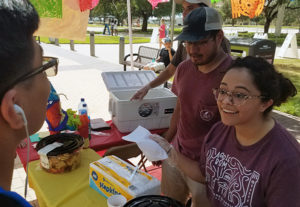
Sarai Aparicio (right) and Regelio Corbian serve treats and provide information about Viva: Faith-Based Hispanic Community, a program of the Aggie BSM. (Photo / Isa Torres)
Viva: Faith-Based Hispanic Community began this semester as a student group under the BSM umbrella after Tiffany Aquino, Arely Mendiola, Rogelio Cobián and Caleb Jackson saw a need they wanted to address.
The conversation about starting a ministry focused on inviting and connecting Hispanic students to the BSM started last May. The students shared their ideas with Joel Bratcher, BSM director at Texas A&M, and Associate Director Rebecca Hernandez.
“We noticed we were Hispanic, and there were a couple of other Hispanic students at the BSM,” Mendiola said. “We each knew other Hispanic students, but there weren’t that many of us at the BSM.”
Even after the academic year ended for the students, BSM leaders continued to make plans and prepare to offer their support once students returned for the fall semester, Hernandez said.
Extended welcome
Aquino described the challenges Hispanic Americans who may come from more diverse communities or from Hispanic majority towns face when they move to College Station, with its majority Anglo population. For students coming from Latin America, that culture shock may be amplified, she said.
Arely Mendiola (right) and Sarai Aparicio (left) prepare to serve fellow students at Texas A&M during a welcome event where they shared information about Viva: Faith-Based Hispanic Community, a program of the Aggie BSM. (Photo / Isa Torres)
Last semester, Aquino sensed a calling to reach her own people, a calling that became clearer when she served through Go Now Missions in Mexico City during the summer.
The BSM represents a home for Mendiola. It is where she also found many of her college friends including Aquino, who is also is her roommate. However, she perceives a need for the BSM to become a home for more Hispanic students.
“Any time you go to the BSM, you’ll find very welcoming people. I think we just want to extend that but maybe be a little more specific towards the Hispanic community,” Mendiola said.
As students shared their ideas, Bratcher realized God seemed to be providing the beginning for a ministry that grows more important every year. Last semester, Hispanic students at Texas A&M comprised about 20 percent of the student body.
Empower and encourage student leaders
Empowering them to pursue their calling not only gives students the trust they need when they respond to a call God gives them, but it also teaches leaders at the BSM where and how they must minister, he added.
“I’m not Hispanic, so I get to learn from them,” Bratcher said.
BSM students’ desire to reach more Hispanic students certainly needed the support and trust of the BSM leadership, he noted.
“Our students have amazing ideas, and so I am kind of like a player-coach when I see their hearts wanting to reach more people,” Bratcher said. “We just try to encourage them, and in some cases that means just encouraging their leadership by saying, ‘You guys can do this!’”
As more universities experience an increase in the Hispanic student population, Bratcher recommended providing strong discipleship for Hispanic students.
“Giving them a place to begin to read the Bible with other believers and discover how great that is, that’s one great thing we can give them,” he said.
“The other thing we can give them is leadership opportunities where they’re integrated into everything we are doing—where their ideas and their leadership are highly valued.”
Hispanic Convention focuses on financial discipleship
October 29, 2019
McALLEN—“Abundancia” is the theme of the Hispanic Baptist Convention of Texas annual meeting June 23-25 in McAllen, which marks the beginning of a yearlong emphasis on financial discipleship.
Hispanic Texas Baptist churches will be challenged to abandon a theology of scarcity and develop a theology of abundance—not to be confused with the so-called “prosperity gospel,” said Jesse Rincones, executive director of Convención.
Convención will offer sermon materials for pastors and Bible study materials for church leaders focused on financial discipleship, along with practical help to teach individuals and families to take control of their finances, Rincones noted.
Working in conjunction with Andres Gutierrez and his “Paz Financiera” program, the annual meeting will offer workshops so churches can provide training to their congregations.
As families adopt a new perspective on finances, churches and Convención will continue growing, Rincones said. Christians who commit to financial discipleship become more generous and faithful with what they have, he noted.
In business sessions, messengers from Hispanic Texas Baptist churches will consider a resolution regarding sexual abuse in the churches, Rincones said. The proposed resolution would “challenge our churches to adopt procedures and policies to help protect children,” he said.
Southern Baptist Convention’s newly adopted Caring Well Initiative—a program to enhance efforts to prevent abuse and provide care for abuse survivors—will be available in Spanish, and it will provide a valuable resource for Hispanic Texas Baptist congregations, he said.
Training and curriculum for churches taking part in the Caring Well Initiative is accessible on the Church Cares website.
Also at the Convención annual meeting, the Young Latino Leaders group will recommend the creation of a platform through which they could continue working.
The proposal focuses on the development of up-and-coming young leaders and education for first-generation pastors and churches so they can include younger generations in their ministries, Rincones said.
The 15-member core group of Young Latino Leaders will meet at San Antonio in October and continue working toward the suggested goals.
Garcia wants to see Hispanic Texas Baptist history preserved
October 29, 2019
Jimmy Garcia believes the changes in Hispanic Texas Baptist life in the past five decades are too important to ignore, and he wants to make sure that history is preserved.
Garcia observed Hispanic Baptist life in Texas as a pastor, associational director of missions and denominational worker with the Baptist General Convention of Texas language missions department.
Even before he entered ministry, he saw it from the perspective of a preacher’s kid, as his father served as pastor of churches in Houston and San Antonio.
He even remembers when the unification agreement between Convención Bautista Hispana de Texas and BGCT took place in the 1960s. His father was a member of the committee that presented the motion to unify Convención with the BGCT.
Preserve history before it is lost
As the years went by, he discovered surprisingly little information preserved on key figures such as Oscar Romo and Joshua Grijalva, who both served in what was then known as “ethnic missions” with the Southern Baptist Convention’s Home Mission Board.
Garcia, who retired in 2016 after 16 years on the BGCT staff, noted the need for a coordinated effort to collect and preserve Hispanic Texas Baptists’ history.
So, with the encouragement of Alan Lefever, director of the Texas Baptist Historical Collection and Bill Pinson, executive director emeritus of the BGCT and volunteer director of the Baptist Heritage Center, Garcia began to gather and curate historical data, seeking what is available from Hispanic pastors and churches.
Since the stories of previous generations often are not transmitted, their history—and the history of the churches in which they ministered—may be lost, he noted.
Developing trends among Hispanic Texas Baptists
Jimmy Garcia
One trend Garcia has observed in recent decades has been a movement toward churches that attract people from multiple cultures and ethnicities.
On the one hand, Texas Baptists remain “way behind” in developing truly multicultural congregations, he noted.
However, he also pointed to pastors of Hispanic heritage who lead congregations where the membership historically was largely Anglo, such as Ellis Orozco at First Baptist Church in Richardson, Jason Paredes at Fielder Church in Arlington and Julio Guarneri at Calvary Baptist Church in McAllen.
Garcia also notes the significant number of young adults who grew up in predominantly Hispanic churches but now attend congregations that are more ethnically diverse.
As a keeper of history, Garcia now tries to contact Hispanic pastors, churches and associations to find those who remember their stories.
He wants rising generations to understand their heritage, as well as recognize developing trends in congregational life.
“Tell me where you’ve been, and I tell you where you’re going,” Garcia said. “I have been here. I have seen the transitions, and I want churches to know what happened as they seek where to go.”







 Hispanic Texas Baptist churches will be challenged to abandon a theology of scarcity and develop a theology of abundance—not to be confused with the so-called “prosperity gospel,” said Jesse Rincones, executive director of Convención.