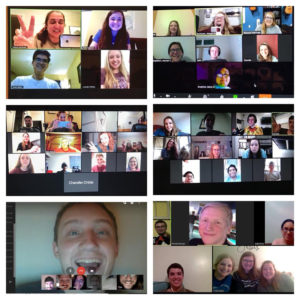
The Hispanic Baptist Convention of Texas celebrated its 110th anniversary and held its annual meeting virtually due to the COVID-19 pandemic.
Jesse Rincones
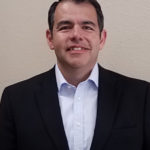
When it became clear the traditional in-person gathering could not be held as originally planned, Convención officials worked rapidly to put together the virtual annual meeting on short notice, Convención Executive Director Jesse Rincones said.
“When the circumstances change, we have to adjust to address the needs of our congregations,” Rincones said.
Normally, messengers to the annual meeting elect officers, approve a budget and deal with other business items. The virtual format required Convención to grant its executive committee authority to make some decisions and to postpone other matters until the 2021 annual meeting, he noted.
Meeting needs in challenging times
The meeting—centered on the theme “From Generation to Generation”—included various reports on Hispanic Texas Baptist work during a time when congregations face a series of challenges due to the ongoing pandemic.
For months, Rincones said Convención stayed in touch with ministers, leaders and churches through emails and phone calls.
Convención provided information to member congregations regarding the stimulus package passed by U.S. Congress.
It also offered a series of webinars in Spanish for 116 people and webinars in English for 93 individuals, as well as webinars geared specifically toward pastors.
Current resources provided by Convención can be found online.
Rincones reported the number of cooperating churches increased from 63 churches to 97 churches last year.
Information about Convención’s budget is posted online.
Teach your children well
While the Hispanic Convention continues to face a year filled with unprecedented circumstances, Convención President Tony Miranda said Texas Baptist Hispanic churches must focus on teaching the next generation what truly matters.
He pointed out the Great Commandment in Deuteronomy 6:4-9—to love God with all of one’s being—was given with instructions about how to keep it foremost in the minds of God’s people and to teach it in each home.
“As we know and learn that, we must also pass it on to the next generation,” he noted.
But a disconnect between younger generations and the church shows congregations and their leaders have a lot of work to do to pass on that knowledge, said Miranda.
“As leaders prepare for ministry, they must prepare to serve for various generations, not just one,” Miranda remarked. “We must involve all generations in all aspects of the church.”
Need for change and renewal
Connecting with younger generations requires change and renewal, which means churches must exercise wisdom in letting go of unnecessary traditions and focusing on relationships, he added.
“We recognize that God will express himself in whichever way he chooses to … (in) the next generation,” Rincones said during a panel with other Hispanic Baptist leaders.
Through personal relationships with pastors and church leaders, members of the congregation will see how ministers treat others and how they lead with humility, panelists noted.
Passing the knowledge and love of God to the next generation starts with the pastors and other ministers, they added.
“Include youth in your leadership,” Miranda said. “Help them discern their calling.”
As some Hispanic communities struggle with the issue of different languages, Rincones acknowledged relationships have primary importance. Respect, listening and investment matter more than everyone speaking the same language, he observed.
Everyone will leave a legacy, Rincones said. “Some will leave a good legacy, and others will leave a not-so-good legacy,” he noted.
As Christians serve God and others, following the Great Commandments, they are called to do so understanding the fruits of all their works is borne in those who will come after them, Rincones said.
“The legacy is not for us. That is for those who will come after us,” he said. “The focus of the pastors should always remain in helping people grow and not the ministries of the church, because Jesus said he himself will build his church.”
Hispanic Baptist Convention to meet online in July
July 29, 2020
The Hispanic Baptist Convention of Texas annual meeting—originally scheduled for June 23-25 at Dallas Baptist University—will be held online July 26-28, with participants accessing it through Facebook, YouTube and Zoom.
Jesse Rincones
“We decided to go virtual because of COVID-19,” said Convención’s executive director Jesse Rincones. “Because of the videotaping, editing and all the additional work that will be required, we asked the board to change the dates of our annual meeting.”
While Convención leaders considered other options, such as partnering with the Baptist General Convention of Texas or the Hispanic Leadership Conference which will take place later this year, they decided to take on the challenge and explore new opportunities.
“We thought it could be a good idea to not offer what is usually offered at the annual meeting, but at the same time be open to the new advantages that technology offers us,” Convención President Tony Miranda said, noting participants this year will not have travel and lodging costs.
“Another big opportunity we noticed was on how easy it will be to connect with leaders across the world,” he added.
One of the main speakers during the Convención annual meeting is pastor Luis Gabriel César Inzunza of Primera Iglesia Bautista in Ciudad Satélite, Mexico.
A band from Spain will lead one of the worship services, and guests from other Spanish-speaking countries will join the sessions.
The meeting also will feature some speakers in English, including Delvin Atchison, pastor of Westside Baptist Church of Lewisville, and Todd Still, dean of Baylor University’s Truett Theological Seminary.
“We have the leverage to have people we normally would not have and reach people we normally would not have,” Rincones said.
Online format offers flexibility
Another advantage the online format offers participants is the opportunity to avoid scheduling conflicts. If they are interested in two sessions offered at the same time, they can attend one online and view the recorded video of the other at their convenience, Rincones noted.
Tony Miranda
Freedom from the space and time limitations related to a physical location gives Convención and participants greater flexibility, Miranda said.
“We want to give younger generations an opportunity to learn more about the faith,” he said.
As younger generations battle to find their identity among clashing cultures, Miranda said, this year’s annual meeting hopes to offer a foundation for the life Christ wants them to have.
“We hope they will see the example of those who came before them and placed their faith in Jesus,” Miranda added. “But we also hope churches will see how to reach and work with younger generations.”
Convención already gained some experience in online content delivery through the video meetings they offered as “Contacto Pastoral”—training courses for pastors such as the Greek class Miranda provided to more than 200 people in 15 countries.
“This is certainly a historic time,” Rincones said. “Though there were other times in the early 20th century when annual meetings were cancelled, this is the first time we move to a virtual meeting and I think this is the first time a Hispanic convention in the U.S. holds a virtual annual meeting.”
Registration information for the annual meeting will be posted on the Convención website.
Denton pastor sees Confederate memorial removal as victory
July 29, 2020
DENTON—The day the Denton Confederate Soldier Memorial no longer stands on the south side of the Denton County courthouse square, Pastor Cedric Chambers of Mount Calvary Baptist Church will consider it a victory.
On June 9, Denton County commissioners voted to move the Confederate Soldiers Memorial from the courthouse square. Pastor Cedric Chambers credits the persistence of a member of his church, Willie Hudspeth. (Photo / Isa Torres)
On June 9, Denton County commissioners voted to move the monument—102 years after it was dedicated and 155 years after the Army of Northern Virginia surrendered at Appomattox Court House, signaling the end of the Confederacy.
The Katie Daffan United Daughters of the Confederacy erected the memorial in Denton on June 3, 1918, in honor of Confederate President Jefferson Davis’ birthday. The Texas State Historical Association identified Daffan as the daughter of a first-generation Ku Klux Klan member.
A year after the monument was erected, the City Federation of Women’s Clubs—an organization led by members of Denton’s United Daughters of the Confederacy—led the city to remove a predominantly African-American inner-city neighborhood called Quakertown. By 1923, any trace of the self-sufficient African American community had disappeared.
Although research has not been able to prove any citizen of Denton actually fought for the Confederacy and was killed in action, the monument has continued to stand, even though many have called for its removal.
Now protests around the country have successfully removed statues honoring Confederate soldiers. While Denton County commissioners voted to safely remove the memorial, they have yet to announce when it will be removed and where it will go. Last year, the county also said it would consider adding historical context to the monument, but it never added anything.
Pastor credit’s persistence of Willie Hudspeth
When the monument finally is removed, Chambers believes credit belongs largely to the persistence of a member of his congregation, Willie Hudspeth, who has advocated its removal since 1999.
Hudspeth, a Vietnam veteran and retired teacher, became well known in the city, where he consistently protested the memorial on Sundays and also attended county commissioners’ meetings. But for years, the commissioners and county judges ignored Hudspeth’s requests.
“Willie’s consistency, his strength and his will, makes it so that once he believes in something, then he is going to accomplish it,” Chambers said. “That is the way we’ve all got to be—that if we believe in something, we must make sure we see it happen.”
More often than not, Hudspeth was only one at the monument calling for its removal, but he still never gave up, Chambers said.
Hudspeth invited Chambers to Denton
Just as Denton County residents have Hudspeth to thank for the Confederate Memorial’s anticipated removal, members of Mount Calvary Baptist Church have him to thank for inviting Chambers to Denton.
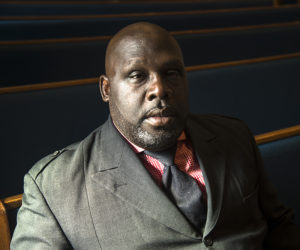
Pastor Cedric Chambers poses for a photo inside Mt. Calvary Baptist Church in Denton, Texas. (Photo by Jake King/ Reprinted with permission / Denton Record-Chronicle)
Chambers grew up in one of the poorest neighborhoods of Dallas, where few children grew up with fathers, and families experienced challenging situations, he said.
Still, the West Dallas community supported each other and encouraged each other to move forward, he recalled.
Chambers received the call to ministry at age 15. Since that day in 1987, he has continued to preach every chance he gets.
He had served in ministry for 19 years when Hudspeth invited him to an interview regarding the Mount Calvary Baptist Church pastorate.
Once he was called to the Denton church, Chambers found a community where he could share what he had learned all his life, committing to the service of others.
“I have a passion to help and be a blessing to people,” Chambers said.
Denton African Americans still face challenges
The African American community in Denton is strong, he said. While most of his church members in Denton are getting up in years, they remain committed, he added.
But life in Denton is not easy for many African Americans, Chambers observed.
“It is something we live with everyday at the stores, in the workplace, in corporate life,” he said. “While some may be surprised that racism is still going on at the rate that it is, this is very much real.”
Even when people of other backgrounds may not see the oppression unless someone is killed, African-Americans continue to feel it, he added.
“It is systemic, and it is something we live with every day,” he said.
But removing a monument in honor of the Confederacy gives Mount Calvary and its pastor a sense that some are listening—that some recognize their pain.
“The fact that the statue is being removed does not fix everything, but it’s a step in the right direction,” Chambers said. “There can’t be any change without talking about the issue.”
And while others may start seeing the challenges members of his 66-year-old church have experienced for so long, Chambers also wants others to understand where their vision is.
‘Point people to Jesus’
Chambers recalled someone asking him how she could be angry at the injustice and oppression and still show the love of Jesus to others.
He remembers answering her question by saying, “It takes work, but I have to get a picture of Jesus Christ on the cross and how he died for everybody.”
While racism and oppression angers Chambers, he knows nobody here is perfect, and Jesus Christ loves every single one.
“It’s not that I’m not angry, but I do understand that if this is going to change, we’ve got to point people to Jesus Christ,” Chambers insisted.
Willie Hudspeth receives an award for his determination to see the Confederate statue taken down at a ‘Celebrate Willie’ gathering at the Square Sunday, June 14, 2020, in Denton, Texas. (Photo by Al Key/ Reprinted with permission / Denton Record-Chronicle)
In facing the oppression and the small mindedness of those who hate others for relatively minor differences, Christians must remember God gives hope and God can bring change, he said.
Chambers acknowledged the challenge of reminding his congregation of the hope Christ brings when they know every day comes with a possibility of suffering more or even losing their lives at the hands of intolerant people.
But while the world may look scary and dangerous, Chambers invites the church to look beyond what they see and remember God is working to bring redemption.
“It’s challenging to ask them to continue to trust and hold on because God will bring change,” Chambers added. “But that’s the only message we have, and that’s the one we want to keep.”
When churches avoid considering the pain and challenges of a person, then they will not be able to be in fellowship with people, he said.
“No longer can we just speak to the spiritual being of an individual. We’ve got to speak to the whole person,” he insisted. “In speaking to the whole person, you have to understand feeling, you have to understand pain, you have to understand hurt.”
Chambers noted churches still have a long road ahead of them.
But he finds reason for hope. Hudspeth’s work now is recognized by many. Last Sunday, a crowd gathered in downtown Denton to celebrate Hudspeth and give him an award for his dedication. Others started a fundraiser for him and his family, and some have suggested marking June 9 as “Willie Hudspeth Day.”
In the meantime, the memorial still stands, but the tireless efforts of Hudspeth and others have inspired African American organizations to continue planning protests in Denton on Juneteenth.
Time capsule sparks memories for San Angelo Hispanic church
July 29, 2020
Fond memories of a major event Segunda Iglesia Bautista in San Angelo once celebrated had been lost. Because of its difficult history, recollections of the event had been as buried as the time capsule that contained mementos of better days.
In one respect, the church grew up with a difficult history due to discrimination and prejudice, but in recent years, most of its problems came from within.
Time to heal and restore
Four years ago, the church called Edgar Trinidad, who had served as a church planter in New England and Puerto Rico, as well as Texas. Trinidad knew Segunda had experienced challenges, and the congregation needed to heal.
“Segunda built a new church building in 1964, which is where we still are, but nothing had changed much since that time,” Trinidad said.
Internally, the church was decaying, he noted. Like the building that housed the congregation, a lot of repairs were necessary.
For a year and a half, Trinidad guided the church through a difficult time of healing, he said.
“The church decided to make changes, and those changes can be painful, because you will face resistance and uncertainty,” Trinidad said. “That uncertainty can be the most challenging part.”
But the church grew from 25 people meeting every Sunday to more than 150 people gathering each week before COVID-19 hit.
Rekindling memories
The church used funds it had saved to renovate its building. As word spread about the changes at Segunda, some people called Trinidad to schedule a visit of the church.
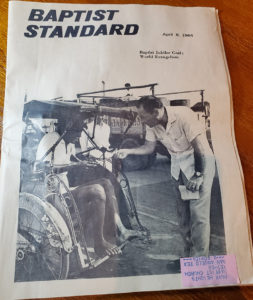
A newsletter article and photo on the back cover of the April 8, 1964, issue of the Baptist Standard reports that the first services will be held in the new facility of Segunda Iglesia Bautista in San Angelo. (Photo provided by Edgar Trinidad)
“An older lady came to me and asked if she could walk around the church one day, and I gladly welcomed her,” Trinidad said.
As she walked around she suddenly stopped. With tears in her eyes, she told Trinidad she had grown up attending the church.
Then she asked Trinidad if the time capsule was still there. Trinidad knew nothing about it.
Later, another pastor in San Angelo whose grandfather had been pastor of Segunda in the 1960s told Trinidad that when the church building was dedicated in 1964, a time capsule had been placed behind the plaque to commemorate the event.
When Trinidad opened the time capsule, one of the items that caught his attention the most was an issue of the Baptist Standard. A newsletter printed on the newspaper’s back cover announced the dedication of the new church building.
Victory in a challenging time
Trinidad noted 1964 as a challenging but fruitful year in the Civil Rights Movement—the time when the Civil Rights Act that ended segregation of public places became law and Martin Luther King Jr. received the Nobel Peace Prize.
Pastor Edgar Trinidad heard about a long-forgotten time capsule placed behind a plaque commemorating the church’s new building in 1964. Inside the time capsule, he discovered a newsletter printed on the back cover of the Baptist Standard reporting on the new building. (Photo provided by Edgar Trinidad)
For Hispanics in San Angelo, most of whom came from a Mexican background, discrimination had been and would continue to be a normal experience for them well into the 1980s, Trinidad explained.
“Even until the 1980s, many businesses denied service to Hispanics,” Trinidad noted. “So, Hispanics here grew up witnessing racism constantly, and yet still Hispanics continued to grow.”
Agriculture and oil provide the foundation of the economy in San Angelo, and the people who provided labor for those businesses were Hispanics, he said. Hispanics worked hard and became an essential part of San Angelo, he added.
Now, Segunda remains as the only church in the neighborhood called “La Villa” or “La Villita,” and every area of its ministry is in Spanish.
Hispanics in the San Angelo area make up 48 percent of the population, and 36 percent of them speak Spanish at home, Trinidad noted. Nearly three quarters of Hispanic millennials in San Angelo—72 percent—prefer speaking Spanish at home.
Developing an online presence
Even though Segunda went through some difficult times and resisted change in some respects, it built a successful online presence—even before the COVID-19 pandemic forced many churches to develop online resources in a hurry.
Nearly 20 years ago, Trinidad noticed the shift universities were making toward distance learning and thought churches needed to prepare for that. While it took time, Segunda invested well in technology.
Prior to COVID-19, Segunda already broadcasted its worship service in high-resolution online. For a time, it was the only Hispanic church in the area using Facebook, YouTube, Amazon Prime Video, Apple TV, Uno Red and various other media.
People from 15 to 20 Latin American countries tuned in online, which means Segunda potentially was reaching close to a million people every week.
Broadcasting increased Segunda’s reach massively. Although the church already had started churches in Ballinger, El Paso and had plans to start one on the other side of San Angelo, the congregation began receiving communication from Latin American groups calling themselves part of their church.
“Suddenly, we were working in South America without us even knowing,” Trinidad said. “I received a message from a congregation in Chile saying, ‘Pastor Trinidad, we want to inform you we are a group here in Chile that have been discipled by your church.’
“When I asked why they were saying that, they told me a group of around 20 people has been meeting at a house where they have a worship service. And when I start preaching, they turn on the TV so they can watch the sermon.”
Trinidad has heard similar stories from groups in Mexico, Nicaragua and Argentina.
Back to the future
While COVID-19 is new, the early church had to limit assemblies to just house gatherings because of persecution, Trinidad noted. Often, Christians’ creativity helped them find other locations where they could gather in secret, he added.
As universities have realized, learning can be done from a distance, Trinidad said. So, churches should not fight the concept of teaching and learning from a distance, he said.
But fellowship does not change, he added. Individuals will have to still seek to know and spend time with each other. It just does not have to be with everyone present at the same time, Trinidad said.
Pastor Edgar Trinidad arrived at Segunda Iglesia Bautista in San Angelo four years ago. While the church had experienced difficulties previously, the church has grown in ways the congregation did not expect. Part of that growth has been thanks to its acceptance and use of technology. (Photo provided by Edgar Trinidad)
“Christians must study how to learn and how to gather,” Trinidad said. “That means that although they can learn online, from a distance, fellowship still must happen through personal connection.”
Without losing trust in who God is, Trinidad insisted churches must pay attention to how God is working in this time of uncertainty.
“Maybe this is a time for us to learn new lessons and consider many other options,” Trinidad said. “I think this time has come so we can see those options and learn from them.”
While COVID-19 affected the lives of Segunda’s members and the ways in which they gather, it also helped the church reach many people it may not have been able to reach before, he observed.
Following federal, state and local guidelines, Segunda partially opened its doors in May.
The church meets individuals outside, where volunteers take their temperature and ask screening questions regarding their health. Church services are held in several rooms, and the number of individuals in each room is limited. Segunda offers a separate service for elderly individuals and people with lowered immunity.
But again, Trinidad said, this is an opportunity to grow and learn.
“Church had to come into this new reality,” Trinidad asserted. “The church must learn to be a church and not a religion. People must worship in their homes and read their Bibles in their homes. They must go beyond those four walls, learn to depend on God and not a building or a structure.”
Persecution or no persecution, pandemic virus or no pandemic virus, the church must continue being the church and adapt, he commented.
“We did not close the church. We just changed the way of gathering together,” Trinidad said.
Stark College helps Corpus Christi church
July 29, 2020
CORPUS CHRISTI—Ministry deeply shapes the lives of Steve and Cindy Jaquez, who have been together since they became a part of Segunda Iglesia Bautista of Corpus Christi in the 1970s.
Steve and Cindy Jaquez returned to serve at Segunda Iglesia Bautista in Corpus Christi five years ago. A Technology in Ministry class at Stark College helped Segunda Iglesia Bautista start webcasting its worship services after the COVID-19 pandemic hit. (Photo provided by Cindy Jaquez)
The couple pursued ministry, and God called them to serve churches in Dallas and the Rio Grande Valley. But five years ago, God called them back home to Segunda Iglesia Bautista, when the church needed to heal and focus on the mission God had given the congregation.
Since Steve Jaquez arrived as pastor, the church has grown, and the congregation began looking for ways to reach others.
Cindy Jaquez noticed potential for church’s digital outreach to grow. Although Segunda had a website, the church barely used it.
As the couple considered how they could reach others through online communication, they found more than just answers at Stark College and Seminary.
The vice president of student experience at Stark, Tina Cooper, offered for the first time a class on Technology in Ministry
Thankfully, Steve and Cindy Jaquez each had learned to follow when God calls one of them. More than 40 years ago, he first helped her connect with Segunda Iglesia Bautista, and she became a Christian.
Now that they are back at Segunda, she noticed the outreach they could do through the Internet. And while he decided first to continue his education at Stark, she was the one who chose to take the Technology in Ministry class.
Moving quickly from theory to application
Cooper intended the class to help students analyze how technology affects churches, but COVID-19 change those plans and also helped create an opportunity.
“We know everyone involved at Stark College just experienced a major life event because of COVID-19,” Cooper said. “But the purpose of this class was to help students outside of their comfort areas.”
About 80 percent of the student population at Stark fit the nontraditional category, which means they are age 25 or older, Cooper said. Nearly half—47 percent—of the students are 40 years old or older.
So, while those students may hold important leadership roles at their churches, they also may not be familiar with using technology in an increasingly digital world, Cooper added.
Cooper imagined the class discussing and analyzing theories on how technology could help churches. Then, by the middle of March when the COVID-19 lockdown began, the school began preparing its faculty and staff so classes could continue online after spring break.
“We ended up getting thrown into doing technology at church because of COVID-19,” Cooper said. “We moved from a class on theory to problem-based learning.”
At first, each student worked individually on a project. But students soon realized they could all work together and target different areas individually. They chose to focus on helping Segunda Iglesia Bautista.
“We knew technology could help and hinder churches and their mission,” Cooper said.
Class helps develop strategy for streaming worship
As churches limit their person-to-person interaction, providing video of the church services can help individuals stay connected and even broaden the church’s message, she noted.
But due to its limited budget, Segunda Iglesia Bautista thought it lacked the equipment or the staff necessary to webcast its services.
“There are many aspects of technology that can become overwhelming for churches,” Cooper said. “But we also wanted to show there are ways their churches can take advantage of technology for the sake of their church and the gospel.”
Students learned the basics of different concepts of technology, including software, hardware and digital services. As students experimented with new technologies, they shared their experiences with each other, Cooper noted.
Working with Segunda Iglesia Bautista in Corpus Christi allowed students to learn how to work with budgets and administration, as they aimed to provide a service that would be sustainable for the congregation, Cooper added.
For instance, one of Cooper’s students considered the cost of webcasting worship services by looking at cameras, cables, a streaming system and audio, along with software and hardware updates. He estimated the cost at about $20,000 per year—far beyond the budget of a congregation like Segunda.
So, students focused on “finding solutions with room for growth and the understanding on how to grow,” Cooper said.
Considering Segunda Iglesia Bautista’s budget, students developed a plan for the church to begin streaming its worship services using a smartphone camera. Next, students projected a three-year plan for the church to find the funds to buy more technology and hire someone to operate the equipment on Sundays.
On March 29, Segunda Iglesia streamed its first worship service on Facebook, Cindy Jaquez said.
“From that, we moved to other online services like YouTube,” she added. “While my intentions were to just get our church a website, we were able to get a lot more than that.”
Segunda Iglesia now reaches people not only in its community, but also throughout the United States and in Latin America, Steve Jaquez said. The church is continuing to expand its online presence, thanks to the help Stark College provided.
“Hopefully, our experience can help others figure this out and reach more people with the message God has for them,” he said.
BSM adjusts to student ministry in COVID-19 era
July 29, 2020
Baptist Student Ministries at universities in Texas transitioned from a continuous on-campus presence to an off-campus and almost entirely virtual approach.
Many college students left their campus for spring break and then were informed their schools would not open back because of COVID-19.
Since then, schools have announced they plan to return to campus in the fall.
“There’s nothing going on on-campus right now,” said Texas Tech University Baptist Student Ministries Director Jeff Kennon. “I could go up to the building, but nobody else would come in.”
At first, Texas Tech announced plans to extend spring break for students, then said classes would go online until the crisis was over.
But by the end of April the university informed students they would not return to on-campus classes for the academic year, Kennon said.
Brainstorming idea
In a matter of days, students and the ministers who worked with them halted plans and began brainstorming ways to continue to meet some of their goals through other methods.
Kennon canceled mission trips and on-campus outreach ministries, as well as times of worship and fellowship at the new student center, which BSM just inaugurated last fall.
Other activities such as leadership development and Bible study groups continue through online video calls, he added.
“The only thing we can do right now is to embrace this,” Kennon observed. “This is the way it is. So, let’s continue to do ministry and see what happens.”
While Tech BSM already used online tools for ministry, Kennon said, this season is one of learning new ways of ministering to others, many of whom face new challenges.
New opportunities to minister
Using more technology for communication opened up interactions many did not have before, he said.
During a video conference call with international students, a student from China who formerly attended Texas Tech also joined the call.
After the call was over, she suggested Kennon consider participating in a class on Chinese culture she teaches.
Kennon accepted the invitation and interacted with students who then also wanted to learn about the culture.
Opportunities like that have opened up to other students who are part of the BSM at Tech and the classes this former student teaches.
“If we continue to be faithful, then other opportunities will open up,” said Kennon. “We now have an opportunity with students in China, which is something we couldn’t have imagined. So yeah, I think we only have to go along with this.”
Crossing borders
The Texas A&M University BSM has seen its ministry cross borders as well. While the majority of American students went home, most of the international students were unable to return home and had to stay in College Station.
Many students in the Aggie BSM quickly understood the severity of COVID-19 after two students who went to Beach Reach during spring break contracted the virus.
But many international students, specially those from Asia, had been on edge since the beginning of the semester, and many students from China began wearing masks in January, Aggie BSM Director Joel Bratcher said.
Many students from India also live around the BSM building and they have rarely left their homes.
While they have limited person to person contact, BSMs like the one at Texas A&M University now continue Bible studies and discipleship over video calls. This has allowed them to reach people who once studied at A&M and are now in another country. (Photo provided by Aggie BSM)
Person-to-person interactions have dropped off, but relationships with previous students who are now back home have been rekindled through video calls.
“It’s given us the opportunity to go in deeper in ways we could not have done before,” Bratcher said.
One student—who became a Christian a short while before she went home to Japan—has kept in touch with leadership at the Aggie BSM. Through the communication they have maintained, the student has stayed connected with a Christian community as she begins looking for one back home.
A former student from Mexico, who had studied at A&M and teaches in Mexico City now, began participating in one of the Aggie BSM video conference Bible studies. After the study was over, she said she felt God’s call to begin a Bible study with her peers at the university in Mexico.
“Because of what we have learned, we have noticed it is a lot more doable to continue meeting with international students after they have gone back home,” Bratcher commented.
Reinforced the importance of relationships
Leaders of the Aggie BSM now understand they can minister more to former students who have gone back home and mentor them through some transitions, he said.
Fear and change have not affected the commitment of student leaders at the BSM, Bratcher noted. Student leaders quickly stepped up and continued working with their own groups doing things like Bible study while everyone is at home, Bratcher said.
Though Bratcher also said he and his team have had to learn to work almost exclusively through digital communication, he pointed out many students have opened up more spiritually during this season.
Support between other state BSM directors and national Baptist collegiate ministries has increased, Bratcher said. Directors are more open to share ideas, he added.
“I think this time has reinforced to me the importance of relationships,” Bratcher said. “We can try to do a lot with big groups of people, but if we don’t look for that personal relationship with each other, then we may not grow together as much.”
Expanding a ministry to meet needs
The BSM at the University of Texas at Rio Grande Valley expanded an existing ministry in response to the COVID-19 crisis.
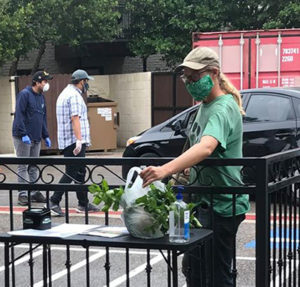
BSM Director Robert Rueda began a “pay-what-you-can” deli right next to the student center last year. Rueda and his team decided the deli would stay open two days a week to continue serving students through the COVID-19 pandemic.
Using a drive-through service, the BSM at the University of Texas Rio Grande Valley helps feed students and their families for a low cost. (Photo provided by UTRGV BSM)
Their ministry of providing food for students during this crisis also now involves a drive-through free lunch on Thursdays, which not only serves students at UTRGV but also their families.
“It has been great to see students and their families coming together and getting their meals. Then we pray for them and send them on their way,” said Rueda.
The university noticed what the BSM there was doing and invited the collegiate ministry to partner with the school and increase those efforts to feed students.
On Fridays, students and their families pay what they can for fresh vegetables and fruits.
When the university realized many of the students didn’t know how to cook fresh produce or include it in their meal planning, UTRGV began making how-to videos with recipes and step-by-step instructions, Rueda said.
“We are actually doing more than when we were seeing each other,” Rueda said. “Before, we just did the Bible studies, leadership development and the typical student ministry you see in other places. But now, we are helping feed students and their families.”
‘Pandemic does not stop ministry’
The deli and fresh produce distribution follow state and local health protocols and recommendations to limit contact between servers and clients. So, a lot of planning and administration is required for the team to provide those services. Rueda said.
“The work of campus missionaries, interns and volunteers has made all of this possible,” Rueda said. “You have to stay on top of things 24/7 and keep everyone safe. But it has been good to see how the team has come together to show God’s love in a tangible way.”
Rueda has directed BSM efforts at both the Edinburg and Brownsville campuses of UTRGV. So, efforts to feed students in both towns means the BSM serves about 400 students every week.
While a lot of thinking and learning has been required, Rueda hopes this change will bring new opportunities of ministry in schools across the state.
“Pandemic does not stop ministry. It can actually open up more opportunities,” Rueda said.
Ministries must learn to wait, see the need and then pray so that they can serve as tools to meet those needs, he explained.
While universities make plans to return to on-campus instruction in the fall, and everyone involved appears eager to return to normal, Rueda thinks BSMs and churches must take this time to see everything with new eyes.
“We used to open the doors of the church and expect people to come,” Rueda said. “But maybe what we need to be aware of is how other doors in society are opening and how we’re the ones who need to go through them.”
Isolation can aggravate mental health issues, counselor says
July 29, 2020
When people must isolate themselves, issues that could be managed previously rise to the surface, Christian licensed professional counselor Olga Harris said.
Addictions, traumas, anxiety and depression affect lives—particularly among people who lacked the safety net necessary to prevent these situations from escalating into something worse, Harris said.
Those situations turn even more difficult when therapists, counselors and clinics shut down to minimize the transmission of COVID-19, she added.
“We have to be creative and figure out how to do online counseling or phone consultations,” Harris said. “But still, the dynamic is completely different.”
Need to connect with one another
In addition to previously existing issues, Harris said, people deal with a variety of fears—not only fear of dying from the virus or contracting and spreading COVID-19, but also fears about how the crisis will affect them financially, she said.
Olga Harris
While social distancing may help minimize transmission of the virus, isolation also may present traps for those dealing with mental illness, Harris explained.
“People who found outlets in going outside and running errands, exercising and playing with the kids do not have that anymore,” Harris said. “But people in my profession understand the need we have to connect with one another.”
Studies focused on prison inmates or senior adults suggest isolation can trigger negative mental health consequences and often also impact a person’s physical health.
Work at communication and connection
Methods of communication and connection already exist to help minimize social isolation while observing physical social distancing, Harris said.
Video calling, instant messaging or even going back to writing and sending letters may help people communicate and stay connected with one another, she said.
“Those are things that can help us stay safe,” Harris said. “But not everything about this is negative, for some of my clients this time has opened opportunities to connect even better than before.”
Couples who worked long hours and had little time for each other now use this time away from work to care for one another, she said. Families can pray together now, help each other with different tasks or even just play games together, Harris emphasized.
Positive results possible
Stay at home orders also can prompt families to address underlying negative issues and consider ways to resolve them, she added.
“Now we have that time where we are forced to quiet our mind and heart, and have that intimacy with our Creator,” Harris said.
Harris noted she has seen positive results quickly. Couples on the brink of divorce have used this time to make new memories, work on their house together and talk through issues, strengthening their relationships and bringing them closer.
Certainly, COVID-19 affects some more than others right now, and Harris said the church must watch for those whose world has fallen completely apart.
While currently it is too early to analyze, Harris said, suicide is expected to rise because of the changes brought on by COVID-19.
“People are reaching their breaking points,” she said. “Churches must reach out to their communities while also figuring out new ways to do so effectively.”
Churches can connect with communities
Just as families have opportunities to grow together, churches also have new chances to connect with their communities, she said.
“We need to grow and heal in our relationships with others, ourselves and with God,” Harris insisted. “We shouldn’t want to go back to the way things were. We need to adapt to a new better normal after learning from this crisis or any crisis for that matter.”
As a counselor for the Baptist General Convention of Texas’ counseling services, Harris understands pastors and ministers now face many unusual challenges.
Because these times can be disconcerting for church leaders, Harris recommends ministers seek the help of counselors who will help them. By doing so, they invest in their own mental health and gain a handle on their personal lives and ministry. They also set an example for those among whom they minister.
“This is like training for a marathon,” Harris said. “We invest and prepare by practicing activities that help us so when the next crisis hits, we can be better prepared.”
Prepare and be proactive
Pastors can use this time to prepare and be proactive so they will be ready when something else disruptive happens, she said.
Just like a negative circumstance not only affects one part of a person, good constant practices also affect more than part of a person, Harris noted.
“The Lord is the one who does the job,” she said. “God is the one who helps us understand we need healing and also provides the healing we need.”
Many times, the issues people suffer through become tools for them to minister in the lives of others, Harris said.
“Isn’t this then an opportunity for churches to know and identify with many people who are experiencing, throughout various degrees, the same circumstances?” Harris asked. “Doors are opening up for pastors and churches to reach out to others in ways they could not do so before.”
Advocating and caring for the community brings growth to the church, she said.
Researching and putting together a list of resources available in the community positions the church to serve and signals to hurting people that the church cares for them, she explained. She recommended resources like auntbertha.com—a social care network website—or calling 211 to learn more about what is available.
Connecting with nonprofits, crisis centers, food pantries and agencies helping with utility bills or rent also opens the door for churches to connect more with the community around them, she added.
COVID-19 forces church ministries to asylum-seekers to adjust
July 29, 2020
Social restrictions continue changing due to the COVID-19 pandemic, and for immigrants seeking asylum in the United States, those changes add more instability to their situation.
Churches in Texas with ministries for asylum seekers have been forced to make adjustments, said Jorge Zapata, coordinator of missions and Hispanic ministries at the Cooperative Baptist Fellowship of Texas and founder of Hearts4Kids.
“Many of us have increased our ministries to neighborhoods of lower-income Hispanic families in the Valley,” Zapata said.
Limited border crossing
Several weeks ago, the United States began limiting travel across its borders to essential travel. More recently, Mexico also began limiting travel from its border with the United States.
Immigrants seeking asylum, who already had to wait in Mexico while their cases were resolved under the Migrant Protection Protocol, also were able to cross the border until recently, Zapata explained.
Jorge Zapata
Now they also must remain in Mexico, which shifts more responsibility to churches in Mexico that until recently shared the ministry with churches in the United States once immigrants were able to cross.
“Right now, we are supporting churches in Mexico who can minister to immigrants,” Zapata said.
Zapata’s connections with pastors and churches around several border towns that go from the Lower Rio Grande Valley in Texas to California have all experienced changes. All of them continue their ministry with immigrants exclusively through churches in Mexico, he noted.
Some U.S. churches still send funds to churches in Mexico; others have found immigrant families in the United States who are being affected by COVID-19 and support them in some way.
Stress increases for immigrants
Stay-at-home orders from county officials vary from place to place, but the police are stopping some, asking them to explain why they are out of their homes.
“I know of some cases where individuals have been pulled over by officers three times while they were out in their cars,” Zapata said. “For many immigrants in the area, that can be really stressful.”
Families who need to go out to get food from church pantries—and even those who receive food from churches delivered to their doorsteps—fear that by stepping outside their homes, they could face legal problems with the local government or immigration agents, he noted.
Hispanic immigrant families also form an essential part of the service industry, which makes them vulnerable. Their need for income forces them into continued interaction with other people at a time when they should limit those interactions.
“People live day by day, week by week and paycheck by paycheck,” Zapata said.
Access to healthcare also is limited, so any unnecessary exposure to the outside seems almost out of the question for them—and more so when law enforcement is involved, Zapata added.
He noted—and immigration lawyers confirmed—that immigrants who show symptoms of COVID-19 safely can seek medical attention without fear of deportation.
Directing support to families and churches in need
The ministries Zapata is a part of are directing funds toward helping families, pastors and churches who need some assistance while everything else is shut down.
Churches that minister to low-income families also are experiencing more hardships now due to a significant drop in offerings, he noted.
“Everyone is in need right now,” Zapata said.
Churches in Mexico have accepted responsibility for ministry to immigrants, but they also must follow limited interaction with asylum seekers in Mexico according to guidelines from the Mexican government, he said.
“If a church has food or any other item they want to provide to a shelter of asylum seekers, then they need to go drop those items outside of their shelter and have someone come outside to pick them up,” he added.
Difficulty in receiving financial support
But the responsibility increases when many pastors and churches in Mexico begin feeling pressure from the lack of resources coming in every week.
Churches and ministries from the United States that provided food, clothing, healthcare items or construction materials now are limited to sending funds. But many churches in Mexico lack bank accounts or credit cards, so that makes it difficult for churches to receive them.
Pastors across the border from California who work with asylum seekers ran out of funds recently. When Zapata and Fellowship Southwest asked how they could support them, the pastors said the only food they would buy for themselves would be rice and beans. The rest of the money would be exclusively used for asylum seekers.
“Everything is on hold, except the ministry in the lives of immigrants” Zapata said. “For churches who had planned a mission trip to the Valley or across the border, then we ask they still use those funds to help the ministry of the ones who remain working here.”
Worship suspended but ministry continues
At Iglesia Bautista West Browsnville, where Carlos Navarro is pastor, the church’s ministry to immigrants—Golán—closed its doors about three weeks ago in order to follow the recommendations of the city.
Like other churches in the area, Navarro also traveled to Mexico up until less than three weeks ago to minister to migrants there, before Mexico also limited travel across its border.
Because of the networks Navarro built in the past years with government officials, he knew which decisions would be made regarding the city’s response to COVID-19, he said.
Work done to serve immigrants transitioned to feeding the homeless population in downtown Brownsville.
“There are close to 30 homeless people in the area, among them we know there are two or three immigrants who could not leave because everything else began shutting down,” Navarro said.
The church takes clothing, food and hygiene items twice a day for people in downtown Brownsville, he said.
Helping during crisis
With extensions in Southwestern Spain and Southern Mexico, Iglesia Bautista West Brownsville keeps a deep connection with areas where COVID-19 had already upended the economy and the healthcare capabilities of other nations, Navarro confirmed.
The association of hotel owners in Sevilla partnered with Golán Internacional so several meals could be distributed in the city.
Through other organizations in Europe, Golán Internacional also has provided ingredients for the preparation of meals which are then distributed to children, families and senior adults, Navarro said.
“Imagine what it would be like to suddenly have absolutely nothing to eat, that is what happened to many people in Spain,” Navarro affirmed. “We’re trying to give them something that will help them as they deal with this crisis.”
Out of all the Hispanic churches in the area, Iglesia Bautista West Brownsville is the only one still open right now, he said.
“This definitely affects most churches who depend on the support they receive from people every week,” he mentioned. “Many pastors and their families do not have income right now.”
Through local and state networks, Navarro said the church provides similar support for families in the area as the ministry they support in Spain.
“Thankfully through these networks God has been preparing us for this during the past two years,” Navarro said. “We see how God has moved around us and we are thankful for that.”
Because of God’s provision and preparation, Iglesia Bautista West Brownsville finds itself in a position to help others during this crisis, stated Navarro.
Moved to Mexico to minister
Other groups and ministries that previously ministered to immigrants have left the area already, both Zapata and Navarro confirmed. So, the need for support increased as the pandemic grew.
As Mexico prepared to limit travel across its border, Pastor Lorenzo Ortiz of El Buen Samaritano went across the border planning to stay until travel restrictions are lifted, said his daughter Ruth Ortiz, who is a missionary for the River Ministry of the Baptist General Convention of Texas.
Pastor Lorenzo Ortiz of El Buen Samaritano moved to Mexico after both the United States and Mexico began limiting their borders to only essential travel. Pastor Ortiz will remain in Mexico and minister to more than 170 asylum-seekers until travel restrictions are lifted. (Photo provided by Lorenzo Ortiz)
“He’s responsible for many things regarding some shelters where asylum seeking immigrants stay, so it was impossible for him not to be there during these travel restrictions,” she said.
From Monday to Saturday, Ortiz’ father will travel to Monterrey at least once a day to help migrants in Monterrey get to the border, where they can present themselves. Although asylum cases are postponed, asylum seekers still must present themselves at the border to receive another hearing date.
Sometimes, Lorenzo Ortiz will make the two-and-a-half-hour trip to Monterrey twice a day, his daughter said.
Pastor Ortiz is one of the few ministers in Northeast Mexico who still is allowed by the government to interact with asylum seekers in the country, Zapata noted.
His ministry includes finding a place for immigrants to shelter, finding and providing essential needs, transporting them to and from different locations, and providing pastoral care.
Ortiz provides shelter for immigrants in three locations—two in Nuevo Laredo and one in a ranch called El Derramadero, a few hours away from Saltillo. Iglesia de Dios en Derramadero in El Derramadero, where Ortiz’ aunt Eva Reyes Marquez is pastor, provides shelter to those who came looking for asylum in the United States.
Immigrants staying there go out looking for jobs and eventually pay for their own expenses too, but the church provides for them until they can find employment somewhere, Ruth Ortiz said.
Drug cartels follow and often extort asylum-seeking immigrants in Mexico, she noted.
“Cartel members have posed as police officers and stopped my dad on the road, and they have also gone to visit shelters, but thankfully nothing has escalated yet,” Ruth Ortiz said. “My mom and I are also definitely concerned about my dad because he is exposed to many people who may be carrying COVID-19.”
In Mexico, Pastor Ortiz works with close to 170 people at the shelters, but those numbers often can reach more than 250 people as well, she said.
PTSD common among asylum seekers
Whether asylum seekers flee their home countries because of financial hardships, violence, sex abuse or any other reason, most share a common trait—post-traumatic stress disorder, said Olga Harris, a licensed professional counselor.
“The reasons they come here are very different than those who come for the American dream,” Harris said. “They come here because of fear, because they are running away from a real threat.”
Harris recalled one of her patients who had a transportation business in Central America, which was enough to provide for his family. A gang located him and demanded 60 percent of his profits in exchange for his safety and the safety of his wife and daughter.
“He lived under fear, and every day, he could not tell whether that would be his last day,” Harris said.
The man left home and came to the United States, Harris said. While he was granted asylum, he already had started the petition to bring his wife and daughter before the government put on hold processes because of COVID-19.
Ministry and assistance provided by churches may seem like a drop of water in the desert for the situations most asylum seekers deal with, Harris said, but often that little bit helps them keep going another day.
“Even if it is just a drop, we must keep doing what we are doing because we alone are not it,” Harris said. “The drop of water we provide may add to other support others give them and that drop may fill one cup of water.”
Though asylum seekers in Mexico had the opportunity to return to their country, Zapata said, most decided staying in Mexico was a better option than going back.
“They’ll say: ‘We’re going to stay here, because we are dying in our own country from violence and hunger, and we risked our lives to come to the border. So, we’re not afraid of the coronavirus,’” said Zapata. “They really trust in God, who brought them here and will continue to protect them while they wait.”
Convención employs social media for census effort
July 29, 2020
When Texas Counts—a statewide collaborative seeking to involve local leaders, social service providers and volunteers to ensure that all Texans are counted in the 2020 Census—invited Convención Bautista Hispana de Texas to be a partner in its effort, neither group anticipated the restrictions caused by the COVID-19 pandemic.
Jesse Rincones, executive director of Convención, and Charles Foster Johnson, executive director of Pastors for Texas Children, serve as co-chairs of Texas Counts’ faith subcommittee as they seek to mobilize churches to help make sure everyone in Texas is counted.
Jesse Rincones
“Our work is to encourage participation in the census of our churches because the hard-to-count communities include Spanish-speakers, minorities, immigrant populations and children,” Rincones said regarding the Juntos Contamos campaign. “Most of our churches will hit three or four of those markers.”
As part of the initiative, Convención calls on churches to emphasize the importance of accurate counting for the census, since an undercount could represent loss of resources.
“The census is important, because it affects funding for schools, hospitals and roads, as well as representation in Congress,” Rincones noted. “In Texas, it is estimated that a 1 percent undercount could cost $ 300 million a year.”
Juntos Contamos also helps people understand the information they provide for the census data is safe and kept sealed for the next 75 years, Rincones said. That means no other government agencies can access personal information found in the census data.
Originally, Convención planned to allocate grants for churches and regional compañerismos to create events and have personnel available to help individuals fill out census documents. But COVID-19 and the restrictions that went with it halted those efforts and forced a change in plans.
“We’re doing more of a social media effort now,” Rincones said.
The U.S. Census Bureau’s initial plan for the count focused on April, but since the White House extended stay-at-home guidelines through April 30, the bureau has shifted its plans.
“The whole month of April is when they prefer people to call or go online to fill out the forms, but people can still mail it in” after this month, Rincones noted.
The Census Bureau will follow up with those who fail to respond this month, beginning in May and continuing until late July, he added.
Convención has begun helping churches set up an online presence, now that COVID-19 impedes them from gathering physically.
While some already had a website or social media presence, many were not using them regularly. Now, Rincones and other Convención representatives are providing support so churches can continue their work by using online services.
“Churches have had to mobilize online and pastors are having to use their leaders to check up on their congregation, most importantly their senior adult members,” Rincones said.
God cares for immigrants, author tells Baylor students
July 29, 2020
Throughout the Bible, God demonstrates special concern for immigrants, a Guatemala-born author reminded Baylor University students.
Until recently, several Baylor departments sponsored Neighbor Nights, where students shared a meal and learned about the culture of other students as part of the university’s Good Neighbor Project.
The Diana R. Garland School of Social Work and its Center for Church and Community Impact hosted an event where Karen Gonzalez, author of The God Who Sees: Immigrants, the Bible, and the Journey to Belong, spoke.
Gonzalez, who works as human resources director for World Relief, said she was encouraged to see students gathered to learn more about immigration in the United States.
“I have a lot of hope the church will rally around this issue,” she said.
Lessons from Ruth
Scripture expresses God’s care for immigrants, Gonzalez noted. From Hagar—the one whom everyone else ignored but God saw—to Jesus and his parents finding refuge in a foreign land, God shows mercy and compassion for the foreigners, she explained.
Speaker and author Karen Gonzalez touched on the command God gives for the care of immigrants even if the laws of other countries interfere or prohibit having compassion for them. She explained one of the best examples for that is found in the Book of Ruth. (Photo/Isa Torres)
Gonzalez focused on the story of Ruth, the Moabite woman who moved to Judah with her mother-in-law, Naomi.
“In the first five verses [of the Old Testament book of Ruth] you already hear about the survival of women in ancient times,” Gonzalez said. “To those challenges, you have to add the people of Bethlehem did not love the Moabites.”
When Ruth told Naomi she would go wherever Naomi went, Ruth became an immigrant, Gonzalez said.
Some Old Testament passages warned Israel against certain people, she noted. She pointed to Deuteronomy 23, which prohibits Ammonites and Moabites from entering the assembly of the Lord. But Gonzalez also pointed out other verses like Deuteronomy 24:19-24, in which God commands Israel to care for people on the margins of society, particularly immigrants, orphans and widows.
While many stories in the Old Testament speak of Israel not obeying God, the book of Ruth shows God’s people obeying God by treating Ruth with justice, she said.
“This is a quaint story where everyone does what they’re supposed to do,” Gonzalez said. “It is what I call a blessed alliance, in which everyone brings something to the table.”
Ruth added her savviness, hard-working ethic and compassion, while Naomi brought her kindness and her advantage as a cultural insider, she noted.
How would Ruth be treated at the southern U.S. border?
The way immigrants are recognized in Ruth differs from how immigrants seem to be perceived in the United States right now, Gonzalez observed.
“Unlike today, when immigrants do the jobs nobody wants to do, Ruth was able to do the job everyone else did,” she said.
Boaz understood his power should be used to help others, Gonzalez said.
“Nobody was superior to others and no one abused someone else,” she maintained. “But what would have happened if Ruth arrived at our southern border now?”
Immigration takes place for several reasons, including the desire to seek a better life, seek employment and be reunited with family members, she explained.
Others seek refuge or asylum, she added. People flee their homes if they face persecution because of their race, religion, nationality, political opinion or belong to a particular social group.
Of all the people seeking refuge, only about 4 percent ever are resettled, Gonzalez reported.
Gonzalez explained the difference between refugees and asylum seekers comes not because of the reasons people flee their home countries, but because of where they solicit aid. Asylum seekers present themselves at a port of entry, while those seeking refuge solicit the aid of one country while in a different one.
Both are completely legal, she said. But only less than 10 percent of asylum seekers to the United States are successful.
Immigrants face challenges, dangers
Once immigrants come into this country, they are more likely to become victims of crime than U.S. citizens. Since they see their status as vulnerable and may not fully understand their rights or the civil process, immigrants face more cases of abuse than those born in the country, Gonzalez said.
Besides falling victims of crime or abuse in their home country and at the countries where they immigrated, many asylum seekers suffer from violence while journeying to the U.S., she said.
She noted 70 to 80 percent of immigrant women crossing the border between Mexico and the United States are victims of sexual assault.
The history between the United States and immigrants carries with it some antagonism, Gonzalez observed.
In 1882, President Chester Arthur signed the Chinese Exclusion Act. The Immigration Act of 1917 restricted immigration by imposing literacy tests and creating new categories of inadmissible people. Then in 1924, the Johnson-Reed Act signed by President Calvin Coolidge prevented immigration from Mexico and placed other limits.
The Johnson-Reed Act was created to preserve ethnic homogeneity and found support from groups like the Ku Klux Klan. While in jail, Adolf Hitler learned of the 1924 Immigration Act and found it inspiring.
A year later in Mein Kampf, Adolf Hitler wrote: “There is currently one state in which one can observe at least weak beginnings of a better conception. This is of course not [Germany], but the American Union. The American Union categorically refuses the immigration of physically unhealthy elements, and simply excludes the immigration of certain races.”
When other nations accused Germany of abuse against Jews, the Nazis simply cited American laws against African-Americans and other minorities in defense of their government.
The Virginia General Assembly passed the Racial Integrity Act of 1924, which defined as “white” a person “who has no trace whatsoever of any blood other than Caucasian.”
“What was known as the ‘one drop’ rule seemed a little too extreme for the Nazis, who formed their ideas from our laws,” she said.
U.S. laws change; God’s love never changes
Christians must shape the laws they follow according to God’s desires, Gonzalez said.
“Immigration is a political, social and economic issue, but it also certainly is a biblical issue,” Gonzalez stated. “It is a biblical issue because immigration deals with people, and people are made in the image of God.”
Laws that allowed certain horrible things in the United States at one time no longer are legal today, so the laws of a country cannot be taken absolutely, she observed.
“U.S. laws are not God’s,” Gonzalez insisted. “U.S. laws change or are repealed frequently.”
What does not change and is never repealed is the love God has for the field worker whose labor cost prevents produce’s prices from going higher, or the family who ran through the night hoping to find refuge in the United States, she said.
“Immigration is good for countries and for their economy,” Gonzalez observed. “But even if it were not, God commands us to welcome and do justice for immigrants.”
Texas UFM continues stepping out in faith
July 29, 2020
LUBBOCK—With “Steppin’ Out in Faith” as their theme, members of Unión Femenil Misionera of Texas met in Lubbock to celebrate God’s blessings and hear reports on new initiatives that demand continued faith—including the launch of Unión Femenil Misionera de las Américas.
UFM leaders presented several projects, some of which explore new areas and others that continue work others started long ago.
Bea Mesquias, executive director/treasurer, reported on ways Texas UFM has connected with and helped guide UFMs in other states. Last year, Mesquias announced an ongoing project with other states to start a national UFM.
UFMs in California, Florida, Lousiana, New York and New Jersey joined the effort.
Along with Texas UFM, those groups have formed UFM de las Américas, which will also work with UFMs in Latin America, Mesquias said. Gloria Zapata of Texas UFM will serve as president of UFM de las Américas, which plans to meet in May and continue laying its groundwork.
“We’re glad of where God is leading us to do things and where he’s opening doors,” Mesquias said.
New publication launched
One of those new opportunities builds on a foundation laid nearly seven decades ago, when Woman’s Missionary Union of Texas began publishing Nuestra Tarea under the direction of Doris Diaz, Mesquias noted. When Diaz went to work at national WMU, the Spanish-language missions publication also transitioned nationwide.
Bautista Mexicano also granted Texas UFM a platform to report its work. But eventually, Bautista Mexicano ceased publication. Spanish-language articles published in Missions Mosaic of WMU were just translations of the same articles written in English, Mesquias said.
When Mesquias suggested starting a publication uniquely for UFM, it sparked interest among many other Hispanic Baptist women, she said. In deciding on a name for the publication, Mesquias thought it fitting to call it Nuestro Tiempo—Our Time.
Myriam Chairez was elected president of Unión Femenil Misionera of Texas. (Photo courtesy of Texas UFM)
“It is our time to stand up, proclaim the Good News, pray for missions, do missions and give to missions,” Mesquias said. “So, we knew it was our time, because everything has come together.”
The first quarterly issue of Nuestro Tiempo includes stories of missionaries and provides ideas about how others can serve in missions. The magazine also addresses mental health issues, which Mesquias said tend to be ignored in many Hispanic families.
As Mesquias and other UFM leaders interact with churches across the state, they want to learn about other issues Hispanic Baptists deal with and hope to address those issues in the magazine.
At the annual meeting, Texas UFM also elected as officers Myriam Chairez of Harlingen as president, Ana Ramos of Houston as first vice president, Maxi Portales of Fort Worth as second vice president and Melida Musquiz of Houston as secretary.
Zorzoli urges Baptist women to take a leap of faith
July 29, 2020
LUBBOCK—When faced with obstacles, Alicia Zorzoli challenged Hispanic Baptist women to take a “leap of faith.”
Zorzoli was the keynote speaker at the 103rd annual meeting of Unión Femenil Misionera de Texas, held March 6-7 in Lubbock. Women from throughout Texas gathered to explore the implications of the conference theme, “Steppin’ Out in Faith.”
Just as the Apostle Paul experienced obstacles in his second missionary journey, Zorzoli recalled facing a roadblock at the beginning of a mission trip to Chile.
Just before she could board her flight, an agent told Zorzoli something was wrong with her documents. While everyone else accompanying her could board the plane, she had to find another way to get to Chile.
She reflected on the experience of Paul, as recorded in Acts 16-18. Paul wanted to visit Asia on his second missionary trip, but the Holy Spirit prevented it. When Paul, Silas and Timothy sought to enter Bythinia, the Spirit also turned them away. They went to Troas with nowhere else to go, “but God was showing he had other plans,” Zorzoli said.
When told she could not board the airplane to Chile, “the opportunity appeared for us to take a leap of faith,” Zorzoli noted. “But taking that leap also requires we make a decision first.”
Not free from problems, but blessed results
One of Zorzoli’s mission partners informed her she could take a taxi across the Andes Mountains. After boarding the taxi, two other passengers joined her in the taxi—one who was sent back to Chile after legal issues in Argentina related to drug use and another who hoped to traffic prohibited items across the border.
“A leap of faith does not keep us from not dealing with problems,” Zorzoli said. “That was the case for me and for Paul.”
Both she and the first century apostle wanted to serve God, but they had been prevented from serving in the way they hoped to do it, she asserted.
“But while the leap of faith does not imply problems will end, a leap of faith does end with a marvelous result,” she said.
In Troas, Paul saw a man from Macedonia in a dream who implored him: “Come over to Macedonia and help us.”
Paul did not find the man from Macedonia, but he discovered a group of women praying by the river in Philippi, Zorzoli observed. One of those women, Lydia, listened closely to Paul and then invited him to her house. The group that met in Lydia’s house grew into a church Paul deeply loved.
“We know because of what he wrote to them that he ‘loved and longed for them with the compassion of Jesus Christ,’” Zorzoli said, quoting from Paul’s letter to the Philippian church.
See the wonders of God
Most of the New Testament letters written by Paul served to help churches resolve conflicts, but Paul’s writings to Philippi mostly show the joy he had for them, Zorzoli noted.
“My experience was similar,” she said. “I do not know if God would have given me the ministry he gave if I had not taken that step.”
Talking about faith at church seems easy until problems appear, she added.
Sometimes, faithfulness does not require a great leap. It may just require a believer to take a small step, she observed.
“But it will always require us to leave what is known and head toward the unknown,” said Zorzoli. “It will cost us to leave our comfort zone.”
As they obey God, Christians cannot expect an end to problems, but they can expect to see the wonders of God, she concluded.
“It will be more than what you and I could have ever dreamed,” Zorzoli said.