BaptistWay Bible Series for November 18: Live like this

Posted: 11/09/07

BaptistWay Bible Series for November 18

Live like this

• Romans 12:9-18; 13:1-14

By Andrew Daugherty

Christ Church, Rockwall

More than 30 years, Bill Hybels and Willow Creek Community Church in South Barrington, Illinois, have been a mainstay institution of American evangelical Christianity. Hybels pioneered a movement that attracted nonchurch-going “seekers” weary of “old school” Christianity but presumably still searching for spiritual meaning in their lives.

He created a highly effective formula that has spawned the rise of megachurches across the country. Complete with easy-to-understand sermons, live Christian rock bands, large video screens, concert-style auditoriums and the best in audio-visual media, critics of this movement say it is high on entertainment but light on the gospel. Now, it seems Hybels may agree in part.

A few years ago, Willow Creek Church convened a self-study to determine whether their programs and ministries were producing the sort of Christians they deemed “fully devoted followers of Jesus Christ.”

A comprehensive survey was conducted of the congregation to find out what the church was doing that actually was helping people mature spiritually. The church leadership also wanted to determine what they were doing that was ineffective at helping people grow in their faith. They wanted to find out if their resources were being used as well as possible to achieve their mission to turn irreligious people into fully devoted followers of Jesus Christ.

The survey turned up startling results. In what Hybels called “the wake up call of my adult life,” they discovered millions of dollars went into helping people grow spiritually, but it really wasn’t helping much. Willow Creek had been effective at attracting a crowd of pre-Christian seekers but not effective at producing self-described mature Christians. Many members indicated they were not being fed by biblical studies and traditional Christian practices.

The longer they stayed at Willow Creek, the more dissatisfied they became with their spiritual life. Once they crossed the line into becoming more committed Christians, what attracted them to Willow Creek was not what made them want to remain at Willow Creek.

Says Hybels: “Some of the stuff that we have put millions of dollars into, thinking it would really help our people grow and develop spiritually, when the data actually came back, it wasn’t helping people that much. Other things that we didn’t put that much money into and didn’t put much staff against is stuff our people are crying out for.”

Apparently, church growth has not necessarily produced spiritual growth. In many cases, these trends show American church-goers have become consumers of religious goods and services looking for the church that can provide the best “bang for their bucks.” Many people coming to churches are asking, “What can the church do for me and my family? What services and products can you provide us?”

The American church-growth movement arguably has fostered this dependence on spiritual pablum. Just as many have become dependent on the church to spoon-feed them spiritually, many churches have compromised the gospel’s priorities to the cultural priorities of convenience, on-demand entertainment and self-help sermons. Perhaps spiritual significance has been subordinated to cultural convenience.

Hybels continues: “We made a mistake. What we should have done when people crossed the line of faith and became Christians, we should have started telling people and teaching people that they have to take responsibility to become ‘self-feeders.’ We should have gotten people, taught people, how to read their Bible between services, how to do the spiritual practices much more aggressively on their own.”

Any church that seeks to speak to the moral and spiritual issues of our time constantly must evaluate its relationship to culture. But obviously technological savvy is not the only element that defines a church’s relevance to culture. A church’s relevance to culture has less to do with rock bands, smoke machines and overhead screens. A church’s relevance to culture has more to do with the ways the church engages the gospel’s priorities outlined by the Apostle Paul in these texts.

What Willow Creek is rediscovering is what concerned the Apostle Paul from the beginning of the Jesus movement. The enduring truth of the gospel is rooted in the substance of Christ’s way of life, not the styles and trends of the latest fads and fashions.

We can attract a crowd to church by being trendy. But we can attract people to Christ by being truthful about what the gospel ultimately demands of us. Ultimately what produces full-grown Christians is practicing the way of life Jesus lived. What defines a Christian, according to Paul, is genuine love. Genuine love manifests itself in sharing this way of life by practicing patience in suffering, perseverance in prayer, and showing hospitality to strangers (12:12-13). It means practicing peace in the midst of violence and living according to the values of the gospel, even when it puts us at odds with society.

The nature of this genuine love Paul talks about in these texts is a love that is the fulfillment of the law God gave to Israel: Love does no wrong to a neighbor; therefore, love is the fulfilling of the law (13:10).

Contrary to popular romantic opinions, this sort of love is not an emotional state of being. The love that motivated God to reach out to the world is the same love that motivates the church to reach out to fellow people within the church and the world beyond. How, then, is the church called to transcend its own insular culture to affect the people around it? When will churches get beyond the so-called worship wars to take stock of the sorts of Christians being formed by the priorities of the gospel?

The way God feels about us pales in comparison to the good God has done on our behalf, namely, to pave the way for our redemption and wholeness through the gift of Christ. Therefore, ask not what your church can do for you, ask what you can do for your church. Better yet, ask what you can do for Christ.

News of religion, faith, missions, Bible study and Christian ministry among Baptist churches, in Texas, the BGCT, the nation and around the world.


Explore the Bible Series for November11: The call to be Jesus

Posted:11/02/07

Explore the Bible Series for November 11

The call to be Jesus

• Matthew 19:1-15

By Travis Frampton

Hardin-Simmons University, Abilene

A couple of years ago, I received a phone call late Friday afternoon, before leaving from work to head home for the weekend. It was a friend from church.

“Travis, I need a favor from you.”

It had been an unusually long week for me at work, and I was looking forward to the weekend before me. In my mind, I was already searching for an excuse to pardon me: “I am not feeling well; I’m busy this weekend with home projects; we have Little League baseball games to attend.” I had several excuses lined up ready to go, anything to spare me.

“Yes, OK, what is it?” I said, hoping it was something that would not require too much effort or commitment on my part.

“This weekend several churches downtown are putting on an outdoor interactive play for children. We’re dramatizing the life of Christ from Palm Sunday to the Passover meal.”

There was a pause.

“Yes,” I replied. My friend probably needed someone to help set up scenes or read from the Bible. I already felt a cold coming over me. My boys did have Little League games Saturday afternoon. The yard always needed work.

“I know this is rather late and all, but we need your help tomorrow morning during the play.”

I winced and said, “OK, what is it you need me to do?”

“Would you be Jesus?”

There was another pause. I was speechless. How does one say no to a request like that? It seemed none of the excuses I had prepared seemed legitimate. After all, who is ever too busy to be Jesus? I accepted the part.

That Saturday morning I put on my sandals, threw on my robe and sash, loaded my kids into the minivan and drove downtown to play Jesus.


Being like Jesus


The Passion play was set up in several stages, and to my disappointment, I was not the only Jesus in town. There was another. He was shorter, though, and had black hair and a black beard. I was taller with brown hair and a brown beard. The other actor played Jesus for all the scenes except mine. I was filling in as Jesus during the time when the little children came to him.

I wondered if having two radically different looking Jesuses would be too confusing for the children. After all, there is just one Jesus. I figured they would identify more with the other Jesus since they would see him more often that morning. Nevertheless, I played my part.

My routine went like this: As I sat there on a box of hay teaching my disciples, several women brought their children to me. These women and children were actors, too. My disciples began sending these people away, chastising them for coming to me. I stood up and rebuked the disciples, saying: “Let the little children come to me, and do not hinder them, for the kingdom of heaven belongs to such as these” (Matthew 19:14).

As I finished my line, I then placed my hands on their heads and greeted each child that had a part in the play. As I was uttering the line “the kingdom of heaven belongs to such as these,” and as I was stretching my arms out to indicate the children in the play, I turned to look at the audience and found 30 sets of eyes staring back at me, all various ages ranging 10 and under.

We had not rehearsed our parts with an audience watching. I realized I was interpreting the very life and ministry of Jesus before these little ones who had come to watch the play, and I had just indicated that the kingdom of heaven belonged to children such as those who were in the play. Immediately, almost as if it were instinctive, I spread my arms wider to include the children in the audience who were watching.

They all smiled, and I walked over to touch them on the heads and bless them as well. I realized I was now committed to touching and blessing every child. My greatest fear was that I would miss one. They each came closer to me, all wide-mouthed and teeth showing. One woman even rushed from the back of the crowd to the front with her infant and toddler so that I would not miss her children.


Surprised by Jesus


The morning was exhausting. I saw about 10 sets of 30 kids. After I had finished my part, I blended in with the rest of the crowd that gathered to watch the final scene where the other Jesus broke bread with his disciples.

James walked off the tractor bed where Jesus and the disciples were sharing their meal and addressed the entire audience: “Dear friends, Jesus told us that evening that the Son of Man would be taken away, tried before authorities, crucified, dead and buried. But after the third day, he will be raised again. He told us that we, his disciples, would suffer trials and persecutions for following him. He told us not to lose hope, for one day, my friends, he will come again and be in our midst. So have hope, you who follow Christ, for he has risen and will come again.”

As I was standing there among the rest of the audience listening to James speak, a little girl caught my attention out of the corner of my eye. She was staring at me. I looked at her. She smiled. She looked up at her mother who was paying attention to the play. She looked at me. At her mother. Then back to me. The girl tugged at her mother’s shirt. Her mother looked down at her and said: “What is it?”

“It’s Jesus.”

“What?”

“It’s Jesus. He’s come again. He’s right there,” the little girl whispered to her mother, stressing each word emphatically, as she pointed in my direction. Her mother laughed, and I did too.

For whatever reason, even though she had spent more time with the other Jesus, even though he spoke more often than I, that little girl identified more with the Jesus who took time to welcome her into the kingdom of heaven. She related to the Jesus who blessed her and gave her personal attention.

As my family and I were walking back to our minivan to go home, I recalled the words of Jesus that follow my lines in the play: “Therefore, whoever humbles himself like this child is the greatest in the kingdom of heaven. And whoever welcomes a little child like this in my name welcomes me” (Matthew 18:4-5). During the ride home, I thought about what the little girl had said to her mother; it made me chuckle again. I wonder if she’ll ever know that it was actually she who, on that day, was Jesus to me.


Discussion questions

• Have you ever been the presence of Christ to others?

• Has anyone been the presence of Christ to you?

• What did Jesus mean when he said the kingdom of heaven belonged to children?

• Why did Jesus strongly rebuke the disciples?

News of religion, faith, missions, Bible study and Christian ministry among Baptist churches, in Texas, the BGCT, the nation and around the world.


IMB trustees censure Burleson, bar him from board activities

Posted: 11/08/07

IMB trustees censure Burleson,
bar him from board activities

By Robert Marus

Associated Baptist Press

SPRINGFIELD, Ill. (ABP)—In a rare move, trustees of a Southern Baptist Convention agency voted to censure one of their own and effectively bar him from carrying out the duties of his office.

However, reform-minded Oklahoma pastor Wade Burleson has vowed to continue doing the job to which his fellow Southern Baptists elected him. And he defended his right to dissent, saying he will continue to offer a respectful critique of some International Mission Board policies.

IMB trustee chairman John Floyd (right) talks with trustee Wade Burleson after the board's meeting in Springfield, Ill., Nov. 7. Trustees voted in executive session to censure Burleson and suspend him from four meetings for violations of the trustee code of conduct. (BP Photo)

Trustees of the SBC’s foreign missionary-sending agency, in a closed session during a regularly scheduled Nov. 6 meeting in Springfield, Ill., voted to censure Burleson. The trustees reported the move in a public session the next morning.

Burleson, pastor of Emmanuel Baptist Church in Enid, Okla., said there were no tallies available for the voice vote, and the IMB did not release information about the vote count.

The resolution of censure also banned Burleson from active participation in the board’s work for at least the next four trustee meetings, which take place every other month. The board said Burleson violated two recently adopted policies barring individual trustees from criticizing actions of the board or reporting on any private conversations between trustees about IMB business.

The board cannot fully eject Burleson from its membership—only messengers to an SBC annual meeting can do that. Two years ago, a majority of IMB trustees voted to ask messengers to do just that but later rescinded the action.

Burleson rose to prominence across the SBC for his critique—spread mainly through his blog, "Grace and Truth to You" at kerussocharis.blogspot.com—of board policies he believes are unjustifiably tightening the parameters of who may be appointed as SBC missionaries, such as the IMB guideline that rejects candidates who practice a "private prayer language," a variation of speaking in tongues.

In a blog post published shortly after the board announced his censure, Burleson said he would continue serving.

"The bylaws of the Southern Baptist Convention state that I am elected by the Southern Baptist Convention,” he wrote. “Though I had initially intended to cease blogging about IMB and SBC issues, I will now continue blogging for the indefinite future. My wife and I will pay for my own way to the trustee meetings, and I will be present and voting at all plenary and executive session board meetings. I will continue to be courteous and kind to all my fellow trustees and will blog about those issues I believe to be of an essential nature to the future of the SBC.”

The censure resolution said Burleson has violated the policies because he has “repeatedly used his blog to share private communications with fellow trustees with persons who are neither trustees nor senior (IMB) staff, in violation of the trustee standards of conduct” and has also used his blog and other public forums to speak “in terms that are not positive and supportive of the board when interpreting and reporting on actions by the board.”

The resolution also accused Burleson of speaking “in disparaging terms about fellow trustees,” and said that Burleson declined to apologize for any of his violations of the new trustee rules except for speaking in a way about fellow trustees that they found disparaging. The resolution said he offered to apologize for any offense other trustees may have taken at his words, but not for the other violations.

In a telephone interview, Burleson confirmed that account.

“In any place or portion, people I have spoken of disparagingly, all they have to do is tell me and I will immediately correct it and seek their forgiveness, because that is not my desire,” Burleson said.

However, he added, he continues to disagree with policies prohibiting any public critique of board actions and barring discussions of any private conversations with fellow board members.

“I voted against it on the basis they were stifling dissent. I have intentionally continued to dissent,” he said. “That’s the Baptist way, if I disagree. But I’ll always be supportive of our mission and our cause. And so what they wanted me to apologize for is saying that the guidelines were leading to the narrowing of the doctrinal parameters in the SBC.”

Burleson said he would continue to attempt to participate in IMB meetings—although he would not be disruptive “in any form or fashion”—unless and until the full SBC takes action to remove him from the board.

“I’m going to be there, I’m going to vote. Whether they count the vote or not … I can’t control that,” he said. “I believe I represent Southern Baptists; I don’t represent my fellow trustees.”

Burleson said he attempted to make a statement to the trustees to inform them of that intention after the board’s action was announced, but trustee Chairman John Floyd refused to recognize him to speak. Floyd is a former top administrator at the agency, and has been linked to the missionary-appointment policies that Burleson has criticized.

Burleson published the statement he would have made on his blog. It concluded, “I pray that those who supported the motion will be able to understand I cannot violate my Baptist distinctives, particularly the freedom to dissent. I am an IMB trustee for a season. I am a Southern Baptist for a lifetime. I am a follower of Jesus Christ for eternity.”

The action to censure Burleson was taken shortly after one of his most outspoken critics on the board sent fellow trustees a 153-page treatise accusing the Oklahoman of what he called “gross and habitual sin.” Jerry Corbaley, an associational director of missions from California, said Burleson was “an unrepentant slanderer and an unrepentant gossip. He continues to initiate slander and gossip against the trustees of the International Mission Board.”

Corbaley is also a supporter of the policies that Burleson has criticized. He did not return a phone call requesting an interview.


News of religion, faith, missions, Bible study and Christian ministry among Baptist churches, in Texas, the BGCT, the nation and around the world.


Bible Studies for Life Series for November 11: The cure for anxious care

Posted: 11/02/07

Bible Studies for Life Series for November 11

The cure for anxious care

• Matthew 6:19-34

By Steve Dominy

First Baptist Church, Gatesville

In the first half of Matthew 6, Jesus describes the inner life of the disciple—giving, fasting and praying. In the second half, Matthew 6:19-34, Jesus is concerned with our public work in the world. Jesus uses illustrations of money, possessions, food, drink, clothing and ambition to illustrate that the Christian life is about more than just “spiritual” matters. We cannot separate our lives into neat little compartments of spiritual and secular; if Jesus really is Lord, then he is Lord of all, not just the “spiritual.”

Jesus summons his followers to a different life in both sections of chapter 6. In the first half of the chapter, Jesus calls his followers to be different from the hypocrisy of the Pharisees. In the second half of the chapter, Jesus calls his followers to be different from the materialism of the rest of the world.

Jesus places the alternatives before his followers in each section of the second half of chapter 6. There are two treasures, two conditions of sight, two masters and two concerns. In each case, Jesus recognizes the earthly loyalty the first alternative offers and counters that with a different loyalty.

The first question Jesus poses is one of treasure: In whom or what do we trust? There is a consistent echo throughout all of chapter 6. In the first half, Jesus mentions not to practice giving, prayer and fasting so that we are seen by others. We are not to practice these in a manner that draws attention to ourselves, but give the attention to God.

The same is true in the question of treasure. Jesus’ warning is not that we all should take a vow of poverty, but that we “should not store up treasures for yourselves.” The danger of wealth is not in the money or possessions themselves; it comes when we become attached to them or somehow feel we have earned them, or have a right to them.

The fact is, money is a necessity in our culture. Luke 8:3 tells us there was a group of women who helped support the ministry of Jesus “out of their own means.” It was a necessity even for Jesus and his disciples.

So, how do we use what God has given us? Are we storing it up and hoarding it, or are we using it in the work of God’s kingdom? Jesus said on three occasions in the first half of the chapter, “Your Father, who sees what is done in secret, will reward you.” Just as we are to honor God and seek God in our private life, we are to do so in our public life as well.

The choice between two treasures really is the choice between two masters. Jesus says we “cannot serve both God and mammon.” “Mammon” can be translated several ways, one of which is money. One of my former professors suggested a good translation for our society might be “stuff.” We build bigger houses with bigger closets for our stuff. We park our cars outside and fill our garages with stuff. We build storage facilities specifically for our stuff. The more stuff we accumulate, it seems, the less time and space we have for God. Jesus makes the choice clear to us: Will we serve God and master the money and stuff we are given to be used for God’s glory, or will we be mastered by our money and stuff?

Jesus begins the conclusion of this section of the sermon with, “Therefore, I tell you, …” When we have made the comparisons, and Jesus states it in such a way that the correct choice is obvious, Jesus tells us the implications of that choice. Don’t worry about your life or your body (notice he does not tell us we should not care for them). Rather, seek first his kingdom and righteousness.

The choice of the master we serve will radically affect the way we view each. To choose to serve mammon is to make it our priority, to seek it in all of our efforts. It means the financial bottom line is the ultimate decision maker and not the bottom line of the kingdom of God.

When Jesus speaks of seeking God’s kingdom, he is speaking of his followers seeking to be obedient to God in every area of life. To seek God’s kingdom first is to seek to follow Christ in such a way that every area of our lives, our homes, work, personal morality, finances, ethics and citizenship is joyfully and freely submitted to Christ. It continues in our communities accepting the call to share the gospel with our friends, neighbors and coworkers and reaches out to include the witness of the church in the entire world.

Worry enters our lives when our trust is placed in the wrong things. It enters our lives when our loyalty is given the wrong master. When we seek God’s kingdom first, when we seek God’s righteousness, it is hard to expend much emotional energy on the things of this world.

Children who live with the assurance and security of their parents' love know the joy of childhood. You can see it in their faces and hear it in their voices. They do not worry about tomorrow because they know their parents will take care of them. This is the promise the Father gives us through Jesus: We are loved and will be cared for. What place does worry have when we are children loved by the Father?

News of religion, faith, missions, Bible study and Christian ministry among Baptist churches, in Texas, the BGCT, the nation and around the world.


Missouri convention rejects candidates backed by fundamentalist group

Posted: 11/05/07

Missouri convention rejects candidates
backed by fundamentalist group

By Bill Webb

Word & Way

OSAGE BEACH, Mo. (ABP)—For the first time in eight years, messengers to the Missouri Baptist Convention annual meeting have rejected a slate of officer candidates allied with an organized fundamentalist organization.

Meeting at a resort on the state’s Lake of the Ozarks, messengers did an abrupt about-face, overwhelmingly rejecting four officer nominees closely identified with Project 1000. The effort, almost a decade old, had been a successful strategy for fundamentalists to take control of the state convention.

However, messengers did not return the Missouri Baptist Convention to the moderate fold. They elected Gerald Davidson, a retired pastor who was one of many Missouri Baptist conservatives to break ranks with the Project 1000 faction in the past year.

Since 1999, messengers have backed officer slates endorsed by Project 1000, which refers to the number of messengers that fundamentlaist leaders estimated would be needed to beat any moderate candidate for Missouri Baptist Convention president. But among this year’s election casualties was Roger Moran himself, architect of the bitter takeover effort.

Instead, messengers opted for a slate endorsed by a group supportive of the so-called “conservative resurgence” in the state convention but critical of what they said was a legalistic spirit and the increased tightening of control by Moran, his five-member Missouri Baptist Laymen’s Association and other Project 1000 insiders.

The group held Save Our Convention rallies across the state starting in May to state their case for a leadership change.

Messengers elected Davidson, retired pastor of First Baptist Church in Arnold, Mo., who had served a previous stint as Missouri Baptist Convention president, over incumbent Mike Green 832-381. Green is director of missions for Twin Rivers Baptist Association, based in Wright City, Mo.

In perhaps the most closely watched election—for second vice president—John Marshall, pastor of Second Baptist Church of Springfield, Mo., garnered 80 percent of the votes to defeat Moran. The vote was 649 to 160.

Marshall’s church is one of the state convention’s largest and is the state’s leader in gifts through the Cooperative Program and the Lottie Moon and Annie Armstrong missions offerings.

For first vice president, incumbent Bruce McCoy, pastor of Canaan Baptist Church in St. Louis, was an easy winner over Jay Scribner, retired pastor of First Baptist Church of Branson, Mo., 577 to 310.

Chadd Pendergraft, pastor of Splitlog Baptist Church in Goodman, Mo., was elected recording secretary. He defeated Jerry Williams, director of missions for Barry County Baptist Association in Cassville, Mo., 601 to 174.

In their Save Our Convention rallies, speakers decried the power of the laymen’s association and its allies. They criticized Moran groups not only for having an inordinate amount of influence in the selection of trustees to state convention boards and commissions, but also for positioning themselves on the most powerful boards and committees in Missouri and Southern Baptist life.

At last year’s annual meeting, Davidson prefaced the annual sermon with an appeal that Project 1000 shut down its operation. He declared that while the “conservative resurgence” needed to happen, Missouri Baptists did not need anyone or any group to be “a kingmaker.”

At the Save Our Convention rallies, speakers expressed dismay at a St. Louis Post-Dispatch article that called Moran “the most powerful Baptist in Missouri.” They circulated a list of positions held by Moran and fellow Missouri Baptist Laymen’s Association members Kerry Messer, Cindy Province, Richard Stone and Ron Turnbull, as well as Moran’s brother-in-law, Jason Rogers.

Four of the six —Messer, Province, Turnbull and Rogers—were simultaneously members of the powerful Missouri Baptist Convention Executive Board until March, when Province resigned.

At one rally, pastors spoke of being contacted the year before by Moran when he was chair of the convention’s nominating committee and being told that Executive Board positions needed to be filled by people willing to address “a problem” on the Missouri Baptist Convention staff—the future of then-Executive Director David Clippard.

The Executive Board fired Clippard in a closed session on April 10. Clippard claimed he was not given a chance to defend himself.

Davidson, the new Missouri Baptist Convention president, said in an interview shortly after this year’s annual meeting that he felt the convention had given him and the other officers a mandate.

“I’m going to convey that to the Executive Board as we endeavor to lead,” he said. “We’ll have to wait and see what their spirit is.”

Messengers felt the need for change, Davidson added.

“I think Missouri Baptists just got tired of the fact that they really didn’t feel like they were given a choice,” he explained. “Everything was already handpicked for them, the committees were being built and stacked, and there was great dissatisfaction with that. Missouri Baptists want to be heard.

“I think we’re just wanting to get on with the task of evangelism and missions and soul-winning and building churches and quit bickering, fussing and fighting,” Davidson continued.

“Baptists believe the Bible. We Baptists as a whole are conservative and we are just interested in getting down the road,” he said. “We can spend our time tearing up one another and tearing up churches and everything else. But there’s no need for it.”

How long will Save Our Convention continue?

“As far as I’m concerned, it can stop right now,” he said.


Robert Marus contributed to this story


News of religion, faith, missions, Bible study and Christian ministry among Baptist churches, in Texas, the BGCT, the nation and around the world.


Foreclosure narrowly averted on former Windermere acreage

Posted: 11/05/07

Foreclosure narrowly averted
on former Windermere acreage

By Vicki Brown

Associated Baptist Press

CAMDENTON, Mo. (ABP)—A refinancing agreement with a bank means private development will move forward on land adjacent to Missouri Baptists’ Windermere Baptist Conference Center.

Corporate representative Jerry Hill confirmed a foreclosure notice has been served on Windermere Development Company, Inc., owners of 941 acres that once belonged to Windermere Baptist Conference Center. The center occupies valuable land on a cove of the Lake of the Ozarks, a popular resort destination in south-central Missouri.

Windermere officials approved sale of the land to National City Bank of Cincinnati as part of a loan restructuring plan on Nov. 15, 2005. They undertook the sale to reduce the conference center’s debt from $21 million to $14 million. Windermere Development then purchased the property from the bank in early 2006.

Hill said the foreclosure notice came as a bit of a surprise to the development company’s officials, who were negotiating a refinance plan of their own.

“It has since been resolved, and the land will not be sold” again, Hill said in a telephone interview.

According to a legal notice in the Oct. 15 edition of the Lake Sun Leader, an area newspaper, the property was scheduled to be auctioned on Nov. 6 at the Camden County Courthouse in nearby Camdenton.

The Springfield, Mo.-based firm will move forward with the first phase of its development plan, Hill said. Planning and engineering work has already been done for a residential subdivision on the point beyond the conference center’s chapel.

“It will not be visible from the (Windermere) campus,” Hill added.

When the development company purchased the land in 2006, Jester had assured center administrators that he wanted development to complement the center’s existing programs.

At that time, Jester’s plans included townhouses, villas, condominiums, private residences and commercial areas.

If foreclosure against Windermere Development Co. had occurred, sale of its property would not have affected the conference center, Windermere chief executive officer Dan Bench contended.

“The property isn’t ours,” he said, noting that no restrictions or conditions were placed on the land at the time it was sold to the bank.

Conference center attorney Jim Shoemake agreed.

“The land that was included in the foreclosure notice is not land that is being utilized by Windermere Baptist Conference Center for operations or future development,” he said.

The Missouri Baptist Convention wants the 941 acres, which was part of a 1,300-acre tract deeded to the conference center after messengers to the 1999 annual meeting agreed to convert Windermere from a committee-governed entity to a separate institution.

The convention is seeking to reclaim the land as part of its ongoing litigation against the conference center, as well as four other historic Missouri Baptist institutions. The Missouri Baptist Convention filed legal action against the five in 2002 in an attempt to overturn corporate charter changes made in 2000 and 2001 that allowed the five to elect their own trustees.

The case is still pending, with a jury trial scheduled in the convention’s suit against Windermere on Feb. 1, 2008.

Despite continuing controversy, the conference center has experienced its “best year ever,” Bench said, noting that guest numbers and revenue have paced 10 to 12 percent above last year’s figures.

News of religion, faith, missions, Bible study and Christian ministry among Baptist churches, in Texas, the BGCT, the nation and around the world.


BWA leader urges U.S. Baptists to cooperate

Posted: 11/05/07

BWA leader urges U.S. Baptists to cooperate

By Trennis Henderson

Kentucky Western Recorder

CAMPBELLSVILLE, Ky. (ABP)—Declaring that “the mission of God in this century of glorious mission opportunity needs as much unity as possible,” Baptist World Alliance President David Coffey is calling on his Baptist brethren in America to set aside their differences, for Christ’s sake.

Coffey, who was elected in 2005 to a five-year term as BWA president, recently made a tour of the United States. He retired last year after 15 years as general secretary of the Baptist Union of Great Britain.

In several stops to speak to Kentucky Baptist groups, he urged his brothers and sisters of Southern Baptist heritage to cooperate with others.

“The Baptist World Alliance needs Kentucky Baptists, and I dare to suggest to you that Kentucky Baptists need the Baptist World Alliance—because we are family,” he told a crowd at Campbellsville University, a Kentucky Baptist Convention-related school.

Speaking candidly about the Southern Baptist Convention’s 2004 withdrawal from the BWA, Coffey said: “I was very intimately involved in all the conversations that eventually led to the Southern Baptist Convention resigning from the Baptist World Alliance. … The decision saddened me and I still have some very good friends on the other side of the decision.”

Citing the separation and eventual reconciliation between the Apostle Paul and John Mark in the New Testament, Coffey noted, “I think Christians must always hold in their hearts the hope of reconciliation.”

Insisting that “very, very little should divide Baptist Christians,” Coffey said, “I’m proud to be a conservative evangelical in the Baptist tradition.”

Alluding to SBC leaders’ charges of liberalism among some BWA member bodies, Coffey said: “Are there liberals in the BWA? When you have a family of 34 million baptized believers … inevitably you will have those who will cast themselves as liberals. The real question is: Is the Baptist World Alliance liberal? The answer to that is no.”

Warning that “an adherence to orthodoxy is no guarantee of spirituality,” Coffey affirmed fellow Baptist leaders who have “a passion for seeing the lost world come to know Jesus Christ … a passion for the Scriptures, a passion for spirituality.”

He added, “Christians who have sound minds and warm hearts are those who bless the world.”

Cautioning against the extremes of “cynical liberalism and sentimental evangelicalism,” Coffey declared, “I long for Baptists to learn the lessons of history, the good and the bad. We had a history before the Reformation.”

News of religion, faith, missions, Bible study and Christian ministry among Baptist churches, in Texas, the BGCT, the nation and around the world.


First woman BGCT president elected, budget approved

Updated: 11/02/07

Messengers to the Baptist General Convention of Texas annual meeting vote by raising their ballot packets. (PHOTO/Robert Rogers/Baylor University)

First woman BGCT president
elected, budget approved

By Ken Camp

Managing Editor

MARILLO—Messengers to the Baptist General Conven-tion of Texas annual meeting narrowly elected the first woman president of the state convention—and continued a two-decade string of officers endorsed by the moderate Texas Baptists Committed organization.

By about a two-to-one margin, messengers approved a $50.1 million Cooperative Program budget, and they overwhelmingly rebuffed a move to consider a “no-confidence” vote in the BGCT Executive Board. They also approved creation of a committee to recommend a “shared vision” for the convention—but without the 2008 completion deadline or the 2020 target goal proposed by the original maker of the motion.

Joy Fenner presides over a session of the Baptist General Convention of Texas annual meeting in her capacity as first vice president. She was elected the convention’s first female president in Amarillo. (PHOTO/Robert Rogers/Baylor University)

The annual meeting drew 2,027 messengers and 1,098 visitors from 601 churches. The 2006 meeting in Dallas attracted 1,990 messengers and 820 guests—the lowest attendance in more than 50 years.

Fenner, 72, a former missionary to Japan, executive director emeritus of Woman’s Mission-ary Union of Texas and incumbent BGCT first vice president, was elected over Canyon pastor David Lowrie. Fenner—a member of Gaston Oaks Baptist Church in Dallas—received 900 votes (52 percent), compared to 840 (48 percent) for Lowrie.

Fenner’s election marked another in a series of presidential elections demonstrating BGCT diversity. In recent years, the state convention has elected its first Hispanic president and its first African-American president.

Many convention messengers attributed the close margin of Fenner’s election less to her gender and more to dissatisfaction with current BGCT leadership, as well as the other nominee’s West Texas ties.

In nominating Fenner, Steve Wells from South Main Baptist Church in Houston acknowledged Texas Baptists “have been going through a difficult time,” and he insisted Fenner could provide the “clear and courageous voice” needed. Fenner “knows this is a new day that needs a new vision,” Wells said.

Lowrie—who would have been the first second-generation BGCT president—had been endorsed by several Baptist bloggers who called for an end to what they saw as the Texas Baptists Committed organization’s control over the BGCT.

They also called for change in BGCT leadership in light of a church-starting fund scandal in the Rio Grande Valley, a recent round of layoffs at the Baptist Building in Dallas and a ruling by the presiding officer at the 2006 BGCT annual meeting that essentially al-lowed the Executive Board to trump the decision-making authority of convention messengers.

Lowrie particularly voiced concern that since the majority of BGCT churches continue to relate to the Southern Baptist Convention, he wanted to see members of loyal BGCT churches with SBC ties given a more prominent role in BGCT life.

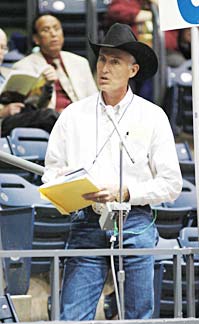
Gary Morgan, pastor and messenger from the Cowboy Church of Ellis County, questions why the missions, evangelism and ministry area of the BGCT budget showed a reduction. (PHOTO/Eric Guel)

In a news conference after the election results were announced, Lowrie pledged his continuing loyalty to the BGCT and encouraged messengers who voted for him to follow suit.

“You don’t create a future by pulling out,” he said. “You create a future by being engaged in the process.”

Joking with reporters, Lowrie added: “I feel like the winner. I accomplished my goals, but I don’t have to be president.”

Fenner could help promote unity among Texas Baptists by ensuring that people who have not served previously be appointed to places of service on BGCT boards and committees, he asserted.

Communicating with 5,700 diverse churches presents a challenge, Fenner noted, and she indicated Texas Baptists who believe they have not been represented adequately have a responsibility to help keep the lines of communication open.

“We have tremendously gifted people in our churches,” she said. “Help us know who they are and what they bring to the table” in terms of talents, experience, knowledge and ability.

Messengers also elected Mike Massar, pastor of First Baptist Church in Tyler, as first vice president and Jeff Raines, associate pastor at First Baptist Church in Amarillo, as second vice president. Massar received 967 votes, compared to 257 for Lee Saunders, minister of church development at Garden Oaks Baptist Church in Houston. Raines was unopposed.

During discussion of the 2008 budget, several messengers went to the microphones to raise questions—particularly regarding decreased funding for the missions, evangelism and ministry section.

Gary Morgan from the Cowboy Church of Ellis County called the reduced funding for that area “almost unconscionable.”

The annual meeting voted not to consider a motion by Michael Chancellor from Crescent Heights Baptist Church in Abilene calling for messengers to give the BGCT Executive Board directors a vote of “no confidence.”

With only a smattering of dissenting votes, messengers instead approved a motion by Dan Malone of First Baptist Church in El Paso objecting to the consideration of the “no-confidence” motion.

Ed Jackson from First Baptist Church in Garland introduced a motion calling on the BGCT president and the Executive Board chair to appoint a committee with no more than 25 members to consider a “shared vision” for the BGCT for 2020.

His original motion called on the committee to bring interim reports to the Executive Board in its February, May and September meetings next year and to bring a final report to the 2008 BGCT annual meeting.

It also gave specific charges to the committee about addressing the relationship between the BGCT and its institutions, setting priorities, studying changing missions strategies and analyzing “the impact of innovation on our ministries and the sustainability of all programs.”

Philip Wise of Lubbock, chair of the committee on convention business, brought a substitute motion that abbreviated the language of the original motion, expanded the number of people naming the committee to include all convention officers and extended the deadline for a final report to “no later than the 2009 annual meeting.” It also made no mention of the 2020 date.

Executive Board Chair Bob Fowler reports on a statement adopted by the board regarding its role in relation to the convention in annual session. (PHOTO/Eric Guel)

Messengers to the annual meeting approved the substitute motion from Wise’s committee.

At the recommendation of Wise’s committee, two motions introduced by Daniel Downey from First Baptist Church in Memphis were referred to the Executive Board. One called on the Executive Board’s administrative subcommittee to examine the chief operating officer’s position to determine “if it is really vital or necessary to the operation of BGCT ministries since the recent reorganization and consolidation of BGCT departments.”

The other motion—which a sizeable minority of messengers wanted to vote on to show the will of the body—called on the Executive Board to examine the necessity and effectiveness of the Baptist Building’s service center.

The presiding chair ruled out of order a motion by Kyle Clayton of First Baptist Church in Farwell calling for biographical information about all officer nominees to be provided to messengers. Since nominations are allowed from the floor of the annual meeting according to the BGCT governing documents, advance preparation of a resume of all possible nominees would be impossible, the chair determined.

Messengers also approved a special agreement with Baptist Child & Family Services to allow the agency to elect two-thirds of its trustee board and for the BGCT to elect one-third of the board.

In other business, messengers gave initial approval to a constitutional amendment that will clarify the decision-making authority of the convention in annual session.

The amendment to Article VII, Section 1 of the BGCT constitution says, “The Executive Board shall have charge and control, except when otherwise directed by the convention, of all the work of the convention, including missions, education and beneficence, in the interim between its sessions.”

The motion of clarification was prompted by outcry following a ruling by the presiding officer at the 2006 BGCT annual meeting, who said a decision by the Executive Board in a called meeting immediately prior to the annual meeting “pre-empted” action by messengers to the state convention. Constitutional amendments require two-thirds approval at two consecutive annual meetings.

Messengers to the annual meeting also approved a resolution that Texas Baptists “encourage, promote and support Baptist ministries that show the love of Christ in practical ways to immigrants within the confines of the law and according to biblical mandates.”

They also approved a resolution commending strategies that strengthen early childhood education, drop-out prevention, language ministry, adult literacy and higher education and encouraging churches and institutions to “provide academic and other support to at-risk students, including forming partnerships with schools.”

Other motions included appreciation to Charles Wade, who retires as BGCT executive director Jan. 31, 2008, as well as recognition of the 300th anniversary of Baptist associations in North America and thanks to the hosts of the annual meeting and the officers of the convention.

News of religion, faith, missions, Bible study and Christian ministry among Baptist churches, in Texas, the BGCT, the nation and around the world.


More than 100 profess faith in Christ during CityReach

Posted: 11/02/07

A child plays in an inflatable obstacle course during a block party sponsored by City Church of Amarillo. (Photo by John Hall/BGCT)

More than 100 profess faith
in Christ during CityReach

By John Hall

Texas Baptists Communications

AMARILLO—While children ran around, bounced in inflatable castles, played basketball, tossed Frisbees and scaled a climbing wall, a young man across the street quietly smiled as he received The Gift.

That’s the name of the Bible translation a volunteer from CityChurch of Amarillo gave him as he heard the Christian plan of salvation. The pair closed their eyes in prayer, and then they embraced in celebration of a new life in Christ.

A CityChurch of Amarillo volunteer shares the gospel with a block party participant during CityReach, an evangelistic emphasis held in conjunction with the Baptist General Convention of Texas annual meeting. (BGCT Photo/John Hall)

The young man was one of more than 100 people who professed faith in Christ during Baptist General Convention of Texas-sponsored City-Reach evangelistic activities. More than a dozen events—scheduled in conjunction with the BGCT annual meeting—included block parties, prayerwalking and prison ministry.

Gerald Davis, a BGCT specialist who led City-Reach, celebrated the additions to God’s kingdom and the evangelistic efforts that took place in the Amarillo area.

“We’re igniting churches in the area to be more evangelistic,” he said. “I think that’s what this effort is all about.”

John Shelton, who led an Inner City Evan-gelism team, said people in Amarillo are hungry for the gospel. They are hurting and looking for answers to life’s big questions. When they hear about Christ, they are drawn to him, Shelton said.

Shelton’s team walked streets in Amarillo known for their high crime rate and gang activity, introducing people to Christ. Team members began by striking up conversations and looked for opportunities to share their faith. More than 70 professions of faith came as a result of the team’s actions.

Christ calls his followers to share the good news about him, Davis said.

“We’re commanded to do it,” he said.

“When we don’t do it, we’re disobedient.”

News of religion, faith, missions, Bible study and Christian ministry among Baptist churches, in Texas, the BGCT, the nation and around the world.


Missions take forefront among ministry awards recipients

Posted: 11/02/07

Missions take forefront among
ministry awards recipients

By Marv Knox & Ken Camp

Editor & Managing Editor

AMARILLO—Passion for missions provided the theme of the 2007 Texas Baptist Ministry Awards, presented during the Baptist General Convention of Texas annual meeting in Amarillo.

Elmin Howell accepted the W. Winfred Moore Award for lifetime ministry achievement. Cindy and Dennis Wiles took the George W. Truett Award for ministerial excellence. And Dick Hurst—who was unable to attend—was named the recipient of the Marie Mathis Award for lay ministry.

Cindy and Dennis Wiles Elmin Howell

Baylor University and the Baptist Standard confer the awards annually to recognize excellent ministers and to highlight role models for ministry. They present the awards during Truett Theological Seminary’s banquet at the BGCT meeting.

Howell’s philosophy of ministry centers on a simple conviction—the spiritual needs of the world are too great to be met by preachers alone. From the colonias along the Rio Grande to an urban neighborhood in transition, he has focused on mobilizing all God’s people—clergy and laity—for missions and ministry.

In the spring of 1968, Howell—a former coach—put his team-building ability to the test when he accepted the challenge of launching a ministry to meet spiritual and physical needs along both sides of the Texas/Mexico border. Initially, the BGCT and its State Missions Commission envisioned a two- or three-year program. Howell led what came to be known as River Ministry 30 years, coordinating the work of more than 10,000 volunteers a year much of that time.

During his tenure as director, River Ministry started 706 churches and two Baptist associations on the Mexico side of the Rio Grande, established six children’s homes and built 67 health clinics. Under Howell’s leadership, River Ministry also developed a volunteer field staff of 45 regional consultants, and about 900 summer missionaries served in hands-on ministry along the border.

After he retired from the BGCT Executive Board staff, Howell discovered 40,000 people representing nine ethnic groups lived within a five-mile radius of Shiloh Terrace Baptist Church in Dallas, where he and his wife, Betty, are members. He also found out more than half lacked medical insurance.

In response, the church helped start Mission East Dallas, and Howell served for a time as president of the nonprofit ministry’s board of directors. Mission East Dallas has provided health care to more than 5,000 patients in eastern Dallas County, and at least 600 people have come to faith in Christ through its ministries.

The Moore Award recognizes a Texas Baptist minister, in any area of specialization, for a lifetime achievement in ministry. A minister meriting consideration should have a cumulative record of service that exemplifies commitment, stability and effectiveness.

Just about everyone who knows Cindy and Dennis Wiles associates them with two passions—church and missions. So, it’s no surprise they would lead a movement to equip congregations for hands-on missions. She is executive director and he is chairman of the board of the Global Connection Partnership Network, which helps churches train, send and support missionaries.

Cindy Falkner and Dennis Wiles intended to pursue careers in medicine when they met as students at the University of Alabama in Birmingham. But as their love blossomed, God revealed new plans. After they married in 1981, they headed to Southwestern Baptist Theological Seminary to prepare for ministry in local churches.

Along the way, they have served Jimtown Baptist Church in Jimtown, Okla.; First Baptist Church in Mertens; Southside Baptist Church in Tyler; Calvary Baptist Church in Garland; First Baptist Church in Huntsville, Ala.; and First Baptist Church in Arlington, where he currently is pastor. In every church, he has provided pastoral direction to guide members toward missions, and she has committed herself to missions education, action and support.

Under the Wileses’ leadership, First Baptist in Arlington has created a department, Global Ministries, that has sent mission teams to New York City, Costa Rica, Mexico, Washington state, San Antonio, Niger, Guinea, Cuba, Southeast Asia, Senegal, Macedonia, Russia, France, Alaska and Switzerland.

Now, working through the Global Connection Partnership Network, First Baptist in Arlington has appointed two overseas missionaries. Cottonwood Baptist Church in Dublin also is sending a missionary family abroad through GCPN, and more than 10 candidates are in the organization’s missionary pipeline.

The Truett Award recognizes a Texas Baptist minister, in any area of specialization, for a singular ministry achievement in the recent past. Achievements meriting consideration combine and exemplify imagination, leadership and effectiveness.

Hurst enjoyed a happy reunion in Eastern Europe this fall. He spent time with Denis, a little boy from Macedonia who has a healthy heart, thanks to Hurst’s medical expertise and Christian compassion. Hurst first met Denis a couple of years ago, when the Tyler physician traveled to the boy’s home in the backwater of the Balkans and realized Denis suffered from a congenital heart defect.

So, he came home and raised funds for Denis and his mother to travel to Bulgaria, where the boy underwent heart surgery. Now, he’s a “run and go” child.

Denis is but one of countless people whose lives—and eternities—have been changed by encounters with Hurst. Shortly after graduating from Baylor Medical School, Hurst opened a family medicine practice in Tyler, where he raised a family and also taught Sunday school and served as a deacon in First Baptist Church.

Down through the years and around the globe, one of Hurst’s defining characteristics has been his passion for missions and commitment to share the gospel in some of the world’s “hard places.” Hurst, a Vietnam veteran, has been to Iraq seven times, and his work on behalf of Kurdish refugees placed him on Saddam Hussein’s “hit list.” He also has visited Kosova seven times.

Other mission trips have taken him to Brazil, Thailand, Iran, Indonesia, Syria, Northern Ireland, Albania, Macedonia, the Chechnya region of Russia and throughout other parts of Europe. Hurst has shown a proclivity not only for providing healthcare to some of the world’s poorest people, but also making sure they have food and clothing and, quite often, church houses—donated and delivered in the name of Christ.

Closer to home, Hurst has served on the Tyler Race Relations Task Force, the Texas State Board for Jail Standards and the Cooperative Baptist Fellowship Coordinating Council. He also has been a volunteer leader at the Smith County Juvenile Center.

The Mathis Award recognizes a Texas Baptist layperson for a recent singular or lifetime ministry achievement. A layperson meriting consideration should have achievements that combine and exemplify imagination, leadership and effectiveness or whose cumulative record of service exemplifies commitment, stability and effectiveness.


News of religion, faith, missions, Bible study and Christian ministry among Baptist churches, in Texas, the BGCT, the nation and around the world.


WMU board discusses transition period, plans to select interim executive director

Posted: 11/02/07

WMU board discusses transition period,
plans to select interim executive director

By Teresa Young

Wayland Baptist University

AMARILLO —The Woman’s Missionary Union of Texas board of directors may have started their meeting with uneasiness about the future, but they ended on a positive note about ongoing missions work around the state—and the hope of having an interim executive director-treasurer for the missions organization in place by December.

The board began its business session with words of encouragement from a Baptist General Convention of Texas representative and Texas WMU President Nelda Taylor concerning the Oct. 16 resignation of Texas WMU Executive Director-Treasurer Carolyn Porterfield.

Taylor introduced Wayne Shuffield, director of the BGCT missions, evangelism and ministry area, to provide encouragement during the time of transition.

“We’re both in transition together, but we’re going to be OK because we’re doing God’s work, and he’s still working in the world,” Shuffield said. “We’ll stand hand-in-hand, shoulder-to-shoulder with you in whatever we have to do. I pledge to you to continue to work together, because there are people in our Judeas and Samarias who need to hear about Jesus.”

During the transition, Taylor challenged WMU leaders to claim the promises of Ecclesiastes 11:5—“Just as you’ll never understand the mystery of life forming in a pregnant woman, so you’ll never understand the mystery at work in all that God does.”

“God does things differently, but he is always in control,” Taylor said. “WMU of Texas is about the work of God, not any one person. If you feel discouraged during this time, God provides the grace to either endure or enjoy.”

The board learned WMU leaders will form a job description for an interim director, and they hope to have an interim leader in place by December. Board member Nina Pinkston of Fort Worth will help provide direction in the WMU office during November.

Reports from staff members included an update on the Texas WMU partnership with Texas Baptist Men for water purification efforts and disaster relief in terms of e-mail prayer alerts. Other updates included a report on a partnership with Montana Southern Baptist Women for leadership training.


News of religion, faith, missions, Bible study and Christian ministry among Baptist churches, in Texas, the BGCT, the nation and around the world.


WMU annual meeting features theme of ‘shaping’ for God’s purpose

Posted: 11/02/07

Sudanese Women on Mission lead worship and praise at the Texas WMU annual meeting. (PHOTO/Eric Guel)

WMU annual meeting features
theme of ‘shaping’ for God’s purpose

By Teresa Young

Wayland Baptist University

MARILLO—With a backdrop of terracotta and colorful glazed pottery, Woman’s Missionary Union of Texas celebrated another year of missions endeavors during its annual meeting, held in conjunction with the Baptist General Con-vention of Texas in Amarillo.

Centered on the theme “Shaped for His Purpose,” the 127th annual meeting featured testimonies that showed individuals being shaped to do God’s work and how that work is being carried out in around the world.

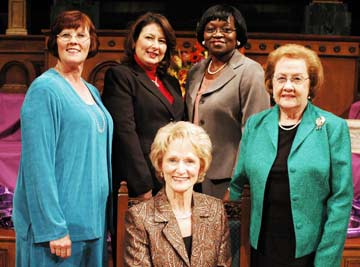
Texas WMU officers elected at the missions organization’s annual meeting are (front) Nelda Taylor of Gonzales, president; (left to right) Suzy Wall of Canyon, second vice president; Anna Zimmer of Kingwood, recording secretary; Frankie Harvey of Nacogdoches, first vice president; and Jo Lee of San Antonio, third vice president. (PHOTO/Eric Guel)

Texas WMU President Nelda Taylor made reference to the pottery and related it to believers.

“We, too, are earthen vessels shaped by God for his purpose,” she said. “We are vessels possessing great power through the Holy Spirit. We each have been molded by the Potter’s hands and have been designed for a purpose—to love people in Jesus’ name.”

Bea Mesquias of Harlingen described her mission trip to Moldova, which God laid on her heart after reading the WMU magazine, Mosaic. God showed his provision by preparing her to speak to the people, she reported.

Suzy Wall of Canyon talked about her experience at a Discovery camp with children from various countries—a week that taught her to use her own talents and gifts to do God’s work, she said.

Frankie Harvey of Nacogdo-ches reported on the annual Sisters Who Care Leadership Conference, an effort to teach African-American women about missions and introduce them to missions resources for their churches. This year’s conference included a track for teen girls, and 55 attended, with two making professions of faith in Christ, she noted.

“This may be planned by African-American women, but our goal is to minister to all women, inside and outside the body of Christ,” Harvey said. “These conferences have helped us touch more than 1,000 women across Texas.”

Texas Baptist Men told how their partnership with WMU in a water purification effort called Agua de Vida is helping reach people across the world and meet an important need.

Dick Talley, volunteer re-cruiter coordinator with TBM, explained the drip filters that volunteers have taken to 32 countries have made an impact not only on the health of residents, but also on their spirituality as they have an opportunity to link the purification process to salvation through Christ.

“These filters have changed the way we do ministry with our water program, to share the gospel,” said Talley. “We can use those filters to reach the world for Jesus Christ.”

The partnership with WMU, TBM Executive Director Leo Smith noted, is enabling the program to reach more people and impact the kingdom of God in greater ways.

“What will God do to shape WMU to meet the new challenges ahead? God is not through shaping you … making you more on track with him,” Smith said. “This is a team effort, and we’re committed to that. We’re seeing now how we can work together to do good things.”

Smith described benefits WMU has provided through funding for projects like the first Hispanic Royal Ambas-sadors camp held last summer, attended by 80 boys—including 50 who made professions of faith. The Mary Hill Davis Offering for Texas Missions provided funding for the camp. And further funding and program support, as well as promotion through WMU avenues, will increase the difference that can be made through the water purification efforts, Smith said.

“In Mongolia, the governor of a state asked a Baptist missionary to go into every home in the village and install the water filter units, and at the same time, he can share the love of Jesus with each home,” Smith said. “All that came from one unit we came and installed. God can use anything we lay before him and bless it.”

In other meeting activities, participants heard testimonies in song from the Sudanese Women on Mission group from First Baptist Church in Amarillo and the deaf choir from Paramount Baptist Deaf Church, along with praise and worship led by Mission Service Corps volunteers Bob and Sylvia Jordan of Amarillo.

A brief video chronicled 20 years of the Korean WMU work in Texas, and Texas WMU also marked the 10th anniversary of the Christian Women’s Job Corps.

Participants at the annual meeting elected officers for WMU, granting Taylor another year as president and Harvey another term as first vice president. New incoming officers are Anna Zimmer of Kingwood, recording secretary; Suzy Wall of Canyon, second vice president; and Jo Lee of San Antonio, third vice president.

Texas WMU will meet for its 128th meeting in April 2008 in Waco, reflecting a change in the traditional structure of meetings held with the BGCT. The two-day format will feature workshops and seminar sessions, as well as the traditional reports.


News of religion, faith, missions, Bible study and Christian ministry among Baptist churches, in Texas, the BGCT, the nation and around the world.