Survey reveals lack of knowledge about First Amendment

Posted: 11/06/07

Survey reveals lack of knowledge
about First Amendment

By Ken Camp

Managing Editor

WASHINGTON—Nearly two-thirds of Americans believe the Founding Fathers meant for the United States to be a Christian nation, and more than half believe the U.S. Constitution establishes a Christian nation, a national survey revealed.

The survey also showed 28 percent believe freedom to worship never was meant to apply to groups that a majority of Americans would consider on the fringe.

The State of the First Amendment 2007 report revealed only 19 percent of the people who responded to the survey could name “freedom of religion” as one of the rights guaranteed by the First Amendment, down from a high of 22 percent in 2003. The First Amendment Center has conducted the survey every year since 1997.

Similarly, only 16 percent named “freedom of the press,” 16 percent named right of assembly and 3 percent named “right to petition.” Almost two-thirds—64 percent—named “freedom of speech.”

Only 56 percent agreed freedom of worship applies to all religious groups, regardless how extreme their beliefs are, compared to 72 percent who agreed with the statement in 2000.

Most of the people who responded to the survey said they believe teachers and other public school officials should be allowed to lead prayers in public school—42 percent strongly agree, and 16 percent said they mildly agree.

The survey also revealed that more than one-third of Americans believe the press has too much freedom.

Other findings include:

• 46 percent strongly agree the country’s founders intended the United States to be a Christian nation, and 19 percent mildly agree.

• 38 percent strongly agree the U.S. Constitution establishes a Christian nation, and 17 percent mildly agree.

• 57 percent strongly agree a public school teacher should be allowed to use the Bible as literature in an English class, and 23 percent mildly agree.

• 71 percent strongly agree a public school teacher should be permitted to use the Bible as a text in comparative religion class, and 17 percent mildly agree.

• 33 percent strongly agree a public school teacher should be allowed to use the Bible as a factual text in a history or social studies class.

Charles Haynes, senior scholar with the First Amendment Center, noted the survey shows Americans highly value religious freedom, but they interpret it in terms of freedom for the religion held by a majority.

“The strong support for official recognition of the majority faith appears to be grounded in a belief that the United States was founded as a Christian nation, in spite of the fact that the Constitution nowhere mentions God or Christianity,” Haynes said.

“Of course, people define ‘Christian nation’ in various ways, ranging from a nation that reflects Christian values to a nation where the government favors the Christian faith. But almost one-third of respondents appear to believe the religious view of the majority should rule.”

Actually, the First Amendment—and all the Bill of Rights—are “counter-majoritarian,” said Brent Walker, executive director of the Baptist Joint Committee for Religious Liberty.

In a column in the Report from the Capital newsletter, Walker lamented the survey findings that revealed many Americans display “woeful ignorance of the Constitution and history.”

“It does not matter what the majority thinks. The protection for religious liberty in the First Amendment protects against the tyranny of the majority,” he wrote.

“But, we must do a better job in convincing the culture. Eventually, it does matter what the majority thinks. They can elect new members of Congress and vote for presidents that will make new appointments to the Supreme Court and, in rare cases, a super-majority can amend the Constitution. So, ironically, for this counter-majoritarian understanding of the First Amendment to survive challenges, it must be embraced by a majority, if not a consensus, of the American people.”

The survey of 1,003 respondents was conducted by phone between Aug. 16 and Aug. 26 by New England Survey Research. Sampling error was plus or minus 3.2 percent.



News of religion, faith, missions, Bible study and Christian ministry among Baptist churches, in Texas, the BGCT, the nation and around the world.


TBM mobilizes disaster relief team to meet needs in southern Mexico

Updated: 11/08/07

TBM mobilizes disaster relief team
to meet needs in southern Mexico

By Ken Camp

Managing Editor

Baptists have responded to urgent needs in southern Mexico after hundreds of thousands of people were driven from their homes in that region’s worst-ever flooding. Texas Baptist Men mobilized a disaster relief team to serve in the state of Tabasco, and both the Baptist World Alliance and the Southern Baptist Convention’s International Mission Board sent funds to Baptists in the region.

When more than a week of heavy rains caused the Grijalva River to burst its banks, floods displaced up to 800,000 people in Tabasco. Later, at least 16 people were missing and presumed dead when a mudslide buried the San Juan de Grijalva community in the state of Chiapas.

Federal police assist a group of flood-affected residents as they prepare to board a helicopter on the outskirts of Villahermosa, the state capital of Tabasco, in southeastern Mexico. Thousands of homes were flooded after rivers burst their banks in the southern Mexican state of Tabasco and heavy rains left 70 percent of the swampy region under water. (Photo/Tomas Bravo/REUTERS)

“Because of the heavy rains and the flood, the people have lost all their belongings—houses, vehicles, food, clothes and personal items,” said C.P. Raul Castellanos Fernandez, chief executive officer of the National Baptist Convention of Mexico. “Seventy percent of the state of Tabasco has been flooded.”

Texas Baptist Men responded to a request from Baptist leaders in Villahermosa, Tabasco, to provide emergency food service. TBM Disaster Relief Director Gary Smith sent out a request Nov. 7 for trained volunteers who could serve in southern Mexico through Thanksgiving.

TBM activated the regional South Texas Mobile Unit, and workers in Dallas prepared two water purification units for transport to Tabasco.

The Baptist General Convention of Texas treasurer’s office authorized the purchase of food supplies that would allow volunteers to serve up to 40,000 meals a day for three days.

“We’re going on faith, because the money isn’t there” in the disaster relief fund for a long-term response, Smith noted. “We’re just trying to respond to the needs at the invitation of the Baptist pastors in Villahermosa.”

How you can help:
Send gifts designated “disaster relief” to either: Baptist General Convention of Texas, 333 N. Washington, Dallas 75246 or Texas Baptist Men
5351 Catron, Dallas 75227
To donate online, visit
www.bgct.org/disaster

Lilia Aguilera de Maltez from Luz Bautista, the Mexican Baptist newspaper, reported speaking with leaders in Tabasco who described a “desperate situation,” particularly in Villahermosa.

“There are several church buildings under water. There is no food left in the supermarkets. There is no potable water. They cannot withdraw money from the banks. The highway to Cardenas is blocked. And all the trucks with food supplies cannot get into the city,” she wrote in a Nov. 1 e-mail.

Josue Valerio and David Tamez from the BGCT missions team were scheduled to meet with officials from the National Baptist Convention of Texas in Mexico City to explore ways Texas Baptists could respond to needs in southern Mexico.

Texas Baptists can support the relief efforts in Mexico financially by sending checks designated “disaster relief” to the Baptist General Convention of Texas, 333 N. Washington, Dallas 75246 or to Texas Baptist Men at 5351 Catron, Dallas 75227. To donate online, visit www.bgct.org/disaster.

The Baptist World Alliance and the Southern Baptist Convention’s International Mission Board each initially sent $10,000 to help provide disaster relief.

Representatives from Texas Baptist Men and the Border/Mexico Missions office of the Baptist General Convention of Texas also have been in contact with Mexican Baptist leaders to offer assistance, and Dexton Shores of Buckner International was seeking to identify ways to respond to the needs of children and families.

Baptist World Aid—the relief and development arm of the Baptist World Alliance—provided $10,000 in response to needs voiced by leaders of Mexico’s national Baptist convention.

Likewise, Southern Baptists will support relief efforts conducted by local Baptist churches and the National Baptist Convention of Mexico because there are no Southern Baptist field personnel in the area, said Jim Brown, Americas area director for Baptist Global Response, a Southern Baptist international development and relief organization.

An initial grant of $5,000 from Southern Baptist relief funds was released to Baptist congregations in Merida, located in southern Mexico’s Yucatan state, reported David Brown, Southern Baptists’ regional disaster relief coordinator. Those congregations were planning a relief convoy to Tabasco once roads become passable, and the funds will be used to assemble food packets.

An additional $5,000 was released to the Mexican convention for a relief project in Tabasco being conducted by Baptist congregations nationwide.


With additional reporting by Baptist Global Response and the Baptist World Alliance.


News of religion, faith, missions, Bible study and Christian ministry among Baptist churches, in Texas, the BGCT, the nation and around the world.


Arkansas Baptists narrowly reject opening on communion, baptism

Posted: 11/14/07

Arkansas Baptists narrowly reject
opening on communion, baptism

By Robert Marus

Associated Baptist Press

VAN BUREN, Ark. (ABP)—Arkansas Baptists narrowly rejected an attempt to remove a constitutional provision on communion and baptism that historians say is rooted in a 19th-century Baptist controversy.

Messengers to the Arkansas Baptist State Convention annual meeting, held Nov. 7 at First Baptist Church in Van Buren, Ark., voted 383-225 to remove the provision. However, the motion required a two-thirds majority, and it fell a few percentage points short.

The proposal would have deleted a passage that has been in the state convention’s governing documents for decades. The phrase, following a section noting that the Southern Baptist Convention’s Baptist Faith & Message also serves as the Arkansas Baptist doctrinal statement, says, “The Baptist Faith & Message shall not be interpreted as to permit open communion and/or alien immersion.”

Wes George, new Arkansas Baptist convention president

“Open communion” refers to the practice of offering the elements of the Lord’s Supper to any worshipper who is a baptized Christian, regardless of their church membership or denominational background.

“Alien immersion” refers to Southern Baptist churches accepting transfers of membership from churches of other traditions that also practice believer’s baptism by immersion.

Both terms date to the 19th century, and opposition to both practices is among the hallmarks of a Baptist movement commonly referred to as Landmarkism.

“Baptism is not a matter of heritage, history or denomination,” said Greg Addison, chairman of the state convention committee that recommended removing the provision, according to the Arkansas Baptist News. “Baptism is best and only defined by Scripture.”

Addison, pastor of the First Baptist Church of Cabot, Ark., urged reliance on the Baptist Faith & Message section and Bible passages on baptism without further interpretation. He also said the committee “affirmed that we would never step away from any process that would remove or weaken our dependence on the Baptist Faith & Message.”

Addison also argued that the passage in question conflicts with another in the Arkansas Baptist constitution that prohibits the state convention from interfering with the autonomy of local churches.

But Van Harness, pastor of Westside Baptist Church in Greers Ferry, Ark., argued against removing the phrase. He said open communion is not nearly as much a threat to the doctrinal standards of Arkansas Baptist churches as is alien immersion.

“We all agree that a valid baptism is a prerequisite for church membership,” Harness said. “When we receive someone into our church, we want to be sure they have had a valid baptism. … Only congregations that teach a correct doctrine of salvation and have a correct practice of baptism can authorize and administer a valid baptism.”

Despite the prohibitions, many Arkansas Baptist churches have long practiced open communion and accepted new members from non-Southern Baptist backgrounds without re-baptizing them.

Pastor Randy Hyde of Pulaski Heights Baptist Church in Little Rock, Ark., said his 95-year-old congregation “has never practiced closed communion, as far as I know.” He also said Pulaski Heights accepts as members those who have received believers’ baptism in other traditions.

Hyde said every time he presides at a communion service, he extends an invitation to partake for all Christians present, noting that the table of wine and bread “belongs to God” and not to the church.

“I think that’s theologically and biblically correct, and I think the Arkansas Baptist State Convention is representative of a culture that, from my perspective—at least in light of this issue—does not reflect what Scripture conveys.”

Baptist historian Bill Leonard, dean of the Wake Forest University Divinity School, said the Arkansas provision stems from the state’s history as a center of Landmarkism in the late 19th and early 20th centuries.

Landmarkism split many Southern Baptist congregations during that period, particularly in Tennessee, Kentucky, Arkansas, Missouri and Oklahoma. While some Landmarkists went on to form their own denominations—two are still headquartered in Arkansas—others stayed in Southern Baptist churches.

“One of the ways the state convention kept churches and pastors in the fold was to add that phrase” to its governing documents, Leonard said. “Many of those congregations look a lot more like Landmark-independent churches than they did denominationally based churches.”

The Landmarkist provisions come from an era in the South when Southern Baptists exerted much more cultural hegemony than they do today, Leonard said.

“When you had Southern Baptists as the sort of dominant, publicly privileged denomination, then many of these churches could afford to draw these lines, because people were going to join them anyway,” he said. “There were reasons enough to be Southern Baptist that churches had the luxury of drawing these distinctions.”

But today, Leonard continued, many young people and newer congregations have little or no denominational loyalty and have “no comprehension” of concepts like closed communion or alien immersion.

“There’s a kind of generic Christianity where these distinctions are difficult to make. …. But you still have a core of people for whom these are important traditions,” he said. “They are the kinds of traditions, to these people, for which changing them would be a kind of watering down.”

He added, “With Baptists, we’re all just a few steps from the 19th century at any moment.”

In other action, Arkansas Baptist messengers elected three officers who ran unopposed— Wes George, pastor of the First Baptist Church of Rogers, Ark., as president; Clay Hallmark, pastor of the First Baptist Church of Marion, Ark., as first vice president; and Robbie Jackson, pastor of East Mount Zion Baptist Church in Clarksville, Ark., as second vice president.

Messengers also adopted resolutions on encouraging church unity and opposing a state lottery. They approved a $20.5 million 2008 budget, which includes 41.97 percent for SBC causes and 58.03 percent for missions and ministries within Arkansas. The .2 percent increase for SBC causes is the first such increase in a five-year plan to increase the SBC portion by 1 percent. The 2008 budget represents a 2 percent increase over last year’s budget goal.


News of religion, faith, missions, Bible study and Christian ministry among Baptist churches, in Texas, the BGCT, the nation and around the world.


Belmont and Tennessee Baptists reach settlement, end lawsuit

Posted: 11/14/07

Belmont and Tennessee Baptists
reach settlement, end lawsuit

By Robert Marus

Associated Baptist Press

KINGSPORT, Tenn. (ABP)—Belmont University and Tennessee Baptists have reached an agreement that will end a crucial lawsuit, messengers at the Tennessee Baptist Convention annual meeting learned.

The agreement means that Belmont will provide the Tennessee Baptist Convention a total of $11 million toward a ministry-endowment fund and Tennessee Baptists will drop their lawsuit attempting to regain control of the school, lost in 2004 when the school moved to become independent.

Messengers, meeting in Kingsport, Tenn., received the news from a negotiating committee with applause. The agreement ends the convention’s 56-year-old relationship with the school and also likely marks the end of a sometimes-bitter three-year dispute.

“One of the things that we must learn from this is that relationships are extremely valuable and that they are sometimes fragile, and I hope that we have learned that, as we have worked together as brothers and sisters in Christ, we will not always agree,” said Clay Austin in announcing the settlement to convention messengers.

Austin is pastor of First Baptist Church of Blountville, Tenn., and chairman of a special convention committee charged with negotiating with Belmont officials.

Marty Dickens, chairman of Belmont’s trustees, released a statement Nov. 13 saying the settlement “honors the many significant contributions that Tennessee Baptists have made to the university and upholds the teachings of Jesus Christ, whom we all seek to serve by ending litigation.”

Under the agreement’s terms, Belmont will provide an initial $1 million gift, followed by annual gifts of $250,000 for the next 40 years. The funds will be added to an endowment that will support Tennessee ministries.

The convention initially sued to regain the approximately $58 million in funds it has donated to Belmont since buying the school. The suit asked a judge to enforce an obscure 1951 document—whose existence was discovered on the eve of the convention’s annual meeting in 2005—that appears to require Belmont to reimburse the convention for contributions should the school “pass from Baptist control.”

But attorneys for Belmont argued that later agreements between the school and the convention superseded that document.

The conflict between Belmont and the convention dates to 2004, when convention officials asked all ministry partners to craft proposals for covenant documents describing their relationship with the convention.

Belmont trustees proposed that they begin electing their own successors, that the school be allowed to draw up to 40 percent of its trustees from Christians of non-Baptist traditions, and that all Tennessee Baptist Convention-contributed funds would go exclusively to fund scholarships for students from Tennessee Baptist churches.

While the Tennessee Baptist Convention Executive Board’s education committee approved the covenant, a divided board rejected it. Officials from the convention and the university jointly crafted a new document agreeable to both groups.

In May 2006, at a rare special meeting of the convention, messengers voted 923-791 to reject a $5 million offer from Belmont to settle the case. They then voted to declare the school’s entire trustee board vacant and established Austin’s committee to negotiate with Belmont officials.


News of religion, faith, missions, Bible study and Christian ministry among Baptist churches, in Texas, the BGCT, the nation and around the world.


Former pastor returns money to congregation; church agrees to give funds to BGCT

Posted: 11/14/07

Former pastor returns money to congregation; church agrees to give funds to BGCT

By John Hall

Texas Baptist Communications

DALLAS—The former pastor of First Baptist Church in Weslaco has returned to his former congregation the Baptist General Convention of Texas church-starting funds he used in a questionable manner, and the church has agreed in principle to return the money to the convention.

BGCT Executive Director Charles Wade revealed Nov. 9 on the BGCT blog that the convention and First Baptist Church are in the process of finalizing an agreement on the return of $26,550.

The BGCT has agreed not to seek the recuperation of funds above $26,550, which matches the amount sent to First Baptist Church in Weslaco to start a church, The Family Fellowship, he reported.


See complete list
of Valley funds scandal articles

The funds were allocated to First Baptist Church to start a congregation that was designed to originate as a third worship service at First Baptist Church. Most of the membership of First Baptist Church never understood it was starting another congregation, and former Pastor Jonathan Becker claimed the BGCT funds as a salary supplement for leading the new church.

Becker noted he have gave the money to First Baptist Church in Weslaco of his own accord without the congregation or the convention asking for it. While figures higher than $26,550 have been attributed to what Becker claimed as a salary subsidy, Becker said the $26,550 represents all the money he received. BGCT records also show the convention sent First Baptist Church in Weslaco $26,550 for the Family Fellowship.

The BGCT helps fund as much as 50 percent of new church budgets and allows congregations to make decisions on how to best use that money, officials noted.

Since the allegations of misappropriation arose, Becker has resigned as pastor of First Baptist Church in McAllen, where he went to serve after leaving First Baptist Church in Weslaco.

In a letter to leaders of First Baptist Church in Weslaco, Wade thanked the congregation for its efforts to return the money.

“Your willingness to initiate this response without any urging from us speaks clearly about the wonderful character and integrity of your people,” he wrote.

In his blog post, Wade noted the misuse of church-starting funds happened under guidelines that have since been revised and improved.

“Our new policies and guidelines outlined in our new church starting manual will minimize the risk of misuse of church starting funds,” he wrote. “Our whole process has been changed and improved. And if someone does try to inappropriately use church starting funds of the BGCT, we will be able to know it quickly and respond appropriately.”

BGCT church starters meet more frequently with church planters, sponsoring churches and associational representatives now. They ask church planters about specific areas of new church development, including the development of contributors and finances. When answers don’t meet expectations or gaps appear, BGCT church starters take a deeper look at the situation.

The BGCT is making every attempt to handle each donated dollar in a way to honors God, Wade stressed.

“Every dollar any one of our members gives through our churches is precious to God and to every pastor,” he wrote. “Every dollar given by any one of our churches or missions is precious to God and to me.”


News of religion, faith, missions, Bible study and Christian ministry among Baptist churches, in Texas, the BGCT, the nation and around the world.


Cybercolumn by John Duncan: Unpacking memory, nostalgia and emotion

Posted: 11/10/07

CYBER COLUMN:
Unpacking memory, nostalgia and emotion

By John Duncan

I’m sitting here under the old oak tree, thinking about unpacking boxes. The process of moving, transition and change creates memory, nostalgia and emotion. As I unpack boxes, the memory, nostalgia, and emotion form tributaries in my mind that flow in to the river of change.

First, I think of the memory that moving creates. As I unloaded boxes in our new home in our new town, I stumbled onto a box of baseball trophies. When did I ever play for the Dodgers? I remember the Jets, not New York and the Joe Namath of yesterday, but the pee-wee football Jets with red and white jerseys. I remember the spring days of playing baseball in fields of green with bees buzzing, back when I was an expert bunter because I could not hit a fast ball from the pitcher. A box of trophies takes up space in a box—the basketball, the football, and the baseball ones, all shiny and dusty and a few with broken pieces, incomplete like a bird with a broken wing. My trophies, they fill a box soon to be stashed in the attic.

John Duncan

Second, I recall the nostalgia that moving stirs up. How many pictures have I rediscovered in the process of moving? Wedding pictures and pictures of my daughters and pictures of places like Hawaii and England and North Carolina and pictures from home and church where people smile around tables stacked with food from pot luck dinners? Do churches still have pot luck dinners?

One picture stands tall, a chalk sketch of me and a first grader named Brock standing in front of Lakeside Baptist Church in Granbury, where once upon a time, I served as pastor. The church lay tilted in shades of orange and cream, with Brock and me standing in front of the stained glass in the shadow of the cross, both of us wearing huge smiles, smiling like we were licking our chops while waiting for ice cream at the counter or like we had just seen Jesus riding by on a donkey on Palm Sunday. Come to think of it, standing in the shadow of the cross is not a bad place to stand. Oswald Chambers agrees, “The underlying foundation of the Christian faith is the undeserved, limitless miracle of the love of God that was exhibited on the Cross of Calvary; a love that is not earned and can never be.” When I think of Brock and me standing under the stained-glass cross, I can only imagine God’s love shining on us like the reflection of stained glass behind a lighted window.

Third, I feel the emotion. Moving by itself is an overwhelming thing. I mean, did our attic hold that much stuff? Do we really need a dozen boxes of stuffed animals and Beanie Babies? And really, does any dear soul place pictures in boxes for future reference in this sophisticated digitized age where people send pictures over waves and wires a where they arrive via the Internet on computer screens? Family pictures and fun pictures like the time you went to Alaska and climbed a glacier and pictures like the first time you rode your bicycle and had no teeth and the pictures when your hair looked bad and pictures of houses with snow flakes in the winter and pictures that make you cry because you remember your deceased grandmother or maybe when life was simple and the digitized world had not taken over and there was no such a thing as a computer or e-mail. Emotion tumbles slowly, like a small rock rolling down a mountainside until it stops when it hits something like, maybe, that ridge in your heart.

Emotion tumbled in my own life in all this moving. My Aunt Mildred died. Right smack dab in the middle of moving, life took an expected but unexpected turn. Expected because she had been in a nursing home for four years; unexpected because, quite frankly, even though she was 83, I thought she had more time on this earth. My aunt Mildred lived in the mountains of North Carolina. She never married, lived most of her life in the same house and rarely ventured off of the mountain. Life for her was simple things—laughter at the table amid the passing of biscuits, gravy, green beans and chocolate pie; trips around the mountain on the Blue Ridge Parkway, where often we stopped at a place called Little Switzerland for ice cream; washing clothes in an old-fashioned crank-style machine and hanging them to dry in the sunshine and wind; watching the leaves change an array of colors in autumn; going to get your hair fixed on Friday and catching up on the local news; sitting on the front porch swing and watching fireflies blink in the cool of the evening as the sun set; planting and watering flowers while observing their growth; and attending the red-bricked Pine Branch Baptist Church and singing to the Lord “Amazing Grace” with the gathered saints each Sunday. “These are my people,” so sounds a lyric in a country song. Or as the poet Langston Hughes says, “Beautiful, also, are the souls of my people.” Mildred was a simple person who loved simple things in a simple place. And might I add, she possessed a beautiful soul, for beautiful are the souls of my people.

Memory, nostalgia and emotion form a river that runs deep into my own soul as I unpack boxes. But there are in those boxes tons of trivia and treasures, of junk and stuff. The Apostle Paul, earth wanderer that he was, sojourner who knew how to sew a tent and pack a tent on his missionary travels, referred to stuff as dung: “Yet, indeed, I count all things loss for the excellency of the knowledge of Christ Jesus my Lord, for whom I have suffered the loss of all things, and count them as dung that I may gain Christ.” Even Jesus used the word “dung.” He told the parable of a farmer who planted a fig tree in his vineyard and found no fruit. The farmer said to the keeper of his vineyard, “What in the world am I finding no figs on this tree?” (my paraphrase). The keeper of the vineyard said, “Leave it alone for a year until I dig around it (to give it air) and dung it (to fertilize it).” So dung, in essence, is rubbish or refuse or trash, or manure or fertilizer like the kind that turns your yard green when sprinkled in spring.

Dietrich Bonhoeffer adds wisdom, “Earthly possessions dazzle our eyes and delude us into thinking that they can provide security and freedom from anxiety. Yet all the time they are the very source of anxiety.” Bonheoffer is so right. Do you think he wrote that after unpacking boxes?

So, here I am under this old oak tree, thinking and unpacking boxes. I have found memory, nostalgia and emotion. I have unpacked trash and treasures, junk and stuff, stuff for shelves to behold and some stuff good for nothing more than for making fertilizer to spread on my yard. I have remembered the past, yet anticipate the future because you cannot live in the past. I have reached for the excellency of Christ and yearned for spiritual fruit on my limbs like mouth-watering figs.  “My soul,” in the words of Langston Hughes, “has grown deep like the rivers” and beautiful are the souls of my people. All told, though, this old oak tree drives deep roots and sprouts green leaves, and so it is with life. And I have concluded one more thing as I stare at unpacked boxes: I have way too much stuff. So live in his joy and bask in his glory and, every once in awhile, give stuff away or at least have a garage sale!


John Duncan is pastor of First Baptist Church in Georgetown, Texas.


News of religion, faith, missions, Bible study and Christian ministry among Texas Baptist churches, in the BGCT, the Southern Baptist Convention ( SBC ) and around the world.


Bible Studies for Life Series for November 18: The cure for anxious care

Posted: 11/09/07

Bible Studies for Life Series for November 18

20/20 vision

• Matthew 7:1-12

By Steve Dominy

First Baptist Church, Gatesville

The Christian life cannot be lived in isolation; it is not an individualistic affair. Our tendency is to make our faith private, to wall it off from the rest of our life and fly solo.

Tom T. Hall wrote a song that captures our isolationist Christianity, “Me and Jesus, got our own thing going; Me and Jesus, got it all worked out. Me and Jesus, got our own thing going. We don’t need anybody to tell us what it’s all about.”

While I love listening to Tom T. Hall, his theology in this song is way off base. It may be that he writes in response to the kind of judgmental attitude Jesus condemns in chapter 7. Jesus does not believe the Christian community will be without conflict and gives us the way to deal with conflict between brothers.

“Judge not lest ye be judged” is one of the best-known phrases in all the Bible. It also is one of the most misunderstood and most wrongly applied phrases in all of the Bible. We cannot understand it to mean that we are to turn a blind eye to other people’s faults (or our own), nor can we understand it to mean that we cannot distinguish between right and wrong.

To declare an action or attitude to be sin is not casting judgment on a person. Jesus calls us to use the discernment we have been given to choose what is right and to do what is right. This section deals with the manner in which we are right.

The story of the prodigal son is a good example of what Jesus was teaching. While we generally associate the story with the son who left and squandered everything, it really is the story of a man with two sons.

The son who stayed home had done everything right. The problem was he had judged his brother, and in doing so, he was right in the wrong way. If he had recognized his brother had done wrong yet accepted him home, he would have been right. But he not only condemned what his brother had done, but also condemned his brother.

The word we translate “judge” carries with it the idea of condemnation. Jesus is concerned with the self-righteous attitude that finds fault in everyone else but never looks at its own faults.

All of us have known Christians with this attitude, and if we are honest with ourselves, we have been guilty of it as well. Jesus had every opportunity to condemn not only our actions but us, yet on the cross he asked, “Father, forgive them.” If Jesus, who is Lord and Judge of all, refuses to condemn us, who are we to condemn?

Jesus follows this with a section on hypocrisy. All of us are sinners. We stand before God guilty of sin and rebellion. None of us has an excuse, and all of us have been disqualified from the bench. To stand in judgment when we are just as guilty as the person whom we judge is the height of hypocrisy.

That is the point that Jesus is trying to get across in verses 3 and 4—not that we are supposed to ignore the speck in our brother’s eye, but that we do so with the recognition that we are in the same shape. The hypocrite’s error is not in recognizing fault in his brother but in not applying that same criticism to himself. The standard Jesus sets for us in verses 1-4 is that we are to play neither the judge nor the hypocrite, but the brother.

Verse 6 is one of the most difficult for us to deal with, so much so that most of us never deal with it at all. When we deal with a passage such as this, it is a good idea to look at other passages with similar themes.

In Matthew 10, Jesus sends his disciples out on a mission with specific instructions. One of those that is applicable to our text is Matthew 10:14: “Whoever does not receive you, nor heed your words, as you go out of that house, or that city, shake the dust off your feet.”

What we must take note of is that Jesus’ admonition in verse 6 comes immediately after his instruction not to be judgmental or hypocritical. There are those who never will respond to the gospel. As we share the gospel, there comes a point at which we recognize that our efforts will be more fruitful somewhere else. This does not mean we cease to pray for those who are stubborn to the gospel. It does mean we have to be willing to go to those who are receptive to the grace of God.

It is a natural move for Jesus to go from our relationships together to our relationship with God. Perhaps he makes this transition because we cannot do what he has commanded us in verses 1-6 without divine help. Jesus’ call to ask, seek and knock is the call to persistent prayer. Not the prayer that badgers God, but consistently and constantly seeks his wisdom, presence and mercy.

It is confident prayer because God wants to give us all good things. We can have confidence in our requests to God because of God’s great faithfulness. If even we can seek the best for our children in our fallen nature, how much more does God seek the best for us?

The Golden Rule concludes this section. It sums up what Jesus makes explicit in our relationships to one another; in all that we do, we are to treat others in the manner we desire to be treated. Jesus goes on to say this is the law and the prophets, which places it in pretty high standing. We will not be wrong before God and others if we keep this in the forefront of our actions.

News of religion, faith, missions, Bible study and Christian ministry among Baptist churches, in Texas, the BGCT, the nation and around the world.


Explore the Bible Series for November18: Show compassion and love to those in need

Posted:11/09/07

Explore the Bible Series for November 18

Show compassion and love to those in need

• Matthew 25:31-46

By Travis Frampton

Hardin-Simmons University, Abilene

Compassion, mercy, grace, forgiveness, sacrifice and love. As we have discussed in previous lessons, these words represent true power in the kingdom of God. These words have potential to change the world in which we live radically. We have seen each of these qualities in Jesus as we have read through Matthew’s Gospel over the past several weeks. In Matthew 25:31-46, these words move from impressions of the heart to action he demands from his followers.


Jesus in our midst

Jesus said: “Come, you who are blessed by my Father; take your inheritance, the kingdom prepared for you since the creation of the world. For I was hungry, and you gave me something to eat; I was thirsty, and you gave me something to drink; I was a stranger, and you invited me in; I needed clothes, and you clothed me; I was sick, and you looked after me; I was in prison, and you came to visit me” (Matthew 25:34-26).

He instructed his disciples about how, in the kingdom of God, those who cannot yet take care for themselves should be shown mercy and compassion by those around them. No judgment. No condemnation. No theoretical solutions lacking substance. No evangelical tracts left behind. Just food, water, friendship, clothes, the warm care of a mother and companionship. That’s it.

Why doesn’t Jesus say, “I was lost, and you preached the gospel to me,” or “I had errant theology, and you disabused my heresy,” or “I voted wrongly in the last election and, thanks to your organized public picketing and active political 7006 site, I am now a better person”? Why is it that what we care so deeply and so passionately about (e.g., preaching the gospel, proper theology, political activism) does not receive attention in the narrative about separating sheep from the goats.

Righteousness, here, is not about proper preaching, theology or party affiliation but about compassion, mercy, grace, forgiveness, sacrifice and love in action. Jesus demands, by way of strong hyperbolic metaphors, that his followers be directly involved in the suffering present in the world around them.

I attended a conference where Jürgen Moltmann said that if we want to see how we can contribute to building the kingdom of God here on earth, we should “look at ourselves through the eyes of our victims.” How do we voluntarily or involuntarily contribute to human suffering? How can we remedy the problem? We can offer solutions by ceasing to do evil and by taking care of those less fortunate.

Christ is ever-present among those who suffer. He is the great physician; he offers hope to those who have none; he offers his body (bread) to those who are hungry; and, according to Matthew 25:46, he offers “eternal punishment” for those who do not care for those marginalized in society and “eternal life” for those who do.

Many Christians in America are extremely fortunate. We have jobs and can support our family with the basic necessities of life. Some of us go to very large churches with enormous budgets for staff salaries, building maintenance, running programs at the family recreation center, multimedia equipment used during worship, and energy costs to keep the sanctuary heated or cooled depending on the season. The church does all this in order to glorify God.

Do we have enough left in the church operating budget to feed, clothe and visit Jesus? Do we care? I believe the church does care about meeting people’s physical as well as spiritual needs. It’s just that sometimes we need to be reminded about where Jesus is in the midst of all that keeps us busy at church. Does Jesus prefer the cushioned seat in the air-conditioned/heated sanctuary that has the most recent multimedia presentations where film clips are shown along with the Sunday sermon. Or is Jesus outside—in the winter cold or the summer heat—with those who care more about where their next meal is coming from than what the pastor has to say to the congregation that given Sunday.

Have you heard these excuses before: “God takes care of those who take care of themselves!” or “There are plenty of jobs available; if they’d just stop looking for handouts and get a job like the rest of us”?

I’d hate to think what Jesus would say in response to these statements: “I was naked, and you called the cops” or “I was hungry, and you told me to get a job.” As Christians, we are commanded to take care of the poor; we are not supposed to come up with the solution to cure poverty or stop crime, although working toward those ends is admirable. We are required simply to show compassion and love to those in need.

Why?

Because Jesus did it for us.

Discussion questions

• How does your church minister to those who are down-and-out?

• How do we voluntarily or involuntarily contribute to human suffering?

• What can we do to remedy human suffering?

• Do you believe the statement that belief and behavior are two sides of the same coin? Why?

News of religion, faith, missions, Bible study and Christian ministry among Baptist churches, in Texas, the BGCT, the nation and around the world.


Nigeria mission trip takes volunteer far outside her comfort zone

Posted: 11/09/07

Nigeria mission trip takes volunteer
far outside her comfort zone

By Craig Bird

Baptist Child & Family Services

KINGWOOD—Paige Maupin played the numbers—10 days, 6,500 miles one way, 800 patients, 24 professions of faith, two remote villages and one life changed forever—her own.

Maupin, a member of First Baptist Church of Kingwood, near Houston, joined a recent Children’s Emergency Relief International medical missions team to Nigeria. The trans-Atlantic journey challenged her, since she can “count on the fingers of one hand” the number of times she has flown on an airplane and had “never imagined going to another country to serve God,” even for a few days, she said.

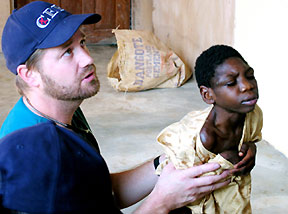
Paige Maupin struggled for a year before getting out of her comfort zone to go on a mission trip to Nigeria that she says changed her life forever. (CERI photos)

“I would be the last person to volunteer for a trip anywhere away from my family,” she explained.

“I’ve lived in the same Houston community since I was 4-years-old, and now our house is just a few blocks from my parents. I always shop at the same grocery store, usually vacation at the same spot and have attended the same church—Kingwood First Baptist—since I became a Christian. I really like my comfort zone.”

But a year ago her pastor, Kevin McCallon, began challenging the congregation to “believe that God is who he says he is and that, like Abraham, we could believe that, as well.”

For several months, Maupin recalled spending most Sundays sobbing through the sermons, yearning to do just that.

That’s why she found herself in Otululu and Anyigba, Nigeria, with a Children’s Emergency Relief International team. CERI is the overseas arm of Baptist Child & Family Services, a San Antonio-based agency affiliated with the Baptist General Convention of Texas.

Her team treated 200 patients in Otululu and 600 in Anyigba.

“I’ve often heard people say that mission trips are sometimes about the volunteers and not always only about those they go to serve,” Maupin says. “I definitely found this to be true. I am forever grateful and changed because I believed God and saw his faithfulness—and so were my four precious girls, my husband and my family. I learned to reach out to others, see hope where things looked hopeless and pray.”

Every day, every face was etched into her memory. But the most vivid was the last day the team worked at Anyigba, at a clinic that had not been open in several years.

Andrew Bentley, a Tyler doctor who is the volunteer medical director for CERI, examines a young Nigerian at the Mission of Mercy orphanage in Otululu.

The people, desperate for treatment, pushed open doors, climbed through windows and even lied to get seen by the doctors and nurses and receive medicine and treatment.

“I found myself very disillusioned until I looked at it from God’s perspective,” she admits. “This was a picture of people in need, dying from disease or hunger. I was seeing what poverty looked like. It was not a pretty scene, and it drove people to do things they wouldn’t ordinarily do, but that’s what desperation looks like.”

At church the next day, the team heard repeatedly that they had brought the people hope. “God used us to show them that they were not forgotten by him,” she says. “They needed, like us, to see that God loved them and heard their prayers.

“We received their thanks humbly, knowing it was us who should be thanking them. God’s gifts are good. He revealed himself to me in a greater way in Nigeria than I could see here in Kingwood.”

Alongside the medical clinics, team members witnessed and preached. At least 24 Nigerians made professions of faith in Christ, and numerous others rededicated their lives in response to their efforts.

“We are already planning on when we can go back and brainstorming ways we can help,” said CERI Project Director Pam Dickson, who led the team.

One volunteer already has placed her name on the list for the next trip—Paige Maupin.

For information about CERI’s work in Nigeria—as well as Moldova, Sri Lanka and Mexico—e-mail pdickson@cerikids.org, call (281) 360-3702 or visit www.CERIkids.org.


News of religion, faith, missions, Bible study and Christian ministry among Baptist churches, in Texas, the BGCT, the nation and around the world.


Buckner volunteers help Valley woman receive dying wish

Posted: 11/09/07

Juvencio and Martina Garcia and youngest son, Marcos, 2, survey the construction of their new home. (Photos by Analiz Gonzalez/Buckner)

Buckner volunteers help
Valley woman receive dying wish

By Analiz González

Buckner International

ELSA—Martina García wanted to live, and she asked God for life. But if she couldn’t have that, she made one request—that God would give her family a home.

For 12 years the García family lived in a bus in Elsa, a small community northeast of McAllen. When they moved in, there was no electricity or water. They had to go to a friend’s house to shower and cool off from the South Texas heat. Then they carried back buckets to wash clothes and dirty dishes.

The bus where the Garcias lived before their house was completed.

But there was no protection from bugs. And every night, mosquitoes would bite their newborn baby.

Eventually, they convinced neighbors to let them tap into their electricity and water. They got rid of the bus seats and replaced them with a stove, a refrigerator, shelves and a small wooden table. Then they hung a water hose over the entrance and covered it with a thick blanket to use as a shower. They even added a one-room annex with a restroom next to the bus.

The modified bus offered slightly improved living conditions. But soon, tragedy hit the family.

After García gave birth to the family’s third child at age 41, she was diagnosed with colon and liver cancer. The colon cancer could be treated with chemotherapy, but the doctor told her the liver cancer was terminal.

As she received chemotherapy, it caused side-effects that made it hard to sleep. Her mouth filled with open sores, so the only thing she could taste was blood. And she was constantly nauseated and drained. Her two older boys, ages 16 and 13, helped care for the baby while her husband took care of her.

Jorge Zapata, director of Buckner Border Ministries, heard about the family when someone he knew saw their story on a local television news broadcast, García said.

Volunteers from churches in the Rio Grande Valley and from Northside Baptist Church in Victoria joined mission workers with KidsHeart, a collaborative effort between the Cooperative Baptist Fellowship and Buckner, to build a home for the Garcías.

Finally, 12 years after moving into the bus, the family received what they wanted for so long— a three-bedroom home.

“All of God’s people really came together to get this done,” Zapata said. “We bought material to frame the house. The Valley Hispanic Baptist Men helped with the walls, and a church from Victoria took care of the roof and all the inside. Buckner provided the insulation and sheet rock.”

García said the hardest thing about being sick wasn’t her suffering, but her family’s worries. It’s hard for her husband to take care of the baby, she said, and wiped a tear before it left the rim of her eye. Even though she’s in a lot of pain, she has to be strong for her family.

García died in her home Nov. 4—two weeks after she made a profession of faith in Christ.

“We finally have our home now,” García’s husband, Juvencio, told Zapata. “It was Martina’s dream. I just wish the house didn’t feel so empty.”


News of religion, faith, missions, Bible study and Christian ministry among Baptist churches, in Texas, the BGCT, the nation and around the world.


Laura Bush affirms faith-based youth programs

Posted: 11/09/07

Laura Bush affirms faith-based youth programs

By John Hall

Texas Baptist Communications

DALLAS—First Lady Laura Bush urged Americans to engage and encourage young people in the United States during a regional Helping America’s Youth conference held at Dallas Baptist University.

Saying today’s youth face more challenges than previous generations, Bush called the country’s adults to provide positive examples for youth.

First Lady Laura Bush urged Americans to engage and encourage the country’s youth during a regional Helping America’s Youth conference held at Dallas Baptist University. (Photo courtesy of DBU)

 “And we all know that the challenges facing young people in the United States today are far greater than they were for children just a generation ago,” Bush said.

“Drugs and gangs, predators on the Internet, violence on television and in real life are just some of the negative influences that are present everywhere today.

“And as children face these challenges, they often have fewer people to turn to for help. More children are raised in single-parent families, most often without a father. Millions of children have one or both of their parents in prison. Many boys and girls spend more time alone or with their peers than they do with any member of their family.”

She praised several faith-related efforts for providing positive outlets for young people. She specifically mentioned Homeboy Industries, a Catholic outreach that provides jobs for former gang members and CeaseFire, a Chicago based effort that encourages clergy to be role models for young people in neighborhoods with high crime rates.

Bush addressed a gathering of community leaders, including Albert Reyes of Buckner International and Tony Evans, pastor of Oak Cliff Bible Church in Dallas, noting that youth need people to listen to them and encourage them to develop their gifts.

“To make sure every child is surrounded by these positive influences, even more adults must dedicate themselves to helping young people,” she said.

“Adults should be aware of the challenges facing children, and then they should take an active interest in children's lives. Adults, and especially parents, should build relationships where they teach their children healthy behaviors by their own good example.”


News of religion, faith, missions, Bible study and Christian ministry among Baptist churches, in Texas, the BGCT, the nation and around the world.


IMB attorney says board has power to suspend Burleson

Posted: 11/09/07

IMB attorney says board has
power to suspend Burleson

By Robert Marus

Associated Baptist Press

RICHMOND, Va. (ABP)—Although the full Southern Baptist Convention is the only group with the power to unseat a trustee of one of its agencies, the International Mission Board’s attorney said the board has legal power to effectively bar the participation of trustee Wade Burleson.

Derek Gaubatz, the IMB’s general counsel, said: “Any board has the ability … to regulate how it will conduct itself. And anybody, including the International Mission Board … has the power to take measures that it thinks will help it function most effectively as a deliberative body.”

Trustees voted Nov. 6 to censure Burleson and suspend him from voting and other official participation in the board’s work for its next four meetings. The censure resolution accused Burleson of intentional and unrepentant violation of board policies—approved in 2006 over his objection—that bar trustees from speaking critically of any board action or publicizing any information from a non-public conversation with a fellow IMB trustee or a senior staffer.

Burleson characterized those policies as “the worst policies that have been published in the history of any Southern Baptist Convention agency.”

Burleson, pastor of Emmanuel Baptist Church in Enid, Okla., and a leader of a group of reform-minded bloggers across the SBC who want the massive denomination’s agencies to be more accountable to and inclusive of average Southern Baptists. His feud with IMB trustees fueled a denominational revolt that helped elect the current SBC president.

Burleson has blogged repeatedly in criticism of two board policies—adopted in 2005—that tighten the doctrinal parameters for who may be appointed an IMB missionary. The policies limit the proper mode of baptism and prohibit the practice of glossolalia, or speaking in tongues, when in private prayer moments.

The censure resolution, which the board approved in a closed session and reported publicly Nov. 7, effectively prevents Burleson from any participation on the board, including serving on its committees or speaking or voting in meetings.

Burleson has said his participation in trustee meetings is governed by the SBC members who elected him, not his fellow trustees. He has vowed to continue to attend IMB meetings—at his own expense—and will attempt to vote and carry out his other duties, short of being disruptive.

But Gaubatz said Burleson’s colleagues were within their rights to do anything they could short of actually removing him from office.

“Any board, whether it is the board of IMB or the board of IBM, has the power to take measures that it thinks will help it function most effectively as a deliberative body,” he said. “The only limit that exists on that power is if there’s something in the bylaws that says, … you can’t do such-and-such.”

He said a much more extreme example of such a situation would be suspending a trustee who “came into a meeting and used a bullhorn the whole time and was disrupting the meeting.” The board would have the right to eject that person from the meeting even though the SBC had not unseated him, Gaubatz said.

But Burleson, contacted Nov. 8, called that analogy “irrational and illogical,” because he is not disrupting the board’s business.

“In the past year and a half, I have spoken politely in public board meetings—and very courteously—only twice,” he said. “And it was about raising the pay we give our missionaries when they retire.”

He also noted that he has served as a parliamentarian for the Baptist General Convention of Oklahoma. “So I completely understand how one must conduct business in a manner that is conducive to order.”

Gaubatz also noted that although Burleson said he disagrees with the code of conduct under which he was censured, he has not made any official attempt to rescind it. “Mr. Burleson like any other trustee, has been free since that code was passed to express his dissent about that by, in a proper forum, bringing a motion to the board to rescind it or rescind portions of it he disagrees with,” he said. “To my knowledge, he has not done that.”

Burleson countered that he knows any such motion would garner no support other than his vote and perhaps a handful of others on the board.

He noted that the trustees approved those policies March 22, 2006—the same day they rescinded an earlier attempt to ask the SBC to unseat him. The ouster attempt came in response to Burleson’s initial blogging in opposition to the restrictive new missionary policies. It was widely criticized in the Southern Baptist blogging community, and contributed to a wave of discontent that lifted long-shot candidate Frank Page, a South Carolina pastor, to the SBC presidency that year over candidates endorsed by the denomination’s fundamentalist power structure.

Burleson said the new trustee-conduct policy essentially took his critiques of the missionary requirements “out of the hands of the Southern Baptist Convention to deal with, and they brought them in internally, and said, ‘We’re going to deal with it by passing new (trustee-conduct) policies.'“

“In the beginning, I tried to abide by those policies,” he continued. “But what I found is those policies about prohibiting dissent are the worst policies that have been published in the history of any Southern Baptist Convention agency.”

The Nov. 6 censure came two weeks after a fellow IMB trustee who has been highly critical of Burleson sent his colleagues a 153-page letter accusing the Oklahoma pastor of “gross and habitual sin” for his blogging. Trustee Jerry Corbaley, an associational director of missions from California, also said Burleson “continues to initiate slander and gossip against the trustees.”

Gaubatz said that Corbaley’s letter only precipitated the censure action against Burleson in the sense that Burleson’s decision to publicize the letter was itself a violation of the trustee-conduct policy.

“This was not a public letter; it was a private communication and it was released, and that was a violation of the code of conduct,” he said.

Some of Burleson’s supporters have asked whether IMB Chairman John Floyd or other trustee officials would also recommend censure of Corbaley for violating the trustee-conduct code. It also bans trustees from speaking disparagingly of their fellow board members.

Asked if trustee officials would recommend censure of Corbaley, Gaubatz said he could not reveal the contents of any internal or executive session of IMB trustees.

However, he added: “The code of conduct is enforced consistently against all trustees. Part of that code of conduct includes how steps of discipline should be followed. The first thing that’s taken in any case is to allow an opportunity for someone to repent and apologize for what he’s done and promise to not engage in such action again. If that takes place, you don’t get to the next step of having to take a censure.”

Floyd did not return a message left with him requesting comment. Wendy Norvelle, an IMB spokesperson, directed a reporter inquiring about the censure vote to Gaubatz.


News of religion, faith, missions, Bible study and Christian ministry among Baptist churches, in Texas, the BGCT, the nation and around the world.