Singer/songwriter shares life story through music

Posted: 11/16/07

Charlie Hall and his band.

Singer/songwriter shares
life story through music

By Leann Callaway

Special to the Baptist Standard

ARLINGTON— While leading worship at this year’s Focus Conference for students and Texas Baptist Youth Ministry Conclave, Charlie Hall shared his life story through songs.

Through times of soul-searching, personal struggles and trials, Hall offered a personal message to youth and college students.

“I love people who question things and are trying to figure things out. That’s one of the reasons I love leading worship for youth and college students,” Hall said.

During his own wayward teenage years, Hall said he turned away from the church. But while he was in high school, he made a profession of faith in Christ and that turned his life around.

Hall started “reading the Scriptures like mad” and developed an intense desire to make an impact on people for God’s kingdom.

He even thought about becoming a pastor, but while he was attending a worship event in Oklahoma City, he felt God leading him toward a music ministry.

“I saw that when people’s hearts interacted with God through songs, that something awesome happened,” he said. 

Soon after, Hall began to lead worship at his church, and he started writing songs. He also began meeting with a small group of college students for prayer, Bible study and worship.

About that time, Louie Giglio heard some of Hall’s music and invited him to lead worship at Passion worship gatherings and conferences for college students.

As a songwriter, Hall is known for the authenticity and vulnerability expressed in his songs. From his days as a young Christian, to his struggle to find a place where his love for music and ministry could meet, to the subsequent growth of recent years, Hall uses those experiences as a way to minister to others.

“Somewhere in the beginning of 2003, disappointments were culminating for me,” Hall said. “Some of my relationships became confusing, my sister died from cancer, some of my songs were being rejected. … It made me question my calling, my artistry—everything. All my crutches were being kicked out from under me.”

With little left to lean on, Hall relied on God during those difficult times.

“It was hard, but the bottom line is that God was in all of that, preparing me for the next step,” he said. “My heart is now set on a pilgrimage towards God—no matter what. I want to help people desire God and not just humdrum through their faith.  Through pain and dark, joy, ups and downs, losses, I’m going after God, and I want to help connect people to him.”


News of religion, faith, missions, Bible study and Christian ministry among Baptist churches, in Texas, the BGCT, the nation and around the world.



D.C. congregation gives homeless a ride to church

Posted: 11/16/07

D.C. congregation gives
homeless a ride to church

By Beckie Supiano

Religion News Service

WASHINGTON (RNS)—Jill Peddycord and Gary Bradley bow their heads and pray in the front seats of a white van parked outside Metropolitan Baptist Church in the nation’s capital.

Peddycord asks for God’s blessing as they begin the weekly rounds of Metropolitan’s transportation ministry.

Many churches provide rides to worship services for seniors and people with disabilities. Metropolitan takes transport a step further—sending a van to pick up women from several area homeless shelters.

Metropolitan has a long-standing ministry to homeless people, but it did not always include transportation.

“The purpose is to give them an opportunity to go to church,” Peddycord said. “It’s an opportunity to introduce them to Jesus, who is called the bread of life in the Gospel of John, but they also need physical bread. We have to attend to both of those needs.”

With this in mind, Metropolitan serves breakfast and lunch to women who come from the shelters.

Metropolitan is not the only District of Columbia church to bring people from homeless shelters to services. Back to Basics, a nondenominational church, has a bus that usually can be found right behind Metropolitan’s van.

Throughout the country, transportation ministries are targeting other populations as well.

Westminster Presbyterian in Greenville, S.C., gives free rides to people visiting a family member in prison. Chinese Bible Church of Greater Boston picks up college students on campuses to bring them to church. Still others drive members to and from doctor’s appointments or the hospital, a service Black Rock Congregational Church in Fairfield, Conn., provides.

A recent National Council of Churches survey on health care ministries found that more than half the 6,000 congregations that responded offered transportation of some kind.

Metropolitan’s transportation ministry started small, with Peddycord picking up a homeless woman she had invited to church in her own car.

The next week, the same woman brought several friends. Eventually, Peddycord convinced the church to let her use its van to bring people from the homeless shelters to church.

Each Sunday, a driver and another volunteer drive from the church to several locations, picking up as many as 20 people, most of them from women’s shelters.

At one stop, Peddycord notices a woman reading in the lobby and asks if she’d like to come to church.

“Not today—maybe next week,” she responds.

A dozen women head to the van, some wearing a suit or Sunday dress, others in jeans. Most of them have been to the church before. One woman said she became a member last week.

Bradley, the driver, spent time in a shelter himself, and it was there he experienced a desire to come to church while listening to a choir on tape.

“I started in the back,” Bradley said, gesturing to the passenger section of the van. “Now I’m a driver.”

For Peddycord, this ministry is “where I could truly see the work of God—the hungry fed, the naked clothed and the good news given to the poor.”

That’s the goal, said Larry Sampson, who directs Metropolitan’s ministry to the homeless.

“There are certain people who don’t come to church for whatever reason,” Sampson said. “They may have been burned, they may be scared or just have never gotten into it. We have to take Christ outside the church to meet them where they are.”


News of religion, faith, missions, Bible study and Christian ministry among Baptist churches, in Texas, the BGCT, the nation and around the world.



Christian leaders urge compassion in debate regarding immigration

Posted: 11/16/07

Christian leaders urge compassion
in debate regarding immigration

By Heather Donckels

Religion News Service

WASHINGTON (RNS)—The faith community needs to help bridge the gap between immigrants and a society that often rejects them, representatives of Christians for Comprehensive Immigration Reform said last week.

“We call on people of faith to stand with immigrants as fellow human beings deserving of God’s love and to advocate for effective immigration policies consistent with our history as a nation,” said James Winkler, who heads the United Methodists’ Board of Church and Society.

A new attitude toward the ongoing immigration debate is just as necessary as new legislation, the religious leaders said.

“How we talk about undocumented people is a matter of … life and dignity,” said Jim Wallis, founder of the Sojourners community and the Call to Renewal movement.

According to a report released by the Christians for Comprehensive Immigration Reform, the talk about immigrants has worsened recently, resulting in what Winkler called the “demonization of immigrants.”

The report documents “the increasing prevalence of mistreatment of immigrants” in the United States and says “immigrant families are ripped apart and individual undocumented immigrants are treated as less than human.”

Samuel Rodriguez, president of the National Hispanic Christian Leadership Conference, said although Christians for Comprehensive Immig-ration Reform does not foresee immigration reform being debated in Congress until early 2009, the group is concerned with how immigrants will be treated in the meantime.

Christians in the United States should reach out to immigrants with compassion, an issue at the very heart of the Christian faith, said John Wester of Salt Lake City, chairman of the Catholic bishops’ committee on migration.

“When Jesus spoke those words in Matthew’s Gospel—when you welcome the stranger, you welcome me—I can’t help but think he was thinking of his own beginnings when he became one of us,” he said.

Wallis voiced concern that Christian ministry to immigrants is close to becoming illegal, but he doesn’t doubt the church will defy civil laws and do what is right.

“I think you’re going to hear from people in churches across the political spectrum that ‘if you tell us Christian ministry is illegal, we will go ahead and do Christian ministry, whether it’s legal or not,’” he said.


News of religion, faith, missions, Bible study and Christian ministry among Baptist churches, in Texas, the BGCT, the nation and around the world.


JEZEBEL: Did the Bible’s bad girl get a bad rap?

Posted: 11/16/07

Did the Bible’s bad girl get a bad rap?

By Heather Donckels

Religion News Service

WASHINGTON (RNS)—Few historical characters rival Jezebel for negative stereotypes. Today, “she’s a household word for badness,” one scholar said. Culturally, she’s portrayed as a brash, sexually provocative woman wearing too much make-up, another observed.

So in her new book, author Lesley Hazleton strives to set aside stereotypes and cultural images and show whom Jezebel, one of history’s most infamous women, really was.

“She was a magnificent, proud, powerful queen of Israel,” said Hazleton, author of the recently released book, Jezebel: The Untold Story of the Bible’s Harlot Queen. “She was anything but the harlot and the slut of legend.”

Jezebel was a Phoenician princess whose marriage to Israel’s King Ahab was one of political convenience. She ran into trouble with the prophet Elijah when she brought her many gods to monotheistic Israel.

After a 31-year reign, she died a gruesome death, pushed out of a window and trampled by horses, then eaten by dogs.

In today’s society, Jezebel practically means prostitute, an association Hazleton said springs from the “dismaying literalism” with which people have read an Old Testament metaphor.

Biblical authors, not unlike modern writers, knew they could get their readers’ attention by sexualizing their material, Hazleton said. And so, they used the term “harlot” to describe people who abandoned Israel’s God to pursue foreign gods.

Jehu, the man who killed Jezebel, forever linked the word “harlot” with her name when he asked her son: “What peace, so long as the harlotries of your mother Jezebel and her witchcrafts are so many?” (2 Kings 9:22).

Alice Ogden Bellis, a professor at Howard University School of Divinity and author of Helpmates, Harlots, and Heroes, a book about Old Testament women, agreed the writer’s metaphor has been dangerously misconstrued.

“The narrator is not accusing her (Jezebel) of any sexual impropriety,” she said.

Hazleton’s book is the latest installment in a continuing trend of books focusing on the overlooked stories of biblical women. Liz Curtis Higgs wrote Bad Girls of the Bible in 1999, focusing on some of the not-so-nice women in the Bible.

She agreed Jezebel had a powerful personality and strong leadership abilities, but does not put the queen in such a good light in her book.

“Hers is a tragic story when you get right down to it, because she had so much potential,” Higgs said. “But she was working for the wrong God.”

And while Hazleton wrote her book to debunk centuries-long legends about Jezebel, Higgs had a different purpose.

“I write about the bad girls (of the Bible) primarily … to show the goodness of God, because he loves and uses his people even though they’re flawed,” she explained.

Bellis, meanwhile, wrote her book when she couldn’t find a textbook to use in her graduate school class on Hebrew women. Her work surveys the literature—academic, creative and sermonic—written about biblical women.

In the last 30 years, “most of the books written about women in the Bible have been written by women,” Bellis observed. And while some women wrote on this subject before the 1970s, she said most treatments were nonacademic.

The advent of birth control, though, combined with increased accessibility to higher education, launched women from the home into careers that allowed them to write scholarly works.

“Basically, the profusion of books on women in the Bible … has coincided with the women’s movement and the increasing numbers of academically trained female biblical scholars,” Bellis said.

Recent years have brought an “increased interest in historical women, period,” Higgs said. Women are interested in stories that have stood the test of time, she said.

As a Christian, Higgs finds herself inspired by stories of virtuous women. But as a human, the stories of the Bible’s “bad girls” intrigue her.

“They’re the ones I’m most like,” she said.


News of religion, faith, missions, Bible study and Christian ministry among Baptist churches, in Texas, the BGCT, the nation and around the world.


Texas Baptist Forum

Posted: 11/16/07

Texas Baptist Forum

Confession & churches

As a minister to youth, I was perplexed by Marv Knox’s approval of a forced public confession by two teenagers (Oct. 15). I would support these young people if they chose to confess their sin publicly. But forced confession is not true confession, just as forced conversion is not true conversion.

Jump to online-only letters below
Letters are welcomed. Send them to marvknox@baptiststandard.com; 250 words maximum.

“Hell is the crazy cousin that Protestants keep locking in the basement. … A lot of people don't want to talk about hell and engage it because if there is a hell, there’s a possibility they are going there.”
Greg Stier
President of Dare 2 Share Ministries, an evangelical youth ministry in Denver (The Washington Times/RNS)

“There’s another church in our community that doesn’t have a baptistery, and that pastor and I were talking. He has five folks. I have three. I told him we might want to wait just a little bit, and I’ve never had to do that.”
Brian Harris
Pastor of Rock Springs Baptist Church in Rock Springs, S.C., on the drought that has prevented church members from filling up their baptistery and delayed the baptism of new members (WYFF4.com/RNS)

“When I was growing up, denominations were a big deal. I don’t see that today. In our church, we have Baptists, Methodists, Jewish people—all kinds of people. I think a lot of those walls have come down.”
Joel Osteen
Houston megachurch pastor and author (USA Today/RNS)

I also fear many churches would not have reacted as this church did. Instead of humble acceptance of these young people, forced confessions often create communities that reject, despise, humiliate and condemn sinners, even repentant ones.

I find it alarming that while Jesus, in John 8, refused to humiliate the woman, loving her even in her sin (“neither do I condemn you”) and yet still confronted her sin (“go and sin no more”), often our attitude is to condemn as the Pharisees did.

I applaud the church in Knox’s story for reaching out in acceptance and forgiveness, allowing their arms and tears to express God’s love to these two precious youth. Though these youth’s actions were scandalous, these youth were not treated as scandalous.

This leaves us with a penetrating question about the condition of our churches: Are we ready to embrace those who confess such sin? Are we ready to forgive, restoring gently, looking out for ourselves that we too may not be tempted (Galatians 6:1)? The issue is not merely about sinners “owning up” to their sin, but also churches “owning up” to their responsibility to love and unconditionally accept and restore those who confess.

Matt Brown

Burnet


Slow greening

I’m all for going green. Each person can do the things mentioned in the Oct. 1 edition, and it will help some. But industry really needs to be cleaned up to make a big difference.

We have a real problem in that area, because there is no consensus on the best form of alternate energy. Ethanol has major problems, because it puts out as much carbon dioxide and nitrous oxide as oil fuels. If we are to grow massive amounts of corn, we need to feed the poor, not use it as fuel. Cellulose ethanol may be a better option; then we can feed the poor and use the byproducts as fuel. Algae has good possibilities too. Space-based solar energy would probably be the cleanest and most powerful option. There many more possibilities.

Let’s not make a fast, rash decision and hurt ourselves in the long run. Let’s develop and share clean technology for now and do more research to find the best solution, not a fast, politically correct solution that will show itself as a bad decision in the future.

Jean Whitmore

Okinawa, Japan


Pastor searches

Much debate has gone on about the appropriate manner in which a search committee looks for a pastor. The virtues of search committees secretly infiltrating a church to decide whether or not to steal the pastor away have been extolled and condemned. 

However, no one has mentioned looking at resumes sent in to a church by potential pastors who actually are looking for a church. Why go to the trouble of stealing a pastor away from a congregation where he or she is content when there are ministers who actively are seeking a congregation? 

As one who has sent out resumes and waited, I would like to encourage search committees to give time to look at the resumes they are sent. I have been a member of churches that chose pastors based on the resumes they recieved; those churches were very pleased with their decisions.

David Tankersley

Abilene


What do you think? Send letters to Editor Marv Knox by mail: P.O. Box 660267, Dallas 75266-0267; or by e-mail: marvknox@baptiststandard.com.


News of religion, faith, missions, Bible study and Christian ministry among Baptist churches, in Texas, the BGCT, the nation and around the world.


Churches, volunteer receive LifeCall missions recognition

Posted: 11/16/07

Churches, volunteer receive
LifeCall missions recognition

A longtime Texas Baptist missions volunteer and five churches recently received LifeCall Missions honors.

Sue Low received the LifeCall Missions lifetime achievement award in a presentation at Hampton Road Baptist Church in DeSoto. Low, 91, began ministry in jails and prisons more than 70 years ago and continued until failing eyesight limited her abilities last year.

For many years, she made twice-weekly visits to the Lew Sterrett Justice Center in downtown Dallas—a practice she and her late husband, Asa, initiated and she continued after his death in 1996.

In 1998, the Southern Baptist Convention’s North American Mission Board recognized her as Mission Service Corps volunteer of the year. She was commissioned as a Mission Service Corps volunteer in 1994 and as a LifeCall volunteer 10 years later.

LifeCall church of the year honors went to Primera Iglesia Bautista in Alamo in the small-church category and First Baptist Church of Vernon in the large-church category.

Primera Iglesia Bautista in Alamo recently sent 33 of its 120 members to serve over a three-week period in Costa Rica to conduct Vacation Bible Schools and train churches in how to lead them. Team members also participated in construction projects in churches and orphanages.

First Baptist Church in Vernon involved 370 members of all ages in a “Faith in Action Sunday” event to meet needs in their community. Members worked in the yards and performed home repairs for elderly and disabled residents, visited homebound people and conducted Backyard Bible Clubs for children who were not attending church on Sunday morning.

First Baptist Church in Mexia received the LifeCall Philippian Award for initiating a partnership with Antioch Baptist Church in Mexia to minister among African-Americans in their community.

Primera Iglesia Bautista in Mission received the LifeCall Genesis Award for developing an innovative community ministry to reach children and teenagers. The church developed a skateboard park and multi-use building for Christian concerts. More than 60 young people have become involved in weekly Bible studies each Wednesday, and special events have drawn from 200 to 400 teenagers.

Oak Street Baptist Church in Graham received the LifeCall Salt and Light Award. In addition to local missions and ministries in its community, the church also sent volunteers to work in New Orleans with disaster recovery and reconstruction following Hurricane Katrina, and members have served in church-starting efforts and ministries to orphans in Ukraine and Uganda.


News of religion, faith, missions, Bible study and Christian ministry among Baptist churches, in Texas, the BGCT, the nation and around the world.


Couple offers hard-to-place children a family where everyone fits right in

Posted: 11/16/07

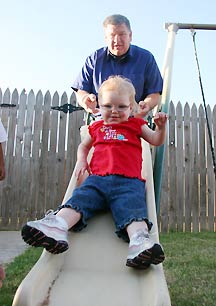
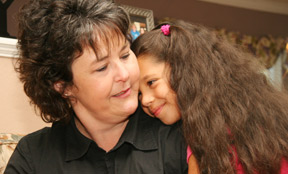
Robert and Sheila Lee play with Jazmine, 7, Nico, 6, and Kylie, 2, in their front lawn. The adoption was expected to be completed Nov. 16—the day before National Adoption Day.

Couple offers hard-to-place children
a family where everyone fits right in

By Analiz González

Buckner International

LUBBOCK—Robert and Sheila Lee waited until their four children reached their teens and 20s before starting over with a younger batch—Jazmine, 7, Nico, 6, and Kylie, 2.

The couple brought the three foster children home in March and April of 2005. The plan was to foster them through Buckner, then let them move on.

But the Lees were hooked. A year and a half after the new three landed in their home, the Lees began the adoption process.

“We had no idea we’d get as attached to them as we did,” Mrs. Lee said, looking at Jazmine who hung over her shoulder. “They fit so well with our kids. They’re part of us now.”

The Lees, now in their 40s, said they struggled back and forth before deciding to adopt because they didn’t want to cheat the children out of having younger parents. But Kylie has shaken-baby syndrome and Jazmine and Nico are Hispanic. They knew special-needs children and non-Anglos are harder to place in adoptive homes.

The Lees didn’t want their babies in foster care forever. So, they began the adoption process.

Mrs. Lee was amazed at how the new children fit in with each other and their existing family. Jazmine and Nico had an older sister with medical problems, so the seizures suffered by Kylie didn’t scare them.

The Lees’ biological children long had done volunteer work and participated in mission trips, so they were ready to serve.

And if it hadn’t been for the Lees’ medical background, they never would have been able to care for Kylie, who used to have up to 30 seizures a day. Lee is a lab and x-ray technician, and his wife is a licensed vocational nurse.

“Everyone just fit,” Lee said.

Still, the family had to make several adjustments to accommodate the new children.

There are Legos and dolls in the living room and a playground in the backyard. And Mrs. Lee has to drive Kylie to Dallas every couple of months so she can see a doctor. Kylie has had about 30 doctor’s appointments and four hospital admissions since she’s been under the Lees’ care.

The Lees expected the adoption process to be complete in mid-November. Weeks before, Jazmine was already making plans.

“When I get adopted, me and Amy (the Lee’s 17-year-old daughter) are going to the mall,” she said. “And when Kylie grows up, we’re all going to go to Hawaii.”

Kylie also attends physical therapy twice a week, and the Lees get help from a nurse who visits their home during the week.

Lee even quit his job for one year so that he could stay home and care for Kylie, whom doctors said would never walk or talk. Now, she does both, and he insists the sacrifice was worth the reward.

“She’s our miracle baby,” Mrs. Lee said. “We just didn’t accept the diagnosis that she wouldn’t get better. She’ll look at me now and say, ‘I love you Mama.’ For a child who’s not supposed to talk, it’s just amazing.”

And the Lees don’t mind having a full house.

“A lot of people don’t understand that it’s a calling God has put on our lives,” Mrs. Lee said. “Six kids at home and one away is the norm for us now.”

But she added that bringing in more children has had its challenges, like juggling Kylie’s medical condition with work and raising teens and young children at the same time.

Jazmine has grown a lot since she first came to live with them, Mrs. Lee said, remembering how scared she was when she first came in.

“One night she was sitting on my lap and we were talking about Jesus. Jazmine said, ‘Who is Jesus?’ and I said Jesus is the one in your heart. Then Jazmine said with teary eyes, ‘I don’t feel anything in my heart.’

“Since then, Jazmine has grown close to God,” Mrs. Lee said. “She spends time praying and looking forward to church. She says she wants to be a foster parent one day.”

Although Kylie, Nico and Jazmine found a loving home with the Lee family, many children still are displaced.

“There are kids sleeping in CPS offices because there aren’t enough homes for them,” said Anna Rodriguez, program manager for Buckner in Midland. “They are our responsibility.”

For information on becoming a foster parent, visit www.buckner.org.


News of religion, faith, missions, Bible study and Christian ministry among Baptist churches, in Texas, the BGCT, the nation and around the world.


It’s a bird, it’s a plane, it’s …a superhero in a burqa?

Posted: 11/16/07

It’s a bird, it’s a plane, it’s …
a superhero in a burqa?

By Beckie Supiano

Religion News Service

WASHINGTON—Move over, Fantastic Four. There’s a new team of superheroes in town.

Meet Jabbar the Powerful, a Hulk-like strong man, and Noora the Light, who can create holograms. Darr the Afflicter wields powerful pain waves. One hero, The Hidden, wears a burqa.

All are part of the 99, Muslim superheroes created by Kuwait-based Teshkeel Comics. Each has a power based on one of the 99 characteristics of God described by Islam.

Superheroes from the new comic book, The 99, include Jabbar the Powerful, a Hulk-like strongman; Noora the Light, who can create holograms; and Darr the Afflicter, who wields powerful pain waves.

The comic, already sold throughout the Middle East, made its U.S. debut recently, and the new issue, “Welcome to America,” finds Jabbar, Noora and Darr—like other immigrants—arriving at New York’s JFK airport.

While the comic has its roots in Muslim and Arab culture, creator Naif Al-Mutawa said the series is geared toward a wider audience. An American reader wouldn’t need to know anything about the Muslim world to understand the storyline, he said.

Edina Lekovic, a spokeswoman for the Muslim Public Affairs Council, thinks the comic could find a broad American audience. The key, she said, will be appealing to human values rather than faith principles.

“These 99 names of God are attributes people aspire to,” Lekovic said. “These are not shared solely by Muslims. They are human values and characteristics.”

The 99 features a diverse cast of characters, each from a different country. But the comic’s back-story is decidedly Arab. It’s based on the destruction of Baghdad’s ancient libraries in the Mongol invasion of 1258—a familiar story in the Middle East.

Al-Mutawa said it was important to create modern cultural heroes for young people in the Middle East. His superhero concept merges the American/Judeo-Christian model of go-it-alone action heroes with the Japanese model of heroes who work as a team.

That kind of cultural hero also can resonate with American Muslims—even those with no connection to the Middle East. Eboo Patel, who heads a Chicago-based interfaith youth group and is a frequent commentator on Muslim culture, said heroes serve a dual function—exemplifying values to humanity at large and speaking specifically to the group that shares their cultural background.

In Al-Mutawa’s fictionalized history, the Mongols invaded with the express purpose of razing the library and destroying Baghdad’s knowledge. This wisdom, however, was hidden in 99 jewels, which were scattered throughout the world. In the comic, modern-day character Ramzi Razem has learned of the gems’ ability to provide individuals with superhuman abilities and coordinates the heroes’ activities.

While the 99 heroes display attributes of God, each has only one, and they must work in teams of three.

Female characters are dressed more modestly than those in most comics, and they are shown in various forms of Muslim dress. Some, but not all, wear headscarves, and those who do display different countries’ interpretations.

And while the diversity of characters demonstrates Al-Mutawa’s conviction that “there is not one Islam,” he is nonetheless conscientious of Muslim social mores.

“The 99,” he said, “won’t be dating each other.”

By design, the comic never mentions Islam, Allah or the Quran. Nonetheless, it has been banned in Saudi Arabia. Apparently censors thought a promotional tagline that mentioned the 99 characteristics of God was blasphemous, Al-Mutawa said. This decision was arbitrary, he said, noting that while the comic books themselves are censored, a comic strip featuring the 99 runs in Saudi newspapers.

Even if not every American reader is dazzled by The 99, the real purpose of the U.S. launch is “visibility,” Al-Mutawa said in an interview.

“Our eye is on animation and the film market,” Al-Mutawa said.

Branching out in those markets likely would require American resources.

Troy Brownfield, a columnist for the comic book news site Newsarama, said in the publishing industry at large, and for comic books in particular, most revenue comes from advertising and licensing. Comics alone rarely pay the bills.

The 99 is Tesh-keel’s first original title, but the company also translates and distributes books from comic book giants DC and Marvel in the Middle East.

Teshkeel is self-publishing The 99 in the U.S. In order to have The 99 published and distributed by Marvel or DC, Teshkeel probably would have to sell the comic, said Sven Larsen, Teshkeel’s chief operating officer. Big companies usually stick with books to which they own the intellectual property rights, he noted, except in cases of high-profile tie-ins, such as comics based on a video game.


News of religion, faith, missions, Bible study and Christian ministry among Baptist churches, in Texas, the BGCT, the nation and around the world.


Ministers want Ohio to become ‘Political Sleaze-Free Zone’

Posted: 11/16/07

Ministers want Ohio to become
‘Political Sleaze-Free Zone’

By David Briggs

Religion News Service

CLEVELAND (RNS)—A coalition of Ohio religious leaders is asking for the battleground swing state to be a “Political Sleaze-Free Zone” for the 2008 election.

We Believe Ohio kicked off the campaign at rallies in Columbus and Cleveland, asking candidates and political parties to promote what they stand for and refrain from attack ads.

Organizers said they have more than 900 names on petitions urging politicians to bring dignity and civility to the political process. Gov. Ted Strickland supports the effort, according to the interfaith group.

The Columbus-based group asserted the 2004 and 2006 elections brought “gutter politics” to Ohio.

In their petition drive, the clergy ask participants in the upcoming election to reject “the politics of polarization,” and promote the common good by addressing issues such as poverty, jobs, education and health care.


News of religion, faith, missions, Bible study and Christian ministry among Baptist churches, in Texas, the BGCT, the nation and around the world.


On the Move

Posted: 11/16/07

On the Move

Terry Johnston to Trinity Memorial Church in Marlin as associate pastor.

Jonathan Leftwich to Fel-lowship of Plum Creek in Kyle as associate pastor from First Church in Rockport, where he was youth minister.

Alan Morris to Paluxy Church in Paluxy as pastor.

Hal Mundine to First Church in Sinton as interim music director.

David Powell to Mambrino Church in Granbury as minister to youth.

Don Rainey to First Church in Petersburg as pastor from Westside Chapel of Possum Kingdom Lake.

Justin Southall to First Church in Lipan as minister to youth.

Koby Strawser to First Church in Barlett as minister of youth.

Mark Taylor to Hillcrest Church in Bryan as minister of music.

Clell Wright has resigned as music minister at Lytle South Church in Abilene.

George Yarbrough to First Church in Refugio as pastor, where he had been interim.


News of religion, faith, missions, Bible study and Christian ministry among Baptist churches, in Texas, the BGCT, the nation and around the world.


New book probes poetry’s power to stir the soul

Posted: 11/16/07

New book probes poetry’s power to stir the soul

By Cecile S. Holmes

Religion News Service

CHICAGO (RNS)—Poetry is that unusual combination of words with the power to move, delight, nurture and transport readers beyond the here-and-now. It also can nourish our souls, according to the authors of a new book celebrating how poetry can kindle the spiritual in attentive readers.

“Poetry slows us down. It asks us to look—and look again. Poems have a way of reminding us we are part of something larger than ourselves,” said Judith Valente, co-author/editor of the new volume, Twenty Poems to Nourish Your Soul.

Valente, a Chicago-based on-air correspondent for the PBS show Religion & Ethics NewsWeekly and Chicago Public Radio, wrote the book with her husband, Charles Reynard, a judge of the 11th Judicial Circuit in central Illinois.

Their book represents both the chronicle of a deeply personal journey and an opening for others seeking a deeper connection to the divine. The 20 poems included are drawn mainly from modern American poets. Most are not overtly religious, nor are they the sort of poems usually found in anthologies of religious or spiritual poets.

Instead, the poems collected by Valente and Reynard lure readers into slow recognition of the divine presence, steeping them in identifying how mystery moves into life through poetry.

“Finding God by paying attention is the theme of this collection,” Valente writes in her introduction. “God isn’t mentioned by name very often in these poems, but God’s presence suffuses them.”

The poems are organized around 10 themes—attentiveness, gratitude, acceptance, simplicity, praise, work, loss, body and soul, mystery and prayer. To Valente and Reynard, each is a foundation stone for building a rich inner spiritual life.

Two poems are offered with each theme, along with a short commentary that is more invitation than exposition. Each explores why the poem is meaningful to Valente or to Reynard, and then suggests readers reflect on its meaning in their own lives.

In recent months, Reynard and Valente have been conducting workshops to help busy professionals learn how poems can become “soul friends” and pathways to solitude and deeper spirituality.

Poetry, Reynard says, is a “centering influence” in his life, a prayer from which he gains strength and balance.

“This work seems less and less different than my past and professional work,” he said. “Paying attention is important for me as a judge. Poetry is helping me to become a better judge because I am to recognize people by listening and watching more acutely.”


News of religion, faith, missions, Bible study and Christian ministry among Baptist churches, in Texas, the BGCT, the nation and around the world.


Neurotheology opens doors for scientific study of belief

Posted: 11/16/07

(Art by Andrew Garcia Philips/The Star-Ledger)

Neurotheology opens doors
for scientific study of belief

Hannah Elliott

Associated Baptist Press

NEW YORK (ABP)—Some scientists say neurotheology—an emerging discipline that addresses the correlation between neurological and spiritual activity—proves God created the brain. Others claim “the brain created the god.”

At the root of the debate, some say, is the threat that faith could be reduced to nothing more than chemical reactions in the brain.

The coupling of science and belief has become increasingly prominent in popular media. Time and Newsweek magazines both have run long stories exploring the newly recognized discipline. And current studies at Wheaton College, Columbia University and the University of Pennsylvania are using neuro-imaging to locate brain regions activated during emotional or spiritual events.

See Related Articles:
Have we gone too far in the race for parenthood?
• Neurotheology opens doors for scientific study of belief
Consesus lacking on end-of-life issues
Ethicists in quandary over surrogacy
Hospital chaplains minister in the workplace

The quest is to find a neurological basis for out-of-body or enlightenment experiences, including trances, time perception, oneness with the universe and altered states of consciousness. But neurotheology also can help explain the more mundane habits of a religious life—prayer, beliefs, meditation and senses of the presence of the supernatural.

Paul Simmons, a clinical professor of family and community medicine at the University of Louisville School of Medicine, said the brain is intimately related to relationships with and perceptions of God. So, neurotheology is a good way to help theologians use all of their capacities to study God.

Simmons, a former pastor and ethics professor at Southern Baptist Theological Seminary, insists the underlying question is whether that experience is “just a mental state, or have you gotten in touch with a transcendence?”

“Our brain is basic to all that we are, all that we understand, all that we perceive,” Simmons said. “We can’t avoid that in theology any longer. At least, we must be aware of the fact that many of our claims made about religion are actually based on science.”

Theories about correlations between the brain and beliefs are nothing new. Historians have speculated that figures like Joan of Arc, Saint Teresa of Avila, Fedor Dostoevsky and Marcel Proust had ailments like epilepsy, which in turn led to their obsessions with the spiritual world.

Beginning in the 1950s, scientists used electroencephalograms, or EEGs, to record electrical activity in the brain. By placing electrodes on the scalp, they could study brain waves concurring with elevated states of consciousness. In the 1980s, they stimulated different areas of the brain with a magnetic field, causing subjects to claim senses of ethereal presences in the room.

The first modern book published on the subject came in 1994. Called Neurotheology: Virtual Religion in the 21st Century, it was promoted in a theological journal called Zygon. And Newsweek recently citied a 1998 book—published by MIT Press, no less—called Zen and the Brain. Since then, scholarly journals have devoted issues to religion and the mind, including studies using data from meditating Buddhist monks and praying Franciscan nuns.

The reason for the renewed interest, according to neurotheology pioneer Brian Alston, is that the people writing about it have changed the terms of the field. This popular type of neurotheology focuses on beliefs, he said.

“In some ways, with neuroscience in pop culture, it sometimes seems more simple and basic than it really is,” said Alston, who is pursuing a doctorate in clinical psychology from Argosy University. “What bubbles up to the surface in culture may make it seem simple, but it’s not. It’s really complicated. … There’s still so much we don’t understand about the brain.”

Studies since the 1960s consistently have reported that between 30 percent and 40 percent of people have felt “very close to a powerful, spiritual force that seemed to lift you out of yourself,” Newsweek reported. According to the Gallup Poll, 53 percent of Americans say they have experienced a “sudden religious awakening or insight” at least once.

But has the fascination with the brain and belief come from an oversimplified version of neurotheology? Some have criticized Time’s article as equating science with Darwinism and religion with God—over-generalized definitions for such complex subjects.

“It’s oversimplified, but at the same time, there’s a large kernel of truth in there,” Simmons said. “The issue is whether a religious experience is a matter of brain circuits or God. Religiously inclined people will say, ‘Well, that’s God using our brain manifesting (itself) in brain activity.’“

Alston, who wrote What is Neurotheology?, said popular writing certainly has oversimplified the dialogue between science and theology. Theology does not just deal with the religious and the spiritual; it has much broader implications, he said.

Neurotheology should represent beliefs that are broader than just religious and spiritual, he added. It should represent cultural and political beliefs, as well.

“What neurotheology tries to do is say: ‘Look, here are ways that all this works together. Instead of seeing these things as enemies, let’s look at these as things that can relate,’“ he said.

Part of the issue, Alston added, is that, “in the Western world, we have created a dichotomy between what we consider to be physical and what we consider to be spiritual.”

That divide has been implicated in some of the criticisms of neurotheology. The key problem with neurotheology is its attempt to unify two strikingly different perspectives on human beings within one discipline, Alston wrote in a paper he presented to the American Psychological Association last year.

Massimo Pigliucci, a professor of ecology and evolution at the State University of New York at Stony Brook, has published essays questioning the discipline itself. In an essay titled “Neurotheology: A Rather Skeptical Perspective,” Pigliucci wrote he had two problems with neurotheology: “First, it is no theology at all. Theology is the study of the attributes of God. … The neurological study of what happens to the brain during mystical experiences cannot tell us anything about God because all we can do is to measure neural patterns.”

The other problem, Pigliucci wrote, is that it violates a basic rule of logic that what “can be done with fewer … is done in vain with more. That is, when faced with multiple hypotheses capable of explaining a given set of data, it is wise to start by considering the simplest ones, those that make the least unnecessary assumptions.”

That logic would leave God out of the equation.

Simmons called that criticism “on target.” Neurotheology doesn’t deal with theology as it traditionally is done—trying to get religion and experience together with reasonable consistency, he said. Progress in the field will come mostly in mental health, he said.

Alston, who studied ethics and philosophy at Yale Divinity School, says criticism of neurotheology depends on who is receiving the information. Much of it has to do with the difference between the physical brain and the metaphysical mind. Some experts believe ideas in the mind cause action, while others say chemicals in the brain cause action—and if chemicals are altered in the brain, behaviors will change, Alston said. Either way of thinking is OK, since neurotheologists aren’t interested in changing firmly held beliefs, he said.

“What I’m trying to do with neurotheology is to explain that each of these has a way with relating to the subject matter,” he said. “It once again depends on the standing point of a person in terms of if they’re a biologist and what their tools are and if they are a psychologist and what their tools are.”

And with the stakes so high in this new and complex discipline, there’s likely to be no shortage of opinions from either camp.


News of religion, faith, missions, Bible study and Christian ministry among Baptist churches, in Texas, the BGCT, the nation and around the world.