Researcher says hypocrisy not biggest obstacle to evangelism

NASHVILLE, Tenn. (ABP) — People who don't attend church are not too bothered by what they view as hypocrisy in the church, but there are some things they don't like about Christians, says the head of the Southern Baptist Convention's publishing arm.

Thom Rainer, president of LifeWay Christian Resources, has been researching the "formerly unchurched" — men and women who have been Christians for less than a year — for nearly a decade. He says the results are surprising.

Contrary to popular belief, Rainer says, non-Christians by and large are not turned off by the church, preaching or Sunday school and are quite responsive to direct one-on-one evangelism.

But there are some things non-churchgoers don't like about Christians, Rainer says in a recent blog:

— Christians who treat other Christians poorly. "The unchurched don't expect us Christians to be perfect, but they can't understand why we treat each other without dignity and respect."

— Holier-than-thou attitudes. "The unchurched know that Christians will make mistakes, and they often have a forgiving attitude when we mess up. But they are repulsed when Christians act in superior ways to them."

— Christians who talk more than they listen. "Many of the unchurched, at some point, have a perception that a Christian is a person who can offer a sympathetic and compassionate ear. Unfortunately, many of the unchurched thought Christians were too busy talking to listen to them."

— Christians who don't go to church. "The unchurched saw the disconnect between belief and practice in the lives of Christians who did not or who rarely attended church."

Rainer's original research was published in a 2008 book titled Surprising Insights from the Unchurched, but he has continued to follow those groups over the years.

Rainer says that contrary to the stereotype that hypocrisy is the main obstacle to evangelism, non-churchgoers are really not too bothered by some hypocrisy with Christians.

"They are well aware that any human will stumble at times," he says. "But these lost men and women want to know that Christians will treat each other well. They want to see humility in our lives. They want to know that we will take the time to listen, and even take more time to really be involved in their lives. And they want to know that we love our churches."


–Bob Allen is senior writer for Associated Baptist Press.


Good Samaritan series hopes to kick-start Christian action

GRAND RAPIDS, Mich. (RNS)—The camera follows Steve Jones as he walks along an alley in Grand Rapids, Mich., just as he did one early December morning singing “O Holy Night.”

He came upon a man sleeping in the snow that morning, Jones tells his interviewer. But he kept on walking, like the two travelers Jesus spoke of who passed a half-dead man on the road to Jericho.

“The story of the Good Samaritan was really beating me up inside,” Jones says on the video. The man haunted his mind until he returned to the alley, picked him up and carried him to shelter, as the Samaritan did in Jesus’ story.

Chad Gast, senior motion graphics designer for The C2 Group, watches a clip from a church curriculum DVD project his team is working on, Start Becoming a Good Samaritan. (RNS PHOTO/ Lori Niedenfuer Cool/The Grand Rapids Press)

“The Holy Spirit was beating in my chest so hard,” said Jones, the volunteer coordinator at a local homeless mission. “It’s like, this is exactly what we’re supposed to do.”

Watching the video in his office at The C2 Group, graphics designer Chad Gast said, “It’s an honor just to hear these stories.”

Gast and his co-workers are editing more than 100 interviews such as this for a DVD series they hope will kick-start viewers into social action. Start Becoming a Good Samaritan will be a six-part video curriculum, workbook and website designed to help everyday Christians find ways to combat poverty, pandemic diseases and other social ills through the stories of others.

Andrew Sheneman, senior producer/editor for The C2 Group, calls the DVD project “powerful and moving.”

“You realize you have talents and resources that can bless other people’s lives,” he said.

From South Africa Archbishop Desmond Tutu to Prison Fellowship founder Chuck Colson, the program brings together diverse voices calling on Christians to get involved.

Due out in August, the series is the brainchild of Mike Seaton, owner of the C2 video production and Web development company. After 20 years of producing materials for corporations and churches, Seaton got the itch a few years ago to break beyond the comfortable Christian life.

After a conversation with best-selling author Philip Yancey, Seaton conceived of a project involving many authors—activists and pastors who were living out the Good Samaritan story. Through their interviews, he would create a “quilt of what it means to be the hands and feet of Christ today.”

“The church has become like (a) football game,” Seaton said. “We sit on the sidelines. We can have our fish bumper stickers and all this stuff, but if we’ve lost the joy of participation, and Christ is the quarterback with nobody to throw the ball to. He’s just got a bunch of fans.”

By filming the stories of about 60 Christian leaders and dozens of lay volunteers, Seaton hopes to show churches, adult education classes and small groups how to take the field.

“We have to have average people showing us, ‘Yes, in spite of my hurried life and the economy, God still prompts me to go out and share my faith by helping other people in need,’“ Seaton said.

His vision resonated with Zondervan, the giant Christian publishing house. Zondervan will produce the DVD series, workbook and a subsequent study book in partnership with C2 and the evangelical aid organization World Vision. The program also will be marketed through ONE, the anti-poverty organization co-founded by the rock artist Bono.

Planned topics and speakers include:

Who is my neighbor?: Eugene Peterson, Philip Yancey and Tony Campolo

Caring for the sick: Kay Warren, Francis Collins and Horace Smith

Justice and reconciliation: Archbishop Desmond Tutu, Zach Hunter and Gary Haugen

Serving the poor: Jim Wallis, Shane Claiborne and John Perkins

Tending creation: Matthew Sleeth, Gerald Durley and Shirley Mullen

Loving the forsaken: Jim Cymbala, Joni Eareckson Tada and Chuck Colson.

The series is the first time Zondervan has collected so many of its authors for a single purpose, said John Raymond, vice president and publisher for church engagement.

“Instead of people being frustrated that they don’t think they can do anything, we hope this curriculum will spawn enough interest that people will see, ‘I can make a difference,’“ Raymond said.

To find Christians who already are role models, C2 producers flew or drove more than 85,000 miles across the U.S., to London and South Africa. They interviewed people about a wide span of issues: Tada, a quadriplegic artist and author, about disabilities; Wallis, CEO of Sojourners, about serving the poor; Tutu about reconciliation.

In Wilmore, Ky., they talked to Matthew Sleeth, an environmental activist who wrote Serve God, Save the Planet. Sleeth spoke of scriptural commands to care for the Earth, and of how he serves God by taking shorter showers and drying clothes on a line.

“A lot of people know what Christians are against,” Sleeth said. “What we have that is winsome is what we are for. I believe that is going to be the real power of this curriculum.”

-Charles Honey writes for The Grand Rapids Press in Grand Rapids, Mich.


Research shows sharp difference between scientists, public on religion

WASHINGTON (RNS)—Only a third of scientists say they believe in God, according to a new survey, and while 18 percent believe in a high power, four in 10 scientists believe in neither.

The report was released by the Pew Research Center for the People and the Press in collaboration with the American Association for the Advancement of Science.

Scientists were evenly split—at 48 percent each—between those who claimed a religious affiliation and those who did not.

The new statistics vary sharply with findings for the general public—83 percent of Americans say they believe in God and 82 percent said they are affiliated with a religious tradition.

The Pew report indicated sharp divergence between scientists and the general public on issues such as evolution and climate change. While 87 percent of scientists believe humans have evolved over time, just 32 percent of Americans in general hold that belief.

A similarly large percentage of scientists—84 percent—said the earth is warming because of human activity, while only 49 percent of the public agreed with that statement.

Also, while 93 percent of scientists favor federal funding for embryonic stem cell research, just 58 percent of the general public agreed with such research.

But despite differences between scientists and the general public, a majority of people acknowledge that science contributes to the well-being of society.

Two-thirds of people surveyed who said science conflicts with their religious beliefs nevertheless said scientists contribute “a lot” to society’s well-being. A slightly higher percentage (72 percent) of people who said there were not conflicts between their beliefs and science had similar praise for scientific contributions to society.

The report was based on a random sample of the scientific association’s 2,533 members and a random survey of 2,001 U.S. adults. Each of those surveys had an overall margin of error of plus or minus 2.5 percentage points.


Road to recovery from addiction

Terry Walker fell to his knees in the shower stall of a South Texas substance-abuse treatment center, crying out to God for release from the chains of addiction.

“God blessed me with the gift of desperation,” Walker said. “At that point, if God had told me I needed to stand on my head for 30 minutes a day on the roof of my house in order to get clean and sober, I would have done it.”


Walker, who had grown up in First Baptist Church of Sulphur Springs, discovered at age 15 alcohol made him “feel different and better”—at least for a short time. In the Navy, he became a binge drinker. Upon his return to civilian life, he developed an addiction to prescription drugs—so severe he landed in prison for prescription fraud.

“The state of Texas did not take kindly to me calling in my own prescriptions,” he recalled. “I was dyslexic when it came to reading the instructions on pill bottles. Instead of one pill every three to four hours for pain, I took three to four pills every hour to numb my emotional pain.”

By the time he entered a treatment center, Walker said, he would have welcomed the release death offered. Having exhausted every other option, he recalled the faith from which he had strayed as a teenager and placed his life in God’s hands.

“It wasn’t an audible voice, but I heard God say to me, ‘You’ve suffered long enough.’ God told me he would carry the burden for me,” he recalled.

Walker’s best friend, Pastor Van Christian of First Baptist Church in Comanche, described Walker’s deliverance as “the closest thing to Damascus Road experience I’ve ever known a person to have,” comparing it to the Apostle Paul’s dramatic conversion.

But while Walker has re-mained clean and sober nine years after he said God took away the physical desire to “feed the beast,” he acknowledges his life demands daily discipline.

“I can’t live on the edge. I have to be around Christian friends. I stay involved working with the youth at church. It helps me maintain my focus,” said Walker, who works as a hay broker in Comanche.

He expressed gratitude to First Baptist Church in Comanche for the acceptance and support the congregation has offered him, “holding my hand in the early stages of my recovery.” But Walker noted Christians could do more to reach out to people struggling with addiction—not wait until they take the initiative and seek out the church, as he did.

Walker’s experience should serve as a cautionary tale for churches, said Carrie Beaird, substance abuse consultant with the Baptist General Convention of Texas Christian Life Commission .


“Too many of our folks think addicts and alcoholics all live under bridges. The reality is that on any given Sunday, there probably are teenagers in the congregation who have said ‘yes’ to drugs or alcohol for the first time,” she said.

Christians are “probably just as susceptible to addiction as the general population, but they find it harder to talk about it,” she noted.

First Baptist Church in Austin —a longstanding host to ongoing Alcoholics Anonymous and Al-Anon 12-step recovery groups—launched a Faith Partners team ministry more than a year ago.

“Faith Partners is geared toward members of our own congregation who have themselves struggled with addiction and members whose families have been affected by addictions,” said Ben DeLeon, Faith Partners team leader and facilitator. At the same time, he added, people outside the church also have become involved through the invitation of members.

“We need to address addictions and the families affected by them within the context of our congregations,” DeLeon said. “It’s an issue that’s been swept under the rug for too long.”

Faith Partners , developed by the Rush Center of the Johnson Institute in Austin, involves trained laity in a team approach to addiction prevention, education and recovery.

Faith Partners has sponsored guest speakers, such as a recovery expert who discussed biblical and spiritual foundations of the 12 steps and a child psychologist who talked to parents and teenagers about prevention issues.

In addition to alcohol and drug dependency, Faith Partners also deals with such issues as gambling, food and sex addictions, DeLeon noted.


“We want to create a place of affirmation where people whose lives are affected by addictions can be embraced and accepted,” he said.

Church-based recovery programs can be tremendously successful—if churches take the time to find a program that fits the specific congregation, Beaird insisted.

“Churches that have identified programs that meet the needs of their community and congregation and that have the resources to put into it are very effective,” she said.

Beaird singled out Celebrate Recovery —a Scripture-based program developed by Saddleback Church in Southern California—as a particularly valuable approach, provided a congregation has the resources to dedicate to it.

Darrel Bye works on staff at Willow Bend Church in Plano as Celebrate Recovery ministry director. He became involved in the program in 2002 after “a friend told me it was time for me to deal with the junk in my life.”

“The goal of Celebrate Recovery is not just sobriety but a changed life. Sobriety is a byproduct,” Bye explained.

While Celebrate Recovery follows to a degree the 12-step approach pioneered by Alcoholics Anonymous, it grounds the program in the Beatitudes, as taught by Jesus in the Sermon on the Mount, he noted.

“If you don’t see Jesus Christ as your Savior, the program will not work for you. Our Higher Power is Jesus Christ,” Bye said. “The goal is to remove anything that stands in the way of a relationship with God. That’s what addictions do.”

The pastor, ministerial staff and elders at Willow Bend Church all have gone through the Celebrate Recovery program to learn its principles, he added.

“It’s a significant part of the DNA of our church,” Bye said. “We have an awareness that we live in a broken world, and we all need help.”

Helpful websites:

www.drugabuse.gov/

www.2young2drink.com/

www.samhsa.gov/

www.madd.org/

www.casacolumbia.org/

www.ncadd.org/

www.mediacampaign.org/

www.theantidrug.com/

BGCT Christian Life Commission Substance Abuse Updates

https://www.drugrehab.com/

Celebrate Recovery has affected the way members of Willow Bend Church see each other and the way they welcome newcomers, Pastor Dave Jobe said.

“There’s an immediate acceptance of people where they are in the journey,” he said. “Celebrate Recovery has given us a clear path for discipleship and life transformation. It’s created an awareness that people don’t have to stay where they are, but they can grow and experience life change.”

Willow Bend has helped other churches start Celebrate Recovery ministries—even sending out three people from its membership to help launch the program in other congregations, Bye noted.

For churches seriously considering a ministry like Celebrate Recovery, it demands a willingness to be open to “people who are not church people,” he added.

“It means seeing the church as a hospital. And sick people go to a hospital,” Bye said. “Our job is to do spiritual triage and bring people to a healthy state.”

While Celebrate Recov-ery demands a high level of commitment in terms of personnel, churches can offer effective ministries on a much smaller scale, Beaird noted, pointing to First Baptist Church in Bonham .

“We found something that works for us,” said Lanny Burnett, who leads an ongoing Bible study and recovery ministry for patients in the substance-abuse recovery unit of the local Veteran’s Administration hospital.

Burnett drives a church bus to the hospital once a week. Patients who want to participate in the program board the bus for First Baptist Church, where they join in a simple meal—fried chicken one week, pizza the next—and a study using the Life Recovery Bible .

“We follow the structure of AA,” Burnett said. But instead of a freewheeling discussion, the facilitator seeks to steer the conversation toward how the Scripture reading for that day can be applied to the lives of participants.

“It’s really a Life Recovery group, so we pull in people from the community who are dealing with other issues like grief or divorce,” Burnett said. About 80 percent of the participants are from the VA hospital, and the rest are from the general public, he noted.

Until a change in the correctional system closed the female unit, First Baptist Church also sponsored a Life Recovery Bible study for women at the Fannin County Jail, Burnett added.

“The good thing about our approach is that one person can do it with just a little help,” he said.

Burnett, who is in recovery himself, hopes the simple and easy-to-replicate approach his church follows can serve as an example to others. Already, members of a Presbyterian congregation in Deport—60 miles to the east—visited the Life Recovery Bible study group in Bonham to learn how to start a similar program of their own.

“I really believe the substance abusers of today are like the first century lepers,” he said. “Somebody needs to minister to them—to let them know somebody loves them.”


Shuttered stores find new life as churches

HUNTLEY, Ill. (RNS)—At Prime Outlets in Huntley, Ill., a former fine china store will become the home of Christian Life Church.

“This provided an opportunity, from moving from being kind of a homeless church, if you will, to find a home,” said Pastor Daryl Merrill, whose church had been renting space weekly at a hotel as it started an off-shoot of the main congregation based in Mount Prospect, Ill.

The tough economy may have shuttered some retail stores, but vacated spaces aren’t necessarily remaining empty: some are becoming new locations for worship. Churches have considered former big-box sites, closed auto dealerships and mall locations—all with room for their members to worship and park their cars.

At Prime Outlets in Huntley, Ill., a former fine china store will soon become the home of Christian Life Church. (PHOTO/RNS/Courtesy Daryl Merrill)

Experts say it’s a potential win-win situation for churches that want to have a location they can use every day—rather than once-a-week arrangements at schools or hotels—and property owners having trouble finding new tenants, not to mention shoppers.

“This has been an opportunity for churches to seize upon, with the drop in commercial real estate prices and eagerness for commercial real estate owners to get anybody, somebody, to occupy their facilities,” said Jim Tomberlin, senior strategist with Third Quarter Consulting.

His Scottsdale, Ariz., firm recommends churches seeking additional sites for sanctuaries to consider what commercial real estate is available for purchase or rental. Existing buildings prevent a church from having to pay for land and build on it, he noted.

“This is why healthy, growing, aggressive church leaders are seeing this as a huge option on the table that didn’t exist a few years ago,” said Tomberlin, a former megachurch pastor who helped Willow Creek Church in Barrington, Ill., develop multiple worship sites. “You could have a nice, commercial facility ready to go for a church for under $2 million.”

Some churches are opting for renting rather than purchasing retail space. At two Prime Outlets—one in Illinois and one in Florida—congregations have gone that route.

Rick Feder, general manager of the outlet mall in Huntley, said the Christian Life Church will use about 4,000 square feet of former commercial space. He expects the church will help build the number of shoppers that visit the mall during its two-year lease period.

“These are trying economic times for retail uses, so I think it’s all what’s beneficial to the property,” said Feder, whose mall currently has 42 stores and several spaces available. “It’s one of those things where we tried to do something outside the box.”

At Prime Outlets in Florida City, Fla., general manager Al Dos Santos has a similar philosophy. The mall south of Miami signed a new two-year lease with Torre Fuerte Homestead Church in April when the church moved from one location in the mall to another that can better accommodate its growth.

“For the church, it provides them with adequate space within the shopping center setting, which gives them convenience,” he said. “For us, it’s just occupying space that otherwise would be sitting empty.”

Pastor Jose Santiago of Torre Fuerte said the church occupies a total of 6,000 square feet, including a former home decor store, for a sanctuary that will seat up to 300, and an additional once-vacant space for children’s ministries.

Larry Ortega, a commercial real estate veteran in Phoenix, said he recently accepted a $1.3 million deal for a church to purchase a 16,000-square-foot former drugstore in Mesa, Ariz., a site that sold for twice the price as little as three years ago. He’s also working with a church on the purchase of a former auto dealership in nearby Scottsdale.

“Now, all of a sudden, there is an opportunity for churches, if they have a strong membership or they’ve been looking at building a new facility,” he said. “They are buying a facility for the price that they used to buy just the land.”

Larry Maison, ministry operations director at Highlands Com-munity Church in the Seattle suburb of Renton, Wash., said his congregation has been negotiating with the owner of a former grocery store because the church has run out of parking, and its classrooms are full.

“We need something like 14,000 square feet,” he said. “Where are you going to find 14,000 square feet? Where we’re at, that kind of space is not available except for in an empty box. That may be in a former retail store.”

As Maison put it, “Sometimes someone else’s misfortune is somebody else’s golden opportunity.”

The use of former big-box stores is not new with the current economy. Julia Christensen, author of the 2008 book Big Box Reuse, has chronicled the increasing appeal of these spaces for everything from the Spam Museum (at a former K-Mart in Austin, Minn.), to an indoor go-cart track, to a Florida church that swapped a former Winn-Dixie grocery store to a former Wal-Mart.

“I think we’ll see the fallout from this in the coming months and years, but it’s not like Linens ’N Things goes out of business and a church buys it and moves in the next day,” said Christensen, a visiting assistant professor of the emerging arts at Oberlin College in Ohio. “It takes a while.”


Road to Recovery: The 12 Steps

Step 1

We admitted we were powerless over our addiction—that our lives had become unmanageable

Step 2

Came to believe that a Power greater than ourselves could restore us to sanity

Step 3

Made a decision to turn our will and our lives over to the care of God as we understood God

Step 4

Made a searching and fearless moral inventory of ourselves

Step 5

Admitted to God, to ourselves and to another human being the exact nature of our wrongs

Step 6

Were entirely ready to have God remove all these defects of character

Step 7

Humbly asked God to remove our shortcomings

Step 8

Made a list of all persons we had harmed and became willing to make amends to them all

Step 9

Made direct amends to such people wherever possible, except when to do so would injure them or others

Step 10

Continued to take personal inventory and when we were wrong promptly admitted it

Step 11

Sought through prayer and meditation to improve our conscious contact with God as we understood God, praying only for knowledge of God’s will for us and the power to carry that out

Step 12

Having had a spiritual awakening as the result of these steps, we tried to carry this message to other addicts, and to practice these principles in all our affairs


This version of the 12 steps is an adaptation from the original 12 Steps of Alcoholics Anonymous and is intended for general use with any addictive or dysfunctional behavior.

 From http://www.12step.org .


No longer Episcopalians, North American Anglicans launch own conservative church

PLANO (RNS)—Conservative Anglicans disenchanted with the liberal drift in their North American churches say they are confident a newly launched church body one day will gain a seat in the worldwide Anglican Communion.

The Anglican Church in North America has been organized, its leaders say, as an alternative for Anglicans who disagree with the theology of the Episcopal Church in the United States and the Anglican Church of Canada.

Delegates representing about 69,000 active Anglicans from 650 North American parishes met June 22-25 at St. Vincent’s Cathedral in Bedford to ratify their church constitution and nine canons, or laws.

They installed former Pittsburgh Episcopal Bishop Robert Duncan as archbishop in a ceremony at Christ Church, a Plano megachurch that cut its ties with the Episcopal Church three years ago.

The Episcopal Church removed Duncan last year for leading his diocese to secede from the denomination.

Nine of the 37 provinces in the Anglican Communion sent official representatives to the inaugural Provincial Assembly, most of them from Africa and Asia.

To become recognized as an official province within the Anglican Communion, the new body will need the approval of two-thirds of the world’s 38 Anglican primates and a key international Anglican council.

The North Texas gathering also drew solid ecumenical support from groups such as Southern Baptists and the National Association of Evangelicals.

Speakers included California megachurch pastor Rick Warren.


Even after 500 years, Calvin isn’t slowing down

WASHINGTON (RNS)—About 4,000 young Christians packed into a convention center in Palm Springs, Calif., to hear preachers tell them that they are totally depraved, incapable of doing the right thing without a mighty hand from God, and—most importantly—have no control over their eternal fate.

The mind behind that message is John Calvin, the 16th-century Refor-mer often better known for condemning sinners and heretics than for igniting evangelical zeal. But as Presbyterian and other Reformed churches have prepared for the 500th birthday of their spiritual godfather this summer, young American evangelicals increasingly have taken up his theological torch.

Young evangelicals are scooping up books by neo-Calvinist authors, packing churches and conventions led by Calvinist preachers and studying at staunchly Calvinist seminaries. They’re blogging their way through Calvin’s behemoth Institutes of the Christian Religion, setting up Facebook fan clubs and opening Twitter feeds.

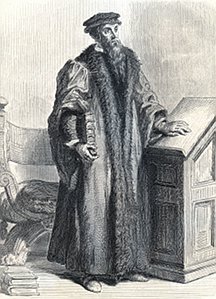
Protestant Reformer John Calvin, whose 500th birthday is being celebrated around the world this summer, is an inspiration and guide to many young evangelicals. (RNS GRAPHIC)

Earlier this year, Time magazine served notice that “The New Calvinism” is one of “10 ideas that are changing the world right now.”

In other words, Calvinism has moved out of the Puritan meetinghouse and into the megachurch.

Though he often is portrayed as a dour, prickly Puritan, Calvin was a sensitive pastor with a thankless task, said Karin Maag, a professor of history at Calvin College in Grand Rapids, Mich.

“He had the complicated and painstaking job of creating a new church,” Maag said. So, while Martin Luther fired up the masses, Calvin, essentially, gave them new rules.

As a Protestant leader in a Catholic territory, Calvin lived under the constant threat of siege, Maag said.

American neo-Calvinists say they similarly are besieged by the forces of secularism. And while the ministers and churches of their youth kept them entertained, they didn’t offer the kind of intellectual firepower many find in Calvinism.

“Most of them grew up in some kind of church, but they were not taught much doctrinal formation; they played youth-group games,” said Collin Hansen, author of the 2008 book Young, Restless, Reformed: A Journalist’s Journey with the New Calvinists. “When they went to college, the games didn’t seem worth it.”

Calvinism, Hansen and others say, provides a time-tested doctrinal anchor to keep young evangelicals from being swept away by the mainstream.

But Calvin also can be a profoundly divisive figure. The Calvinist belief that Jesus died only for an elect few has split Christians for centuries, said Peter J. Thuesen, a professor and author of a forthcoming book called Predestination: The American Career of a Contentious Doctrine.

“That idea has upset so many different religious groups, the backlash against it gave rise to some of the denominational diversity in the United States,” as churches split from each other over predestination debates, Thuesen said.

In fact, Baptists still are fighting over Calvin. About 30 percent of young Southern Baptists consider themselves Calvinists, according to a survey by the denomination’s research arm. Pastor Tom Ascol, executive director of the pro-Calvin Founders Ministries, considers that evidence the rising generation is “awakening to a fresh vision of God’s sovereign majesty over every square inch of earth.”

But former Southern Baptist Convention President Jerry Vines said Calvinism inhibits evangelism and missionary work, which is the lifeblood of the SBC, the nation’s largest Protestant denomination. If Jesus died only for the elect, then what’s the point of trying to reach others, said Vines, who co-organized a conference last year dedicated to refuting Calvinism.

“I do believe it is possible to be a five-point Calvinist and be evangelistic and missionary-minded,” Vines said. “But their evangelism and missionary work is in spite of their Calvinism, and not because of it.”


Episcopal presiding bishop terms individualistic salvation ‘heresy’

ANAHEIM, Calif. (ABP) — The presiding bishop of the Episcopal Church called the evangelical notion that individuals can be right with God a "great Western heresy" that is behind many problems facing the church and the wider society.

Describing a United States church in crisis, Presiding Bishop Katharine Jefferts Schori told delegates to the group's triennial meeting July 8 in Anaheim, Calif., that the overarching connection to problems facing Episcopalians has to do with "the great Western heresy — that we can be saved as individuals, that any of us alone can be in right relationship with God."

"It's caricatured in some quarters by insisting that salvation depends on reciting a specific verbal formula about Jesus," Jefferts Schori, the first woman to be elected as a primate in the worldwide Anglican Communion three years ago, said. "That individualist focus is a form of idolatry, for it puts me and my words in the place that only God can occupy, at the center of existence, as the ground of being." 

Presiding Bishop Katharine Jefferts Schori blames individualistic views of salvation for ills plaguing the church in the United States.

Jefferts Schori said countering individualistic faith was one reason the theme chosen for the meeting was "Ubuntu," an African word that describes humaneness, caring, sharing and being in harmony with all of creation.

"Ubuntu doesn't have any 'I's in it," she said. "The 'I' only emerges as we connect — and that is really what the word means: I am because we are, and I can only become a whole person in relationship with others. There is no 'I' without 'you,' and in our context, you and I are known only as we reflect the image of the One who created us."

Jefferts Schori said "heretical and individualistic understanding" contributes to problems like neglect for the environment and the current worldwide economic recession.

"The sins of a few have wreaked havoc with the lives of many, as greed and dishonesty have destroyed livelihoods, educational possibilities, care for the aged, and multiple forms of creativity," she said. "And that's just the aftermath of Ponzi schemes for which a handful will go to jail."

She said in order to be faithful, "we need to be continually rediscovering that my needs are not the only significant ones."

"Ubuntu implies that selfishness and self-centeredness cannot long survive," she said. "We are our siblings' knowers and their keepers, and we cannot be known without them."

"We have no meaning, no true existence in isolation," she said. "We shall indeed die as we forget or ignore that reality."

About 200 Episcopal bishops and 850 clergy and lay deputies were expected to convene for the 10-day meeting. Business items are set to include debates over human sexuality, politics and poverty.

One resolution being considered calls for "generous discretion" to be extended to clergy in exercising pastoral ministry in six states — Connecticut, Iowa, Maine, Massachusetts, New Hampshire and Vermont — where the civil marriage of same-gender couples has been legalized as well as other states that may follow suit in the next three years.

The 2.1-million-member denomination has argued vociferously about homosexuality since 2003, when the group approved the election of its first openly gay bishop, Gene Robinson of New Hampshire. Many more conservative Episcopalians and a handful of congregations have begun breaking away from the church in the years since.

Southern Baptist mega-church pastor Rick Warren, author of The Purpose Driven Life, took sides in his sister denomination's debate recently by showing up in Texas to encourage about 800 Episcopalians attending the first annual meeting of a conservative breakaway group calling itself the Anglican Church in North America.

Warren, who spoke out last fall against legal gay marriage in California, said in January that any nearby Anglican congregation that loses its property after breaking with the U.S. Episcopal Church was welcome to meet on the campus of his Saddleback Church.


–Bob Allen is senior writer for Associated Baptist Press.


Faith Digest

German Muslims more numerous than suspected. Germany has nearly a million more Muslims than previous estimates, a new study showed. The Federal Office for Migration and Refugees in Germany concluded up to 4.3 million people—5 percent of Germany’s 82 million people—are Muslims. More than half have German nationality and have integrated into German society more than had been expected, according to the study.

Israeli company launches kosher search engine. A new Internet search engine is making it possible for ultra-Orthodox Jews who use computers to obtain information online—but not on the Sabbath, when the site shuts down. Dubbed Koogle—a cross between Google and kugel, the name of a Jewish noodle pudding—the Hebrew-language search engine is being touted as a kosher portal for devout Jews who almost universally shun the Internet because many online sites are inappropriate. It includes news, business directories and links to real estate agents, kosher restaurants, hotels as well as mohels, or ritual circumcisers, and rehab centers.

Liberty changes rules for student political clubs. Liberty University has decided to detach itself from all campus political clubs that it believes misrepresent the school’s Christian mission, stripping them of funding, but compromising on regulations. Classifying them as “unofficial clubs,” the Fundamentalist Baptist school founded by the late Jerry Falwell adopted new policies to regulate school groups that “are not aligned with Liberty’s core values—mainly pro-life and pro-traditional marriage.” These clubs still can use the school’s name, but only if they publicize that the school does not endorse them. They also can assemble on school grounds and use campus resources if their purposes are not in conflict with the religious doctrines of the university. The new regulations, which will take effect in the 2009-2010 academic year, were developed after the university withdrew recognition of the College Democrats because of the candidates and issues the group supported. The school reinstated recognition, but only if the club complies with the revamped rules.

Evangelicals name new chief lobbyist. The nation’s largest evangelical umbrella group has tapped a veteran expert on refugee settlement and international relief efforts as its new top lobbyist in the nation’s capital. Galen Carey was named director of government affairs for the National Association of Evangelicals, effect Aug. 1. Carey, 53, has worked more than 25 years with World Relief, the NAE’s humanitarian relief agency. During his time with World Relief, he lived in six countries, addressing floods in Mozambique, working to prevent HIV/AIDS in Burundi and overseeing relief efforts after the 2004 tsunami hit Indonesia. Carey succeeds Richard Cizik, who resigned last December under pressure after angering some evangelicals with his outspoken work on the environment and by seeming to signal support for same-sex civil unions in a National Public Radio interview.


Movie sends message about Islam, but which message?

WASHINGTON (RNS)—While chaotic post-election demonstrations threaten to tarnish the image of Iran and its hard-line Islamic government, Hollywood filmmakers are releasing a drama they hope will send an opposite message about Islam itself.

Centered on the stoning of a woman unjustly accused of adultery, the graphic and stomach-turning violence in The Stoning of Soraya M. has the potential of sparking anti-Islamic sentiment—or at least giving Islam a bad name.

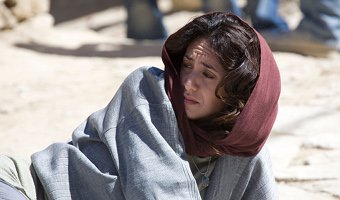
Soraya M., played by Mozhan Marno (second from left), is accompanied by her aunt, Zahra, played by Shohreh Aghdashloo (second from right), as villagers prepare to stone her for alleged adultery. (RNS PHOTO/Courtesy Grace Hill Media)

But producers of the film hope their drama, which hit theaters June 26, will not focus so much on the villains—in this case, corrupt Islamic authorities—as on the hidden martyrs: women beneath the veil.

Set in 1986 Iran, the film is based on the true story of a divorce-seeking husband who framed his wife (Soraya) for adultery, a misdeed punishable by death according to Islamic law. The governing clerics of the remote village wash their hands of the flagrant misuse of Islamic law, and the graphic stoning scenes have the potential to convince viewers Islam is a faith of extremists and murderers. But the director, Cyrus Nowrasteh, insists the film actually attacks a perversion of Islam, not the faith itself.

“I don’t see it as an anti-Islamic film or an anti-religious film,” he said in a phone interview. “It’s Islam versus Islam. There are those who will misuse religion for their own benefit and others who will see religion as their salvation.”

Nowrasteh said his film focuses on women as second-class citizens in Iran who are subjected to gross misinterpretations of Sharia law. In fact, producer Stephen McEveety said the film’s lead female characters “represent the best of a Muslim person.”

Mozhan Marno plays a woman stoned to death for alleged adultery in the new film, The Stoning of Soraya M. (RNS PHOTO/Courtesy Grace Hill Media)

Since the film is banned in Iran, McEveety said it is one of the few times he will condone underground piracy so that the “pro-Muslim” movie can be seen in restrictive corners of the Muslim world.

Michael Cromartie, a member of a federal watchdog panel that has singled out Iran for its religious freedom abuses, said the film is “anti-brutality” and “anti-mistreatment of women,” not anti-Islam.

The film has a greater purpose, he said—“a redemptive effect in contemporary Iran.”

“I’m all for stigmatizing corrupt evil actions by government authorities,” said Cromartie, a member of the U.S. Commission on International Religious Freedom. “I have no problem with anything that stigmatizes these types of heinous acts.”

The film, he said, does just that.

“One hope is that … it will call attention to something that didn’t just happen in the Middle Ages, but is happening now in the 21st century,” he said.

Director Nowrasteh said the film’s timing with the political unrest in Iran is largely coincidental, but it’s a perfect opportunity to raise awareness about age-old injustices that are taking on new life.

“This movie is about reform,” Nowrasteh said. “And the people who are demonstrating in Iran currently are seeking reform.


Separation of church and state from the underside

For many Baptists in the United States, the separation of church and state is no more than a historical concept or fodder for the culture wars. For Baptist minority groups in other countries, however, it can be a matter of survival.

While American evangelicals quibble over controversies like holiday greetings in department stores, other Christians around the world face intimidation, arrest and violence as members of unpopular minority faith communities.

Veiled Muslim woman (PHOTO/Steve Evan/Wikimedia Commons)

Christopher Marsh, director of the J.M. Dawson Institute of Church-State Studies at Baylor University, calls it “the allure of establishment.”

“Religious groups that have fought for freedom forget the ideal they fought and died for,” Marsh said. “Separation is about freedom, and freedom means nothing if it doesn’t protect ‘the least of these.’”

Zaur Balayev, a Baptist pastor in Azerbaijan, served 10 months of a two-year prison sentence imposed after his conviction on what his supporters insist were false charges. Since Baptists in Balayev’s small town of Aliabad established the first congregation in 1993, they have had periodic brushes with the law for meeting without a license.

That is despite the fact that Baptists in Aliabad have been trying to register for the last 15 years but have been unsuccessful because of stonewalling by local bureaucrats who view them as outsiders and an undesirable influence in the community.

A Baptist World Alliance delegation visiting Azerbaijan in January concluded religious freedom was only partially accorded. Muslims and Orthodox Christians meet virtually without restriction, the group said, but the same is not true for Baptists.

An Iranian protester holds a placard during a protest in Tehran. (REUTERS/Fars News)

The head of Azerbaijan’s Baptist union said recently Baptists have been described in media as “enemies of the state.”

“The strategy of the authorities is to pressure the Christians step by step until there will be no more Christian activity here,” Balayev said in a recent report to the European Baptist Federation.

The federation, a regional branch of the Baptist World Alliance, is working on several fronts to advance human rights and religious freedom in the Middle East and former Soviet Union. The Cooperative Baptist Fellowship is earmarking a third of an offering to be collected at its upcoming general assembly in Houston to support those efforts.

“Many CBF field personnel have to work in countries that do not guarantee basic human rights or care for religious freedom,” said Jim Smith, director of field ministries for the CBF. As of May, all pastors held in Azerbaijan were out of jail, Smith said, “but you never know if that will continue to be the case.”

In places like Azerbaijan, Baptist groups struggle against non-Christian religions or secular governments. In others, conflicts are of a more intramural variety.

In parts of the former Soviet Union, for example, Orthodox majorities view themselves as entitled to the favored status they enjoyed prior to the communist era and rapidly growing evangelical groups as an affront to national pride.

Last year, Baptists in the city of Lipetsk, Russia, a focal point of tension between Baptist Christians and the Russian Orthodox Church, complained local authorities were using bureaucratic methods to restrict their activity.

A Palestinian worshipper prays as Israeli police stand guard outside Damascus Gate in Jerusalem’s Old City. (PHOTO/Steve Evan/Wikimedia Commons)

Vitaly Vlasenko, director of external church relations for the Russian Union of Evangelical Christians-Baptists, said government officials in Lipetsk obviously are partial to the Orthodox, but he doubts they are singling out Baptists for discrimination. Vlasenko did say, however, processes of registration, documentation and taxation for churches have become more complex, and disputes once settled through negotiation with local officials now often wind up in court.

In February, the International Baptist Theological Seminary in Prague, Czech Republic, convened a gathering of European Baptist and Orthodox scholars to promote understanding between two Christian groups often at odds over issues like proselytizing and the separation of church and state.

Planners said a lot of problems stem from misunderstandings related to the Orthodox notion of canonical territories and canon law and of evangelical emphases on religious freedom and evangelism.

In other parts of the world, church-state conflicts are more volatile. In the Gaza Strip, evangelicals face pressure from both Muslims and Israel’s military.

“We live between two fires,” Hanna Massad, pastor of Gaza Baptist Church, said in a message at last year’s New Baptist Covenant Celebration in Atlanta.

One, Massad said, is “the fire of the Israel occupation,” which he described as a “siege.” Massad referred to Israel’s two-year-old blockade of Gaza, which severely restricts travel and postpones rebuilding of homes destroyed or damaged by missiles during hostilities that ceased months ago.

In December, Massad’s church, the only Protestant church in Gaza, was damaged in fighting between Israeli troops and Hamas militants. Previously, Palestinian police twice seized the six-story building as a sniper post.

“Also we experience the fire of the militant Muslim, who is not happy about what we do and who we are,” Massad said.

Two years ago, the Baptist manager of Gaza’s only Christian bookstore was kidnapped and murdered, presumably by Muslim extremists.

Baptists in parts of Asia, meanwhile, face hostility from Buddhist or Hindu extremists who view evangelism by Christians as a threat to the social order. Riots in Orissa, India, in December 2007, were described as the worst-ever attacks targeting Christians in democratic India.

Bonny Resu, general secretary of the Asia Baptist Pacific Federation, said the attacks in Orissa affected the poorest of the poor. “Their only crime is that they have chosen to believe in Christ according to their conscience,” Resu said in 2008.

Marsh said Baptists in America would do well to consider experiences of oppressed religious minorities in other parts of the world in evaluating arguments about civil religion in the United States.

“When we Christians are the majority, establishment or accommodation sounds great,” he said. “But when we are the minority, we complain if Hindus promote Hindutva or if the Orthodox seek special accommodation for their church.”