Supreme Court’s sodomy ruling draws sharp reaction_71403

Posted: 7/11/03

Supreme Court's sodomy
ruling draws sharp reaction

By Robert Marus

ABP Washington Bureau

WASHINGTON (ABP)–The U.S. Supreme Court's June 26 decision to overturn state bans on sodomy has drawn sharp rebuke from cultural and religious conservatives.

“It is clear from this that the court has taken sides in the culture war,” said Justice Antonin Scalia, summarizing from the bench his dissent in the Lawrence and Garner vs. Texas case. “This effectively decrees the end of all morals legislation.”

Ken Connor, president of the Family Research Council, said, “Once again judicial activists have used their fertile imagination to create rights that simply don't exist in the Constitution. In doing so, they have imposed their own moral judgments in place of state legislatures and have thereby undermined the democratic process.”

Connor went on to warn that the “radical homosexual lobby” will use the decision to extend “a blanket privacy protection over one's choice of sexual partner to one's choice of marital partner as well–regardless of sex.”

While gay-rights activists and civil libertarians have denounced such blanket statements as hyperbole, some of the conservatives' nightmares may already be coming true.

In the recent decision, the Supreme Court voted 6-3 to overturn a Texas law that banned “sodomy”–a term for any kind of non-vaginal sexual intercourse–for homosexuals but not for heterosexuals. Five of the six justices in the majority claimed the law violated the 14th Amendment's guarantees of due process and privacy and implied that the law also violated that amendment's equal-protection clause.

The court's ruling was unexpectedly broad, explicitly embracing the right-to-privacy argument and implicitly embracing the equal-protection argument.

The decision means all bans on consensual, adult sodomy–for gays and heterosexuals alike–violate the right to privacy that the majority of the court believes exists in the 14th Amendment.

In the case, two Houston men were arrested, convicted and fined in 1998. The men appealed, claiming the statute under which they were convicted violated their rights to privacy and equal protection.

The recent decision already has had legal ramifications. On June 27, the day after the Lawrence decision was announced, the Supreme Court invalidated a sodomy conviction that a Kansas teenager received for having sex with a younger boy. Kansas law imposed a harsher penalty on same-sex violators of the state's age-of-consent law than it did on opposite-sex violators.

On the same day, a New Jersey judge asked for additional written arguments, in light of the new court decision, on a case in which seven gay couples are suing the state for the right to marry.

And a Massachusetts court is hearing arguments in a case many experts believe will expand that state's marriage laws to include homosexual marriage, given the Supreme Court's new ruling.

“Our victory last week was just the beginning,” said Kevin Cathcart, executive director of the Lambda Legal Defense and Education Fund, in a July 2 press release. “We're on stronger ground than ever before to fight for gay couples, parents, employees and students–to win fairness in every area of life.”

But conservatives are fighting back on the issue of gay marriage. Senate Majority Leader Bill Frist, R-Tenn., announced June 29 he will support a constitutional amendment, already pending in Congress, that not only would ban recognition of same-sex marriage on the federal level but also invalidate any state or municipal law that confers either marriage or its corresponding benefits on gay couples.

White House spokesman Ari Fleischer declined to say June 30 if President Bush supports the proposed amendment, which has been introduced in the House but not yet in the Senate.

Where the Lawrence decision may have its most immediate effect is in custody battles and other day-to-day struggles in the lives of gay and lesbian Americans. According to several gay-rights groups, courts and government agencies repeatedly have cited sodomy laws in denying homosexuals custody rights, state certifications and other legal advantages. In those cases, the court has assumed that homosexuals are, by definition, lawbreakers.

News of religion, faith, missions, Bible study and Christian ministry among Texas Baptist churches, in the BGCT, the Southern Baptist Convention ( SBC ) and around the world.


CYBERCOLUMN: Walking the aisle_younger_71403

Posted 7/11/03

CYBERCOLUMN:
Walking the aisle

By Brett Younger

For years, some people have assumed that a real worship service hasn’t taken place unless it ends with a constantly interrupted invitation hymn. After a long sermon, a preacher with a booming voice says something along the lines of: "This is the time of commitment. If you feel God pulling at your heart, then you need to come forward. If you feel something in your heart and you’re not sure what it is, you need to come. No matter what you’re feeling, you need to come, as we stand and sing."

Brett Younger

Time is now fleeting, the moments are passing, passing from you and from me.

"If you would like to rededicate your life, this is the time for that decision. You may have rededicated your life 50 times; come again. Maybe you rededicate your life every revival; come now. Maybe you rededicated your life last Sunday, but had a bad week; come again, as the choir hums."

Ooooooooooooooooohh.

"If you are a male, then you may be called to full-time Christian service, or if you are really brave then you should be a missionary. Come as the pianist plays only the black keys."

Shadows are gathering, deathbeds are coming, coming for you and for me.

"I know that many of you wish this invitation was over. Maybe your leg has fallen asleep from standing so long. Even so, I think that there is someone here who needs to come forward." (A husband whispers to his wife, "Do you think you could rededicate your life? I’m missing the kickoff.") "Let’s have every head bowed and every eye closed." (At this point almost every head is bowed and more than two-thirds of the eyes are closed.) "If you are a member of the church, pray for those who are not. If you are not a member, then know that there are people near you who are telekinetically pushing you to the front. Raise your hand if you feel like you need to make a decision. Raise your hand if someday you might make some decision. Raise your hand if you want to encourage me. If no one comes on this verse, then we’ll close the invitation." The less-spiritual members of the congregation offer a sigh of relief. For some, the measure of worship is whether anyone joins the church.

"Walking the aisle" has its roots in the 1830s, when Charles Finney began utilizing the "anxious bench," where those in need of salvation were to sit. The job of those who had already made decisions was, one can only assume, to stare the anxious into the kingdom. This practice evolved into the bizarre evangelical custom of shaking the preacher’s hand as the primary expression of the desire to become a Christian. (The early church thought of baptism as the primary expression of the desire to become a Christian.) Most churches that ask people to walk the aisle will keep doing so (and with some good reasons), but even as we invite those who are weary to come home, we should know how peculiar it is.

Brett Younger, pastor of Broadway Baptist Church, Fort Worth, still hopes people will walk the aisle on Sunday.


More than 400 youth evacuate camp due to Hurricane Claudette_72803

Posted 7/15/03

More than 400 youth evacuate
camp due to Hurricane Claudette

By John Hall

Texas Baptist Communications

More than 400 youth evacuated the Texas Baptist Encampment Palacios By the Sea July 14 due to the threat of high winds and flooding as the eye of Hurricane Claudette neared the site.

Hurricane Claudette has sustained winds of near 75 miles per hour and could gain strength before it reaches the Texas coastline. Forecasters predict storm surge flooding between five and eight feet, accompanied with as much as eight inches of rain.

The campers relocated to First Baptist Church in Katy, where they are continuing the weeklong One Camp, affiliated with several Baptist associations, including Coastal Plains Area, Gulf Coast and Guadalupe.

Jeff Kluttz, director of One Camp, said he hoped previous forecasts of the hurricane moving toward Brownsville would be true so the camp could stay the entire week. But with the storm approaching, "we had to make a decision based on the best information we had," he conceded.

"A lot of churches we cater to are small churches, and this is the only (youth) thing they do all year," Kluttz commented. "We didn’t want to cancel camp."

With the help of the Katy church, the camp largely has continued as originally planned, he said. The Texas Baptist Men Dallas Associational feeding unit is en route to provide meals for the youth, and the Hill Country shower unit is on the way to supply showering facilities.

"It’s really been amazing how everyone jumped in and helped," Kluttz added. "We’ve been able to go right on doing camp."

Kluttz said he hopes to be back at the encampment by lunch July 16 if it is not badly damaged or flooded.

TBM South Texas and Bluebonnet units are on alert waiting to be called by the Red Cross to assist in disaster relief around the state.


TBM mobilizes in aftermath of Claudette_72803

Posted 7/16/03

TBM mobilizes in aftermath of Claudette

By John Hall

Texas Baptist Communications

Several feeding, victim relief, clean-up, retiree builder and chainsaw Texas Baptist Men units are en route to Southeast Texas July 16 to serve victims of Hurricane Claudette.

Winds up to 80 mph and as much as eight inches of rain severely damaged some areas of Southeast Texas. Initial reports indicate missing walls and roofs as well as substantial structural damage to buildings and homes. Fallen trees toppled power lines. Some towns still do not have electricity.

The East Texas feeding unit is on the way to First Baptist Church in Bay City, the South Texas feeding unit is headed to First Baptist Church in Port Lavaca and the Bluebonnet feeding unit is going to First Baptist Church in Victoria.

Chainsaw and clean-up units from around the state are traveling to Goliad.

The retiree builders are assembling a team to repair a hole about the size of a car in the roof of Central Baptist Church in Port Lavaca.

"We to hope to feed the people until they get their power back on and help do the clean up," said Bob Dixon, off-site coordinator of this TBM relief effort.

At First Baptist Church in Katy, the Dallas Association feeding unit and the Hill Country shower unit continue serving more than 400 campers who evacuated the Texas Baptist Encampment Palacios By the Sea the night before the hurricane caused millions of dollars in damages.

It is not known how long the units will operate and the Red Cross is surveying the state to see if there is need for more units in other places.


COMMENTARY: A Plea for Texas Baptist leaders: No more fighting!_miley_72803

Posted 7/17/03

COMMENTARY:
A Plea for Texas Baptist leaders: No more fighting!

By Jeanie Miley

Gathered around a conference table at a large church in Seoul, Korea, this spring, I was prepared to respond to questions about contemplative prayer, the topic on which I had been invited to lecture for two days.

Quickly, however, one of the pastors asked me to explain the "war" among Baptists, a war I don’t want to think about any longer. It’s a war that brings up, still, huge pain for me, and I was embarrassed, half a world away, that the war was a subject of interest to them. Is our war, I wondered to myself, what defines us?

I recalled, that morning, that I was young and idealistic back in ‘79. As a young minister’s wife with a passion for Christ, a love for the local church and a lifelong loyalty to my denomination, there was no way I could have imagined the impact of the now-famous meeting at Café du Mond in New Orleans.

My father was a Texas Baptist minister, and so I didn’t come into my role in the church with stars in my eyes. I did want to make a difference–with my life and with my work–but I had no idea that part of the challenge would be dealing with the threats to the very fabric of my religious world from my own people.

I am no longer naïve; I am frightened by what can happen if we continue to fight with each other.

In these intervening years, I’ve learned a lot, and the people with whom I work and worship have learned a lot, as well. We are not the naïve innocents we were in ‘79, and most of the people in my life don’t want any more fighting.

I have been profoundly disillusioned, but the truth is that dis-illusionment is a good thing, for it is only when the illusions are shattered and the lies exposed that the truth and the Truth of Christ can thrive. One of the hard lessons I have learned through this denominational warfare is that the truth can and will set you free. But first, it may make you miserable!

And so, as I read about current changes in our state, I recall some of the hard lessons I’ve learned. Basically, I’ve learned what I don’t believe and what I don’t want, and I’ve also gotten clearer and more focused and more committed and passionate about what I do believe and what I do want.

I’ve learned that most people don’t care nearly as much about how you interpret the Bible as they do about how you treat them. Most folks already have enough challenges in making a living and making their lives work, and if and when they come to church, the last thing they need is another battle to fight, a war to win or a position to take.

Most folks, I’ve learned, desperately need to know they are loved by God and by the people with whom they worship, and when they come to church, they need to be inspired, encouraged, equipped and empowered to live the abundant life that Jesus promised and provides.

I’ve also learned fear is a powerful motivator, and it feels safe to be in large groups where everyone agrees and where there are leaders who offer certainty and safety, absolutes and guarantees, easy answers to complex questions and a return to the patterns and practices of the past when the present and the future seem too scary or when changes are too fast and too tumultuous.

In seeing churches split and families torn asunder over one doctrinal issue or another, I’ve learned how precious and how fragile is the family of God known as the local church. I have learned how quickly what took previous generations years to build can be destroyed.

I’ve learned that most people in the pew don’t want to wrangle and fuss with each other. The people I know have lost their appetite for political strategizing. They aren’t nearly as interested in rallies and meetings now, but that doesn’t mean they are going to roll over and play dead when somebody with an agenda of control and power comes to town.

I’ve also learned some people do want others to do their thinking for them, and some folks need and want authoritarian systems. Some people simply don’t want to deal with complex issues, and some people would rather jeopardize freedom for themselves and others than face hard issues, call things what they really are and have the courage to speak out and speak up about controversial issues. I’ve learned some folks are too afraid of others’ disapproval to stand up for their convictions, and sometimes I’m one of those persons!

I’ve also learned some people on both sides do want to fuss and fight, no matter what the issue is, and that is their way of being in the world. I’ve learned some people aren’t happy without a war or without an enemy to defeat, and that is fine, for them. As for me, that isn’t the way I want to be in the world. It really doesn’t fit with my theology as a flawed, but eager, follower of the Prince of Peace, and I’ve had to learn not to let myself be used by people who need warriors for their battles.

I’ve looked into the faces of people whose careers were blown up over whether or not they fit the mold or the plan of the people in control, and I’ve watched them struggle to put their lives back together. I’ve learned it is a dangerous thing to mess with another person’s calling, and I shudder at the way we humans tamper and trifle with the things and the people of God.

I’ve also learned God truly is at work in all things, and in some cases, people who have been ravaged by denominational power plays come out better and stronger. Often, however, they’ve moved on to other denominations.

I’ve sat with pastors and pastors’ wives across the country and listened to the despondency and despair as they have tried to visit the sick, bury the dead, balance the church budget and preach week after week while also meeting weekly interrogations by folks who listen for the right buzzword that will satisfy their need to know they are in a true Baptist church and that their pastor toes the line of one particular group or another.

I’ve seen highly educated leaders being challenged on issues of doctrine by people who are recent converts, brand new to Bible study, church polity and doctrine. I’ve seen brand-new church members with their own political agenda handed to them by someone else turn the hard work of trained staff people upside down in one business meeting, and I’ve seen church members who think that is a good thing! I have seen people from other denominations come into a Baptist church and try to impose another denomination’s polity or doctrine on Baptists. I know, firsthand, the stress our leaders carry, having to spend their energy dealing with denominational conflict, knowing that they have been diverted from the most important tasks of all.

I’ve heard pastors share what happens when they do speak out, for one side or another, and I’ve heard them tell about what they are called if they don’t.

From where I sit, some of the most tragic victims of this denominational warfare have been the children who observe the warfare with tender and impressionable minds. I’ve heard the sad tales of our leaders’ children who have witnessed the ugliest side of this warfare, up close and personal, and have said, "If this is what church is about, I’m outta here," and I’m wondering if those who have been so cavalier among us remember it is not a good thing to cause the little ones to stumble.

I’ve learned those who set themselves up as judge, jury or executioner of someone else’s life or calling had better be ready to have the same standard applied to their own lives, and I’ve seen those who live by the lie, the innuendo, the rumor and the political strategy often get their weapon of choice used on them.

In traveling around as I do, leading retreats and workshops for Baptists and other denominations, I have witnessed the suspicions that have grown in church life as we members of the family of God have polarized around various hot-button issues and doctrinal points of view. I have witnessed the fear and the diminishment of creativity as power became the ruling principle in our agencies and boards.

I have learned to differentiate myself from one kind of Baptist or another, and my tough standard for myself is to be the kind of Christian whose life and message are formed by the mercy, grace and love of God, and that the news I give really is good news and not the bad news of conflict, judgment and censure.

Some of us love to say we "aren’t into politics", but the truth is that anyone who has been two years old has dabbled in politics, pitting one parent against another. Politics is a part of life, but we need to recall who the real enemy to the gospel of Christ is and what the real threats are. We Baptists need to remember what our Commission is and forget our campaigns against each other.

With all of my heart, I believe there are principles that are worth defending. I have learned that individuals and groups must be savvy, informed and aware of the threats to religious integrity and freedom. I have learned that one of the tests of character is the ability to stand up for one’s convictions. But we Baptists must learn how to do that without destroying each other.

I have learned bad things happen when secular political strategies are used in sacred places. I cringe when I consider that we employ the tactics of the political world to "win" and "lose," to "conquer and defeat" each other. The most minimally sophisticated among us knows the principle that where love is lacking, power and control rush in, and I have learned that where power and control dominate, there is no room for love.

When I read Jesus’ teachings, I can’t find anywhere that he said, "By your doctrinal agreements, your political maneuverings or your powerful positions, people will know that you are my disciples."

No matter how many times I try to find an easier way, the words stay the same: "By this shall all know that you are my disciples, by the love that you have for each other."

I take that, well, literally.

And imperfectly, incompletely and under the grace of God, I try to live it, and when I cannot, I fall back into the open arms of a merciful God who keeps on giving me another chance not to get it right, but to love the world that God loves.

And in that spirit, I beg you, presidents and leaders of Texas: No more fighting! No more takeovers. No more politics of power and control.

I am no longer naïve; I am frightened by what can happen if we continue to fight with each other.

I do not speak for any group or any church. I speak only for myself, but I plead with deacons and ministers, church members and agency heads: No more using people, created in the image of God, as pawns and objects in political games!

There’s a world that needs to know the saving grace and healing love of Jesus Christ, and part of the world that needs to know the healing love of Jesus most is the church. If all the world knows of us is that we fight each other with intent to dominate, defeat, diminish and destroy, we have tainted and sullied the very life of the One we claim to represent.

As I understand it, the Good News is that it is possible to have a personal, dynamic, love relationship with the Living Christ, and that that relationship is filled with love, grace and peace and all the other fruit of the Holy Spirit.

Sharing that good news is our mission, isn’t it? The gospel is what we want to be known for in Seoul and Samaria, San Angelo and Sabine, isn’t it?

The passion and love for Jesus Christ is the very thing we share, the thing that transforms and heals, inspires and unites us, isn’t it? And isn’t that the good news we say we are committed to proclaim? Isn’t that what we have been known for?

Or is it, really?


Jeanie Miley is an author and contemplative prayer and retreat leader from River Oaks Baptist Church in Houston


CYBERCOLUMN: Lead the Way…_vancleve_72803

Posted 7/18/03

CYBERCOLUMN:
Lead the Way…

By Donna Van Cleve

Some years ago, a friend approached me about working at the bank here in town when a position became available. It seemed to be a family tradition: My mother, mother-in-law, sister-in-law, and eventually my sister all worked there at one time or another. My children were in school, and I thought long and hard about committing myself to a long-term job. I decided that yes, I was ready.

I called the bank, and an interview was set up for me. This must be some formality they have to go through before I start to work, I thought.

Donna Van Cleve

"No, I don’t have any banking experience," I said to the interviewer, thinking that most of the people I knew that went to work there didn’t either. "But I’m willing to learn." I smiled at her knowingly–thinking that we both knew I had the job. I wonder in what part of the bank they’ll start me…

She asked several more questions and thanked me for coming in. I guess they’ll be calling me pretty soon.

The next week I went to the bank to do some business and was surprised to see a new lady working in a teller’s window. I walked up to her to make a deposit and said that I hadn’t seen her there before. She told me she had just started the job, and with a shock I realized they had hired her over me. I hadn’t even known they were considering anyone else. I forced a smile and slunk out of the bank with my deflated ego dragging behind me like Linus’ blanket. I felt so embarrassed since I had been talking to everyone like I had the job lined up–that it was going to be such a big change in my life, but I could handle it, blah, blah, blah.

OK, Lord, so you didn’t want me to take this job. But did you have to let the door SLAM in my face like that? Couldn’t you have told me in a less humiliating way?

Would you have listened?

Huh?

Not long after that humbling experience, the idea of home-schooling my children began to take root in my mind, thanks to a dear friend. At mid-term, we pulled our children out of school and began the challenge and adventure of home schooling. After a few months, the bank called again and offered me a job–no interviews–the job was mine if I wanted it. I declined, telling them I had decided to teach my children at home for awhile. When I put the phone down and thought about what had just happened, I realized that I might have missed the most wonderful opportunity with my children if I had been offered and had taken that job the first time around. And I cried when I realized that God had sent a balm to heal my bruised ego. I really didn’t expect that, and it just overwhelmed me to realize God cares about every aspect of my life–even areas I hadn’t even thought about or I thought were too petty for God to bother with. It has been over 10 years, but it still brings tears to my eyes when I realize that God had kept me from missing three of the best years in our family life.

Sometimes God shuts doors of opportunity because he has something better for us down the road. We may not understand why at the time, but we just have to keep on trusting him. He sees the big picture; we only see a fraction.

Lead on, O King Eternal. And thank you for shutting the door back there.

Donna Van Cleve is a writer and wife of one, mother of two, and grandmother of Audrie, and is a new member of Great Hills Baptist Church in Austin.


Solving the Great Kingdom Caper_72803

Posted: 7/25/03

Solving the Great Kingdom Caper

At First Baptist Church of Athens, Mikyla Walker carefully stirs paint for a Vacation Bible School project as she and her classmates seek to solve "The Great Kingdom Caper," the theme for this year's VBS at First Baptist and many other Texas Baptist churches. (Ferrell Foster/BGCT Photo)

News of religion, faith, missions, Bible study and Christian ministry among Texas Baptist churches, in the BGCT, the Southern Baptist Convention ( SBC ) and around the world.


CBF: Understanding urged in facing fundamentalism_72803

Posted: 7/25/03

CBF: Understanding urged in facing fundamentalism

By John Pierce

Baptists Today

CHARLOTTE, N.C. — The rift between fundamentalist and moderate Baptists has been so painful that another generation likely will have to do most of the fence mending, predicted Philip Wise, pastor of Second Baptist Church of Lubbock.

Wise co-led a breakout session on understanding and responding to fundamentalism during the Cooperative Baptist Fellowship general assembly. His co-leader was Fisher Humphreys, a theology professor at Samford University's Beeson Divinity school.

Moderate Baptists need to consider now how they will respond to those who often malign them, Wise said, because “fundamentalists are not going away, and we need to develop a philosophy about how we can best relate to them.”

“We think it is regrettable, even if it is sometimes understandable, that many people in America today feel contempt for fundamentalists,” Humphreys said.

Dehumanizing fundamentalists by suggesting they are not true Christians is tempting, but wrong, added Wise. Treating them as fellow believers and showing kindness are better responses, he suggested.

“Kindness is not a characteristic for which fundamentalists have become known,” Wise said. “I hope it is characteristic of moderate Baptists. … We should treat fundamentalists with kindness because that is the way many fundamentalists become ex-fundamentalists.”

Fundamentalism arose in America in the late 19th century when evangelicals began pulling together across denominational lines to counter what they saw as threats to the Christian faith, Humphreys said. He identified biblical criticism, biological evolution and liberal theology as factors driving the reaction.

Unlike European theologians like Albert Schweitzer and Karl Barth, who challenged liberalism through scholarly writings, fundamentalists organized their opposition, Humphreys explained.

He described the wide distribution of “The Fundamentals,” a series of 12 pamphlets published between 1910 and 1925, and use of the word “Fundamentalists” by Northern Baptist newspaper editor Curtis Lee Laws in 1920 as giving the movement its name.

The “five fundamentals” first articulated in 1910 were belief in the inerrancy of Scripture, the virgin birth of Christ, the substitutionary atonement of Christ, Christ's bodily resurrection and the authenticity of biblical miracles. The latter sometimes was replaced in the lineup with a premillenial view of the end times.

“Although fundamentalists affirm these five beliefs for good reasons, in the process they seem to forget what is truly fundamental,” Wise said. He argued that these fundamentals are “not fundamental enough” and are actually supplementary rather than fundamentals of the Christian faith.

“Each of these beliefs, if properly nuanced, can be affirmed,” he added. “However, moderate Baptists have been reluctant to affirm this list, or even individual items, without careful qualifying.”

Such qualification, he explained, is usually seen by fundamentalists as wavering in belief and therefore a sign of theological liberalism.

Wise addressed each of the five fundamentals, describing why the list would not be considered “foundational” theology by many moderate or traditional Baptists.

For example, he said moderate Baptists overwhelmingly embrace the virgin birth of Christ. But the original intent of the doctrine is to affirm the humanity of Christ as well as his divinity.

Since Scripture does not teach that one must hold this belief in order to become a Christian, it could not rightly be called foundational, Wise asserted.

Wise told of being asked by his ordination council in south Alabama if he believed in the virgin birth. Then 21 years old, Wise said, he truthfully and innocently replied: “Yes, but it is not necessary for salvation.”

When asked to defend his position, Wise noted none of the conversion stories in the New Testament mention affirmation of the virgin birth as part of becoming a disciple of Christ.

After excusing Wise while they discussed the matter further, the young minister was invited back in and told by the council: “We agree that it is not necessary to believe in the virgin birth in order to become a Christian, but we don't think you ought to teach this.”

Many observers wrongly assume that fundamentalism was originally a rural, Southern anti-intellectual movement, Humphreys said. In reality, he said, the movement first impacted Baptists and Presbyterians in northern cities.

Fundamentalism has appeared widely within Christian groups as well as other faith traditions in more recent years, he noted. Using the “family traits” of fundamentalism, as defined by Martin Marty and Scott Appleby, Humphreys said fundamentalism is identifiable in various religious settings, including the Southern Baptist Convention.

Humphreys presented reasons for considering the new SBC agenda to be a version of fundamentalism. The “family resemblance,” he said, can be seen in several ways.

Among them are resistance to aspects of modernity–such as the role of women in society and church–and reactions to what they perceive as liberalism. He also pointed to the recent firing of missionaries for not affirming a narrow faith statement as evidence of creating “unequivocal boundaries,” another mark of fundamentalism.

However, Humphreys warned against underestimating the role of theological concerns in the SBC controversy that began in 1979.

“One of the most serious moderate misunderstandings of the controversy was that it was about power only, not about theology,” he said. “The dichotomy was misleading. It was about power, but it also was about theology.”

The new SBC leaders hold deep religious and theological convictions, he said. “They felt these were threatened, and they acted to protect them.”

Fundamentalism is marked not only by its theological positions, the two theologians asserted, but also by its attitudes.

Suspicion, fear, anger and separatism are common attitudes among fundamentalists, Wise said. Suspicion, he added, seems to be a “continuing state of mind” with fundamentalists.

“Because fundamentalism is predicated on the theory that liberals are trying to subvert the church, fundamentalists must constantly be checking the theology of others to ensure that they are not liberals,” Wise explained. “This causes fundamentalists to be suspicious of those outside their community as well as those within it.”

Exaggerated fear and anger also are present in fundamentalism, Wise said, due to the perceived threats of modernity and liberalism to their understanding of faith.

Fundamentalists feel a need to separate from these threats–including separation from fellow Christians who do not share their concerns and beliefs, he added.

“This separatism causes fundamentalists to label others as being 'with us' or 'against us.' This means that even those within the fundamentalist family are suspect, since they may choose the wrong path or weaken in the faith at any point in time.”

Fundamentalists consider accepting people who hold differing views to be the same as condoning heresy, Wise explained. Therefore, church splits and efforts to “purge liberals” result.

News of religion, faith, missions, Bible study and Christian ministry among Texas Baptist churches, in the BGCT, the Southern Baptist Convention ( SBC ) and around the world.


CBF: Leonard discusses ways to converse in pluralistic society _72803

Posted: 7/25/03

CBF: Leonard discusses ways
to converse in pluralistic society

By Marv Knox

Editor

CHARLOTTE, N.C.–Many Baptists bog down in theological “quicksand” as they try to relate to people of other religions, church historian Bill Leonard reported.

They've got “one foot set in Jesus-ism and the other in pluralism,” Leonard said in a breakout session held during the Cooperative Baptist Fellowship's general assembly.

But by taking clues from their heritage, Baptists can find firm footing to remain respectful while advocating for their cause, said Leonard, dean of Wake Forest University's Divinity School.

“Since the beginning of our movement, Baptists generally have affirmed the belief in a regenerate church membership or believer's church,” he said. “Conversion to Christ is non-negotiable” for salvation and membership in the church.

“But since almost the beginning, Baptists have not agreed on the nature or process of that conversion,” he noted.

As early as 1608-09, Baptists affirmed the thinking of religious reformer Jacob Arminius, who believed all people have free will and can decide if they will accept God's grace in Christ and be saved.

Less than 30 years later, Baptists influenced by reformer John Calvin believed Christ died only for the “elect,” or those God already had chosen to be saved, he said.

In Calvinism, “some are elect, some damned,” Leonard explained, adding this understanding implied individuals play no significant part in salvation. “If you are elect, God's irresistible grace will find you anyway.”

So, almost from the beginning of their history, Baptists affirmed two unique plans for salvation, he said.

Moreover, Baptists developed the concept of religious pluralism in America, he added. They took their cues from English Baptists, who first said God, not government, is the Lord of conscience, and neither the church nor the state can dictate religious faith.

Led by Roger Williams, founder of Rhode Island Colony, Baptists in America advocated for pluralism, the notion that “every individual is free to believe the right stuff, the wrong stuff or nothing at all,” Leonard said.

But even as they championed the rights of others, Baptists advocated for their own beliefs, he noted. “Baptists were not silent about the need for regeneration. Baptists said, 'You're free to believe, but we're free to tell you you're wrong.'”

This principle of religious pluralism is in serious danger today, Leonard warned. “It is half a step from saying all other religions are wrong to saying we have to protect 'the innocent' with sanctions” against other religions, he explained. “The Baptists (who were persecuted for their faith in Colonial America) knew that before everybody else.”

Throughout the generations, most Baptists have struggled to live in two worlds–unashamed commitment to Christian religion and an understanding of religious liberty that nurtured pluralism, he said.

These potentially competing values create the “quicksand” that provides uncertain footing for evangelistic Christians who also affirm others' rights, he noted.

Up until the late 18th century, when Calvinistic thinking prevailed among Baptists, the challenge between “Jesus-ism” and pluralism wasn't significant, Leonard said. Since God would save whomever God chose to save, Baptists were not threatened by pluralism or compelled to confront other faiths. That was God's issue, not theirs.

But when Baptists began to engage in world missions after 1792, they had to consider God's purposes and their interaction with other religions, he noted. “If you have a responsibility to say Jesus is the only Savior of the world, you have to deal with other religions in ways you didn't when Calvinistic theology was in place.”

Consequently, world missions and evangelism opened the door for dialogue with other religions and the sensitive issue of competing truth claims.

Often, some critics attack Christianity on this point, claiming Christians try to exert “salvific hegemony” over others, Leonard observed. However, other religions–particularly Islam–often are more extreme in denying Christians the opportunity to express their faith.

The way out of the “quicksand,” he said, is recognizing Christians can live responsibly and effectively in a pluralistic society without forfeiting their beliefs or abandoning the right to express them to people who believe differently.

In recent years, many Christians have feared pluralism because they have confused it with syncretism, a politically correct blending of various beliefs that waters each of them down and neutralizes them, Leonard said.

“Pluralism is not capitulation to syncretism,” Leonard said. “I've seen students confusing pluralism with syncretism,. They hesitate to speak (on behalf of their Christian faith) lest it be confused with bigotry.”

But syncretism is offensive to all religions, because it does not represent any of them fairly or accurately, he said.

Christians should think carefully about how they witness in the pluralistic world in light of the results they hope to achieve, Leonard stressed.

“Some are compelled by conscience that all other religions other than Christianity are lost,” he said, noting they should act upon their convictions.

“But they need to know … in church (their belief) will be perceived as a statement of conviction but on CNN it will be interpreted as bigotry,” he added. “You have to ask, 'Who are you saying that to, and what is the witness in that moment?'”

Still, the notion that Christ is only one among several possible roads to faith is “syncretistic pabulum,” Leonard declared.

Moreover, the idea that Christians must choose between “convictional particularism” and “pluralistic libertarianism” is a false dichotomy, he said. Christians can express their convictions while remaining respectful listeners to others and gain ground in the dialogue, he said.

As evidence, he pointed to the rapid growth of Christianity “outside the West,” where faithful Christians diligently but thoughtfully and winsomely confront pluralistic societies.

Leonard said he has learned to “be with them, but not one of them” as he talks to people of other faiths.

“To respond to other world religions, I do it as a person of faith,” he said. “It does me no good to tell Muslims, 'If you don't believe in Jesus, you're going to hell.' You take them seriously, communicate with them. … You can say, 'We're together here and here, but not here.'”

And in discussing where the faiths diverge, the Christian gains an opportunity to share the gospel, he said.

For example, he told about talking to a person from another religion who said to him, “We could never believe God, the transcendent, would become human.” Leonard responded, “I can't imagine God wouldn't.”

Ultimately, Christians must take seriously the Bible's teachings, Leonard stressed.

Evangelical Christians quickly turn to the Gospel of John, where Jesus is recorded as saying: “I am the way, the truth and the life. No one comes to the Father but by me.”

They also should consider the Gospel of Matthew, where Jesus states that God will welcome into the kingdom of heaven the people who feed the hungry, clothe the naked, visit the prisoners an heal the sick, Leonard said. “And they did it even when they did not know it.”

News of religion, faith, missions, Bible study and Christian ministry among Texas Baptist churches, in the BGCT, the Southern Baptist Convention ( SBC ) and around the world.


Baptist aid blows into town with hurricane_72803

Posted: 7/25/03

Gov. Rick Perry speaks with Texas Baptist Men volunteers Ben Freeman and Jim Southerland after a news conference in Port Lavaca, in which the governor praised the Baptist men's group for its ability. (Jenny Hartgraves/BGCT Photo)

Baptist aid blows into town with hurricane

By Jenny Hartgraves

Texas Baptist Communications

The papers reported Claudette wasn't that bad of a hurricane, but thousands of people fed by Texas Baptist Men might tell a different story.

Southeast Texas residents turned to the Baptist feeding units for more than 32,000 meals during the five days after Hurricane Claudette's fury crippled patches of the region.

Winds blew as strong as 80 miles per hour, and up to 8 inches of rain left portions of Palacios, Port Lavaca and Victoria powerless and drenched for days. Roofs and branches were flung haphazardly through the air, landing where nature left them.

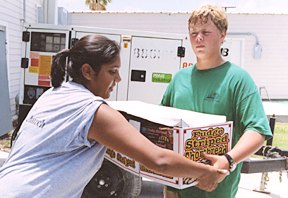
Summer staffers from Texas Baptist Encampment at Palacios by the Sea unload food after campers were evacuated to a safe location.

Citizens slowly stumbled through the streets, blankly staring at the unexpected damage from the storm that was barely classified as a hurricane.

Hope and help came in the form of warm smiles beneath yellow Texas Baptist Men caps and shining Victim Relief Ministries trailers. Four feeding units, two shower units, a chainsaw unit and several clean-up units traveled from around the state to serve in Southeast Texas.

The volunteers served thousands of meals at Baptist churches in Katy, Bay City, Port Lavaca and Victoria. Clean-out units worked in Goliad. Shower units served in Katy and Port Lavaca. A Victim Relief Ministries unit also set up at First Baptist Church in Palacios and later moved to Victoria.

Texas Baptist Men began their work the night before the hurricane made landfall, aiding in the evacuation of more than 400 youth from the Texas Baptist Encampment Palacios by the Sea. The youth were beginning the weeklong OneCamp when they were relocated to First Baptist Church in Katy.

The next day, the camp site suffered severe damage as every building but one lost a wall or roof. High winds crushed an outdoor worship tabernacle.

The church and the city immediately came to the campers' aid, donating food, drinks and plenty of entertainment. Texas Baptist Men units provided meals and showers for the rest of the week.

“We were overwhelmed by the amount of cooperation met in the middle,” said Jim Kluttz, director of OneCamp. “The community of Katy embraced us. We could almost drown our kids in bottled water and soda.”

Victim Relief units were quickly on the scene to counselthe campers when needed, begin damage assessment in the region and console local victims immediately after the storm.

“The faster you get into an area, the more beneficial you are to the people who walk out of their homes dazed and traumatized from the storm,” said Gene Grounds, director of Victim Relief Ministries.

The pier at Texas Baptist Encampment offers a perilous path after its encounter with Hurricane Claudette.

In Palacios, Texas Baptist Men chaplains set up a trailer in the parking lot of First Baptist Church the night after the storm, and they were surprised when more than 50 people came to them needing food, Grounds said.

Within an hour, they finessed a make-shift feeding line at the camp. Texas Baptist Men, members of First Baptist Church and the Salvation Army used gas burners and flashlights to cook without electricity. They fed more than 400 people.

“We had prayed for God to send us where the people were hurting, and he did,” Grounds said. “It was an impromptu ministry and feeding unit. Incredible spiritual things happened as a result.”

Texas Baptist Men served similarly large groups everywhere they went, according to Grounds. The chaplaincy unit met with more than 300 people a day in Palacios and Victoria, and they had plenty of opportunities to share their faith and put people in contact with local church pastors.

“Every volunteer in there sees it as their ministry to respond to the physical needs of people in trauma,” Grounds said. “People are open to tell us about their story and hardships. They just appreciate that someone cares.”

Gov. Rick Perry may have described the work of Texas Baptist Men most succinctly during his visit to Port Lavaca.

“These men and women are the best in the country when it comes to disaster relief,” Perry said. “Texas Baptist Men could feed this entire community if they needed to.”

Gov. Rick Perry speaks with Texas Baptist Men volunteers Ben Freeman and Jim Southerland after a news conference in Port Lavaca, in which the governor praised the Baptist men's group for its ability. At left, summer staffers from Texas Baptist Encampment at Palacios by the Sea unload food after campers were evacuated to a safe location. Inset: The pier at Texas Baptist Encampment offers a perilous path after its encounter with Hurricane Claudette.Jenny Hartgraves/BGCT

News of religion, faith, missions, Bible study and Christian ministry among Texas Baptist churches, in the BGCT, the Southern Baptist Convention ( SBC ) and around the world.


Whirlwind of activity greets new camp director_72803

Posted: 7/25/03

The duplex where Texas Baptist Encampment interim director Rob Kessler lives with his family and staff member Jeannie Stahlecker and her 10-year-old son was destroyed.

Whirlwind of activity greets new camp director

By Jenny Hartgraves

Texas Baptist Communications

PALACIOS–Rob Kessler's first days as interim director of the Texas Baptist Encampment Palacios by the Sea came with a whirlwind of responsibility and weather.

Two days after sending 400 OneCamp campers to Katy and one day after Hurricane Claudette destroyed his new home, Kessler viewed the coast with new eyes.

Bob Kessler, interim director of the Texas Baptist Encampment Palacios by the Sea, stands outside his destroyed home. (Jenny Hargraves/BGCT Photo)

He and his staff survived the storm without any injuries, but the camp was virtually destroyed with the exception of one building.

Kessler waited out the hurricane because it was not forecast to produce much damage. But the storm gained strength prior to hitting the encampment.

“We couldn't have been in a worse location,” he said. “We were right at the wall of the eye and never got a break. The wind was hitting us at 100 miles per hour from every direction.”

The hurricane devastated Kessler's home, a duplex his family shared with Administrative Assistant Jeannie Stahlecker. High winds and a possible tornado stripped off the roof, while a large piece of metal from the nearby dormitory impaled the walls.

Stahlecker and her 10-year-old son were inside the house when the first winds came. She whisked her son into the closet as the living room wall collapsed, and they cowered in prayer until Kessler rescued them.

“We sat in that closet and prayed for 10 minutes,” Stahlecker said. “That prayer came alive. God is good. He kept us safe.”

Kessler and the Stahleckers met other full-time camp staff members in a brick conference building where they anticipated the worst of the hurricane.

The encampment's dormitory was trashed by Claudette's 80-mile-an-hour winds.

They waited safely behind brick walls as Claudette wreaked havoc on the camp–lifting the roofs from the largest dormitory and part of the dining hall, crushing the tabernacle worship center and unleashing the fishing pier to sea.

Heavy rains damaged every building at camp, and all the carpets and roofs will need replacing, he said.

Despite the destruction in Palacios, Kessler sounded upbeat about the clean-up and potential for new facilities.

The tabernacle worship center, an outdoor facility built more than 60 years ago, was soon to be replaced before it tumbled in the storm, Kessler said. “We had a need for an indoor worship center for a long time, so it's kind of a God thing that it's gone.”

Damage assessments declared the tabernacle and staff home “totaled,” and insurance and emergency relief will cover most of the property damages.

The camp never has gone into debt, but the loss of power concerned Kessler as a potential loss of income from other upcoming camps. “We want to get going,” he said. “We want everyone to know that we're the toughest camp in Texas.”

Texas Baptist Men established feeding units at the camp, and they stayed four days using the camp's kitchen facilities and supplies to feed the Palacios community and surrounding area.

Texas Baptist Men's Collin County chainsaw unit and Retiree Builders arrived in Palacios the week of July 21 to aid in clean up.

The outdoor tabernacle was crushed.

Youth from First Baptist Church in Rosenberg spent two days gathering debris.

The Baptist General Convention of Texas designated $50,000 to help repair the camp and the staff home.

With the whirlwind of attention and decisions, Kessler had no time to grieve over the damages to the camp and his home, he said. He and his wife have found comfort in his wife's favorite Bible verse.

Jeremiah 29:11 states, “'I know the plans I have for you,' declares the Lord. 'Plans to prosper you and not to harm. Plans to give you a hope and a future.'”

“We know that God is going to take care of us,” he said. “It might seem kind of creepy to have that attitude, but we're ready for a new beginning.”

News of religion, faith, missions, Bible study and Christian ministry among Texas Baptist churches, in the BGCT, the Southern Baptist Convention ( SBC ) and around the world.


Storm teaches intern to ‘be ready for anything’_72803

Posted: 7/25/03

Storm teaches intern to 'be ready for anything'

By John Hall

Texas Baptist Communications

VICTORIA–An intern at Templo Jerusalem Baptist Church learned to “always be ready for anything” this summer.

Anyra Cano, a student at Hispanic Baptist Theological School, served as a youth intern at the church through a cooperative effort between the Baptist General Convention of Texas, Northside Baptist Church in Victoria and the San Antonio school.

She was working at Northside Baptist Church when Hurricane Claudette raged over the Southeast Texas town. Although a minister invited her to stay at his house, Cano ran toward where she was staying as soon as she could.

“What about the poor people here?” Cano remembers thinking as she ran. “When I came down the street, I was almost crying because that's all I could think of.”

Her host home was undamaged, but trees and piles of leaves were blown into the front yard. Cano helped her host family clean up and moved on to help others.

Teo Cisneros, pastor of Templo Jerusalem, handed her a set of keys to the church, and Cano took turns with the rest of the ministers at the church serving the community. The church facilities, one of the few buildings that had power the five days after the hurricane, remained open to provide families a place to eat and sleep comfortably.

She used the opportunity to become better acquainted with the people in the community and learn their needs. In several instances, she shared the gospel. Cisneros said he was amazed at the ease with which Cano testifies, calling it a “gift.”

Cano said she was disappointed the storm rolled through because it delayed a prayerwalk she now hopes will happen before she leaves. But the time with the people helped her get the word out about an upcoming church lock-in for youth.

“She's got a very good positive spirit,” Cisneros commented. “She takes initiative in things that need to be done, but at the same time she is sensitive to the leaders here.”

News of religion, faith, missions, Bible study and Christian ministry among Texas Baptist churches, in the BGCT, the Southern Baptist Convention ( SBC ) and around the world.