Oklahomans give Texas church a lift_63003

Posted: 6/27/03

Oklahomans give Texas church a lift

By George Henson

Staff Writer

CRESSON–A group of Christians on mission from Oklahoma sees Cresson as more than “just a stoplight on the way to Granbury.”

To them, it's a place to make an investment in the kingdom of God.

Thirty-five workers from Trinity Baptist Church in Ada, Okla., arrived June 9 to begin making First Baptist Church in Cresson more closely resemble the finely crafted structure it was when constructed in 1910.

Located just off Highway 377 between Benbrook and Granbury, the church had been deteriorating for some time, Pastor Clark Frailey said.

Oklahoma volunteers install siding on First Baptist Church of Cresson.

“We wanted to maintain the look of the outside–it's just such a unique building–but we wanted to protect it too,” Frailey said. “The paint was peeling all over it really bad. It had really become an eyesore.”

The church building had received so many coats of paint over the years that sanding it down to the wood would have been impossible. So the Oklahoma crew attached insulation to those exterior walls, then attached siding to that, giving the aging edifice a fresh new look.

The Oklahomans also placed ceramic tile throughout the church's fellowship hall and Sunday School rooms, which had been covered with an indoor/outdoor carpet of varying hues.

The Oklahoma handymen and women were led by Sid Green. “We do this each year as a mission project,” Green said. “We just do what we can to help.”

In addition to projects in their home state, the church also has come to the aid of churches in Louisiana and Colorado.

The Cresson congregation also plans to build a sand volleyball court, a pavilion and children's playground, as well as place cushions on the original hand-crafted, custom-made pews.

“We are a historic church, as are the pews we sit on. However, they also are sometimes a sore subject,” the pastor quipped.

Removable seat cushions and back cushions are being crafted to fit the pews. The pews currently sport seat cushions, but the cushions were added in the 1950s, and “they've lost their cush,” Frailey pointed out.

Upgrading the facilities to be more child-friendly is important in Cresson, the pastor said. “Even though we are a small church, we had 65 kids enrolled last year in VBS. There's not a whole lot else for kids to do around here except for church activities, so the kids really turn out.”

All this is possible for the congregation of about 40 only through the donated sweat, labor and skills of the Oklahoma church and a small-church loan from the Baptist General Convention of Texas, the pastor said.

Even though the older members of the Cresson church can't do all the manual labor required for the renovation, they have made important contributions.

“I told them … to bring extra food because so many were coming to help us with this project, and they really brought a lot,” Frailey said. “We might not be able to do construction, but we can cook.”

Martha Manuel, a member since 1961, said the food was just a token of the appreciation the Texans feel for their neighbors.

“There's no way we could repay them for all they've done, but we can pray for them and thank them,” she said. “We're trying to fatten them up before they go back to Oklahoma.”

Mildred Milburn has been a member of the Cresson church 58 years, and she, too, is grateful.

“When they get ready to leave, I'm going to line them all up and hug every last one of them,” she said. “They'll never know how grateful we are.”

Frailey said the women speak for his whole congregation.

“It's the first time anybody's really stepped up to help them in a big way in at least the last 50 years,” he noted. “I've been seeing a lot of smiles around here.”

News of religion, faith, missions, Bible study and Christian ministry among Texas Baptist churches, in the BGCT, the Southern Baptist Convention ( SBC ) and around the world.


BGCT to offer more curriculum online_63003

Posted: 6/27/03

BGCT to offer more curriculum online

By John Hall

Texas Baptist Communications

The Baptist General Convention of Texas Bible Study/ Discipleship Center plans to offer free online curriculum for children's Bible studies in September.

Downloadable material for children up to sixth grade will be available on the Baptistway Press website, www.baptistwaypress.org. Four age-specific materials specialized for preschoolers 5 years old and younger will be available. Curriculum for older children will be broken down into studies for grades one and two, three and four, and five and six.

The BGCT will post the curriculum in month-long blocks to give teachers more time to plan for the studies. The children's material will be a continuous study program.

Twelve topical studies for older youth also will be available.

The site also will provide a commentary to accompany the adult curriculum. That commentary will be written by Jim Denison, pastor of Park Cities Baptist Church in Dallas.

Free downloadable Bible study material in different languages such as Spanish, Vietnamese and Korean will continue to be available.

Dennis Parrott, director of the center, said the online lessons represent a compromise the section had to make to further its ministry. Many people were asking Baptistway to publish the material, but funds became increasingly tight as the stock market fell, and distributing printed lessons was not economically feasible.

BGCT staff discovered they could minister to churches worldwide and stay within budget by offering the materials free online.

Online curriculum may be the most effective way of delivering Bible study materials, Parrott said, noting churches around the world are using online products from other publishers with a great degree of success. The material is cheaper and more convenient for many class leaders.

“We at first approached this as the next-best thing, but we're starting to wonder if it's not the best thing,” Parrott said.

He encouraged churches to continue supporting the printed Bible study to provide support for ministry in financially strapped congregations.

“When you buy adult materials, you allow the Baptist General Convention of Texas to provide curriculum for other churches,” Parrott said.

Churches throughout Texas, the United States and around the world already are using free Baptistway Press online materials, Parrott noted. He believes the upcoming materials will have a similarly strong impact on churches of all sizes, locations and budgets.

“It's a neat thing to know we can provide that kind of ministry to the churches that need that kind of financial assistance,” he said. “We can also provide it to churches who simply don't want to use anyone else.”

News of religion, faith, missions, Bible study and Christian ministry among Texas Baptist churches, in the BGCT, the Southern Baptist Convention ( SBC ) and around the world.


CYBERCOLUMN: Freedom_simpson_63003

Posted 6/27/03

CYBERCOLUMN:
Freedom

By Berry D. Simpson

In the movie "Braveheart," the last word out of William Wallace’s (Mel Gibson) mouth as the English torturer was literally ripping his body apart was "Freedom!" I don’t know if that was historically correct, but it was certainly the theme of the entire movie, and it is the justification for many of the things we do.

Freedom, however, is a dangerous thing. When you give someone true freedom they may not use it the way you wanted. They may not use it the right way.

For example, the United States just spent money and lives liberating Afghanistan and Iraq from oppressive dictatorial regimes that trampled on civil rights and fostered worldwide terrorism. But now that it is over, what will we do if the Afghans, votiing in free and open elections, elect the Taliban? We can’t go back in and overthrow a freely elected government. What if the Iraqis vote for a Shiite ayatollah as their leader, and they hate us? What will we do about that? Giving someone freedom is risky because a truly free person may not use that freedom as we wish.

Berry D. Simpson

One of the reasons Americans resent the recent stand by France against out president is because we think they should be more grateful for all the American lives sacrificed to give them freedom. We feel we’ve earned a little more respect from them. But instead of being forever grateful to us, the French government thinks it should have an equal position to the United States on the world stage, and to prove its independence and leadership, it has staked out a position opposite from their very liberators. "How dare they," we think, "after all we’ve done?" That’s the trouble with freedom; the freed are free to run away and turn their backs on their freedom givers.

As parents, one of our jobs is to pass along freedom to our children. As they get older, say 20 and 22, we feel obligated to let them make their own decisions and bask in their own freedom. However, we want them to make the same choices we would make, live the same way we live, go to bed the same time we go to bed and pay for their own way the same way we pay for our own way. (Sorry, that last one was about responsibility, not freedom, even though the two go hand-in-hand.) They cannot grow up without freedom, yet that very freedom allows them make choices we don’t like. Giving freedom is risky.

God took a great risk when He gave us freedom through the blood of his Son, Jesus Christ. Galatians 5:1 says, "It was for freedom that Christ set us free." What God wants us to do with that freedom is to stand firm and don’t be a slave to sin. Instead, what we often do with our freedom is run away, stake out our own position, prove our position on life’s stage and establish our independence from God. We waste our freedom; we don’t use it the right way. God knew that might happen when he set us free, but he did it anyway, since it is only through freedom that we can truly love him.

In the movie "Bruce Almighty," God granted omnipotence to Bruce (Jim Carey) because Bruce thought he could handle situations better than God did. However, unfortunately for Bruce, he discovered he could not make his girlfriend, Grace (Jennifer Anniston), love him by using his powers. He couldn’t even manipulate her to love him by leaving clues and hints scattered all around her path. He could win her back only when he gave her the freedom to leave, hoping only for her happiness and peace.

Bruce couldn’t force the free will of other people because of the limitations placed on him by God. In the real world, however, God can do whatever he wants, including trampling on our free will. Yet he has chosen to restrict himself and grant us free will as a gift. He has limited his own powers over our life in order to set us free with no guarantee that we will love him in return, with no promise that we will walk in his ways. Even though God knows that his ways are what’s best for us, they will protect us and make us wise, they will warn us away from harm, they will keep us close to him, he has granted us the freedom to live how we want.

Freedom is a dangerous thing, but I wouldn’t want to live any other way. I want my kids to be free to be adults. I want the people of the world to be free to elect their own leaders. And I want to be free before God to love him and serve him.


Berry Simpson, a Sunday School teacher at First Baptist Church in Midland, is a petroleum engineer, writer, runner and member of the city council in Midland.


Dobson returns to his roots with video series on raising boys_63003

Posted: 6/27/03

Dobson returns to his roots
with video series on raising boys

By Mark Wingfield

Managing Editor

At the apex of his career, James Dobson has returned to the communication medium that first made him one of the nation's foremost spokesmen for conservative Christian family values.

Dobson, founder of Focus on the Family and host of a daily radio program of the same name, has produced a new 11-part video series to be shown in churches and other group settings.

The series, “Bringing Up Boys,” harkens back to the 1970s, before the advent of video, when Dobson's message was projected via film in churches around the nation. That instructional film series, titled “Focus on the Family,” put the child psychologist on the map and sparked the dawn of a different style of family ministry in many evangelical churches. More than 70 million people viewed that series in church fellowship halls, sanctuaries and Sunday School rooms.

The new video series is based on a book also titled “Bringing Up Boys,” a book Dobson labels the “fastest-selling” of his 19 published titles.

In promotional comments released by Focus on the Family, Dobson described his first film series as “the booster rocket that put Focus on the Family into orbit.”

The new video series has that same energy, he said, explaining, “I worked as hard on this project as anything I've ever done.”

Over the past 30 years, Dobson discovered radio to be a more effective means than film of getting his message out on a daily basis. His radio programs now are heard by 200 million people on 3,000 stations in North America and 3,300 overseas.

The video series, however, presents a medium suitable for group interaction and discussion, he said.

“The purpose for this is to get neighborhoods together that don't know these Christian principles,” he explained. “It's very soft-sell so it doesn't offend people who don't know these principles of the faith.”

More liberal-minded critics of Dobson and Focus on the Family aren't likely to find the videos soft-sell, however, as he places the blame for troubles raising boys today on feminists, liberals and homosexual activists.

The problem parents face in raising boys, Dobson said, is “they don't know what it means to be a boy, and they certainly don't know what it means to be a man. Everything masculine has been vilified.”

That vilification, he said, has come from feminists who hate men and from others who wrongly have taught that boys and girls should behave similarly.

“Masculinity was God's design,” Dobson explained in the publicity materials. “Males and females are different. They are intended to be different.”

In the publicity and in the video series, Dobson contends feminists have for the last 30 years attempted to make men “look like little boys, to make them look foolish.”

As evidence, he points to common themes in television commercials and TV sitcoms.

Christian parents, he contends, must hold up the model of masculinity as a worthy goal and stop trying to make boys behave like girls.

God has created boys to be more rambunctious and physical than girls, and nothing parents do can change that internal yearning, he said.

“In the late '60s, a really goofy idea came along, a really crazy idea, and it was the notion that males and females are identical except for the ability to bear children and that boys and girls are different only to the degree to which they've been raised differently,” Dobson says in the first video.

However, he adds, “The people who were behind this movement in telling parents how to raise their kids were not married, were not mothers, had never raised kids, didn't like men and had no academic training whatsoever and had no basis on which to tell parents how to raise kids.”

This philosophy permeated schools with the notion that “men are kind of goofy, so we need to fix boys while we can,” he says.

New medical technology, however, should end the argument forever, Dobson says, explaining that new imaging techniques demonstrate that “male brains are different from female brains” and testosterone makes the difference.

Christians must reclaim the uniqueness of maleness because men and boys are in serious trouble today, Dobson contends.

“When compared to girls, boys are three times more likely to be on drugs, four times more likely to be emotionally disturbed, six times more likely to have learning problems, 12 times more likely to murder someone,” Dobson reports on the video. “Four of five suicides are boys.”

Further, “boys are not linking in to life in quite the same way as girls,” he adds, reporting, for example, that 59 percent of graduate students are women.”

The causes of today's problems with boys are many, Dobson admits, but he finds the root of the evil in “the disintegration of the family.”

Two of the 11 videos deal with homosexuality, how it impacts males and how parents can inoculate their children from becoming homosexuals.

Dobson and three guest speakers on the homosexuality segments advocate that homosexuality is caused by nurture, not nature. The two most common ingredients in the backgrounds of homosexual men, they contend, are fathers who were either distant or critical.

Other segments of the video series leave behind controversial topics and engage in the bread-and-butter parenting advice format that has built Dobson's audience from the start.

Two of the 11 segments feature Dobson fielding questions from parents and grandparents in a studio audience. One segment includes humorous interviews with a sampling of young boys.

News of religion, faith, missions, Bible study and Christian ministry among Texas Baptist churches, in the BGCT, the Southern Baptist Convention ( SBC ) and around the world.


DOWN HOME: Just buggin’ you: count blessings_63003

Posted: 6/27/03

DOWN HOME:
Just buggin' you: count blessings

Do you ever wonder if bugs think Independence Day is a holiday too?

The U.S. Census Bureau reports that 66 million Americans participated in a “backyard barbecue” last year. (Of course, many Texans would not call it a “barbecue” unless it involved slathering vast quantities of meat with spicy sauce, but we'll allow the Census people, probably Yankees for the most part, a generous understanding of the term.) “It's probably safe to assume a large number of these events took place on the Fourth” of July, the Census Bureau interpreted.

Americans these days articulate all kinds of ideas, beliefs, creeds and suppositions. But it seems we can agree on one thing: When we have a holiday, we eat. And since much of America is frozen over by Thanksgiving and Christmas, the Census Bureau's estimation that the Fourth of July is the No. 1 “backyard barbecue” day of the year probably is correct.

MARV KNOX
Editor

Which brings me back to bugs. While we're out eating hamburgers or grilled chicken or smoked brisket, mosquitoes and chiggers and biting flies are eating us. So, don't you supposed they're in their little bug-houses, marking off the days on their little bug-calendars, licking their little bug-lips in anticipation of chewing on your ankles this Friday evening?

Bugs may join us in feasting, but they obviously can't appreciate the most unique sensory expression of this American holiday. That would be the ceremonial watching of fireworks. Maybe because I eat 365 days a year and watch fireworks only one day a year, I like fireworks best.

Last year, our family placed our lawn chairs on one of the highest knobs in southern Denton County, near our local fireworks. Their wicks must've been wet, because we waited forever. But in the meantime, we looked east toward The Colony and Plano, southeast and south toward Richardson, Carrollton, Dallas and Coppell, and southwest toward Grapevine, Colleyville, Bedford and Fort Worth. By the time the mosquitoes had drained us of about a quart of blood apiece, we'd seen glimpses of at least 13 fireworks shows across the horizon.

All the while, I thought about Popo, my maternal grandfather. He loved the Fourth of July, and he indulged me in a multitude of flying, sparkling and exploding fireworks. He would've loved sitting on a hillside and watching 13 celebrations of our nation's freedom.

Maybe because we've had a war this year and we've thought and talked more about liberty and our blessings as a nation, I've been thinking we should combine Independence Day with Thanksgiving. We have been blessed with 227 years of freedom.

So this year, every time you watch a fireworks display explode, bite a hotdog, spit a watermelon seed or slap a mosquito, thank God for “life, liberty and the pursuit of happiness.”

News of religion, faith, missions, Bible study and Christian ministry among Texas Baptist churches, in the BGCT, the Southern Baptist Convention ( SBC ) and around the world.


editorial At Southwestern, Patterson will finish what he started_63003

Posted: 6/27/03

EDITORIAL:
At Southwestern, Patterson will finish what he started

Paige Patterson's election to the presidency of Southwestern Baptist Theological Seminary should help Texas Baptists clarify their feelings about the Fort Worth school. If you like what has happened in the Southern Baptist Convention for the past 25 years, you're going to love what's about to happen to Southwestern. If you don't, you won't.

Patterson, after all, was the theological mastermind of the “conservative resurgence” or “fundamentalist takeover” of the SBC. In the early 1970s, young Patterson, then president of the Criswell Center for Biblical Studies in Dallas, teamed up with Houston judge Paul Pressler to determine how their kind of Baptists–they called themselves “conservatives”; others called them “fundamentalists”–could control the SBC. Pressler figured out how the legal and political mechanism should work. Patterson supplied the theological rationale. They claimed the SBC leadership needed to be changed, because the “liberals” in charge deny the truth of God's word.

Paige Patterson helped engineer the fundamentalist takeover of the Southern Baptist Convention a quarter-century ago; you can count on him to finish the job at Southwestern Seminary.

This “don't believe the Bible” ruse worked flawlessly. For their opponents, it became as hard to answer as, “Say 'yes' or 'no': 'Have you quit beating your wife?'” So-called moderates, who struggle with short answers and sound bites, always came off as tentative and defensive. So the assertion stuck. “If they can't clearly respond to the charge, it must be true,” Southern Baptists seemed to think. Consequently, the SBC elected one fundamentalist president after another. This allowed the fundamentalists to dominate the process for selecting trustees to SBC institutions and eventually to gain complete control of the national convention.

Along the way, Patterson thrived. By 1987, Southeastern Baptist Theological Seminary in North Carolina became one of the first SBC institutions controlled by fundamentalists. When their first choice for president failed and the seminary seemed on the brink of disaster, the trustees called in Patterson, who wore his Texas-tooled Cowboy boots down Tobacco Road and turned the school around. It soon became one of the fastest-growing seminaries in the world, and he launched several initiatives that boosted morale, rounded up students and coralled cash.

Patterson's success at Southeastern Seminary bore fruit in 1998, when he became the first sitting SBC agency head in almost 60 years to be elected president of the convention. For two terms, he stood atop the SBC mountain, articulating his vision for the national convention to SBC audiences and to the public at large through the mass media.

Not coincidentally, the SBC re-wrote is doctrinal statement, the Baptist Faith & Message, during Patterson's watch. Early in the fundamentalist movement, Patterson disavowed any plan to change or re-write the BF&M. However, by 1981, he said it contained “code words” for “neo-orthodox theology.” He specifically cited the sentence, “The criterion by which the Bible is to be interpreted is Jesus Christ.” Not surprisingly, the 2000 BF&M removed that statement, a step that led many Texas Baptists to believe the SBC exalted Scripture over Jesus. Ironically, the new version did not include the political/theological code word fundamentalists used to rally votes and gain control of the SBC; it did not refer to the Bible as inerrant. Interestingly, the new BF&M did refer to itself as an “instrument of doctrinal accountability.” That mirrors Patterson's notion of a creed–“an iron-clad definition of a doctrine to which all initiates had to subscribe in order to be a part of that particular order.”

As noted here April 14, Patterson has been the odds-on favorite to succeed Ken Hemphill as Southwestern's president. The seminary trustees' unanimous vote last week merely confirmed the inevitable. From their perspective, it's an obvious choice. He's a native Texan and knows how to work Texas crowds. He's successfully turned around a struggling seminary and can be expected to help a large and wealthy school soar. He brings the prestige of the SBC presidency. Moreover, he's thoroughly committed to the fundamentalists' cause of totally overhauling the SBC. And now that the final dissenting foreign missionaries have been fired, the last apparent holdouts are Southwestern faculty members whom a former seminary trustee chairman called “moderates” who have “hunkered down and gone underground.” Patterson helped engineer the fundamentalist takeover of the SBC a quarter-century ago; you can count on him to finish the job at Southwestern Seminary.

Also expect him to work hard to build up the fortunes and membership of the competing Baptist convention in Texas. He's a gifted pulpiteer, affable conversationalist and forceful personality. He will strengthen this 4-year-old convention.

But make no mistake: He will forever change Southwestern Seminary and the Texas Baptist landscape. This has been his goal from Day One. Southwestern no longer is the seminary that trained generations of Texas Baptist pastors. It is a new school. This is a new day in Texas.
–Marv Knox
E-mail the editor at marvknox@baptiststandard.com

News of religion, faith, missions, Bible study and Christian ministry among Texas Baptist churches, in the BGCT, the Southern Baptist Convention ( SBC ) and around the world.


Anonymous gift will enable CBF to appoint missionaries despite budget shortfalls_71403

Posted 6/28/03

CBF church starting strategist Phil Hester introduces Mary Beth Caffee, who is starting a church in Maine, one of 40 CBF new church starts across the nation. Hester was an advertising executive in Houston before entering seminary later in life and then starting a church in California.

Anonymous gift will enable CBF to appoint
missionaries despite budget shortfalls

By Mark Wingfield

Managing Editor

CHARLOTTE, N.C.–Gifts of $9 million from an anonymous donor will enable the Cooperative Baptist Fellowship to continue to appoint new missionaries next year despite budget shortfalls.

Participants in the CBF's general assembly approved a basic budget of $17.1 million for the 2003-2004 fiscal year, to be supplemented by an additional $2.64 million in designated gifts. The bulk of that designated money derives from a $5 million gift received in April and a $4 million gift received the previous year, both to be disbursed over a four-year period.

Without the special gifts, the CBF would not be able to appoint any new missionaries in the 2003-2004 fiscal year, said CBF Coordinator Daniel Vestal. And the anonymous gifts made possible the appointment of 15 short-term and career missionaries at the CBF general assembly June 27.

Cooperative Baptist Fellowship Moderator Phill Martin presides over the tri-annual meeting of the Coordinating Council at its June 25-26 meeting preceding the Fellowship’s 13th General Assembly in Charlotte, N.C. (Lance Wallace photo)

“We are not appointing any new missionaries, except for those that are funded by designated gifts,” Vestal told the CBF Coordinating Council June 25. He re-emphasized that at the June 27 general assembly commissioning service for 18 mission workers.

“Honestly, we could not be here tonight without the support of a generous donor,” Vestal told the assembly.

Total giving to the CBF increased this year, but undesignated gifts did not meet budget goals, Vestal reported to the Coordinating Council.

The CBF was projected to end the current fiscal year June 30 with a $650,000 shortfall in undesignated receipts over expenditures, even while keeping expenditures at 85 percent of budget. That budget shortfall will be covered by drawing from reserve funds, said finance committee Chairman Philip Wise, pastor of Second Baptist Church in Lubbock.

Total income for the year was projected to reach about $15 million, said CBF Chief Financial Officer Jim Strawn. That's short of a basic budget of $18.2 million.

The CBF's budget woes mirror national trends in other religious bodies, noted outgoing Moderator Phill Martin, a layman and member of Wilshire Baptist Church in Dallas. “This is not a phenomenon CBF is dealing with. This is a phenomenon faith-based organizations are dealing with.”

The shortfall, various CBF officials explained, stems from a collision of two primary forces–optimistic budgeting and tough economic times in churches.

Vestal told the Coordinating Council 241 churches gave to the CBF for the first time in the last six months. About 25 of those first-time givers are Hispanic churches, and about 115 are from Texas, he added.

That is one of many signs that things are going well in the CBF, despite the budget challenge, Martin told the general assembly.

“Things really are great with CBF, but there is one thing that is of concern. … Our corporate vision and dreams for CBF are greater than our commitment to funding,” he reported.

For example, Martin said, 130 people are exploring a call to missionary service with CBF. “We are uncertain about being able to add to our numbers. That is not in keeping with our vision.”

He added: “Funding is not an easy question or subject. … If we are to continue to say things are great at CBF, we must all pay attention to funding of national CBF.”

The funding challenge portends changes for other areas of CBF life beyond missions.

CBF staff will receive no salary increases in the new fiscal year. That's the second year of flat compensation for the CBF's coordinators, the corps of top-level division directors.

The CBF's partner entities also face reduced financial support, although a policy change creates the potential for them to get more money sooner in the year.

Under previous policy, the CBF distributed allocations to seminaries and other partners at an 85 percent of budget ratio until year end, then made up the difference, if funds allowed, in a 13th check. Under the new policy, partners will receive a monthly allocation keyed to that month's flow of gifts into the CBF. For example, if total gifts run 5 percent below budget, the partners will receive 95 percent of their budgeted allocations for that month. The distributions will not exceed 100 percent of budget, however.

Cooperative Baptist Fellowship Finance Committee Chair Philip Wise made the recommendation that monthly partner funding be directly tied to the Fellowship’s monthly undesignated receipts. Wise serves as pastor of Second Baptist Church, Lubbock, Texas. (Lance Wallace photo)

For the 2003-2004 fiscal year, the partner entities are budgeted at the level of actual distributions in the year just ended, meaning a full allocation for 2003-2004 will be 85 percent of what had been budgeted in the 2002-2003 year.

Partner entities, none of which are owned or managed by the CBF, include 13 schools that are budgeted to share $1.13 million. Other partners are the Baptist Joint Committee, $212,500; Associated Baptist Press, $137,700; Baptist Center for Ethics, $85,000; Baptists Today, $42,500; and Baptist World Alliance, $20,000.

The BWA contribution could draw particular scrutiny in the year ahead, as the CBF seeks final approval for its membership application. That application could be approved by the BWA this summer.

That likelihood already has cost the BWA $125,000 in funding from the Southern Baptist Convention. SBC leaders have protested strongly against the CBF application and have hinted they might reduce funding even further. This year's drop from $425,000 to $300,000 from the SBC is a 34 percent reduction from the SBC.

Ironically, the CBF several years ago reduced its own funding for the BWA from $100,000 to the current $20,000 level–an 80 percent reduction. That change was done in a budget realignment, officials said at the time.

Speaking to the Coordinating Council June 25, Vestal acknowledged the CBF's level of funding for the BWA needs to be revisited. “If our application is accepted, we've got to be good partners,” he said. “That means we have to increase our financial support.”

How the CBF's budget allocations shape up in the future–particularly if further cuts are required–could be influenced by the report of a budget priorities task force given to the Coordinating Council June 25.

The report was not officially adopted but was received as information.

It identified six areas for highest-priority funding–most-neglected and unevangelized people, church starting, developing partnership missions with local churches, supporting theological education, nurturing congregational health, and fostering congregational leadership. Except for theological education, all the top priority areas relate to the CBF's own Atlanta-based programs.

It also identified four areas least important and, presumably, the first suggested for budget cuts–collegiate ministries, marriage and family, chaplaincy, and Baptist identity.

In the new budget, Baptist identity includes funding for ethnic and regional networks, interim pastor support and allocations to the Baptist Joint Committee, ABP, BCE, Baptists Today and the BWA.

Further, the budget priorities task force recommended that in the future, total allocations to partner entities be limited to 20 percent of the CBF budget. Currently, partner funding accounts for 28 percent of the budget.

The prospect of reducing the pool of available money to divide among partner ministries drew mixed responses from members of the Coordinating Council, with some suggesting those ministries ought to be less dependent upon the CBF and others suggesting the CBF ought to help keep them strong.

In the 2003-2004 fiscal year, the CBF has budgeted its largest single share of undesignated money for global missions, $9.63 million. That will be supplemented by $2.02 million in designated funding and will support 149 short-term and career missionaries, partnership missions with local churches, missions administration and church starting.

Other budget areas include $2.33 million for administration, $2.1 million for leadership development, $1.02 million for communications and marketing, $984,579 for building community and networking, $663,063 for faith formation and $375,000 for the general assembly.

Also as part of budget-cutting measures, the CBF will scale back its two regional resource centers–one in Dallas and one in Raleigh, N.C.

See related stories:
CBF: Churches should talk about 'mission' rather than budget to overcome shortfalls

CBF: Vestal: Diversity must express itself in common stream of witness

CBF: Youth ministries need to enlist, affirm parents

CBF: Campolo urges 'Fight the good fight' for justice

CBF: Healthy churches rest on seven pillars, consultant says

CBF: Leonard says Baptists 'bog down' relating to people of other faiths

CBF: Currie calls Patterson statement on women in the pastorate 'arrogant'

CBF: Missionary couple says they're grateful to serve at all after being fired by IMB

CBF: Anonymous gift will allow CBF to appoint missionaries despite budget shortfalls


Missionary couple says they’re grateful to serve at all after being fired by IMB_71403

Posted 6/30/03

Missionary couple says they're grateful
to serve at all after being fired by IMB

By Mark Wingfield

Managing Editor

CHARLOTTE, N.C.–Two missionary couples who lost their jobs with the Southern Baptist Convention for failure to sign a new faith statement expressed gratitude to God for allowing them to serve as missionaries at all.

Larry and Sarah Ballew and Houston and Charlotte Greenhaw told their stories at a breakfast meeting sponsored by the Mainstream Baptist Network June 27, but neither couple dwelled on the negative.

“We may have lost our jobs, but brothers and sisters, there are Christians who lose their lives … for not bowing to heavy-handed authoritarianism,” said Larry Ballew. He and his wife, who have served in Macau, China, were fired by the SBC's International Mission Board in May for failure to sign the 2000 Baptist Faith & Message.

The Greenhaws, veteran missionaries to Brazil, took early retirement from the IMB when given a final ultimatum to sign the 2000 Baptist Faith & Message.

Charlotte Greenhaw spoke of her “gratitude to our awesome God” for allowing her to serve as a missionary. And despite the current challenges, she said, “I know the Lord is with me. I will not be afraid.”

“I have had joy that knows no limits, but I have had some moments in the last year (that were) … very devastating,” added Greenhaw, who is a granddaughter of the legendary Edgar “Preacher” Hallock of Oklahoma.

The breakfast meeting, held during the Cooperative Baptist Fellowship's general assembly in Charlotte, N.C., linked information between the CBF and the SBC, the convention to which most CBF churches once belonged and to which some still relate. The Mainstream Baptist Network is a distinct organization from the CBF and seeks to foster what it calls “mainstream” Baptist ideals in churches and state Baptist conventions.

In the main hall of the CBF meeting, participants focused on their shared witness through the work of 149 CBF mission workers. At the Mainstream breakfast, attention focused on those who have been disaffected by the SBC but may not have joined the CBF.

Both the Ballews and the Greenhaws intend to return to their mission posts and continue the same work they were doing under the IMB, although with different support networks. Neither couple will be CBF-appointed missionaries.

Each couple explained whey they refused to sign the 2000 Baptist Faith & Message.

“We did not do this to get your approval” but rather out of a sense of what was right in God's eyes, Ballew said.

Nor was the issue for him merely that the content of the SBC's faith statement had changed. He would have made the same decision if requested to sign the 1963 Baptist Faith & Message, he said.

Signing blind allegiance to a faith statement written by someone else in a different cultural context is “bad missiology” and a “bad witness,” he declared.

In China, “our people experience heavy-handed, top-down authoritarianism all the time,” he said. Signing “would have been a bad witness” to them.

“If we had signed that document, yes, we could have continued with the IMB. But it would have ruined us as missionaries.”

The choice was so clear even their 9-year-old son understood it when the ultimatum first was given to sign the 2000 Baptist Faith & Message, Mrs. Ballew said. He said to his mother, “This reminds me of Shadrach, Meshach and Abednego,” referencing the three Hebrew teens who in ancient times were thrown into the fiery furnace by King Nebuchadnezzar because they would not bow down to an idol.

The Greenhaws knew from the moment they received the IMB's request that they could not sign the 2000 Baptist Faith & Message, they each said.

“It was not my statement of faith,” Mrs. Greenhaw said.

Her husband held up a sheet of paper with 10 questions they were asked when first appointed as SBC missionaries. Then he read from the current affirmation required by the IMB, indicating agreement with the 2000 Baptist Faith & Message and pledging to work “in accordance with and not contrary” to it.

When first appointed, they were not asked to sign a specific faith statement written by someone else, he asserted. “The Baptist Faith & Message is prepared in a U.S. context. To promise to work in accordance with something that is created in anther culture–you can't do that.”

Holding up both pieces of paper, he declared, “The difference between these statements is immense.”

Both couples described how they believe God miraculously has provided a way for them to return to their mission fields, citing evidence such as unlikely encounters that led to new housing and just-in-time arrangements on visas.

Mrs. Ballew called it a “step of faith” that God has honored.

Neither couple expressed animosity toward the IMB, although both acknowledged the trauma of the past year and a half.

Ballew quoted the Apostle Paul's words from the eighth chapter of Romans to say of God: “These present sufferings are nothing compared to the glory he will reveal in us.”

He added: “Every temporary problem is an opportunity for the glory of the Lord to shine out.”

See related stories:
CBF: Churches should talk about 'mission' rather than budget to overcome shortfalls

CBF: Vestal: Diversity must express itself in common stream of witness

CBF: Youth ministries need to enlist, affirm parents

CBF: Campolo urges 'Fight the good fight' for justice

CBF: Healthy churches rest on seven pillars, consultant says

CBF: Leonard says Baptists 'bog down' relating to people of other faiths

CBF: Currie calls Patterson statement on women in the pastorate 'arrogant'

CBF: Missionary couple says they're grateful to serve at all after being fired by IMB

CBF: Anonymous gift will allow CBF to appoint missionaries despite budget shortfalls


cbf_Campolo urges: ‘Fight the good fight’ for justice_71403

Posted 6/30/03

Campolo urges: 'Fight the good fight' for justice

By Marv Knox

Editor

CHARLOTTE, N.C.–Christians must “fight the good fight” for justice, speaker and author Tony Campolo told participants at the Cooperative Baptist Fellowship's general assembly.

“The Bible speaks to every social issue,” Campolo insisted, and he touched on many of them in an hour-long sermon.

The centerpiece of his message included a challenge to champion the causes of minorities and the oppressed. Campolo is founder and president of the Evangelical Association for the Promotion of Education and a retired sociology professor at Eastern University, an American Baptist school in suburban Philadelphia.

Tony Campolo left no stone unturned in a wide-ranging and challenging message that highlighted the opening night session of the Cooperative Baptist Fellowship’s 2003 General Assembly in Charlotte. (Mark Sandlin photo)

“We shouldn't be fighting against each other,” he told supporters of the Fellowship, who split from the Southern Baptist Convention over fundamentalism 12 years ago. Baptists should do what every basketball player is coached to do when elbowed in a game, he said: “Walk away.”

However, some fights are worth fighting, he added, focusing on a range of justice issues, including:

Racism. "I'm bothered that this group is so white," he said, scanning the Fellowship audience, imploring the organization to involve more African-Americans and Hispanics.

A byproduct of racial inclusion will be joy, he promised.

“You gotta get more joy,” he urged. “Allow the Holy Spirit to come in and fill you. … I want a Fellowship where there's laughter, joy and we're filled with God's spirit.”

Sexism. "We don't want women preachers. … That's sinful," he said, apparently aiming a broadside at the SBC, whose doctrinal statement says a church should not call a woman to be its pastor.

The Apostle Paul says, “Neglect not the gift of God's Spirit,” Campolo noted, claiming that to deny a gifted woman the opportunity to preach or lead a church as pastor runs counter to the will of the Holy Spirit.

“There's something crazy” about allowing women to go as missionaries and preach overseas but refusing to allow their sisters to serve as pastors in the United States, he said.

The aversion against women pastors even caused the conservative translators of the New International Version of the Bible to change Scripture to suit their purposes, he alleged. The NIV translation of Romans 16:7 say a man named Junius was “outstanding among the apostles,” an office higher than pastor, when the other major translations note the person's name was Junia, a woman.

“When you start changing the Bible to suit your theology, you better look at yourself,” Campolo warned.

Homosexuality. "I'm not asking you to be conservative or liberal. I'm asking you to be loving," he said of Christians' response to gays and lesbians.

Christians are divided on their response to homosexuality, he conceded, noting he and his wife do not agree. He doesn't believe homosexuals should be married, while she does.

“But I believe in justice for all people,” he said. “I am asking you to show love and compassion for people who have had their teeth kicked in for far too many years.”

Even Christians who are conservative about the morality of homosexual practice, as he said he is, will get attacked if they advocate basic human rights for homosexuals, he predicted. “But if we're going to be unique, … we've got to stand up and say things nobody is saying.”

Anti-Semitism. "We've got to be a voice for the weak, and that means the Jews," Campolo said.

“There's no place for anti-Semitism” in the world today, he insisted, stressing Jews should have a right to a land of their own protected by secure borders.

“But as we say that, we better stand up and speak on behalf of the Palestinians,” he said, noting they were “driven off their land in 1948.”

“I do not legitimize Hamas and (Palestinian) terrorism any more than I legitimize the terrorism of the Israeli army,” he insisted.

He also spoke of the influence of the “evangelical lobby” in the United States, pointing out that half of all U.S. foreign aid is allocated to Israel.

Given the amount of money the United States contributes to Israel, the U.S. ought to influence Israel to treat the Palestinians well, Campolo said, also calling also for fair treatment of the Israelis by the Palestinians.

“We've got to say to the Palestinians and the Jews: 'In the name of Jesus, you've got to stop,'” he urged.

In an earlier aside, Campolo also railed against the “Left Behind” novels, which are based on a premillennial dispensationalist interpretation of the Book of Revelation that places a premium on Jews occupying the Holy Land before Jesus can return.

“Nobody wants to say it. You are scared to attack the 'Left Behind' books which are false theology and unbiblical to the core. And it is about time you stand up and say so,” he urged preachers. “I mean all of this stuff comes out of not only fundamentalism. It comes out of dispensationalism, which is a weird little form of fundamentalism that started like 150 years ago.”

Poverty. "Most importantly, we've got to be a voice for the poor," he declared.

The United States ranks last among the 22 industrialized nations in social support for the poor, he reported. In addition, 500,000 poor children in America will lose after-school care in order to provide the latest round of tax relief for the rich, he added, including himself among the financial beneficiaries.

Although the United States is the wealthiest nation on Earth, millions of Americans cannot afford basic medical care, he said, observing, “That's obscene.”

And while government plans enable the wealthy to increase their financial status, the government is cutting back its spending on education and environmental controls, he acknowledged, noting, “That's sad.”

Lest some Christians claim social issues are an individual responsibility and should not be approached by government, Campolo pointed to the 25th chapter of the Gospel of Matthew, where Jesus said the “nations” will be judged according to how they treat the sick, hungry, poor and homeless.

Turning to risers filled with scores of teenaged choir members, he called for Baptist young people to spend a year of their lives affiliated with his organization, working with poor people in several of America's inner cities.

Of course, they should get a good education, he said. But contrary to popular opinion, the purpose of a good education is not to get a good job and buy “stuff,” but to “do good for God's kingdom.”

If young people will spend a year working with impoverished people, they will return equipped to spend the rest of their lives advocating for justice and seeking to do God's work among people.

“If Mormon kids are willing to give two years of their lives for their church, I don't know why we can't give one year for the church,” he lamented.

The gospel demands more than just response to social needs, he said, stressing the need for evangelism.

“The truth we hold above all else is Jesus,” he insisted. “We must preach Jesus. … Keep Jesus central. Make Jesus known.”

Even though times and culture change, the most successful means of proclaiming the gospel has not changed in 2,000 years, he said, calling for Christians to “reach out” to non-Christians around them.

One method of reaching out is faithfully telling people about the Bible and teaching the Bible to them, he said.

Unfortunately, most mainline churches do not emphasize the Bible enough, Campolo said. To illustrate, he told about how he was asked to evaluate a set of resolutions that were to be considered by the National Council of Churches. While they dealt with important topics, they did not support their claims with Scripture, he said.

“Don't you ever listen to Billy Graham?” he asked. “Every fifth sentence that Billy Graham utters is what? 'The Bible says,' 'The Bible says.' People, they won't believe anything we tell them unless we can convince them that the Bible says it.”

He continued: “When we say we're Baptists, we accept no creed but the Bible, but then after we say that we never talk about the Bible. We never announce what it is the Bible says on each and every social issue and theme. … The Bible speaks to every social issue.”

After Campolo's message, CBF participants were invited to give a special offering for CBF's Rural Poverty Initiative, an effort to minister among residents of the nation's poorest counties, including several along the Texas-Mexico border.

That night and the next night, an offering totaling $175,210 was collected, surpassing an offering goal of $100,000.

See related stories:
CBF: Churches should talk about 'mission' rather than budget to overcome shortfalls

CBF: Vestal: Diversity must express itself in common stream of witness

CBF: Youth ministries need to enlist, affirm parents

CBF: Campolo urges 'Fight the good fight' for justice

CBF: Healthy churches rest on seven pillars, consultant says

CBF: Leonard says Baptists 'bog down' relating to people of other faiths

CBF: Currie calls Patterson statement on women in the pastorate 'arrogant'

CBF: Missionary couple says they're grateful to serve at all after being fired by IMB

CBF: Anonymous gift will allow CBF to appoint missionaries despite budget shortfalls


cbf_Healthy churches rest on seven pillars, consultant says_71403

Posted 6/30/03

Healthy churches rest on seven pillars, consultant says

By Marv Knox

Editor

CHARLOTTE, N.C.–Although every church is unique, healthy congregations tend to reflect seven characteristics, a veteran church consultant insisted.

Les Robinson, vice president of the Center for Congregational Health in Winston-Salem, N.C., described those seven characteristics to participants in a seminar during the Cooperative Baptist Fellowship general assembly.

Building on research developed by Peter Steinke, a Lutheran minister and church-systems specialist, Robinson said healthy churches:

Set boundaries. Church members, clergy and laity alike, do not "get into other people’s relationships," try to speak for the entire group or talk about others without speaking directly to them, he said.

Take responsibility. Members of healthy churches are wiling to take stands on important congregational issues, he said.

"They’re willing to say, ‘This is where I am’ on a particular issue," he said. This approach contrasts with unhealthy churches, where clergy and laity refuse to acknowledge their positions or beliefs, thus confusing the situation and causing conflict.

Have resiliency. The challenge is to remain rooted and centered on principles but also to be flexible to changing circumstances and new opportunities, Robinson said.

"Without resiliency, there is no creativity," he said. "It’s not that tradition is bad, but if everything is determined by tradition, we’ll never add anything to it."

Creativity also helps churches recover from trauma by enabling them to adapt to new circumstances.

Practice clarity. "Some churches don’t know where they’re headed," he lamented. "You must have a mission or vision. With a mission and vision, there is very little (church) conflict, because you know where you’re going."

Read mood or tone. This quality helps churches head off trouble before it develops, Robinson said.

Church leaders who can see ahead far enough to "know when trouble’s coming" are able to manage conflict more effectively than those who are surprised by apparently sudden conflict, he noted.

Likewise, leaders who deal with elements of change in advance help their churches process the shifting circumstances reasonably well.

Negotiate conflict. While most people avoid conflict because it is painful, wise church leaders learn to balance conflict and derive creativity from the tension that results.

In fact, healthy churches need both times of comfort and times of tension, Robinson said. "If we’re always comfortable or always in tension, we’re not going anywhere. We need healthy stress."

Develop leadership. "Every congregation needs ‘stewards’ who will manage and care for the group," he said.

In fact, leaders are like the "immune system" that protects the church from disease.

Healthy church leaders understand their roles and function responsibly, he said. They also focus on the church’s strengths, resources and options.

In time of crisis and trauma, healthy church leaders remain calm and reflective, rather than react in panic, he added. They always are in process of assessing the church’s situation, preparing for the future.

They also accept and deal with anxiety, help the church clarify its situation and its mission, and they maintain relationships with church members who are anxious because of threatening circumstances or others who are opposed to change.

See related stories:
CBF: Churches should talk about 'mission' rather than budget to overcome shortfalls

CBF: Vestal: Diversity must express itself in common stream of witness

CBF: Youth ministries need to enlist, affirm parents

CBF: Campolo urges 'Fight the good fight' for justice

CBF: Healthy churches rest on seven pillars, consultant says

CBF: Leonard says Baptists 'bog down' relating to people of other faiths

CBF: Currie calls Patterson statement on women in the pastorate 'arrogant'

CBF: Missionary couple says they're grateful to serve at all after being fired by IMB

CBF: Anonymous gift will allow CBF to appoint missionaries despite budget shortfalls


Leonard: Baptists ‘bog down’ relating to people of other faiths_71403

Posted 6/30/03

Leonard: Baptists 'bog down'
relating to people of other faiths

By Marv Knox

Editor

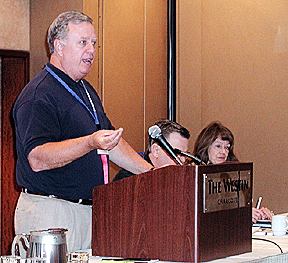
CHARLOTTE, N.C.–Many Baptists bog down in theological "quicksand" as they try to relate to people of other religions, church historian Bill Leonard reported.

They’ve got "one foot set in Jesus-ism and the other in pluralism," Leonard said in a breakout session held during the Cooperative Baptist Fellowship’s general assembly.

But by taking clues from their heritage, Baptists can find firm footing to remain respectful while advocating for their cause, said Leonard, dean of Wake Forest University’s Divinity School.

"Since the beginning of our movement, Baptists generally have affirmed the belief in a regenerate church membership or believer’s church," he said. "Conversion to Christ is non-negotiable" for salvation and membership in the church.

"But since almost the beginning, Baptists have not agreed on the nature or process of that conversion," he noted.

As early as 1608-09, Baptists affirmed the thinking of religious reformer Jacob Arminius, who believed all people have free will and can decide if they will accept God’s grace in Christ and be saved.

Less than 30 years later, Baptists influenced by reformer John Calvin believed Christ died only for the "elect," or those God already had chosen to be saved, he said.

In Calvinism, "some are elect, some damned," Leonard explained, adding this understanding implied individuals play no significant part in salvation. "If you are elect, God’s irresistible grace will find you anyway."

So, almost from the beginning of their history, Baptists affirmed two unique plans for salvation, he said.

Moreover, Baptists developed the concept of religious pluralism in America, he added. They took their cues from English Baptists, who first said God, not government, is the Lord of conscience, and neither the church nor the state can dictate religious faith.

Led by Roger Williams, founder of Rhode Island Colony, Baptists in America advocated for pluralism, the notion that "every individual is free to believe the right stuff, the wrong stuff or nothing at all," Leonard said.

But even as they championed the rights of others, Baptists advocated for their own beliefs, he noted.

"Baptists were not silent about the need for regeneration," he observed. "Baptists said, ‘You’re free to believe, but we’re free to tell you you’re wrong.’"

This principle of religious pluralism is in serious danger today, Leonard warned. "It is half a step from saying all other religions are wrong to saying we have to protect ‘the innocent’ with sanctions" against other religions, he explained. "The Baptists (who were persecuted for their faith in Colonial America) knew that before everybody else."

Throughout the generations, most Baptists have struggled to live in two worlds–unashamed commitment to Christian religion and an understanding of religious liberty that nurtured pluralism, he said.

These potentially competing values create the "quicksand" that provides uncertain footing for evangelistic Christians who also affirm others’ rights, he noted.

Up until the late 18th century, when Calvinistic thinking prevailed among Baptists, the challenge between "Jesus-ism" and pluralism wasn’t significant, Leonard said. Since God would save whomever God chose to save, Baptists were not threatened by pluralism or compelled to confront other faiths. That was God’s issue, not theirs.

But when Baptists began to engage in world missions after 1792, they had to consider God’s purposes and their interaction with other religions, he noted.

"If you have a responsibility to say Jesus is the only Savior of the world, you have to deal with other religions in ways you didn’t when Calvinistic theology was in place."

Consequently, world missions and evangelism opened the door for dialogue with other religions and the sensitive issue of competing truth claims.

Often, some critics attack Christianity on this point, claiming Christians try to exert "salvific hegemony" over others, Leonard observed. However, other religions–particularly Islam–often are more extreme in denying Christians the opportunity to express their faith.

"Every religion has the right to propagate and promote its world views," he said. That’s just as true for Christians as it is for Jews, Muslims, Buddhists and others.

In fact, the way out of the "quicksand," he said, is recognizing Christians can live responsibly and effectively in a pluralistic society without forfeiting their beliefs or abandoning the right to express them to people who believe differently.

In recent years, many Christians have feared pluralism because they have confused it with syncretism, a politically correct blending of various beliefs that waters each of them down and neutralizes them.

"Pluralism is not capitulation to syncretism," Leonard said. "I’ve seen students confusing pluralism with syncretism,. They hesitate to speak (on behalf of their Christian faith) lest it be confused with bigotry."

But syncretism is offensive to all religions, because it does not represent any of them fairly or accurately, he said.

Christians should think carefully about how they witness in the pluralistic world in light of the results they hope to achieve, Leonard stressed.

"Some are compelled by conscience that all other religions other than Christianity are lost," he said, noting they should act upon their convictions.

"But they need to know … in church (their belief) will be perceived as a statement of conviction but on CNN it will be interpreted as bigotry," he added. "You have to ask, ‘Who are you saying that to, and what is the witness in that moment?’"

For example, he cited the 1980 statement by former Southern Baptist Convention President Bailey Smith, "God Almighty does not hear the prayer of a Jew." Many Jews still quote Smith, and the sentence has been an impediment to evangelism for almost a quarter of a century, he said.

Still, the notion that Christ is only one among several possible roads to faith is "syncretistic pabulum," Leonard declared.

Moreover, the idea that Christians must choose between "convictional particularism" and "pluralistic libertarianism" is a false dichotomy, he said. Christians can express their convictions while remaining respectful listeners to others and gain ground in the dialogue, he said.

As evidence, he pointed to the rapid growth of Christianity "outside the West," where faithful Christians diligently but thoughtfully and winsomely confront pluralistic societies.

Leonard said he has learned to "be with them, but not one of them" as he talks to people of other faiths.

"To respond to other world religions, I do it as a person of faith," he said. "It does me no good to tell Muslims, ‘If you don’t believe in Jesus, you’re going to hell.' You take them seriously, communicate with them. … You can say, ‘We’re together here and here, but not here.’"

And in discussing where the faiths diverge, the Christian gains an opportunity to share the gospel, he said.

For example, he told about talking to a person from another religion who said to him, "We could never believe God, the transcendent, would become human." Leonard responded, "I can’t imagine God wouldn’t."

Ultimately, Christians must take seriously the Bible’s teachings, Leonard stressed.

Evangelical Christians quickly turn to the Gospel of John, where Jesus is recorded as saying: "I am the way, the truth and the life. No one comes to the Father but by me."

They also should consider the Gospel of Matthew, where Jesus states that God will welcome into the kingdom of heaven the people who feed the hungry, clothe the naked, visit the prisoners an heal the sick, Leonard said. "And they did it even when they did not know it."

See related stories:
CBF: Churches should talk about 'mission' rather than budget to overcome shortfalls

CBF: Vestal: Diversity must express itself in common stream of witness

CBF: Youth ministries need to enlist, affirm parents

CBF: Campolo urges 'Fight the good fight' for justice

CBF: Healthy churches rest on seven pillars, consultant says

CBF: Leonard says Baptists 'bog down' relating to people of other faiths

CBF: Currie calls Patterson statement on women in the pastorate 'arrogant'

CBF: Missionary couple says they're grateful to serve at all after being fired by IMB

CBF: Anonymous gift will allow CBF to appoint missionaries despite budget shortfalls


Currie calls Patterson statement on women in the pastorate ‘arrogant’ _71403

Posted 6/30/03

Currie calls Patterson statement
on women in the pastorate 'arrogant'

By Mark Wingfield

Managing Editor

CHARLOTTE, N.C.–Paige Patterson's assertion that the Bible is “crystal clear” that women should not be pastors is “arrogant, asinine and ignorant,” declared David Currie, executive director of Texas Baptists Committed.

In brief comments to the Texas state meeting during the Cooperative Baptist Fellowship general assembly in Charlotte, N.C., June 26, Currie addressed Patterson's election as president of Southwestern Baptist Theological Seminary in Fort Worth.

In a news conference after his election, Patterson said the New Testament is “crystal clear that pastors are to be men” and explained he would not allow women to teach men in the seminary's School of Theology.

Such a statement is “ignorant of simple biblical hermeneutics,” asserted Currie, who, like Patterson, holds a seminary doctor of philosophy degree. “It is a perversion of the gospel to say women can't do that stuff.”

Currie told about his recent battle with prostate cancer and his fear that he would not live through the surgery. When he awoke from the sedation, Currie joked, he realized God had a sense or humor.

“God realized Paige Patterson was going to come, and God said: 'Currie can't go yet. It's going to be too much fun.'”

Currie also acknowledged his previous comments in the Fort Worth Star-Telegram in which he called Patterson a “well-meaning theological pervert.”

His description was true, he said, “because it is a perversion of the gospel to have that kind of hermeneutic. It is a perversion of the gospel to have that kind of understanding of what God can do through women.”

Two Southern Baptist Convention leaders jumped to Patterson's defense, issuing statements to Baptist Press and discounting Currie's biblical interpretation skills.

“What he characterizes as 'ignorant' and 'asinine' is the majority interpretation of the church for more than 2,000 years,” said Al Mohler, president of Southern Baptist Theological Seminary in Louisville, Ky., and a frequent apologist for the SBC.

“This comment reflects the sheer desperation of the Texas

Baptists Committed organization and their tremendous fear of a great defender of the faith moving into their terrain,” Mohler added.

SBC President Jack Graham, pastor of Prestonwood Baptist Church in Plano, also defended Patterson through Baptist Press and said: “I am absolutely convinced that David Currie does not represent the theology nor the ecclesiology of Texas Baptists.”

At the Charlotte meeting, Currie warned Texans they must take Patterson as a serious threat to the Baptist General Convention of Texas and the CBF movement in Texas.

He charged that in North Carolina, where Patterson has been president of Southeastern Baptist Theological Seminary, Patterson has paid students to serve as interim pastors of churches, thus exporting his brand of fundamentalism across the state.

Two officials at Southeastern responded through Baptist Press to say no such program ever has existed there.

Also at the Texas breakout session, Rick McClatchy was introduced as the new coordinator for CBF Texas.

McClatchy, a native Texan who has worked with the Oklahoma CBF, called for a “spirit of collaboration” among moderates Baptists in Texas.

“It is time to get started … being Baptist,” he declared. “We don't need any more debate about what it means to be Baptist. We know.”

He also called Texas Baptists to be progressive and ecumenical, to shun chauvinism and prejudice, to be filled with grace and people of humility.

Picking up a perpetual theme of Charles Wade, executive director of the Baptist General Convention of Texas, McClatchy urged Texas Baptist moderates to “start being the presence of Christ” in the state. He called for “no more self-absorbed churches, … no more tradition-bound churches, … no more apathetic churches.”

CBF-related churches in Texas should offer themselves as models of healthy, vibrant churches so that others will want to emulate their spirit, McClatchy said.

CBF Texas also adopted a 2003-2004 budget of $157,025.

See related stories:
CBF: Churches should talk about 'mission' rather than budget to overcome shortfalls

CBF: Vestal: Diversity must express itself in common stream of witness

CBF: Youth ministries need to enlist, affirm parents

CBF: Campolo urges 'Fight the good fight' for justice

CBF: Healthy churches rest on seven pillars, consultant says

CBF: Leonard says Baptists 'bog down' relating to people of other faiths

CBF: Currie calls Patterson statement on women in the pastorate 'arrogant'

CBF: Missionary couple says they're grateful to serve at all after being fired by IMB

CBF: Anonymous gift will allow CBF to appoint missionaries despite budget shortfalls