Archives
-
-

2nd Opinion: A microcosm of the body of Christ
Posted: 3/14/08
2nd Opinion:
A microcosm of the body of ChristWhen in Rome, doing as the Romans do usually doesn’t involve attending an English-language Baptist congregation. For this Texan, looking for a church while living in Italy last fall required plenty of my own initiative.
Despite several false starts and only one month of Italian under my belt, I finally managed to find Rome Baptist Church near the famous Spanish Steps.
Organized in March 1963 as a mission to “serve the Americans who live in Rome,” the church is now led full-time by Dave and Cat
hy Hodgdon, who moved to Rome from Colorado in 2001.
The church draws people from all walks of life and facilitates an atmosphere of openness and diversity, largely because of its heterogeneous congregation. Tourists or students like me join the church for just a few months, or even for just one Sunday.
03/15/2008 - By John Rutledge
-
EDITORIAL: U.S. faith swapping & relationships
Posted: 3/14/08
EDITORIAL:
U.S. faith swapping & relationshipsOne word kept coming to mind as I read the new Religious Landscape Survey produced by the Pew Forum on Religion and Public Life. I’ll admit I felt guilty every time I thought that word, but I just couldn’t get away from it. I said it out loud when I read that 44 percent of American adults have faith-swapped—switched religious affiliations or dropped their connections with faith altogether. And while I tried to think other thoughts, it crept back into my brain when I considered other facts, such as only one in four young adults are affiliated with any religious faith; and Protestants comprise barely 51 percent of the population, down from two-thirds two decades ago; and 10 percent of the population are former Catholics; and almost 40 percent of American adults are married to someone from a different religion.
Promiscuity.
That’s the word. I know it sounds judgmental, but I couldn’t help thinking it. Americans are a religiously promiscuous people. We’re movers. We change spouses, houses, jobs and communities more often than our foreparents changed tires. So, why should we expect faith—or no faith, as the case may be—would be any different?
Of course, Baptists historically have benefitted from a degree of religious promiscuity. We call it “conversion,” and our ranks have grown because we have presented a compelling reason for unbelievers to believe in Jesus and for Christian pilgrims unhappy in other sections of God’s kingdom to immigrate to our shores, “through the water,” as it were. The evangelistic imperative, not to mention the Great Commission, bids us to beckon toward others.
03/15/2008 - By John Rutledge
-
-
Faith Digest
Posted: 3/14/08
Faith Digest
Hinn submits records to Senate committee. After several weeks of delay, televangelist Benny Hinn has submitted a “significant amount” of financial material to a Senate committee that is investigating the finances of six prominent ministries to make sure they are complying with tax laws that apply to other nonprofit entities. Jill Gerber, a spokeswoman for the Senate Finance Committee, said ranking Republican Sen. Charles Grassley of Iowa and his staff “will evaluate whether the material responds sufficiently but are encouraged by the demonstration of cooperation.” Joyce Meyer Ministries in Fenton, Mo., already provided materials that were reviewed by Senate staff. Kenneth Copeland Ministries submitted some materials. The other three ministries—Creflo Dollar, Paula and Randy White and Bishop Eddie Long—have yet to provide financial records.
Union Seminary appoints first woman president. Serene Jones, a feminist scholar who has taught 17 years at Yale Divinity School, has been named president of Union Theological Seminary. Jones, 48, is the first woman to head the 172-year-old nondenominational seminary located in upper Manhattan and affiliated with Columbia University. Jones will begin her duties July 1 at an institution that has served as a scholarly home for such major theological figures as Reinhold Niebuhr and Paul Tillich. Jones is an ordained minister in both the Christian Church (Disciples of Christ) and the United Church of Christ.
03/15/2008 - By John Rutledge
-
Faith films still not flooding big screen
Posted: 3/14/08
Faith films still not flooding big screen
By Kim Lawton
Religion & Ethics NewsWeekly
LOS ANGELES (RNS)—This year’s batch of Academy Awards nominees for Best Picture portrayed some complex moral dilemmas: A pregnant teen figuring out what to do; a lawyer in an ethical crisis; a Western saga overwhelmed by evil; a romance doomed by lies; a clash between an oil man and a greedy evangelist.
But except for the unsavory clergyman in There Will Be Blood and maybe the title Atonement, there’s little explicit treatment of religion.
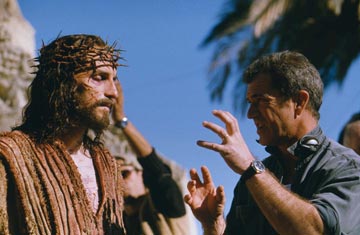
Mel Gibson (right) directs Jim Caviezel in his portrayal of Jesus for The Passion of the Christ. Movie executives have been chasing “Passion dollars” since the 2004 motion picture became a megahit worldwide, taking in more than half a billion dollars. (RNS photo/Philippe Antonello/Courtesy Icon Distribution Inc.) 03/15/2008 - By John Rutledge
-
What has Hobbiton to do with Jerusalem?
Posted: 3/14/08
What has Hobbiton to do with Jerusalem?
By Jay Smith
Howard Payne University
Bible Belt Christians have struggled long with literature and film espousing a view of reality that confronts the values of our Christian life.
03/15/2008 - By John Rutledge
-
IN BETWEEN: Mentoring: Is someone coaching you?
Posted: 3/14/08
IN BETWEEN:
Mentoring: Is someone coaching you?I retired from working with our Baptist General Convention of Texas churches in March 2006. I determined more work was needed to help pastors and other church leaders because too many ministers were being terminated, and little preventive (pro-active) help was coming forth from our offices. I felt it was time for me to focus on developing leaders as a “free agent” and not as a staff person.
Soon I found myself working with a colleague, Kerry Webb, in training ministers and laypersons as leaders, not just followers. One of the extremely interesting discoveries for the two of us was the need to build a mentoring dimension into our training. Of course, how could we mentor others unless we were committed to going through that process ourselves?
We found a wonderful lady who became our coach. Actually, she was an executive coach, formally trained in a nationally recognized coaching certification process. Later, we determined each of our participants needed to experience that same coaching.
The Bible is loaded with examples of mentoring relationships. Some were with older-to-younger models (Paul/Timothy), others were with models in which age was not a big difference (Paul/Barnabas). It appears to me that younger ministers/laypersons today seem to be more open to the Paul/Timothy model. Regardless, this kind of relationship is vital to leaders today.
03/15/2008 - By John Rutledge