Nearly two-thirds of wired American adults surf Net for spiritual reasons_50304

Posted: 5/03/04

Nearly two-thirds of wired American
adults surf Net for spiritual reasons

WASHINGTON (RNS)–Nearly two-thirds of American adults with Internet access have used it for spiritual or faith-related reasons, according to a recent study by the Pew Internet and American Life project.

The 82 million Americans who use the Internet for religious activities represent 64 percent of all wired adults in the United States.

The study found one-third of U.S. Internet users have sent or received e-mail with religious content or spiritual greeting cards, or go online to read current religion news. Others look for information about religious services and holidays.

The trend is about the same across different denominations, pollsters said.

“These practices are appealing to people across all of our categories of religion and spirituality, and across all levels of Internet use,” the report said.

Half of the online faithful said they attend church at least once a week and 33 percent describe themselves as evangelicals. Most–69 percent–said they use the Internet for personal spiritual growth, not for work related to their places of worship. Only 14 percent said they use the Internet to plan church-related meetings, which the report called surprising.

“The online faithful seem more interested in augmenting their traditional faith practices and experiences by personally expressing their own faith and spirituality, as opposed to seeking something new or different in the online environment,” the report said. “This is interesting, because many analysts have assumed that the Internet would make it more likely for people to leave churches in favor of more flexible options.”

Half of those who use the Internet for spiritual purposes are women, 83 percent are white and half are college-educated. They also are likely to be wealthy and between 30 and 49 years old.

A quarter of respondents said they look for information about other religious faiths online out of curiosity, with Catholics the least likely to go online for religious information.

The report said the study's results were surprising and its implications unclear.

“It is possible that those currently affiliated with religious institutions will maintain a foothold in both the online and offline worlds,” the report said. “On the other hand, we may see an integration occur between the two.”

The study surveyed 1,358 U.S. Internet users in November and December 2003. It has a margin of error of plus or minus 3 percentage points.

News of religion, faith, missions, Bible study and Christian ministry among Texas Baptist churches, in the BGCT, the Southern Baptist Convention ( SBC ) and around the world.


Texas Baptist Forum_50304

Posted: 5/03/04

TEXAS BAPTIST FORUM:
Ten Commandments

Phil Strickland asserts, “We undercut the profound truths … and the moral instruction of the Ten Commandments when we give responsibility of teaching to the government and don't embrace that responsibility in the churches” (April 19).

The Ten Commandments were given by God to a chosen Hebrew leader, Moses, to teach all people how to behave themselves. God wanted to establish a nation–not a church–and this is how he commanded people should conduct themselves and their affairs.

E-mail the editor at marvknox@baptiststandard.com

The Founding Fathers established a great nation–these United States–because they feared God. And the Ten Commandments were guiding principles in establishing the Constitution, a task made more difficult because now there were more “religions.”

I am not Jewish, but because I was created by God, the Ten Commandments tell me how God expects me to act.

I also noticed Strickland is a Texas Baptist ethics leader and director of the Christian Life Commission of the Baptist General Convention of Texas.

Shouldn't Strickland be leading and directing “this responsibility to the churches”?

I.P. Ruiz

Dallas

Love, not division

Roger Olson's column, “Baptist & Pentecostals stand stronger on common ground” (April 5) deserves a big thank you, thank you, thank you.

Professor Olson presented a fair, balanced and accurate assessment observed by one who was raised Assemblies of God.

When we learn from each other, the head of the church, our Lord and Savior Jesus Christ, is exalted.

The world will know us by our love, not our division.

Stan Lewis

Uvalde

Salvation by grace

As a Presbyterian elder and Pentecostal, I welcome the opportunity to reply to C.T. McGuire's letter (April 19).

I agree salvation is by grace–all who will may receive it. The letter intimates Baptists believe the hard-line Calvinist doctrine of predestination, roughly stated, “The chosen can't refuse the grace, and those not chosen can go to hell.”

“They (Pentecostals) teach sinless perfection.” I have heard such teaching from folks calling themselves Pentecostal, usually on TV. However, such doctrine is far from prevalent among true Pentecostals, who make up the vast majority of people calling themselves Pentecostal.

“The doctrine of the Holy Spirit misses the mark of Bible truth.” This statement mystifies me. Over the past 42 years, I have come in contact with countless persons from all Christian denominations who have received the fullness of God's Spirit. They are better, more dedicated, more useful in the kingdom than they were before, being baptized in the Holy Spirit. Notice: Not better than others; better than they were before.

I have sat under teaching from Presbyterian ministers who echo some of the charges brought against Pentecostals. When any of them agrees to discuss the matter, it turns out that a seminary professor started them in that direction. Since then they have tended to look for examples to bolster their belief.

Thank you for allowing me to respond. I try to remember Paul told the Corinthians, “We are given the ministry of reconciliation,” and as I say to my Bible class, “not of condemnation.”

Dick Carter

Amarillo

Classroom witnesses

The letter by Dick Ellis (April 5) has two major fallacies related to vouchers.

His argument that “many schools with highly performing students spend considerably less per student than the majority of public schools where performance is poor” may have some validity, but it is oversimplification. Student performance is the result of many factors, including class size. Voucher schools traditionally have smaller classes than public schools; therefore, school-to-school comparisons are misleading.

Many voucher schools–unlike public schools–are not required to report how students do on assessments.

However, his most damaging statement is the classification of voucher opponents as discriminating and predatory.

Using his logic, voucher supporters are discriminatory because they don't want their children in the same public schools with “those” children. They could be considered predatory because they support pulling children out of public schools, thereby taking jobs of good teachers, some of whom are Christians. Using race as an argument for vouchers is just wrong.

There is a solution–build effective public schools for all children.

In my 20 years of classroom service, I was often the only Christian example for many students. … A Christian teacher can be called to the classroom just as a pastor is called to the pulpit.

The future of public schools is in jeopardy. Do Christians not have some responsibility for children?

Public schools are a field ready for the harvest. Children need Christian models, and you can be a mentor, tutor or Christian example during lunch or recess.

Freida Golden

Manhattan, Kan.

Gambling & schools

I find Gov. Perry's school finance reform proposals inane. I had rather be taxed for going to church and the money be used for educating our children than to depend upon the lottery, other forms of gambling and other sin taxes to do the job of public education. Public education is the public's job.

Taxing for going to church would probably improve the quality of some of our worship, and it would cause church people to become involved in and supportive of the public education of America's children, which we should have been deeply involved with all along.

“Important projects should be paid for with important money.” Educating our children is one of our most important projects. Sin-tax money is derived from socially destructive forms. That cannot be important money. Important money can only come from people who care.

A state income tax to fund what is needed for the good of Texas' future is quite acceptable to me. It would not be the end of the world.

I pray for all Texans to attain the social and political courage to consider this or some other responsible solution for providing a good future for Texas. Ethical behavior is acting now to provide a great state for our great-grandchildren.

As a citizen, I call for someone in authority to initiate an investigation into Gov. Perry's relationship with gambling interests. I think it imperative to fully know what all that relationship is.

Alvin Petty

Friona

Depressed & angry

After reading the articles on positions taken by evangelicals (April 19), I was left feeling pretty depressed and angry.

Angry that so many so-called evangelicals seem to have no foresight, wisdom or discernment on social issues that are specifically spelled out in Scripture–gay marriage, abortion, etc.–and depressed that we evangelicals have obviously made ourselves irrelevant in our own culture because we have melted in so well in our values, beliefs and behavior. Divorce rates, porn addictions, etc. are about the same as non-evangelicals.

This is bad news for the outlook of our country. The salt has lost its saltiness and therefore is useless.

May we see the error of our ways and repent and turn from our wicked ways so that God will hear our prayers and heal our land–before we morally destroy it.

Jean Whitmore

Altus, Okla.

Worship freedom

I support the contemporary worship style because it gives the greatest amount of freedom for worship.

Many of us ministers of music really prefer to say that we believe in the use of “psalms, hymns and spiritual songs” as the style preferred in the music part of worship. Those terms are biblical. The other terms seem to be so divisive.

The real need is not style of worship but to “worship the Lord in Spirit and in truth.”

Tim Holder

Port Neches

What do you think? Submit letters for Texas Baptist Forum via e-mail to marvknox@baptiststandard.com or regular mail at Box 660267, Dallas 75266-0267. Letters must be no longer than 250 words. They may be edited to accommodate space.

News of religion, faith, missions, Bible study and Christian ministry among Texas Baptist churches, in the BGCT, the Southern Baptist Convention ( SBC ) and around the world.


Annuity Board staff member joins BGCT as director of information technology office_50304

Posted: 5/03/04

Annuity Board staff member joins
BGCT as director of information technology office

DALLAS–Dave Lyons has joined the Baptist General Convention of Texas staff as director of information technology.

Lyons will serve in a new position that is the direct result of a technology review pursued by the BGCT in 2002, said David Nabors, chief financial officer and treasurer of the convention.

Lyons comes to the BGCT from the Southern Baptist Annuity Board in Dallas, where he was a business systems development and support team leader. He had been with the Annuity Board since 1995.

Previously, he was a systems manager for Colotone-Riverside in Dallas.

Titles have been changed for two other positions in BGCT's information systems area.

Jeannie Bordovsky is now associate director of technical operations. Clay Price is associate director of research information

The addition of Lyons to the staff helps the BGCT in implementing recommendations of the review, which was led by Gartner Inc., Nabors said.

“The review determined that we needed additional resource support in regard to project management, change management, solutions development and integration management,” he said.

“Dave Lyons' experience and expertise match well with those needs and make him an excellent addition to our information systems staff.”

Lyons holds a bachelor's degree in computer science from Texas A&M University in College Station.

He is a member of The Heights Baptist Church in Richardson.

He and his wife, Darla, have two children, Lauren, 19, and Drew, 17.

News of religion, faith, missions, Bible study and Christian ministry among Texas Baptist churches, in the BGCT, the Southern Baptist Convention ( SBC ) and around the world.


Growing churches have deep roots, clearly defined purpose_50304

Posted: 5/03/04

Growing churches have deep roots, clearly defined purpose

By Kari Hawkins

Religion News Service

ATLANTA (RNS)–Why does one church grow and another just down the street fall stagnant?

Does it have something to do with the type of denomination, the vision of the church and the people sitting in its pews? Or is growth caused or not caused by traffic patterns, economic ties and cultural expectations?

Several factors influence a church's growth, experts say. A friendly atmosphere, community involvement, multiple programs for all age groups and evangelism are obvious.

But other reasons for growth can be harder to pinpoint.

Calvin Miller

“Growth is a fruit, to use a biblical metaphor. It's an outgrowth,” said Thomas Frank, director of Methodist studies and a professor of church administration at Emory University in Atlanta.

“But fruit comes from trees that are deeply rooted. The fruit of growth in the church is drawn on things of tradition. The key here is not just growth, but also a faithfulness to a church's own identity and tradition.”

A survey by the Hartford Institute for Religion Research (www.fact.hartsem.edu) found churches with specific definitions and goals for their members and high standards for personal morality and communal justice have greater vitality as well as growth in membership and financial giving.

Researchers interviewed leaders of 14,301 U.S. congregations of Protestants, Roman Catholics, Mormons, Jews, Muslims and other faith groups. The survey defined growth as an increase of at least 5 percent in Sunday-morning attendance (or Saturday for faith groups that observe the Sabbath on that day) for a five-year period from 1995 through 2000. Fifty-one percent of the congregations involved in the survey reported growth.

But throughout the country, Christianity is on the decline, with a loss of 12 percent in attendance since 1994, said Calvin Miller, professor of preaching and ministry studies at Beeson Divinity School at Samford University in Birmingham, Ala.

“It's a radical decline, and the more secular cities become, the harder it is to make churches grow,” he said.

“I believe the decline is a matter of attrition for most churches. It reflects a failure to be responsive to the people who we ought to be reaching. They may have gone to church with mom and dad as a child. But now they've grown up, and they just don't enjoy it, and they drift away.”

Growing an established church takes a lot of self-study, Miller said. Congregations must decide if they want to grow, what they need to change to grow and if they will welcome the change that comes along with growth.

Growing churches begins with a survey of the target audience so the church knows the people it wants to serve and understands what has kept these people from coming to the church, he said.

“You have to take away the things that keep a church from growing, because an old-style administration, old-style music, a pastor who isn't relational and a sermon style that no one likes will not make a church grow. Things that make churches grow are kind of edgy.”

While church leaders consider ways to increase the numbers of their church, Frank said, the only real concern is that churches help people in their relationship with God.

“Growth is not the objective of the church. The objective is to be a faithful, Christian community, and when you meet that objective, your church will grow in many ways,” he said.

“You will see growth in the spiritual life of your members, in the commitment of members to the well-being of the community and in the number of people who want to be part of your church.”

Some churches may, indeed, be meant to stay small to fulfill God's vision, Frank said.

“Smaller churches tend to be a face-to-face community,” he said. “Most people tend to know the face of everyone else in a small church.

“At a church where a few hundred people have become 8,000 or 9,000 people, you tend to lose the face-to-face community. People become surrounded by strangers, and they can start feeling overwhelmed by that.”

Some larger churches have taken steps to create small communities, such as weekly Bible study groups of about 15 members within their churches to offer the personal touch people desire in the Christian faith.

When churches grow large, there also is a change in the way decisions are made and in the relationships that longer-standing members have within the church, Frank said.

“It is no longer possible to make decisions in the same way,” he said.

“In a small group, people can make strategic decisions. In a church that has become a large church, people who have been around a long time find themselves at some point being excluded from those decisions.”

They also may find themselves excluded from the direction in which their church is growing–or growing away from–such as traditional songs and preaching styles, Frank said. They begin to wonder, “Who are we?”

In trying to please large numbers of eager new Christians, large churches may fall into the trap of trying to be so relevant in today's world that they forget to deliver the message of an afterlife.

“These churches major on the idea of relevance,” Miller said. “They aren't worried about telling you how to die but on telling you how to live while you are here. You lose a lot of transcendental values. There's a lot of 'how to' sermons–how to forgive your brother and how to build a family.”

In Atlanta, 35 of the congregations in the city's suburbs each have more than 5,000 members.

“The reason these churches thrive is because the suburbs are full of displaced people who have no roots in the community,” Frank said.

“For these people, the large church functions like a small town. It is a place of belonging that fits a wide range of needs. They offer recreation, social events, even credit unions.”

Large churches also provide that “big religious experience” some Americans are looking for in a church.

“They want their religion to be spectacle,” Frank said. But that is not for everyone, especially those “who want to know everybody and they have a personal relationship with the pastor.”

Some churches aren't meant to go on forever, Frank said. Older churches once in a vibrant neighborhood may now be in an area of town where people have moved out to make way for industrial and business sectors.

“Most (growing) churches are located in places where new people are moving in,” he said. “The healthiest churches are intergenerational with three generations, maybe four, actively involved in the church.”

New congregations grow more easily than long-standing traditional congregations because “they don't have to learn the traditional issues of a Christian faith,” Frank said.

New congregations don't have to sing older hymns or follow traditional liturgical styles if they don't want to. As a new church, they can start their own traditions–which can be attractive to newcomers.

Many of these new churches “have a pep rally feel about them,” Miller said. “They're exciting. The hymns are buoyant, the music is upbeat. The young megachurch connotes excitement.”

The key to growth is “not to adopt somebody else's culture, but to promote your own culture in a more effective way,” Frank said. “I've heard traditional congregations sing songs from 200 years ago, but in a way that is very dynamic and exciting for today.”

News of religion, faith, missions, Bible study and Christian ministry among Texas Baptist churches, in the BGCT, the Southern Baptist Convention ( SBC ) and around the world.


Christian leaders should maximize abilities, pastor suggests_50304

Posted: 5/03/04

Christian leaders should maximize abilities, pastor suggests

By John Hall

Texas Baptist Communications

SALADO–Leadership is not telling people what to do, but working with and for others, a Rockwall pastor told the Baptist General Convention of Texas Ministers of Education Retreat.

Leaders understand when to take a stand, but they spend much of their time helping people through projects or following the advice of others, said Steve Stroope, pastor of Lake Pointe Church.

Pastors, ministers, Sunday school teachers or church project coordinators need to realize the ways God strategically blessed them and lead in a way that maximizes their unique abilities, he said.

Abilities typically align with a person's passions, he explained. Enthusiasm can drive people to accomplish much more than someone working on the same project without excitement.

“It's not about the power of positive thinking,” he said. “This is not a pep talk. This is not 'If you can dream it, you can do it.' It's 'If you can grab (God's) dreams, you can do them.'”

If leaders recognize how they are gifted, they can build a staff of workers around them to balance weaknesses, Stroope said. He added that ministries grow when Christians are working where they are passionate.

Where leaders are not gifted, they should work under the direction of another person in hopes of strengthening the ministry, he said.

Stroope encouraged the ministers of education to use trial periods to help volunteers find where they best fit.

Allow workers to try different positions for short periods until they and the minister find the proper place of ministry, he suggested.

“If you're doing something and you're not bearing fruit, you're doing the wrong thing,” he said.

When delegating work to others, volunteers need passion, but they also must have strong character and competence, he emphasized. Leaders must model their beliefs and work effectively.

Supervisors also need to share a vision with the people who work for them, and it helps if they like the people they oversee, Stroope said.

Those factors help the two enjoy working together toward a common goal. The relationship enables each party to strengthen where the other is weak, he noted.

These steps will help ministers and ministry, but they will not keep the work from wandering off track, he said.

Individuals, programs and churches run through typical five- to seven-year cycles that include stages of dreaming, doing, feeling something is wrong and a period of reinvention that can lead to dreaming again, he maintained.

In tough times, ministers must lean on God to carry them through, Stroope said.

“There are people who look at you and me and say, 'You can't,'” he said. “They don't know our Father.”

News of religion, faith, missions, Bible study and Christian ministry among Texas Baptist churches, in the BGCT, the Southern Baptist Convention ( SBC ) and around the world.


Missouri convention appeals suit dismissal_50304

Posted: 5/03/04

Missouri convention appeals suit dismissal

By Robert Marus

Associated Baptist Press

JEFFERSON CITY, Mo. (ABP)–Attorneys for the Missouri Baptist Convention have appealed the dismissal of a lawsuit against five breakaway institutions, and state convention messengers will be asked to authorize the use of Cooperative Program funds to pay for the ongoing lawsuit.

Lawyers representing the convention and a group of convention-affiliated churches filed a notice of appeal to the Missouri Western District Court of Appeals in Kansas City. The appeal will challenge Cole County Circuit Judge Thomas Brown's March 11 dismissal of the suit against the agencies, as well as three related rulings.

In the March dismissal, Brown ruled the convention's Executive Board and the six churches had no standing to bring legal action against Missouri Baptist University, the Baptist Home retirement-home system, the Missouri Baptist Foundation, Windermere Baptist Conference Center or the Word & Way newspaper. Brown concluded the convention legally consisted only of individual messengers rather than churches or elected representatives.

Brown later re-affirmed that ruling and denied the convention the opportunity to amend its lawsuit to include a group of individual messengers as plaintiffs.

In 2000 and 2001, trustees of all five agencies changed the organizations' charters to begin electing their own successors. Previously, the institutions' trustees had been nominated by an MBC committee and elected by messengers to the convention's annual meeting.

The charter changes came after a successful campaign by fundamentalist leaders to gain control of the convention's nominating process and thereby steer institutions in a more conservative direction.

Leaders of the breakaway institutions cited the political issues, as well as liability concerns, in making the decision to switch to self-perpetuating boards.

Convention messengers voted in 2002 to sue the institutions, demanding the agencies' trustee boards be returned to convention control. Because the MBC itself is an unincorporated association under Missouri law, convention leaders decided to name the MBC Executive Board and six sympathetic MBC-affiliated churches as the plaintiffs.

Messengers removed funding for the agencies from the convention budget. However, the MBC Executive Board voted April 13 to place the five institutions back in the convention's Cooperative Program budget for 2005. The new budget proposal will be presented to convention messengers for final approval at their annual meeting in October.

According to a column posted on the convention website by Executive Director David Clippard, “These budget dollars will be given to them for operations needs only upon their return” to convention control.

And, despite previous promises from convention leaders that Cooperative Program receipts would not be used to fund the lawsuit, Clippard also said the money could be used in the interim “to fund (the agencies') return.”

The proposal, according to the convention-supported Pathway newsletter, would include $1.2 million in the first year.

The convention already has spent about $1 million on the lawsuit. Funding for the legal fees initially came from convention reserve funds.

At their 2003 annual session, convention messengers approved a $1 million line of credit to continue funding the lawsuit, as well as establishment of a Missouri Baptist Agency Restoration Fund separate from the convention's budget.

The fund was intended as a place for individuals and churches to contribute designated gifts for waging the legal battle over and above their regular convention giving.

But according to a document distributed at the April board meeting, only $3,779 had been contributed to the fund in the first three months of 2004.

Also at the April 13 meeting, reporters representing Word & Way–which had been the official MBC newspaper for more than 100 years before it removed itself from convention control–were ejected from a second Executive Board meeting.

At a previous meeting, convention President David Tolliver excluded Word & Way from covering the open meeting, citing the fact that the paper and the convention were involved in litigation.

By the April 13 meeting, the convention's lawsuit had been dismissed and the convention had not yet filed its appeal.

According to Word & Way Editor Bill Webb, that meant, in his determination, that Tolliver's rule no longer applied.

Webb agreed to leave under protest.

Robert Cox, chairman of the newspaper's board, later sent a letter of complaint to convention officers.

“It would seem your rationale for exclusion was without merit for this meeting,” Cox wrote.

Cox also noted the Word & Way staffers are members of Missouri Baptist Convention churches and thus should never have been excluded from otherwise open Executive Board sessions.

“The governing documents of the Missouri Baptist Convention assure that Executive Board meetings are open to any Missouri Baptist who wishes to attend,” he wrote.

“If for no other reason than this, the Word & Way staff should be entitled to be present.”

News of religion, faith, missions, Bible study and Christian ministry among Texas Baptist churches, in the BGCT, the Southern Baptist Convention ( SBC ) and around the world.


Multicultural retreat_50304

Posted: 5/03/04

Multicultural retreat

Kate Leong of Southwest Chinese Baptist Church in Stafford and Delbert and Mary Lou Serratt of First Baptist Church in Amarillo enjoy a lighthearted moment while making pottery during the Baptist General Convention of Texas Multicultural Retreat. About 50 church leaders representing 10 cultures attended the event, where they discussed techniques for handling conflict within congregations and enjoyed times of fellowship and recreation.

News of religion, faith, missions, Bible study and Christian ministry among Texas Baptist churches, in the BGCT, the Southern Baptist Convention ( SBC ) and around the world.


New Orleans Seminary leaves sole member vote to SBC messengers_50304

Posted: 5/03/04

New Orleans Seminary leaves sole
member vote to SBC messengers

By Lacy Thompson & Robert Marus

Associated Baptist Press

NEW ORLEANS (ABP)–New Orleans Baptist Theological Seminary trustees will leave up to Southern Baptist Convention messengers a final decision on how best to tie the institution to the denominational body–but in the process may have only deepened their dispute with the SBC's Executive Committee.

At their April meeting, the seminary's trustees approved a motion to present to convention messengers during the SBC's 2005 annual meeting two alternatives on how best to assert the convention's ownership of the seminary.

Trustees will ask messengers to decide between making the denomination the “sole member” of the institution's corporation or asserting the convention's ownership through another yet-to-be-determined legal means.

Trustees approved the motion by a 33-to-6 vote after a lengthy and often lively discussion in which several seminary leaders raised concerns about the Executive Committee's handling of the case.

It has been an issue since 1997, when the SBC's North American Mission Board became the first denominational institution to amend its legal charter to declare the SBC its sole member. SBC leaders and the Executive Committee have encouraged other denominational entities to make the same move. Their motivation has been to ensure that no entity could follow the lead of some state-convention-related institutions and choose to leave the control of the convention.

SBC leaders also have cited concerns with limiting the spread of liability to other entities if one institution or the denomination is sued.

The sole member approach makes the Southern Baptist Convention the single controlling legal member of an entity. So far, all convention entities have agreed to the sole membership structure except New Orleans Seminary.

Last fall, after extensive study, the school's trustees declined to adopt the sole membership model, citing legal and Baptist polity concerns.

Seminary leaders have argued sole membership could be used by the Executive Committee to exert undue authority over the seminary, violating historic Southern Baptist polity. Seminary leaders also have said adopting a sole membership clause would present special problems in Louisiana because of that state's unique system of state law, which has its origins in Napoleonic code rather than in English common law.

Attorneys for the seminary have said that such an arrangement under Louisiana law would give the denomination total control over the seminary, increasing its exposure to liability in lawsuits against the institution.

However, even in rejecting sole membership last fall, seminary trustees indicated their intent to find an acceptable alternative–one that would offer the same protections sought by convention leaders.

During the Executive Committee's February meeting, seminary President Chuck Kelley and committee members presented competing cases on the issue. Following discussion, committee members voted to request seminary trustees to amend the school's charter and adopt sole membership.

At the seminary trustee meeting, Kelley offered trustees a chance to “lament” and voice whatever frustrations they felt about the ongoing process.

Kelley acknowledged he was disappointed by it. He noted that seminary leaders previously had been assured their decision on the issue would be accepted no matter what, only to find that was not the case when the decision they reached was not the one the Executive Committee desired.

Kelley also said he did not find the seminary's appearance at the recent Executive Committee meeting to be “an entirely pleasant experience.”

However, he assured trustees he has a “very settled peace” in his heart about the way the seminary has handled the issue.

Trustee Chair Tommy French of Baton Rouge agreed the seminary “picked up a lot of heat” at the Executive Committee meeting and that he and Kelley were spoken to “very plainly” by committee leaders.

However, French said he is determined not to be adversarial. “Let us not, as a board, develop friction between us and the Executive Committee. They have one opinion, and we have another opinion,” French said.

“Let us do our work (and) let them do their work–and then the Southern Baptist Convention will settle the matter,” French continued. “And we'll still be friends, and we'll still work together for the kingdom of God and for this institution and for our great denomination.”

Trustee Don Taylor of Alameda, Calif., said he has been unable to get answers to questions directed to the Executive Committee. He said he came to the trustee meeting with a “heavy heart,” unable to support adoption of sole membership.

Kelley presented the board with several options for responding to the Executive Committee's ultimatum. He warned that delaying a decision until the SBC's 2005 meeting could expose the seminary to further attack on the issue. He said the school would have to spend the time educating Southern Baptists on the issue.

Kelley and some trustees noted that presenting the issue to convention messengers at their 2004 meeting–only two months away–would leave little time for educating them on the issues at stake. Historically, SBC messengers have almost always voted in favor of Executive Committee recommendations.

Kelley maintained the committee has violated convention bylaws by seeking to dictate a timetable for the seminary to act.

“My conscience tells me what is right is to give the Southern Baptist Convention an alternative to sole membership that accomplishes the same thing.” Kelley said. “I would love to do the very best alternative and to be able to get it evaluated, looked up one side and down the other.”

French agreed, urging seminary trustees to listen to Louisiana attorneys, none of whom have agreed with the Executive Committee's stance so far. Characterizing the school as a “seminary of innovation,” French suggested trustees could move in a direction that “could save us a lot of headache down the road.”

Taylor then proposed the motion that ultimately passed–that trustees set a deadline of resolving the issue by 2005. At that point, the seminary would “put two alternatives before the SBC, pre-approved by the board, and ask the convention to choose which it prefers,” Taylor noted. “Whichever one the convention (chooses) would be enacted immediately without further action by the board.”

Another trustee questioned if a misinformation campaign is likely regarding whatever alternative is developed.

Kelley said that was possible. He emphasized that it will fall to the seminary to make clear that sole membership “will be an option” and to publicize the alternative as well.

He also suggested that by setting a deadline and guaranteeing the convention a chance to vote on sole membership or an alternative, it will be difficult for people to say the seminary is trying to avoid the issue.

“They can try to put a negative spin on it,” he said. “They can say all kinds of things. But we are just going to make it plain and clear.”

Another trustee asked if the seminary simply was delaying the inevitable, since Executive Committee leaders have made it clear sole membership is the option they want. One trustee even said SBC President Jack Graham had suggested to him the convention could vote to remove the trustees en masse and replace them with a slate more open to giving the SBC sole membership.

That could be, Kelley said. “But we might convince them” (otherwise), he added. “We don't know because we haven't been able to get all the way through (the process). … That's my biggest frustration.”

Kelley also reminded trustees that the seminary must communicate its intentions clearly. “This is a good-faith effort,” he said. “We're not trying to sandbag anybody.”

Trustees also discussed Kelley's view that sole membership could give the Executive Committee too much control.

It is a step in the direction of allowing the committee to shut off a grassroots movement such as the conservative group that captured the SBC's leadership during the 1980s and 1990s, Kelley argued. “Whoever's at the top will have a much easier means of staying at the top … and shutting off a conservative resurgence,” he emphasized.

“My fear is that if it's me or somebody else at the top and something starts bubbling up from the grassroots, this could be used to stop it,” Kelley warned. (This) “makes whoever is at the top harder to dislodge.”

Executive Committee President Morris Chapman released a statement expressing strong dismay at the “spirit” of the seminary's trustee meeting.

“The unwarranted and unjustified characterizations that cast aspersions upon the integrity and credibility of the SBC Executive Committee is a sad day for Southern Baptists, one of the saddest since I have been at the Executive Committee,” he said, in a communication carried by the SBC Executive Committee's Baptist Press. “I am grieved for Southern Baptists and the Executive Committee and earnestly pray there will be no escalation of the spirit of confrontation evident in the New Orleans seminary trustee meeting.”

News of religion, faith, missions, Bible study and Christian ministry among Texas Baptist churches, in the BGCT, the Southern Baptist Convention ( SBC ) and around the world.


Relief agency seeks to improve life for Nigeria_50304

Posted: 5/03/04

An open-air market in Ogbomosho, Nigeria, is typical of the living conditions Partnership for the Environment workers witnessed in West Africa.

Relief agency seeks to improve life for Nigerians

By John Hall

Texas Baptist Communications

A Texas Baptist relief and development organization wants to improve living conditions at an African Baptist ministry outpost plagued by scarce water and rudimentary sanitation.

Leaders of Partnership for the Environment, a nonprofit corporation with roots in the Baptist General Convention of Texas Christian Life Commission, recently visited the Baptist seminary, day school and hospital in Ogbomosho, Nigeria, to assess needs.

They discovered an overall lack of drinkable water for the 2,400 people who live in the Baptist compound, according to Terri Morgan, president and chief executive officer of the development agency.

Engineers found an inadequate number of wells and many of them dry, contaminated or in disrepair. The seminary is not connected to the city water supply.

The lack of water creates sanitation issues, said Morgan, a member of Royal Lane Baptist Church in Dallas. People are unable to bathe or clean dishes, utensils and medical equipment. There is no trash pickup, and waste runs along open gutters.

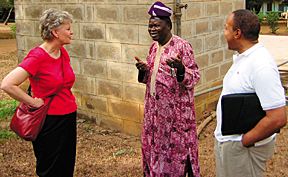
Terri Morgan, president and CEO of Partnership for the Environment (left), and Douglas Washington, a member of Royal Lane Baptist Church in Dallas (right), discuss life at the seminary in Ogbomosho, Nigeria, with a Baptist leader.

But Morgan is optimistic her organization can help resolve the situation. Engineers plan to drill new, deeper wells that should provide water for years to come. Experts will train Nigerians in well maintenance and repair. Workers also will fix some of the piping and pump problems in the community. Volunteers hope to start a landfill and encourage a sewerage management system.

“This is not a hopeless situation,” said Doug Washington, a member of Royal Lane Baptist Church. “It's just one that has to be identified, and a plan has to be laid out to correct it.”

Washington would like to return to Nigeria as soon as possible, but Partnership for the Environment lacks the funds. Leaders are attempting to raise $30,000 to launch the effort before their three-month visas expire and re-entering the largely Muslim nation becomes difficult.

The organization also is recruiting volunteers for the program, particularly experienced engineers, Morgan said.

“If we don't do something, it will only get worse,” said Washington, who is a veteran of water engineering efforts.

This development project can play a crucial role in Baptist work in Nigeria, Morgan said. By bringing Nigerians the water they need, believers would be opening people to the gospel as they improve lives.

"If you want to help people, you meet them at the point of their greatest need," she said. Donations can be made through the PFE website, www.partnershipfortheenvironment.org, or by mailing a check designated "PFE Nigerian Relief" to 333 N. Washington, Dallas 75246. For information about volunteer possibilities, contact Morgan at (214) 828-5190.

News of religion, faith, missions, Bible study and Christian ministry among Texas Baptist churches, in the BGCT, the Southern Baptist Convention ( SBC ) and around the world.


On the Move_50304

Posted: 5/03/04

On the move

Gerald Austin has resigned as interim pastor of Friendship Church in Ennis.

bluebull Byron Ayers to Mildred Church in Corsicana as youth minister, where he had been interim.

bluebull Charlie Barganier to Arcadia First Church in Santa Fe from Heights Church in Temple.

bluebull J.D. Barrow to Ballew Springs Church in Weatherford as youth minister.

bluebull Gary Baxley to Heights Church in Temple as interim minister of music.

bluebull Emil Becker has completed an interim pastorate at Harvey Church in Stephenville.

bluebull Greg Bowers to First Church in Blytheville, Ark., as pastor from Calvary Church in Garland.

bluebull Joe Brady to First Church in Centerville as minister of music and education.

bluebull David Braun to Southcrest Church in Lubbock as minister of student ministries from First Church in Gardendale, Ala.

bluebull Dale Buchanan to First Church in Luella as pastor.

bluebull Sam Burgeson to First Church in Mineral Wells as minister of education/administration from First Church in Lamesa.

bluebull Kelsey Coleman to First Church in Midway as pastor.

bluebull Mike Cord to First Church in The Woodlands as student minister.

bluebull Wayne Cotton to Hampton Road Church in DeSoto as minister of preschool and childhood education.

bluebull Wes Dean has resigned as pastor of Floyd Church in Greenville.

bluebull Norman Diehl to North Creek Church in Centerville as pastor.

bluebull Carl Douglas to Dixie Church in Whitesboro as pastor.

bluebull Gerald Dudley has completed an interim pastorate at Dixie Church in Whitesboro.

bluebull Roger English has resigned as director of missions for Concho Valley Association.

bluebull Dwight Foster to Primeria Iglesia in Goliad as pastor, where he had been interim.

bluebull Jay Foster to First Church in Brenham as minister of music.

bluebull Laura Fregin to CityChurch in Dallas as pastor.

bluebull Lee Geffert to First Church in Nixon as youth minister.

bluebull Gary Godkin to Red Springs Church in Seymour as pastor.

bluebull Paul Howie to Leon River Cowboy Church in Eastland as pastor from First Church in Tom Bean, where he was youth pastor.

bluebull Don Inman to Shiloh Church in Itasca as pastor, where he had been interim.

bluebull Jim Lafferty to First Church in Calvert as interim pastor.

bluebull Kevin Laseter to First Church in Mount Calm as interim minister of music.

bluebull Dave Lingenfelter to Fairview Church in Sherman as music minister.

bluebull Richard Macellaro has resigned as pastor of Downtown Chapel in Sherman.

bluebull Robert Magee to First Church in Roosevelt as pastor from Emmanuel Church in Lubbock.

bluebull Glenn McCollum to First Church in Wortham as interim music minister.

bluebull Dale McDaniel to First Church in Tehuacana as pastor.

bluebull John McDonald has resigned as pastor of First Church in Calvert.

bluebull Brian McKay to North Side Church in Weatherford as interim childhood minister.

bluebull Joe Meador has resigned as minister of music and youth at First Church in Campbell.

bluebull George Merriman to Leona Church in Leona as interim minister of music.

bluebull Larry Morris to First Church in Teague as associate pastor and minister of music.

bluebull Franklin Orr to Bethsaida “Y” Church in Bivins as interim pastor.

bluebull Greg Qualls to First Church in Olton as youth minister from Halfway Church in Halfway.

bluebull Stephen Richardson to First Church in Thorndale as minister of youth.

bluebull Steve Schuler to First Church in Golinda as minister of music.

bluebull Howard Schutt to Northside Church in Corsicana as administrator.

bluebull Scott Shaw to First Church in Hillsboro as minister of music.

bluebull Russell Shires has resigned as pastor of Pilot Grove Church in Whitewright.

bluebull Tracy Sims to First Church in Groesbeck as interim pastor.

bluebull Terry Snow to East Denison Church in Denison as children's ministry intern.

bluebull John Stewart to Henderson Street Church in Cleburne as worship leader.

bluebull Mark Still to First Church in Marlin as interim pastor.

bluebull Steve Tompkins to First Church in Palacios as pastor from First Church in Menard.

bluebull Larry Wilson to Central Church in Hillsboro as interim minister of music.

bluebull Forrest Wood to Harvey Church in Stephenville as pastor from Waller Church in Waller.

bluebull Robert Works to First Church in Sherman as minister of administration/education.

bluebull John Yeates to First Church in Kingwood as minister of adult discipleship from First Church in Vernon, where he was minister of education and administration.

bluebull Edwin Young to Southcrest Church in Lubbock as associate pastor of media ministry from Central Church in Henderson, N.C., where he was minister of youth and media.

News of religion, faith, missions, Bible study and Christian ministry among Texas Baptist churches, in the BGCT, the Southern Baptist Convention ( SBC ) and around the world.


Oregon judge halts gay marriages, instructs state registrar to record unions for benefits_50304

Posted: 5/03/04

Oregon judge halts gay marriages, instructs
state registrar to record unions for benefits

By Robert Marus

ABP Washington Bureau

WASHINGTON (ABP)–Both sides of the gay-marriage debate found something to cheer in an Oregon judge's recent decision to put a halt to the same-sex marriages one county in the state had been performing.

Multnomah County Circuit Judge Frank Bearden ordered a halt to gay marriages in that county, the state's most populous and home to the city of Portland. Officials there had been issuing same-sex marriage licenses since March 3, when county supervisors decided their policy against offering marriage licenses to gay couples violated the Oregon Constitution.

But Bearden also ordered the state registrar to record more than 3,000 same-sex couples who have been married in Portland since March 3. He agreed denying the couples more than 500 state benefits that accrue to married couples would be impermissible under the state constitution.

Bearden further ordered the Oregon legislature to deal with the issue of same-sex marriage within 90 days of the beginning of its next session, which convenes in June. He said the legislators would have to find a way to provide equal protection to same-sex couples–whether through full-fledged marriage or a “civil union” arrangement that extends the same benefits as marriage.

He also said the Oregon Supreme Court could further settle the issue. However, that is unlikely to happen before the legislature's deadline. Bearden said he would order Multnomah County to begin re-issuing marriage licenses to same-sex couples if the legislature fails to act by the 90-day deadline.

Bearden's ruling is virtually certain to be appealed.

The county had been the last municipality in the United States still marrying same-sex couples after judges ordered city or county officials in California, New York and New Mexico to cease similar actions over the last two months.

However, that will change May 17, when a Massachusetts Supreme Judicial Court ruling ordering that state to begin issuing marriage licenses to same-sex couples takes effect.

Legislators in that state have given initial approval to a constitutional amendment banning same-sex marriage, but it will not take effect for at least another year. Massachusetts anti-gay-marriage groups have filed a motion with the court to stay its ruling until the amendment process is played out. However, most legal observers don't believe the court will grant the motion.

One Washington-based conservative group that has been fighting against gay marriage offered limited praise to the Oregon ruling. “Today's decision is a victory for those of us who were seeking an immediate stop to the illegal distribution of same-sex 'marriage' licenses,” said Family Research Council President Tony Perkins.

“However, the court's logic is flawed in stating that it is the Oregon Supreme Court who ultimately must decide the fate of marriage in that state. Public policy decisions, especially those as far-reaching as the radical redefinition of marriage, are meant to be determined by the people and their elected representatives in the legislature, not judges.”

Meanwhile, the head of the nation's largest gay-rights group said Bearden's decision offers some victories to her cause. “Judge Bearden recognized that Oregon can't differentiate between opposite-sex and same-sex couples when doling out the rights of marriage,” said Human Rights Campaign President Cheryl Jacques. “To do otherwise would be fundamentally wrong.”

However, Jacques said offering marriage-like civil unions in Oregon–similar to what is already practiced in Vermont–would be an insufficient resolution.

“We hope the appeals court recognizes that marriages, and only marriages, provide true equality for same-sex couples,” she said. “Vermont's civil unions were a great step forward, but they provide only a limited portion of rights.”

News of religion, faith, missions, Bible study and Christian ministry among Texas Baptist churches, in the BGCT, the Southern Baptist Convention ( SBC ) and around the world.


Christians face persecution, charges of blasphemy in Muslim Pakistan_50304

Posted: 5/03/04

Christians face persecution, charges
of blasphemy in Muslim Pakistan

By Deann Alford

Religion News Service

LAHORE, Pakistan–A market vendor sold Christian brothers Saleem and Rasheed Masih ice cream, then told them they had to pay for the bowls because he couldn't again serve a Muslim from the now-defiled utensils.

The brothers refused. Days later, the vendor accused the brothers of verbally insulting the Prophet Mohammed. Under Pakistani law, Section 295-C, that's blasphemy, which can be punishable by life in prison, a stiff fine or death.

The Masihs were sentenced to 35 years. They spent four years in Sahiwal Central Jail before a Lahore High Court judge acquitted them in April 2003.

But the case received wide press coverage. Fundamentalist Muslims who refused to believe their innocence immediately began pursuing them. The brothers left the jail in one car and switched to a different one as they fled into hiding. They shaved their beards and have lived in three cities since their release from prison to protect themselves from violent mobs.

A year after their acquittal the brothers, who are Roman Catholic, remain in hiding as they seek asylum in the West.

“We can't go home to our village. In Islamabad, people are looking for us. Our lives are in danger,” Rasheed Masih said. “In Pakistan, there isn't any safe place (for us).”

The Masihs are among a growing number of Pakistanis, both Christian and Muslim, whose lives have been thrown into turmoil because of allegations of blasphemy. According to prominent Karachi-based Christian attorney M.L. Shahani, from 1948 until 1986, only 14 blasphemy cases were registered. But from 1987 until 1999, 44 stood accused of blasphemy, and in 2000 alone, 52 cases were registered–43 against Muslims and nine against Christians.

Pakistan's Christian community claims to be some 4 million strong in a country of 150 million.

“Anybody can go to a police station and register a case under Section 295-C against any person,” Shahani writes in an undated report titled “Sharia and State.” “The police would immediately register a case and arrest the accused without checking the veracity of the facts.”

An accusation by a single person is all that's needed to put the alleged blasphemer behind bars, where he must prove his innocence, said Elizabeth Kendal, the World Evangelical Alliance Religious Liberty Commission's main researcher and writer. The charge of blasphemy itself inflames Muslim sensibilities so much that even before an arrest is made, irreparable and fatal damage has been done.

“The amount of suffering a charge of blasphemy produces is so great that the blasphemy law must be considered a serious problem,” she said. “The accusation virtually turns the victim into a 'dead man walking.'”

During colonial rule, the British enacted the blasphemy law to protect the religious sentiments of minority Muslims against majority Hindus. The law should have been abolished after Pakistan's creation as a state for Muslims, Shahani said.

Joseph Francis, director of the Lahore-based Christian organization Centre for Legal Aid Assistance and Settlement, or CLAAS, said that lower courts punish all blasphemy cases “but higher courts acquit them after investigations.” CLAAS lawyers defended the Masih brothers.

But simply abolishing that law today isn't so easy. In the early 1990s, the Supreme Court upheld its constitutionality. Pakistan President Pervez Musharraf, who came to power in a 1999 coup, sought to repeal it, but a violent public outcry and general strike forced an end to his efforts. The presence of militant mobs can pressure judges to rule against defendants in even the most absurd of accusations. Fundamentalists often threaten courts that find accused blasphemers innocent.

In response to the rising numbers of blasphemy cases, CLAAS has joined Christian lawyers and political leaders in preparing a bill that will criminalize filing false blasphemy charges. Christian lawmaker Akram Gill aims to introduce the bill in the current session of Parliament.

Because the blasphemy law is used more against Muslims than those of minority faiths, Muslim opposition to the law is rising. “But it will take time,” Francis said. After the new bill is drawn up, lawmakers will need at least six months to process it. And it, too, may be met by extremist violence.

Meanwhile, as Saleem and Rasheed Masih feel pressed to leave Pakistan and begin new lives in a safer place, Saleem said that his faith sustains him in the interim. “We are optimistic that God has plans for us,” he said. “We are witnesses of God, and he will help us preach the gospel.”

News of religion, faith, missions, Bible study and Christian ministry among Texas Baptist churches, in the BGCT, the Southern Baptist Convention ( SBC ) and around the world.