‘Conservative resurgence’ leaders swap 25 years worth of war stories_62804
Posted: 6/25/04
 |
|
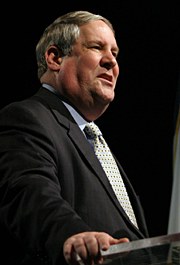
| Paul Pressler and Paige Patterson were among those who reminisced during a "conservative resurgence reunion" the night before the start of the 2004 SBC annual meeting. | |
'Conservative resurgence' leaders
swap 25 years worth of war stories
By Steve DeVane
North Carolina Biblical Recorder
INDIANAPOLIS (ABP)–An architect of the “conservative resurgence” in the Southern Baptist Convention acknowledged that in the heat of battle during the denominational controversy, he and his colleagues considered a proposal to split the six Southern Baptist Convention seminaries with moderates.
Paige Patterson said the suggestion that conservatives and moderates each get control of three seminaries was made because some leaders of the “resurgence” feared conflict was hurting the convention.
 |
The idea was put aside, Patterson said, after a pointed objection from Homer Lindsay Jr., former co-pastor of First Baptist Church in Jacksonville, Fla.
Lindsay, who died of cancer in February 2000, stood during a discussion about the plan, announced he was leaving and called others in the room a “bunch of wimps,” Patterson recalled.
“I thought I was with men of God,” Patterson quoted Lindsay as saying.
Patterson told the story during a “conservative resurgence reunion” the night before the start of the 2004 SBC annual meeting, during which participants celebrated the 25th anniversary of their rise to power in the SBC.
Patterson used the story as an example of how God guided the convention's sharp turn to the right.
Supporters of the movement generally refer to it as the “conservative resurgence.” Critics tend to call it the “fundamentalist takeover.”
Religious Right leader Jerry Falwell led the opening prayer for the conservative reunion, which attracted about 600 people to the late-night celebration. Falwell is pastor of Thomas Road Baptist Church in Lynchburg, Va., which was an independent Baptist congregation before affiliating with the SBC in recent years.
“I was not a Southern Baptist when you guys hijacked it, but I joined soon after,” he joked before praying.
Planners said the reunion was intended to remind younger Southern Baptists of the problems that prompted the conservative “take-back” of the SBC.
Richard Land, president of the SBC's Ethics & Religious Liberty Commission, said the reunion was necessary because great events should be commemorated. But he said there was another reason for the celebration.
“Those who do not know their history and do not learn from history are doomed to repeat it,” he said.
Land, who presented a historical review, said he believes God will bless the SBC.
 |
| Richard Land |
“We believe God has tested us and he has found us faithful,” he told participants.
Speakers at the rally also included Patterson and Paul Pressler. The two are widely credited with beginning the conservative movement after they realized SBC presidents held a great deal of power over the appointment of trustees to SBC seminaries, agencies and institutions.
In the 1970s, Patterson and Pressler preached liberalism was taking hold in the SBC–particularly in the seminaries. They organized people to come to SBC meetings to elect like-minded presidents.
Patterson now is president of Southwestern Baptist Theological Seminary in Fort Worth, the largest of the six SBC schools. He is a former president of the SBC and Southeastern Baptist Theological Seminary in Wake Forest, N.C.
Pressler has served in several key SBC trustee posts.
Reunion participants gave Patterson and Pressler two standing ovations.
Before the meeting, Pressler, a retired judge from Houston, talked with admirers and posed for photographs. He said during the meeting he felt overwhelmed.
Pressler, author of “A Hill on Which to Die,” a memoir of the “resurgence” from his perspective, said Southern Baptists must not rest on their laurels.
“My friends, if we hesitate, we're going to lose it,” he said.
Jim Richards of the Southern Baptists of Texas Convention–a group that broke away from the Baptist General Convention of Texas–said the younger generation must know about the movement.
“We must never lose sight of the methodology that was used,” he said. “Although we consider ourselves all conservatives, we must not wink at someone who may be wavering.”
The reunion also included video clips of sermons by W.A. Criswell, late pastor of First Baptist Church of Dallas, at the 1985 and 1988 SBC meetings.
Jerry Johnson, president of Criswell College in Dallas, said the 1988 sermon was especially important when conservatives won the SBC presidency by a close margin.
“Dr. Criswell, I believe, turned the tide,” Johnson said.
The video clips started with Criswell asking if he could talk about liberals, whom he said were then becoming known as moderates.
“A skunk by any other name still stinks,” he said to cheers from the videotaped audience and the reunion.
But a former SBC agency executive who was asked to provide a reaction said he was “not impressed” by the celebration.
“Almost without exception, the people I have known across the decades in Southern Baptist life have been Bible-believing conservatives,” said Lloyd Elder, president of the denomination's Sunday School Board from 1984 until 1991.
“So, to have this kind of very sad and continuing battle was not necessary and has not done the kind of good that was claimed.”
Elder noted that, early on in the controversy, many of the conservative movement's leaders claimed they were simply looking for “parity” of conservative representation on the boards of Southern Baptist institutions.
“If there had been such a desire for shared leadership on the part of some of the fundamentalists as is claimed, then why is that not what they have done since they have been in power?” he asked.
Elder noted moderate Southern Baptists now are effectively barred from holding elected or appointed office in the denomination.
“The very nature of power in a democratic society … is the responsibility of the majority to protect the rights of the minority.”
Elder said he was impressed with the effectiveness of the conservative movement, though.
“If their goal was to be in control of the SBC, they have just done a remarkable job,” he said.
However, he added, “If their goal had been to involve the largest number of Bible-believing Southern Baptists in the kingdom cause of Christ as possible, they have been woefully negligent.”
With additional reporting by Robert Marus of Associated Baptist Press


 Educate people on the issues.
  Register people to vote. Churches can sponsor voter registration drives without threatening their tax-exempt status, he said.