Cybercolumn by Brett Younger: Do you dare to wait?_101804

Posted: 10/08/04

CYBERCOLUMN:
Do you dare to wait?

By Brett Younger

Stephen O’Brien, an investigative reporter who’s always on the lookout for breaking news, published a thought-provoking piece on how to pick the right checkout line. His article in the Waco Tribune-Herald is a compelling look at, and this is a quote, “the pain of waiting longer than necessary—even if it’s just a few seconds.”

The author offers tips on how to avoid the anguish of extra seconds in line:

On the way into the grocery store, look for efficient cashiers.

Avoid checkers with blinking lights or name tags that say things like “Hi, I’m Mike. This is my first day.”

If you hear the words “price check,” move quickly in the opposite direction.

In addition to evaluating cashiers, don’t forget that sackers play a critical role. If bag-boy help looks thin, consider a longer line that has customers with fewer groceries.

Brett Younger

Don’t look just at the length of lines, but also at who’s in the line. Stay away from distracted shoppers who are less likely to fill out checks ahead of time. The article is mercilessly critical of those who wait until the transaction is complete to swipe their credit card though the machine. Everyone knows that they should do that as soon as the cashier starts ringing them up!

Steer clear of customers with coupons or an abundance of produce.

Once you’ve processed all the variables, pick a line and don’t look back. The article quotes one embarrassed shopper saying: “I don’t put a lot of thought into the checker or exactly what the customers in line are buying. Maybe I should.” The implied response is: “Of course, you should. What’s wrong with you? You don’t deserve a place in the express line.”

Is it just me, or is it scary that newspapers assume that we worry about “the pain of waiting longer than necessary—even if it’s just a few seconds”? If journalists are investigating how to pick the quickest checkout line, shouldn’t we all be asking whether we’re in too much of a hurry? The problem isn’t the speed of the cashiers. We are the problem.

We complain that we don’t have enough time. There’s so much to do—earn a living, explore a vocation, nurture relationships, care for dependents, get exercise, schlep over-programmed children from one activity to another, clean the house. Time abhors a vacuum.

Modern technology promises to make our lives easier, but in the end, computers and cell phones increase the pace of work. We can no longer say that a proposal is in the mail; they’ll tell us to fax it. Prior to cell phones, we relaxed when we were driving. Now, even if we don’t have a cellular phone, it’s hard to relax knowing that other drivers do.

We want everything fast—fast food, eyeglasses in an hour, drive-through banking. Like the white rabbit in “Alice in Wonderland,” we’re always in a hurry. There’s never a moment when there’s not something else we should be doing. We carry a list of errands in our head. We fill every minute.

How many times have you thought, “I wish there were a few more hours in the day”? The assumption is that given more hours we would accomplish more of what we want to get done. What’s more likely is that it would only mean more hectic hours to live through each day. Maybe we should wish for a shorter day, so that the crazy pace of our lives would be limited to fewer hours.

When we believe that busyness is noble, we measure our days by how much we get done, stop measuring things that matter more and hardly recognize the gifts we’ve been given. We lose our ability to play. We lose our passion. We forget our priorities. The psychiatrist Carl Jung said: “Hurry is not of the devil. Hurry is the devil.”

So here’s what we should do: We should take a break. We should stop working, thinking about work, or talking about work. We should rest. Relax. Breathe. Sleep. Dream. Hope. Think. Contemplate. Read. Reflect. Pray. Play. Walk. Talk. Listen. Sing. Dance. Love. Celebrate.

We should stop long enough to look at the world, see that much of it is good, and give thanks. We should stand back and view our lives the way that an artist stands back from the canvas to get a broader perspective. We should take our lives off the easel to get a better look. Attaining some degree of independence from our routine can be the difference between feeling like a gerbil on a spinning wheel and giving thanks for the gift of life.

We should slow down by finding a nice long line in which to stand.

Brett Younger is pastor of Broadway Baptist Church in Fort Worth and the author of “Who Moved My Pulpit? A Hilarious Look at Ministerial Life,” available from Smyth & Helwys (800) 747-3016.

News of religion, faith, missions, Bible study and Christian ministry among Texas Baptist churches, in the BGCT, the Southern Baptist Convention ( SBC ) and around the world.


javascript testing_100404

Here's the code:


‘Aiding spaces’ at 121 Community Church_100404

Posted: 10/01/04

Allen Branam stops to reflect on the messages of thanks left for him and his crew of volunteers from 121 Community Church who remodeled the house of a family in need.

'Aiding spaces' at 121 Community Church

By John Hall

Texas Baptist Communications

GRAPEVINE–If healthy families begin with healthy homes, 121 Community Church recently gave several families a huge shot in the arm.

To celebrate the congregation's fifth anniversary, members remodeled the homes of several families who live between Dallas and Fort Worth. The families are not members of the church but were selected through an interview process.

The project, dubbed “Aiding Spaces” after the cable television show “Trading Spaces,” included repairing homes in many cases, as well as painting, carpeting, insulating and redecorating–all in 48 hours.

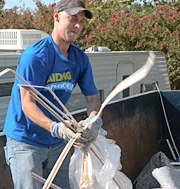
Josh Phillips throws trash into a large dumpster in front of a home 121 Community Church members remodeled.

Allen Branam, who directed the effort at one of the homes, said the stories of each family touched the congregation in a unique way. The house where he was working provided shelter for a single mother of four children, three with special needs. Hearing her testify about how God is working in their lives led him to want to help them.

“It just grabbed me,” Branam said. “I can't tell you how or why.”

While the family rested in a hotel paid for by the church, volunteers put in hardwood floors, added air conditioning to a room, replaced furniture, erected a wall and gave the family new pots and pans, as well as its first set of matching dishes.

The family's gratitude was clear even before construction started. Each member wrote notes on the walls for volunteers to read. Many praised God's goodness. Others were expressions of thanks to the workers. Long poems were written in several parts of the house. The family marked “God is good” on many of the windows.

The project took hold of the community as well. Neighborhood residents were drawn to the project and the number of volunteers surged from 30 per house to 75. Other individuals bought toys for the children. Hardware stores donated materials.

“I've not yet called anyone who has said, 'No, I will not donate,” Beth Brockert said before the construction started.

Workers gathered at the end of construction to present the homes to the residents and celebrate the work. The congregation viewed a video of the project that was shot in a reality-show style.

“I think this is where I'm supposed to be,” Brockert said. “This is where the Lord want me to be.”

News of religion, faith, missions, Bible study and Christian ministry among Texas Baptist churches, in the BGCT, the Southern Baptist Convention ( SBC ) and around the world.


Learn to control, channel anger into positive outlets, therapist recommends_100404

Posted: 10/01/04

Learn to control, channel anger into
positive outlets, therapist recommends

By George Henson

Staff Writer

DALLAS–Anger is not a sin; it's an emotion that needs to be controlled and channeled into positive action, Mark Gomez, a therapist with Rapha Christian Counseling, told youth ministers during a workshop at Lakeside Baptist Church in Dallas.

The workshop was part of series sponsored by Dallas Baptist Association for youth ministers.

Time constraints, finances, children, car problems and a myriad of other problems constantly build pressure in lives–just like what happens when a soft drink can is shaken, Gomez observed.

The question, he said, is whether the pressure is going to be expelled in small, safe bursts or spewed all over people nearby.

“You're always going to have pressure,” Gomez asserted. “The question is 'How are you going to channel it, release it, control it?'”

Gomez, a former pastor, said the Bible gives evidence that anger is a neutral emotion and can be channeled for either good or bad.

He pointed to Proverbs 17:27, which says a wise man is even-tempered.

“He is even-tempered, not non-tempered. It doesn't say he doesn't have anger. It says he controls it,” Gomez said.

“Anger is natural and spiritual. It is a part of human nature, but it also is a part of God's nature.”

He explained that being created in the image of God makes humans moral creatures with a concern for right and wrong.

But anger is an emotion that must be kept under control, he cautioned.

“Anger is power; it's like dynamite,” he said.

He also compared it to a river. “Like a roaring river, it can wipe out a village, or it can be channeled to produce electrical power for that village.”

The first step in channeling anger is to know what precedes it.

“Pay attention to your body and how it is that your body does anger. Pay attention to your kids in your youth group and what they do when they are feeling the pressure build, but also pay attention to yourself,” he counseled the youth ministers.

It is important to deal with anger before it becomes the controlling factor, Gomez said.

“If I'm going to work with someone on their anger, the last place I'm going to start is the feelings. Thoughts are the key,” he said. “Anger as an emotion is something you can't control directly.”

Gomez used a volcano as another illustration of anger. Behaviors are the rock and lava that spew from the top, but other forces beneath the surface are the real cause.

“Anger is not a primary emotion. It is secondary. It has to have another core emotion to get anger going,” he said.

“You never vomit from the neck up. It has to have a deeper source. Anger is the same way. Something deeper is needed to push it up.”

Some of the core emotions that fuel anger are frustration, fear, hate, depression, grief, guilt and shame.

“While anger sometimes seems like it comes out of nowhere, if you do an 'anger autopsy,' you'll see the patterns involved,” he said.

Anger often begins in a gap between expectations and reality.

“The gap between our expectations and reality are where emotions are born,” Gomez said. “The farther our expectations are from reality the more volatile the emotion.”

Part of changing expectations is changing thoughts and words. Words like “must,” “never” and “always” provide for unrealistic expectations. “These are words that demonstrate no flexibility or room for compromise in the way a need can be met,” Gomez said.

Gomez turned to Romans 12:2 to illustrate his point. “We are not renewed by the changing of our emotions, but our minds, our thoughts,” he said. “The bottom line is I need to change my expectations.”

One youth minister at the workshop said he could see how he needed to change some of his thinking to curb his own anger.

“I have to watch having anger toward certain students in my youth group. I'm beginning to see that maybe I have some unrealistic expectations for them–that I don't need to look at them and think, 'You should be better than this by now,'” he said.

Gomez told the youth ministers they can help change the way teens react to frustrations. "Teens are still moldable. The concrete hasn't set yet," he said.

He put on a tool belt that held nothing but different sizes and types of hammers to illustrate.

“Some of us don't have enough different tools in our emotional tool belt–not enough coping skills,” he said.

“Some kids, all they have in their tool belts are hammers for whacking. It may not be physical. It may be verbal, but that can do just as much damage.”

The test for whether anger is healthy is whether it restores relationships or destroys them, he said.

“An angry God aims to restore, bringing people together, to ultimately give them peace. Satan's anger aims to destroy, divide and bring fear,” he said.

Core emotions that may bring on a healthy anger are a hatred of evil, zealousness for righteousness and disappointment.

Gomez used Jesus' cleansing of the temple to illustrate.

“Jesus expected the temple to be a place of worship, and it was turned into a mall where common people were being used and abused to the point where the last thing on their minds was worship. And worship was supposed to be the only purpose for the temple,” he said.

“God has the same zeal for cleansing the lives of young people and restoring them, just as he did that temple 2,000 years ago,” Gomez added.

News of religion, faith, missions, Bible study and Christian ministry among Texas Baptist churches, in the BGCT, the Southern Baptist Convention ( SBC ) and around the world.


Christian therapist Mark Gomez offers 10 tools for beating stress_100404

Posted: 10/01/04

Christian therapist Mark Gomez
offers 10 tools for beating stress

Get a grip on yourself.

You are in contol of your emotions. You may not be able to change the outside world, but you can learn to deal with it.

bluebull Recognize you are in charge of your stress.

You have control over most of your activities. Prioritize your time to reduce stress.

bluebull Determine the importance of a situation.

Not getting invited to a party is not the end of the world. It may seem that way, but there will be other parties.

bluebull Go easy on yourself.

No one is perfect. Try hard and do your best. That's all anyone can ask of you.

bluebull Take one thing at a time and prepare for it.

Prioritize your time. Don't wait until the night before to study for two tests. Keep a calendar of activities.

bluebull Take care of yourself.

Eat healthy food, exercise and get enough rest. Drugs and alcohol only lead to bigger problems.

bluebull Laugh or cry to relieve your tensions.

Laugh at yourself. It's hard to do, but it helps reduce stress.

bluebull Get involved.

You will have less time to be sad, bored and lonely if you stay busy.

bluebull Visualize.

Use your mind to “see” how you can manage a potentially stressful situation.

bluebull Don't suffer in silence.

An honest talk with someone you trust helps you get rid of bottled-up feelings and see things in a different light.

News of religion, faith, missions, Bible study and Christian ministry among Texas Baptist churches, in the BGCT, the Southern Baptist Convention ( SBC ) and around the world.


Around the State_100404

Posted: 10/01/04

Around the State

Tom Moritz, assistant professor of marketing for the Hardin-Simmons University Kelley College of Business for 24 years, has retired.

bluebull Henry Morin, Lauren Clemens and Brent Burks have been hired as admissions counselors at the University of Mary Hardin-Baylor.

bluebull East Texas Baptist University has added four faculty members–David Collins, instructor in kinesiology and associate athletic trainer; Shane Fuller, assistant professor of theater arts; Donald Spencer, associate professor of chemistry; and Stanley Self, instructor in accounting.

First Church in Early held a noteburning ceremony to celebrate paying off the note on the congregation's Christian Activity Center. Participating were Pastor Eddie Ailshie (left) and deacon Jerry Wheat.

bluebull Baptist Hospital in Beaumont will hold a training program for registered nurses interested in becoming a congregational nurse. Classes will be held Nov. 17-20 at the Holy Family Retreat Center in Beaumont. Call Rebekah Seymour at (409) 212-5648 for more information or to register.

Anniversaries

bluebull First Church in Wimberley, 120th, Aug. 15. Bill Jones is pastor.

bluebull Gregorio Albineda, 20th in the ministry, Sept. 19. He has been pastor of Iglesia Calvario in Vernon eight years.

bluebull Dan McClinton, 25th as associate pastor, minister of music, and formerly minister of education at The Oaks Church in Grand Prairie, Sept. 23. Prior to relocation, the church was known as First Church of Oak Cliff in Dallas. His wife, Myla, has served as pianist, organist and preschool director during the same time period.

bluebull Charles Davenport, 30th as pastor of First Church in Tulia, Sept. 26.

bluebull First Church in The Woodlands, 25th, Oct. 2-3. The church held a community give-away on Saturday as part of the celebration, where members of the community could claim items given by church members. Founding Pastor W.D. Broadway attended. Pete Freeman is pastor.

bluebull Good Hope Church in Three Rivers, 100th, Oct. 10. A barbecue luncheon will follow the morning service. People attending are asked to bring photos and recipes for inclusion in an anniversary scrapbook. A second service will begin at 1 p.m. Guest speakers for the day will include area pastors Chris Walker and Lee Bevly, and former director of missions for Blanco Association Claude Jacks. Guest singers will be The Baileys and Song of Glory. David Darling is pastor.

bluebull Fairplay Church in Carthage, 100th, Oct. 10. A luncheon will follow the morning service. An afternoon service and reception will begin at 1:30 p.m. David Murrell is pastor.

bluebull First Church in O'Donnell, 90th, Oct. 10. A noon meal and afternoon service will follow the morning service. Scott Hensley is pastor.

bluebull Broyles Chapel Church in Palestine, 65th, Oct. 16-17. Saturday at 5 p.m., the church will hold a barbecue to honor the fire department, sheriff's department and other emergency personnel. Local officials and former pastor Ken Rawson will speak. On Sunday, flautist Lino Lopez and singer Lorraine Handorf will participate in the morning service. Mike Smith, director of missions for Dogwood Trails Area, will preach. The church's history also will be remembered and the congregation's new facility dedicated. A handmade quilt will be auctioned to benefit the building fund. Willie Reagan is pastor.

bluebull First Church in Seymour, 120th, Oct. 24-31. The preaching schedule of former pastors includes Rick Markham, Sunday; Jerry Lemon, Monday; Joe Ainsworth, Tuesday; Don Chaffin, Wednesday; Corky Karka-lits, Thursday; and Tommy Culwell, Saturday. Markham's sermon will be at noon, all others at 6 p.m. Fellowships will follow each service. There will be no Friday night activities. Oct. 31 will be high attendance day and a lunch will follow the morning service. Glenn Shock is pastor.
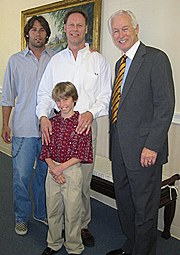
Pastor Ray Vickery of Royal Lane Church in Dallas (right) recently baptized three generations of the Berrier family–father, Sean; grandfather, J.J.; and son, Austin.

bluebull Hollie Briscoe, 20th, as pastor of Caranchua Chapel in Bay City.

bluebull Bosqueville Church in Waco, 150th, Nov. 7. Speaking in the morning service will be former pastors Preston Taylor and Jim Houser, and former Music Minister Bert Crossland will lead the congregation in worship. A luncheon and time of fellowship will follow the service, during which other former pastors and members will have the opportunity to speak. A video of past events in the church will be shown throughout the afternoon. Brad Herridge is pastor.

bluebull Update: Former Pastor Otis Testerman will not be able to attend the anniversary services at First Church in Breckenridge Oct. 9-10.

Retiring

bluebull Don Blackley, as associate pastor of music and worship at First Church in Richardson, Sept. 30. He served the church 13 years, and has been in the ministry 45 years. He previously served First Church in Norman, Okla., and Shiloh Terrace Church in Dallas. The church will hold a reception in his honor Oct. 10 at 6:30 p.m.

bluebull Larry Taylor, as pastor of Holly Brook Church in Hawkins, Oct. 31. He has served the Hawkins congregation 13 years and has been in the ministry more than 45 years. Other places of service include Northwest Hills Church in San Antonio, First Church in Arlington and Moyer Church in Moyer, Okla. He also was Baptist Student Ministries director at Kilgore and Panola colleges and the University of Texas at El Paso. He can be reached at (903) 769-5164.

Licensed

bluebull Bobby Spangler to the ministry at Trinity Church in Quanah.

bluebull John Messenger and Chris Uhlaender to the ministry at First Church in Wimberley.

Ordained

bluebull Clinton Staj to the ministry at College Heights Church in Plainview.

bluebull David McPherson and Jason Dean to the ministry at Coryell Community Church in Gatesville.

bluebull John Lay to the ministry at First Church of Urbandale in Dallas.

bluebull Dennis Kelly, Sara Lee and Pat Whisenant as deacons at Broadway Church in Fort Worth.

bluebull Milton Watson as a deacon at First Church in Seguin.

Deaths

bluebull Jesse Leonard, 77, Sept. 9 in Kerrville. Leonard served the U.S. Marine Corps as a dog trainer. After graduation from Wayland Baptist University, he began a life of ministry, serving churches in Texas, Washington and Georgia. He was preceded in death by his wife of 52 years, Carolyn; brothers, Lester and William; sisters, Laverne Newman and Roberta Stevens; and grandson, Jason Ray. He is survived by his wife, Lynn; daughters, Gina Ireland and Gay Ivey; sons, Ray, Jay and Trenton; brothers, Joe, Dinzel and Aubrey; and eight grandchildren.

bluebull Ray King, 72, Sept. 28 in Corpus Christi. A deacon at First Church in Bishop, he participated in Texas Baptist Men disaster relief projects. Missions work took him to Honduras, Brazil, Ecuador, Germany, England, The Netherlands and Scotland. He also served as a coordinator for missions groups in the Texas-Mexico border region. He is survived by his wife of 50 years, Deloris; daughters, Del Rhea Watson, Glenann Gebhart and Jill King; and three grandchildren.

Events

bluebull A select vocal ensemble and hula dancers from Hawaii Baptist Academy will perform in Texas churches as part of an October tour. Included among the stops will be First Church in Tulia, 11 a.m. Oct. 3; First Church in Amarillo, 6:30 p.m. Oct. 3; First Church in Texarkana, 6:05 Oct. 6; Mobberly Church in Longview, 9:30 and 10:45 a.m. Oct. 10; First Church in Tyler, 6 p.m. Oct. 10; First Church in Winnsboro, noon Oct. 11; Columbus Avenue Church in Waco, 7 p.m. Oct. 11; First Church in Richardson, 6:30 p.m. Oct. 13; Broadway Church in Fort Worth, 10:50 a.m. Oct. 17 and Wedgwood Church, 6 p.m. Oct. 17.

bluebull A dinner theater will be presented Oct. 7-9 and 14-16 at Park Central Church in Dallas to benefit the Well Community Center, a home for the mentally ill. Tickets are $16 and include a dinner from La Madeleine; tickets are specially priced for the Oct. 9 gala performance. For tickets, call (972) 661-8888 or (972) 669-8517.

bluebull A Southern gospel concert will be held at Lakeside Church in Dallas Oct. 15 at 7 p.m. Featured performers will be The Galileans, The Wills Family, The Jubil-Heirs, Trusting Hearts and Sylvia Green. The concert will benefit Mission East Dallas, a clinic offering Christ-based health care to low-income and uninsured residents of eastern Dallas County. The clinic began as a ministry of Shiloh Terrace Church in Dallas, and now also partners with Casa View, Gaston Oaks, Lake Highlands and Lakeside churches in Dallas, as well as St. Pius X Catholic Church. Adult admission is $10 in advance or $12 at the door; children are $6. For tickets or more information, call (972) 682-8917.

bluebull First Church in Clint will dedicate its refurbished sanctuary Oct. 17. A lunch will be served. A program of music and testimony will follow in the afternoon. Gayle Hogg is pastor.

bluebull The student ministry of First Church in Denton will hold its annual House of Judgment Oct. 20-31 from 6 p.m. to 9 p.m., except for Oct. 22, 25, 26 and 29 when there will be no performance. An alternative to haunted houses, it is a walk-through drama of 10 scenes. It takes approximately 40 minutes and is not recommended for children younger than sixth grade. Admission is $5, and reservations are required for groups of 10 or more people. Call (940) 382-2577, ext. 194 for group reservations.

bluebull The Heights Church in Richardson will offer a free festival that will include a petting zoo, preschool bounce house, rock climbing wall and many other attractions Oct. 27 from 6 p.m to 8 p.m.

Revivals

bluebull College Avenue Church, McGregor; Oct. 3-7; evangelist, Malcolm Ellis; music, Sherman and Tammy Aten; pastor, David Thompson.

bluebull Old Palestine Church, Lufkin; Oct. 8-10; evangelist, Curtis French; music, Brush Arbor and One Way; pastor, Dan Eakin.

bluebull Immanuel Church, Paris; Oct. 10-13; evangelist, Chet Haney; music, Alan Shoumaker; pastor, Randall Scott.

bluebull First Church, Vernon; Oct. 10-13; evangelist, Bubba Stahl; pastor, Derrell Monday.

News of religion, faith, missions, Bible study and Christian ministry among Texas Baptist churches, in the BGCT, the Southern Baptist Convention ( SBC ) and around the world.


Autistic child’s gift teaches lesson about God’s love; leads to church start_100404

Posted: 10/01/04

Autistic child's gift teaches lesson
about God's love; leads to church start

By George Henson

Staff Writer

THORNDALE–Some people think the days of miracles are past, but Pastor Larry Griffith says he knows better. He's seen God use a child's toy to start a church.

Griffith took a step of faith when he prepared to travel to Brazil with Evangelist Sammy Tippit this summer, leaving behind his pregnant wife.

“One of the hardest things I've ever had to do was get on that plane instead of staying with her,” Griffith said.

But he still felt God's leading to go. He received confirmation as he said his goodbyes to his two sons.

His oldest son, Dallas, is 9 years old. He also is autistic. His father says Dallas lives primarily in his own world, and the key components of that world are his little toy Hot Wheels cars.

“He is very possessive of his toy cars and had his favorite one that he always kept with him–his security blanket–in his hand,” Griffith recalled.

While some autistic children are not very vocal, Dallas is. Dallas asked his father to bring him back a car from his trip.

“Part of the price you pay for being a preacher's kid is that everything is a life lesson,” Griffith said.

“So I preceded to tell him that I would try, but I wasn't sure if I would be able to or not. And he should remember that in Brazil, the children were very poor, and many of them had never had even one car or any other toy.”

Dallas stood before his father for a few seconds and then held out the hand that held his most precious possession.

“He told me to give it to a boy in Brazil. My wife and I were dumbfounded and just stood there in tears,” Griffith said.

Autistic children tend to be self-centered and reluctant to share, he explained.

“We knew at that moment that God was up to something very special,” he said.

The flight from Texas to Sao Paulo, Brazil, was a long one, and all the way there, Griffith's thoughts were drawn back to his son's gift of his most prized possession.

“I began to see that as a picture of what God has done for us–the way he gave his son that we might have eternal life,” he said.

In Brazil, he preached at First Baptist Church in Jardra, and he recounted the story of his son's gift.

In the midst of telling that story and relating to the congregation how it was a picture of God's love, he asked if a 9-year-old boy were present.

A boy named Jefferson came to the front. Griffith presented Jefferson with the first toy he ever possessed on behalf of his son, Dallas, who was giving the first gift he ever gave.

“The congregation just wept,” Griffith said.

After the service, four men said they had been impressed that they needed to share the story of God's gift of love with people in a nearby neighborhood that had no church.

One of the men owned a garage where he worked on cars and said it could serve as a church for the community.

The next day, Griffith and the four men went door-to-door through an impoverished neighborhood. The residents' poverty had hardened their hearts toward God, he said.

“They said, 'God doesn't love me.' But as we shared the story of Dallas' gift and God's gift of his Son, we would see hearts melt, and 27 people gave their hearts to Christ that first day,” Griffith recalled.

The men decided that with so many making professions of faith in Christ, the meetings in the garage could not wait until the next Sunday but needed to start that night.

Each of the 27 who had made commitments to Christ was present.

Griffith and the men continued witnessing to the people and telling the story of a boy's gift and how it mirrored God's gift. By the end of the week, 131 people had made professions of faith in Christ.

When Sunday came, the garage overflowed with people.

“It was the most amazing thing I've ever seen God do–start a church with an 88-cent car,” Griffith said.

The church in the garage still doesn't have a name. Charter members have to go through paperwork and receive city approval before they have an official name.

But unofficially, Griffith has his own name for the congregation.

“I call it First Baptist Church of Dallas.”

News of religion, faith, missions, Bible study and Christian ministry among Texas Baptist churches, in the BGCT, the Southern Baptist Convention ( SBC ) and around the world.


BaptistWay Bible Series for Oct. 10: Christians are ambassadors of reconciliation_100404

Posted: 10/01/04

BaptistWay Bible Series for Oct. 10

Christians are ambassadors of reconciliation

2 Corinthians 5:11-21

By Todd Still

Truett Seminary, Waco

Christian believers arguably are at their worst when they are disconnected from one another and unbelievers. It is easy to become self-absorbed in tasks and routines and to ignore the spiritual and physical needs of neighbors both near and far. When we fail to love our neighbors as we love ourselves, we sin against them and God.

Adding insult to injury, some Christians have embraced a doctrine of election whereby they seek to exonerate themselves from the responsibility of outreach. They reason that God has destined some to be saved (and others to be damned), and nothing can be done to alter divine design.

If this theological orientation were not objectionable enough, some of these “elect” also possess an attitude of hubris and hardheartedness. Their beliefs and behaviors say, “We are the chosen few; all the rest are damned. There is no room in heaven for you; we don't want heaven crammed.”

Christian believers at their best view outsiders as potential insiders and lovingly seek to bring them into the Good Shepherd's fold. This is what the Apostle Paul did in his ministry. Having been entrusted by God with the ministry and message of reconciliation, Paul perceived himself Christ's ambassador (5:18-20). As such, he entreated and sought to persuade people in Corinth and elsewhere to embrace the evangel (5:11, 20).

The text for this week not only highlights Paul's reconciliatory ministry but also gives important insights into the motives and message that underpin Christian ambassadorship.

Because Paul believed Christians would be held accountable by Christ for the way they live their lives (5:10), and because the apostle felt an acute sense of accountability to a holy God in the midst of life (5:11), he sought to persuade people to “walk by faith, not by sight” (5:7). Perhaps some detractors of Paul accused him of trying to please people (Galatians 1:10) and of “breaking his arm trying to pat himself on the back” (5:12). Slanderous accusations notwithstanding, the apostle propounds he has a clear conscience before God and hopes the Corinthians can see their way clear through the smear campaign of his opponents (5:11).

Paul insists his purpose in “setting the record straight” is not to commend himself again to his converts; rather, he is attempting to equip the church with the necessary knowledge and motivation to defend him when others malign him (5:12). While Paul thinks his adversaries are guilty of putting on airs and placing too much value on external appearances (5:12), the Corinthians should have known full well he knew what Samuel of old knew–whereas people look on the outward appearance, the Lord looks on the heart (1 Samuel 16:7). The apostle knew his own heart and did not lose faith (4:1, 16), because Paul, like King David, was a man after God's own heart (1 Samuel 13:14; Acts 13:22).

During the course of his Christian life, Paul was sometimes privy to ecstatic spiritual experiences, including “speaking in tongues” (1 Corinthians 14:18), “being caught up into the third heaven” (2 Corinthians 12:1-6) and certain other revelations (Galatians 2:1). Be that as it may, the apostle, in contrast to those who criticized him, did not make much ado about his mystical encounters with God when relating with the Corinthians. On the contrary, he conducted his ministry with clarity and frankness for the benefit of his congregants in Corinth (5:13).

Spiritual oneupmanship did not drive Paul; Christ's love compelled the apostle. He did not think for a moment, however, that the love of Christ was his individual preserve. His conviction was that Christ's wondrous love as shown through his vicarious death was for any and for all (5:14). Paul was persuaded that there is no shortage of or limit to the love of God in Christ (Romans 5:8; 8:38-39).

Why did Christ die? According to Paul, it was not merely so people could go to heaven. The apostle asserts Christ's physical death led to the spiritual death of all people. What is more, he contends Christ's resurrected life enables those people who believe the gospel to truly live, not for or unto themselves and not for this life only, but for and unto Christ the Lord, both now and forevermore (5:14-15; Romans 14:7-9; Galatians 2:20).

There was a time, Paul acknowledges, when he conceptualized Christ and others “according to the flesh,” that is, from an unregenerate perspective. What was once true, however, was not always true (5:16). His conversion and call, coupled with subsequent theological reflection, led Paul to conclude a new day had dawned and a new epoch had begun in Christ. Resultantly, Paul proclaimed that those who would entrust themselves to Christ could live in the new reality. In Christ, “there is a new creation; the old things passed away, behold new things have come” (5:17).

Paul grounded God's reconciliatory work in Christ's life-giving death. The One who knew no sin became sin so the people who knew sin all too well might experience and express God's righteousness (5:19, 21).

Discussion questions

bluebull If you perceived yourself as Christ's ambassador, what would change in your life?

bluebull Are Christians Christ's ambassadors whether they accept the position or not?

bluebull How is the value of the sacrifice of Christ's life evidenced in the life you lead each day?

News of religion, faith, missions, Bible study and Christian ministry among Texas Baptist churches, in the BGCT, the Southern Baptist Convention ( SBC ) and around the world.


BaptistWay Bible Series for Oct. 17: Paul was faithful in ministry despite hardships_100404

Posted: 10/01/04

BaptistWay Bible Series for Oct. 17

Paul was faithful in ministry despite hardships

2 Corinthians 6:1-13; 7:2-4

By Todd Still

Truett Seminary, Waco

In last week's lesson, 2 Corinthians 5:11-21 was considered–a text centered upon Paul's ambassadorial role as a minister of reconciliation. Paul was convinced God had given him a reconciliatory ministry and entrusted him with the message that “in Christ God was reconciling the world to himself” (5:18-19).

In the passages this week, Paul reflects further upon his apostolic ministry with special reference to the Corinthians. At this point in the letter, the apostle appeals to his own afflictions and affections as well as to his personal character and commitments in an effort to reinforce his recipients in the faith and in their relationship with him.

As one who works with God in reconciling people to God through Christ, Paul enjoins the assembly not to compromise their received faith. He does not want the grace of God they have embraced to be rendered inoperative in their lives (6:1). To iterate their need to act with all due diligence and allegiance to God's kindness made manifest in Christ, Paul cites Isaiah 49:8. The apostle employs this text not only to underscore God's mercy, but also to call the Corinthians to renew their commitment to the gospel. All deferring and delaying will be tantamount to disobedience (6:2).

If the church were impeded in responding positively to the message Paul proclaimed, he insists his ministry is not to blame. Paul contends he had not placed an obstacle in anyone's path (6:3). To support his claim that he is a commendable servant of God, Paul emphasizes his “great endurance” in the face of undefined “afflictions, hardships and calamities” as well as external opposition (“beatings, imprisonments and riots”) and personal exhaustion and deprivation (“labors, sleepless nights and hunger”) (6:4-5).

Paul was intimately acquainted with the spiritual progression he would later articulate in his letter to the Romans–“affliction produces endurance” and “endurance produces character” (5:3-4). Having listed nine illustrative hardships in 6:4-5, Paul notes in 6:6-7 eight virtues that characterize and thus commend his ministry. His ministerial service was marked by moral purity or integrity, knowledge or understanding, patience or forbearance, and kindness.

Moreover, Paul's apostolic work was conducted “in the Holy Spirit” (or less likely, in my view, “in holiness of spirit”), “in sincere love,” “in truthful speech” and “in the power of God.” At the conclusion of 6:7, the apostle indicates he did not enter the “ministerial combat zone” unarmed; rather, he was fully armed by God's righteousness so that he might withstand spiritual onslaughts and prevail in spiritual battle.

The contrast with which 6:7 concludes (right hand/left hand) is followed by two additional contrasting pairs in 6:8 and then by seven antithetical clauses in 6:8-10.

The end of verse 8 suggests that while some regarded Paul as honorable and reputable, others considered him to be dishonorable and without repute. Furthermore, people responded to the apostle as an obscure imposter and as a well-known, trustworthy messenger. The contrasts continue in 6:9-10, where Paul juxtaposes dying with living, punishment with being killed, sorrow with rejoicing, poverty with wealth and the possession of nothing with having everything. Such an incongruous existence would reduce most people to a confused, if not crazed, state, but not so with Paul. Ironically, he regarded the paradox and disparity that typified his ministry to be a seal of its authenticity. Paul knew well another who was a man of sorrows and well acquainted with grief.

On the heels of a riveting description of his apostolic ministry, Paul speaks directly to the Corinthians. He indicates he has opened his mouth and his heart to them (6:11). Moreover, he maintains there is no restriction in his affections toward them, only in theirs toward him (6:12). Like a parent pleading with children, Paul calls upon the church to reciprocate (6:13). Then in 7:2, he reiterates his desire for the Corinthians to make room in their hearts for him. Whatever his detractors might say to the contrary, Paul insists he and his colleagues have not wronged, corrupted or exploited anyone (7:2).

The apostle's motivation for making such assertions is not the condemnation of the congregation. He assures the Corinthians they are very dear to him. Paul's commitment to the assembly runs deep. They are not only in his heart; they also are people with and for whom he would live and die (7:3). Paul clearly possesses much more than a passing apostolic interest in the Corinthian assembly.

Second Corinthians 7:4 serves as both a conclusion to what Paul has been saying and as an introduction to what he will go on to say in the letter. The apostle notes he has spoken with much boldness toward and with much boasting on behalf of the Corinthians. He also speaks again of the consolation with which he has been filled and of the joy with which he has been overcome in the face of his various afflictions. Paul's straight talk to the church signals his affection for the church; his personal hardships serve as a reminder of God's powerful presence in the midst of his human frailty.

Second Corinthians 6:1-12, 7:2-4 indicates that the apostle was intimately acquainted with the ideas that Robert Grant would later express so poignantly and poetically in the fourth stanza of “O Worship the King”: “Frail children of dust, and feeble as frail, in thee do we trust, nor find thee to fail: thy mercies how tender, how firm to the end; our Maker, Defender, Redeemer and Friend.”

Discussion question

bluebull Have you seen hard times lead to character development?

News of religion, faith, missions, Bible study and Christian ministry among Texas Baptist churches, in the BGCT, the Southern Baptist Convention ( SBC ) and around the world.


Regents postpone indefinitely a call for Baylor president’s resignation_100404

Posted: 10/01/04

Regents postpone indefinitely a call
for Baylor president's resignation

By Ken Camp

Managing Editor

WACO–Baylor University regents voted to postpone indefinitely a call for President Robert Sloan's resignation, and they unanimously rejected a request by the university's Faculty Senate to hold a facultywide referendum on Sloan's administration.

After a motion was introduced at the Sept. 24 meeting calling for Sloan's resignation, a second motion called for the matter to be postponed indefinitely, Chairman Will Davis announced after the executive session.

“It does not kill the idea for ever and ever. It can be brought up at another time,” he said, but he declared the matter “dead” for now.

Robert Sloan

Davis declined to reveal the vote margin on the motion to postpone, but one regent characterized it as “very close.”

When asked if any regents had negotiated a deal with Sloan to secure his resignation without a vote, Davis replied: “Not that I'm aware of, and I think as chairman of the board, I would be aware if such an agreement had been made.”

The motion to postpone a call for resignation was one in a series of votes by regents on Sloan's leadership. The board voted 31-4 in September 2003 to affirm Sloan. But his support had eroded by spring, and at the board's May meeting, a motion to ask for Sloan's resignation failed by an 18-17 secret ballot.

Regents took no vote on Sloan's presidency at their July retreat, other than unanimously affirming the Baylor 2012 10-year plan that has become the often-controversial centerpiece of his administration.

Sloan insisted he remained optimistic about Baylor 2012 and committed to leading the university.

“Of course, it's been a challenging time,” he said. “It's been difficult for all of us. But I am focused on serving Baylor University to the best of my ability. … I have every intention of continuing to serve as president and to focus on the continuing implementation of Baylor 2012.”

Sloan pointed to the incoming freshman class as evidence that Baylor's 10-year plan is on the right track. While overall enrollment at Baylor is down slightly, the freshman class was the fourth-largest in the school's history, had higher SAT scores and showed greater diversity, with minority students making up 30.3 percent of the class.

“The marketplace of Baptist families and Christian families is giving a resounding 'yes' to Baylor University,” he said. “Students want to come to a school like this, and parents want to send their children to a comprehensive academic institution that is committed to a strong Christian identify within the Baptist tradition, academic excellence and excellence in every aspect of student life.”

While Davis described the Sept. 24 board meeting as “collegial,” a regent said the mood was “very tense.” A majority of the board members expressed their views during extended discussion of Sloan's leadership, he added.

In spite of division, Davis insisted Sloan can heal those divisions and lead the university effectively.

“I support Dr. Sloan,” he said. “I think he's a very fine president–a very fine man. I think he has skill and talent, and I think he can lead Baylor.”

Clifton Robinson, a steering committee member of the Friends of Baylor organization, agreed.

“I believe Dr. Sloan is reaching out to all the dissident groups and making every effort humanly possible to resolve problems with them,” said Robinson, founder and co-chairman of National Lloyds Insurance Company of Waco.

While saying he was “thrilled” with the regents' decision to postpone a vote on dismissing Sloan as president, Robinson added he hoped the question is settled.

“I think it makes Baylor look a bit dysfunctional to have the board vote at every meeting on the administration,” he said.

Twice in a little more than a year, the university's Faculty Senate passed votes of no confidence in Sloan's leadership.

At a recent retreat, the group voted 29-1 to call for an independently administered secret-ballot survey asking all university faculty whether they believe Sloan should remain as Baylor's president. Davis said the regents unanimously turned down that request and he personally did not believe it was appropriate to put the issue to “some kind of popularity contest.”

The regents' vote came the same day Baylor started parents' weekend and dedicated a $103.3 million science building. The 508,000-square-foot facility consolidates the chemistry, biology, geology, physics and neurology programs under one roof, along with most of the university's pre-professional healthcare programs and five multidisciplinary research centers.

New facilities have been a key component of Baylor 2012, Sloan's ten-year vision for making Baylor a top-tier university.

But capital expansion at the university–coupled with unprecedented levels of debt–during Sloan's tenure as university president have raised the ire of his critics. They also faulted him for increasing tuition, failing to foster good relationships with alumni and faculty, and imposing narrow religious restrictions on faculty.

Prior to the regents' meeting, 22 former Baylor regents submitted a resolution calling for the current board to replace Sloan immediately with an interim leader and initiate a nationwide presidential search.

The resolution accused Sloan of creating “the greatest divisiveness and distrust in the history of Baylor.”

“As a consequence, the faculty and staff have become demoralized, deflated and uncertain, and alumni and friends of the university are astounded that such problems have been allowed to continue for so long to the detriment of so many,” the resolution stated.

Signers included John Baugh, founder of the Houston-based SYSCO Corporation and a major Baylor benefactor. Baugh had addressed the regents at their May meeting, warning he would ask for loans to be repaid and his financial gifts to Baylor be returned unless the board took action to rescue the university from “the paralyzing quagmire in which it … is ensnared.”

Sources close to the university estimated gifts by Baugh and his family at more than $15 million, plus $3 million in outstanding loans.

Following the Sept. 24 regents meeting, Baugh said he felt university leaders were “still bogged down,” but he would not make a decision regarding his gifts and loans until he knew more about “what went on behind the scenes” or until “the direction they take is definitive.”

Other former regents who signed the resolution include George Anson, C.T. Beckham, Travis Berry, Dan Bagby, Glenn Biggs, Os Chrisman, George Cowden, Buckner Fanning, Randy Fields, Jack Folmar, Gale Galloway, Vernon Garrett, Jack Hightower, Gracie Hatfield Hilton, Sid Jones, Milfred Lewis, David McCall, Kelly McCann, Ella Wall Prichard, Ralph Storm and Hal Wingo.

Sloan, 55, is a native of Coleman and a graduate of Baylor University, Princeton Seminary and the University of Basel.

Before assuming the Baylor presidency in 1995, he was dean of Baylor's Truett Theological Seminary.

Sloan served on the Baylor religion faculty from 1983 to 1995, and he taught at Southwestern Baptist Theological Seminary from 1980 to 1983.

News of religion, faith, missions, Bible study and Christian ministry among Texas Baptist churches, in the BGCT, the Southern Baptist Convention ( SBC ) and around the world.


Time taking toll on church racist bombers couldn’t destroy_100404

Posted: 10/01/04

Time taking toll on church racist bombers couldn't destroy

By Greg Garrison

Religion News Service

BIRMINGHAM, Ala.–Carolyn McKinstry guided a visitor through the basement of the historic Sixteenth Street Baptist Church and pointed out some glaring cracks in the walls.

“The building is a symbol and has its own voice,” McKinstry said.

Right now, the voice seems to be asking for help. Church and community leaders are answering the call with the launch of a fund-raising campaign to repair and upgrade the structure.

The historic Sixteenth Street Baptist Church in Birmingham, Ala., is in need of structural repairs. Community leaders have launched a drive to raise $3.8 million to fix up the building, where four girls were killed in a racial bombing in 1963. (Jeff Roberts Photo)

“This is our sacred site; this is our community treasure,” said McKinstry, who as a 14-year-old girl survived the Sept. 15, 1963, bomb that killed four other girls, her friends, as they prepared for Sunday service.

The $3.8 million restoration plan calls for stabilizing the foundation, repairing cracks, re-roofing the building and creating a new drainage system to stop water leaks into the church basement.

“It's something that needs to be done,” said Arthur Price, pastor of the 200-member church. “Sixteenth Street is a Birmingham icon, an Alabama icon.”

At a ceremony for Mayor Bernard Kincaid's second-term inauguration in January, Neal Berte toured the church after a worship service.

“There was water standing on one side of the downstairs where they teach Sunday school,” said Berte, chancellor of Birmingham-Southern College and co-chair with McKinstry of the campaign steering committee. “On the outside, the bricks were separated. It just sort of said over and over, there are major restoration needs for this facility.”

Berte helped gather community participation for a newly formed nonprofit foundation that commissioned a detailed report on what it would take to stabilize the building. Anyone walking around the building can see the need.

“You can see a crack right in the middle of the back wall of the church,” Price said. “Where they found the bodies, there's cracking in the wall. On a rainy day, the church takes in water.”

The deterioration of the architectural icon means that Birmingham's historical heritage is at stake.

“This is in many ways Birmingham's church,” Berte said. “It just needs to be taken care of.”

Berte hopes about $3 million will be raised in Birmingham and hopes for $800,000 in contributions from around the country, including possibly some federal funding.

So far, the foundation has pledges of about $1,367,000, Berte said.

“We're counting on the community at large to step up and get this done,” Berte said.

The nonprofit foundation will fund the restoration. It will remain completely separate from the church budget, Berte said.

The foundation plans to use about $80,000 of the money to make a push for national historic landmark status for the church, a designation similar to that given to the Old North Church in Boston.

“We think it is appropriate to be named a landmark,” Berte said.

A recent community service at the church commemorated the deaths of the four girls in 1963.

Since the bombing, the church has attracted more than 200,000 visitors a year.

“As a survivor of 1963, I just witnessed an outpouring of emotion and awe and respect for that church by people all over the world,” McKinstry said. “I've seen it over and over again.”

The steady stream of visitors offers the city a chance to convey a new image to the world, she said.

“There's more to the story than what happened on Sept. 15. How did all of Birmingham rise above what happened here?” McKinstry said. “It is a poignant story. It leaves us with a grave responsibility. We have a legacy to preserve.”

In 1963, Sixteenth Street Baptist Church served as a key meeting place for civil rights rallies led by the Rev. Martin Luther King Jr., and a starting point for marches and rallies.

Founded in 1873 as the First Colored Baptist Church, Sixteenth Street Baptist Church members began construction on the present building in 1909; it was finished in 1911, with seating for 1,600 people. Wallace Rayfield, the city's first black architect, designed the structure.

After so far withstanding a bomb and the ravages of time, it remains a beautiful and enduring monument, Price said.

“This is a pretty sound building,” Price said. “There was a lot of detail and excellent work that went into the building.”

The modified Romanesque and Byzantine arch design features twin red-roofed towers at the front corners.

“It provides a sense of hope, a sense of courage for the struggle,” Price said. “This is one of Alabama's treasures, and we need to keep it around.”

News of religion, faith, missions, Bible study and Christian ministry among Texas Baptist churches, in the BGCT, the Southern Baptist Convention ( SBC ) and around the world.


Directors approve name change for Baptist Joint Committee_100404

Posted: 10/01/04

Directors approve name change for Baptist Joint Committee

By Robert Marus

ABP Washington Bureau

WASHINGTON (ABP)–The Baptist Joint Committee on Public Affairs will become the Baptist Joint Committee for Religious Liberty after the agency's directors approved a name change recently.

Holding their annual meeting in Washington, D.C., representatives of the national and regional Baptist bodies that support the group voted unanimously to alter their certificate of incorporation.

The alterations include the name change, designed to better reflect the Baptist Joint Committee's mission of advocating for religious freedom and church-state separation.

“'Baptist Joint Committee on Public Affairs' is a relic from the old days when there was possibly more of a public-affairs mission” for the organization, David Massengill, chair of the BJC's bylaw revision committee, told board members in recommending the change.

The Washington-based group deals strictly with legal and legislative issues regarding the First Amendment's two religion clauses that ban both government establishment of religion and government infringement on religious exercise.

The Baptist Joint Committee does not deal with other public-affairs issues in which Baptists might be interested. Therefore, Massengill said, the name change was in order.

The change came about with a revision of the group's incorporation documents, as well as its bylaws, to bring the documents better into line with District of Columbia law for non-profit corporations.

Opening the board's meeting with a devotional message, Falls Church, Va., pastor Jim Baucom told BJC leaders that many Baptists don't understand or appreciate the concept of church-state separation anymore.

Therefore, Baucom said, the organization needs to focus its public message more on advocacy for religious freedom–and then note that such freedom is underpinned by the separation of church and state.

The board also voted to enter into a fund-raising campaign that would culminate in 2006, the 70th anniversary of the Baptist Joint Committee's founding.

The campaign would center on raising funds to build, buy or lease a religious-freedom center somewhere in Washington. The building would house Baptist Joint Committee's offices as well as meeting space for educational and lobbying efforts.

A document provided to board members says the center would “provide a strategic base to protect and advance religious liberty.”

For several decades, the agency has rented office space from the Washington office of the Veterans of Foreign Wars.

The Capitol Hill building is located adjacent to both the Supreme Court and the Senate office buildings, and only a block from the Capitol. Rent for the space will exceed $80,000 this year.

After the board approved the campaign's outlines, chairman Jeffrey Haggray appointed a steering committee to set more specific fund-raising goals and plan implementation of the campaign.

The committee's members are Reggie McDonough of Tennessee, Barbara Baugh of Texas, Sue Bennett of Oklahoma, Mark Wiggs of Mississippi, Pat Ayres of Texas, Russell Tuck of Virginia, Reba Sloan Cobb of Kentucky, Richard Ice of California, Susan Stewart of Georgia, and Cynthia Holmes of Missouri.

In other business, the board approved a 2005 budget of $1,096,100. The proposal represents a $33,000 increase over the agency's 2004 budget.

The board also re-elected its current officers–Haggray, executive director of the District of Columbia Baptist Convention, as chairman; Ray Swatkowski, executive vice president of the Baptist General Conference, as vice chairman; and Bennett, a Tulsa businesswoman, as secretary.

The new Baptist Joint Committee bylaws created a treasurer position separate from the executive director's position. To fill that new slot, the board elected Valoria Cheek, president of the American Baptist Extension Corporation, as treasurer.

News of religion, faith, missions, Bible study and Christian ministry among Texas Baptist churches, in the BGCT, the Southern Baptist Convention ( SBC ) and around the world.