Cross Over San Antonio events yield commitments to Christ_111504

Posted: 11/12/04

Children cheer on Christian wrestlers during a block party held as part of the Cross Over San Antonio evangelistic emphasis prior to the Baptist General Convention of Texas annual session.

Cross Over San Antonio events yield commitments to Christ

By John Hall

Texas Baptist Communications

SAN ANTONIO–San Antonio Baptists reflected the Baptist General Convention of Texas annual meeting theme of “Celebrando la Familia de Dios–Celebrating the Family of God” as they shared their faith with non-Christians across the city leading up to the gathering.

Nearly 70 churches from a variety of cultures and representing different ethnic groups put together block parties and alternative Halloween events as part of Cross Over San Antonio, a joint effort between the BGCT and San Antonio Baptist Association.

The BGCT Inner City Evangelism Team also traversed the city handing out tracts and Bibles and sharing their faith. More than 260 faith decisions were made during Cross Over-related efforts.

Members of the Christian Wrestling Federation competed in a wrestling match and then shared their faith with the audience.Eric GuelSan Antonio Baptists shared their faith with non-Christians across the city in often-innovative ways. Some of the largest events were block parties that featured members of the Christian Wrestling Federation. (Eric Guel Photos)

Rob Rolison, multihousing ministries facilitator for San Antonio Baptist Association, said Cross Over gave area churches another chance to follow Christ. Though Christians dressed differently and came from different cultures, they cooperated beautifully as "brothers and sisters in Christ," he noted.

“Evangelism is highly important, because we are commanded to do it, and it gives us the opportunity to share the love of Jesus that's in us.”

The effort's two largest events were block parties that included members of the Christian Wrestling Federation, who wrestled several matches and then delivered a gospel presentation.

Wayne Shuffield, BGCT local church evangelism consultant, said 59 of the participating congregations also are using Operation Multiplication, an individual discipleship method that will enable Texas Baptists to connect new believers to churches.

“The plain truth of the Great Commission is the heart and soul of Texas Baptists,” he said. “San Antonio-area churches have demonstrated once again the passion for keeping the main thing the plain thing–sharing Christ's love and presence with everyone with the goal of making disciples for Christ.”

Rolison hopes this effort jump-starts further evangelistic efforts throughout San Antonio.

“I hope not only that souls are saved, but churches will follow up and gain enthusiasm to do evangelism year-round,” he said.

News of religion, faith, missions, Bible study and Christian ministry among Texas Baptist churches, in the BGCT, the Southern Baptist Convention ( SBC ) and around the world.


Hold on until God provides a ‘second wind’ for ministry, Dailey preaches_111504

Posted: 11/12/04

.The Macedonia Missionary Baptist Church Choir leads in worship prior to the BGCT convention sermon by their pastor, Jerry Dailey. (Nan Dickson Photo)

Hold on until God provides a 'second
wind' for ministry, Dailey preaches

By Teresa Young

For Texas Baptist Communications

SAN ANTONIO–“I know someone today is in the valley, but I've come to tell you not to give up. Your second wind is coming,” Jerry Dailey, pastor of Macedonia Missionary Baptist Church in San Antonio, promised during the convention sermon at the Baptist General Convention of Texas annual session Nov. 9.

Dailey pointed to the Old Testament story in which God told the prophet Ezekiel to resurrect dry bones strewn across a valley.

And he encouraged Texas Baptists to hold firm to God during trying times of ministry and allow God to bring about a second wind in their lives.

Jerry Dailey, pastor of Macedonia Missionary Baptist Church in San Antonio, preaches the BGCT convention sermon.

Dailey, president of the Texas Baptist African American Fellowship, described how Olympic track and field athletes know well the benefit of a second wind in completing their races.

“Many of us here this day are not long-distance runners; we've not been on the field,” Dailey said. “At times, we feel we're about burned out, and when our feet almost slip, there is this new burst of energy that we can't explain, but we say we've caught our second wind.”

Dailey cited a “cultural and moral Armageddon” in society and the stronghold of biblical principles as a reason for Christians to turn to God for a second wind in fighting their spiritual battles.

He also encouraged Texas Baptists not to avoid the valleys–or the low times–even though they represent challenges.

God “wants to teach us that we can't stay on the mountain all the time,” he declared.

“Ministry does not take place on the mountain. Ministry takes place in the valley.

“I'm afraid too many of us are afraid to go where the bones are. But only when you find out the needs of the house, then the Lord can help you move them from where they are to where he wants them to be.”

Christians should practice thanksgiving in every situation, whether on the mountain or in the valley, and they should be expressive in thanks, Dailey urged.

“Many go to church and act like God hasn't done anything for us,” he said.

“But if God's been good to you, you ought to show some sign. If he put runnin' into your feet or clappin' into your hands, you ought to show some sign.”

The Texas Baptist family needs to look to God for his provision and trust his power, Dailey concluded.

“I've come to ask you: Can these bones live? Sometimes you have to say: 'I don't understand it, but God knows it. I don't know how he works it out, but he does.'

“There's power in the word, and God's word brings restoration, order and peace that passes understanding. God can bring the bones together.”

News of religion, faith, missions, Bible study and Christian ministry among Texas Baptist churches, in the BGCT, the Southern Baptist Convention ( SBC ) and around the world.


Texas Baptists look to future, celebrate diversity_111504

Posted: 11/12/04

Texas Baptists look to future, celebrate diversity

By John Hall

Texas Baptist Communications

SAN ANTONIO–The Baptist General Convention of Texas is primed for a bright future in a changing state, according to its leadership.

The convention has positioned itself to minister in a state where the Baptist environment is settling and residents are becoming more diverse, said BGCT Executive Director Charles Wade, outgoing President Ken Hall and new President Albert Reyes.

At its annual meeting in San Antonio Nov. 8-9, the convention embraced its diverse constituency like never before.

A shower of confetti concludes the missions rally at the Baptist General Convention of Texas, as messengers and guests celebrated the family of God. (Eric Guel Photo)

Reyes became the first non-Anglo BGCT president. This past year, he and African-American Pastor Dennis Young served as convention vice presidents and were the first two ethnic minorities to be officers together in the same year. The officers appointed ethnic minorities as chairpersons of six committees.

In San Antonio, African-American Pastor Michael Bell was elected first vice president alongside Reyes.

African-American, Anglo and Hispanic voices spoke out when the convention discussed its business during the annual meeting in San Antonio. About 2,200 of the 5,700 BGCT churches are non-Anglo congregations.

“I don't think there's any question that as we project the future, we have to be inclusive,” Hall said during a news conference at the annual meeting.

Hall, Reyes and Wade all indicated they want the increased inclusion of ethnic minorities to continue, as do those minorities. Each official spoke of a desire to increase the number of ethnic minorities on the BGCT Executive Board.

“I sense as we as Texas Baptists are becoming aware that the world around us is changing; we are changing,” Reyes said.

For the first time in recent history, the BGCT appears to have made it through the year without a major scrape with the Southern Baptist Convention or the Southern Baptists of Texas Convention, Wade observed, noting Texas Baptists appear squarely behind their leaders.

The convention “is looking to the future,” he stressed. “We are not fighting any more old battles. It is a historic day.”

Reyes described the convention as a family. Although Texas Baptists disagree at times, they come together at the end of discussions. The group's ability to rally around its members is one of its strengths.

“It's been a very good day,” Hall said after messengers made an initial vote to overhaul the convention's structure. “We Baptists do our business best in the open.”

Each leader said he hoped to build on the strength of the convention as restructuring begins.

The BGCT appears healthier than in recent years, but Wade, Hall and Reyes said they look for God to use Texas Baptists in even mightier ways in the future.

“We are an extraordinary people gifted with unbelievable resources,” Hall said.

News of religion, faith, missions, Bible study and Christian ministry among Texas Baptist churches, in the BGCT, the Southern Baptist Convention ( SBC ) and around the world.


‘Covenant of trust’ for Baptist ministers deals with ethics_111504

Posted: 11/12/04

'Covenant of trust' for Baptist ministers deals with ethics

By Craig Bird

For Texas Baptist Communications

SAN ANTONIO–Ethical failures by Christians are more about breaking trust and shattering relationships than simply breaking rules, Texas Baptist leaders believe.

That is why, two years after messengers to the Baptist General Convention of Texas annual meeting asked for a code of ethics for Baptist ministers, they got a “Covenant of Trust” instead, explained Phil Christopher, chairman of the committee that drafted the covenant.

“We tried to be faithful to the intent and spirit of the 2002 motion,” Christopher, pastor of First Baptist Church in Abilene, told participants in a ministerial ethics breakout session at the BGCT annual meeting.

“We spent a lot of time talking about 'code' versus 'covenant,' and the consensus was that 'covenant' is more consistent with the Baptist way of thinking about things,” he noted.

Some Texas Baptists might have expected “a checklist of thou-shalt-nots,” added committee member Bill Tillman, who teaches ethics at Hardin-Simmons University's Logsdon School of Theology.

“That is appropriate in the business world, where the main concern is to control external behavior. But the biblical model is about dealing with the spiritual and internal failures that cause the 'bad' actions.”

The committee's 29-page report, “Ministerial Ethics: A Covenant of Trust” is not a ready-made, one-size-fits-all document, Christopher stressed.

“We have tried to identify the theological, biblical, behavioral and practical issues that need to be considered,” he said. “Any congregation can take this material and find enough to begin the conversation to develop what is appropriate for their situation.

“Some folks may think 'covenant' is too 'churchy' a term, but we feel it is a most appropriate term, because we approach this from a 'churchy' perspective, since ethical failure within the church destroys the church. And as a pastor, I am different from a doctor or a lawyer, because I don't have clients, and the personnel committee is a lot more than just my boss.”

The committee also heavily stressed that, while the title speaks to ministers, the principles apply to all Christians.

The doctrine of the priesthood of the believer logically makes all Baptist believers ministers, and the agreement between professional/paid staff and the congregation entails responsibilities that run both ways, they emphasized.

“Following Jesus does not mean one thing for vocational ministers and something less for laity,” Christopher said.

The report includes three subsections–ministerial integrity, the stewardship of power and the biblical concept of covenant, as well as supporting sections on “call,” relationships, stewardship of time, health, economic responsibilities, sexual conduct and community involvement.

A three-page summary reframes the main points and “could be handed out to a personnel committee or a group of deacons because we know not too many people will read all 29-pages,” Tillman said.

“We want very much for this to be something useful and not just another report that never makes a difference.”

Ideally, the resulting covenant “will guard against moral failures and help restore relationships when moral failures occur,” Christopher added.

Trust is the lynchpin of the report, because Christian fellowship is based on being able to trust each other, he said.

“People can disagree with an application I draw from Scripture, and we can split our votes on how to allocate the budget and still be the church,” Christopher said.

“But if I do something that breaks trust so they can't have confidence in my integrity, we have failed.”

The covenant still resonates with “code-type language,” just as the Old Testament talks of God's covenants with Israel that resulted in specific standards of behavior. The summary has a suggested eight-point “pledge” from the minister and a suggested eight-point list of responsibilities for the church.

“I recently went with a member of my church to his Alcoholics Anonymous meeting to celebrate his 25th anniversary of being sober, and what I experienced there made me want to bring it back to my church,” Christopher concluded.

“And I made a connection between their 12-step program and what this committee has been working on. I was particularly struck by the confession that abuse of alcohol resulted in their lives getting out of control. They don't go into specifics about how that loss of control worked out. They are confessing in a covenant situation.”

News of religion, faith, missions, Bible study and Christian ministry among Texas Baptist churches, in the BGCT, the Southern Baptist Convention ( SBC ) and around the world.


Exhibit hall draws diverse crowd_111504

Posted: 11/12/04

Exhibit hall draws diverse crowd

Texas Baptists–young and old–were part of the celebration of the BGCT annual session in San Antonio. Students Holly Figart (left) and Jamie Boren are shown in the exhibit area sampling giveaways at the Baptist Child & Family Services booth.

News of religion, faith, missions, Bible study and Christian ministry among Texas Baptist churches, in the BGCT, the Southern Baptist Convention ( SBC ) and around the world.


To battling Baptists, BGCT president says ‘Here’s a rose’_111504

Posted: 11/12/04

To battling Baptists, BGCT president says: 'Here's a rose'

By Teresa Young

For Texas Baptist Communications

SAN ANTONIO–Baptist General Convention of Texas President Ken Hall worked his way down a list of Baptists on different sides of various issues in his address to the convention's annual session. And as he did, he symbolically offered a long-stemmed rose to each as a peacemaking gesture.

In his president's address, Hall urged Texas Baptists to “be good” in speech and focus on good when relating to each other and the world.

Basing his sermon on Titus 3:1-11, Hall spoke of the Apostle Paul's admonition to the church in Crete to speak kindly of others, be peaceable and remember the righteousness they have received from Christ, avoiding anyone who seeks to divide the body.

BGCT President Ken Hall delivers the president's address to the convention's annual session in San Antonio.

“We must be careful to do good works on behalf of successful people around us as well as those in need,” Hall said, admonishing Texas Baptists to speak positively. “I think we've lost something in our generation in how we speak about each other and to each other. The recent political races were an example … and this speech has invaded our churches and our denomination.”

Hall said the problem of backbiting and speaking hatefully about others within the denomination and outside is universal across Christianity, and that doing good involves speaking as Christ would speak.

Hall also encouraged Baptists to focus on the good and not on “useless things,” including foolish disputes and strivings of the law as Paul addressed to the church in Crete.

“Are we focusing on useless things and spending too much time on our comfort rather than helping comfort others in need?” Hall asked. “We say we want to be inclusive, but some of the people we intend to include have to wait their turn.”

Hall urged setting aside those things in order to focus on the Great Commission.

“The world is too broken, and people are too lost for us to focus on useless things,” he said, urging convention participants also to remember God's goodness and humanities “borrowed” righteousness.

“We can only be good because God is good,” Hall said. “We have a great foundation, but it's easy to forget God's goodness at times. It's easy to forget that we stand on the shoulders of those who have gone before us. But it's also wrong to think that the past was our best time ever.”

Hall recalled how R.C. Buckner presided at 19 BGCT sessions with a bouquet of roses instead of a gavel, symbolic of his peacemaking spirit.

Lifting roses as symbols of peace to Baptists on different sides of varied issues, Hall closed his message by asking for unity among Texas Baptists.

“To those who feel we should ever be vigilant to guard against creeping fundamentalism, watch your rhetoric,” he said. “You don't have to be mean-spirited as you advocate for Baptist principles. Here's a rose.”

He reminded Texas Baptists “not everyone who is strongly conservative is a fundamentalist,” and he urged Texas Baptists to “avoid tactics and strategies that divide us and make us look like the people we say we aren't.”

At the same time, he defended moderate leaders David Currie of Texas Baptists Committed and Daniel Vestal of the Cooperative Baptist Fellowship, saying to those who misrepresent the Fellowship's stand on moral issues, “Shame on you.”

He also directed a pastoral word to feuding supporters and opponents of Baylor University's current administration: “Your rhetoric is hurting us all. Please, on behalf of all of us, find a way to make peace.”

News of religion, faith, missions, Bible study and Christian ministry among Texas Baptist churches, in the BGCT, the Southern Baptist Convention ( SBC ) and around the world.


Congregatonal health ministries offering wholeness_111504

Posted: 11/12/04

Congregatonal health ministries offering wholeness

By Penny McCulloch

For Texas Baptist Communications

SAN ANTONIO–During a fellowship supper in Beaumont, a nurse takes the blood pressure of a 42-year-old man. His blood pressure is high enough to cause a stroke.

But because his condition is detected in time, the young man worships and serves God disease-free, his blood pressure well under control.

In another part of town, another nurse visits a widow who has been identified as “homebound.” She discovers the woman is not homebound; she is embarrassed because her son has AIDS, so she doesn't go to church anymore.

The nurse mobilizes the congregation to deliver food, provide sitters and help with other needs. Because of the church's congregational health ministries program, the man dies peacefully, knowing he is loved by his church family. His mother returns to active membership, also knowing she is loved and not judged.

David Cross of Memorial Hermann Baptist Hospital leads an early morning workshop on health ministries during the BGCT annual session.

David Cross, a chaplain at Memorial Hermann Baptist Beaumont Hospital in Beaumont, shared these stories as part of a presentation on congregational health ministries during a breakout session at the Baptist General Convention of Texas annual meeting in San Antonio.

Congregational health ministries encourage church members to monitor and take responsibility for their health by focusing on prevention, assessment, education and advocacy, Cross said, noting they promote holistic wellness.

The ministries provide registered nurses who serve as referrals and resources within the faith community, he said. Their roles are designed to meet the needs of the particular group or congregation.

More than 3,000 congregational nurses practice in the United States, Cross said. The majority are college-prepared and have been in nursing more than 10 years. They practice in churches of every denomination in rural, urban and suburban settings.

Some examples of congregational health ministries include blood pressure screening, stop-smoking programs, transportation of the elderly and disabled to medical and dental visits, grief or other health-related support groups, health education, exercise programs, flu shots, weight-loss programs, telephone buddies, caregiver support groups and health fairs.

“Wouldn't it be better to prevent health problems than to be at the other end of the continuum?” Cross said.

“Wouldn't it be better to listen to a widow's grief instead of visiting her after it has eroded into a depression? Or to comfort a newly diagnosed diabetic instead of missing her on Sunday because she is at home, confused about how to handle her new life changes?”

For more information about congregational health ministries, call (409) 212-5648, or write Becky Seymour, Chaplaincy Department Congregational Health Ministries Coordinator, Carl T. Hinote Building, 3450 Stagg Dr., Beaumont 77701. She also can be reached at rebekah.seymour@mhbh.org.

News of religion, faith, missions, Bible study and Christian ministry among Texas Baptist churches, in the BGCT, the Southern Baptist Convention ( SBC ) and around the world.


Hispanic Fellowship explores family lessons from familiar parable_111504

Posted: 11/12/04

Two-year-old Elizabeth Acosta and her mother, Ivett Acosta, of Templo Getsemani in San Antonio, enjoy the music at the Hispanic Baptist Fellowship.

Hispanic Fellowship explores family lessons from familiar parable

By Craig Bird

For Texas Baptist Communications

SAN ANTONIO–Families–whether spiritual or biological, can learn lessons from the parable of the Prodigal Son, said the featured preacher at the Hispanic Baptist Fellowship meeting.

About 300 people gathered at Primera Iglesia Bautista in San Antonio for the 2004 meeting of the Hispanic Baptist Fellowship.

Martin Ortega, first vice president of the Hispanic Baptist Convention of Texas and pastor of Iglesia Bautista Emanuel in Midland, explored the lessons to be learned from the “good family” in the story known as the Prodigal Son.

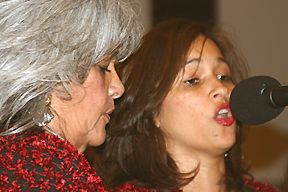
The mother-daughter duo of Enriqueta Ortiz and Rhoda Vance from the praise team at New Beacon Hill Baptist Church in San Antonio lead in worship at the Hispanic Baptist Fellowship.

Three words figure prominently in the Scripture passage in Luke 15:11-32–God, family and celebration, Ortega said. All three have things to say to the Hispanic biological family, the church family and the Baptist family of the Baptist General Convention of Texas.

Christians need to honor God with their lives so their children will respond to their example of faith and become faithful members of the church themselves, Ortega said. Christians also need to love those who live around them who don't have a relationship with Jesus Christ so they will come and join the family, he added.

He also urged Hispanics to be true to the New Testament teachings on joy and their own culture and “seek and find” reasons to celebrate the good things God does for and through his people.

“That is one thing perhaps we can model” for some of the non-Hispanics brothers and sisters in the BGCT, he joked.

“Most Anglo churches bring out the cakes and cookies and pies when they celebrate, but we Hispanics are like the father in this Scripture–we kill the cow when we have a party. And we eat it all.”

Another highlight of the evening was the sustained applause that greeted Albert Reyes, president of Baptist University of the Americas in San Antonio, when he was introduced as “the man who is expected to be elected the first Hispanic president of the Baptist General Convention of Texas later this week.”

Reyes urged a continued and increasing involvement of Hispanic churches in the mission and ministries of the BGCT.

BGCT Executive Director Charles Wade also drew laughter and applause when he noted, “We can't refer to the ethnic fellowships of the BGCT as minorities anymore because we all are minorities in Texas now as you well know.”

He thanked the Hispanic Fellowship for providing increasing leadership for all Texas Baptists in the coming years.

News of religion, faith, missions, Bible study and Christian ministry among Texas Baptist churches, in the BGCT, the Southern Baptist Convention ( SBC ) and around the world.


Historical Society explores how associations handle conflict_111504

Posted: 11/12/04

Van Christian of Comanche (right), newly elected president of the Texas Baptist Historical Society, joins Executive Committee member Stephen Warren of Kyle (left) and Secretary-Treasurer Alan Lefever of the BGCT Historical Collection in Dallas. Not pictured are Ellen Brown of Waco, vice-president; and Emily Row of San Angelo, Executive Committee member. (Nan Dickson Photo)

Historical Society explores how associations handle conflict

By Ken Camp

Managing Editor

SAN ANTONIO–Texas Baptist associations long have wrestled with how to balance principles of independence and interdependence when doctrinal diversity has sparked controversy, a veteran director of missions told the Texas Baptist Historical Society.

Associations historically have played a role distinctly different from state or national Baptist conventions, said Paul Stripling, executive director emeritus of Waco Baptist Association, when he addressed the historical society's meeting prior to the 119th Baptist General Convention of Texas annual session.

“Because of its history and the close proximity of churches, the association is the only unit in Baptist life other than the church with any responsibility akin to disciplinary action,” he noted.

“It can receive churches or withdraw fellowship if the churches' practices or beliefs are contrary to adopted doctrines.”

Associations seldom have withdrawn fellowship from churches, Stripling said. However, he pointed to three controversies –over charismatic practices, alien immersion and ordination of women–involving Dallas, Lubbock and Amarillo Baptist associations

In the mid-1970s, Dallas Baptist Association voted 604-401 not to seat messengers from Beverly Hills and Shadygrove Baptist churches because of those churches' charismatic practices, such as speaking in tongues.

“The effect of this unprecedented action by the Dallas Association was heard around the state,” Stripling observed.

In 1976, the seating of messengers to the BGCT from those two Dallas churches was challenged. Even though the convention's credentials committee agreed to deny the challenge, the convention body rejected the committee's recommendation, permitting the challenge to stand.

“The two churches were not seated at this convention–an historic first,” Stripling said.

Alien immersion–accepting for membership Christians baptized by immersion in non-Baptist congregations–sparked controversy in Lubbock Baptist Association in the early 1980s.

At an associational executive board meeting in 1982, Trinity Baptist Church of Lubbock was challenged over its decision not to require baptism of prospective members from other denominations “under certain circumstances.”

The issue had been swirling in Lubbock Association for nearly 20 years, then-Director of Missions Doyle Holmes said at the time, pointing to a longstanding controversy involving Second Baptist Church of Lubbock.

At its October 1983 meeting, Lubbock Baptist Association failed to pass a constitutional change that would have deleted a definition of a “regular” Baptist church as one whose membership is comprised “wholly of individuals baptized into a church of like faith and order.” In essence, the association left in place a definition that excluded churches such as Trinity Baptist or Second Baptist that accepted alien immersion.

The third controversy Stripling noted involved ordination of women. Terry Hill, then-pastor of South Lawn Baptist Church, presented resolutions at two meeting in the early 1980s declaring the association should not seat messengers from churches that ordain women as deacons or ministers.

Roy Kornegay, who was then director of missions for Amarillo Baptist Association, called a meeting of people representing various views on the issue.

Out of that meeting, the association's executive board approved a motion acknowledging a majority of member churches believed the practice of ordaining women is unscriptural and the association had the right to withdraw fellowship from churches “unorthodox in faith, un-Christian in character or leadership, or non-cooperative in practice.”

But the motion also stressed the importance of interdependence and voluntary cooperation, and it did not call for withdrawal of fellowship from any churches.

Without drawing any definitive conclusion, Stripling closed by quoting a 1983 editorial by Dick McCartney, who was then editor of the Oklahoma Baptist Messenger, “Every autonomous Baptist body has the right to define its own constituency, but we must be careful not to encroach on the authority of one body in attempting to further the ends of another.”

The Historical Society presented writing awards in five categories: church resident membership under 500, Don Wilkey for “Onalaska Baptist Church: Our History, 1910-2000”; church resident membership 500 to 1,000, Charlene Carson for “Building His Kingdom: 140-Year History, First Baptist Church, Salado, Texas”; church resident membership over 1,000, Charles Thompson of Temple for “God With Us: The Heritage of Immanuel Baptist Church”; general Texas Baptist and associational history to Carr Suter of Garland for “Dallas: The Doorway to Missions”; and for an unpublished paper, Ron Ellison of Beaumont for “A.C. Maxwell and J. Frank Norris, 1924-1935.”

The organization elected as officers for 2004-2005: president, Van Christian of Comanche; vice president, Ellen Brown of Waco; secretary-treasurer, Alan Lefever of Dallas; and executive committee members, Emily Row of San Angelo and Stephen Warren of Kyle.

News of religion, faith, missions, Bible study and Christian ministry among Texas Baptist churches, in the BGCT, the Southern Baptist Convention ( SBC ) and around the world.


Inaugural intercultural banquet stresses unity_111504

Posted: 11/12/04

Inaugural intercultural banquet stresses unity

SAN ANTONIO–The Baptist General Convention of Texas' first Intercultural Banquet stressed unity in Christ and strong support for the BGCT Cooperative Program budget.

About 90 people attended the dinner during the BGCT annual session in San Antonio.

The event featured presentation of 28 certificates of appreciation by Glenn Majors, the BGCT's director of Cooperative Program services.

Participants represented the Philippines, Japan, Vietnam, Cambodia, Brazil, China, Taiwan, Singapore, Malaysia, Korea, Nigeria, Laos, India and the United States.

“We are here tonight because of Jesus Christ,” said Ernest Dagohoy, pastor of First Philippine Baptist Church in Houston. “In Jesus Christ, we are one family. … We are one family because we seek unity and break down the walls that divide.”

BGCT Executive Director Charles Wade told the participants the hope for the future of the newly reorganized BGCT is for at least 30 percent of the convention's Executive Board to come from those ethnic backgrounds.

Other program personalities included Pak On Chan, pastor of Arlington Chinese Baptist Church, who gave the invocation; Cecile Dagohoy, music director at First Philippine Baptist Church of Houston; Patty Lane, director of intercultural initiatives for the BGCT; Le P. Le, worship leader at Vietnamese Baptist Church of Garland; Peter Leong, pastor of Southwest Chinese Baptist Church of Stafford, who gave a Cooperative Program testimony; and Lorenzo Peña, coordinator of associational missions and administration for the BGCT.

News of religion, faith, missions, Bible study and Christian ministry among Texas Baptist churches, in the BGCT, the Southern Baptist Convention ( SBC ) and around the world.


Jeremiah offers lessons for ministers, ETBU professor tells BGCT workshop_111504

Posted: 11/12/04

Jeremiah offers lessons for ministers,
ETBU professor tells BGCT workshop

SAN ANTONIO–An Old Testament prophet offers insights for ministers who face serious challenges, an East Texas Baptist University teacher said at a workshop on Jeremiah during the Baptist General Convention of Texas.

Jeph Holloway, associate professor of theology and ethics at ETBU, said, “Jeremiah's challenge to the religious and political establishment meant that all those who wielded power in Jerusalem saw the prophet as a threat to be nullified.”

The prophet searched the streets of Jerusalem in vain to find one person who was doing justice, but instead he found a dysfunctional society in which the wealthy lived by deceit and enjoyed their advantage at the expense of the vulnerable.

Jeremiah's lament provided him four crucial strategies for negotiating his vocational crisis, Holloway said. It taught him to pray in specific ways, display vigorous faith, find a measure of order amidst chaos and place his life and crisis in perspective.

News of religion, faith, missions, Bible study and Christian ministry among Texas Baptist churches, in the BGCT, the Southern Baptist Convention ( SBC ) and around the world.


Vision, empowerment crucial building blocks for healthy churches, Ballinger pastor says_111504

Posted: 11/12/04

Vision, empowerment crucial building blocks
for healthy churches, Ballinger pastor says

By Miranda Bradley

For Texas Baptist Communications

SAN ANTONIO–Vision and empowerment provide the building blocks for active, healthy churches, Bobby Broyles told participants in a lay-leadership workshop held during the Baptist General Convention of Texas annual meeting.

Broyles, pastor of First Baptist Church in Ballinger, illustrated by pointing to his own congregation.

When he became pastor of the Ballinger church more than a year and a half ago, Sunday school attendance had fallen from 300 to 75.

“It had become a dysfunctional church,” he acknowledged. “There was a hired-gun mentality that robbed laypeople of using their abilities to serve the Lord.”

When the congregation transferred controlling power from the deacons to the members, laypeople showed renewed interest among individuals serving the church, he said.

“People no longer felt afraid or unable to use their abilities. Instead, they felt encouraged.”

Broyles' plan began with a ministry vision and included empowering groups within the church to establish their own description and select their own leadership.

Instead of 30 committees, the church now only has four, and it functions much better that way, he said.

“There are so many churches maintaining the organization instead of maintaining the body,” he observed.

Broyles shared the Ballinger church's outline for lay leadership:

Begin with clear objectives. The church places a priority on carrying out Christ's Great Commission and meeting human needs.

bluebull Believe that Christians want to do God's work. they can begin to do that work when they begin to understand their gifts and talents, he said. And the pastor should give them the freedom to use those gifts and talents without a lot of bureaucracy.

bluebull Establish ministry teams. The church can clarify its needs and list ministry opportunities for meeting those needs, he said. The ministry teams can choose their leaders and detail how to carry out their tasks.

bluebull Create a vision team. This team includes church staff and key leadership.

New plans often require strong leadership, Broyles said, citing flexibility, layers of communication, relationship-building and constant encouragement as important attributes of leadership. By handing over ministry leadership to laypeople, Broyles said, his congregation has felt moved to participate, but that plan is not for every church.

“None of this is in the Bible,” he said. “There might be better ways. This is what helped us, and we have had to tweak it as we go.”

News of religion, faith, missions, Bible study and Christian ministry among Texas Baptist churches, in the BGCT, the Southern Baptist Convention ( SBC ) and around the world.