Congress includes anti-abortion provision in its omnibus spending package_120604

Posted: 12/03/04

Congress includes anti-abortion
provision in its omnibus spending package

By Robert Marus

ABP Washington Bureau

WASHINGTON (ABP)–Shortly before leaving town for their Thanksgiving break, members of Congress slipped into a spending bill a provision that supporters say limits “discrimination” against anti-abortion hospitals but that opponents say will circumvent state laws intended to guarantee access to abortion services.

The provision–which had gained the House's explicit approval but never the full Senate's –was slipped by House-Senate negotiators into a massive omnibus appropriations package and approved by both chambers of Congress Nov. 20.

The “Abortion Non-Discrimination Act” was added to the bill at the behest of its sponsors, Reps. Dave Weldon (R-Fla.) and Henry Hyde (R-Ill.). Both of the Congressmen are strong opponents of abortion rights.

It would effectively ban states from “discriminating” against health-care entities–including doctors, hospitals and insurers–that refuse to provide women with abortion services or referrals. Federal law already explicitly protects medical students who refuse to go through abortion training.

The bill's proponents said it also already protects other health-care entities from performing abortions but had been misinterpreted as applying only to individuals.

“Without this provision, pro-life hospitals could be forced to participate in the unconscionable killing of innocent human life,” said Tony Perkins, president of the conservative Family Research Council, in a statement on the bill's passage. “Protecting the choice to not perform abortions is a huge win for right-to-life supporters and the pro-life medical community.”

But opponents of the provision said it had the potential to limit access to abortion services for millions of women–particularly women in the 20-plus states that use state money to provide abortion services to Medicaid recipients. Many health-care providers rely on Medicaid funds to provide a full range of services to patients.

The provision “allows any health-care provider or institution, religious or otherwise, to refuse to provide a much-needed reproductive health-care service,” said Gloria Feldt, president of the Planned Parenthood Federation of America.

“The bill is not about religious freedom. There is no federal law that requires health-care providers to perform abortions in the first place.”

A dispute on an unrelated matter means the $388 million bill will not be sent to President Bush's desk for a signature until that spat is resolved.

To assuage complaints of abortion-rights supporters in the Senate, Majority Leader Bill Frist (R-Tenn.) agreed to a floor vote soon on a separate bill that would repeal the Weldon-Hyde provision. But observers noted an anti-abortion majority in the House means that bill probably would not pass.

News of religion, faith, missions, Bible study and Christian ministry among Texas Baptist churches, in the BGCT, the Southern Baptist Convention ( SBC ) and around the world.


Around the State_120604

Posted: 12/03/04

Around the State

Four bivocational pastors and their wives were honored during the 18th annual Bivocational Ministers and Spouses Conference. Carlton and Dianna Bailey of Mount Calvary Church of Marysee in Hull were selected as 2004 Exemplary Bivocational Pastor and Wife. Kevin Shipp of Avondale Church in Sweetwater is was named 2004 Exemplary Bivocation Minister of Music. He also is the church's education and children's minister. Two couples were honored for their youth ministry efforts. Sammy and Japana Roberts of Arlington Christian Bible Fellowship in Arlington, and Benji and Kathy Cole of Lone Willow Church in Cleburne were both named 2004 Exemplary Bivocational Youth Ministers.

bluebull Jack Longbotham, retired professor of education at Hardin-Simmons University, and this wife, Elizabeth, have completed a children's book, “The Adventures of Buffalo Bill and Cody.” The volume completes a triology of children's books which seek to foster an appreciation for the buffalo. The Longbothams have buffalo on their ranch. The book is bound in HSU colors and is available in the university bookstore.

Converse Hispanic Church in Converse recently incorporated as a bilingual congregation thanks to Trinity Church in San Antonio. The San Antonio congregation had sponsored the Hispanic mission 20 years, and gifted them the land and facilities there so that church could become a self-supporting body without incurring significant debt. Trinity Pastor Charlie Johnson (left) signed over the deed of trust to Converse Pastor Jesse Aguilar. The congregation also honored retired pastor Jimmy Garcia, founding pastor of the mission.

bluebull The University of Mary Hardin-Baylor newspaper, The Bells, and the yearbook, The Bluebonnet, received national recognition at the Baptist Press Excellence in Journalism conference held in Nashville, Tenn. The Bells won first place overall in its division, and the Bluebonnet received third place overall in the yearbook category. Individual newspaper awards went to Natalie Kaspar, first for in-depth writing, second for column writing and third for front page design; Leslie Helms, first for infographics and second for photo spread; Amanda Dickinson, second for feature writing; and a group of four reporters, third for in-depth writing. Winners of individual yearbook awards were Christi Snow, first for student life copy; Sara Hillis, first and second for portrait spread design; Tiffany Turk, first for creative/artistic photo, second for sports/club design and third for photo spread; and Jacob Sais, third for personality spread.

bluebull Robert Ellison, professor of English at East Texas Baptist University, has contributed a chapter to the book “John Keble in Context.” The chapter is part of Ellison's research in Anglican preaching during the 19th century.

bluebull Loretta Starkey has joined the Hardin-Simmons University staff as coordinator of alumni services. She replaces Shelly Dotson, who has moved to enrollment services as a counselor for new student relations/financial aid.

bluebull Angelique Myers of the University of Mary Hardin-Baylor has been named one of two national recipients of the Public Relations Society of America Multicultural Affairs Scholarship. Each student will receive a $1,500 scholarship. Myers is a reporter for the campus newspaper and also is a mid-day personality on a local radio station. The scholarship was awarded at the society's annual conference held in New York City.

bluebull Hardin-Simmons University's annual All School Sing was dedicated to the school's director of financial aid, Jim Jones and his wife, Nancy. They are members of First Church in Abilene.

bluebull Jud Powell has been elected chairman of the Hardin-Simmons Board of Trustees. He and his wife, Linda, were recipients of the John J. Keeter Jr. Alumni Service Award in 2001. He is a member of First Church in Abilene. Other officers are Clinton Wolf, vice chairman; Norma Schaffer, secretary; and George Gaston, vice chair and assistant secretary.

Anniversaries

bluebull Gordon Hightower, 20th, as pastor of First Church in Canyon Lake, Nov. 14. The congregation presented him with an inscribed silver bowl and a pocket watch, as well as a three-week sabbatical to be taken any time during 2005 and a $2,000 love offering.

bluebull Benito Cardenas, fifth, as pastor of Iglesia Calvario at Living Rock in Robstown, Dec. 1.

bluebull Paul Brand, fifth, as minister of youth and education at First Church in Whitewright, Dec. 5.

Deaths

bluebull Charles Phipps, 76, Oct. 21 in Houston. He was pastor of churches in Texas and California more than 50 years, including two years as an Army chaplain in Germany. He was a member of South Main Church in Pasadena. He was preceded in death by sons James and Don. He is survived by his wife of 55 years, Norma Jeanne; daughter, Ann Manning; and six grandchildren.

Country Church in Mesquite capitalized on the Mary Hill Davis Offering theme of “Plant, Water, Harvest” by having trees that “grew” after being watered by change offerings each week. Not only did the trees grow in height, but they also grew an “apple” for every $25 given. Here, the first and last tree are shown. The church surpassed its $500 goal, with an offering of $850.

bluebull Gene Thompson, 79, Nov. 13 in Denton. Thompson ran the Baptist Center at Broadway Church in Fort Worth almost 40 years. When he retired in 2001, the center was renamed the Gene Thompson Baptist Center to honor his dedication to social work programs. Thompson was a pastor of several North Texas churches during seminary training but then returned to his native Illinois to pursue a master's degree in social work. He returned to Texas in 1963 as associate pastor at Broadway Church. While maintaining his work at the Baptist Center, in the 1980s, he began focusing more on pastoral care–visiting the sick and officiating at funerals. He is survived by his wife, Rosemary; sister, Lora Fay Johnson; daughter, Ann; sons Phil and Todd; and several grandchildren.

bluebull Eddie Dwyer, 92, Nov. 16 in Waco. He was a professor of religion at Baylor University 37 years. His life changed when he became a Christian while attending a revival at age 16. The following night, his father became a Christian, and they attended Bible lessons together. He was student body president at Oklahoma Baptist University. Prior to coming to Baylor, he led a mission on the Osage Indian Reservation in Oklahoma. His time at Baylor included a tenure as the acting chairman of the religion department. He is survived by his wife of 63 years, Velma; son, Paul; daughter, Dee Dee Rich; and three grandchildren.

bluebull Gilbert Gonzalez, 63, Nov. 17 in Corpus Christi. He served five Texas churches as minister of education and was a migrant missionary in Tennessee. He was ordained to the ministry in 1988 at Woodlawn Hills Church in San Antonio. He was director of the Christian Family Center in Corpus Christi from 1992 until his retirement in 2002. He was a member of Primera Iglesia in Corpus Christi. He is survived by his wife, Pauline; daughter, Diana De La Portilla; son, Henry; mother, Maria; brother, George; and five grandchildren.

Licensed

bluebull Timothy Groves to the ministry at Pleasant Grove Church in Dallas.

bluebull Gary Anderson to the ministry at Trinity Church in Kerrville.

Ordained

bluebull Timothy Overton to the ministry at South Avenue Church in Pasadena.

bluebull Jason Bannister, Dwight Bennett, Dell Canright, Terry Evans, Leonard Loughner, David Smith, Rusty Watkins and John Williams as deacons at South Oaks Church in Arlington.

bluebull Jesse Blankenship, Ron Colburn, Barbara Gunnin, Joel Hill and Douglas Washington as deacons at Royal Lane Church in Dallas.

News of religion, faith, missions, Bible study and Christian ministry among Texas Baptist churches, in the BGCT, the Southern Baptist Convention ( SBC ) and around the world.


BaptistWay Bible Series for Dec. 12: Jesus reminds his disciples to do what is right_120604

Posted: 12/03/04

BaptistWay Bible Series for Dec. 12

Jesus reminds his disciples to do what is right

Matthew 5:17-48

By Todd Still

Truett Seminary, Waco

Those who restore older homes and cars have a desire to see them as they were before years of wear and tear took their toll. Instead of consigning a rickety house to a wrecking crew or a corroding car to a salvage yard, they are willing to expend tremendous amounts of time, energy and money on repairs and replacement parts.

This lesson from the Sermon on the Mount features Jesus' instruction to his followers regarding the law. Far from wanting to jettison God-given, time-honored teachings, Jesus demonstrates his commitment to explaining and fulfilling sacred writ. He impresses upon his disciples the perpetuity and indispensability of scriptural commandments (Matthew 5:17-20).

In verses 21-48, Jesus offers instruction on six subjects addressed by Jewish law in the Scriptures–anger (vv. 21-26), adultery (vv. 27-30), divorce (vv. 31-32), oaths (vv. 33-37), retaliation (vv. 38-42) and love of enemies (vv. 43-48). Jesus' intention does not seem to be the abrogation of the law despite discernable and even considerable contrasts between what the law required and what he demands of his disciples. Jesus' principle aim appears to be the restoration of the original purpose of the representative legislation Yahweh had entrusted to Israel.

Before we consider Jesus' instruction on these topics, it may prove helpful to observe that verses 21-48 may be divided into two sections.

David Garland points out a first series begins with the phrase “You have heard that it was said to those of ancient times” (v. 21) and deals with laws from Exodus and Deuteronomy. The second series begins, “Again, you have heard that it was said to those of ancient times” (v. 33) and deals with laws from Leviticus.

Having briefly remarked on verses 17-20 and having considered the contents and structure of 5:21-48, we may now look at each of the subjects Jesus addresses.

Anger

Various Old Testament texts denounce murder and proscribe the death penalty for murderers (Exodus 20:13; 21:12; Deuteronomy 5:17; Leviticus 24:17). Jesus took the matter further and deeper. By underscoring the serious repercussions of anger and verbal assaults, he addresses the underlying attitudes and actions that give rise to the rage and hatred that might prompt one to commit murder (v. 22). Moreover, Jesus offers practical counsel on how to reconcile ruptured relations before injurious actions transpire (vv. 23-26).

Adultery and divorce

While the sixth commandment denounces murder, the seventh commandment prohibits adultery–sexual relations outside marriage (Exodus 20:14; Deuteronomy 5:18). Jesus opposed adultery, but his instruction extends beyond mere negation. Jesus redefines adultery not only as a lustful act but also as a lustful attitude (v. 28). Jesus stresses one must treat sexual lusts seriously lest one become enslaved or destroyed by degrading desires (vv. 29-30).

In verses 31-32, Jesus equates divorce with adultery, except in the event of unchastity. Later in Matthew's Gospel, when he is queried by Pharisees about the Mosaic legislation permitting divorce (Deuteronomy 24:1-4), Jesus says divorce is out of synch with the divine design (19:4-6). He maintains Moses' ruling on divorce was simply an allowance for their ancestors' hard-heartedness (19:7-9). In our time as divorce rates skyrocket, it would be a positive step if Christian couples viewed divorce as a last resort and not a first recourse.

Oaths

The Old Testament instructs individuals to keep vows made to the Lord (Leviticus 19:12; Numbers 30:2; Deuteronomy 23:21). Closing legal loopholes for those who had grown accustomed to swearing by things connected to but not equated with God (such as “heaven,” “earth,” “Jerusalem,” one's “head”), Jesus prohibits oath-taking and promotes a standard where a disciple's simple “yes” or “no” will suffice (vv. 34-37). A world where one's word is one's bond may seem quaint, but it is no less Christian.

Retaliation and love of enemies

Whereas the Old Testament permitted the people of Israel to retaliate in a manner proportionate to a given offense (Leviticus 24:20; Exodus 21:24; Deuteronomy 19:21), Jesus calls his followers to forego retaliation. Turning the other cheek, giving one's inner garment and going a second mile might well shame one's opponents and be a form of passive resistance. Be that as it may, Jesus stops short of advocating aggression against one's oppressors (vv. 39-41). He calls his disciples to be generous and gracious to a fault (v. 42). He enjoins them to love their enemies and pray for their persecutors (v. 44). Even as God gives indiscriminately and liberally to all, so should his children (v. 45). It is no tall order to love those who love us and to greet those who greet us; most everyone can manage that much (vv. 46-47). Those who want to mirror their heavenly Father will have to aim much higher (v. 48).

Discussion question

bluebull Which of these teachings do you feel are most ignored?

News of religion, faith, missions, Bible study and Christian ministry among Texas Baptist churches, in the BGCT, the Southern Baptist Convention ( SBC ) and around the world.


BaptistWay Bible Series for Dec. 19: Make God the focus of giving, prayers, fasting_120604

Posted: 12/03/04

BaptistWay Bible Series for Dec. 19

Make God the focus of giving, prayers, fasting

Matthew 6:1-18

By Todd Still

Truett Seminary, Waco

While no sensible individual admires spiritual pomposity or hypocrisy, no honest person can deny being susceptible to putting on religious airs or playing religious charades. Being a follower of Jesus in no way immunizes one from the temptation to put on a spiritual show or masquerade as a saint.

Jesus' awareness of the human proclivity to parade one's piety before others coupled with his observation of spiritual grandstanders in his own day prompted him to warn his disciples against making their spirituality a spectacle.

He cautions the faithful in Matthew 6:1 to avoid practicing their righteousness before people so they might be noticed by them. To do so, Jesus insists, is to cash in prematurely any heavenly reward one might have accrued for the transitory thrill of human applause.

Discontent to leave his exhortation against piety for the sake of self-promotion on a general level, Jesus proceeds to apply the basic principle he articulates in verse 1 to three particular expressions of spirituality regularly practiced among his Jewish contemporaries–almsgiving (vv. 2-4), prayer (vv. 5-15) and fasting (vv. 16-18).

Before considering Jesus' instructions to his disciples regarding these spiritual exercises, it is worth noting that he presupposes his followers will in fact give alms, pray and fast. And lest we break our arms patting ourselves on the back for being people of spiritual sincerity, we must remind our neglectful, undisciplined selves that at least the hypocrites pilloried in this passage were concerned enough about piety to practice it, even if it was with pride and pretense.

Jesus first addresses almsgiving. Charitable gifts on behalf of the poor often were given by Jews in their synagogues on the Sabbath. Contributions for the impoverished also might be collected in public places. Jesus propounds that those who draw attention to their donations and who seek the affirmation of others for their feigned generosity should expect no spiritual return. The fleeting praise of impressed people is the only dividend they can hope to receive. On the contrary, Jesus calls his disciples not to be self-absorbed in their giving. Instead of seeking to give at those times when others might be looking, Jesus charges his audience to forget about false fronts and to remember they have a Father who sees in secret and rewards in full (vv. 3-4).

Jesus also enjoins his listeners to forego play-acting in their praying. Instead of joining hands in prayer with spiritual pretenders at the front and center of synagogues or at strategic places on street corners, followers of Jesus are instructed to pray in private where no one is watching but God. The purpose of prayer, Jesus implies, is to communicate with the heavenly Father, not to impress others.

It is reported that President Lyndon Johnson once exhorted Bill Moyers to pray more loudly as he was offering a public prayer. In response, Moyers is reported to have said, “Mr. President, with all due respect, I am not talking to you.”

To be sure, Jesus does not prohibit praying in public. Furthermore, when praying aloud in a group, we should speak loudly enough that others might hear. Be that as it may, all of our prayers are to be directed to God. While we are to pray on behalf of people, we are not to pray to impress people, who in the final analysis are mere mortals as are we.

Setting structural symmetry to one side (Note the presence of “when(ever)” in vv. 2, 5, and 16 as well as “but” in vv. 3, 6, and 17. Negating the way hypocrites practice piety (vv. 2, 5, 16), Jesus instructs his disciples how to give alms (vv. 3-4), pray (v. 6), and fast (vv. 17-18).), Jesus continues to teach his followers more fully about prayer. They are not to pray for publicity like the scribes and the Pharisees–the people Jesus most frequently calls hypocrites in Matthew's Gospel (22:18; 23:13-21)–nor are they to pray like Gentiles, who erroneously equate length of prayer with strength of prayer (v. 7). Rather, Jesus' followers may approach the heavenly Father as trusting children, knowing God is aware of our needs and will answer our prayers (6:8; 7:7-11).

When God's people pray, we may do so with simple, intimate reverence–“Our Father, the One who is in the heavens, may your name be blessed” (6:9). Acknowledging our allegiance to God's rule and will (v. 10), we can call upon him for daily provision (v. 11), spiritual restoration (vv. 12, 14-15) and deliverance from temptation and the source thereof (v. 13).

Rounding out this section of instruction on doing righteousness, Jesus tells his listeners not to draw attention to themselves when they fast by disfiguring their faces–smearing ashes or the like on their heads and faces. Instead, Jesus instructs them to go about their regular routines of oiling and combing their heads and washing their faces as they fast (v. 17). As with almsgiving and praying, the disciple's fasting is to be motivated by and directed toward God. Ulterior motives and alternative audiences are unacceptable to a God who sees, knows and loves all.

Discussion questions

bluebull What is the biggest danger in playing religious games?

bluebull What preventative measures can be taken to assure that God remains the focal point?

News of religion, faith, missions, Bible study and Christian ministry among Texas Baptist churches, in the BGCT, the Southern Baptist Convention ( SBC ) and around the world.


Baptist Briefs_120604

Posted: 12/03/04

Baptist Briefs

Baylor dean named Belmont VP. Todd Lake, dean for university life at Baylor University, has been named vice president for spiritual development at Belmont University in Nashville. Lake came to Baylor in 1999 from Wingate University as dean of chapel and minister to the university community. Under Lake's direction, Baylor's university ministries office began Baylor's resident chaplain program, which allows Truett Seminary students to live and minister in 10 residence halls. Other initiatives launched during his tenure include discipline-specific mission trips and service-learning opportunities, sports chaplaincy, graduate and law school Christian fellowships and partnerships with various university departments for chapel speakers. Lake received his bachelor's degree in German studies magna cum laude from Harvard University in 1982. He studied at Princeton Seminary before earning his master of divinity degree in 1988 from Southern Seminary. In 1997, he earned his doctorate in systematic theology with a minor in church history at Boston College.

CBF task force changes name. The Cooperative Baptist Fellowship's ecumenical task force has changed its named to the task force on ecumenism and justice. "We wanted to acknowledge that we, as a task force, were not an ecumenical body because we are composed only of Baptists. But we are Baptists uniting to do the work of ecumenism, justice and interfaith dialogue," said task force member Chris Skidmore, who works as associate director of the Kentucky Council of Churches. The task force plans to develop an ecumenism resource kit for pastors and churches. The kit will include a bibliography of literature about ecumenism and "Building Bridges," a brochure describing the Fellowship's position on ecumenism. Initial versions of the kit will focus on relationships between Christian groups.

National WMU acknowledges Virginia WMU's autonomy. Rather than responding directly to the "declaration of the dignity of women" statement adopted by Virginia Woman's Missionary Union, national WMU Executive Director Wanda Lee simply noted national WMU and Virginia WMU are autonomous organizations. The Virginia WMU declaration alleges discrimination "against women in the work of Christian ministry" and takes particular aim at the 2000 Baptist Faith & Message, which asserts only men are biblically qualified to be pastors." Just as every state Baptist convention is an autonomous body, so is each state WMU organization, particularly as they deal with issues in their state," Lee said. "We respect the autonomy of both bodies and their right to speak for themselves."

Mission tour inspires recording. Dove Award-winning recording artist Bruce Greer has released a new album he compiled after a Cooperative Baptist Fellowship Global Missions tour of Asia. "The Mission," which debuted at October's We Love Missions conference in San Antonio, is a "collage of songs about mission," Greer said. In February, Greer was part of a six-person team from First Baptist Church in Lewisville, sent to explore potential people- group partnerships. As the team rode on a boat passing impoverished people, Greer wrote "Faces," the song that inspired the album. For more information, visit www.brucegreer.com

N.C. church protests woman preacher. Parker's Chapel Missionary Baptist Church in Marion, N.C., voted to withdraw from the Baptist State Convention of North Carolina and the Blue Ridge Baptist Association after learning Anne Graham Lotz had been slated to preach the annual sermon at the state convention. Lotz, daughter of evangelist Billy Graham, delivered the convention message during the meeting in Winston-Salem. Pastor Larry Brown said Lotz is "a fine Christian woman" and "a good teacher and speaker," but her presence in a pulpit or preaching to a state convention is "an affront to the word of God."

News of religion, faith, missions, Bible study and Christian ministry among Texas Baptist churches, in the BGCT, the Southern Baptist Convention ( SBC ) and around the world.


Baptist University of the Americas seeks BWA associate membership_120604

Posted: 12/03/04

Baptist University of the Americas
seeks BWA associate membership

SAN ANTONIO–Baptist University of the Americas has applied for associate membership in the Baptist World Alliance.

At its July meeting in Seoul, South Korea, the Baptist World Alliance General Council amended the international organization's constitution to allow associate membership.

The new membership category was created “to involve Baptist churches and organized Baptist groups in the global ministry of the Baptist World Alliance through prayer, the sharing of resources and participation in the meetings, congresses and conferences of the Baptist World Alliance,” the amendment stated.

“The ministry of churches, organized Baptist groups and the Alliance are all strengthened through this intentional partnership.”

Albert Reyes, president of Baptist University of the Americas, likewise viewed having his institution as an associate member of the BWA as mutually beneficial, as well as a way to make a statement of solidarity in support of the alliance and its member bodies around the world.

“I have stated numerous times that Baptists are at our best when we cooperate with each other,” said Reyes, recently elected president of the Baptist General Convention of Texas.

“I cannot imagine any other stance to take than to say we stand together with the millions of our Baptist brothers and sisters around the world.”

Arnie Adkison, vice president of advancement at Baptist University of the Americas, noted associate membership in the BWA also provides “incredible opportunities” for his school's students.

Ninety percent of the theological university's student body is Hispanic, and 25 percent is international, he noted.

“BWA is the logical global organization for Baptist University of the Americas to participate with,” he said.

News of religion, faith, missions, Bible study and Christian ministry among Texas Baptist churches, in the BGCT, the Southern Baptist Convention ( SBC ) and around the world.


Little good news for Baptist World Alliance in state convention meetings_120604

Posted: 12/03/04

Little good news for Baptist World
Alliance in state convention meetings

By Greg Warner

Associated Baptist Press

FALLS CHURCH, Va. (ABP)– If the Baptist World Alliance, which lost its largest member and funder earlier this year, hoped to recoup some of that funding from state Baptist conventions, the organization got little encouragement during the recent round of convention meetings.

Proposals that could have resulted in more funding for the Baptist World Alliance were defeated in the Alabama and Kentucky Baptist conventions. Meanwhile, the South Carolina Baptist Convention, which already blocked any state funding for the BWA, asked its Woman's Missionary Union to reconsider its relationship to the worldwide fellowship.

On the bright side, however, two moderate state conventions that already forward funds to the BWA–in Texas and Virginia–acted to increase that support.

Last June, the Southern Baptist Convention withdrew its membership and final $300,000 in funding from the Baptist World Alliance, an international umbrella organization representing 211 Baptist bodies. Southern Baptist leaders said BWA harbors theological liberalism, a charge denied by BWA and many of its member groups worldwide.

Since coming under fire from the SBC, the Baptist World Alliance has had some success generating new money from other sources, such as the national Cooperative Baptist Fellowship.

The Baptist General Association of Virginia voted during its Nov. 9-10 meeting to seek BWA membership, perhaps under new rules that permit associate membership for individuals and organizations. And messengers increased BWA funding from $90,000 a year to about $150,000, with half of the increase coming from funds earmarked for the SBC International Mission Board.

The departure of the Southern Baptist Convention means the BGAV gives more money to BWA than any of the 211 member bodies worldwide. The BWA, with its headquarters in Falls Church, Va., has long had close ties with the Virginia association, even though the BGAV has not had membership in the group.

The Baptist General Convention of Texas, meanwhile, formalized its financial support of BWA by making the organization a permanent part of one of its funding plans for world missions.

Churches that choose the “BGCT World Missions Initiatives” plan will contribute 5 percent of their mission gifts to BWA.

Based on October 2004 year-to-date annualized figures, 5 percent of the BGCT worldwide initiatives would amount to about $38,000, said David Nabors, treasurer and chief financial officer.

Elsewhere, however, state Baptist conventions have been reluctant to get involved in the controversy over the Baptist World Alliance.

Messengers to the Alabama Baptist State Convention defeated an amendment to their $41.5 million budget to siphon $30,000 earmarked for the SBC Executive Committee and send it to the BWA. The motion failed on a show-of-hands vote.

At the Kentucky Baptist Convention, messengers narrowly defeated a proposal from the convention's mission board to establish a study committee to examine how the convention “may relate to the Baptist World Alliance.” An opponent noted a study was not necessary because the Southern Baptist Convention had already studied the issue and determined to withdraw BWA funding.

In South Carolina, convention messengers adopted a resolution asking the national Woman's Missionary Union, as well as the convention's WMU affiliate, to “consider their relationship with the Baptist World Alliance and its Women's Department.” The resolution affirmed South Carolina's WMU for its “longstanding decision not to forward or channel any financial or other support” to the BWA's Women's Department, which promotes leadership development, empowerment, prayer and evangelism among women worldwide.

Spokeswoman Wendy Ryan said the BWA was not counting heavily on new funding from state Baptist conventions, so the actions in Kentucky and Alabama are not a major setback. The BWA expects its new membership policy to increase funding and involvement of individuals and groups around the world, not just in the United States.

But Ryan said it's too early to tell if the BWA will be able to replace the money–$425,000 until recent years–historically contributed by the Southern Baptist Convention. Those payments ran out only last month.

“The jury is still out on that,” she said. “We have to wait a while longer.”

News of religion, faith, missions, Bible study and Christian ministry among Texas Baptist churches, in the BGCT, the Southern Baptist Convention ( SBC ) and around the world.


Hispanic & Anglo churches pool resources, expand ministries_120604

Posted: 12/03/04

Hispanic & Anglo churches pool resources, expand ministries

By George Henson

Staff Writer

DALLAS–Members of Cockrell Hill and Hampton Place Baptist churches in Dallas believe in the power of synergy. Merging their congregations has provided a wealth of assets that exceeds what the two churches held apart from each another.

Hampton Place Baptist Church was not looking to move, but events earlier in the year left members no choice. The Dallas Independent School District wanted to build a new elementary school in the Oak Cliff neighborhood, but a drive around the area by officials left them scratching their heads as to where.

Representatives of Cockrell Hill and Hampton Place Baptist churches in south Dallas publicly sign legal papers to merge their congregations.

They went back to the school district's offices, pulled out and map and saw a large open area they had missed, so they drove back to the location.

It was the parking lot of Hampton Place Baptist Church.

“I told them, 'I don't think so–we've got people who have been here for 50 years and I don't think they will go for that,” Pastor Rolando Rodriguez told officials wanting to buy the church's property.

He could have added that he didn't want to move either, he said.

School officials, while cordial, made it plain that the district would take the property in the courts using the eminent domain clause, Rodriguez said.

After discussing the matter with deacons, Rodriguez said the church decided that rather than tying up funds in a legal fight it would most likely lose, Hampton Place should negotiate for the best possible price.

As soon as the decision to sell the property was made, Hampton Place created three teams to investigate the church's next step.

One team checked into the possibility of merging with another congregation, another the prospect buying property in the area to build upon and a third looked into securing a temporary location.

“Our main thing was that we wanted to stay in the area. The church had a long history of ministry to this community, and we wanted to continue that,” Rodriguez said.

It quickly became apparent that purchasing land in the area would be cost-prohibitive, and “merging looked like a better option every time we looked at it,” he said.

Initially, Hampton Place considered another church in the area, but leaders soon decided its facilities were too small. Rodriquez was contemplating the church's next step when he received a call from Ed Cole, pastor of Cockrell Hill Baptist Church.

“We didn't want to come to Cockrell Hill and didn't think they would be open to considering it, but we were wrong–I was wrong. I thought if he called us, maybe God was in it.”

The merger has been a great thing for both churches, Cole said. The Cockrell Hill congregation was dwindling.

“We were having people join still, but since our congregation was aging, I also was preaching a lot of funerals,” he said.

“We were slowly dwindling. Also, those that we were losing were tithers, and many of our new members had not matured to that point, so finances were getting tighter.”

It also was a primarily Anglo congregation in a community that is 80 percent Hispanic.

The congregations met together for some months but maintained separate bank accounts until all the legal paperwork was in place.

The congregations officially became one Nov. 21, retaining the Cockrell Hill Baptist Church name.

Cole will lead an English-language service, Rodriguez will lead the Spanish-language service and Gus Reyes, formerly youth pastor at Hampton Place, will lead a contemporary service in English on Saturday nights.

“We don't have a senior pastor, but a pastoral team–Pastor Ed, Pastor Rolando and Pastor Gus,” Rodriguez explained.

The church also will be the site for a Laotian mission that formerly met at Hampton Place.

Sunday school will be provided in both Spanish and English.

“That's what we can now provide since we are together,” Rodriguez said.

The Hampton Place congregation also is bringing the $2.5 million it received from the sale of its facility to the school district.

“By coming together, we didn't have to buy property or build, so the money is going to take this church very far in ministry,” Rod- riguez said.

“With the resources we have, our goal is to reach 1,000 in Sunday school.”

Prior to the merger, Cockrell Hill had about 100 people attending, with another 20 people coming to a Spanish-language mission. Hampton Place had about 300 people in attendance each week.

About 450 people watched as the incorporation papers were signed Nov. 21, uniting the congregations during a joint service.

The service was in four languages, Rodriguez pointed out–English, Spanish, Laotian and American sign language.

While the Hampton Place congregation did not initially want to move, Rodriguez said, members now are excited about the prospects for ministry.

The Oct. 31 vote to merge with Cockrell Hill was unanimous, he noted.

Many of the younger Hispanic families now attend the English-language services.

On a Sunday in early November, 173 people attended the traditional English-language service, and 173 people also attended the Spanish-language service.

The extra activity at the Cockrell Hill church has been noticed by the surrounding community, both Cole and Rodriguez agreed.

“We had families who told us, 'Once you merge, we're going to join.' But they didn't wait; they joined before the merger,” Rodriguez said.

The Cockrell Hill congregation is pleased as well, Cole said. “We've seen it as so obviously God's hand on all of this. We now have a healthy older congregation, a healthy younger congregation, a healthy Spanish outreach and a new Laotian outreach.”

“Things had to change for this church to reach this community, and this has enabled us to do that,” he added.

The congregation not only wants to reach the surrounding community, but also to be active on mission in other places as well, Rodriguez said.

“We're going to be sending groups to do missions around the state, to Mexico and hopefully around the world,” he said. “God has given us so much, so we're just having to say, 'God guide us, send us.' He's given us the resources, and all we have to do is work hard.”

Blending the congregations will be a learning process, but it is being done with eyes open, Cole said.

“We know they have different music, time schedules and traditions, but we recognize that and respect that. I don't think it will be a problem,” he said.

Cole and Rodriguez also don't believe the shared mantle of pastor will be a problem.

“We are all pastors, but we each have our areas of responsibility,” Rodriguez said.

“Pastor Ed handles matters related to the traditional English service. I am responsible for the Spanish service. And Pastor Gus takes care of the contemporary service.

“Pastor Ed and I may not always agree, but we will have a third person there to help us settle our disagreements in Pastor Gus,” Rodriguez explained.

So far, those disagreements have not come. “I'm really enjoying this time of ministry,” he continued.

Rodriguez contended the merged churches really are one congregation.

“We are one church, but the ministry differences and cultural differences are big enough that we do handle it as three ministries,” he explained.

To help maintain a unity of spirit, members from each of the three distinct services will worship together every three months, he said.

Having more than one pastor really is an asset, Rodriguez asserted. “We have different personalities and ministry approaches, but our differences are really our strength,” he said.

“The key is that we both trust and respect each other,” Cole added.

“We had to put our egos aside. You can't have an ego and have something like this work,” Rodriguez pointed out.

“We were both senior pastors of our churches, but now we have to share that. It's not about a position or a title. It's all about ministry. It's all about Jesus.”

News of religion, faith, missions, Bible study and Christian ministry among Texas Baptist churches, in the BGCT, the Southern Baptist Convention ( SBC ) and around the world.


ANOTHER VIEW: ‘Jesus’ celebrates 25th birthday_120604

Posted: 12/03/04

ANOTHER VIEW:
'Jesus' celebrates 25th birthday

Recently I participated with other volunteers in distributing the gospel on the streets of a sprawling mega-city in Central Asia.

We struck up conversations with shopkeepers, cafe owners, college students, bus passengers and anyone else willing to talk to us in the overwhelmingly Muslim city. We prayed for opportunities to give our new acquaintances small packets containing a New Testament, a video showing local followers of Christ and how they worship–and a DVD version of the “Jesus” film.

Not everyone took our gift. Some declined politely; a few returned it after looking it over. But many accepted it with curiosity, gratitude, even emotion. They seemed eager to read, hear and see all they could about Jesus. Several asked for extra packets.

Almost anywhere you find the gospel–and people hungry for it–you'll find “Jesus.”

It's by far the most-watched and most-translated movie in history. It's also one of the church's most potent evangelism tools. The film, which first appeared in theaters in 1979, is marking the 25th year of its amazing run. The Jesus Film Project, an arm of Campus Crusade for Christ, distributes various versions worldwide. A few “Jesus” statistics (updated just this fall) will give you a feel for its global reach:

Cumulative viewing/listening audience (includes multiple viewings) since 1979: more than 5.8 billion.

bluebull Languages with “Jesus” film/audio translations: 874, with 229 more in the works.

bluebull Countries where the film has been shown: 228.

bluebull Countries where the film has been broadcast on television: 176.

bluebull “Jesus” film prints, videocassettes, DVDs and VCDs in circulation: more than 510 million.

bluebull Personal decisions to follow Christ at public film showings: more than 197 million.

There's no slowing down on the horizon. In addition to its availability in tailored versions for various formats and age groups, “Jesus” just made its Internet debut. In October, the entire film became accessible online–in more than 300 languages–via streaming video at www.JesusFilm.org.

“To our knowledge, a film has never been freely available on the Internet in so many different languages,” says Jim Green, who directs The Jesus Film Project. “The 300-plus translations available represent the heart language of more than 90 percent of the world's population.”

What is the continuing power of this movie? When people see “Jesus,” they see Jesus–and understand his words–often for the first time.

“Jesus speaks our language!” one elderly woman in Mozambique joyously cried after seeing the first showing of “Jesus” in her Makhuwa language. International Mission Board missionaries spearheaded the Makhuwa version of the film and saw thousands come to Christ among the 5-million-member animistic people group.

The emotional impact of witnessing Jesus' life and death–particularly his crucifixion–also explains the film's appeal. In many places, audiences weep, tear their clothes and toss dirt in the air to express grief, throw sticks at the Roman soldiers beating Jesus on the screen–or sit in silent awe.

Perhaps the true source of the film's power, however, is this: It conveys the word of God, specifically the Gospel of Luke, with virtually word-for-word faithfulness.

A recent campaign in Tomsk, Siberia, drew thousands of people to screenings around the city. Theaters overflowed, and 150 people who were turned away from one cinema walked more than a mile in the cold to see the movie at another location.

“I'm tired of thrillers,” one of the viewers said. “I want something that will talk to my heart. It's time to believe in God.”

So great is the film's impact that International Mission Board mission strategists include its availability as one of their measures of the evangelization of a people group. The Jesus Film Project has formally partnered with the IMB since 1997. Southern Baptist mission teams remain the top users of the film worldwide–and they continue to find new and more effective ways to utilize it.

As missionaries “continue to push into people groups that have little literacy and no Bible knowledge, it's requiring them to re-think using the 'Jesus' film,” media strategist Mark Snowden notes. “In many places, they delay showing the film until basic concepts of God, sin and redemption are understood by the people. Otherwise, in places where ancestors or other gods are worshipped, the people will just add Jesus to their pantheon of gods.”

When those concepts are effectively communicated first, the film is increasingly becoming “a discipleship tool for new believers,” Snowden adds. “They view Jesus' life and readily identify with the disciples who are seeking to follow Jesus.”

Happy 25th birthday, “Jesus.” May your influence increase!

Erich Bridges is a senior writer at the Southern Baptist International Mission Board in Richmond, Va. His column is distributed by Baptist Press.

News of religion, faith, missions, Bible study and Christian ministry among Texas Baptist churches, in the BGCT, the Southern Baptist Convention ( SBC ) and around the world.


Rice’s selection unlikely to impact religious liberty, observers say_120604

Posted: 12/03/04

Condoleeza Rice waves to the crowd after she was introduced at the American Israel Public Affairs Committee's annual summit in Hollywood, Fla.

Rice's selection unlikely to impact
religious liberty, observers say

By Robert Marus

ABP Washington Bureau

WASHINGTON (ABP)– President Bush's choice of National Security Adviser Condoleezza Rice to replace Secretary of State Colin Powell may not mean much change in the United States' foreign policy regarding religious-freedom issues, experts on the subject maintained.

Bush formally selected Rice days after her 50th birthday and one day after Powell announced his resignation. Rice was raised in Jim Crow-era Alabama, the daughter of an African-American Presbyterian minister. She was the first woman of color to serve as national security adviser, and, if confirmed by the Senate, will break the same barrier at the State Department. She is a professing evangelical Christian.

But her actions as secretary of state may differ little from those of her two predecessors–who often came under fire from advocates of international religious freedom–in regard to making religious-liberty and other human-rights issues more central to American foreign policy.

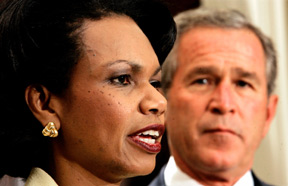
President George W. Bush listens to National Security Adviser Condoleezza Rice speak after Bush nominated her to replace Colin Powell as secretary of state. (REUTERS/ Kevin Lamarque)

“I'm not optimistic” about Rice's appointment heralding renewed emphasis on religious freedom, said Larry Uzzell, president of the Virginia-based group International Religious Freedom Watch.

He pointed to a press briefing Rice had with reporters prior to Bush's 2002 trip to St. Petersburg, Russia, to meet with Russian President Vladimir Putin. Russian studies is Rice's area of academic expertise.

In the press briefing, Rice noted that Bush was to visit a Christian cathedral and a recently restored Jewish synagogue in that city, giving him “the chance to witness firsthand the right to freedom of worship, which is now thriving in Russia.”

Uzzell said that was, at best, a misleading characterization.

“It was shortly after a wave of expulsions of Roman Catholic clergy from Russia” in addition to several other incidents curtailing religious freedom in the former Soviet Union, he said.

“I was extremely disappointed that somebody in Dr. Rice's position would make such an unqualified statement about the state of church-state relations in Russia. That was not helpful for those of us who are trying to nudge that still semi-authoritarian country in the right direction. And right now, Russia is going in the wrong direction.”

Of Rice's commitment to religious freedom as a central focus of American foreign policy, Uzzell continued, “I think Condoleezza Rice is in the Washington mainstream on that issue–and that is not a compliment.”

A senior State Department official familiar with human-rights issues, speaking on the condition that his name not be published, expressed more optimism that his new boss would pay close attention to international religious-freedom issues because of her own “personal sensitivity to religious faith” and the support of the president.

“I can say, as far as the administration goes, and religious-freedom advocacy going forward into a second term, you'll see an ongoing commitment to religious freedom,” the official said.

Some religious-freedom observers–such as the independent United States Commission on International Religious Freedom–have criticized the State Department under Powell's leadership and that of his predecessor, Madeleine Albright, for not doing enough to use the mechanisms provided by the 1998 International Religious Freedom Act to punish countries that commit egregious violations of their citizens' liberty of conscience.

That act created the commission to serve as a watchdog agency and also created an ambassador-at-large position for international religious freedom within the State Department itself.

The department is charged with publishing an annual report on international religious freedom and with designating major religious-liberty violators as countries of particular concern under the terms of the 1998 law.

The law then sets forth a series of actions, including sanctions, the government can take against those countries.

Although the department has named several nations countries of particular concern under the act, it has not invoked any additional U.S. sanctions on the countries other than those already in place for other reasons.

Robert Seiple, the first U.S. ambassador-at-large for religious freedom, said that was partially due to the relatively toothless nature of the religious-freedom office, the human-rights division of the State Department and the department itself in the Washington power scheme.

“If the weakest office in the weakest bureau in the weakest agency in Washington, D.C., is going to have any validity to it, there has to be a massive effort to change that reality or that perception,” he said.

“When I was at the State Department, part of my frustration in making things work was that I felt we were part of the junior varsity,” Seiple said.

He now is president of the Pennsylvania-based Institute for Global Engagement, which seeks to find realistic and pragmatic ways to advance religious freedom around the world.

Seiple said one way to gain more influence for religious-freedom issues would be to focus more government agencies, such as the Defense Department and the National Security Council, on religious issues.

“We have to find a way for anyone in government working on the issue of religious freedom to be associated with the strongest agency, and the strongest bureau, in the strongest office in Washington, D.C.,” he said.

That–and a strengthening of the role of the State Department–may become more of a reality under Rice, he noted, due to her close personal and ideological relationship with Bush. Powell generally is believed to have disagreed often with the stances of other senior administration officials on foreign-policy issues, while Rice is one of Bush's closest advisers.

“Now, the agency that houses religious freedom is headed up by someone who not only has the ear of the president, she knows him well enough to finish his sentences,” Seiple said.

“That should augur well for this issue. That, and the times in which we live–highlighted by the first war of the 21st century being a religious war.”

But, he added: “Whether it will do it or not, I don't know. But one could optimistically look at Condi Rice's presence there and say, given her association with the president, the State Department is not going to be the junior varsity in this equation.”

Nonetheless, Uzzell argued, the war on terrorism may lead to further muting of a human-rights critique of countries–such as Pakistan or Saudi Arabia–that are vital to the United States' interest, in favor of maintaining good relations with them.

“I think it was clear even before Secretary Powell's resignation that the same kinds of policies in the war on terror are going to continue. And I think it's clear from the developments of the last three years that that's not good for religious freedom,” he said.

“Like any war, that means you have to develop some alliances with pretty unsavory characters.”

News of religion, faith, missions, Bible study and Christian ministry among Texas Baptist churches, in the BGCT, the Southern Baptist Convention ( SBC ) and around the world.


Dispute between Criswell College & contractor to be settled out of court_120604

Posted: 12/03/04

Dispute between Criswell College
& contractor to be settled out of court

By Ken Camp

Managing Editor

DALLAS–A dispute between Criswell College, the W.A. Criswell Foundation and a computer contractor will settled by an arbitrator rather than a jury.

Parties in what had been a multimillion-dollar lawsuit agreed to binding arbitration rather than proceed with a scheduled Dec. 6 trial.

They reached the agreement soon after a Nov. 19 summary judgment hearing. At that hearing, a district judge dismissed charges of libel and defamation stemming from a letter written by John Thomas, founder of International Data Systems, and mailed to more than 120 prominent Baptists, ranging from leaders of the Southern Baptist Convention's six seminaries and the Baptist General Convention of Texas to former President Jimmy Carter.

"Religion permeates this case and cannot be excised from it, no matter how fine a scalpel you use."
—Attorney Scott Hershman

Attorneys for the Criswell Foundation said the letter alleged self-dealing and other financial misdeeds. The foundation sought damages of at least $2.5 million.

But Scott Hershman, lead attorney for Thomas, framed the letter as a plea for Christian mediation. He claimed a civil court lacked subject-matter jurisdiction to rule on what essentially was a religious dispute, and he moved that the defamation charges be dismissed.

“Religion permeates this case and cannot be excised from it, no matter how fine a scalpel you use,” Hershman argued.

The dispute arose from an agreement Thomas reached in 1995 to digitize the tapes, transcripts and outlines of sermons by W.A. Criswell, longtime pastor of First Baptist Church in Dallas–an effort that came to be known as the Criswell Legacy Project. As a Baptist layman, Thomas claimed he agreed to donate his own time and charge only what it would cost him to complete the work.

Criswell College paid on invoices received for services and equipment through October 1999, but in the months that followed, the relationship between the contractor and representatives of the Criswell Legacy Project broke down, and the Criswell entities stopped paying on invoices IDS presented. Since then, each party has accused the other of trying to change the terms of the earlier agreement.

Eventually, the Criswell entities ended any relationship with IDS and entered a contract with Chris Moreau, president of DIAWS Systems, to complete the project. Thomas maintains the sermon preservation project essentially was completed at that point, a matter the foundation disputes. Thomas also alleged financial conflict of interest involving the foundation's board.

Thomas stated his case and included his allegations in a March 12, 2003, letter he mailed to Criswell College trustees and former trustees and leaders at First Baptist Church in Dallas, as well other high-profile Baptists.

In the letter's opening paragraph, Thomas described what he called his “spiritual dilemma” and claimed he was seeking the help of “the church” at-large to settle the dispute, in keeping with New Testament passages such as 1 Corinthians 6 and Matthew 18.

Initially, the foundation identified more than two-dozen allegedly defamatory statements in the letter–including quoted references that included terms such as “heresy” and “apostasy,” which Thomas' lawyers emphasized.

Later, the foundation narrowed its focus, stressing passages where Thomas alleged foundation board members and their associates invested more than $1 million in the companies that replaced IDS on the Criswell Legacy Project.

The foundation also pointed to a Baptist Standard article Thomas included with his letter. The article described a book by Houston pastor Chris Seay titled “The Tao of Enron: Spiritual Lessons from a Fortune 500 Fallout.” By insinuation, foundation attorneys claimed, Thomas was accusing the Criswell entities of “an Enron-style scandal.”

Blake Beckham, lead attorney for the foundation, pointed out Thomas and his former attorney had drafted several versions of the letter before mailing the final version.

He characterized the letter as the work of “a skilled attorney with a sharp pencil” and a “calculating serial litigator,” rather than a humble appeal by a Baptist layman to respected spiritual leaders. Thomas has been involved in 37 civil disputes in the last 21 years, he noted.

Beckham asserted the secular claims of financial misdealing could be segregated from the religious language in the letter.

But Hershman cited a 1996 fraud case involving televangelist Robert Tilton, saying, “The court cannot adjudicate the truth or falsity of religious matters or even let a jury hear evidence regarding those matters.”

Matters of heresy and apostasy are “beyond the scope” of secular courts, he argued, saying, “The courts know no heresy.”

Conceding the letter touched on secular issues, Hershman contended, “Secular issues are so entwined with religious issues, you cannot untangle them.”

District Judge Karen Johnson granted the motion for summary judgment, dismissing the defamation claims “on multiple grounds.”

In October, she had dismissed complaints by IDS against the Criswell entities filed under the Racketeering Influenced Corrupt Organizations Act. By finding no evidence of racketeering, she reduced the claim for damages from more than $46 million to about $15.5 million. Anti-racketeering statutes allow recovery of three-fold damages.

News of religion, faith, missions, Bible study and Christian ministry among Texas Baptist churches, in the BGCT, the Southern Baptist Convention ( SBC ) and around the world.


DBU volunteers build on-campus Habitat house_120604

Posted: 12/03/04

About 400 Dallas Baptist University students, faculty and staff volunteered to help build a Habitat for Humanity house on the university campus.

DBU volunteers build on-campus Habitat house

By Kristie Brooks

Dallas Baptist University

DALLAS–For the second consecutive year, Dallas Baptist University volunteers built a Habitat for Humanity house on the school's campus.

DBU Executive Vice President Blair Blackburn worked with the university's student chapter of Habitat to launch the building project in late October, and it was completed in about a month.

Students, faculty and staff volunteered daily to work on the house that was built right outside the university's John G. Mahler Student Center.

“The project has been highly publicized around campus to various DBU organizations,” explained Melissa Johnson, president of the DBU Habitat student chapter. “We had the DBU baseball team out here hammering and nailing up siding, while others worked with caulking before we added the final layer of paint. It's been a huge team effort, and it's exciting to see all the organizations work together to achieve such an enormous goal.”

Blackburn noted DBU students not only participate in the on-campus building project, but also travel during spring break to another part of the country to work on a Habitat project.

Blair Blackburn, DBU executive vice president, gives the house key to Maria Teresa Cazares, the new homeowner of a Habitat house built on the university campus.

“We believe that the fall 'on-campus' builds create an excitement and awareness of the impact Habitat has on the lives of the families who will call these houses 'home.' Last year, that excitement carried over, leading to a record number of students going on the spring break Habitat build to Tallahassee, Fla.,” he said. “This spring, our students will travel to Russell, Ala., to work with a local Habitat chapter.”

Chris Crawford, DBU director of residence life, has a background in construction and has been active in Habitat for several years. On the worksite, he was in charge of helping students get signed in and assigned to work areas where they were needed most.

“We had approximately 400 students, faculty and staff volunteer their time to build this house,” he explained. “It was great to see the students working together as a team and giving of their personal time to make a positive change in the life of a homeowner most of them will never know.”

Robert Erickson, director of physical operations and co-coordinator for the on-campus build, helped raise funds for supplies and worked with numerous contractors who volunteered their labor and donated materials for the construction of the house.

“All that I really do with the contractors and vendors is plant a seed,” Erickson explained. “God does the rest. It is such a great personal blessing for me to see God in action.”

DBU students worked on the project alongside the new homeowner, Maria Teresa Cazares, a 38-year-old single mother of three. Cazares was born in Mexico and became a naturalized U.S. citizen in December 1998.

The house was scheduled to be moved recently, and the spot outside the student center will be vacant until next fall, when construction will begin on a new project.

“Seeing the support of the university behind this project has been really amazing,” said Jay Harley, DBU Habitat sponsor and director of spiritual life. “It will be exciting to see how our chapter continues to grow as more students become aware of the impact Habitat has in people's lives.”

News of religion, faith, missions, Bible study and Christian ministry among Texas Baptist churches, in the BGCT, the Southern Baptist Convention ( SBC ) and around the world.