Suit filed to block ‘intelligent design’ theory from schools_11005

Posted: 12/24/04

Suit filed to block 'intelligent design' theory from schools

By Robert Marus

ABP Washington Bureau

WASHINGTON (ABP)—Two civil-liberties watchdog groups have filed the first known lawsuit to prevent public schools from teaching the theory of "intelligent design."

Critics of the theory, including supporters of evolution, call it "junk science" and say it is a back-door way to teach creationism. Americans United for Separation of Church and State and the American Civil Liberties Union filed a federal lawsuit against the Dover, Pa., school board to bar the district from teaching intelligent design.

The theory argues that an "intelligent agent" guided the development of life on Earth, using that assertion to explain alleged gaps or inconsistencies in the theory of evolution. Conservative evangelical Christians have been intelligent design's main promoters.

Many mainstream scientists, including many Christian biologists and anthropologists, have criticized intelligent design as pseudo-science.

On Oct. 18, the Dover Area School District Board passed, by a 6-3 vote, a resolution requiring students to "be made aware of gaps/problems" in evolutionary theory. The district—in a small town near the state capital of Harrisburg—then produced a statement that ninth-grade biology teachers at Dover High School would have to read to their classes.

The statement asserts that "gaps in the theory (of evolution) exist for which there is no evidence" and points to an intelligent-design text, "Of Pandas and People," as available for students who "would like to explore this view."

The groups filed the lawsuit on behalf of 11 Dover parents who oppose the teaching of intelligent-design theory in their children's classrooms. It charges that such teaching violates the First Amendment's ban on government endorsement of religious views.

The Supreme Court has previously ruled that public schools could not teach creationism, which is the belief that God created the world—according to many advocates, in six literal, 24-hour days several thousand years ago.

"Intelligent design is a non-scientific argument or assertion, made in opposition to the scientific theory of evolution, that an intelligent, supernatural actor has intervened in the history of life, and that life 'owes its origin to a master intellect,'" the suit charges.

Dover science teachers opposed the policy at the time of the board's vote, and the three board members who voted against it later resigned in protest.

The suit further contends that "Of Pandas and People" was published by a group that promotes so-called "creation science" and Christianity, and that the school board's purpose in recommending it was religious.

"As far as we know, this is the first (legal) challenge of the intelligent-design concept being taught in science classes," said Americans United spokesman Joe Conn. Intelligent design is "clearly not coming from the science community; it's coming from ideological sources," he said.

A statement posted on the school district's website said that the schools' attorney was reviewing the lawsuit and that administrators would not comment on the case until the review was completed.

The Seattle-based Discovery Institute, which promotes intelligent design, nonetheless called the Dover school policy "misguided" and said it should be "withdrawn and rewritten."

"When we first read about the Dover policy, we publicly criticized it because according to published reports the intent was to mandate the teaching of intelligent design," said John West, associate director for the Discovery Institute's Center for Science and Culture, in a Dec. 14 press release. "Although we think discussion of intelligent design should not be prohibited, we don't think intelligent design should be required in public schools.

"What should be required is full disclosure of the scientific evidence for and against Darwin's theory," he continued.

The case is Kitzmiller vs. Dover Area School District.

News of religion, faith, missions, Bible study and Christian ministry among Texas Baptist churches, in the BGCT, the Southern Baptist Convention ( SBC ) and around the world.


Investigation pending into Southeastern Seminary finances_11005

Posted: 12/24/04

Investigation pending into Southeastern Seminary finances

By Steve DeVane

North Carolina Biblical Recorder

WAKE FOREST, N.C. (ABP)—The Wake County District Attorney has asked the State Bureau of Investigation in North Carolina to look into finances at Southeastern Baptist Theological Seminary.

Colon Willoughby, the district attorney, said he has not received a report from the State Bureau of Investigation.

"We asked for some preliminary information to try and determine if an investigation is warranted," he said.

Bureau spokesperson Noelle Talley said Willoughby asked her agency to conduct interviews and provide him with information. She did not know the current status of the inquiry, but said no formal investigation is underway. Jerry Higgins, director of public relations for Southeastern, said the school had no comment.

C. B. Scott, a former director of special projects at Southeastern, said he was interviewed by a bureau agent in November. The agent told him that he could expect to be interviewed more thoroughly later.

Scott said the agent's questions focused on a car given in 2003 to an aide of former seminary president Paige Patterson. Scott was one of two seminary whistleblowers who brought the potentially illegal transaction to the attention of school officials and was later fired.

The seminary initially considered the six-month-old car a gift but later received a $6,500 check from the aide's father-in-law to pay for the vehicle. The check was marked as "unrestricted" and a tax-deductible receipt was issued, which experts say is a violation of tax laws. The seminary said it later corrected the "mistake," sending the father-in-law a letter saying the money was not tax deductible and sending the aide an IRS form stating that a portion of the car's value should be treated as income.

Scott said the bureau agent interviewed his wife, Karen, in mid-December. Karen Scott served as human resources and payroll manager for Southeastern and is now an accountant for Lutheran Theological Seminary at Gettysburg, Pa.

C. B. Scott, who was fired by Southeastern in March allegedly for reasons unrelated to the car, is now director of development for the Middle Creek Bible Conference near Gettysburg, Pa.

Southeastern officials asked auditors to take a closer look at the seminary's financial procedures, in part due to the controversy surrounding the car. Auditors made "a number of constructive suggestions for improvements" to financial procedures but did not adjust their "unqualified opinion" of the school's finances, the seminary said.

News of religion, faith, missions, Bible study and Christian ministry among Texas Baptist churches, in the BGCT, the Southern Baptist Convention ( SBC ) and around the world.


UMHB students collect toys_11005

Posted: 12/24/04

University of Mary Hardin-Baylor students Jason Moore, Dustin Swaim and Jesse Holmes participate in a toy drive.

UMHB students collect toys

Braving the cold and the wind, members of the Sader Sports Medicine Association held their final push for toys by providing a drive-thru drop-off at the Andersen Field House at the University of Mary Hardin-Baylor.

All the toys being collected by the group will go to the U.S. Marine Corps, which holds an annual toy drive county-wide in Bell County. According to the group's sponsor, Trevor Swift, this is a relatively new organization on campus, just formed in 2000, but they have exceeded other organizations in delivering toys for the annual drive.

"We were the most per location last year, and we have already collected more this year than last year, in fact, we filled our third drop box today," said Swift.

The 20 students involved in the organization this year are primarily exercise and sports science majors. Many of them want to go into sports medicine. This was the first year for junior Jesse Holmes to be involved in the drive.

"It's good to see people come out and bring toys. I've been surprised to see so many toys, and it's always nice to help someone out," said Holmes.

News of religion, faith, missions, Bible study and Christian ministry among Texas Baptist churches, in the BGCT, the Southern Baptist Convention ( SBC ) and around the world.


Profile: India’s billion people have a booming economy, enormous needs_122004

Posted: 12/17/04

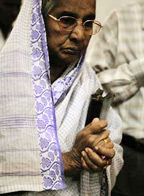
As many as 30 million pilgrims flooded the Hindu holy city of Ujjain to seek spiritual cleansing in the sacred Shipra River. India alone is home to 14 "super-mega" people groups with more than 10 million members each who are currently "unengaged" by a church-planting movement strategy. (Matt Jones Photo)

'As India goes, so goes the Great Commission'

By Erich Bridges

International Mission Board

MUMBAI, India (BP)–What country is home to thousands of millionaires and nine of the world's richest billionaires, makes more movies than Hollywood, boasts the world's largest democracy and is home to 24 million Christians, including 19 million evangelicals?

India.

Americans whose most vivid impressions of India come from old National Geographics and Rudyard Kipling's jungle stories might update their mental file with these facts:

bluebull Eighty percent of India's 1.07 billion people–second only to China in total population–are Hindu.

See Related Stories:
'As India goes, so goes the Great Commission'

Latin American students serve in India

Veteran missionary called to bring healing in Christ's name

San Antonio church provides BUA scholarships for two students from India

But more than 130 million Muslims call India home, and some estimates range above 150 million. That rivals the combined population of all countries in the Arab Middle East.

bluebull The Indian middle class–those earning $2,000 to $4,000 annually–now numbers 300 million, larger than the entire U.S. population. It's expected to approach 450 million within the next five years.

bluebull Massive rural-to-urban migration likely will double the population of India's cities within two decades. That's equal to “all of Europe, all of a sudden, needing water, sanitation, drainage, power, transportation, housing,” says an Asian Development Bank official.

bluebull No fewer than 555 million Indians are under the age of 25, and Indian universities produce more than 1.5 million graduates each year.

bluebull The booming Indian economy was forecast to grow 8 percent this year as Indian industries match or surpass some of the world's top producers.

bluebull India has some 200 million English-speakers. The nation's vast collection of people groups also speaks several hundred other languages and dialects.

Pilgrims seeking spiritual cleansing in the sacred Shipra River offer fire to their gods. (Matt Jones Photo)

bluebull Three Indians made Time magazine's list of the world's 100 most powerful and influential people this year–Bollywood superstar Aishwarya Rai, former Prime Minister Atal Bihari Vajpayee and information technology mogul Azim Premji–reputedly the world's fourth-richest man.

Make no mistake: India still faces enormous problems of poverty and need. The poor in some 800,000 towns and villages still account for the great majority of the population. About 300 million people live on less than a dollar a day. As many as 3,000 Indian farmers in a single state–Andhra Pradesh–have killed themselves over the last six years because of debt and drought.

India has the world's largest number of working children–up to 115 million. Many toil in sweatshops. At least half the population cannot read.

Meanwhile, many of the graduates pouring out of the nation's universities can't find decent jobs. Despite economic growth, too many applicants are competing for too few positions. The government counts 40 million jobless workers, while the vaunted Indian info tech industry employs fewer than 1 million.

But India has made amazing progress on many fronts–economic expansion, education, technology. Its scientists, academics, computer specialists, entrepreneurs and entertainers are challenging–and often surpassing–the best other countries can offer. Expectations are soaring.

Hundreds of India's ethnic, religious and caste groups live in geographical or social isolation from each other, looking at the rest of this vast “nation of nations” with curiosity or suspicion. Many a south Indian, if set down somewhere in the north, would be as bewildered by the customs and languages as someone from the U.S. heartland parachuting into Scandinavia.

In other places, particularly the cities, different peoples and cultures mix and mingle in seemingly countless combinations. Mumbai–or Bombay, as it also is known–is India's largest city and is a world unto itself.

India boasts nearly 20 million evangelicals, such as this member of Andheri Baptist Church. Yet 80 percent of the country's 1.05 billion people are Hindu. (Matt Jones Photo)

With more than 17 million people jammed into a 180-square-mile peninsula, Mumbai is the financial capital of India, the film capital, the organized crime capital, the AIDS and prostitution capital. It is the home of India's most expensive real estate–and Asia's biggest slum. Multitudes live under plastic tarps on the streets, and others dine with old money at the exclusive stadium cricket club, where the joining fee is $30,000.

Travelers on Mumbai's sidewalks and crowded commuter trains can rub shoulders with stock traders in $1,000 suits, beggars, college students, Muslim women covered by black burqas, Punjabis, Tamils, Kashmiris, Bengalis, Assamese, Gujaratis, Keralites.

“Diversity is India,” observes a leading Christian strategist who lives there. “You can lose yourself in all the challenges and unlimited horizons for missions in this country. You could pour a thousand lifetimes into India and never exhaust it.”

India's 24-million-member Christian community is growing, but it remains a small minority of the national population of 1.07 billion.

India and its immediate South Asian neighbors have more than 200 people groups with populations exceeding 1 million. Nearly half of the world's unreached people groups live in India and the South Asian region. South Asia, which includes India, has half of the world's Last Frontier population–more than any other region.

India alone is home to 14 “super-mega” people groups with more than 10 million members each currently “unengaged” by a church-planting movement strategy. In other words, Christians are not yet focusing on any of these groups in a way that will result in growing, self-sustaining church movements. Just one of these ethnic peoples, the Rajput, totals 40 million souls.

“As India goes,” the Christian strategist said, “so goes the Great Commission.”

News of religion, faith, missions, Bible study and Christian ministry among Texas Baptist churches, in the BGCT, the Southern Baptist Convention ( SBC ) and around the world.


Around the State_122004

Posted: 12/17/04

Pastor Corey Webb looks on as Everyday Christian Fellowship in Schertz prepares to break ground on a 17,0000-square-foot multipurpose facility. At the end of the ceremony, bags were passed out so that everyone could scoop up a bit of the dirt to take home as a prayer reminder. Since the church's start in 2001, more than 400 people have prayed to receive Christ through its ministry, and 120 have been baptized. The day of the groundbreaking, the church baptized 10 people, including a family of three.

Around the State

bluebull Ronnie Kidd has been re-elected president of the the Hardin-Simmons University Alumni Association. Linda Perkins will serve as president-elect. Other leaders include Andrea Howey, Larry Moss, Karen Johnson, Erin Maddox, Karen Gurganus, Debbie Young, Deborah Ashmore, Ann Scargall, Pat Kelley, Billy Bob Neff, Janis Altom, Vance Cooksey, Dean Taggart, Donald Tittle, Dorothy Kiser, Debbie Harruff, Bea Shakleford and Fred Ewing.

bluebull Twelve East Texas Baptist University students participated in a model United Nations conference in Chicago. Representing the Marshall school were Amanda Bishop, Ben Bryan, Clarissa Knabenshue, Ginna Hobbs, Hollie Klumpp, Jay Carriker, Jon Roach, Keith Guthrie, Mark Jackson, Paul Potter, Ryan Abt and Ryan Fason.

South Texas Children's Home and the Baptist General Convention of Texas hosted a day of inspiration and dove shoot for South Texas pastors and staff at the STCH Boothe Campus north of Beeville. More than 50 guests participated in a Bible study and fellowship led by Ed Rogers of Georgetown and Homer Hanna of Beeville followed by a dove hunt and barbeque meal. Enjoying a laugh about the doves that got away are (back row, left to right) Greg Taylor, pastor of First Church in Beeville; David Nabors, CFO and treasurer of the BGCT; Bill Fowler, pastor of First Church in Pleasanton; Mike Flanagan, pastor of First Church in Pharr; Jim Furgerson, BGCT South Texas regional office associate; Michael Murphy, pastor of First Church in Smithville; and Jad Hubbard, deacon at First Church in Smithville. Front row from left, Ross Chandler, pastor of First Church in Hondo; Jerry Haag, president and CEO of STCH; Charles Wade, executive director of the BGCT; Lee Bevly, pastor of First Church in Skidmore; and Ruben Perez, deacon at First Church in Pharr.

bluebull Eleven University of Mary Hardin-Baylor students were accepted into the 25th annual Central Texas Art Competition. Top awards were earned by senior art majors Katherine Salter, Paula Smith and Brian McClure. Other UMHB students accepted into the competition were Tabitha Lovelace, Dean Youngblood, Nancy Holder, Katy Seals, Lea Wulbrecht, Hope Greeley, Melinda Hawkins and Karen Burgess. One hundred sixty artworks were chosen from 400 entries.

bluebull Science students at Wayland Baptist University will be able to add another dimension to their studies, thanks to a grant from the Welch Foundation. The $75,000 grant will cover three summers of an undergraduate research program in the chemistry department. The 10-week program will employ four students as research assistants on two different projects. One project will deal with investigation of the Steroidogenic Acute Regulatory gene, which produces natural steroids. The other will deal with methods for removing nitrogen from compounds placed in water.

bluebull Fifteen students from Houston Baptist University will be listed in the 2005 edition of “Who's Who Among Students in American Universities and Colleges.” They are Christine Abraham, Brittney Adams, Kathryn Bowser, Gary Horn, Jamie Kelly, Mina Madani, Anadita Pal, Adrienne Parson, Mary Payton, Leena Samuel, Melanie Stuff, Amber Syphrett, Lisa Underland, Sarah Upton and Rachel Werner.

bluebull Mike Jones, a former coach at Howard Payne University who has been serving as the university's director of student support services, has been named athletics director at HPU.

Anniversaries

bluebull James Wilcox, 10th, as pastor of South Prong Church in Waxahachie, Dec. 1.

bluebull Marcus Sheffield, 15th, as pastor of First Church in Mexia, Dec. 3.

bluebull Betty Downey, 20th, as pianist at First Church in Big Spring, Dec. 9.

Deaths

bluebull Cecil Meadows, 99, Nov. 17 in San Angelo. He was the retired pastor of several rural churches in Missouri and Arkansas, as well as San Saba, Rochester, Earth and Grand Prairie. He had lived at Baptist Memorials in San Angelo the last 29 years. He was preceded in death by his wives, Millicent and Mary Nell. He is survived by his daughters, Margaret Sprinkle and Evelyn McAnelly; sisters, Hazel Coleman, Effie Hawkins and Jaunita Haughey; brother, Howard; four grandchildren; and five great grandchildren.

bluebull Robert Clogston, 82, Nov. 28 in Houston. He was ordained to the ministry in 1954 at First Church in Berclair, his first pastorate. He was pastor of many churches in the Houston area and established churches in Montana and West Virginia with the Home Mission Board. In 1965, he joined the Harris County Sheriff's Department and in 1967 became chaplain under the auspices of the HMB. In 1977, he received the Special Services Award for services above and beyond the call of duty while serving as staff chaplain with Harris County. He is survived by his wife, Ellen; sons, Wes and George; and grandchildren and great-grandchildren.

bluebull Ted Lucenay, 79, Dec. 2 in Waco. Lucenay grew up in Hollywood, Calif., where one of the members of his household was Pete, the “Our Gang” comedy show dog, owned by his father. He was a former mayor of Robinson. He was a trustee of the University of Mary Hardin-Baylor nine years. He was a deacon at Columbus Avenue Church in Waco, serving as chairman two years. He is survived by his wife of 57 years, Helen; daughters, Dicque Oliver and Adelle Lucenay; sons, Harry and Tom; 11 grandchildren; and two great-grandsons.

bluebull Eugene Hoover, 72, Dec. 3 in Temple. A pastor 54 years, he served Merriman Church in Ranger, Webb Church in Arlington, Ridglea Church in Fort Worth, Calvary Church in Denison, Memorial Church in Temple and Travis Oaks Church in Lago Vista. After retiring from full-time ministry, he entered the intentional interim ministry program and served at First Church in Rockdale and Keys Valley Church in Belton. He is survived by his wife, Carol; son, John; daughter, A'Lisa Ozment; and six grandchildren.

bluebull Ed Riley, 92, Dec. 12 in Norman, Okla. He was a member at First Church in Wheeler, where he was a deacon 37 years. He was preceded in death by his daughter, Mary Mitchell. He is survived by his wife, Erma; son, Bob; daughters, Nelda Cote and Ann Henderson; brother, Earl; sisters, Minerva Jones, Wilma Barker and Hannah Chapman; 13 grandchildren; 30 great-grandchildren; and five great-great-grandchildren.

Events

bluebull The Southern Congregational Parish Nurse Conference will be held Jan. 21-22 at First Church in Nederland. Sponsored by Memorial Hermann Baptist Hospitals, the theme will be “Jars of Clay.” Keynote speakers will be parish nurse program coordinator and Assistant Chaplain Anne Osborne Gifford of North Hills Hospital in North Richland Hills; Debbie Seider, congregational nurse coordinator of Methodist Health System; and Linda Garner, Baylor University associate professor of nursing. Special music will be brought by His Song. For more information or to register, call Becky Seymour at (409) 212-5648.

bluebull The Todd Keller Family of Plainview will be in concert at First Church in Devers at 10:45 a.m. Jan. 2. Harry McDaniel is pastor.

News of religion, faith, missions, Bible study and Christian ministry among Texas Baptist churches, in the BGCT, the Southern Baptist Convention ( SBC ) and around the world.


BaptistWay Bible Series for Dec. 26: Christians should invest in eternal treasure_122004

Posted: 12/17/04

BaptistWay Bible Series for Dec. 26

Christians should invest in eternal treasure

Matthew 6:19-34

By Todd Still

Truett Seminary, Waco

Having warned his disciples against becoming hypocritical spectacles by parading their piety before other people (6:1-18), Jesus turns in his “sermon” to address another critical issue that can distract or even undo those who would seek to follow him–the accumulation of and devotion to material wealth (vv. 19-34).

At the outset of the passage we are studying this week, Jesus enjoins his listeners not to stockpile treasures on earth (vv. 19-21). He calls them to be marked by generosity (vv. 22-23). Instead of being beholden to mammon and absorbed by anxiety over bare necessities, those who follow Jesus are to serve God and seek his kingdom, believing the heavenly Father is willing and able to care for his own (vv. 24-34).

In theory, most people would agree with Job's sober assessment of life and death: “Naked I came from my mother's womb, and naked shall I return there” (v. 21). As one preacher quipped, “Hearses do not pull U-Hauls.”

Be that as it may, it is probably true that a majority of Christians living in the Western hemisphere do not take seriously enough Jesus' command, “Do not to store up treasures for yourselves on earth” (v. 19). Despite knowing that material possessions are transitory and should be secondary, our conspicuous consumption and frantic accumulation continue.

We too frequently forfeit the opportunity to be rich toward God and too infrequently treasure what truly matters. Modern-day Christians who live in relative affluence would be unwise not to be unsettled by Jesus' sobering statement, “For where your treasure is, there your heart will be also” (v. 21).

Whereas a person who treasures treasure above all else is likely to be greedy, an individual who views money as a means and not as an end may well be generous. By speaking of the eye as the lamp of the body and by referring to one's eye as sound or unsound, healthy or unhealthy, Jesus appears to be suggesting that a person who has a sincere or single eye will be generous and full of light even as the one who has an “evil” eye will be stingy and full of darkness (vv. 22-23). Moreover, “if the light that is in you is darkness, how great is the darkness” (v. 23).

Far from being innocuous, Jesus warns that money and other material things can be sinister and can even become one's master. Those who follow Jesus are to be cognizant that they cannot simultaneously serve God and money. A divided heart results in fractured affections, and the God who commands us to love him above and beyond all else will brook no rivals. It is as ironic as it is tragic that while “In God we trust” is printed on United States currency, we sometimes succumb to the temptation to depend upon our money and that which we can purchase with it rather than upon God (v. 24).

While it is both natural and responsible to concern oneself with basic human needs such food, drink and clothing, Jesus cautions his disciples not to be consumed with anxiety about such things lest they become enslaved to them. He asks his followers to realize that life is more than food and the body is more than clothing (v. 25).

For illustrative purposes, Jesus appeals to the heavenly Father's care for the birds of the air. Although they do not sow or reap or gather into barns, they are fed by him (v. 26). Additionally, Jesus asks his listeners to consider how beautifully and adequately the lilies or wildflowers of the field are clothed. So decked out are they that even King Solomon would pale in comparison (vv. 28-29).

By pointing to carefree birds and well-donned flowers, Jesus intends to do more than show himself an astute observer of and great admirer of nature. Primarily, he wants to impress upon his disciples that even though God cares for the birds of the air and the flowers of the field, he cares much more for them. So, even as God sees fit to feed the birds and clothe the flowers, God will see all the more fit to feed and clothe them (vv. 26, 30).

Jesus would have affirmed the psalmist who wrote, “I have been young, and now am old, yet I have not seen the righteous forsaken or their children begging bread” (Psalm 37:25).

If the principle of simple trust in and reliance upon God that Jesus promotes in this passage strikes us as somewhat naïve and overly passive, we would do well to consider the ultimate origin of the gifts and graces that we presently possess. Do we really believe God is the one from whom all blessings flow? Or have we become “practical atheists” who work and worry and worry and work within what amounts to a closed-world continuum (v. 32)?

Jesus' instruction to his followers about money and anxiety should cause his disciples today to reaffirm our belief in God's care and keeping and should prompt us to redouble our efforts to seek first God's kingdom and righteousness (v. 33). This would include, among other things, a deep gratitude for and a warm generosity with our material resources.

Whether or not we are willing to admit it, we are in fact limited in power and perception (vv. 27, 34). If for no other reason, our own human limitations provide reason enough for us to entrust ourselves anew to an all-powerful, all-knowing God who cares for birds, lilies and those of little faith.

Discussion question

bluebull Is your trust in God reflected in your giving to others?

News of religion, faith, missions, Bible study and Christian ministry among Texas Baptist churches, in the BGCT, the Southern Baptist Convention ( SBC ) and around the world.


BaptistWay Bible Series for Jan. 2: Jesus offers nuggets of wisdom to his disciples_122004

Posted: 12/17/04

BaptistWay Bible Series for Jan. 2

Jesus offers nuggets of wisdom to his disciples

Matthew 7:1-27

By Todd Still

Truett Seminary, Waco

Matthew 7 is comprised of seven sections of instruction (vv. 1-5; v. 6; vv. 7-11; v. 12; vv. 13-14; vv. 15-23; vv. 24-27) plus a conclusion (vv. 28-29). In this lesson, we will overview the contents of this third and final chapter of Jesus' Sermon on the Mount.

On judging

Chapter 7 commences with the command, “Do not judge in order that you might not be judged” (v. 1). This verse has become rather popular in contemporary American culture where it typically is construed to mean: “You have no right whatsoever to call my actions or convictions into question.”

The verses following this admonition cast aspersions upon this common, if mistaken, understanding. Jesus does not call his disciples to jettison moral and theological discernment; rather, he prohibits hypocritical judgment among his followers and enjoins his disciples to exercise mercy and demonstrate humility when judging fellow believers (v. 2).

Disciples not only are to recall “Blessed are the merciful, for they will be shown mercy” (5:7), but also are called to examine themselves before dispensing correction or discipline (7:3-4). For some reason, it always is easier to sweep off the doorstep of another. It is far more prudent, however, to correct our own spiritual vision before seeking to assist others with theirs. Beware Christians who think they possess perfect spiritual vision and perception. It is possible they are being hypocritical (v. 5).

Dangerous dogs and pearl-less pigs

Although enigmatic, Jesus' injunctions not to give what is holy to dogs lest they turn and maul you and not to throw pearls to pigs lest they trample upon them seem to serve as a warning to not pollute or profane what is sacred. This verse also may suggest that believers should be discerning and deliberate in their relations with outsiders. “Airing the church's dirty laundry” in the public square or button-holing unbelievers on street corners may sully the community, engender hostility or be an exercise in futility. It is wise to realize that pigs eat pods not pearls, and rabid dogs want meat not bones.

On prayer

Jesus further underscores the importance of prayer in the lives of his followers in 7:7-11. Disciples are instructed to ask, to seek and to knock and are informed they will receive, find and gain entry (vv. 7-8). Although sinful, most earthly fathers provide for their children's needs (vv. 9-10). God, who is not tainted by evil, is both willing and able to give good things to those who ask him (v. 11).

This passage should not be construed to mean that believers have been granted heavenly carte blanche. Disciples should pray with the model prayer in mind (6:9-13). Nonetheless, Christians should be fully aware they pray to a gracious God, not a divine despot.

The Golden Rule

The person who aspires to live by the so-called Golden Rule does well. Not unlike other rabbis of his day, Jesus taught his followers to treat others with the treatment they desire from others. In essence, Jesus is instructing his disciples to love their neighbors even as they love themselves. This is never easy, especially when one's neighbor is an enemy (5:44). This simple principle lay at the very heart of the law and the prophets, not to mention the gospel.

On gates, trees and foundations

As the Sermon of the Mount nears its end, Jesus calls his disciples to enter by the narrow gate and walk the hard road. To be sure, a wider gate leads to a primrose path, and it is far and away more popular. Despite its alluring beginning, the wide way leads to spiritual disaster, whereas the arduous road leads to spiritual life. Although following Jesus leads to Golgotha, death will give way to life (vv. 13-14).

From its inception, the church has had to cope with counterfeits. Jesus warns his followers not to be eaten alive by ravenous wolves who pose as innocent sheep (v. 15). The way to differentiate between “real McCoys” and “fine decoys,” Jesus instructs, is by their fruits (vv. 16, 20). Even as a tree is known by the fruit it bears or fails to bear (vv. 17-18), prophets may be discerned as true or false by the fruit they produce. Orthodox confessions and miraculous manifestations must be supported by loving obedience to the heavenly Father (vv. 21-23).

Jesus concludes his message from the mountain by comparing those who hear and heed his words to a wise man who built his house upon the rock. Although this location did not preclude storms from coming, it did prevent the house from falling. Those who fail to embrace Jesus' instruction are likened to a foolish man with his house on the sand. When the rain fell and the floods came and the winds blew against this house, it could not withstand such a storm (vv. 24-27).

In 7:28-29, Matthew reports the crowds were amazed at Jesus' teaching. They particularly were impressed that Jesus taught with authority and not as a scribe–that is, he did not think it necessary to rehearse rabbinical opinion on each and every issue he addressed. Furthermore, 8:1 informs that the crowds (not merely his disciples) followed Jesus as he descended the mountain. Whether they (and we) will follow him as he ascends Mount Calvary is another question that awaits an answer.

Discussion question

bluebull What wisdom in this lesson did you need to hear?

News of religion, faith, missions, Bible study and Christian ministry among Texas Baptist churches, in the BGCT, the Southern Baptist Convention ( SBC ) and around the world.


Voting faculty nix Baylor president; supporters find fault with referendum_122004

Posted: 12/17/04

Voting faculty nix Baylor president;
supporters find fault with referendum

By Ken Camp

Managing Editor

WACO–A majority of Baylor University faculty who voted in a nonbinding referendum on the leadership of President Robert Sloan believe he should be dismissed.

Sloan's supporters already have pointed out the 418 voters calling for the president to be fired still is less than half of the faculty–but just barely.

Results posted on the faculty senate's website showed 59 percent of 838 eligible faculty voted. Of the 490 votes cast, 85 percent were against retaining Sloan as president.

“The results of the referendum unequivocally confirm and reinforce the position that the Baylor faculty senate has taken in its two no-confidence votes against President Sloan in September 2003 and May 2004,” said a public statement from the faculty senate on its website.

“Over the course of the last 18 months, various Baylor administrators have continued to assert publicly and in private meetings that the opposition to President Sloan's leadership was limited to a small, vocal group of faculty. The results of this referendum clearly refute that assertion.”

On the contrary, said Baylor Regents Chairman Will Davis of Austin, the referendum “sheds no new light on the fact that a segment of faculty do not agree with the current administration” at the Texas Baptist university.

“I would remind all Baylor constituents that the board of regents has the sole responsibility for determining who serves as president of the university,” Davis said.

“I hope that the administration will continue to make progress in reaching out to faculty to address their concerns and that the faculty will reciprocate.”

The Baylor University administration offered no further comment.

Student Body President Jeff Leach called the referendum “divisive” and “ineffective in achieving reconciliation” at the university.

“The results of the referendum do nothing but to once again state what we already know–that there are debates and divisions that still remain amongst the faculty over President Robert Sloan and his administration,” Leach said. “All parties should realize that the ultimate responsibility in this dilemma lies with the board of regents. We call for divisive steps such as these to come to an end so that Baylor students can move forward, continuing to be proud of the university that we all love so dearly and so that true unity and reconciliation may be achieved.”

A public statement issued by 20 Baylor faculty–including Douglas Henry, director of the Institute for Faith & Learning, and Robert Kruschwitz, director of the Center for Christian Ethics–critiqued both the methodology and motivation for the faculty senate referendum.

“Debating ideas is the hallmark of academic life; taking polls is the province of politicians,” the group said. “Professors should be in the business of debating ideas. The Baylor faculty senate's recent referendum was a political move that did not give any such opportunity, even as it was also a flawed and invalid means for assessing faculty opinion.”

The faculty said the regents “cannot possibly welcome the presumptuous rhetoric of some senators that the referendum has 'established a precedent' for the future conduct of the faculty.”

The group dismissed the votes calling for Sloan's dismissal, pointing out that half of the eligible faculty either did not participate or voted in Sloan's favor.

But the faculty senate applauded the “courage and integrity” of faculty members who cast ballots.

“We do know and appreciate that they did so in the face of semi-official calls for a boycott and in many cases placed their professional future in jeopardy,” said a statement on the faculty senate website.

Bill Carden, president of the Committee to Restore Integrity to Baylor, agreed, saying, “The results of the referendum speak for themselves, regardless of any spin that anyone might try to put on it.”

A little more than a year ago, Baylor University regents voted 31-4 to affirm Sloan. But by May, his support on the board had eroded to the point that he retained his job by one vote. A motion to ask for his resignation failed in an 18-17 secret-ballot vote.

In September, the regents voted to postpone indefinitely a call for Sloan's resignation. At the same time, they unanimously rejected the faculty senate's call for a facultywide referendum on Sloan's presidency. The faculty senate proceeded with the vote anyway.

The McLennan County elections office conducted the referendum from Nov. 30 to Dec. 2 at the faculty senate's request.

The next regularly scheduled board of regents meeting is Feb. 4.

News of religion, faith, missions, Bible study and Christian ministry among Texas Baptist churches, in the BGCT, the Southern Baptist Convention ( SBC ) and around the world.


Church guides visitors through interactive journey to Bethlehem_122004

Posted: 12/17/04

Jim Vickroy, a member of Western Oaks Baptist Church of Springfield, Ill., portrays Zechariah in the church's interactive Christmas drama.

Church guides visitors through
interactive journey to Bethlehem

By Michael Leathers

Associated Baptist Press

SPRINGFIELD, Ill. (ABP)–With just a portable heater as defense against the cool night, Kendra Jackson waits for the next group of Christmas celebrants to arrive. The 30-something mother of two daughters is portraying Anna in the interactive Christmas drama produced by Western Oaks Baptist Church.

Jackson has never acted before, unless you count bit parts in her high school's production of “Li'l Abner.” But she's been involved in the Western Oaks production, “Journey to Bethlehem,” for the past three years because it “attracts people to church and helps them celebrate the season better.”

The walk-through drama, told in nine scenes, has been performed by Western Oaks for the last five Decembers. Some 300 church members are involved in every aspect of the drama–from construction of outdoor and indoor sets in the fall to baking thousands of cookies for visitors. Even the script is locally written, tailored for the layout of the church.

While many churches stage living nativities and choir cantatas for Christmas, Western Oaks Pastor Jeff Blevins wanted the church to try a different approach–something unique that would be a gift to the community.

Melodee Blevins, a member of Western Oaks Baptist Church of Springfield, Ill., is one of two actresses who portrays Anna in the church's interactive Christmas drama on alternating nights. Audience members travel through the drama's nine scenes in and around the church as they search for the newborn Messiah.

The answer was an interactive play. Visitors are taken through a tour of the Christmas story, led by a wise man searching for the location of the birth of the Christ child. The traveling audience follows their guide through the journey's nine scenes in and around the church. The audience interacts with different characters, each one revealing a little information they need to find the birthplace of Jesus.

“By making it an interactive journey, people feel like they participate in the story and in the journey,” said D.J. Shultz, director of worship and music at Western Oaks.

That's important, because visitors are reminded in the final scene that “we're all on a journey” to find Christ–a journey that continues after they leave the church, he added.

This season, Western Oaks transformed its lobby into Herod's court, complete with a running fountain. Visitors are greeted and then sent through the drama in groups of 15 to 25 each. On busy nights, groups are dispatched every four minutes. Actors like Jackson may perform their scenes up to two dozen times in one evening.

Other characters include Zechariah, an excitable priest delighted to have visitors after losing and regaining his speech when his son, John the Baptist, was born. They meet Herod, who assigns a skeptical servant to tour with the group as they search for Jesus. They find help from a beggar child in a bustling marketplace. A merchant tells them about a star another caravan of travelers had been following.

The tour ends with a reflective stop at the Bethlehem manger. There, Herod's servant tells the travelers she cannot return to Herod because she has been changed by the story of the newborn Messiah.

About 120 church members serve as cast and crew each night during the six-night production over two weekends. Last year, more than 4,200 people attended, the highest attendance of the five-year run. The church rewrites the story each year, adding new scenes and retiring some characters to keep the drama fresh for return visitors.

The interactive drama has been spreading to other churches. Calvary Baptist Church of Alton, Ill., planned a three-night performance of its own version of “Journey to Bethlehem.” The church sent about a dozen members to Western Oaks last year to attend a production. “Having the opportunity to see it done was so much more helpful than just reading it on paper,” said Rick Patrick, the church's minister of education. The church is incorporating a living nativity into its production.

Blevins said one strength of the drama is that it brings families together to slow down for a few moments and reflect “in a world where we're racing toward Christmas.”

Another strength, he said, is the drama's life-changing potential.

One 19-year-old man, who was halfway through a drug rehab program, talked to Blevins after the drama because he was having serious questions about his life and purpose. He later made a decision to commit his life to following Jesus Christ.

The drama strengthens church members as well.

“I see our people coming alive and serving,” Blevins said.

“That's what we're designed to do.”

News of religion, faith, missions, Bible study and Christian ministry among Texas Baptist churches, in the BGCT, the Southern Baptist Convention ( SBC ) and around the world.


Governance committee named to draft new bylaws for Baptist General Convention of Texas_122004

Posted: 12/17/04

Governance committee named to draft new
bylaws for Baptist General Convention of Texas

By Ferrell Foster

Texas Baptist Communications

DALLAS–Twenty-one Texas Baptists have agreed to serve on a governance committee to develop new bylaws for the Baptist General Convention of Texas.

The committee, selected by Executive Board Chairman John Ogletree and BGCT Executive Director Charles Wade, will review current bylaws for both the convention and its Executive Board and then propose one new set of bylaws.

“We are working to bring that all together, make it more concise and comprehensive,” Wade said

The new bylaws also will deal with issues that are in the current BGCT constitution, but are not part of a proposed new constitution, he said.

"This committee is representative of every area of Texas because the Baptist General Convention of Texas has strength in its churches in all areas of our state. We celebrate that, and we want to recognize that in our governance."
—BGCT Executive Director Charles Wade

Messengers to the BGCT annual meeting last month in San Antonio approved a sweeping revision of the convention's primary governance piece, its constitution. It must now be approved on a second reading during the 2005 annual meeting in Austin in order to take affect.

New bylaws are being developed now so Texas Baptists can know more about how the new governance structure will work and so the bylaws will be ready for convention consideration if the new constitution is approved, Wade said.

“Everyone on the committee is passionate about the work of the BGCT,” said Ogletree, pastor of First Metropolitan Baptist Church in Houston. “When we all get together and put our heads together, God's going to get some glory out of it.”

Everyone who was asked to be on the committee agreed to serve, Wade said.

There are four women, five laymen, four denominational leaders and eight pastors. In regard to ethnic diversity, the committee includes four Hispanics, three African Americans and one Asian American.

“This is a diverse group of Texas Baptists,” Ogletree said. “All segments of our state are represented. There is diversity not just in geography but in viewpoint, as well.”

“We want to demonstrate that this convention wants to reach all the peoples of Texas,” Wade said. The diversity of the committee “also recognizes that across the last several years the ministry among Hispanic, African-American and other ethnic groups has exploded as we have started more churches and churches have become more multicultural.

“This committee is representative of every area of Texas because the Baptist General Convention of Texas has strength in its churches in all areas of our state,” Wade said. “We celebrate that, and we want to recognize that in our governance.”

Wesley Shotwell, pastor of Ash Creek Baptist Church in Azle, will chair the committee. The three top BGCT officers–President Albert Reyes of San Antonio, First Vice President Michael Bell of Fort Worth and Second Vice President Stacy Conner of Muleshoe–will serve on the committee.

Ken Hall, immediate past president of the BGCT and president of Buckner Baptist Benevolences, BGCT Administrative Committee Chair Bob Fowler of Houston, BGCT Executive Board Vice Chair Jim Nelson of Austin and Ogletree also will serve.

Pastors on the committee are Mike Barrera of United Baptist Church in Laredo, Charles Davenport of First Baptist Church in Tulia, David Massey of First Baptist Church in Hallsville and Mitch Wilson of First Baptist Church in Shallowater.

Laypersons on the committee are Rudy Camacho from Iglesia Bautista Genesis in Fort Worth, Willie DuBose from First Baptist Church in Midland, Elizabeth Hannah from Calder Baptist Church in Beaumont, Frankie Harvey from Nacogdoches Bible Fellowship, Ly Klassen from Richardson Vietnamese Baptist Church, Linda Masten from First Baptist Church in Corpus Christi and Tommy Thompson from Conway Avenue Baptist Church in Mission.

BGCT Executive Board staff on the committee are David Nabors, treasurer and chief financial officer, and Lorenzo Peña, coordinator of associational missions and administration.

The committee will develop a proposal during the next couple of months then seek feedback during the regular March 1 meeting of the BGCT Executive Board, Wade said. A final recommendation will be presented the Executive Board at its May 24 meeting.

“I ask people to pray for us,” Wade said. “I'm very grateful for the strong affirmation of the constitution in its first reading. I hope this continuing process will strengthen understanding and improve the ability of this convention to serve the churches of Texas.”

News of religion, faith, missions, Bible study and Christian ministry among Texas Baptist churches, in the BGCT, the Southern Baptist Convention ( SBC ) and around the world.


Baptist Briefs_122004

Posted: 12/17/04

Baptist Briefs

Mercer president announces retirement plans. Kirby Godsey, Mercer University's longest-serving president, announced he will retire in 18 months, and trustees expect to start the search for his successor as early as spring. At a recent trustee meeting, Godsey, 68, revealed his plans to step down June 30, 2006. Mercer trustee and Augusta attorney David Hudson will head the search committee, which will begin work in the spring. Godsey went to work for the historically Baptist university in 1977 as executive vice president and dean of the College of Liberal Arts. Previously he was vice president and dean of the college at Averett College in Danville, Va. When Godsey became president in 1979, Mercer had an enrollment of 3,800 students, an endowment of $16.5 million and a budget of $21.3 million. It grew under his leadership to become Georgia's second-largest private university, with an enrollment of 7,300 students, an endowment of more than $176 million, a budget of $173.8 million and 665 faculty members.

BGCT president to address CBF assembly. Baptist General Convention of Texas President Albert Reyes has been added to the list of keynote speakers at the Cooperative Baptist Fellowship general assembly, June 29-July 2 at Gaylord Texan Resort and Convention Center in Grapevine. Reyes, who also is president of Baptist University of the Americas in San Antonio, will speak during the Thursday evening session. Online registration and hotel reservations for the general assembly can be made at the Fellowship's website, www.thefellowship.info.

Baptist chaplain honored. The Chapel of the Four Chaplains recently presented its Legion of Honor award to Cooperative Baptist Fellowship-endorsed chaplain Keith Ethridge. Ethridge is acting deputy director for the National Chaplains Center for the Department of Veterans Affairs. A former U.S. Navy chaplain, Ethridge has been a clinical pastoral education supervisor 17 years. The Chapel of the Four Chaplains, a national nonprofit organization established to encourage cooperation and promote unity without uniformity, annually recognizes individuals from all walks of life who render selfless service. Dedicated by President Truman in 1951, the chapel was inspired by the courageous acts of four U.S. Army chaplains serving aboard the U.S. troop carrier Dorchester, which was sunk by a torpedo off the coast of Greenland in 1943. The chaplains–Catholic, Dutch Reformed, Jewish and Methodist–went down with the ship after surrendering their own lifejackets to servicemen aboard.

LifeWay to offer seminars after 2005 SBC. LifeWay Christian Resources will offer intensive ministry training sessions immediately following the 2005 Southern Baptist Convention in Nashville, Tenn. "Fast 50: 50 Seminars for Growing Leaders" will be held June 23-24. Seminars will cover evangelism, discipleship, Sunday school, general church leadership, age-group specific leadership and mission leadership. "Fast 50" participants will have the opportunity to attend four seminars each day. Online registration is available beginning Feb. 1 at sbc.net. Registration fee is $50 per day per person or $80 for both days.

CBF partners to provide consulting services. The Cooperative Baptist Fellowship has launched a three-year partnership with the Center for Congregational Health, a consulting and training center in Winston-Salem, N.C., to provide a number of consulting services free to churches. The center will provide consultation to Fellowship churches in strategic planning, interim ministry, conflict management, staff relationships and leadership. Bo Prosser, the Fellowship's coordinator for congregational life, said the partnership also will allow for the creation of a network of CBF-trained intentional interim pastors available for churches. The partnership, which will run until June 2007, will provide free on-site consultation for up to 75 hours, with the churches paying only travel costs for the consultants.

News of religion, faith, missions, Bible study and Christian ministry among Texas Baptist churches, in the BGCT, the Southern Baptist Convention ( SBC ) and around the world.


Pastor launches support network for other military families_122004

Posted: 12/17/04

Pastor launches support network for other military families

By George Henson

Staff Writer

BROADDUS–Aaron Barth always has had his dream firmly in sight. From his earliest days, his mother and father can remember Aaron and his brother, William, playing army with sticks they found in the yard.

Aaron joined the U.S. Army on his 18th birthday, and now he is in Iraq doing what he always wanted to do–serving his country. And William, 21, is training for deployment to Afghanistan.

They are living their dream, but that doesn't make it any easier on their parents.

Their father, Wayne Barth, is pastor of First Baptist Church in Broaddus. But a strong faith doesn't make him immune from fear.

Wayne Barth, pastor of First Baptist Church in Broaddus, and his wife, Diana, want to offer not only prayer support for other military families, but also a network to help them communicate with each other.

“There are moments when I get worried and afraid–fearful more than anything,” Barth said.

There also are moments when tears roll down his cheeks. While being a pastor does not insulate Barth from the worries and pain of fatherhood, he does find solace in God's word and his overarching faith that both he and his son are firmly in God's hand.

“God has really been gracious in lifting me out of my gloom and dispair,” he says, his unforced smile adding to the veracity of his testimony.

Each day, sometimes several times a day, Barth looks to Scripture for comfort. More often than not, he turns to the passage he highlighted in bright yellow the day he was told Aaron would be going to Iraq–2 Samuel 22, particularly the first seven verses.

King David's song of praise found there is often just the balm Barth needs to soothe his frayed emotions.

“Knowing that God hears me when I get afraid, fearful and emotional makes all the difference,” he said.

He and his wife, Diana, also have found support in their church, especially from more than a dozen veterans in the membership. Those men also spoke to their sons about what to expect in combat.

Broaddus, population 218, and nearby Zavalla, where Mrs. Barth teaches kindergarten, also have been supportive. The bank, various restaurants and the school have Aaron's picture on the wall.

“We've had the support of God, church, the community, our family. I don't know how we would make it without all the support,” Barth said.

One particularly trying day, Barth even sent an e-mail to President Bush.

“I know he probably didn't get it, but I had to send it. It simply said: 'Dear President, Please take care of my son.'”

He said he and his wife don't hide their concerns from their children still living at home–Sarah, 17, and Bryant, 15.

“They know we hurt, and they hurt right along with us. They get angry. We don't hide our feelings from one another,” Barth said.

While Mrs. Barth also shares her husband's concerns for her sons, she also finds comfort that Aaron in particular is living his dream. She says some people tell her they don't see how she can cope.

“It could be difficult, and some days it is, but this is what he loves to do. How many kids know at 19 or 20 what it is that they want to do and are actually getting to do it?” she pointed out.

That doesn't mean she didn't steer him away from a military career path. Aaron was salutatorian of his 2002 graduating class, and his mother wanted him to go to college. She filled out applications for universities and scholarships, but he was steadfast in his desire to serve his country.

His intellectual skills led the Army to try to steer him toward work with computers, but he requested a combat role instead.

“One of the hardest things is day to day not knowing what is going on–not knowing what he is doing,” Barth said.

He said his sons knew exactly what they were signing up for. While they had military aspirations from a young age, he said the attacks on the World Trade Center and the Pentagon on Sept. 11, 2001, angered them and solidified their resolve to serve their country.

Barth recalls telling them that they were enlisting during a time of conflict and that “it was possible they might be called on to make the ultimate sacrifice.”

“As a parent, you want to say, 'Are you out of your mind?' But we've raised them the best we knew how, and they're grown. You just have to let them go and support and respect their decisions,” he said.

Aaron left for Iraq days after Thanksgiving with the 3rd Infantry Division. William has been issued his desert fatigues and expects to deploy to Afghanistan within months with the 82nd Airborne.

“They were both here for Thanksgiving and came to church in their uniforms. I don't think my chest could have swelled any more,” their father admitted.

Still, when he looked at the soldiers, he saw his boys.

“These are typical 19-, 20-, 21-year-old kids. They still like hanging out with their friends. They love to play video games. I don't want to give the impression that they are immature by any means, however. These are boys in a man's world, doing a man's job. These are real men; more men than their father will ever be,” he said.

Barth's personal struggles have inspired him to start a support group for soldiers' families throughout the state.

He said military bases have excellent support systems, but parents, spouses, grandparents and siblings living away from a base may feel like no one else can identify with their fears and struggles.

He hopes to form a telephone and e-mail support system. Military families can use it on days when they are struggling, allowing them to communicate with someone who knows exactly what they are feeling.

“I know there are a lot of people who are hurting out there. I want to offer them someone to turn to,” he said. “As families of military personnel, we have a common bond with these folks.”

He says he is making himself available out of obedience to God.

“You never know where God is going to bring support from. God has seen those times when we have personally been struggling and he's always prepared someone to be there for us,” Barth said.

“If there's anything I can do with what God has placed in my hands, that's what I want to do,” he added.

The Barths can be contacted at (936) 872-3751, (936) 872-3508 or WmWBarth@aol.com.

News of religion, faith, missions, Bible study and Christian ministry among Texas Baptist churches, in the BGCT, the Southern Baptist Convention ( SBC ) and around the world.