Former seminary president Honeycutt dies at 78_11005

Posted: 1/07/05

Former seminary president Honeycutt dies at 78

By Trennis Henderson

Kentucky Western Recorder

LOUISVILLE, Ky. (ABP)–Roy Honeycutt, retired president of Southern Baptist Theological Seminary, died Dec. 21, one day after suffering head injuries in a fall at his home in Louisville, Ky. He was 78.

Honeycutt, a noted Old Testament scholar, was elected president of Southern Semi-nary, also in Louisville, in 1982.

His 11-year tenure as president paralleled much of the controversy in the Southern Baptist Convention's conservative shift.

Roy Honeycutt

Many remember Honeycutt for one headline-making speech in 1984, when he declared “holy war” on the “hijackers,” a reference to fundamentalist leaders leading the effort to gain control of the Southern Baptist Convention.

Honeycutt immediately became a target in the controversy. As the seminary's board shifted to fundamentalist control, he came under increased pressure to resign. He retired in 1993, at age 67, three years earlier than he planned.

Bill Leonard, dean and professor of church history at Wake Forest Divinity School, joined Southern's faculty in 1975, the same year Honeycutt was named dean of Southern's School of Theology.

“In many ways, Roy was a bridge-builder,” Leonard recalled.

Honeycutt's efforts at bridge-building included working with the five other Southern Baptist Convention seminary presidents to draft the “Glorieta Statement” in 1986.

Adopted at the height of the SBC controversy, the Glorieta Statement declared the seminary presidents' commitment “to the resolution of problems which beset our beloved denomination.” But the document largely was ignored by conservative leaders, who already controlled most of the seminaries' boards.

Honeycutt was a graduate of Mississippi College, Southern Seminary and the University of Edinburgh, Scotland. Prior to being elected president in 1982, Honeycutt served as provost, theology school dean and professor of Old Testament at Southern. He previously was academic dean and chair of the Old Testament department at Midwestern Baptist Theological Seminary in Kansas City, Mo. He also was pastor of churches in Kentucky, Indiana and Mississippi.

Honeycutt and his wife, June, were longtime members of Crescent Hill Baptist Church in Louisville. In addition to his wife, he is survived by two children, Roy Lee and Mary Anne.

News of religion, faith, missions, Bible study and Christian ministry among Texas Baptist churches, in the BGCT, the Southern Baptist Convention ( SBC ) and around the world.


Sullivan praised as denominational statesman_11005

Posted: 1/07/05

Sullivan praised as denominational statesman

NASHVILLE, Tenn. (BP)–James Sullivan, Southern Baptist statesman and retired president of the Sunday School Board of the Southern Baptist Convention, died Dec. 27 at a Nashville hospice following a brief illness. He was 94.

Sullivan served as president of the denominational publishing house from 1953 until his retirement in 1975.

He was widely known as an authority on Southern Baptist polity and had been actively involved in denominational service since his first pastorate in 1932.

James Sullivan

“He was president at one of the most crucial times at the Sunday School Board during the civil rights struggles of the 1950s and '60s,” said Jimmy Draper, president of LifeWay Christian Resources, the agency that succeeded the Sunday School Board.

“He led in production of materials promoting the biblical view of human worth, regardless of race, and modeled his beliefs by providing an equitable work environment for a multicultural staff. He was my friend and supporter and a great statesman.”

Among a wide range of roles he filled was pastor of churches in Kentucky, Tennessee, Mississippi and Texas; president of the Tennessee Baptist Convention; and trustee of numerous Southern Baptist universities, seminaries and hospitals. He also served as vice president of the Baptist World Alliance.

Sullivan taught as guest professor at Southern Seminary and Boyce Bible School in Louisville, Ky., and at Mississippi College in Clinton following his retirement.

Sullivan wrote many articles and books, including “Your Life and Your Church,” with a distribution of more than a million copies, and “Baptist Polity: As I See It,” published by Broadman & Holman in 1998. The extensive overview of Baptist polity pulls from insights of Sullivan's 22-year tenure as president of the board.

A graduate of Tylertown (Miss.) High School, Sullivan's higher education included a bachelor of arts degree from Mississippi College; a master of theology degree from Southern Baptist Theological Seminary; and doctor of divinity degrees from Mississippi College and Campbell College in Buies Creek, N.C.

Sullivan's wife, Velma Scott Sullivan, preceded him in death in 1993. His daughter, Martha Lynn (James) Porch of Tullahoma, Tenn., died in 1999.

Survivors include a daughter, Mary Beth Taylor of Nashville; a son, James David Sullivan of Oxford, Miss.; seven grandchildren; and 14 great-grandchildren.

News of religion, faith, missions, Bible study and Christian ministry among Texas Baptist churches, in the BGCT, the Southern Baptist Convention ( SBC ) and around the world.


Kenya shoe distribution marks last step for 2004 Shoes for Orphan Souls drive_11005

Posted: 1/07/05

Kenya shoe distribution marks last step
for 2004 Shoes for Orphan Souls drive

By Scott Collins

Buckner News Service

NAIROBI, Kenya–Laughter, giggles and a lot of smiles filled the Baptist Children's Center of Nairobi as more than 70 orphan children received brand-new shoes and socks from Buckner Orphan Care International and a team of volunteers.

The Kenya distribution marked the culmination of the 2004 Shoes for Orphan Souls drive that saw Buckner collect more than 165,000 pairs of shoes for needy children around the world. Since taking over the shoe drive in 1999, Buckner has collected and distributed nearly 1.2 million pairs of new shoes.

Shoes and socks collected during the 2004 drive are being distributed to children in more than 40 countries around the world, from the United States to Russia and China.

Buckner President Ken Hall celebrates giving a new pair of shoes to Michael Ndaka during the "Christmas in Africa" mission trip. Hall and a team of volunteers presented new shoes to children from the Baptist Children's Center of Nairobi, Kenya, as part of the 2004 'Shoes for Orphan Souls' campaign sponsored by Buckner Orphan Care International.

Shaun Hawkins, director of SOS, said that while the numbers are staggering and the overall impact of the project continues to grow, the most important part of the annual drive is the impact a new pair of shoes has on an individual child.

“My first experience was here (Kenya) in April putting shoes on a little girl named Betty who had just been at the children's center for a few days, and I could see the difference in her the minute I put the shoes on her feet,” Hawkins said. “To come back now and see her as she continues to grow is just amazing.”

Hawkins said 2004 was “an incredible year of blessing and hope and excitement, not just for the children who receive the shoes, but for the ministry itself.”

And while Buckner has distributed more than 1 million shoes, Hawkins said SOS is continually flooded with requests from orphanages and other ministries around the globe for more shoes.

“We've still got so many new children, even here in Africa alone, so we're not even close to meeting all the needs. There are millions and millions of children who need shoes. It makes a difference.”

That difference, she added, “means love. It means someone is going to hug them and touch them. It means that someone cares for them. It means telling them about Jesus, and ultimately that's the greatest love they can receive.

“For every pair of shoes that is received on a child's feet, that's the gospel. It's a pair of Good News, and every child needs that.”

With the closure of the 2004 shoe campaign, Hawkins said Buckner already is gearing up for the 2005 drive. She said Buckner needs churches, Sunday school classes, civic groups, schools and others to join the project.


Specific ways to help Shoes for Orphan Souls

Donate a new pair of shoes and $20 for distribution

Become a shoe drive coordinator and lead a collection campaign

Volunteer to sort shoes for shipment around the world

Go on a shoe distribution trip with Buckner and help the children receive the new shoes and socks

Become a prayer advocate for Shoes for Orphan Souls

Additional information and resources is available on the internet at www.shoesfororphansouls.org or 1-877-7ORPHAN


Arkansas ruling overturns ban on gay foster parents_11005

Posted: 1/07/05

Arkansas ruling overturns ban on gay foster parents

By Robert Marus

ABP Washington Bureau

WASHINGTON (ABP)—A judge has overturned an Arkansas state policy banning the placement of foster children in any household with a gay adult, saying the state agency that created it had unconstitutionally overstepped its bounds.

Pulaski County Circuit Judge Timothy Fox ruled the Arkansas Child Welfare Agency Review Board could not enforce the policy because it has no authority under the Arkansas Constitution to regulate “public morality.”

The foster-care ban was the only one of its kind in the nation. But Arkansas law does not ban gays and lesbians from adopting children permanently.

Arkansas legislators gave the welfare agency the responsibility to “promote the health, safety and welfare of children,” Fox said. However, he added, the ban on gay foster parents and household members did nothing to further that goal, and that the ban was a bureaucratic attempt to influence public policy on issues that go beyond child welfare.

“The testimony and evidence overwhelmingly showed that there was no rational relationship between the … blanket exclusion (of households with gay members) and the health, safety and welfare of the foster children,” Fox wrote in the opinion accompanying his order.

The ruling came in a lawsuit filed by the American Civil Liberties Union on behalf of a gay Little Rock couple, a lesbian from Fayetteville, and a married heterosexual man from Waldron who has a gay adult son who sometimes lives at home. All were banned from serving as foster parents under the policy.

“Throughout this case, the state has relied on ugly stereotypes to deny children in the Arkansas foster-care system the chance of having the widest possible pool of foster families available to them,” said Rita Sklar, the ACLU of Arkansas’ director. “We’re very pleased that the court saw through these arguments and has recognized that gay and lesbian people can provide homes just as loving and stable as anyone else’s.”

However, while Fox found that the state had not proved living in a household with a gay adult present had any detrimental effect on children, his decision also did not turn on the main argument that the ACLU put forth. Their attorneys had argued the ban denied gay and lesbian Arkansans equal protection of the law. Fox said state law does not treat homosexuals separately from heterosexuals as a protected class of citizens, like women or ethnic minorities.

Kathy Hall, the state’s main attorney in the case, had argued that the kinds of children commonly put in foster-family situations need stability and normalcy in their lives.

“What we were talking about was the welfare category, and that’s the stress level, and that’s a huge category for these children,” Hall said, according to the Associated Press.

State officials have vowed to appeal the ruling, but Fox’s opinion noted that the legislature could act to give the agency the authority to resurrect the ban—or pass a law doing the same.

The policy on foster parents was established by administrators appointed by Gov. Mike Huckabee (R), who is a former pastor and a past president of the Arkansas Baptist State Convention.

While no other state bans gay foster parents, three states—Florida, Utah and Mississippi— have some sort of restriction on gay individuals or couples who want to adopt children. A federal appeals court recently upheld the Florida law in the face of a challenge to it, but that decision has been appealed to the Supreme Court.

News of religion, faith, missions, Bible study and Christian ministry among Texas Baptist churches, in the BGCT, the Southern Baptist Convention ( SBC ) and around the world.


Texas volunteers seek to rescue villagers from arsenic in water_11005

Posted: 1/07/05

Arsenic-laced water is damaging the lives of many in Mexico, including its emerging generations. Once the metal enters the body, it never leaves. The poison can lead to cancer. Texas Baptist Men is going to install purifiers that make the water safe for drinking.

Texas volunteers seek to rescue villagers from arsenic in water

By John Hall

Texas Baptist Communications

OJO CALIENTE, Mexico–In isolated villages of the Ojo Caliente region of Zacatecas, Mexico, children ride bicycles up and down small strips of concrete. Their friends spontaneously erupt in laughter during a soccer match on a small dirt field. Childhood here is continuous movement.

Unfortunately, that activity is damaging their lives. They get tired. They get thirsty. Then they slowly drink toxins that break down their bodies.

Tests revealed arsenic levels at least five times higher than what the World Health Organization considers safe–10 parts of arsenic per billion parts of water. The lowest level found in these isolated villages has 50 parts per billion. A neighboring village has 1,200 parts per billion. Levels vary at different times as the metal is washed through underground streams.

Arsenic takes its toll over time.Arsenic levels in a person build over time because the human body cannot eliminate the metal. A mother can pass it on to her developing baby.

A single drink of the water does not affect a person. Arsenic takes its toll over time.

The metal builds up in a person's body and slowly begins to cause damage. When the arsenic reaches a certain level, hair becomes brittle. Next, the tips of people's fingers and toes turn dark. The nervous system is damaged, and brain activity is affected. Eventually, dark skin lesions form. These can be seen regularly in Ojo Caliente.

By this point, a person can develop tumors. Lee Baggett, a medical missionary in Mexico, called arsenic the “slow toxin.” Arsenic levels in a person build over time because the human body cannot eliminate the metal. A mother can pass it on to her developing baby.

Texas Baptist Men volunteers are bringing hope to the area by partnering with Manos Hermanas, Baggett's nonprofit group. It was this group's tests that discovered the arsenic.

Both Texas Baptist Men and Manos Hermanas are partnering with the government of Mexico to test water in other areas. Texas Baptist Men now is planning to install one community water purifier in Santo Tomas de Venditos and 150 smaller water cleaners in homes across the area.

The large unit was to be installed in mid-December, but it was delayed at the Texas-Mexico border. This purifier will provide clean drinking water to about 5,000 people in five communities and boost the economy when it is installed, probably in February.

After the water runs through the filter, local residents employed at a water station will bottle and sell it for an affordable price. It will be given to impoverished people for free. The money raised will pay salaries.

Any profit from the water will be reinvested into the community through social projects such as improving sewer systems and building playgrounds.

The smaller units will provide clean drinking water in families' homes.

Early results of work with Manos Hermanas indicate the ministry's effectiveness. Manos Hermanas has brought communities together with local officials and Baptist mission teams to construct wells and outhouses. Each party provides some supplies, and church volunteers work alongside residents to finish projects.

“The people have the right to life,” said Rafael Calzado, president of the county of Ojo Caliente. “They have the right to health. If the people aren't healthy, the rest doesn't matter.”

Residents already are energized by the prospective project. They gather in large groups when Texas Baptist leaders examine and evaluate progress and possibilities. The gospel already has been shared in villages that had previously never heard it.

“We don't try to separate individuals or families from their community,” Baggett said. “We work with the whole community on their project.”

Leaders believe this approach to mission work and evangelism is the way to reach one of the least-evangelized states in Mexico. Less than one half of a percent of the state of Zacatecas is evangelical. There are eight evangelical churches in a state where about 6 million people reside.

“This is the 10-40 window of Mexico,” said Ananias Cruz, a missionary who works in the area. The 10-40 window refers to the area just north of the equator where the least number of evangelical Christians are found.

Those initial efforts have led to towns improving their sewer systems, playgrounds and wells. They also have opened the area to the gospel. Bible studies are beginning. Individuals are making faith professions. Cruz has helped start 22 churches in the last four years.

“You work with a guy for a week–spend time with them digging ditches,” Baggett said. “And then they invite you into their homes, and you can share the gospel with them over a cup of coffee. You first earn their respect. Then they want to listen.”

For more information about this effort, contact Texas Baptist Men at (214) 828-5350.

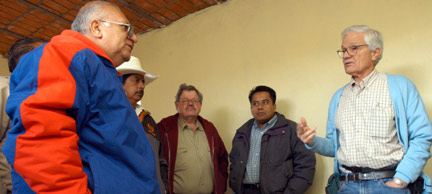
Lee Baggett (right), a missionary in Mexico, explains to Dick Talley (3rd from left) of Texas Baptist Men and local community leaders how a water purification project will benefit residents of villages near Zacatecas, Mexico.

News of religion, faith, missions, Bible study and Christian ministry among Texas Baptist churches, in the BGCT, the Southern Baptist Convention ( SBC ) and around the world.


Campbell remembered as compassionate, visionary leader_11005

Posted: 1/07/05

Campbell remembered as compassionate, visionary leader

DALLAS–R.C. Campbell, whose tenure as president of Buckner Baptist Benevolences spanned 31 years, died at his home Jan. 3 following a brief illness. He was 83.

Best known for leading Buckner through one of the greatest eras of growth in the agency's 126-year history, Campbell was elected as the fourth president of Buckner in 1963 at age 41. He retired in January 1994.

“Dr. Campbell's vision set the stage for Buckner to enter into the 21st Century prepared to minister to the challenges facing children and families,” said Ken Hall, who succeeded Campbell as Buckner's president. “His is a legacy of a builder whose tools were compassion, vision and courage.”

R. C. Campbell

While Buckner experienced numerous milestones during Campbell's tenure, one of his favorite accomplishments was the 1975 relocation of nearly 100 orphans and staff from the Cam Rahn Christian Orphanage in Vietnam to Buckner Children's Home in Dallas. The relocation, which received worldwide attention, included a harrowing escape from Vietnam as the country fell into the hands of communists.

Prior to his election as Buckner's president, Campbell served as pastor of three Texas churches–First Baptist Church of Alvarado, First Baptist Church of Gainesville and Calvary Baptist Church of Dallas.

A native of Chattanooga, Tenn., he was a graduate of Texas Wesleyan College and Southwestern Baptist Theological Seminary, both in Fort Worth, and received the doctor of divinity degree from Howard Payne Baptist University in Brownwood and a doctor of humanities degree from Dallas Baptist University.

Campbell was co-founder and president of the National Association of Homes and Services for Children and president of the Texas Association of Homes and Services for the Aging, Southwestern Association of Child Care Executives and Texas Association of Services to Children.

He chaired an advisory committee for the Texas Department of Human Services and was a member of the White House Conference for Children and Youth, Dallas County Committee on Aging and the Governor's Blue Ribbon Task Force on Aging.

He was honored with Southwestern Baptist Theological Seminary's Distinguished Alumnus Award in 1995, and the National Association of Homes and Services for Children recognized his work with the 1992 Samuel Gerson Nordlinger Child Welfare Leadership Award.

Campbell is survived by his wife of 57 years, Marilyn Ruth McFadyen, who he met while attending Texas Wesleyan College in 1945. Other survivors include his daughters and sons-in-law Gayla and Howard Crain of Irving, and Robbie and Larry N. Lehman of Tioga; grandsons Robert Crain and Ken Crain and wife, Amy; and granddaughters Laci Bracewell and husband Bradley; Lori Huff and husband Heath; and three great-grandsons.

Campbell was a member of Park Cities Baptist Church in Dallas.

News of religion, faith, missions, Bible study and Christian ministry among Texas Baptist churches, in the BGCT, the Southern Baptist Convention ( SBC ) and around the world.


Cartoon_11005

Posted: 1/07/05

“You're welcome to look down, but viewer discretion is advised.”

News of religion, faith, missions, Bible study and Christian ministry among Texas Baptist churches, in the BGCT, the Southern Baptist Convention ( SBC ) and around the world.


Church-state issues will remain prominent in new Congress_11005

Posted: 1/07/05

Church-state issues will remain prominent in new Congress

By Robert Marus

ABP Washington Bureau

WASHINGTON (ABP)—As the 109th Congress goes to work in an atmosphere already charged with partisanship, legislative battles over religious and moral issues are virtually certain to remain as prominent as they were in the last session, according to two Washington observers of church-state issues.

Holly Hollman of the Baptist Joint Committee for Religious Liberty and Roger Limoges of the Interfaith Alliance agree many of the religious-freedom and moral issues that arose in the 108th Congress will come up again.

And with a handful of conservative Republicans in the Senate replacing moderate Democrats, some church-state legislation passed by the House but halted in the Senate could have more hope of passing.

Hollman, BJC’s general counsel, said she expects “three major issues will be back”—another attempt to allow churches to engage in partisan political campaigning while maintaining their tax-exempt status; a series of bills that would strip federal courts of their jurisdiction to rule on various church-state issues; and President Bush’s continued efforts to expand the government’s ability to fund social work through churches and other religious charities, also known as the “faith-based initiative.”

Limoges, the Interfaith Alliance’s deputy director for public policy, agreed with Hollman’s assessment, but also said he expects church-state issues to arise in likely Senate fights over confirming Bush’s nominees to federal courts — especially one or more possible vacancies on the Supreme Court. He said his group would be particularly concerned with nominations “that are going to be couched in (terms of) whether someone is a good Catholic or a good person of faith.”

Limoges also said his group considers the Federal Marriage Amendment—a constitutional ban on same-sex marriage, which failed in the last Congress but is almost certain to come up again—a religious-freedom issue.

Church electioneering

Both Hollman and Limoges said they expect another attempt from Rep. Walter Jones (R-N.C.) and Religious Right forces to pass the Houses of Worship Political Speech Protection Act. They have pushed the bill in the past two sessions of Congress, including forcing a floor vote in the House. Although it has failed, it also has steadily gained support.

Hollman noted that some of the bill’s chief opponents in the House “are no longer there.” Chief among them is retired Rep. Amo Houghton (R-N.Y.), who chaired a key subcommittee of the House Ways and Means Committee that dealt with the proposal. His departure “might make the bill more likely to get through the committee process,” Hollman said.

“Court-stripping” bills

Last fall, the House passed two bills that would strip federal courts of their ability to rule on marriage issues and on the constitutionality of the Pledge of Allegiance. While the Senate never acted on the proposals, they are likely to come up again, Hollman said.

“We saw last term that court stripping is a new popular strategy for addressing issues that may not do as well (for them) in the federal courts,” she said.

She also noted that a third “court-stripping” proposal that ran out of time in the House is likely to gain publicity and momentum because of two high-profile court cases that will be in the news this spring. The bill would have removed jurisdiction from federal courts in cases involving displays of the Ten Commandments on government property.

“Given the attention that will be on the Ten Commandments because of the Supreme Court’s decision to hear cases this term, we will likely see legislation designed to protect government displays of the Ten Commandments,” Hollman said.

Faith-based initiative

Bush’s faith-based initiative is likely to come up again too, Limoges and Hollman agreed, although they differed slightly on how. Because of many conservative religious leaders’ perception that President Bush’s stances on religious and moral issues are why he won re-election in November, Hollman said, they may try to pressure more moderate Republicans into legislative advancement of the faith-based plan.

“I think that there will be some members of Congress coming back with more confidence post election that will try again to move faith-based legislation,” she said.

“Some who interpret the president’s win as a mandate for ‘moral values’—including his top kind of faith-related domestic priority, which is the faith-based-initiative—may push to pass something akin to the CARE Act,” Hollman continued. That bill was left languishing in the last Congress, but in its original version would have made it easier for government to provide social-service funding through churches.

Limoges predicted Bush would make a renewed attempt at writing the faith-based plan into federal law. In his first term, he attempted to push authorization for funding of virtually all social services through churches and other deeply religious charities. The effort was stymied in the Senate. He then used his administrative powers—executive orders —to accomplish much of the same in individual federal agencies.

But a future president can undo such orders, while laws have to be repealed or overturned by federal courts. Emboldened by his perceived mandate on the subject, Bush “is going to go for the complete package again,” Limoges predicted.

Judicial nominations

Limoges noted that Bush had re-nominated several of his appointees to federal courts whom Senate Democrats had halted because of their perceived judicial extremism —including on church-state and abortion-rights issues. Many Washington observers agree the move signals Bush plans to fight to get all his nominees through, causing a significant shift to the right on the federal courts.

Gay marriage

Limoges also said he fully expects supporters of a constitutional ban on same-sex marriage to bring the issue up again. The amendment proposal failed on a procedural vote in the Senate last year, but it is a favorite of social conservatives. “We certainly believe that they will be back again,” he said. “For us, it’s a religious-liberty issue. It always has been. The government cannot be telling churches whom they can and cannot marry.”

Highlighting the prominence such issues are sure to have, several Religious Right leaders have warned members of Congress who oppose them on these issues to back off.

In a recent letter to his supporters, popular Christian radio host and Focus on the Family founder James Dobson singled out Democratic senators up for re-election in 2006 in states with large evangelical Christian populations. He said they should not oppose Bush on court nominations or other matters, or the senators “will be in the ‘bull’s-eye’ the next time they seek re-election.”

And Tony Perkins, president of the Washington-based Family Research Council, used his daily e-mail newsletter to supporters Jan. 4 to ask Bush and Congress to focus on “values” issues.

“Clearly, this recent election was influenced by a strong turnout of ‘values voters,’ who understand the seriousness of the issues at stake in the battle over our culture,” he wrote. “We are grateful that there are strong leaders in Congress who also see the importance of legislative action to defend the American family from a growing and ever more pervasive secularism. However, we ask President Bush and congressional leadership to make social issues a priority of this Congress.”

News of religion, faith, missions, Bible study and Christian ministry among Texas Baptist churches, in the BGCT, the Southern Baptist Convention ( SBC ) and around the world.


Supreme Court set to hear two cases on display of Commandments_11005

Posted: 1/07/05

Supreme Court set to hear two
cases on display of Commandments

By Robert Marus

Associated Baptist Press

WASHINGTON (ABP)—Two friend-of-the-court briefs filed recently in the U.S. Supreme Court present differing views on the role of the Ten Commandments in American history and whether government entities can display them.

The Bush administration, represented by the Justice Department, and a group of religious leaders, led by the Baptist Joint Committee for Religious Liberty and the Interfaith Alliance, have filed briefs in two highly anticipated cases involving government displays of the Decalogue.

The Baptist Joint Committee submitted its brief to the Supreme Court in Van Orden vs. Perry, a Texas case the justices will hear next year. Bush administration officials submitted a brief in McCreary County vs. Kentucky.

In the Texas case, BJC General Counsel Holly Hollman and University of Texas Law School professor Doug Laycock ask the high court to overturn a decision delivered last year by the 5th U.S. Circuit Court of Appeals.

In it, a three-judge panel of the appellate court ruled unanimously that a massive, freestanding granite monument of the Protestant translation of the Ten Commandments, located on the grounds of the Texas Capitol in Austin, does not violate the First Amendment's ban on government establishment of religion.

In that ruling, Judge Patrick Higginbotham, writing for the court, said the commandments monument had a secular purpose in teaching about the history of the development of the state's legal system, and could not be viewed by a reasonable observer as an endorsement of religion.

"Even those who would see the Decalogue as wise counsel born of man's experience rather than as divinely inspired religious teaching cannot deny its influence upon the civil and criminal laws of this country," Higginbotham wrote.

But the BJC brief argues that the display, as it currently exists, cannot be viewed as simply or primarily secular in its purpose or effects.

"The alleged secular effect of demonstrating the commandments' important role in the development of American law is not explicitly stated at the site of the display, is not known to the reasonable observer, and depends on a premise that is demonstrably false," it says.

The brief notes that the introductory line of the commandments, "I am the LORD thy GOD," appears in larger type than the rest of the text, near the top of the Texas monument.

The religious leaders' brief further observes that, although a few of the commandments mirror prohibitions against murder and theft found in laws of societies around the world and throughout history, the Decalogue begins with a set of explicitly religious instructions on idolatry, honoring the Sabbath, blasphemy and other topics.

"The two tables of the commandments are a unified whole, and Texas displays them as such," the brief says. "So even 'Thou shalt not kill' is not a mere statement of secular ethics, or of Texas law; Christians and Jews believe it to be a direct command from God, personally delivered to Moses on Mt. Sinai."

But, the brief contends, the very arguments that attorneys must put forth in support of government-sponsored displays of the commandments can undermine the texts' religious meaning. For such a display to avoid running afoul of the First Amendment's ban on government support of religion, government lawyers must prove that it has neither a primarily religious purpose nor effect.

"Structuring the litigation in this way demeans the religious teachings that governments set out to endorse," the brief reads. "Time after time, in litigation that is nearly always highly publicized, government minimizes the religious significance of government-sponsored religious practices or displays. Government insists that sacred texts are really primarily secular in their meaning, or that they have been displayed primarily for secular purposes and have primarily secular effects.

"In this process, government lends its weight to distorted readings of sacred texts; indeed, government litigators deliberately desacralize these sacred texts. Secular readings of the text are promoted; the religious understanding of the faith groups to whom the text is sacred are deemphasized or ignored.

The Bush administration's brief came in McCreary County, Ky. vs. ACLU. In that case, a divided panel of the 6th U.S. Circuit Court of Appeals found in late 2003 that Ten Commandments displays in courthouses and a school district in three different Kentucky counties violated the First Amendment. The majority judges said the displays were not erected with a sufficiently secular purpose and that they appeared to endorse religion, even though they had later been modified to incorporate legal and historical documents beyond the commandments.

In the Bush administration brief, Acting Solicitor General Paul Clement and a group of Justice Department attorneys argue that the Kentucky displays do not violate the First Amendment, in part because "justices of this court, decisions of lower courts, and the writings of countless historians and academics have long recognized the significant influence that the Ten Commandments have had on the development of American law.

"As this court has repeatedly recognized, the political and legal history of the United States is infused with religious influences, and the (First Amendment's) establishment clause does not require government to ignore or minimize that reality," they argue.

The Justice Department officials also decry one of the requirements set forth for such displays by the lower court.

"To hold, as the court of appeals did here, that any acknowledgement of religious history must be accompanied by elaborate disclaimers or explanations bespeaks a fundamental hostility to or suspicion of religion that has no place in establishment clause jurisprudence," they contend.

But in BJC brief for the Texas case, the religious groups note assertions that the Ten Commandments have had a significant influence in forming the nation's laws may be ill-founded, no matter what judges may have said in the past.

"To say that the Ten Commandments exercised 'extraordinary influence' on American law…is to wrap a kernel of truth in such a vast overstatement as to demonstrate that the statement is a pretext to justify displaying the commandments," they contend.

"What is plausibly true is that three of the Ten Commandments are an early example of prohibitions on homicide, theft, and false witness … and that the commandments have been more visible than other ancient sources because they are part of the sacred text of the dominant religious tradition in Western culture. It is hard to plausibly claim any more than that."

Furthermore, the brief argues, "Penalties for murder, theft, perjury, and defamation tend to appear early in the development of all legal systems, including those of ancient civilizations with no reliance on the Jewish scriptures."

And, it continues, early American prohibitions on such crimes stemmed directly from long-accepted tenets of English common law, the forerunners of which were pre-Christian in origin:

"The American law of murder, theft, perjury, and defamation thus traces back through centuries of English law to the barbarian laws of non-Christian Germanic tribes—and this line of development is far more direct than any development from the Ten Commandments."

The U.S. Supreme Court often agrees to hear cases to resolve conflicting decisions between different appeals-court circuits. However, these cases mark the first time since 1980 that the high court has dealt with the issue of Ten Commandments displays on government property. That year, the court decided Stone vs. Graham, in which they found unconstitutional a Kentucky law requiring public schools to post the commandments on the walls of each classroom.

Since then, the lower federal courts have developed a hodge-podge of rules on allowing Ten Commandments displays in public settings—with some displays found acceptable when they are included as a part of a larger exhibit on the development of America's legal system and some displays are found unconstitutional. In their brief, BJC and the Interfaith Alliance ask the court to create a clear standard for what is constitutionally acceptable in such cases.

"By holding governmental units to an objective standard, much sham litigation will be avoided, and this court will no longer invite governmental units to desacralize sacred texts," they write.

The justices will hear oral arguments in Van Orden vs. Perry (No. 03-1500) and McCreary County vs. ACLU (No. 03-1693) March 2 and are expected render decisions in the cases before the court adjourns in July.

News of religion, faith, missions, Bible study and Christian ministry among Texas Baptist churches, in the BGCT, the Southern Baptist Convention ( SBC ) and around the world.


Author explores ways comic books shape character_11005

Posted: 1/07/05

Author explores ways comic books shape character

By Ken Camp

Managing Editor

When David Zimmerman talks about comic book character development, he doesn't mean Clark Kent's progression from Superboy to Superman.

Zimmerman refers to development of moral character, and he believes superheroes offer a larger-than-life canvas for exploring questions of right and wrong, strength and weakness–even life and death.

Sometimes the answers X-Men, Spiderman and Daredevil offer correspond with real-life Christian experience, and sometimes they don't, he acknowledges.

“But as testing a car in extreme weather conditions flushes out its strengths and limitations, so by testing what appears to be virtuous or axiomatic in the extreme caricatures of comic book superheroes, we can discover what is true, good, right and noble. And once we've fixed our mind on these things, we can get on with living a heroic life,” he writes in his new book, Comic Book Character.

Zimmerman, an InterVarsity Press associate editor and self-described “fanboy,” wrote the book primarily for other “true believers”–comic book fans who are both immersed in the minutiae of the comics culture and interested in exploring the mythic themes of comics with a critical eye.

“A secondary audience would be those who are interested in having a relationship with fanboys and true believers–parents, youth ministers and culture watchers who care about the intersection of faith and culture,” he said. “I see myself as a mediator between the two groups.”

Zimmerman–a suburban Chicago-based writer whose parents now live in Dallas–grew up in Iowa as a Catholic. And he grew up reading comics.

“When I graduated from high school, I thought I had graduated from faith,” he said. “I stopped going to church. But I found myself surrounded by evangelicals, and there was something about them that was compelling to me.” Eventually, he made a personal faith commitment to Christ.

When Zimmerman went to see the “Daredevil” movie in 2003, he was struck by its Roman Catholic imagery and reminded how the comic books he read as a youngster shaped his own understanding of right and wrong. He decided to write a book to explore the moral and religious lessons comics teach–consciously or unconsciously–and compare those teachings to a Christian understanding of life.

Zimmerman's book takes what he calls an “inductive approach” to examining superheroes' cultural significance as moral guideposts–or at least barometers of social ethics.

“I begin with the person's understanding of self–issues like strength and weakness, justice and vengeance, identity and body image,” he said. “That's a critical developmental project of adolescents.”

He then explores relational issues such as race, gender and nationalism before moving on to religious issues such as good and evil.

For instance, he sees Superman both as a Christlike figure and as similar in some respects to Pontius Pilate. Like Jesus, Superman was sent by his father to a far-off world where he used his extraordinary powers for good and stood for truth and justice. But whereas Jesus challenged the status quo and was crucified for it, Superman is its defender.

“As dramatic as superheroes' stories can be, at heart they are serving the interests of the status quo,” Zimmerman said. “Like Pilate, Superman keeps the peace using the power at his disposal.”

Zimmerman also offers tips to help parents, youth ministers and other people who are not part of the comic book culture learn how to select and read stories in what may be an unfamiliar medium.

Although many adults see comics as juvenile, most modern comic books are written for an older audience, he notes.

This provides their creators a platform for exploring some mature themes, but it also means some material may not be suited for children or even young adolescents, he cautions.

“It's important for parents to know what their kids are reading and to show discernment,” he said.

News of religion, faith, missions, Bible study and Christian ministry among Texas Baptist churches, in the BGCT, the Southern Baptist Convention ( SBC ) and around the world.


Cybercolumn by John Duncan: Hope abounds_11005

Posted: 1/07/05

CYBER COLUMN:
Hope abounds

By John Duncan

I’m sitting here under the old oak tree, pondering the horrors of the devastating tsunami. I find myself grieving at a distance as I observe the pain and misery.

I saw a picture of a girl standing in a crowd of onlookers. She held a sign scribbled with letters: “Looking for lost parents, brothers and sisters.” I cannot imagine the pain, the emotion, or, in the poetic words of W.B. Yeats in his poem, “The Second Coming,” the loss: “Things fall apart; the centre cannot hold / Mere anarchy is loosed upon the world / The blood-dimmed tide is loosed, and everywhere / The ceremony of innocence is drowned.”

I think of a little girl who suddenly has to grow up. Her innocence lost, darkness surrounds, and life leaps forward with fury. Still, hope abounds in human existence.

John Duncan

We live in historic days. Amid the triviality of Dallas Cowboy losses and paying off Christmas debt, history has been made. According to a government web site, the 2004 tsunami appears to be the most deadly in recorded history. The most deadly tsunami prior to this was the result of an earthquake near Awa, Japan, in 1703 that killed 100,000. Forty-thousand people were killed in 1782 by a tsunami in the South China Sea, and the tsunami created by the 1883 eruption of Krakatoa is thought to have resulted in 36,000 deaths. The most deadly tsunami between 1900 and 2004 occurred in Messina, Italy, on the Mediterranean Sea, where an earthquake and tsunami killed 70,000 in 1908. The most deadly tsunami in the Atlantic Ocean resulted from the 1755 Lisbon earthquake that, combined with the toll from the earthquake and resulting fires, killed more than 100,000. Still, hope abounds in the center of history.

Nature rampages at times and presents itself a monster on the march—earthquakes, tsunamis, hurricanes, winds that turn over trucks, rains that drench earth while flooding city streets, and fires that blacken places like Yellowstone National Park.

The poet Gerard Manly Hopkins was right, “Nothing is so beautiful as spring / When weeds, in wheels, shoot long and lovely and lush.” But he was also right in declaring in despair that life “yields to the sultry siege of melancholy.” Life captures us, takes us prisoner and instigates a sorrowful sadness not soon satisfied. Nature marches like a monster. Pain arrives as an unwelcome guest. Life hurts. Still, hope shines like a ray of sunlight at the center of nature.

Dietrich Bonhoeffer says, “We must continue to emphasize that Christ is truly the center of human existence, the center of history and now also the center of nature.”

Jesus simplified life, “Seek first the kingdom of God and his righteousness and all these things shall be added unto you” (Matthew 6:33).

A new year stands before us. Grief looms, relief efforts unfold, dreams generate in the mind, and God invites us into the center of life. In the midst of human existence in its misery, history in its data and nature on rampage, the hope of Christ still invites us to find comfort and strength. Make Christ the center of your existence—your existence, your history and your nature.

John Duncan is pastor of Lakeside Baptist Church in Granbury, Texas, and the writer of numerous articles in various journals and magazines.

News of religion, faith, missions, Bible study and Christian ministry among Texas Baptist churches, in the BGCT, the Southern Baptist Convention ( SBC ) and around the world.


Study reveals declining Southern Baptist churches_11005

Posted: 1/07/05

Study reveals declining Southern Baptist churches

By Adelle Banks

Religion News Service

NEW ORLEANS (RNS)–The percentage of “declining” Southern Baptist churches increased in the last two decades, a church growth study has found.

The Leavell Center for Evangelism and Church Health at New Orleans Baptist Theological Seminary found 23.9 percent of churches aligned with the Southern Baptist Convention in the period ending in 2003 were declining, compared to 17.6 percent in the period ending in 1983.

A declining church is defined as one that saw a decrease in its total membership of 10 percent or more in a five-year period.

“The passion for conversion growth appears to be fading at every level of the SBC,” concluded Bill Day, associate director of the center in New Orleans. “The SBC is moving from plateau to decline.”

A growing church is defined as one that had an increase in total membership of 10 percent or more in a five-year period. Plateaued churches are those that do not fit in either the growing or the declining category.

The Leavell Center study found the percentage of growing churches has not changed significantly in the last 20 years. In the period ending in 2003, 30.3 percent of Southern Baptist churches were designated as growing compared to 30.5 percent in the period ending in 1983.

But the number of plateaued churches has decreased–from 51.9 percent at the end of 1983 to 45.8 percent at the end of 2003.

In other findings, Day reported that churches with more than 5,000 members are almost twice as likely to be growing congregations as churches of other sizes. The study also found more than 30 percent of congregations 10 years old or younger are considered to be growing.

News of religion, faith, missions, Bible study and Christian ministry among Texas Baptist churches, in the BGCT, the Southern Baptist Convention ( SBC ) and around the world.