Christians must reclaim their good name, Ratliff urges Texas Baptists_22105

Posted: 2/18/05

Christians must reclaim their good
name, Ratliff urges Texas Baptists

By Ferrell Foster

Texas Baptist Communications

AUSTIN–Christi-ans have become the victims of identity theft in politics, as so-called conservative Christians espouse views that are “inconsistent with our Christian faith,” accor-ding to former Texas Lt. Gov. Bill Ratliff.

Ratliff, a retired Republican state senator from Mount Pleasant, spoke during the annual statewide conference of the Christian Life Commission, a ministry of the Baptist General Convention of Texas.

Many Christians consider themselves conservative and have adopted that mantle because of a few strongly held beliefs, Ratliff said. They are concerned about society's moral decay; support prayer in public settings; and oppose abortions on demand, same-sex marriages and legalized gambling.

Former Texas Lt. Gov. Bill Ratliff

However, some groups advocate for “their definition of a conservative agenda and … purport to fly under the cover of the Christian banner to do so,” Ratliff said. “They present themselves as advocates for Christian ideals and do indeed pursue the types of issues I just mentioned. However, they then use this identity to advocate for other so-called conservative causes which … are inconsistent with our Christian faith.”

See related stories:
Christians must reclaim their good name, Ratliff urges Texas Baptists

To evaluate Texas' taxes, follow the money, experts explain


For example, some self-identified Christian groups take the position that public schools should not be allowed to begin classes before the last week in August, he said. “Now, you may have personal opinions either way about this matter, but does anyone really believe that Christ would have an opinion on this subject?”

Another “Christian” group believes the legislature should reduce the number of election dates in Texas. “May be a good idea, but is it really a subject of concern” to Jesus?

Yet another “Christian” group says the legislature should not expand the state's franchise tax to fund public education and that property tax appraisal increases should be capped at 5 percent, he noted.

“I seem to recall an instance in the Gospel where a group of men attempted to trick Jesus into taking a position on taxes, and Jesus deferred by saying they should render unto Caesar that which was Caesar's. That doesn't seem to square with these groups' supposedly Christian position on taxes,” Ratliff said.

But the identity theft goes further, he insisted.

Some “Christian” groups oppose early childhood and Head Start public education programs for children from underprivileged homes, Ratliff said. “I wonder how Christ would have viewed this position. Perhaps he would consider a modification to his admonition to 'suffer the little children to come unto me.'”

Then there's the matter of funding social services, Ratliff added.

Some “Christian” groups “see no inconsistency in their willingness to sacrifice the health and welfare of underprivileged children and elderly citizens on the altar of low taxes,” he said.

“Texas is one of the two or three lowest-tax states in the nation, and yet there are those flying under the Christian banner who say we must eliminate children's health insurance for hundreds of thousands of poor Texas children rather than having all businesses pay their fair share of taxes.”

The quality of nursing homes and child protective services also are being undermined by “Christian” groups, he said.

This “misrepresentation” of the Christian faith is causing “many good people in government,” including those with a deep faith, to “cringe at the thought of a visit from the Christians.”

Across this broad sweep of issues, Christians are “represented as agreeing with these positions and these outrageous political tactics without our knowledge or consent,” Ratliff said.

It is up to Christians to “take back our banner,” he urged. “We must gather fellow Christians and let the world know that our Christian positions are those which we believe Christ would have endorsed.”

People “certainly have the right to advocate for other issues, but they should not be allowed to do so while hiding behind the Christian faith.”

News of religion, faith, missions, Bible study and Christian ministry among Texas Baptist churches, in the BGCT, the Southern Baptist Convention ( SBC ) and around the world.


To evaluate Texas’ taxes, follow the money, experts explain_22105

Posted: 2/18/05

To evaluate Texas' taxes, follow the money, experts explain

By Ferrell Foster

Texas Baptist Communications

AUSTIN–Where does the state get money for all the good things Texans might want their government to do?

That question dominated many discussions during the Texas Baptist Christian Life Commission's annual conference in Austin.

State Sen. Eliot Shapleigh (D-El Paso) led participants through the maze of education funding options and concluded a state income tax is the best revenue source.

State Sen. Eliot Shapleigh described the criteria for a fair and equitable revenue system during the Texas Baptist Christian Life Conference. (Photo by Ferrell Foster)

Mike Moses, retired superintendent of the Dallas Independent School District, said state funding of education has dropped from from a high of 70 percent, when the state “had a lot of oil money,” to 38 percent today.

State Sen. Jane Nelson (R-Flower Mound) attacked the proposed expansion of legalized gambling as “the path to fiscal disaster.”

Rob Kohler, head of Common Sense & Sound Public Policy, labeled video lottery terminals as “another funding gimmick” that will result in costs being passed down to county governments.

And Ron Anderson, president of Parkland Health and Hospital System in Dallas, said the state's health care safety net is in peril, because needs are rising and funds are dropping for hospitals, such as Parkland, which serve many Texans who are least able to afford care.

Despite all the state's funding challenges, only Shapleigh, talking about education funding, offered a possible solution–a state income tax.

A good revenue system does several things, Shapleigh said. It raises enough money, shares the burden fairly, enhances economic development, avoids over-reliance on any one tax or set of taxes, has minimal costs, withstands shifts in the economy and is broad-based among all taxpayers.

Texas depends primarily on two revenue sources–property and sales taxes, he said. Both are regressive, meaning poor people carry a disproportionately high share of the tax burden.

Texas has the 15th-highest property taxes in the nation and the third-highest sales taxes.

“Our tax system should be a moral tax system,” but it is not, Shapleigh stressed. Looking into the future, Texans must determine not only how to pay for schools but how to do it fairly, with residents sharing the burden in an equitable manner.

See related stories:
Christians must reclaim their good name, Ratliff urges Texas Baptists

To evaluate Texas' taxes, follow the money, experts explain


Forty-three states have created just and equitable tax systems, Shapleigh said. They use a tax structure that collects about one-third from property taxes, one-third from sales taxes and one-third from income taxes.

An income tax in Texas based on the rate used in Kansas would generate $34.6 billion in revenue, he said. That income would enable property taxes to be reduced by $23.1 billion, or 90 percent, and it would raise $11.5 billion for education.

Such a system would lower the tax burden on residents making about $42,000 or less while raising it for those making more, he reported. A person with an annual income of $41,121 would see a tax decrease of $135, while a person making $65,925 would pay an additional $524.

Focusing on education funding, Moses said, “The big question is, 'Will the old pay to educate the young?'”

About 70 percent of Texans do not have school-age children, and the fastest-growing segments of the population are older than 55 and under 18, he said.

If education funding is approached merely as user fees, with school users paying all the school bills, then “the common good is out the window,” Moses said.

Texans must see education funding as an investment in the future, he urged. “What kind of state are we trying to build here? We've done about as much as we can do here with those two funnels” of property and sales taxes.

Most distressing to Moses is people who want to reform education but not fund it. Reforms have been made, he said, declaring, “Now it's time to fund education.”

Nelson has strongly opposed the spread of legalized gambling, and she's one of the legislators facing a gambling industry onslaught. “I've never seen so many lobbyists,” she said. And what “really angers me most” is that the people pushing gambling “don't care one bit about Texas children.”

The industry is promoting legislation to legalize video lottery terminals, especially at Texas racetracks. The terminals essentially are slot machines, and their installation would bring the most prevalent form of casino gambling to Texas.

For the state to get $1.5 billion in revenue from video terminals, “Texans would have to lose $2.5 billion,” Nelson said. “Where do we think gambling revenue is going to come from? … What are families using that money for right now?”

As a small-business owner, Nelson said, the gambling revenue will come out of the pockets of other businesses in the state.

And don't forget the social cost, she added. “You will see an increase in every single measurable crime.”

Some lobbyists and legislators want to let Texans vote on whether or not to allow video lottery terminals into the state, Nelson said.

“Can you imagine the television ads that would run?” she asked. The gambling industry would “pump million of dollars into the state” to influence the vote.

“You cannot out-spend them,” she said. But in the legislature, “you can beat them with people power. … I'm a huge believer in the voice of the people if it's loud and clear.”

The gambling industry is promising a golden revenue egg to the state, but Kohler reported “a tremendous amount of money that has to be spent to get this golden egg.”

Kohler called gambling a regressive and ineffective tax that functions as a “special-interest subsidy.” It has short-term benefits with long-term consequences, and it essentially is an “unfunded mandate” for which city and county governments will have to pick up the costs.

Bottom line: “It's going to create more poor children.”

Anderson said the state's health care safety net faces several challenges–more uninsured and under-insured residents, more immigrants, rising trauma care costs, workforce shortages and funding cuts.

Parkland is part of the national safety net as a public-funded hospital that provides the most technically advanced care and must serve residents who are unable to pay for health care costs.

Twenty-five percent of Texas residents are uninsured, and the No. 2 cause of bankruptcy in the country is health care, Anderson said.

Managed care and governmental funding reductions also have had a negative impact on hospitals, he said.

Parkland served about 350,000 people last year and needs about 1,000 more beds to provide care for the poor, he said, calling the facility “undersized and overcrowded.”

The nation's patchwork system of health care is getting more and more frayed, Anderson said.

The hospital recently cut $260 million in order to keep the doors open, he said. But now, “your safety net has no place to go.”

News of religion, faith, missions, Bible study and Christian ministry among Texas Baptist churches, in the BGCT, the Southern Baptist Convention ( SBC ) and around the world.


2nd Opinion: How much sex before the promise?_22105

Posted: 2/18/05

COMMENTARY:
How much sex before the promise?

By Richard Ross

Almost every Sunday morning, I'm in a different pastor's office. Often the ministers gather for prayer before I preach.

Before we pray, here is what they often say: “Bro. Richard, we are just thrilled with what God has done through True Love Waits. What a powerful movement that literally has brought positive change to the U.S. and now to the world.”

(So far so good, but here it comes …)

“In fact, we so believe in True Love Waits that we provided a beautiful promise ceremony here three years ago.”

Though I keep a smile on my face, thoughts whirl through my mind: Three years ago? During that span, teenagers who entered puberty at 11 or 12 have reached ninth grade with no opportunity to proclaim publicly their promise of purity. Seventh graders fascinated with oral sex have gone all year with no invitation to promise purity to God. Eighth graders who go to parties where the girls give the boys “rainbows” (don't ask) have gone yet another year with no promise. High school juniors gloriously saved graduate with no opportunity to stand tall for purity in a worship celebration. Families with teenagers join the church but then wait three years before they are challenged to slip a promise ring on their teens' fingers.

Perhaps church leaders shy away from an annual promise ceremony because they don't want to ask a student to sign six cards while young. They have missed the point. We never ask teenagers to make multiple promises. In fact, it offends Christian students when they are asked to promise again. In their minds, their original promise was a promise to God, and that promise stands to their wedding day and beyond.

The annual invitation to participate in a promise ceremony is made to middle schoolers who are being promoted into the student ministry, to all students who have made commitments to Christ in the previous year and to students who have joined the church and have no background with True Love Waits. But students who have made promises in previous years participate in Bible teaching on purity and attend the ceremony to support the first-timers. No one places another card in their hands.

Few churches highlight international missions only once every few years. Few would decide to offer Vacation Bible School only once every few years. Churches give annual attention to those initiatives because they have kingdom importance. Those initiatives matter in people's lives–in the same way that a lifestyle of absolute purity matters.

We all are thankful schools are giving more attention to abstinence. Two or three health classes that present the advantages of waiting are far better than what was done before. But that is no substitute for True Love Waits. At school, students make a promise to a program. At church, they make a promise to God Almighty. At school, Christian students can feel alone in their lifestyle choice. Through True Love Waits, they lock arms with several million peers who live as they do. After the unit in school, no one offers much help until the following year. Through True Love Waits, parents and youth leaders provide instruction, warmth and encouragement year-round.

During this time of year, tens of thousands of churches will provide beautiful, moving services and ceremonies built around promises of purity. Some churches won't. When churches go more than a year without inviting their teenagers to settle this issue before God, they are placing those kids at risk.

Maybe someone should place this on the agenda for the next church staff meeting.

Richard Ross is professor of student ministry at Southwestern Baptist Theological Seminary in Fort Worth and a spokesperson for the international True Love Waits sexual-purity campaign. His column is distributed by Baptist Press.

News of religion, faith, missions, Bible study and Christian ministry among Texas Baptist churches, in the BGCT, the Southern Baptist Convention ( SBC ) and around the world.


Cybercolumn by Berry D. Simpson: Find a way_22105

Posted: 2/18/05

CYBER COLUMN:
Find a way

By Berry D. Simpson

C. S. Lewis wrote: “We often say, ‘I never expected to be a saint; I only wanted to be a decent, ordinary chap,’ and imagine when we say this we are being humble. Of course, we never wanted, and never asked, to be made into the sort of creatures (God) is going to make us into; the question is not what we intended ourselves to be, but what he intended us to be when he made us. We may be content to remain what we call ‘ordinary people,’ but he is determined to carry out a quite different plan.”

Berry D. Simpson

God uses a wide variety of methods to carry out his plans. For me, God works me over when I run. I believe he gives me dreams of training better and longer and faster, dreams of running another marathon (or even further), so he can use that training process to mold me into his image. However, I don’t think he really cares that much how well I run. I think he cares more that I learn patience and dependability and courage than whether I can run 20 miles at a stretch or lower my times for quarter-mile repeats at the track. He wants me to be like him, and he’ll use running and backpacking, reading and journal-keeping (or as in Cyndi’s case, dancing and performing and generally living on the edge), as tools in his hands to carry out his intentions. When I look back over my life, I can see how God has done exactly all that. I’ve learned deep lessons and felt surprising changes in my heart as a result of running day after day in the cold rain or blowing sand or 100-degree heat.

However, I’m aware that if you happen to see me out plodding down the street with a grimace on my face and a hitch in my gait and sweaty clothes stuck to my skin, I doubt you’ll think, “There goes a man who is communing with God.” It’s more likely you’ll think, like one of Cyndi’s friends who once saw me running slowly past her house one hot summer day and said to her husband, “Somebody needs to go help that poor man.”

I’ve had friends who were inspired to go out running after reading one of my journals, but the run wasn’t a pleasant experience. Instead of hearing the voice of God all they heard was their own voice saying, “This is stupid; it hurts; you should go back home and lay down.”

I know all about that voice. I hear it all the time. I certainly didn’t have spiritual communion in mind when I first started. It was in 1978 when I went for my first run down Sanger Street in Hobbs, N.M., wearing cutoffs and tennis shoes. I wasn’t trying to connect with God; I was just trying to impress a girl. We’d dated over the Christmas holidays, and now that I was home for the summer, I was hoping to go out with her some more, only I discovered that while I was away at college she had been dating a track-and-field jock, a javelin thrower from back east. I decided I had to do something physical to win her back. I started running, and within a couple of weeks, she was mine again (and still is, 27 years later).

I was smart enough to know it wasn’t running that made her take me back. I wasn’t an impressive athlete even back then at 22 years of age. But by the time I figured all that out, I was accustomed to the solitude of running and the mental relaxation that comes from repetitive motion. I was hooked.

I’ll admit, I often worry that I write too much about running. I’m not trying to convert anyone to running; however, I am trying to encourage everyone to find something in your life, something you can do on a regular basis, something that brings you closer to God, something that lets you hear his voice. For most people, it will be something other than running, probably something that doesn’t hurt. I like to hear all the different ways people find to commune with God. I have a friend to talks to God every morning while he takes a shower. Not a bad way, is it?

The thing is, it isn’t easy to stay in touch with God. We have to overcome our selfish human nature and Satan’s temptations. Robert Pirsig wrote, “It takes a lot of effort to get to the high country of the mind, and even more effort to stay there once you’ve arrived, but it’s worth it. Unless you make the effort, you’ll remain in the same valley of thought your whole life.”

He wasn’t thinking about Christian spirituality when he wrote that, but the principle is true. It takes effort to commune with God, and even more effort to stay with it once you’ve found him . But it’s worth it.

Berry Simpson, a Sunday School teacher at First Baptist Church in Midland, is a petroleum engineer, writer, runner and member of the city council in Midland.

News of religion, faith, missions, Bible study and Christian ministry among Texas Baptist churches, in the BGCT, the Southern Baptist Convention ( SBC ) and around the world.


Doves look to Smith_22105

Posted: 2/18/05

Doves look to Smith

By Adelle M. Banks

Religion News Service

NASHVILLE (RNS)–Longtime Christian artist Michael W. Smith topped the field of nominations for the Dove Awards, which will be awarded by the Gospel Music Association in April.

Michael W. Smith

Smith received eight of the nominations. He was followed by the group Casting Crowns with seven, and lead singer/songwriter Mark Hall with six individual nominations. The Crabb Family also gained six nominations and its patriarch, Gerald Crabb, earned six nominations for his songwriting abilities.

The GMA Music Awards ceremony will be held April 13 at the Grand Ole Opry House in Nashville, at the conclusion of the GMA Week Convention.

Nominations include:

Artist of the year: Casting Crowns, MercyMe, Selah, Michael W. Smith, Switchfoot.

Female Vocalist of the Year: Bethany Dillon, Natalie Grant, Nicole C. Mullen, Christy Nockels, Joy Williams.

Group of the year: Casting Crowns, The Crabb Family, MercyMe, Selah, Switchfoot.

Male vocalist of the year: Jeremy Camp, Jason Crabb, Mark Hall, Israel Houghton, Fernando Ortega.

New artist of the year: BarlowGirl, Building 429, Day of Fire, Bethany Dillon, Matthew West.

Song of the year: “Blessed Be Your Name,” “Dare You to Move,” “Friend of God,” “Glory Defined,” “Healing Rain,” “Meant to Live,” “More,” “Through the Fire,” “Who Am I,” “You Raise Me Up.”

News of religion, faith, missions, Bible study and Christian ministry among Texas Baptist churches, in the BGCT, the Southern Baptist Convention ( SBC ) and around the world.


DOWN HOME: Knothole worthy ‘Senior Dates’ list_22105

Posted: 2/18/05

DOWN HOME:
Knothole worthy: 'Senior Dates' list

Those folks down at the schoolhouse really know how to hurt a guy.

They didn't mean to do it, of course. They were just trying to be helpful when they sent a sheet of paper home with our youngest daughter, Molly, the other day.

When Molly's big sister, Lindsay, started kindergarten in 1989, I wondered about the sheets of paper they'd carry home through the years. I wondered what percentage of those important papers actually would arrive in our home.

Don't tell my mother and daddy, but when I was a kid, some of the sheets of paper I was supposed to take home “accidentally” fell through the knothole in the wooden backyard fence of the house on the east corner of Third Street and Dartmouth. When the teacher handed out a paper I didn't like, I'd volunteer to walk home, instead of ride with Mother, a schoolteacher. I hoped the people who lived in that little house with the knothole fence had a paper-eating dog.

Well, during the past 13 years, Molly's carried countless pages home from school. Many of them have contained “important parental information” for Joanna and me. But this was a sheet of paper unlike all the others.

Someone at the school typed “Senior Dates to Remember 2005” across the top of the page. Big, bold letters, all underlined.

Those “Senior Dates'' chronicle the countdown to my darling daughter's final day of high school:

March 29–Senior Revue

April 27–Scholarship info turned in

May 7–Prom

May 12–Senior honors night

May 17–Rosecutting ceremony

May 24–Graduation practice

May 30–Graduation

Just when everything was going so well, somebody from the schoolhouse messes it up by sending a list of “Senior Dates.”

If you've kept up with our little family the last several years, you know I'm the sappy, sentimental one. The one who cries at weddings and baby dedications. And, yes, the one who cries at high school graduations.

But I've held up remarkably well during our last child's senior year of high school.

No, don't worry. I haven't taken to strong drink. Denial has been my anesthesia. If I refuse to think about it, then Molly's impending graduation won't hurt. At least not in advance, it won't.

That is, until the folks from the high school decide to send parents a friendly reminder that graduation will take place at 5 p.m. on Memorial Day. Be early or sit in the nosebleed section.

Graduation isn't so bad. It's a good excuse for a family reunion and a grand occasion to make a fuss over a kid who's brought abundant joy to her mama, sister and me for 18 years. Graduation will be a great day.

What I want to ignore is what happens next. Our Molly Bird will fly off to college, leaving an empty nest. A much quieter nest.

I'm tired of thinking about it. Too bad Molly doesn't walk past a knothole fence on her way home from school.

News of religion, faith, missions, Bible study and Christian ministry among Texas Baptist churches, in the BGCT, the Southern Baptist Convention ( SBC ) and around the world.


EDITORIAL: What would Jesus put in the budget?_22105

Posted: 2/18/05

EDITORIAL: What would Jesus put in the budget?

A seminary professor once told a roomful of ministers-in-training: “A budget is the barometer of a church. Look at its budget, and you can tell where a church is going. You can see what it really values. You can determine its priorities.”

He was correct, of course. And the principle applies to any institution, whether it's a family, a civic club, a state or a a nation. That's why Christians ought to pay close attention to the budgets being promoted by President Bush and Governor Perry. Those budgets don't simply reflect how we'll pave highways, pay for a war, fund education or finance Social Security. They say an awful lot about what kind of people we are.

Unfortunately, they say we're the kind of people who look at the bottom line of our checkbooks before we look into the anguished eyes of the abused, abandoned and neglected. Increasingly, we're the kind of people who are hoodwinked by the deceptions of special interests, not motivated by the common good. We're conned by the promises and platitudes of the wealthy elites but turn a deaf ear to the honest pleas of the working poor, our neighbors who serve us at almost every turn.

knox_new

For example, the federal budget projects a deficit of more than $400 billion (and doesn't even include the actual cost of the Iraq War). Yet it promises to make tax cuts permanent for the wealthiest Americans while cutting programs that benefit low-income Americans.

Jim Wallis, editor of Sojourners magazine and an unflinching advocate for the poor, correctly observed: “Rather than moving toward a 'living family income,' the budget stifles opportunities for low-income families. Our future is in serious jeopardy if one in three proposed program cuts are to education initiatives …, if there will be less flexibility to include working poor families with children on Medicaid, and if reductions in community and rural development, job training, food stamps and housing are accepted as solutions for reducing the deficit. Cutting pro-work and pro-family supports for the less fortunate jeopardizes the common good.”

Advocating on behalf of the poor in Texas isn't very popular. We're the state that left millions of matching federal dollars for CHIP, the Children's Health Insurance Program, on the table. Any state that under-funds the federal government in support for poor children should be embarrassed.

But we're hard-working and self-reliant. We believe a person ought to put in a day's work for a day's pay. We believe a person ought to have enough pride to seek self-reliance. We believe hard work never hurt anybody.

Those are good and noble traits. If we didn't do it ourselves, we all know folks who “pulled themselves up by their own bootstraps.” This is commendable. But we're also victims of that ancient disease–our greatest strength becomes our sorest weakness. We've replaced pride in hard work with pride in ourselves. And we've lost the capacity to empathize with people–children, the elderly, the disabled–who have no bootstraps, no one to care for them.

Fortunately, we're also people who believe what the Bible teaches. And the message is clear: “Defend the cause of the weak and fatherless; maintain the rights of the poor and oppressed” (Psalm 82:3). “He who is kind to the poor lends to the Lord, and he will reward him for what he has done” (Proverbs 19:17). “Jesus answered, 'If you want to be perfect, go, sell your possessions and give to the poor, and you will have treasure in heaven. Then come, follow me'” (Matthew 19:21).

Lately, a lot of conservative Christians, including Baptists, have tried to get around this by saying, “This is the assignment of the church, not the government.” Two responses:

First, these same people are quick to claim God will judge America for its unrighteousness, but they usually mean sexual unrighteousness. The Bible says a nation will be judged by how it treats the poor and disenfranchised. For example, stated positively, “If a king judges the poor with fairness, his throne will always be secure” (Proverbs 29:14). The prophets and Jesus condemned the nation of Israel for its hard-heartedness toward the poor. Beware.

Second, no one has yet taken up my challenge–issued last September–find a church “that is doing its complete share to help provide food, clothing and shelter, medical care, educational support and emergency relief” for its community. That's because churches alone can't do the task. We can do much, and do it wonderfully, but we can't do it all.

Jesus called his followers to be “salt and light,” to influence society. Now, more than ever, Christians need to influence state and federal budgets to be just and compassionate.

News of religion, faith, missions, Bible study and Christian ministry among Texas Baptist churches, in the BGCT, the Southern Baptist Convention ( SBC ) and around the world.


Most BGCT universities show spring enrollment gains_22105

Posted: 2/18/05

Most BGCT universities show spring enrollment gains

Most universities affiliated with the Baptist General Convention of Texas experienced higher enrollment this spring compared to last year:

Baptist University of the Americas broke its enrollment record for the fourth consecutive semester, with 208 students from 17 countries, up from 207 reported last year.

bluebull Baylor University enrollment dropped to 12,715 students from 12,815 last year. The university attributed the drop to higher graduation rates and smaller class sizes the past two years.

bluebull Dallas Baptist University had its 17th consecutive year of spring enrollment growth, with 4,547 students, up from 4,426 in 2004.
bluebull East Texas Baptist University registered 1,245 students for this year's spring semester, compared to 1,226 last year.

bluebull Hardin-Simmons University's enrollment grew to 2,196, an increase from last year's 2,155. Full-time enrollment also grew–up to 1,549, a 4.2 percent hike.

bluebull Houston Baptist University's spring semester does not begin until March 8, because it is on a quarter calendar.

bluebull Howard Payne University enrolled 1,184 students this spring, compared to 1,202 in 2004.

bluebull University of Mary Hardin-Baylor enrollment climbed to 2,459 this spring, compared to 2,437 last year.

bluebull Wayland University enrolled 948 students this spring on its Plainview campus, up from 929 last year. Its external and virtual campuses are on a four-term schedule, and their spring semester does not begin until the end of February.

News of religion, faith, missions, Bible study and Christian ministry among Texas Baptist churches, in the BGCT, the Southern Baptist Convention ( SBC ) and around the world.


Florida Baptists, others launch effort to pass state marriage amendment_22105

Posted: 2/18/05

Florida Baptists, others launch effort
to pass state marriage amendment

By Robert Marus

Associated Baptist Press

JACKSONVILLE, Fla. (ABP)—The Florida Baptist Convention is among a coalition of organizations that has announced a drive to amend the Florida Constitution to ban same-sex marriage.

At a news conference, an alliance calling itself the Florida Coalition to Protect Marriage announced it would attempt to collect more than 611,000 signatures on a petition to get the measure placed on the statewide ballot in 2006. The coalition includes the Florida convention, the Christian Coalition of Florida and other conservative and religious groups.

The measure would alter the state’s charter to ban gay marriage. It also would declare “no other legal union that is treated as marriage or the substantial equivalent thereof shall be valid or recognized.” Therefore, it would presumably ban marriage-like civil unions for same-sex couples or unwed heterosexuals as well.

Gay-rights supporters said the law is both unnecessary, because state law already bans same-sex marriage, and mean-spirited, since it also would ban civil unions.

“The impact of this kind of attack is very real,” said Nadine Smith, executive director of the statewide gay-rights group Equality Florida, in a press release. “Families will be harmed. Couples who love each other and take care of each other need legal protections. It is morally wrong for the state to get in the way of people taking care of each other, including same-sex partners.”

But in a statement—posted on their website at Florida4Marriage.org—amendment supporters defended the proposal.

“We wish to see marriage established as it was intended by nature, biology, tradition and just common sense—between one man and one woman,” the statement reads. “Gay-identified persons should have all the same rights as everyone else in a free society. However, no one has the right to wholesale redefine natural marriage and then force that definition upon the rest of society.”

Bill Bunkley, legislative consultant for the Florida Baptist Convention, said the group would attempt to gather signatures through its churches—which boast around 1 million members in total. However, he noted, no church would be required to participate in the drive.

“This is probably one of the cornerstone issues that we may face in our life here in Florida,” Bunkley said. He noted organizers of the petition drive would shoot for a goal higher than the 611,001 signatures required to get on the ballot—possibly as high as 800,000 or even 1 million—because he anticipates aggressive attempts to disqualify signatures. The deadline for collecting the signatures is at the end of February 2006.

Bunkley also said circulating the petition in churches offers “an excellent opportunity for Florida Baptists to register to vote,” since only registered voters can sign the petition.

However, the amendment campaign has not been endorsed by Republican Gov. Jeb Bush. On the day the groups announced their petition drive, Bush echoed comments he made in November after messengers to the Florida Baptist Convention annual meeting endorsed the amendment. Then, Bush called it “unnecessary.”

During an appearance in Jacksonville, Bush reportedly said he was waiting on one of the pending court cases challenging the state’s existing anti-gay-marriage laws to succeed before he felt the need to support the amendment.

“Until such time as I can see that there is that threat looming, then I believe the constitution shouldn’t be changed unless it is necessary,” he said.

Bunkley said Bush’s statement “was a softer response than his initial response in November…. Clearly, if one of the pending ( Defense of Marriage Act) cases in Florida were to go south this afternoon, the governor, I believe would be the first one in line to join our effort after being notified of that.”

If passed, Florida would join 17 other states that have already passed amendments banning same-sex marriage. Recently, Virginia legislators gave the green light to a similar amendment.

News of religion, faith, missions, Bible study and Christian ministry among Texas Baptist churches, in the BGCT, the Southern Baptist Convention ( SBC ) and around the world.


Georgetown senior volunteers find warm welcome in West Africa_22105

Posted: 2/18/05

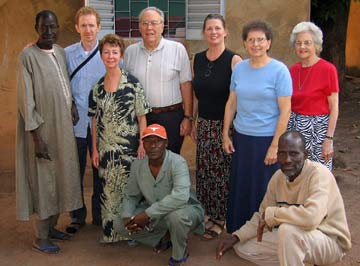
African villagers’ natural respect for their elders provided a welcoming context for a mission team of senior adults from First Baptist Church in Georgetown.

Georgetown senior volunteers
find warm welcome in West Africa

By Sue Sprenkle

International Mission Board

Women and children lined the footpaths throughout the West African village, each wearing their finest festive clothes and adornments. Warriors escorted their Texas Baptist visitors from the main road to this village made up of mud and stick homes.

As they approached, the entire village erupted in song and dance. The visitors were overwhelmed at first but soon joined in. The chief raised his hand to silence the joyous celebration. Then, he ceremoniously welcomed the newcomers to his home.

He told how his village was blessed not only to have people come all the way from America but for the visitors to be wise, respected elders. Then he turned to 84-year-old Alice Nelson and presented her with the most cherished gift imaginable in this culture–a sheep.

She smiled graciously and offered to pray for this Muslim village.

Standing toward the back of the senior adult volunteer team, two International Mission Board journeymen missionaries smiled. The 20-somethings were totally amazed at how well the volunteers from First Baptist Church in Georgetown had been received in every village. The missionaries requested a volunteer team of senior adults in hopes that the visit would bring some validation to their ministry.

Jerry Counselman of Georgia and Joyce Faye Cox, Rodney Cox, Kim Hoerster, Charlotte Watson and Alice Nelson of Georgetown pose with new West African friends.

"In Africa, elders are highly respected," Journeyman Han-nah Jones said. "Because there is so much sickness and very few people live to be over 40 or 50, people who are older are given such respect."

Many times the only Christians these people see are younger people. The idea behind this unique volunteer team was to show there are older people in the American culture who are followers of Christ, as well. The concept worked well within this culture. Jones said it is customary for elders to speak through young people.

"So, to have journeymen translating for this volunteer team was so culturally appropriate," Jones said. "Part of this culture is also that you show honor to someone by visiting them. For our senior adults to visit a village was to bring honor to them."

Charlotte Watson said when the initial request for seniors came across her desk back in Texas, she knew it would be the trip of a lifetime. Her volunteers knew living conditions would be primitive in the West African village. But the hardest thing for them to grasp was the focus of this trip–"being" rather than "doing."

"This is a hard concept for Christians who feel they must be doing something all of the time … like construction, medical or Bible school," she said. "But this trip of 'being' was amazing. We spent hours praying and being spectators as God's word was read. We spent hours just sitting in the villages visiting, talking and observing."

Nelson said during this trip of "being" she prayed, smiled, hugged, shook hands and loved more than ever.

God "seemed to give me a greater awareness and sensitivity for these people, their simple way of life, their love for their children and concern for others," the 84-year-old said of this West African people group numbering more than 140,000. "I have never felt so welcomed in my life. They treated us like celebrities."

When the team visited a village, a journeyman or one of the local Christians led a session of Bible storying, telling scriptural stories in chronological order. Most West Africans are oral learners. Jones said it was amazing to have so many people come to the sessions, all because the presence of the volunteers validated that this message was very important. In one session, a group of women requested prayers that they would remember these stories and understand them.

The senior volunteers made an impact on the villages they visited. In one village, storytellers told the history of their people complete to the point where this volunteer team visited.

One Muslim chief even accompanied the team on the trip from the bush back to the capital city. He attended a church service with them and then saw them off at the airport.

"We were so blessed to have him come back with us," Watson said. "He wanted to make sure Alice got safely on the plane headed back to America."

News of religion, faith, missions, Bible study and Christian ministry among Texas Baptist churches, in the BGCT, the Southern Baptist Convention ( SBC ) and around the world.


Texans discover redemption in reality TV_22105

Posted: 2/18/05

Texans discover redemption in reality TV

By John Hall

Texas Baptist Communications

Jeff Johnson once thought reality television shows have no redeeming qualities.

Then he ended up on one.

Johnson, who leads worship for Crestview Baptist Church in Midland and for the youth ministry of First Baptist Church in Wichita Falls, auditioned for this season's American Idol, just to get “the experience.”

He was so confident he would get cut in the first round, he tried out the day before he was scheduled to lead worship.

See related stories:
Texans discover redemption in reality TV

'Unreality' remains

That plan failed. He passed several rounds of eliminations and received a trip to California, where he competed against singers from around the nation. It was then he realized the show provided “an opportunity to be a missionary in a different way.” It was a chance to share the Christian message to millions of TV viewers.

Worship leader Jeff Johnson's appearance on American Idol opened doors for ministry.

Johnson was eliminated shortly after he arrived in California. But by then, he said, God had accomplished his purpose. The program showed him talking about being a minister and praying with other contestants.

“When I got cut, I knew it was God's will,” he said. “I had hundreds of people praying for me.”

Johnson is one of several reality television personalities with Texas Baptist ties who said their faith played into their actions on the small screen.

Jason Illian, who speaks to Christian organizations across the state, said he saw his appearance on this season's The Bachelorette as a mission opportunity.

He believed it was an opportunity to share a different model of doing relationships. Illian is most well known as the contestant who confessed he was a virgin in the same episode he was eliminated.

“My friends who will never come to church, come to a Bible study, do any of that will watch The Bachelorette,” he said.

A person's characteristics are magnified through the reality television editing process, Illian noted. Slight arrogance looms large. But if an individual demonstrates faith, that also is enlarged.

Christi Proctor, a Baylor University alumna and member of First Baptist Church in Lorena, takes a slightly more subtle approach to her faith as a designer on Trading Spaces. She shares her faith through her actions.

Trading Spaces is a show where two neighbors decorate each other's homes with the help of several interior designers, including Proctor. The pastor's daughter believes she is making an impact by showing she cares and by bringing people closer together.

“There are so many people out there who want to be cared about,” she said.

All three Texas Baptists said they have received positive feedback about their efforts.

Johnson and Illian said they have received many e-mails and notes from Christians who support them sharing their faith.

American Idol also opened more opportunities to lead worship.

Johnson now receives more than 80 phone calls a day, compared to about two calls each day prior to the television appearance. He has done many radio interviews. He said God has answered his prayer to expand his ministry.

Proctor stays in contact with some of the people she helps on her show. Recently, a woman stopped Proctor in an airport to tell her the show inspired her to remodel a room with her daughter.

“I love the people,” Proctor said. “I have met some of the most beautiful people across the U.S.”

News of religion, faith, missions, Bible study and Christian ministry among Texas Baptist churches, in the BGCT, the Southern Baptist Convention ( SBC ) and around the world.


Kingsville church focuses on lay-led ministry to serve community_22105

Posted: 2/18/05

Kingsville church focuses on
lay-led ministry to serve community

By John Hall

Texas Baptist Communications

KINGSVILLE–Many Christians say Texas, with its estimated 10 million non-Christians, is a mission field. Iglesia Bautista Central is acting like it's serving in one.

Pastor Servando Torres Jr. is utilizing many of the lessons he learned as a missionary in Alaska, Washington and Mexico to encourage a congregation focused on growing God's kingdom through lay-led ministry. The church seeks to serve the community in any way it can.

“We're not here to build an empire on earth,” Torres said. “We're here to build the kingdom.”

Pastor Servando Torres Jr. (right) has led Iglesia Bautista Central in Kingsville to reach into its own mission field. (Photo by Rex Campbell)

The congregation provides free clothing, food and kitchen appliances to people around them. Members also serve in the local jail. Torres has distributed chickens that were given to him. He gave one man a car to help him get to a job. The church plans to give away a house located on part of its property.

Church members lead seven weeks of Vacation Bible School during the summer, including one week where youth lead the events. Iglesia Bautista Central delivers food and clothing to a Mexican church 45 miles south of Matamoros. “We don't focus on one ministry here,” the pastor said. “We have a variety.”

The congregation's ministry extends to other churches as well. Torres trains laypeople who feel called to ministry to be preachers. Central members fill four or five pulpits each Sunday.

Hispanic and Anglo congregations in South Texas regularly call Torres looking for preachers. Some of those churches have called those bivocational ministers to be pastor. Central-related pastors fill South Texas congregations and are scattered across the United States. The church's worship team leads youth rallies in other congregations. Eli Lopez provides music lessons to youth groups looking to start a praise team.

“It's our region,” Torres said. “We're not doing as much foreign missions as we were doing three years ago because there is a need in our sister churches.”

Abigail Castillo, a member of Iglesia Bautista Central, said church members are inspired by Torres' unceasing desire to help others. They see him working 16 to 18 hours a day to minister to others. Laypeople naturally follow his lead.

“The vision is, 'How can we reach the community around us?'” she said. “It's done soul by soul.”

This desire is earning the church a reputation for outreach. People with needs contact the church looking for help. Individuals stop Torres during the day and ask for prayer.

And outreach has led to expansion. The congregation has grown to about 120 members and has enlarged and improved its facilities while remaining debt free. Torres believes people are drawn to a ministry that gives people a chance to serve.

“The Lord is bringing people and showing them the way,” Torres said. “We are ministering to them all. That's what Central Baptist Church does. They care for others.”

News of religion, faith, missions, Bible study and Christian ministry among Texas Baptist churches, in the BGCT, the Southern Baptist Convention ( SBC ) and around the world.