Family Bible Series for August 14: Until Jesus comes, live faithfully

Posted: 8/02/05

Family Bible Series for August 14

Until Jesus comes, live faithfully

• Luke 21:5-36


By Mitch Randall

First Baptist Church, Bedford

At the funeral of a dear friend, two elderly men stood near the gravesite contemplating their friend’s death. They grieved for the widow, the children and the grandchildren. Watching this mournful scene play out in front of them, one the friends asked the other, “Hey, how much did Charlie leave behind?” Peering over his half-moon glasses, the other man replied, “All of it!”

It was the same type of common sense used by Jesus, when he surprised a group of temple gossips (Luke 21:5-6). Jesus was teaching in the temple and a group of Jewish faithful came by talking about the ornate beauty of the building. Overhearing them, Jesus decided to teach them something very valuable—even more valuable than the stones they adored.

Readers will be wise to understand at what point this sermon is delivered. First, Jesus had just witnessed the elaborate practice of wealthy people making a show of themselves as they gave their tithes and offerings. He compared them with a poor woman he had witnessed. She gave little in direct comparison to the wealthy, but in the eyes of Jesus, she had given much more.

Second, the other gospels tell of an incident that would have been very close to this sermon. Jesus was very distraught at what was taking place in the temple, especially the corruption of money changers (Mark 11:15-19). The hard working faithful were coming to worship their God, but those inside the temple were cheating them. Jesus turned their tables and took a whip to them. Needless to say, Jesus was very agitated at the priorities of the temple elite. His stern warning about the destruction of the temple took many by surprise.

They asked him, “When will this be and what will be the sign that this is about to take place?” Their question was the open door for which he was looking, so he launched into a warning and message. He wanted the temple gossips to understand the importance of eternal treasures, verses the shallow rewards of this world. The elaborateness of the temple would one day wither with time and invading armies, but the treasures of heaven are eternal.

Those seeking earthly treasures will be warning them about wars and insurrections. They will be using fear to bring about treasures for themselves. The world will be divided, and nation will rise up against nation. Instead of peace leading the way to future glory, war and destruction will lead the way for divine intervention.

Jesus warned about persecution for those who follow him before the end arrived. He spoke of family turning on family, so that the division of the world becomes complete as brother is set against brother. Jesus even took his destruction analogy a step further and out of the temple. He warned even mighty Jerusalem would fall. The pinnacle of Jewish faith will come crumbling down, but the eternal Father will not allow the spirit of his followers to falter.

Followers of Christ are to live by faith, knowing a day is coming when Jesus will return. True justice will reign as the world will submit to his authority, and all will live according to his reign.

Yet, until then, we are called to live faithfully. We are taught to love God with all of our heart, mind and strength; and to love others as we would love ourselves. We are called to be the very presence of Jesus in this world. We are called to love the sinner and help the poor. We are called to feed the hungry and befriend the straggler. Jesus will return one day, and when he does, let him catch us doing his work.


Discussion questions

• What does the world consider important? What does Jesus consider important? Do they contradict?

• How does the world of today compare to the world that Jesus speaks about in this text?

• What will you be doing when Jesus returns?

News of religion, faith, missions, Bible study and Christian ministry among Texas Baptist churches, in the BGCT, the Southern Baptist Convention ( SBC ) and around the world.


Explore the BIble Series for August 14: Daniel’s faith was strong before the lion’s pit

Posted: 8/02/05

Explore the Bible Series for August 14

Daniel’s faith was strong before the lion’s pit

• Daniel 6:1-28

By Dennis Tucker

Truett Seminary, Waco

Throughout the Old Testament, imprisonment or confinement was a powerful symbol for exile. The term for “prisoners” comes from the word “to bind” or “to tie” (asar). Such language appears in Genesis 39:20; 40:3, 5; Isaiah 42:7, 49:9 and 61:1; and in Psalm 146:7-8. We are told that in addition to being bound as Daniel’s friends were in chapter 3, prisoners were thrown in pits (see Jeremiah 37). The idea of the pit became associated with prison and more ominously with death itself (Psalm 88; Jeremiah 41:7-9). In Lamentations 3:53-55, the writer laments the exile, crying out: “They have flung me alive into a pit; and hurled stones on me; water closed over me. … I called on your name O Lord from the depths of the pit.”

The story of the lion’s den in Daniel has the power of such an association. For those who would have read the story found in Daniel 6, the lion’s den would have meant far more than simply a place of punishment for political dissenters. Those who read the story of Daniel would have associated the events of their own exile with the events surrounding the lion’s den.

In both stories—that of Daniel among the lions and God’s people in exile—deliverance seemed quite unlikely. Yet it is in the midst of those unlikely places that God chooses to stand with the “bound” and the “imprisoned.”

Many Christians enjoy reading the story of Daniel and the lion’s den, but may miss the true transforming power of this text. The story is appealing because, in the end, the world is made right. Daniel is charged wrongly, thrown to the lions, but delivered. While appreciating the story, Christians struggle to determine how such a story is relevant to their lives. Must we be political dissenters to recapture the power of this story? Is this story only for those who have stood up for the faith against larger powers? If we limit the text to such readings, I fear we have deprived the text of its ability to intersect our own lives.

By understanding the lion’s den as symbolic of exile and imprisonment, the story may take on an added note of urgency for the reader. The questions that might have entered the minds of those in exile would have been: “Can we survive exile? Will God redeem us from this imprisonment?” And later Jewish communities under oppressive Greek rule would have wondered whether they could survive the persecution and imprisonment so many faced in that day. The story in Daniel is emphatic—God will redeem his faithful from the “pit.”

Although this scenario seems quite foreign for Christians in North America, people wake up daily imprisoned and in exile. The materialism and prosperity of our society has yoked us to jobs that strip us of the energy and time that might be spent on work for the kingdom. The frenetic pace of our lives keeps us in exile from one another and from God.

Many people silently live with the pain of knowing what it is like to live in the pit. The story of Daniel is a vivid reminder that we are never alone in the pit or in the fiery furnace. The God who redeemed his people out of exile is the same God who redeemed Daniel from the lion’s den—and he is the same God who can faithfully deliver us from our own exiles and imprisonment.

What is surprising in this narrative is that Daniel does not speak until after the night in the lion’s den. There are no words on the mouth of Daniel. Before Daniel entered the lion’s den, we might have expected a proclamation of faith, such as the one given by his friends in chapter 3.

But Daniel is silent—but not without faith. We are told in verse 23, “When Daniel was lifted from the den, no wound was found on him, because he had trusted in his God.” Imprisonment and exile often result in despondency and despair, belief that there is no hope in the face of insurmountable challenges.

But Daniel emerged from the pit—from imprisonment and exile—not because of what he said, but because of the faith he possessed. It was a faith that had been patiently nurtured in that upper room. Encounters with God in the upper room led to trust in God in the pit. Trust is not had in the crisis of life—trust is garnered in the ebb and flow of life, enabling one to endure when crises arise. We would do well to do the same.


Discussion question

• In your life, is there a sense of exile or imprisonment? In what areas do you feel in need of deliverance?

• How can you live your life to nurture the kind of faith exhibited by Daniel?


News of religion, faith, missions, Bible study and Christian ministry among Texas Baptist churches, in the BGCT, the Southern Baptist Convention ( SBC ) and around the world.


Longtime Southwestern prof Cal Guy dead at 88_72505

Posted: 7/29/05

Longtime Southwestern prof Cal Guy dead at 88

By Robert Marus

Associated Baptist Press

FORT WORTH, Texas (ABP)—Cal Guy, one of Southern Baptists' most influential and innovative missiologists, died July 25 at the age of 88.

From 1946 until his retirement in 1982, Guy served as a professor at Southwestern Baptist Theological Seminary in Fort Worth, Texas. He was serving as chairman of the school's missions department when he retired.

According to a news release from the seminary, Guy "often challenged the mission techniques that were popular during the mid-20th century. Guy believed that missionaries were too 'westernized, institutionalized, building-ized, and subsidized' in their approach to missions."

His teaching, according to the seminary, influenced generations of Southwestern students who then went to serve as Southern Baptist Convention missionaries in foreign lands.

"In the fall semester of 1949, for example, when 1,435 students were enrolled at the seminary, Guy noted during a chapel service focused on missions that more than 300 of those students had declared their intention to go into missions service overseas," the seminary news release said.

Long after his retirement, Guy continued teaching and preaching. He continued to teach part-time at Southwestern, but also served stints at Southeastern Baptist Theological Seminary in Wake Forest, N.C.; and at Criswell College in Dallas.

Guy traveled extensively, visiting with and teaching indigenous Baptists in nations across the globe. According to an obituary provided by his funeral home, as recently as 2004, he organized and led a conference for Baptist pastors in Bangladesh — a nation with whose native Baptists he had enjoyed a long and productive relationship.

Guy also served as interim pastor of English-speaking Baptist churches in France and Belgium. He was part-time pastor of Retta Baptist Church near Fort Worth from 1951 to 1969. He was still a member of that church at the time of his death.

A native of Jackson, Tenn., Guy received his undergraduate degree at Union University and master's and doctoral degrees from Southwestern. He was preceded in death in 1994 by his wife, the former Terrye Maddox. He is survived by two children, two siblings and several nieces and nephews.


News of religion, faith, missions, Bible study and Christian ministry among Texas Baptist churches, in the BGCT, the Southern Baptist Convention ( SBC ) and around the world.


BWA gathering reflects ‘paradigm shift’ Lotz says_72505

Posted: 7/29/05

BWA gathering reflects 'paradigm shift' Lotz says

By Greg Warner

Associated Baptist Press

BIRMINGHAM, England—About 12,000 Baptist Christians from around the world celebrated a century of togetherness at the opening of the five-day Baptist World Congress in Birmingham, England, with vibrant music, vivid pageantry and stirring stories of faith.

The Baptist World Centenary Congress returned to England, where in 1905 the Baptist World Alliance, now an international fellowship of believers from 200-plus countries, was formed. A century ago, 85 percent of the world’s Baptists were in Europe and North America, said Denton Lotz, general secretary of BWA. Now 65 percent of Baptists are in the Two-Thirds World, Lotz told the delegates.

Baptists from around the world meet for one of their largest gatherings, the July 27-31 Baptist World Congress in Birmingham, England.

“This is the new paradigm shift,” Lotz said as he asked delegates from Africa, Asia and South America to stand. The Southern Hemisphere may lack money, political freedom or clout, he said, but “they are going to re-evangelize the world.”

The July 27-31 Baptist World Congress in Birmingham is one of the largest gatherings ever of worldwide Baptists. Delegates swept aside any concern about recent terrorist attacks in nearby London.

As they made their way through the legendary English drizzle to the National Indoor Arena in Birmingham’s city center, many were unaware that several Birmingham residents were arrested earlier in the day as suspects in the London subway bombings.

“We prayed that you would come, despite the bombings and the terror alerts,” said incoming BWA president David Coffey of Great Britain. The delegates’ presence, he said, was a witness of faith to the victims of terrorism and to persecuted Christians around the world.

The evening gathering of Christians from many languages and nations was a re-enactment of Pentecost, said Coffey, general secretary of Baptist Union of Great Britain, who are hosts for the congress.

“Jesus Christ is head of this global family,” he said.

A procession of banners from BWA member nations, interspersed with colorful 20-foot streamers and delegates in native dress, weaved their way around the arena floor as delegates sang. They also experienced the traditional music and dance from various countries, including India and Korea. And they sang hymns, praise choruses, and in other musical styles representative of their diversity.

Delegates were welcomed to England with letters from Prime Minister Tony Blair, who called the world’s 35 million Baptists a “powerful force for good,” a diverse community “ready to challenge the powers that be.” Other messages came from the mayor of Birmingham and the private secretary of the Queen of England.

As a demonstration of their unity, the delegates were invited to recite together the Apostle’s Creed, an ancient declaration of orthodox faith used in many historic Christian traditions. They were led by actor Eric Petrossian in the role of Alexander Maclaren, who led the first BWA meeting in 1905 in a similar recitation.

Petrossian, quoting Maclaren’s address to the 1905 meeting, said the delegates were gathered not only to celebrate their diversity and fellowship but, more importantly, “in the name of Christ and by the power of the Spirit … the only source of power and peace.”

The opening session of the congress, which is held once every five years, introduced the meeting’s theme, “Jesus Christ, Living Water,” which also denotes a five-year BWA emphasis on evangelism. With drama, video and preaching, the delegates considered the centrality and life-giving nature of Jesus.

A youth drama troupe from Tallowood Baptist Church in Houston, Texas, acted out the biblical story of Jesus with the woman at the well, then accompanied a recording of “Bridge Over Troubled Waters” with choreography.

“As water is essential to life, so is salvation,” said Korean pastor Billy Kim, outgoing BWA president, who delivered the sermon for the session. In stories from Korean history and his own life, he told of the power of the gospel to transform lives. He noted that 30 percent of South Koreans are Christians today, in part because of the courageous commitment of an American determined to take the gospel to the island nation.

Kim, who recently retired as pastor of Suwon Central Baptist Church near Seoul, one of the largest Baptist churches in the world, was followed on the program by the Korean Children’s Choir and orchestra, in traditional costume, who performed a medley of familiar Western hymns in Korean and English.

Other musical groups from around the world sang in their native tongues as well as English, the predominant language for the congress.


News of religion, faith, missions, Bible study and Christian ministry among Texas Baptist churches, in the BGCT, the Southern Baptist Convention ( SBC ) and around the world.


BWA session looks at world needs_72505

Posted: 7/29/05

BWA session looks at world needs

Marv Knox

Editor

BIRMINGHAM, England—Christ’s love commands compassion for a world filled with suffering and pain, speaker after speaker told participants at the Baptist World Centenary Congress.

The Baptist World Alliance set aside an evening of its 100th anniversary celebration in Birmingham, England, to look beyond itself and examine the spiritual and physical needs of people around the globe.

A central element of that challenge is for Baptists to explain how Jesus’ resurrection and life translates into good news for people, both as they live their lives and as they consider eternity, stressed keynote speaker Myra Blyth.

The world is increasingly narcissistic and self-centered, suggested Blyth, a lecturer in worship and ecumenical studies at Regents Park College, the Baptist component of Oxford College in the United Kingdom.

And some critics claim Jesus was narcissistic, too, pointing to his series of “I am” statements in the Gospel of John, she conceded, noting how Jesus said, “I am …” and finished the phrase with such terms as the “Door,” “Bread of Life,” “True Vine,” “Way” and “Alpha and Omega.”

To the contrary, John’s snapshots of Jesus reveal his selfless willingness to follow God’s plan and his unselfish concern for humanity, she said.

“Jesus’ journey to the cross was no ego trip, but an outward journey pointing (people) to the one who sent him,” she insisted. “God’s self-giving nature (in Jesus) is the very opposite of self-centeredness” because he pointed people to Christ.

And Jesus’ “I am” self-descriptions have implications for Christians today, she said, adding: “We must take seriously what it means to be made in the image of God. … It is not pointing inward but pointing out. … The world needs redemption.”

To illustrate, Blyth focused on Jesus’ last “I am” description—“I am the Resurrection and the Life”—which he said to his friend Martha just before he raised her brother, Lazarus, from the dead.

Martha had trouble understanding what Jesus said “not as a future event, but in the here and now,” Blyth explained. Martha could accept that Jesus bring her brother back to life at the end of time, but she couldn’t grasp that what Jesus said could be good news for her in the next few moments.

But Jesus’ compassion for people means his action in their lives is good news in the moment as well as in eternity, Blyth noted.

“Our calling is to be Easter people in a Good Friday world,” helping people to enjoy Christ’s blessings in their lives today as well as to trust in his promise of life in eternity, she said.

As such, Christians have an important message about Jesus, she insisted: “Life is stronger than death. Goodness is stronger than evil. Love is stronger than hate.”

In a variety of ways, speakers pointed to practical and spiritual implications of Christian compassion for the whole world:

— Through Baptist World Aid, the BWA’s relief arm, Baptists “meet people at the time of their greatest need,” reported Paul Montacute, Baptist World Aid director.

He recounted stories of how the BWA has ministered to victims of a volcano in Angola and the Congo, orphans and the ill in North Korea and survivors of the tsunami in Sri Lanka.

“One of the issues for Baptists is: How can we present a holistic gospel?” Montacute told the crowd. People need the gospel, but they also have physical needs that demand Christian response, he explained.

Baptists must not forget the “silent tsunamis” of poverty and hunger and disease that take lives around the globe every day, he urged.

“People are impoverished, not just one day a year (like a tsunami), but 365 days a year,” he said. Through Baptist World Aid, the alliance provides care in Jesus’ name to people, regardless of their race, ethnicity, religion or geography.

— Baptist women in Latin America have followed their spiritual compassion and worked to rescue families from violence throughout the region, said Amparo de Medina of Colombia, a BWA vice president from 2000 to 2005.

The movement began as a meeting of 120 Baptist women in Panama in 2000, she recounted. Since then, many television and radio stations, as well as newspapers and magazines, have promoted the campaign to stop violence in families, both in Latin America and the United States.

“I have seen the hand of God working,” she said. “Women of Latin America have broken the silence. Baptists, who are known for their defense of human rights, cannot be silent. … There is no peace without justice.”

— In Eastern Europe, Christian compassion for Marxists and communists is making a difference in their lives, noted seminary professor Parush Parushev, a former communist.

“Marxist socialism intellectually is very logical, but it is ethically deficient,” said Parushev, academic dean at the International Baptist Theological Seminary in Prague, Czech Republic.

However, the “holistic presence of God in lives” changes people like him, he said. “Communism lacks a moral dimension. Reason can give you law, but there is something beyond law—grace and compassion,” which only Christ can offer.

— Because they have compassion on the people who live in their part of the world, Latin American Baptists are strategizing to start an unprecedented number of churches, said Alberto Prokopchuk, the BWA’s regional secretary for Latin America.

Noting less than 1 percent of the population is Baptist and millions have no relationship with Christ, Prokopchuk said Baptists there sense a strong compulsion to “consolidate evangelization with the plantation of churches.”

New churches are needed to disciple new Christians, develop leaders and impact communities,” he said, announcing Baptists in Latin America hope to start 5,000 churches in the next 10 years.

“This vision should be a world vision for Baptists,” he said, inviting Baptists from elsewhere to help Latin Baptists in their endeavor and offering for Latin Baptists to go elsewhere to help other Baptists start churches.

BWA delegates gave voice to their conviction that compassion demands a practical response as they sang together: “Sent by the Lord am I / My hands are reaching now / To make the earth a place / in which the Kingdom comes.”


News of religion, faith, missions, Bible study and Christian ministry among Texas Baptist churches, in the BGCT, the Southern Baptist Convention ( SBC ) and around the world.


First African elected to lead BWA women_72505

Posted: 7/29/05

First African elected to lead BWA women

By Esther Barnes

Canada Link & Visitor

BIRMINGHAM, England (ABP)—South African Dorothy Selebano was elected president of the Baptist World Alliance’s women’s department, the first woman from Africa to be named to that post.

Selebano was elected to the five-year term in office during the BWA Women’s Leadership Conference in Birmingham, England, prior to the Baptist World Congress.

She is the first president from Africa in the department’s 50-year history. She succeeds Audrey Morikawa of Toronto.

Fluent in six languages, Selebano holds bachelor’s degrees in nursing, sociology and theology. A nurse and midwife, she now works as an academic advisor at Potchefstroom University, a Christian institution.

Selebano has been president of the Baptist Women’s Union of Africa and a vice-president of the BWA. She edits the Baptist Women’s Union of Africa newsletter, Organ of News.

Her late husband, Wellington, was a pastor. She and her family endured a difficult life after his death in 1987. During the revolution against apartheid, her children were in white schools because no schooling took place in black townships. To pay high school fees and other debts, Selebano took four jobs.

Her family never went to bed hungry, she said, and she still seldom missed church and women’s meetings.

“I was faithful in my giving in spite of the financial constraints,” Selebano said. “I am a witness therefore that God is faithful. I want to emphasize that he enabled me through his Spirit to lead a Christian life in the midst of problems and struggles.”

Speaking about women’s identity at the conference, Selebano said, “In Africa a woman is treated like a child, slave, or piece of property. Our culture teaches that a woman may not ask questions. She must do as she is told.”

She urged the women in attendance to see themselves as God sees them.

“We should never allow others to declare who we are,” Selebano said. “We as women should appreciate ourselves. Respect ourselves. Value ourselves. Believe in ourselves. Recognize and utilize the potential in us.”

In accepting her new responsibilities, Selebano said women must use their potential to fulfill a purpose beyond themselves.

“There’s no time to waste,” she said. “The world is dying in sin. God needs women like you and me. … It’s up to us to tell the people about Jesus.”

In another action, Donna Groover of Oakton, Va., was named as secretary-treasurer of the women’s department for 2005-2010. She has served on the financial advisory council of the BWA women’s department for the past four years. She succeeds Alicia Zorzoli of El Paso, Texas.

Groover holds an MBA from George Washington University and has been director of administration at Columbia Baptist Church in Falls Church, Va., since August 1999.


News of religion, faith, missions, Bible study and Christian ministry among Texas Baptist churches, in the BGCT, the Southern Baptist Convention ( SBC ) and around the world.


American Baptists said at crossroads over homosexuality issue_72505

Posted: 7/29/05

American Baptists said at
crossroads over homosexuality issue

By Rob Marus

Associated Baptist Press

VALLEY FORGE, Pa. (ABP)—Leaders on all sides of the debate over homosexuality in the American Baptist Churches-USA see little resolution to concerns raised during the denomination’s recent biennial meeting.

“I don’t think the biennial solved anything, in terms of the future of the denomination,” said Mike Williams, executive minister for the American Baptist Churches of Michigan.

The lack of action means further moves by those disaffected with the national denomination could come between now and the next meeting of the denomination’s General Board in November.

Churches in at least four ABC regions threatened to withhold contributions to the national denomination or leave altogether if their concerns over homosexuality were not addressed at the biennial, which took place July 1-4.

The denomination’s General Board, meeting prior to the larger convocation in Denver, accepted the first reading of a petition from one region that calls for amendments to documents designed to more clearly state American Baptists’ opposition to homosexuality.

Regional fellowships are the channel through which local churches relate to the national body, which counts 1.5 million members in 5,836 churches. In recent years, several gay-friendly churches have been expelled from some of those regional bodies. The ABC General Board changed the denomination’s rules in 1999 to allow churches to join regions outside of their geographical area if the region is willing to accept them.

As a result, many pro-gay ABC churches have joined regions outside their geographical area.

The Indiana-Kentucky region initiated the petition to change the rules on regional affiliation back, as well as to amend a denominational identity statement to read that American Baptists are a people “who submit to the teaching of Scripture that God’s design for sexual intimacy places it within the context of marriage between one man and one woman, and acknowledge that the practice of homosexuality is incompatible with biblical teaching.”

The petition notes the ABC General Board’s 1992 approval of a resolution that declares homosexual practice “incompatible with biblical teaching,” but the petition says subsequent actions by denominational leaders have not sent as clear an anti-homosexuality message.

The denomination has presented “an inconsistent and confusing message to the world about what American Baptists profess to believe and what is actually practiced,” the petition reads.

It and another petition expressing concern over the unity in the denomination will receive a second reading at the November meeting of the General Board. If passed, it effectively would create a mechanism for expelling many gay-friendly churches from the ABC.

But the leader of the Indiana-Kentucky region said, despite the acceptance of their petition, many of his regional leaders who attended the meetings were disappointed.

“Our board … felt that the General Board (meeting) and biennial were somewhat orchestrated in the way that they were presented so that it would present a more open position (on the issue of homosexuality) than we would like,” said Larry Mason, executive minister for the American Baptist Churches of Indiana-Kentucky.

But Ken Pennings, the newly appointed executive director of the gay-friendly Association of Welcoming and Affirming Baptists, had a different view of the meetings.

Mason said the Indiana-Kentucky board had already appointed a task force to study the issue, and that leaders were conducting listening sessions with American Baptists from around the region. The task force will report to the regional board with recommendations on how to proceed at their November meeting—a week prior to the national ABC General Board meeting.

“I have no idea what that task force will decide,” Mason told Associated Baptist Press. But he added he expects the task force will offer some contingencies, should the ABC General Board adequately address the region’s concerns.

Asked what such an adequate action would look like, Mason said it might involve the General Board both approving a second reading of the part of the Indiana-Kentucky petition that involves expelling churches, as well as approving the change to the identity statement to clarify that homosexuality is incompatible with the Bible.

“I think that would help a lot of people here in Indiana-Kentucky to think that at least they have been heard, and that the denomination does stand on an issue of what they consider to be biblical authority,” he said. “So, I believe the first point of the petition—if that is not passed, it will be seen as a real statement of our denomination as to where they are going to lead in the future.”

Action may come sooner in the American Baptist Churches of the Pacific Southwest, one of the regions that threatened to alter its relationship with the national denomination “if the issues regarding homosexuality (were) not biblically dealt with by the end” of the biennial meeting. Dale Salico, executive minister of the Southern California-based region, declined to comment on his view of how the biennial went until after his regional board meets in August.

But Williams, of the Michigan region, said Salico’s region may be the watershed in a wider American Baptist movement. “I think it will be very interesting to see what Pacific Southwest decides to do,” he said. “If they decide to take some action, like formally separating from ABC-USA, then it might be a catalyst for other regions to consider that.”

During his address to about 2,000 delegates to the biennial July 1, ABC General Secretary Roy Medley pleaded for unity in the ethnically, geographically and theologically diverse denomination.

“We stand at a crossroads,” he said, according to the American Baptist News Service. “In our world, the path of radical discipleship—the path of radical love—is the road less taken. We dare not choose another. We dare not choose the wrong road … the road that leads to separation. That choice will certainly unite you with like-minded people but will give you small souls and make you comfortable Christians.”


News of religion, faith, missions, Bible study and Christian ministry among Texas Baptist churches, in the BGCT, the Southern Baptist Convention ( SBC ) and around the world.


House passes Patriot Act, but concerns persist_72505

Posted: 7/29/05

House passes Patriot Act, but concerns persist

By Analiz Gonzalez

Associated Baptist Press

WASHINGTON (ABP)—The House of Representatives voted to reauthorize a law that a diverse array of civil-liberties groups decry but President Bush says is essential to fighting the war on terror.

House members voted 257-171 to renew and make permanent the 2001 Patriot Act with only minimal changes.

The Patriot Act—quickly passed after the Sept. 11, 2001, terrorist attacks—gave government agencies broad new powers to pursue suspected terrorists and terrorist organizations. Civil libertarians on both the left and the right ends of the political spectrum have criticized many of its provisions as too broad and dangerous to the very freedoms the law’s supporters aim to defend.

Its provisions are set to “sunset,” or expire, soon. But the House bill, if passed by the Senate, would make the law permanent.

The day before the House vote, a coalition calling itself Patriots to Restore Checks and Balances held a press conference to urge Congress to “fix the Patriot Act to enable the government to fight terror while preserving important checks and balances on law enforcement, thus limiting undue government intrusion into the private lives of average Americans.”

The group included civil libertarians as well as some religious conservatives. Many of them expressed concern that the bill gives government officials too much leeway to define terrorism and terrorist groups, thus opening some religious or political groups to investigation and even prosecution.

The coalition listed concerns with a section of the law as one of several reasons why “conservatives should support a robust debate on the Patriot Act.” That section defines terrorism as “any act that is dangerous to human life.”

Materials from Patriots to Restore Checks and Balances said Section 802 defines an act of terrorism as an action that “involves a violation of any state or federal law, and appears to be intended to influence government policy or coerce a civilian population. This definition is far too broad and vague, and could easily sweep in pro-life demonstrators, among others.”

Groups such as the American Civil Liberties Union have also criticized Patriot Act provisions that give the Federal Bureau of Investigations broad powers to access an individual’s medical and financial records. The Patriot Act also allows the FBI to search homes without notifying their occupants for months.

ACLU leaders said the House should have spent more time debating its amendments instead of pushing the act through Congress as quickly as it did in 2001.

“One can only wonder why this bill was placed on an artificial fast-track,” said ACLU Senior Counsel Lisa Graves in a press release. “Controversial sections of the act do not expire for another five months, and like the initial passage of the Patriot Act, its reauthorization process was rushed and not given the full measure of time for careful consideration of the ramifications of this bill.

“Instead of allowing a thorough debate on relevant amendments that would help place proper checks against government abuse, the leadership of the House instead pushed forward with a limited set of amendments and refused to allow votes on key amendments that would have restored key checks and balances and helped ensure greater oversight and protection of our civil liberties.”

In a letter addressed to the House, the ACLU said the House Judiciary Committee approved “a flawed bill that makes all but two of its expiring provisions permanent. It puts an excessively long 10-year sunset on those two provisions. It only includes minimal changes that the Justice Department has already conceded and does not address the major concerns raised about these intrusive powers.”

But President Bush, in a Baltimore speech the day the bill passed, defended its provisions.

“I want you to remember … the next time you hear someone make an unfair criticism of this important, good law,” President Bush said. “The Patriot Act hasn’t diminished American liberties. It has helped to defend American liberties.

“Before the Patriot Act, it was easier to track the phone contacts of a drug dealer than the phone contacts of a terrorist. Before the Patriot Act, it was easier to get the credit-card receipts of a tax cheat than that of an al Qaeda bankroller. Before the Patriot Act, agents could use wire taps to investigate a person committing mail fraud but not specifically to investigate a foreign terrorist carrying deadly weapons. Before the Patriot Act, investigators could follow the calls of mobsters who switched cell phones but not terrorists who switched cell phones. That didn’t make any sense. The Patriot Act ended all these double standards.”


News of religion, faith, missions, Bible study and Christian ministry among Texas Baptist churches, in the BGCT, the Southern Baptist Convention ( SBC ) and around the world.


House amends funding bill to help Iraqi Christians_72505

Posted: 7/29/05

House amends funding bill to help Iraqi Christians

By Analiz Gonzalez

Associated Baptist Press

WASHINGTON (ABP)—The U.S. House of Representatives has amended a funding bill in an attempt to focus attention on the postwar plight of Iraqi Christians.

The amendment, which was added to the Foreign Relations Authorization Act on a voice vote, also asks the Bush administration to work with the United States Agency for International Development and use funding for welfare, education and resettlement of Iraq’s Christian minority.

The House then passed the bill, H.R. 2601.

Rep. Anna Eshoo (D-Calif.) offered the amendment. Eshoo is of Assyrian and Armenian descent and is the only Chaldo-Assyrian Christian in Congress. Iraqi Assyrian and Armenian minorities are two of several indigenous Catholic and Eastern Orthodox Christian groups with long histories in Iraq—histories that, in many cases, predate the advent of Islam in the nation.

Estimates of the number of Christians in Iraq vary, but the nation has long had one of the largest Christian populations in the Middle East. Under Saddam Hussein’s regime, they enjoyed a relatively high level of religious freedom. However, the political instability that has engulfed Iraq since American forces deposed Hussein in 2003 has led to an increase in anti-Christian attacks. Christians in Iraq also have complained of being overlooked as U.S. officials attempt to rebuild the fractious nation and broker peace deals and power-sharing agreements among competing factions of Iraqi Muslims.

“If a fully functioning and sustainable democracy is to emerge in Iraq, the basic rights and needs of all minority groups must be safeguarded,” Eschoo said while offering the amendment.

Up to 80,000 Iraqi Christians have fled Iraq since Hussein’s fall. “This ongoing exodus is deeply disturbing, and unless action is taken now to address the pressing needs of these indigenous Christians, we may well witness the complete loss of the Iraqi indigenous Christian community,” Eshoo said.

A lack of Christian representation on the committees drafting Iraq’s new constitution has caused additional fears in the Christian communities there, she added.

Rep. Dennis Cardoza (D-Calif.), who represents a large Assyrian community in central California, supported Eshoo’s amendment by saying he believes the United States has an obligation to “guarantee that the rights of all Iraqis, particularly women and Christians, are not overlooked in the constitutional process.”

“Throughout history, the Assyrian people have suffered greatly in their attempts to obtain greater freedom and recognition,” Cardoza said. “The Assyrians were essential partners in the Iraqi opposition movement, and paid dearly with the assassination of many political leaders under Saddam Hussein’s regime. We must make certain that the ethnic and religious groups that suffered and sacrificed under Saddam’s regime are afforded human-rights guarantees in the permanent constitution.”


News of religion, faith, missions, Bible study and Christian ministry among Texas Baptist churches, in the BGCT, the Southern Baptist Convention ( SBC ) and around the world.


Cyber Column by Jeanie Miley: Kinds of Baptists, among many_72505

Posted: 7/29/05

CYBER COLUMN:
Kinds of Baptists, among many

By Jeanie Miley

“What kind of Baptist are you?”

The question was hurled across the dinner table in my direction on the opening evening of what had been billed as an ecumenical retreat.

As a retreat leader and speaker across denominational lines, I get asked that kind of question all the time. Sometimes, frankly, the kind of Baptist I am is a barrier, and sometimes, it is a benefit, and I’ve learned to roll with the questions and take myself lightly even as I take my denominational affiliation seriously.

Jeanie Miley

I’m not sure if it was the tone of voice or my fatigue on that particular night that sort of set my teeth on edge, but I tried one more time to establish my denominational identity and my credentials in as gracious a manner as possible. On the next night, however, I turned the tables on my inquisitor and asked him, “What kind of Methodist are you?”

I could tell he was surprised, and his reaction made me wonder why it is OK for people to make all manner of comments and ask all kinds of questions about us Baptists before they decide if they can share a retreat weekend with us, but it wasn’t OK for the questioning to go in the other direction! I could also tell that he had not given a moment’s thought to his own denominational identity.

The hard truth is that while we Baptists are big on independence and autonomy, what one of us does affects the perception that others have of us, and it’s a pretty well-known axiom that perception is everything. If someone perceives something or someone in a particular way, that perception becomes reality.

While we say that no one of us Baptists speaks for all of us, when what one of us does gets reported on the front pages of the major newspapers of the country, somehow, in peoples’ minds, we all get lumped in together, as a group.

I’m not sure how far this deal about being “my brother’s keeper” goes, but I have come to care a lot about how I present myself to others as a Baptist and a Christian, not to play to others’ opinion, but to make sure that what I say and do, decide and live does not stand in the way of Christ’s mission on earth.

I don’t feel responsible for changing perceptions, and the truth is that I am only one Baptist, out of many. I don’t have any illusions about having an effect or influence that is out of proportion to who I am. I am not on a mission to whitewash or defend the Baptist image, but neither do I want to tarnish my heritage or my community of faith by doing or saying something foolish.

It turned out that all my inquisitor wanted was to find out which Baptist church I attended in my city, and I thought that he wanted to know how I interpret the Bible, how I voted in the last election and what style of worship I prefer!

Actually, the dialogue turned out to be a good thing, for it moved us beyond the outward trappings or religion and denominationalism and opened up some pretty honest and straightforward dialogue about what it means to be a follower of Christ. In the long run, each of us clarified significant issues for the other, and, hopefully, we moved further along in acceptance, tolerance and hospitality.

In the end, what unites us, as Christians, is our common devotion to Jesus Christ. The centrality of Christ is the main thing.

Sometimes, though, I think that even we Baptists forget that.


Jeanie Miley is an author and columnist and a retreat and workshop leader. She is married to Martus Miley, pastor of River Oaks Baptist Church in Houston, and they have three adult daughters. Got feedback? Write her at Writer2530@aol.com.


News of religion, faith, missions, Bible study and Christian ministry among Texas Baptist churches, in the BGCT, the Southern Baptist Convention ( SBC ) and around the world.


CBF will reconsider purpose statement revision_72505

Posted: 7/28/05

CBF will reconsider purpose statement revision

By Greg Warner

Associated Baptist Press

ATLANTA (ABP)—In a procedural about-face, the Cooperative Baptist Fellowship will reconsider a recent change to its purpose statement that deleted language about Jesus Christ and evangelism.

The revised statement was part of several amendments to the Fellowship’s constitution and bylaws that were considered minor when proposed to the annual CBF meeting July 1. But the statement stirred strong reactions both within the Fellowship’s constituency and beyond.

Joy Yee, incoming CBF national moderator, said July 20 the controversial change will be visited again by the Coordinating Council, the 69-member representative body that handles much of the Fellowship’s business. The council, which approved the changes in February, meets again Oct. 13-14.

The first sentence of the revised statement says the CBF’s purpose is “to serve Christians and churches as they discover and fulfill their God-given mission.” The old statement said, in part, the Fellowship’s purpose is “to bring together Baptists who desire to call out God’s gifts in each person in order that the gospel of Jesus Christ will be spread throughout the world in glad obedience to the Great Commission.”

Fellowship leaders said the change was intended to make the language of the constitution consistent with other CBF documents adopted in recent years, particularly the group’s mission statement—“to serve Christians and churches as they discover and fulfill their God-given mission.”

But some CBF members objected during debate July 1, saying deleting references to Jesus and evangelism would send the wrong message. The general assembly defeated two motions to send the documents or only the questionable section back to the committee that proposed the changes.

However, the debate didn’t end with the general assembly. “Discussions and concerned inquiries among Fellowship individuals” prompted CBF leaders to revisit the issue, the Fellowship said July 20.

The debate wasn’t limited to Fellowship constituents either. Critics in the Southern Baptist Convention said the new purpose statement reveals the Fellowship’s liberal bent. “This represents the eclipse of Christ in the moderate Baptist movement,” said Russell Moore, dean of Southern Baptist Theological Seminary.

“There was never intent in the changes to diminish our commitment to the lordship of Jesus Christ or to the Great Commission,” countered Fellowship Coordinator Daniel Vestal. “I am saddened that anyone would interpret the actions by the council and assembly otherwise, but I do understand the questions that have been raised. One simply can’t read our mission statement, attend our gatherings or participate in our ministries without realizing the centrality of Jesus Christ in all we believe and do.”

Yee, senior pastor of New Covenant Baptist Church in San Francisco, voiced a similar sentiment. “It is in Jesus Christ that CBF lives, moves and has its being,” said Yee. “However, concerns that we remain clear about this fact in our documentation have been heard and the Coordinating Council will be asked to address this issue at our October meeting.”

As national moderator, CBF’s top elected position, Yee also serves as moderator of the Coordinating Council.

Jay Robison, the general assembly participant who made the unsuccessful motion to refer the new language back to committee, was reticent about Yee’s announcement, however.

“It depends on what they’re going to do when they take another look at it,” said Robison, pastor of Trinity Baptist Church in Lexington, Ky. “I think we had a very strong statement previously, one I was very comfortable with. And that’s why I wanted to see it remain. I think we had a strong statement that expressed not just a strong commitment to social action, but also a commitment to evangelism—and those two are not mutually exclusive.”


News of religion, faith, missions, Bible study and Christian ministry among Texas Baptist churches, in the BGCT, the Southern Baptist Convention ( SBC ) and around the world.


HSU students help special needs patients in Piedras Negras_72505

Posted: 7/28/05

Brenda De Rose of Fort Worth, and Lisa Graves of Abilene.

HSU students help special
needs patients in Piedras Negras

Brenda De Rose of Fort Worth and Chad Walding of Conroe.

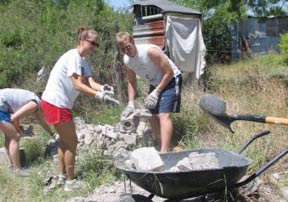
Physical therapy students from Hardin-Simmons University recently spent three days in Piedras Negras, Mexico, working with residents of Casa Bethesda, a home for people with special needs ranging from spinal injuries to Down’s Syndrome.

The 21 students and four university staff worked with 39 residents, as well as working in construction and maintenance at Casa Bethesda and distributing food bundles and New Testaments in some of the poorest parts of Piedras Negras.


Karli Rule of Mt. Vernon.


News of religion, faith, missions, Bible study and Christian ministry among Texas Baptist churches, in the BGCT, the Southern Baptist Convention ( SBC ) and around the world.