Pastor challenges parents and offers incentive to tie the knot

HARRISBURG, Pa.—Daneisha Dunbar was never so happy to see her children cry.

But there they were: 13-year-old Jheran, 10-year-old Aryn and 5-year-old Taryn, shedding tears and squealing with joy at the news that their mommy and daddy are getting married.

“All of their friends who had married parents had questions about why their mom and dad weren’t married,” said Dunbar, is marrying her longtime boyfriend, Aaron Yancey, this month. “They’ll never have to answer those questions again.”

Reclaim the Streets Ministries in Harrisburn, Pa., is offering a no-cost wedding to unmarried couples with children. Participants included (left to right) Daneisha Dunbar, Angel Baio and Jerry Scheib, Lakeya Taylor, Jason Green and Ashley Thompson. Dunbar is marrying Aaron Yancey, who is not pictured, and Thompson is marrying Robert Folks, also not pictured. (RNS photo/Gary Dwight Miller/The Patriot-News of Harrisburg, Pa.)

Better yet, except for the rings they exchange, the wedding will be at no cost to the couple. Dunbar and Yancey will marry at Reclaim the Streets Ministries in Harrisburg, along with three other couples.

Love might be the primary reason those four couples—all of whom have stayed together since having children—decided to take the marital step. But it took a push from the church and Pastor William Jones Jr. to put the “do” in “I do.”

Jones, senior pastor of Reclaim the Streets Ministries, borrowed a concept that developed in New York—Marry Your Baby Daddy Day.

“We wanted to celebrate marriage in Harrisburg,” said Jones, who has been a minister for two decades. “We wanted a vehicle to push marriage in Harrisburg.”

Jones has partnered with another Harrisburg faith-based organization, Firm Foundation of Pennsylvania, and several businesses to provide the no-expense weddings.

There are catches:

• The cohabiting couples must be committed. The four Harrisburg couples have been together an average of eight years.

• Their children must be their own. There are 11 among the four couples.

• They must commit fully to marriage itself, not just the ceremony.

Only after a lengthy screening and counseling process did the couples get to hear the magic word—free.

“All of the couples were enthusiastic, possibly the women more so than the men,” Jones said. “Of course, one of the things that attracted them the most was the ‘all expenses paid’ part.”

The couples didn’t argue the point.

“We’ve been making plans,” said Jason Green, who has been with Lakeya Taylor for four years and has four children. “We just didn’t feel we could afford the kind of wedding we wanted to have.”

Jerry Scheib and Angel Baio, a couple who have been together eight years and have three children, echoed that sentiment.

“We’ve been a couple for a long time,” Baio said. “But we also felt that marriage would provide a better foundation for our children.”


Faith Digest: Muslims affirm Saudi king’s interfaith effort

Muslims affirm Saudi king’s interfaith effort. Hundreds of Muslim leaders worldwide have endorsed Saudi King Abdullah’s recent call for intensified interfaith dialogue in order to dampen global conflict and demonstrate Islam’s commitment to solving world problems. The declaration came at the close of a three-day conference in Islam’s holy city of Mecca to discuss Abdullah’s surprise announcement that he wants to launch a new dialogue among Muslims, Christians and Jews. The lengthy declaration affirmed dialogue as an Islamic value, and cited the need to refute those who promote “clash of civilization” theories and “claims that Islam is an enemy of contemporary civilization.”

Families feud over ‘Footprints.’ “Author Unknown” once asked Jesus why there was only one set of footprints in the sand during life’s most perilous moments. Now a federal court on Long Island is trying to decide just whose footprints those were. Basil Zangare of Shirley, N.Y., claims they belonged to his late mother, Mary Stevenson, and that she’s the author of the “Footprints in the Sand” poem. Zangare filed suit May 12 claiming his mother penned the words in the 1930s and registered them with the U.S. Copyright Office in 1984. Not so fast, said John Hughes, lawyer for Canadian evangelist Margaret Fishback Powers, one of the women named in Zangare’s suit. Hughes said Zangare waited too long to sue and, besides, the registration of a copyright doesn’t prove absolute authorship. Powers, who lives in Coquitlam, British Columbia, is the only one with a registered trademark for “Footprints” and “Footprints in the Sand,” he said. Carolyn Joyce Carty, the other woman named in Zangare’s suit, claims to have written the poem in 1963 when she was 6 years old and inspired by poet Henry Wadsworth Longfellow. The proof of who actually wrote the poem could actually be lost in the mail. In a probate settlement after Stevenson’s death in 1999, Hughes said, an alleged “original document” of her writing was lost in an overnight delivery.

Cal State reaches accord with Quaker teacher. The California State University system and a Quaker college instructor who balked at signing a state-required loyalty oath have reached an agreement that allows her to teach and attach a statement to the oath. Wendy Gonaver, 38, said the oath, with its promise to defend the United States and California constitutions against all enemies, contradicts her Quaker pacifist beliefs. Under the agreement, brokered by CSU and People for the American Way Foundation, Gonaver will be allowed to attach a statement to the oath stating that such compulsion violates her right to freedom of speech. “And, as a Quaker, in order to sign the oath in good conscience, I must also state that I do not promise to undertake to bear arms or otherwise engage in violence,” the attached statement continues. The state-run school system had objected to a previous statement Gonaver attached to the oath, believing it undermined the pledge, which is required of all state employees. Gonaver will teach two classes this fall at Cal State Fullerton.


Aid groups feel the pinch of rising food, gas prices

WASHINGTON (RNS)—Dramatic increases in food and gas prices are leaving some religious hunger-relief groups praying for relief.

Problems already were apparent in 2006, but U.S. churches now report increased difficulty getting meals to people who need them. Food distributors see a perfect storm—a huge jump in requests from new clients, decreased donations and a thinning food supply.

Hunger activists are experiencing severe challenges in at least two areas—a new farm bill that they say is “inadequate” to meet current needs, and a drop in food supplies for local food pantries and soup kitchens.

David Beckmann, president of the ecumenical anti-hunger group Bread for the World, called the nearly $300 billion farm bill that cleared Congress in mid-May only “half a loaf.”

As the global food crisis grows Southern Baptist International Mission Board missionaries work to sustain physical and spiritual needs. According to Baptist Global Response, 16,000 children die from hunger-related causes each day. (IMB PHOTO)


The farm bill saw heavy lobbying by Catholic Charities, the Episcopal Public Policy Network, the Lutheran Office of Governmental Affairs and others. While cheering the legislation’s increase in allocations to food stamps and food banks, advocates said the amount still fell short.

“It (was) inadequate even before the economic crisis hit, and certainly inadequate at this point,” said Candy Hill, a policy expert at Catholic Charities USA. Still, she said, “it’s progress that they didn’t slash it in half.”

Catholic Charities heads a network of more than 1,700 agencies nationwide, which report difficulties at all levels. At the top, groups like America’s Second Harvest, which provides food to 75 percent of the nation’s soup kitchens and food pantries, said the U.S. Department of Agriculture has cut its donations of staples like milk, meat, and fresh fruits and vegetables by 10 percent over the last five years.

“That’s 200 million pounds of food, gone,” said Ross Fraser, spokesman at Second Harvest.

Food prices have gone up for a variety of reasons, including rising fuel costs, the diversion of corn to ethanol production and the related rise in commodities prices worldwide. In 2008, food prices are projected to increase at least 4 percent to 5 percent.

A sluggish economy impacts donations almost as much as the calendar—food donations are usually high during Thanksgiving and Christmas, not the summer.

“This is not a time when most people consider making food contributions,” said Jane Stenson, Catholic Charities USA’s director for human services.

When soup kitchens and pantries see donations slip, they seek more help from businesses and congregations. “But we can’t go back to the well too many times,” Stenson said.

Need is increasing 

Hunger relief activists said while donations are dropping, more and more people are looking for meals. Workers at Second Harvest agree: 99 percent of the hunger relief agencies they surveyed report demand up from last year.

Suzanne Edwards, chief operating officer of Catholic Charities in Jacksonville, Fla., said there has been nearly a 50 percent increase in requests this month alone.

She sees many more working poor and middle-class people coming in for meals, often for the first time.

“A lot of (food pantries) are reporting new families,” Stenson said. “They come in, and they are not sure what to ask for.”

One new sight—parents taking their kids for free meals during spring break.

With a low hourly wage and more of their income going for gas and other expenses, “they are using the food bank to stay afloat,” Stenson said.

In Washington, the Foggy Bottom Food Pantry at The United Church, located just blocks from the White House, has seen less and less food donated from manufacturers or grocery stores.

Volunteers filling the gap

Staffer George Madill said when Foggy Bottom runs out of supplies, volunteers grab their checkbooks and go shopping to fill in the gap. He has to buy products at retail or close to retail prices, which “has increased our costs dramatically.” Food banks and pantries spend an estimated $130 million a year buying food.

A church-run food pantry in Jacksonville, Fla., used to receive frequent deliveries by truck from Miami. As gas prices began creeping toward $4 a gallon, the drivers said they couldn’t afford to drop off the supplies. The solution was an expensive one for a non-profit: Give the drivers $600 for gas.

Despite the setbacks, hunger advocates said they remain determined to demand change in the way the government feeds its hungry. After all, a spokeswoman from Catholic Charities said: “Poor people don’t have lobbyists. They have us.”


Faith Digest: Christians accused of hate crime for witnessing

Christians accused of hate crime for witnessing. A Muslim community police officer accused two Christian preachers from the United States of a hate crime after they handed out evangelical tracts in a predominantly Muslim area in England. Arthur Cunningham and Joseph Abraham complained to police in Birmingham that Police Constable Support Officer Naeem Nagutheney stopped them in a Muslim neighborhood, told them they could not preach there and accused them of committing a hate crime by trying to convert Muslims to Christianity. Birmingham police authorities said the officer “has been offered guidance about what constitutes a hate crime and advice on communications style,” but they insisted he had acted “with the best of intentions.”


Evangelical scientist leaves genome institute. Francis Collins, who helped decode human DNA and build bridges between scientists and religious believers, will resign as director of the National Human Genome Research Institute, effective Aug. 1. Collins, an evangelical Christian, has headed the National Institutes of Health-affiliated center since 1993. Collins, 58, accomplished much in the field of genetic research, from mapping human DNA, which he called “the book of human life,” to identifying genetic risk factors for diabetes and other diseases. Collins’ best-selling 2006 book The Language of God: A Scientist Presents Evidence for Belief, was credited with forging common ground between evangelical Christians and scientists.


British clerk files suit over gay partnerships flap. A Christian government clerk in Britain has taken her town hall bosses to court for threatening to fire her because she refused to register civil partnerships for same-sex couples. Lillian Ladele says she was bullied by officials at London’s Islington Council after she told them she objected on religious grounds to same-sex civil partnerships. In testimony before an employment tribunal in London, Ladele likened forcing her to preside over such ceremonies to force-feeding a Muslim “unclean” food. Ladele has registered births, deaths and marriages at the town hall 16 years and had been allowed unofficially to opt out of civil partnership rites. But that changed with the British government’s introduction of the Statistics and Registration Act, which removed the opt-out option last December and made her subject to local council orders—including registering gay and lesbian civil partnerships.


Where’s the beef? Not in coach class. British Airways has taken beef off the menu for thousands of economy class passengers on long-haul flights due to concerns it might offend Hindus. Britain’s flagship airline announced in-flight choices now are restricted to fish or chicken dishes, and beef is no longer an option, at least for this summer. British Airways’ second-largest long-haul market is to India, where Hindus, who make up the majority population, shun beef because of their religious beliefs. Economy-class passengers will be given the choice of a fish pie or chicken option. However, in the airline’s business and first-class cabins, it will be business—and beef—as usual.


Their names may be lost to history, but their stories endure

WASHINGTON (RNS)—Lot’s wife and daughters. Two thieves crucified with Jesus. Three Wise Men. They’re all iconic figures from the Bible, yet they all have one thing in common. Officially, they have no names.

The Bible is riddled with famous or infamous people who went nameless—in some cases forever, and in others for decades or centuries after their stories were recorded.

How and why they were eventually named, and why they initially went nameless, are the types of questions that intrigue scholars. And while anonymity often is equated with unimportance or insignificance, some scholars have challenged that assumption.

Tradition–not Scripture–ascribes the names Melchior, Caspar and Balthasar to the Magi who brought gifts to the Christ child. (RNS photo courtesy Jaimie Trueblood/New Line Cinema)

Adele Reinhartz, professor of religious studies at the University of Ottawa, is the author of Why Ask My Name? Anonymity and Identity in Biblical Narrative. While some anonymous biblical figures simply aren’t that important, she cited several times when an unnamed person is essential to the story.

The unnamed often are described by their social role—someone’s wife, daughter or servant—so looking at how they fulfill or subvert their social role is key, Reinhartz said.

Take Lot’s wife and daughters. To protect visiting angels, Lot offers up his daughters to the rapacious Sodomites. Later, when God ushers Lot’s family to safety, his wife disobeys and looks back at the doomed city and becomes history’s most famous pillar of salt.

Reinhartz said the anonymity of Lot’s wife underscores her powerlessness and silence. When Lot offers his daughters to the mob, the question arises: Where is the mother to protect them? While unnamed in the Scriptures, she is sometimes known as Ado.

So what’s in a name? William Shakespeare said a rose by any other name would smell as sweet, but for biblical figures, a name—or no name—can mean a lot.

Cleveland Evans, psychology professor at Nebraska’s Bellevue University, is a name specialist, and he said names are important because they are the anchor of one’s identity from childhood.

“Personal names are one of the few cultural universals,” he said. “There isn’t any culture in the world that doesn’t have specific designations for specific people.”

What’s more, having a name makes someone in a story more real.

“Somebody who is completely nameless is somebody who doesn’t seem quite human,” Evans said.

Gender plays a role

In the Bible, gender plays a large role in who is unnamed. Michael Coogan, professor of religious studies at Stonehill College in North Easton, Mass., edited The Oxford Guide to People and Places of the Bible. Women more frequently go unnamed, reflecting the patriarchal culture in which the Bible was produced, he said.

Karla Bohmbach, religion professor at Susquehanna University in Selinsgrove, Pa., said women represent no more than 8 percent of all the named people in the Bible.

“The cultural context that gave rise to the Bible is very male oriented. So, it’s not only that the culture more highly values males and gives them most of the authority and leadership, but also the text itself was largely authored by men, and so they’re naturally going to focus on themselves,” Bohmbach said.

The power of naming starts at the very beginning of the Bible. God named the heavens and the earth. Adam was given the power to name all the animals—and his wife. “Naming denotes a sort of authority over that person,” Bohmbach said.

In post-biblical texts, starting around 200 B.C. and going all the way through the 13th century, Jewish rabbis and others bestowed names on the nameless. Assigning names to previously anonymous biblical figures was part of a broader tradition of enriching and explaining biblical stories, Bohmbach said.

Josephus lent a hand

Josephus, a first-century Jewish historian who wrote Antiquities of the Jews, also was a source for many of the names. “The anonymity was noticed and kind of bothersome to people from quite an early point,” Reinhartz said.

People started giving names to the nameless using a variety of tools, from oral tradition to borrowing from place names. Sometimes, Reinhartz said, an unnamed person would be matched with a named person elsewhere, with the idea that there should be a story for every name, and a name for every story.

Sometimes name assignments were purely random and inconsistent. The magi who visited Jesus in Bethlehem were given the names Balthasar, Melchior and Gaspar—or Hor, Basanater and Karsudan, depending on the source. Noah’s wife, meanwhile, has more than 100 different names, according to The Oxford Guide to People and Places of the Bible. One of the most common is Naamah.

While modern readers may interpret the assigning of names to people centuries later as pure fiction, Bohmbach said post-biblical authors no doubt felt they were being faithful.

“The line that we draw between truth and fiction I do not think was as strongly drawn for many ancient people,” Bohmbach said.

Reworking historical figures in literary fiction is common, said Don L.F. Nilsen, English linguistics professor at Arizona State University and co-president of the American Name Society.

“People’s need to name people after the fact in post-biblical texts is part of the human need for narrative, even in a fictional way,” he said. “When we hear the names of Richard III, Henry VIII, Julius Caesar or Mark Anthony, we are more likely to think of Shakespeare’s rendition of these people than of the actual historical accounts.”

Ultimately, multiple interpretations and names for unnamed biblical figures speak to the human need for narrative and finding meaning.

“That’s what we really learn from these texts—the power of narrative and the drive to create it, to transmit it, to think about it, to use it as a way of understanding spiritual truth,” said Reinhartz.


You’ve got (spiritual spam) mail

MOBILE, Ala. (RNS)—The messages are simple enough. Some include a prayer. Others offer stories or pictures. Then, slipped into the cyber-epistle, the reader comes across the kicker: If you love God and/or are not ashamed of your religious beliefs, forward this e-mail to a particular number of people.

“Sometimes, they are genuine witnessing tools, and some of them have a very good, theologically sound, powerful message,” said Doug Wilson, assistant professor of Christian studies at the University of Mobile, Ala. But others, he said, lack biblical perspective.

“I believe in sharing our faith and doing it openly,” Wilson said. But, he added, he doesn’t know that forwarding e-mails is an effective method.


Modern technology allows the messages to circulate far and wide, but religious chain mail is hardly a new phenomenon. In her book Not in Kansas Anymore: A Curious Tale of How Magic is Transforming America, author Christine Wicker noted the popularity of a chain letter circulated in the early 18th century. The missive, “supposedly written by Jesus, promised that those who carried it could not be damaged by guns or swords, but anyone who did not copy and pass it on would be cursed by the Christian church,” Wicker writes.

Although people inclined to circulate such letters might consider their actions more hallowed than hoodoo, the idea that a blessing is the result of human action is a magical one, according to Wicker, former religion reporter for the Dallas Morning News.

“Religion tends toward supplication, whereas magic sets forces into operation, commands, and de-mands,” she explains in Not in Kansas Anymore. “It relies on the power of objects, of symbols, of numbers, of words and of human will. It empowers human experience over doctrine. Religious people wait on God; magical people push.”

By forwarding messages, senders may be hoping for a particular result. But Wicker said such actions may be a way of witnessing and spreading blessings.

Wilson said his decision to share an e-mail “has everything to do with the content, not the blessing or cursing that may be in that tagline.”

Furthermore, since Wilson doesn’t want to be recipient of numerous forwards, he rarely passes along such e-mails, and if he does so, it’s not necessarily to the number of people stipulated in the messages.

“God’s blessing comes from obedience to him and to his word,” Wilson said, not from the receipt and transmission of e-mail.

While Wilson has found some of the e-mails meaningful, Ray Russell of Mobile said the messages rub him the wrong way.

For one thing, Russell said, he has a problem with questioning someone’s love of God. The messages, in Russell’s view, also trivialize God. “Like God is sitting there with a pager,” he said.

Russell, who has his e-mail forwarded to his Blackberry, said the message that really bugged him was one that buzzed him about 2 a.m.

“I texted back,” said Russell, who’s on the waiting list for a heart transplant and was not feeling well when the message arrived. “I think this is very inappropriate to play with God this way.”

While Philip Chance, pastor of Dauphin Island (Ala.) United Methodist Church, said he typically sees the e-mails as spam, he doesn’t think they’re dangerous.

“I just think it’s bad theology,” he said. “It’s not what I understand the Scripture to promise.”


Popular culture challenges Christians to ‘think outside the box,’ scholars insist

It can be difficult to hear God’s word in today’s media-saturated culture of iPods, YouTube, satellite radio, and DirecTV with over 500 channels and on-demand movies, two culture observers at Houston Baptist University conclude.

“We are shaped by popular culture far more than we think—and not just the young people,” said Louis Markos, professor of English at the university and a C.S. Lewis scholar.

 “Hollywood has taught us what love and marriage mean—or don’t mean—what things we should value and what things we should not value, and what it means to be successful. We are also more influenced than we think by the whole celebrity culture. Still, popular culture can be good when it presses Christians to think outside of the box and to identify those deeper longings that we all yearn for.”

Jon Suter, a professor who teaches American popular culture and science fiction as well as other literature courses in the graduate program at HBU, also commented on the duality of popular culture.

“The popular culture contains much that is bad, even toxic,” Suter said, “but there is also much that is good and worthwhile.”

Suter and Markos agree it can be difficult for Christians to determine what is worth watching or listening to and what is not.

“The challenge for the modern Christian is that it is difficult to recognize which is which,” Suter said.

Good examples are out there, however. “I think one Christian writer and speaker who has done a fine job using popular culture to tell the sacred narrative of the Bible is John Eldredge,” Markos said.

So, is anything good coming up for the summer season?

“The most exciting film of the summer promises to be Prince Caspian,” Markos said. “I only hope it will be as faithful to the book as the film version of The Lion, the Witch and the Wardrobe.  If it is faithful, we will discover what it means to live in a post-Christian culture in which the old stories have been turned into mere myths.”

Markos hopes the character of Prince Caspian will become “a positive kind of pop icon for young people who yearn for a revival of true courage, beauty and chivalry.”


Narnia creators seek to turn beloved books into accessible movies

NEW YORK (RNS)—C.S. Lewis’ Chronicles of Narnia book series is so revered by Christian readers, adapting the books into film becomes a delicate tightrope. Changes risk alienating fans, but what works in the books doesn’t always translate well to the big screen.

Walden Media and Disney recently released The Chronicles of Narnia: Prince Caspian, the sequel to the wildly successful 2005 movie, The Lion, The Witch, and the Wardrobe. The filmmakers faced the challenge of turning a beloved book with a slow plot into a modern movie, but also one that retains the story’s spiritual messages.

Ben Barnes (center) plays Prince Caspian in The Chronicles of Narnia: Prince Caspian. Actors (from left) Georgie Henley, William Moseley, Anna Popplewell and Skandar Keynes play the four Pevensie children, who return to Narnia after 1,300 years.


“The underlying messages are so important and so vital to the story,” said Douglas Gresham, Lewis’ stepson and co-producer of the new film. “Which are the return to faith, truth, justice, honesty, honor, glory, personal commitment, personal responsibility. Also, the message (that) no matter how far away we stray, there’s only one way back.”

The Lion, The Witch, and the Wardrobe told the story of four Pevensie siblings who enter Narnia through an old wardrobe and defeat the tyrannical White Witch. They are aided by the great lion Aslan, but only after he submits himself to be killed in the place of turncoat Edmund Pevensie.

The book is widely regarded as a retelling of Lewis’ Christian faith, with Aslan shining as a golden Christ figure who returns after death.

In Prince Caspian, the children return to Narnia. Although they are only a year older, 1,300 years have passed in their former kingdom. The evil interloper Miraz has stolen the throne from Prince Caspian and forced the true Narnians into hiding.

Aslan has not been seen in centuries. Each character in the movie faces the same crisis: They long to see Aslan, but he remains elusive.

William Moseley, who plays Peter Pevensie, sees the search for Aslan as a metaphor for faith.

“When you talk about seeing, I think it’s more believing,” he said. “You believe, and then you see. Aslan represents God. People say, ‘If God’s there, why can’t I see him?’ Well, because you’re not believing.”

The movie format necessitated some changes to the book’s storyline.

“Essentially, the book is a long walk followed by a short battle,” said Andrew Adamson, the film’s director and producer. He rearranged the timeline to put more action at the beginning and expanded the battle scene.

He also had to leave out some beloved scenes and characters. However, such sacrifices allow more room to fully explore such characters as Reepicheep the valiant mouse, and Trufflehunter the faithful badger, both developed using computer-generated imagery.

The film version also delves more deeply into the heart of Peter. His inability to see Aslan when his sister Lucy does—a key part of the book—is expanded into an inner struggle between his trust in Aslan and an ego-driven desire to prove himself.

Caspian, played by Ben Barnes, has a similar struggle—his desire for revenge against his evil uncle Miraz (Sergio Castellitto) nearly overwhelms his desire to serve Aslan purely in the cause of freedom.

narnia aslan
Aslan roars in the latest Narnia film, Prince Caspian.

Adamson also updated the movie for 21st century mores. To make it more inclusive, he added female dwarves, child-aged fawns and an “Afro-centaur” (Cornell John) as Glenstorm, the noble half-man, half-horse. In addition, the Pevensie sisters, Susan (Anna Popplewell) and Lucy (Georgie Henley), join the battle, which they avoid in the book.

For Adamson, it was an obvious choice to allow women an active role in the fight.

Referring to the gift of bow and arrow that Susan received in the first movie, Adamson joked, “If she’s just going to make sandwiches, then give her a plate and a knife.”

Adamson made his case for the changes to Gresham by arguing that Lewis’ female characters become stronger as the book series progresses —something he attributes to Lewis’ real-life romance with Gresham’s mother, Joy Davidman.

This is the last of Narnia for Moseley and Popplewell, whose characters do not return in later books.

“I was sad about that,” Popplewell said, “but I’m excited to do new things.”

Still, they’ve taken home some lessons from their time in Narnia.

“Peter learned leadership is about serving other people and not serving yourself,” Moseley said. “Peter had to learn to reinstate his trust in Aslan.”


Christians called to make culture; let God handle transformation

Andy Crouch feels uncomfortable when Christians talk about transforming culture or making an impact on society. But he strongly believes churches should do far more to encourage Christians to make culture—right where they live.

“I’m all for cultural transformation—in fact, I believe it’s a very good phrase for what God seeks to do in every human culture. But transformation is surely out of the reach of any human being’s activity or agency. It really is something only God can do in any lasting and deep way,” said Crouch, an author and documentary filmmaker.

Andy Crouch


“People who study culture carefully always come away impressed by how much more culture has transformed and shaped us than we will ever transform or shape it. Still, beginning with our original creation and call in the garden (of Eden), we human beings have always been culture makers. We cultivate and create in our specific cultural contexts, and in those local places we can do a lot of wonderful things. But transformation is not up to us; it’s up to God, which is actually tremendously freeing.”

Crouch, editorial director for the Christian Vision Project at Christianity Today International, has written a book on the subject—Culture Making: Recovering our Creative Calling—due for release by InterVarsity Press this summer.

When it comes to creativity, Christians have made their mark in literature of all kinds—from popular fiction to acclaimed work such as Marilynne Robinson’s Pulitzer Prize-winning novel, Gilead, he said.

“Music is the other place where Christians have been successfully offering up innovative cultural goods for at least a generation now,” he added. From American Idol contestants singing contemporary Christian music selections to classically trained musicians performing works by Christian composers such as John Tavener and James MacMillan, Christian influence permeates music, he noted.

“We’ve always been a people of the word, so it makes sense that there would be a strong Christian presence in literature. We value music in worship, so Christians have done well in that area,” Crouch said. “Where we have not been represented as much are in areas the church has either avoided or viewed with suspicion—film, dance and the visual arts.”

In part, he sees the plethora of Christian musicians compared to the dearth of Christian graphic artists as a simple matter of supply and demand. “With the decline of public arts and music education, the church has become the last significant reservoir of amateur expression in music. It’s the place where young musicians are given a chance to develop,” Crouch said.

While nearly all churches encourage musical involvement because it’s an essential part of worship, churches often fail to encourage other creative expressions because they are not viewed as useful, he added, asking, “Do we only value what the church needs?”


But some Christian groups have developed to nurture aspiring artists. The Act One program trains screenwriters and producers in Hollywood, and the New York Center for Arts and Media Studies trains young artists in Manhattan, Crouch noted.

“The visual art world is stunningly insular and hostile to professions of faith, but Christians are doing serious, good work and will be better represented there in years to come,” he said. “It just takes time.”

Christians have made inroads into the movie industry but not much in television for one simple reason, Crouch noted—market economics.

“One advantage movies have over television is they can be much more narrowly targeted, and they are driven by consumer demand without the intermediation of advertisers,” he said. “So, movies tend to be produced successfully for much tighter niches than TV—and Christian consumers are certainly a large enough niche to be of interest to Hollywood.”

Crouch firmly rejects the idea Christians have to break through into high-impact major media markets in order to influence culture in a big way.

“I really resist the word ‘impact.’ Impact is high-energy and almost by definition short-lived. And human cultures are designed to resist impact—to change only slowly and organically,” he said.

“I also resist the idea that we should let the world define for us what is big. Certainly, some Christians are called to live and work in major media markets or in various kinds of cultural epicenters. … But to seek to have an impact there is almost always not only to miss our Christian calling, but to distort our cultural calling as well.

“The great good news of God’s redemptive story is that we all can be part of it, in whatever location we are called to be. The question of where we are called to make culture is a matter of just that—calling, not of strategy for cultural impact. And all of us are called to cultivate and create somewhere.”


Pass the Popcorn: Christians struggle with best approach to engage culture

If Christians don’t learn to engage the popular culture that surrounds them, they will drown in it, experts insist.

Christians tend to hear the words ‘popular culture’ and react as if spitting something yucky from their mouths,” said David Dark, author of Everyday Apocalypse: The Sacred Revealed in Radiohead, The Simpsons and Other Pop Culture Icons and The Gospel According to America.

Instead of hiding from culture, Christians can use it as a learning tool.


But popular simply means “of the people,” he said. “It is never something we exist objectively from. It’s like the air we breathe, the language we use. … If we’re thinking, ‘Now we’re going to engage pop culture,’ it’s too late. We’re already soaking in it.”

Jeffrey Overstreet, contributing editor for Seattle Pacific University’s Response magazine, freelance movie reviewer, and author of Through a Screen Darkly and Auralia’s Colors, agreed.

“We are born into a pop culture,” he said, describing that culture as the very temporary, disposable details of a particular time and place.

Overstreet didn’t always see the importance of connection to culture. He grew up in a family that encouraged him to avoid pop culture and “steer clear of anything that did not have a clear connection to church,” he said. Rock music was questionable, and theaters were “dens of sin, contaminated by culture.”

Under the guidance of teachers, he realized complete separation from culture wasn’t the model Christ set.

“He was to be found at the corner pub, surrounded by messed-up people,” he said. “He was there among them, but he was different. He was compassionate.

Jeffrey Overstreet


“The more I look at it, in order to have a meaningful influence on society, we need to live fully engaged lives. How do we do that without hearing the stories told? Without listening to the music played?”

If Christians aren’t engaged in culture, they will not change the world or impact society, said Greg Fiebig, associate professor of communication and theater at Indiana Wesleyan University and former theater director at Southwest Baptist University in Bolivar, Mo. “We’re not going to do it. Period.”

He said Christians, especially in Christian academia, tend to live in a bubble. “People isolate themselves,” he said. “There is nothing wrong with isolating ourselves—Jesus did—but if we don’t know how to exist in the larger culture when we emerge, we have failed.”

Instead of hiding from culture, Christians can use it as a learning tool, Fiebig said.

“When I show someone a movie or present a show, I’m telling a story that needs to be told,” he said. “Jesus spoke of loving and caring for people where they were. The last thing he did was judge people. It is harder for us to judge when we are willing to listen to their story.”

Part of the learning experience is realizing that Christians don’t have a monopoly on the truth, Dark said.

“We are learners of Christianity,” he said. “It’s weird the way we talk, as if truth is something we have over other people. That’s no way to talk about faith—as if it is property. … When we view our faith as a bragging right or a secret password, I don’t know how we think others will be attracted to that.”

Instead, that type of view cuts Christians off from their neighbors, Overstreet said. “We need to see and understand our neighbors,” he said. If Christians only pay attention to items of culture that affirm their own worldview, “we don’t understand what the world looks like to them.”

Christ went to the woman at the well and began asking her questions, he said. He didn’t simply bombard her with the gospel.

He added that people know when they are being marketed. “So much of Christian art is just advertising for Jesus,” he said. “If we just keep shouting, we shouldn’t be surprised when people react like we are salesmen.”

He recalled driving under an overpass where someone had spray-painted in big letters, “Jesus is the answer.” Underneath, in a different color, another person had responded, “Yes, but what’s the question?”

Christians shouldn’t be handing out answers to questions that haven’t been asked, he said. Instead, pop culture can be used to kindle questions.

David Dark


Engaging culture will, no doubt, lead to viewing, reading or listening to objectionable content.

“As a Christian, I believe it can be insightful to critique movies for what they might have to say about important aspects of our lives,” said David Thomas, associate professor of rhetoric, emeritus, at the University of Richmond and freelance writer for Christian Ethics Today.

“I’m less interested in whether a movie contains language that offends me, or has scenes that depict sex or violence, than I am in determining whether the stories and characters ring true and in what the characters’ moral and ethical choices lead to.”

“Christians tend to believe that films have the power to single-handedly disrupt or uproot a person’s spiritual development if they contain corrupting elements,” said Chad Johnston, production assistant for Allen Press in Lawrence, Kan., and adjunct online instructor in communication and film at Drury University in Springfield, Mo.

“I do think people should be discerning about what they watch, but throwing out the baby with the bathwater—and sometimes the bathtub—is a flawed method of encountering and dealing with media.”
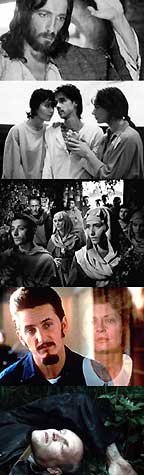
From artsandfaith.com


He compares watching films to meeting people. When meeting a person, it is easy to dismiss him or her due to a simple disagreement, but perhaps at the expense of a potential relationship or opportunity for growth, he said.

“It always surprises me that Christians will dismiss an R-rated film, yet read R-rated books in the Bible, like Judges,” he said.

“I tend to think that life is R-rated and should not be experienced without a Parent—i.e., our heavenly Father. After all, how can we handle the tougher realities of life being as fragile as we are? So I recommend that if you are hesitant to watch a particular film, you should ask yourself why, and perhaps do some research. If you are still uncomfortable with seeing it, or you simply feel it is bankrupt of any value spiritually, by all means avoid it.”

“To think of a human story as objectionable is not fair,” Dark observed. “If all we do is count bad words or feel offended, we are not relating to the world we are called to love or the world God so loved.”

But that does not mean anything goes, he emphasized.

“I wouldn’t say anyone needs to walk into dangerous places,” Overstreet said. “Each person needs to know their own strengths and weaknesses. But a lot of R-rated films are profound movies.”

The importance lies in knowing how to interpret films, which may be difficult for those who have never studied literature or other arts, Overstreet said.

Fiebig added that the American culture has lost a lot of ability for interpretation because of the tendency to be individualistic. “Movies are not meant to be seen in the privacy of your own home,” he said. “They should be communal, with time for discussion.”

Dark agreed that too much “privatization” has occurred. Typically, he said, Christians will watch, listen or read, but pretend the stories aren’t important to them when they step into church. “We are not living out loud to one another,” he said.

When Christians view things in isolation, they often miss the redeeming value, he said. “When we live isolated lives, we often hold wrongly applied guilt, as if our enjoyment is somehow separate from our relationship with God.”

Thomas’ church tries to break through the isolation by offering courses in faith and culture. He worked with Pastor Doug Gebhard in Rockingham, N.C., to design a liturgical film class that accompanied the seasons of Lent and Advent.

“The movies we chose had a Lenten or an Advent theme,” Gebhard said. “David explained rhetorical devices in the film—plot, symbolism, etc.—while I pointed out theological themes—suffering, sacrifice, redemption.”

Gebhard has led other classes that reached beyond film.
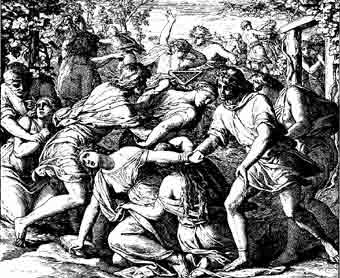
An R-rated scene from the Book of Judges: The Benjamites take wives.


“I hoped to prod people of faith to look at movies, listen to music, read novels with a lens of faith,” he said. “What spiritual messages can you see in Star Wars? The Matrix? Ironman? Where is Christ found in Springsteen’s anthems? U2’s music?”

Johnston also partnered with a friend to lead a film class, called Sanctuary of the Cinema, at University Heights Baptist Church in Springfield, Mo., where he lived until last year when he moved to Lawrence to begin a Ph.D. program in film at the University of Kansas.

“Our goal was to explore films through the interpretive lens of Christian spirituality—to see the light of God in the light of the silver screen,” he said.

The class met in the upstairs college Sunday school class, which featured comfortable chairs and couches and a projector to watch films on a large smartboard screen.

Sanctuary of the Cinema was advertised at local college campuses, coffee shops and an independent movie theater. As a result, the class was a diverse group. “Some of them were churchgoers, and others were a bit leery about the whole thing being set in a church,” Johnston said.

The group watched independent, art and foreign films together, then discussed the film, using questions from a faith perspective to help guide discussion.

Despite differences among the class members, “we all bonded because of the beauty of cinema,” Johnston said. “I think it’s because cinema is capable of reminding us all of what we share, rather than how we differ. Narrative cinema tells the sorts of stories that are common to all of us, and we therefore feel like we have a share in what’s happening onscreen.”
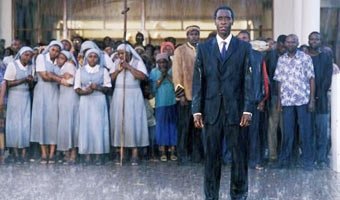
A scene from Hotel Rwanda.

And ultimately, that viewing can lead to Christ. “I have come to see the silver screen as a window overlooking a theologically charged world,” Johnston said. “As I look through this window, I find that I am better able to understand who God is, who I am, and how I relate to God and others. It is not a substitute for the Bible, but rather a supplement to it.”

A starting place for finding films to use in discussion is the Arts and Faith Top 100 Spiritually Significant films list, published at www.artsandfaith.com/t100. The list is compiled by voting members of the website, including Overstreet, and is updated each year. The website also features discussion groups on film, music, literature, visual art, theater and dance, and television and radio.

Fiebig helps lead a film festival at Indiana Weslyan University. Last year, the first year of the festival, they decided to screen Hotel Rwanda, a film depicting the true story of Paul Resesabagina, a hotel manager who helped house over a thousand Tutsi refugees during the Rwandan genocide.

A student from Uganda, who had lost family members during the struggle, attended the screening.

He began the discussion after the film by announcing he could not stay, due to the fresh emotions the film conjured, but he asked the other students to pray for Rwanda and Uganda.

“It was an amazing moment,” Fiebig said. “In a room full of college students, you could hear a pin drop. A Hollywood film became a worship service.”


Faith Digest: Does ET need Jesus?

Does ET need Jesus? Vatican astronomer says, ‘no.’ Intelligent life may exist on other planets and has no need of redemption through Jesus Christ, the director of the Vatican Observatory said. “Just as a multiplicity of creatures exists on the Earth, so there could be other creatures, even intelligent ones, created by God,” Jose Gabriel Funes was quoted in the official Vatican newspaper, L’Osservatore Romano. According to Funes, such creatures may never have fallen into sin, and so they have no need of salvation through Christ. “It is not a given that they have need of redemption,” he said. “They may have remained in full friendship with their Creator.”


Casting Crowns singer reaps Dove Awards. Casting Crowns lead singer Mark Hall and his group reaped a total of seven Dove Awards at the annual Gospel Music Association ceremony. Among his four individual awards, Hall was honored for co-writing the Song of the Year, “East to West.” Casting Crowns was honored three times, including as Group of the Year. TobyMac was named Artist of the Year, a title he claimed in 1996 as a member of dcTalk. His latest solo album, Portable Sounds, debuted at No. 10 on Billboard’s Top 200 albums chart. He was honored in two other categories for his work on that album.


Hotel offers variety of spiritual texts. Overnight guests at one Nashville, Tenn., hotel who crave religious reading material may turn to something other than a Gideon Bible. The Hotel Preston recently started offering a “spiritual menu” to its guests, including the Quran, the Bhagavad Gita and additional versions of the Bible other than the Gideon-provided King James Version. Five hotels in the Portland, Ore.-based Provenance chain have introduced the new offerings in the last few months, with the Nashville property starting them most recently. Researchers for the American Hotel & Lodging Association noted in 1998, 79 percent of hotels surveyed said they provided religious reading material in guest rooms; that figure jumped to 95 percent in 2006.


U.S. visit boosts Pope’s approval ratings. After Pope Benedict XVI’s first papal visit to the United States, six of 10 Americans now report favorable views of the pontiff, a modest bump from pre-trip opinions, according to new polls. Before his April 15-20 visit to Washington, D.C., and New York, the German-born pope was largely unknown in the United States three years after his election. In March, more than 80 percent of Americans said they heard little or nothing about him, according to a survey conducted by the Pew Research Center for People & the Press and the Pew Forum on Religion & Public Life. After Benedict met with President Bush, celebrated public Masses before huge crowds and repeatedly spoke of the pain and shame caused by his church’s sexual abuse scandal, 61 percent of Americans say they hold a favorable or very favorable view of the pope, up from 52 percent before the trip. More than half of Americans now say the pope does an excellent or good job of promoting relations with other faiths, up from 39 percent in March.


Evangelicals state desire to be defined by theology, not politics

WASHINGTON (RNS)—Evangelical Christians should be defined by their theology—not their politics—to avoid becoming “useful idiots” of a political party, a group of Christian leaders said in their recently released document, “An Evangelical Manifesto.”

The manifesto reflects the frustration of some within a movement that claims about one in four Americans over how they are perceived by others and who can speak for them.

The 19-page document declares evangelicals err when they try to politicize faith and use Christian beliefs for political purposes.

“That way faith loses its independence, the church becomes ‘the regime at prayer,’ Christians become ‘useful idiots’ for one political party or another, and the Christian faith becomes an ideology in its purest form,” the document reads.

The statement, however, resists calls to privatize or personalize the faith, saying there is an important place for evangelical voices in the public square.

“Called to an allegiance higher than party, ideology and nationality, we evangelicals see it our duty to engage with politics, but our equal duty never to be completely equated with any party, partisan ideology, economic system or nationality,” the document says.

The manifesto, which at times upbraids evangelicals for contributing to their own image problems, comes about six months after a poll showed many young people grade Christianity as being judgmental and hypocritical. Drafters of the new document said they knew other evangelicals who were “ashamed” or “reluctant” to describe themselves as evangelical.

A nine-member steering committee spent three years working on the manifesto. The document’s initial 75 signers are evangelical leaders from major coalitions, educational institutions and denominations.

They include National Association of Evangelicals President Leith Anderson; best-selling author and megachurch pastor Max Lucado of San Antonio; Bob Roberts, pastor of NorthWood Church in Keller; David Gushee, Christian ethics professor at Mercer University; Jim Wallis, founder and editor of Sojourners magazine; Mark Bailey, president of Dallas Theological Seminary; Bob Buford, founder of the Leadership Network; and Frank Wright, president of the National Religious Broadcasters.

Critics note some key names—including conservative evangelical leaders such as Focus on the Family founder James Dobson and Southern Baptist public policy executive Richard Land—are missing from the statement.

John Huffman, pastor of St. Andrew’s Presbyterian Church in Newport Beach, Calif., said the statement’s steering committee had conversations with Dobson, but his board recommended he not sign it. Dobson spokesman Gary Schneeberger confirmed this.

Land, president of the Southern Baptist Ethics & Religious Liberty Commission, said he had not seen the statement before it was released, but he later released a statement explaining why he would not sign it.

Charter signers of the document said it is intended to explain evangelicals to those outside their fold, as well as challenge evangelicals to better represent their faith.

“We are troubled by the fact that the confusions and corruptions surrounding the term ‘evangelical’ have grown so deep that the character of what it means has been obscured and its importance lost,” the manifesto reads. “Many people outside the movement now doubt that ‘evangelical’ is ever positive, and many inside now wonder whether the term any longer serves a useful purpose.”

The statement calls for a reaffirmation of evangelical identity—including the importance of sharing the belief that Jesus is the only Savior of mankind. It expresses concern that “a generation of culture warring” has created a backlash against religion in public life.