2nd Opinion: Hurricane relief arrives for Texas taxpayers

Posted: 11/04/05

2nd Opinion:
Hurricane relief arrives for Texas taxpayers

By Brian Burton

My job the past nine years as executive director of a faith-based poverty-relief center in Dallas has brought much human misery before my eyes. But nothing in my prior work experience prepared me for the intense, layered trauma of the Hurricane Katrina victims.

Throughout September, I volunteered alongside other social workers and counselors at the Dallas Convention Center. In the milieu of 8,000 dazed survivors, our team did our best to offer listening ears, reassurance, housing referrals and connections to local resources.

Clarice, a distressed, tiny-boned elderly woman, sat across from me while I tried to help. Burying her face in her hands, she mumbled over and over, “I don't know this place.” Unable to console her, I turned to my friend Jan Mitura, who was able to track down the woman's granddaughter at a Houston shelter. Clarice's relieved eyes turned to mine as she said: “That's my grandbaby. She's my diamond.”

As Jan worked to reunite them, a middle-aged gentleman walked up to me looking lost. Squinting as though blocking out a glare, Pablo said he could not see after he lost his glasses at the Superdome. I randomly dialed an optometrist out of the phone book. Minutes later, an emotional Pablo and I were in my car crossing the Houston Street bridge as Jerry Jacobs, a total stranger, agreed to assist him free of charge.

Pauperized and pulverized by a storm that had washed them 500 miles away from everything and everyone they held precious, this unbroken stream of people seemed to accept their circumstances with an almost surreal peace.

While most were in shock, what struck me was their attitude. Contrary to reports I had read on the Internet, these people were exceedingly grateful. Despite losing everything, enduring the horrific squalor of the Superdome, a 10-hour bus ride, and sleeping on concrete floors, I kept hearing people say: “God is good,” “Thank you” and “I'm blessed.”

This experience has fortified my own faith and humbled me. The grace of these survivors causes me to approach the coming Thanksgiving season with less emphasis on what I own and more on the incredible life that I have been given.

In the coming weeks, every American taxpayer has an enhanced opportunity to do something extraordinary for our new neighbors while also benefiting themselves.

Remembering how local charities suffered in the aftermath of 9/11, Congress has passed the Katrina Emergency Tax Relief Act.

Among its provisions, taxpayers may give unlimited cash gifts to any charitable organization for any purpose up to 100 percent of a donor's total income.

Between Aug. 28 and Dec. 31, the IRS will waive the former 50 percent of adjusted gross income limit on charitable deductions, allowing donors to deduct 100 percent (donor-advised funds and private foundations are excluded).

This unprecedented act opens the door to current gifts from individual retirement accounts, qualified retirement plans, money market accounts, annuities, CDs and other types of cash assets.

Of course, donors should consult with their financial, tax or gift-planning professional before making a gift. Visit www.wilkinsoncenter.org or www.irs.gov for more information.

By returning money to taxpayers' own pockets, the government has granted an enhanced but rapidly closing window of opportunity to assist people like Clarice and Pablo in restoring hope, reclaiming dignity and rebuilding their lives.

Brian Burton is executive director of The Wilkinson Center, a faith-based organization that provides pathways out of poverty for more than 20,000 people in Dallas. Contact him through www.wilkinsoncenter.org.

News of religion, faith, missions, Bible study and Christian ministry among Texas Baptist churches, in the BGCT, the Southern Baptist Convention ( SBC ) and around the world.


Huntsville church embraces people in correctional system

Posted: 11/04/05

Dub Wallace hands out forms during a Welcome Back ministry meeting with inmates who will be released the next day. (Photos Courtesy of First Baptist Church, Huntsville)

Huntsville church embraces
people in correctional system

By Marv Knox & George Henson

Baptist Standard

HUNTSVILLE–When David Valentine arrived at First Baptist Church in Huntsville four years ago, he looked across the street and saw a mission field. And the more he looked around Walker County, the more the field grew.

Never mind that most decent, law-abiding Christians would rather look the other way. Valentine saw six state penitentiaries and heard God calling his church to help hurting people.

First Baptist in Huntsville sits adjacent to the Texas Department of Criminal Justice's Huntsville Unit. It's also known as the Walls Unit, infamous for formerly housing Death Row and incredibly busy as the departure point for every male prisoner released by the state. The county also is home to the Byrd, Goree, Holliday, Hunts-ville, Wynne, Ellis and Estelle units.
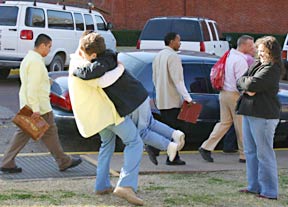
Seeing the reunion of families is one of the blessings for volunteers of the First Contact ministry.

Valentine saw the obvious–1,200 inmates incarcerated in the Walls Unit and 125 to 200 offenders who are released there from Texas prisons every day, with only the clothes on their backs, $50 and a one-way bus ticket. He instinctively knew these men needed to hear welcoming words from Christians and some reintegrating with people "back home," wherever that might be.

He saw the not-so-obvious but visible–families from across Texas and beyond who travel to Huntsville to pick up a son, husband, father, friend. He recognized the uncertainty in these faces, reflecting apprehension about how this wayward loved one would respond to freedom, and how long it would last.

Valentine also soon saw an often-ignored need–the community's corrections officers and their families. He respected their contributions to society and empathized with the stress and anxiety they feel as they take on demanding, often low-paying jobs filled with daily abuse and danger.

Since the Walls Unit opened as the state's first prison in 1848, First Baptist coexisted peacefully in the Texas town known far and wide for its unique industry. Other than the occasional corrections family who joined the church, it kept its distance from the criminal justice institutions all around.

But when Valentine pointed out the needs, the church responded. Members volunteer to meet the spiritual and physical needs of all three groups Valentine identified. First Baptist operates:

bluebull Welcome Back, a ministry to the parolees who arrive from more than 100 correctional facilities across the state to be freed through the Walls Unit every day.

Last year, of the 70,000 offenders released from the Texas Department of Criminal Justice, 55,000 were impacted by Welcome Back.

A central feature of Welcome Back is the opportunity for parolees to network. First Baptist volunteers offer each inmate a link to a church in the community where he intends to go. Like the tip of an iceberg, this link can provide much more than a church name and a phone number. It can translate into the three things released inmates need most–work, housing and the spiritual encouragement to “stay clean.”
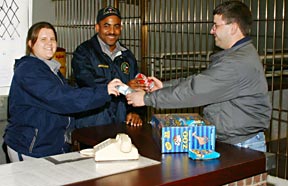
Jerry Phillips, associate pastor for community ministry, passes out goodies to correctional officers. (Photo Courtesy of First Baptist Church, Huntsville)

In addition, more than a dozen volunteers like Mike Cato and Sam Longbottom are at the prison Sunday through Thursday evenings, providing men about to be paroled the next day with practical information to help them on their way. They tell them where to catch the bus, how to get their money and where they will meet family members who have made the trip to Huntsville.

While they are not allowed to share their faith directly during this evening before release, the volunteers feel a definite sense of calling.

Longbottom, who has been working with the ministry on Tuesday evenings for more than two years, looks forward to his time of service. “I think it's what Jesus commanded us to do; help others in his name.”

Cato senses a similar calling to the ministry.

“I serve God. God is my king; Jesus Christ is my Savior. And this is where he has said to me, 'Go,'” Cato said. He has been working in criminal justice ministry since 1992, long before his church began a formal ministry. Cato was the recipient of the Governor's Volunteer of the Year Award.

“I didn't deserve it, but I got it. So many people do more,” Cato said humbly. “But it was really God who gave it to me; no one else did. I was kind of down-in-the-mouth then, and he knew I needed the encouragement.”

Cato works in the Welcome Back ministry three evenings a week and gets up at 4 a.m. on Tuesdays to teach a Bible study for correctional officers.

Just as God encourages him, Cato sees himself as an encourager to men about to try to reclaim their lives.

“This ministry gives hope that they didn't have before. We're not going to reach all the men, we know that, but we're there for those who will take the help,” he explained.

He is not a part of the ministry because he is some sort of super-saint, he maintained.

“I consider myself nothing but a believer. You might call me a Christian, but I don't, because I know I'm not Christ-like, no way. I'm a reprobate and a sinner, but I'm a believer,” Cato testified.

bluebull First Contact, hospitality to 500 families a month who travel to Huntsville to pick up a newly released loved one. Volunteers help relieve anxiety by assuring them the person they are there to greet is on the release list, which the prison faxes to the church each day. Volunteers also provide bottled water and talk with the families to gather information that can be forwarded to churches and after-care ministries in the communities they will be returning to.

Primarily, volunteers ease anxieties that sometimes come with the reintegration of a family member. And since they are outside the prison, testimonies of faith are allowed.

An added bonus for volunteers is to witness the reunions.

“Not everyone has family there to meet them for one reason or another, but the ones who show up are there to support, and there is lots of kissing and hugging. It's a great thing to watch,” said Jerry Phillips, associate pastor for community ministry.

Maudie Boyd has been part of the ministry since its inception and plans to participate much longer.

“It's just wonderful to see the families reunited. And they are such sweet people,” she said. “Sometimes, they have traveled all night, and they are tired and weary and scared. They don't know if they are in the right place. We just reassure them and tell them it's going to be OK. We just share Christ's love with them,” Boyd said.

Often, the volunteers are blessed as much as the families, she said. “The families are so appreciative. They give us a big hug when they leave and sometimes write a note and send it to the church. It's truly a blessing to all of us.”

bluebull Ongoing ministry to the 7,000 corrections officers in the county.

About 25 church members volunteer in this ministry, weekly delivering soft drinks, bottled water and animal crackers to workers on each shift in each unit.

For the church, the ministry to the officers is a way to say thanks for an often-thankless job and a way to bring joy within the stress. Valentine sees it as an opportunity to recognize people who seem invisible but need encouragement.

Ministries to inmates–what corrections officers sometimes call “hug-a-thug”–abound, but the officers get overlooked, reported Joe Fernald, retired senior warden at the Huntsville Unit and a member of Elkins Lake Baptist Church.

"I've been in the system more than 20 years, and nobody has ever ministered to correctional officers. Nobody. Ever," Fernald said. "They're depicted negatively in the media. But First Baptist saw their need."

Ministry to the officers produces multiple benefits, he added.

First, the friendship and networking with the officers by the church volunteers strengthen the officers spiritually, he observed.

Valentine, in particular, excels at this. As he visits the Walls Unit, he calls most officers by name. He's taken the time to learn to speak their jargon and understand their assignments. He also knows about their families and asks how they're doing. Although not their pastor, he's become a spiritual mentor for many of them.

Second, officers who are nurtured emotionally and spiritually do a better job with inmates, Fernald added, noting, “This creates a much more favorable climate.”

Third, the impact spreads through time and impacts the state in multiple ways, he insisted.

“Think of it in terms of dollars and cents: If one person is turned around, think of the dollars that saves–$40 per day in prison costs”–when the inmate gets his life straight and does not return to the corrections system, he said.

“And then there's the human cost,” he said. “Think of the people who will not be future victims, … plus the grief and hurt that will not be inflicted on this inmate's family.

“There's connectivity between all these (First Baptist) programs–offender ministry, officer care, continuity through the parole and discharge process.”

Fernald ack-nowledged the sacrifice First Baptist makes to provide the ministry.

“It takes money and the commitment of a lot of people,” he said. “But this church is willing to commit its resources.”

The state's corrections system needs similar help from churches in or near those 100-plus penitentiary units across the state, Department of Criminal Justice leaders said.

Although only Huntsville is the release point for all male inmates, churches and faith-based organizations can impact each of the units, they said. Church volunteers can go into the units and provide inmates with skills to succeed outside when they are released, and they can provide supportive networks on the outside to keep them from falling. They also can lift up the corrections officers so they do a better job and improve the prisons.

Noting the important role churches can play in helping former inmates stay out of prison, Don Kiel, the criminal justice department's assistant director of religious programming, stressed, “Forgiveness is the paramount issue.”

“Churches are commanded to forgive,” he said, but he acknowledged, “Trust takes time.”

Churches also can help former inmates lift their heads up in society, added Bill Pierce, director of chaplaincy for the department.

“There's a stigma that comes from being in prison,” he said, noting people tend to generalize their perception of inmates without understanding what may have happened to them in prison.

“When you present what takes place in prison–the worship and Bible study,” perceptions can change, he said. “And when church people know families who have members in prison, the light comes on. They see the needs” of the offenders as people, not merely inmates.

One pressing need is for Christians to become mentors for inmates, Kiel said, noting prisoner mentorship is a new approach.

“It requires training and more than a normal volunteer,” because the demands of accountability are stringent, he acknowledged.

But the rewards are worth the investment, said Doug Dretke, director of the department's correctional institutions division.

“A mentor represents the community coming in and telling the offender, 'We care about you,'” he said.

“That has a big impact. … Mentors and volunteers deliver a significant message to the offenders–the community cares about them.”

Dretke also urged churches to help “break the cycle” of incarceration by reaching out to the children of prison inmates.

In addition to church ministries, programs like Big Brothers and Big Sisters need the kinds of volunteers churches can supply.

“The need won't go away,” Valentine said. “The prison population will increase as the general population increases. We're going to be needed more than ever before.”

And members of First Baptist will be there. “In all our criminal justice ministries, we have very few volunteers who drop out,” Phillips said. “They get to see God at work, and get to do the work of Christ.

“It's like going on a mission trip every week.”

News of religion, faith, missions, Bible study and Christian ministry among Texas Baptist churches, in the BGCT, the Southern Baptist Convention ( SBC ) and around the world.




New children’s curriculum aims to teach Baptist beliefs

Posted: 11/04/05

New children's curriculum
aims to teach Baptist beliefs

By Meghan Merchant

Communications Intern

A new children's curriculum from BaptistWay Press aims to teach children something pastors and Baptist General Conven-tion of Texas leaders believe has been overlooked–Baptist beliefs.

“It seems evident that there has been a decline in teaching about distinctively Baptist be-liefs,” said BGCT Executive Director Emeritus Bill Pinson, who works with the convention's Baptist Distinctives Committee and its Baptist Heritage Center. “Many churches do little teaching in this area to anyone and less likely to children than any other age group.”

Let's Explore Baptist Beliefs, written by Johnnie Human, is one of few teaching materials de-signed to fill that hole, said Diane Lane, BGCT preschool and children's consultant.

The curriculum covers distinctive Baptist foundations such as the lordship of Christ, the authority of the Bible, salvation by grace through faith, security of the believer, priesthood of the believer, baptism and the Lord's Supper, church autonomy and the importance of missions and evangelism.

"This was written to encourage families and churches to educate children on why they're Baptist," Lane said. Children should learn what is significant about being a Baptist so they can understand their heritage and have a strong foundation when they go out into the world, she added.

Pinson views childhood as the "prime time" to teach distinctive Baptist principles, since children develop basic beliefs and attitudes that last a lifetime. And while they may not be able to "grasp the full meaning and import of these beliefs," they are likely to associate positive feelings with the teachings, which will benefit them as they mature in their Christian beliefs, he said.

Pinson and Kevin Everett, pastor of First Baptist Church in Wellington, attributed the decline in teaching Baptist principles to a general loss of denominational commitment with the blending of evangelicalism. Since the end of Church Training, no program has taken its place in teaching Baptist beliefs, Pinson said.

Everett's church is using the new curriculum during Sunday evening classes. Adult classes at First Baptist Church completed a study on beliefs important to Baptists earlier.

“The foundation ought to be built very early so it will stay” with the child forever, he said, noting what he learned as a child affects his beliefs today.

Part of the training in Baptist beliefs should come from the home, and educating parents is important for educating the child, Everett said

Let's Explore Baptist Beliefs was created to be used in a variety of settings, including Sunday school classes, Vacation Bible School, weekend retreats, evenings classes and at home with families.

The curriculum is “very user friendly” for teachers and students, Lane said. Each lesson is color-coded and includes activities that “capture the interest of the child.”

For more information about Let's Explore Baptist Beliefs, contact Lane at (214) 828-5287. Orders may be placed through www.baptistwaypress.org.

News of religion, faith, missions, Bible study and Christian ministry among Texas Baptist churches, in the BGCT, the Southern Baptist Convention ( SBC ) and around the world.


DOWN HOME: At the age of ’98,’ Betsy knows better

Posted: 11/04/05

DOWN HOME:
At the age of '98,' Betsy knows better

Betsy has entered her second childhood.

Or maybe it's her second infancy.

Betsy is our dog. She's been part of our family 14 years this week. We got her for our daughters' birthdays when Molly turned 5 and Lindsay turned 8.

If you know the old adage that dogs age seven times faster than humans, and if you're good at your multiplication tables, then you know Betsy is 98 in “dog years.”

I'm surprised she's still around. Except for some sprained knees from time to time, and the fact she's nearly deaf, Betsy's remained in remarkably good health.

But she can't–or won't–mind her manners anymore.

One of my first responsibilities after Betsy came to live with us in 1991 was to potty-train her. Someone told us frequent trips to the backyard were the answer to Betsy's problem, which quickly became our problem.

Joanna, my wife, interpreted that to mean every time Betsy cried, she needed to go “out.” And since only one of us was ever going to go “out” with the dog in the middle of the night, I often stood in the yard with Betsy, pleading with her to do her business so Jo would let us both come back in the house and go to bed.

Well, Betsy was a quick learner. Soon, she figured out how to whack the tiny bell by our back door with her paw, and she started going “out” on her own.

Unfortunately, at age 98, Betsy's decided “out” is only a state of mind. Either that, or she's still mad at me for leaving her 11 days when I went to China this fall.

See, we have this routine in the mornings. We're almost always the first ones up. So, I let Betsy out of her kennel beside my bed and take her to the back door. For years, she has gone “out” for about two or three minutes. Then she's been content to hang out with me in the bathroom, while I shave and take a shower. Then, we both go eat breakfast.

Sounds like the foundation for a beautiful friendship. And to be quite honest, I have enjoyed Betsy's company during those early-morning hours.

But lately, when she's gone outside, she's only pretended to go “out.” First day back from my trip, she came back inside, walked through our bathroom into our closet and pretended it was the Great Outdoors. Two days later, she did it again.

This, of course, is annoying. She's been a trained dog for almost 14 years (nearly a century in “dog years”), and now she wants to act like a puppy again.

I think it's extortion. What she really wants to do is eat breakfast before I take a shower. And I might make her a deal if she'd learn to get up and put on the coffee while I shave. But no. She's a dog and doesn't have opposable thumbs and pretends she can't make coffee.

While cleaning up one of Betsy's messes, I imagined I understand God a little more clearly. How many times do we, theoretically trained and old enough to know better, make messes God has to clean up?
–Marv Knox

News of religion, faith, missions, Bible study and Christian ministry among Texas Baptist churches, in the BGCT, the Southern Baptist Convention ( SBC ) and around the world.


Founder sees DRAMA as avenue for evangelism, worship

Posted: 11/04/05

University student Laura Watson (center), the founder and director of DRAMA–Disciples Running Around Madly Acting–and member of Wedgwood Baptist Church in Fort Worth, poses with cast members.

Founder sees DRAMA as
avenue for evangelism, worship

By Leann Callaway

Special to the Baptist Standard

DENTON–During Laura Watson's college years at the University of North Texas in Denton, she was at a crossroads while searching for a place to serve in collegiate ministry.

After much prayer, Watson–a member of Wedgwood Baptist Church in Fort Worth who has an extensive background in drama and theater–felt led to create an independent, professional Christian theater ministry.

In April 2004, Watson posted audition notices throughout Denton, Fort Worth and Dallas for DRAMA–Disciples Running Around Madly Acting. The team ended up being comprised of crew members ranging in age from 13 to 53 and representing seven denominations.

“DRAMA thrives out of love for God and love for people, primarily to present the gospel to unbelievers, and secondly, to serve, encourage, challenge and teach fellow believers through acts of worship–all for the glory of God,” Watson said.

The group's theme verse is 1 Peter 4:11: “If anyone speaks, he should do it as one speaking the very words of God. If anyone serves, he should do it with the strength God provides, so that in all things God may be praised through Jesus Christ. To him be the glory and the power for ever and ever.”

DRAMA has performed at youth camps, Disciple Now weekends, Vacation Bible Schools, fall festivals, coffee houses and conferences.

During the True Love Waits Rally at the Baptist General Convention of Texas' Youth Evangelism Conference, members of the troupe performed a skit titled “The Gift,” which Watson wrote when she was 14 years old.

The skit begins with Jesus handing each person a gold box with the instructions to give it to the person they marry, but not to open it until then. The drama focuses on two teenaged couples–one couple has sex, and the other does not. Both couples break up because of their choices.

In the third act, the girl who has had sex meets the boy who did not, and he leads her to Christ. She receives a new box from Jesus. They eventually marry, and on the wedding night, he opens his box to reveal his white cross of purity that he has been saving just for her. She opens her box to discover not her white cross of purity, because she already gave that away, but the red cross of forgiveness through the blood of Jesus.

“We had many technical difficulties in the first two acts that caused the audience to miss much of the story line, but in the third act, God's Spirit just fell on us and the audience. When the girl received her new box, the audience just broke into cheering and applause,” Watson said.

“When the play ends with the couple exchanging their red and white crosses, the audience jumped to their feet in a loud, standing ovation. Afterward, many teenage girls made their way to the stage, and with tears in their eyes, said they were proud to hold red crosses now, too. To see the effect of such a story on so many thousands of teenagers was overwhelming.”

In tailoring to the needs of different ministries, Watson creates a unique skit for each event.

“First, I make sure I have a clear understanding of the event we're going to be a part of,” Watson explained. “Purpose, theme, other performers, etc. are all very important in deciding what DRAMA will do. For example, if it's a camp, I want to know the theme, focus Scripture and what the speaker will speak on each morning and night. I want to make sure everything fits together well and easily reaches the audience intended.

“If it's a secular venue, I want to make sure they understand what our message will be. We don't water anything down, but we also make sure it will not turn anyone away before we have completed our performance.

“Each script is reviewed by our board of directors and one or two minister friends of mine to make sure everything lines up with God's word. Lastly, the team as a whole does a read-through where, inevitably, minor changes will be made that they think are best for the character they will be playing. Then, I send the completed scripts to event coordinators shortly before our performance date to let them review all material, as well. We work very hard to make our productions and other aspects of ministry the absolute best that they can be.”

Watson would like DRAMA to travel to Romania, Russia and the Ukraine to work with orphans and perform in churches and secular theatres.

“I have been there before and have many contacts. In fact, they wanted us there this summer, but we just could not afford it at this time. We would probably work with Buckner and Radooga, the English camp hosted by Christians in Ukraine,” she said.

Watson is exploring other missions opportunities, including being on the missions team for the 2008 Olympics in Beijing. “I was part of the missions team at the 1996 Olympics in Atlanta, and it was truly the opportunity of a lifetime. The entire world converges on one city for 10 days every four years,” she said. “What a chance to share the gospel!” Seeing lives changed for eternity is Watson's favorite part of being involved in a creative ministry, she said.

“God has been truly amazing throughout this entire experience. Sometimes when we perform, teenagers will come up to us to say they identified with a character and were brought closer to God in their walk. We tell them: 'It wasn't us. It was all God.'”

News of religion, faith, missions, Bible study and Christian ministry among Texas Baptist churches, in the BGCT, the Southern Baptist Convention ( SBC ) and around the world.


EDITORIAL: When hearts break, God stays with us

Posted: 11/04/05

EDITORIAL:
When hearts break, God stays with us

A fresh report by a team of engineering experts constructs barriers for people who want to blame–or credit–God for the magnitude of destruction Hurricane Katrina heaped upon New Orleans.

Consider several options: (A) A heartless God randomly washed away innocent victims' homes, jobs and ways of life. (B) A wrathful God righteously punished the Crescent City for its wanton lifestyle, featuring strippers, drunks and flagrant debauchery. (C) Lazy and/or greedy contractors recklessly engineered the destruction when they built the levees that eventually gave way.

The answer is (C), human sloth, greed and “malfeasance,” according to the engineering report. It was presented to a Senate committee by Raymond Seed, a civil engineering professor at the University of California at Berkeley.

knox_new

“These levees should have been expected to perform adequately at these levels if they had been designed and constructed properly,” Seed noted in a story published by the New York Times. “Not just human error was involved. There may have been malfeasance.”

Seed's team is following up on indications the levee specifications may not have been adequate to withstand such a storm. But they're also verifying eyewitness reports that contractors failed to drive pilings deep enough to hold the levees, used substandard soils, and cut other corners in constructing the $450 million flood-control system.

The report acknowledges many factors contributed to the disaster. But after hearing the evidence, Sen. Susan Collins (R-Maine) noted: “Many of the widespread failures throughout the levee system were not solely the result of Mother Nature. Rather, they were the result of human error in the form of design and construction flaws, as well as confused and delayed response to the collapse.”

This is thought-provoking news for everyone who has struggled theologically with the destruction heaped upon New Orleans by Katrina. It also offers implications for other struggles: When we wonder why bad things happen to good people. When we ask why a good and loving God could allow _______________ (you fill in the blank).

In the face of natural disaster, people tend to blame or credit God. This is to be expected, since catastrophic events of monumental proportions seem to be out of our hands.

God gets the blame when we think the results are unfair. When a baby dies of Sudden Infant Death Syndrome. When a nonsmoker dies of lung cancer. When a storm wipes out a city and thousands of faithful people lose all their earthly possessions. These are the hardest theological issues, the greatest challenges to our faith. Theories abound. But the truth is plain: We don't know why. We'll never know why. But another truth gets us through. It's explained in Romans 8–my favorite chapter in all the Bible–which tells us that when we suffer, God suffers with us, and the Holy Spirit “intercedes for us with groans that words cannot express,” and which promises God “works for the good of those who love him,” no matter how bleak the circumstances. That doesn't tell us why evil pushes us to the edge of a cliff, but it gives us a ledge to stand on and a vine to cling to.

On the other hand, God gets the credit when we think the results are fair. One of the most petty and annoying examples of this was the fellow who praised God for sending the teeth of Hurricane Rita a few miles east of his home, sparing his property, as if God loves this man more than the families down the road. Plenty of people have given God credit for Katrina's havoc upon New Orleans, which has traded on its wicked heritage in return for tourist dollars. But I'm not so sure the per capita sin in New Orleans is any worse than it is in any city or village in Texas. Who does God hate worse–strippers or people who allow their state to rank near the bottom in the major indicators of child protection? Besides, thousands of New Orleans residents who suffered grievously are devout, church-going folks like you and me. I've met some of them. They're no worse sinners than your average Texas Baptist Sunday school class.

But as the engineering study shows, many calamities visit us because of our own “malfeasance.” People drink and drive. Teens take up smoking. Spouses cut with words. Some actions are more harmful than others, but they all have consequences. Many times–probably most times–God's judgment on our sin is built into the natural repercussions of our actions. Still, Scripture teaches us God eagerly waits to hear our plea for forgiveness and our cry for help. And more quickly than a volunteer can turn the ignition in a disaster-relief truck, God is there beside us.

Marv Knox is editor of the Baptist Standard.

News of religion, faith, missions, Bible study and Christian ministry among Texas Baptist churches, in the BGCT, the Southern Baptist Convention ( SBC ) and around the world.


Correct wiring, grounding crucial for baptistry microphones

Posted: 11/04/05

Correct wiring, grounding
crucial for baptistry microphones

By Ken Camp

Managing Editor

Electricity and water create a potentially deadly combination, but metal–not microphones themselves–present the greatest danger to people in baptistries, acoustic and church building consultants agree.

The issue came to the forefront when Pastor Kyle Lake of University Baptist Church in Waco was killed Oct. 30 after he grabbed a microphone while standing in a full baptistry.

“If everything is working right, there is no way a microphone carries nearly enough electricity to cause a person's death,” said Brian Elwell, senior consultant with Acoustic Dimensions in Addison.

His firm's clients have included the Crystal Cathedral in Garden Grove, Calif.; Willow Creek Community Church in South Barrington, Ill.; and Saddleback Church in Mission Viejo, Calif.; as well as Fellowship Church in Grapevine; The Heights Baptist Church in Richardson; and Prestonwood Baptist Church in Dallas.

A correctly wired, properly grounded microphone carries a maximum 48 volts–nowhere near enough to stop a person's heart, even if the individual stood in chest-deep water, Elwell explained.

But “correctly wired” and “properly grounded” conditions make all the difference, he said. If either the baptistry pool or the metal chassis of the microphone were improperly grounded, it could create a hazard.

Any pool of water carries electrical potential, and if a person standing in electrically charged water reaches out to touch a metal object, it will complete the circuit and cause a shock, Elwell noted.

Also, if a microphone line were cut and came into contact with high voltage, the metal casing of the mike could become highly charged, he added.

“The bottom line is, if you're in the water, don't touch anything metal,” he said.

LifeWay Christian Resources recommends that only wireless mikes be used in or near the baptistry–either a wireless lavaliere mike, a handheld wireless or a wireless mike on a stand.

There is not enough voltage in any wireless mike to do any damage, said Davis Byrd, director of LifeWay's church architecture department. “The water would probably ruin the equipment if it were submerged, but the battery operation doesn't have enough voltage to do any harm,” he said.

If a wired microphone must be used, it should be suspended overhead, out of reach, Byrd added–advice echoed by Keith Crouch, leader of the Baptist General Convention of Texas church architecture team.

When it comes to installing baptistries and the electrical fixtures around them–including pumps and heaters, as well as sound systems–Crouch strongly urges churches to use only licensed, certified electricians and plumbers.

He also recommends electrical plugs near the baptistry be installed with ground fault interrupters.

With additional reporting by Greg Warner of Associated Baptist Press

News of religion, faith, missions, Bible study and Christian ministry among Texas Baptist churches, in the BGCT, the Southern Baptist Convention ( SBC ) and around the world.


Graham helps New Orleans professor rebuild his library

Posted: 11/04/05

Graham helps New Orleans
professor rebuild his library

By Gary Myers

Baptist Press

ATLANTA (BP)–Preston Nix had only been at New Orleans Baptist Theological Seminary one month when Hurricane Katrina inundated the campus with water. A newly appointed evangelism and preaching professor, Nix lost everything–his home, his books and 30-plus years of sermon notes.

Nix's sister, Amber Pendle-ton, wanted to do something special for her brother during his time of hurt and displacement. Knowing her brother's high regard for the work of Billy Graham, Pendleton contacted the Billy Graham Evangelistic Association seeking an autographed copy of one of the evangelist's books.

Evangelist Billy Graham autographed a copy of his book, How to be Born Again, to help New Orleans Seminary Professor Preston Nix restore the library he lost in flooding from Hurricane Katrina. (Photo by Gary Myers/BP)

Graham's correspondence secretary, Carol Segerstrom, gladly sent an autographed copy of Graham's book, How to be Born Again.

But Segerstrom did not stop there. Despite Graham's continuing health problems, he and his staff chose a selection of books from his personal library to send to Nix.

In a note that accompanied the books, Graham's assistant wrote that the Graham organization wanted to do more but could only give a gift of this nature to one person.

"I (re)started my library with a signed copy of How to Be Born Again and some of Billy's own books," Nix said. "I'm so grateful." Nix came to the seminary after serving 11 years as pastor of Eastwood Baptist Church in Tulsa, Okla. He also has served churches in Texas. Nix was appointed to serve as associate professor of evangelism and preaching and director of supervised ministry in July.

News of religion, faith, missions, Bible study and Christian ministry among Texas Baptist churches, in the BGCT, the Southern Baptist Convention ( SBC ) and around the world.


Hurricane repairs demand action

Posted: 11/04/05

Hurricane repairs demand action

By John Hall

Texas Baptist Communications

Repairing hurricane damage as fast as possible requires decisive action on the part of a church, Baptist General Convention of Texas church facilities consultants said.

The BGCT church architecture team can help churches walk through repairing their facilities. It recommends churches first call their insurance companies.

Then churches should protect their damaged buildings as quickly as possible after the storm, said Keith Crouch, who leads the BGCT church architecture team. This may include covering broken windows with plywood or putting a tarp across a hole in the roof. These actions prevent further damage from occurring.

Church leaders should take a large number of pictures of the damaged facilities. This documents what happened for an insurance adjustor.

With the approval of the insurance adjustor, the church then can begin removing anything wet, including furniture, carpet and sheetrock. Wet items can lead to mold throughout a building.

If rainwater has entered a building, the facility needs to be aired out as much as possible. This encourages the drying process. Fans also help.

“Anything you leave wet in that building is going to dramatically increase the damage,” said Russell Maddox, consultant on the BGCT church architecture team.

An insurance company should be able to provide a contractor to handle any needed repairs, Crouch said. This move puts the responsibility on the insurance company to keep costs down while completing the job.

Churches should not allow an insurance company to close a claim prematurely after an initial settlement, Crouch said. “There typically are damages you don't see upon first inspection.” An open settlement allows congregations to receive future funds from insurance companies in case other damages are discovered in the construction process.

If a church sustains significant infrastructure damage, BGCT church architecture team member Pat Ekern recommends leaders also call a structural engineer. That person may see issues an insurance adjustor overlooks.

The BGCT has a number of options to help congregations who sustain damages, including small-church loans and disaster-relief funds. These may be especially helpful for a congregation that needs to fix damages but does not have insurance.

Even with decisive action, a church may be out of badly damaged facilities for more than a year, Maddox said. However, slight roof damage can be repaired in less than a week.

The rebuilding process can be trying but often brings a congregation closer together, Crouch said. Members rally around a common cause of returning to their facilities following significant damage. Some churches may even consider remodeling their buildings.

“Just about every church that we've worked with has been better after the fire or storm,” Crouch said.

For more information about repairing church facilities, call the BGCT church architecture team at (888) 447-6262.

News of religion, faith, missions, Bible study and Christian ministry among Texas Baptist churches, in the BGCT, the Southern Baptist Convention ( SBC ) and around the world.


Texas Baptist Forum

Posted: 11/04/05

Texas Baptist Forum

Root causes & accountability

Hurricane Katrina uncovered a multitude of reasons for great poverty in New Orleans, not the least of which is longstanding graft and corruption.

Letters are welcomed. Send them to marvknox@baptiststandard.com; 250 words maximum.

"Mrs. Parks was much, much more than the bus woman. Rosa Parks shifted the gears of the universe all her life. Now she belongs to the universe. Thank you, Sister Rosa. Thank you, Rosa Parks."

Julian Bond
Chairman of the NAACP, a civil rights organization in which Parks was active, recalling how her simple act transcended the globe (RNS)

"Many of us, particularly those of us who are raising teenagers, feel like we're in a battle for our kids' hearts, minds and souls, and sometimes we're not winning. It occurred to me the other day, the only people who don't have sex on network television are married people."

John Carr
Secretary of the Department of Social Development and World Peace of the U.S. Conference of Catholic Bishops (RNS)

"The issue is not whether you accept Jesus, but whether he accepts you! I'm afraid there will be people in hell who prayed to receive Christ, but who never allowed him to deal with their sin."

Henry Blackaby
Author of Experiencing God, emphasizing the need for repentance (ABP)

Throwing money at the problem will not solve it there. Good citizens and taxpayers must demand that as rebuilding begins the same people who facilitated the poverty are held accountable and not allowed to participate in the “new” New Orleans. If the root problems of poverty are not addressed, all the money in the world will not solve it. More money is spent on poverty now than ever before if you look at individual giving, government spending and corporate giving.

I don't believe racism was a factor in New Orleans' poverty problem, since many if not most of the inhabitants and leadership are of the same ethnic origin.

We must solve poverty by looking at root causes and accountability so the money that is given is used most appropriately, not wasted and does not get into the wrong, greedy hands.

Jean Whitmore

Okinawa

Out-of-kilter notion

The 2nd Opinion article, “'Big issues' confront Baptists today” (Oct. 3) begins well by confronting raw secularism but immediately derails in its description of “widespread rejection of historic Baptist views of church-state separation.”

Folks who think Ten Command-ments cases, religion in public schools or court appointments “establish a national church” are the biggest allies of the forces of secularization. How tragic that one can scarcely tell the difference between positions held by the Christian Life Commission and the Baptist Standard, and positions held by Americans United.

The majority of evangelical Chris-tians who reject an out-of-kilter notion of separation are doing so out of a Spirit-led conviction that so-called “historic Baptist views” are erasing the Founding Fathers' Christian worldview and its influence upon the formation of our laws, as well as dishonoring Christ.

I don't suppose Charles Deweese, the author, gives any credence to “those” Christians when they have a lack of peace about supporting the dethronement of Christ in our land.

Steve White

Dallas

Responsibility & blame

In response to Paul Whiteley's remarks concerning God and the poor (Sept. 19), I must take issue. America has not forgotten the poor.

Since Lyndon Johnson's so-called “Great Society,” America has spent billions of other people's hard-earned money to combat poverty to no avail.

Why? The modern welfare state is built upon a faulty anthropological assumption–if people know the good, they will do it. In fact, the opposite is true–if people can get something for nothing, they will.

We have multiple generations who now are dependent on government for everything and view assistance as their birthright. What we need is a welfare system that requires work for assistance, regardless of whether or not the recipient views the work as proper.

Having grown up poor, I realize there are two types of poor–those who take responsibility and those who place blame.

Ray Wilkins

Frisco

Dinnertime discussions

Thank you for your Down Home columns. It has been interesting to hear about life with your family. My retired minister husband and I have relived these days with you. We both grew up having discussions around the dinner table. We are thankful for the special joys around the dinner table with our two daughters.

We survived the empty nest with them, and now we are trying to adjust to grandchildren who are leaving the nest. We are thankful for special times when we are all together, even though sometimes everyone is talking at the same time.

Dinner discussions are and have been fading for some time because too many families are sitting in front of the TV instead of being at the dinner table.

God bless families who will begin to turn off their TVs and make dinner discussions with their families a priority.

Judy Bush

Port Lavaca

News of religion, faith, missions, Bible study and Christian ministry among Texas Baptist churches, in the BGCT, the Southern Baptist Convention ( SBC ) and around the world.


Missouri Baptist Convention shuts out CBF-affiliated churches

Posted: 11/04/05

Missouri Baptist Convention
shuts out CBF-affiliated churches

By Vicki Brown

Missouri Word & Way

SPRINGFIELD, Mo. (ABP)–The Missouri Baptist Convention no longer is open to churches that support any organization considered to compete with the state convention or the Southern Baptist Convention.

The changes will shut out congregations that participate in the Cooperative Baptist Fellowship or the moderate Baptist General Convention of Missouri but make exceptions for other Baptist organizations.

Such “single alignment” rules are rare in modern Baptist life. Likewise, state conventions normally do not require churches to be Southern Baptist members as well–a practice some historians consider “un-Baptistic” connectionalism.

Meeting Oct. 24-26 at Second Baptist Church in Springfield, messengers adopted two constitutional amendments on second reading that narrow Missouri Baptist Convention membership requirements.

Passed by raised-ballot vote, the first amendment changed the membership eligibility requirement from “any Baptist church in sympathy with the objects of the convention” to “any Southern Baptist church singly aligned with the convention.”

As approved, the membership article permits Missouri Baptist Convention-affiliated churches to relate to racial, ethnic, cultural and community organizations and conventions, as long as those relationships do not violate the state convention's constitution and bylaws or “accepted Southern Baptist faith, polity and practice.”

An adopted amendment to the constitution's relationship article allows the state convention to determine the churches with which it will cooperate. The article had allowed the convention to decline to seat messengers. The change now allows the convention to “decline to accept or continue cooperation with a church” as well.

Messengers overwhelmingly defeated two attempts to modify the proposed constitutional changes.

One amendment attempted to eliminate the word “singly.” Amendment author Jim Goforth of St. Louis said the intent of the alignment language is to prevent churches from supporting the Cooperative Baptist Fellowship at national and state levels and the Baptist General Convention of Missouri, an alternative state convention organized in April 2002 by individuals dissatisfied with the Missouri Baptist Convention's direction.

Calling it a matter of “integrity,” Goforth said the convention could not call affiliation single alignment when the constitution would allow cooperation with other organizations.

“I wish we would have the courage to just name the organizations and be honest about it,” he said.

Proponents of the constitutional changes argued that if specific organizations were listed, they could simply get around the constitution by changing their corporate names.

Messengers also rebuffed an attempt by David Mason of Green Valley Baptist Church in St. Joseph to return the proposals to the committee for continuing review. He suggested consideration of the proposals be delayed until legal action currently pending between the Missouri Baptist Convention and five institutions is settled.

The convention filed legal action in August 2002 to try to force the Baptist Home, Missouri Baptist University, the Missouri Baptist Foundation, Windermere Baptist Conference Center and the Word & Way news journal to rescind charter changes that allow each entity to elect its own trustees. The five agencies filed amended charters with the Missouri Secretary of State in 2000 and 2001.

Messengers also amended the constitution to turn the temporary credentials committee into a standing committee. The new committee will operate under guidelines that spell out the rules a congregation must follow to be considered a cooperating church.

Although the convention's constitution does not list a financial requirement for membership, the committee's guidelines note that a church will be considered singly aligned if it contributes to the convention “at least on an annual basis” and does not belong to or financially support another state convention or organization that “serves and/or acts as a state convention” in Missouri.

The Missouri Baptist Con-vention will consider a church as cooperating with another body if that church sends representatives to the organization's meetings, financially supports its work or includes the organization in the church's budget.

A church also must be a cooperating Southern Baptist church, which the Missouri convention defines as adopting a doctrinal statement in line with accepted faith and practice, contributing financially to the SBC, and refraining from participating with or contributing to another national convention.

The guidelines define a national convention as any organization that can independently endorse chaplains to U.S. military service branches. Under that definition, Cooperative Baptist Fellowship and some state conventions, such as the Baptist General Convention of Texas, would be considered national conventions, although neither CBF nor state conventions consider themselves as such.

Under the guidelines, the credentials committee would be able to investigate the qualifications of churches and of individual messengers if either is challenged. The committee also could investigate “upon receipt or discovery of any information which causes the committee to believe” a church or individual does not qualify.

At the annual session, messengers also:

Adopted a $17 million budget. The first 1 percent is designated to promote the Cooperative Program. The remaining $16,879,500 will be split 35.75 percent for Southern Baptist causes and 64.25 percent to remain in the state.

bluebull Adopted nine resolutions, including resolutions to oppose embryonic stem-cell research, human cloning and eminent domain claims on churches and other ministries, and resolutions supporting New Orleans Baptist Theological Seminary, calling for religious liberty in Romania, and urging parents and churches to monitor children's educations.

Greg Warner of Associated Baptist Press contributed to this article.

News of religion, faith, missions, Bible study and Christian ministry among Texas Baptist churches, in the BGCT, the Southern Baptist Convention ( SBC ) and around the world.


On the Move

Posted: 11/04/05

On the Move

Matt Broaddus to Harris Creek Church in McGregor as worship leader.

bluebull Tiffany Cohn has resigned as minister of youth at Adamsville Church in Lampasas.

bluebull Braxton Edwards to Paramount Church in Amarillo as music associate.

bluebull Dennis Humphrey to Paramount Church in Amarillo as youth associate.

bluebull Nanette Johnson to First Church in Arlington as preschool minister from First Church in Waxahachie, where she was children's minister.

bluebull Bill Jones to Neches River Association as director of missions from First Church in Wimberley, where he was pastor.

bluebull Dan LaFon to Lake Victor Church in Lampasas as pastor.

bluebull Geary Martin to First Church in Vega as pastor.

bluebull Kathy Rider to Fairy Church in Hico as interim minister of youth.

bluebull Kenny Steward to Paramount Church in Amarillo as music associate.

bluebull Alvie Stiefer has resigned as pastor of McMahan Church in Dale.

bluebull Clay Wooten has resigned as minister of youth at Fairy Church in Hico.

News of religion, faith, missions, Bible study and Christian ministry among Texas Baptist churches, in the BGCT, the Southern Baptist Convention ( SBC ) and around the world.