Cartoon
Posted: 11/11/05
| “You can't keep running from your problems.” |
Posted: 11/11/05
| “You can't keep running from your problems.” |
Posted: 11/11/05
By Sherre Stephens
It's that time of year–holidays followed by tax time. Did you know that nearly 94 percent of us wait until the 11th hour to prepare our tax return and ante up what we owe to Uncle Sam?
Perhaps the following tax tips will help you to be among the 6 percent who are not caught unprepared for tax season as 2005 draws to a close:
Be aware of tax changes that affect your 2005 return. The IRS includes a “What's New for 2005” section in its Form 1040 Instructions.
 Make a checklist. A checklist helps you gather required documentation, such as W-2s, 1099s and supporting documents for deductions. Just check the Internet; many tax preparers provide checklists at no cost.
 |
Maximize deferrals to your employer's retirement plan. When you defer the maximum amount, you decrease federal income tax withholding and enhance retirement savings. If you are younger than age 50, the maximum deferral is $14,000. At age 50 or older, the limit increases by $4,000.
 Fund a traditional IRA. You have until April 15, 2006, to open an IRA and contribute up to $4,000 deductible for 2005; at age 50 or older, the limit increases by $500. Remember, your spouse may be able to contribute up to $4,000 to a separate traditional IRA–even if your spouse has little or no income.
Use up your flex dollars. The IRS relaxed the “use it or lose it” rule this year. If your employer took advantage of this change, you have up to two and a half months after Dec. 31 to spend your 2005 flex dollars. Don't forget that you can get tax-free reimbursements for over-the-counter drugs such as aspirin and antacids.
Make the most of eligible deductions. Charitable contributions can help reduce your tax liability. The Katrina Emergency Tax Relief Act of 2005 allows a 100 percent deduction of cash charitable contributions made by individuals between Aug. 28 and Dec. 31, 2005, to any public charity, including churches and ministries of a state or national Baptist convention. Therefore, an individual can make cash gifts to his church up to 100 percent of adjusted gross income and pay no federal income taxes for 2005. Gifts of appreciated property still are limited to 30 percent of adjusted gross income. Gifts from corporations are limited to Hurricane Katrina relief.
Defer income. If you are self-employed, you may have more latitude to defer income into 2006. Nevertheless, if you expect to receive a year-end bonus, ask your employer to hold the bonus and pay it to you in January.
Consider gifting. Take advantage of the annual gift-tax exclusion, which allows you and your spouse to save gift and estate taxes by making gifts up to $11,000 to an unlimited number of individuals.
Change your income tax withholding before year-end. Since the IRS treats withheld taxes as paid in equal amounts throughout the year, regardless of when withholding occurs in 2005, this can help you avoid underpayment penalties.
Sherre Stephens is a certified executive benefits specialist and director of executive and institutional benefit design for GuideStone Financial Resources of the Southern Baptist Convention. This article is intended to provide general information and is not to be relied upon as tax or legal advice.
Posted: 11/11/05
| Daniel Garza, deputy director of external and intergovernmental affairs for the Bush administration, meets participants at the Hispanic Convocation of the Laity. |
By Eric Guel
Texas Baptist Communications
SPICEWOOD–Christians have a unique voice that needs to be heard in government, Daniel Garza, deputy director of external and intergovernmental affairs under President George Bush, told the Hispanic Baptist Convocation of the Laity.
“Let's not interpret separation of church and state to mean that churches should not try to influence policy in government,” he said.
Garza encouraged conference participants to make a difference for God's kingdom by getting involved in the political process.
“If you don't get involved, either in Washington or locally, the secular world will get involved for you,” he said.
Garza affirmed God's sovereign role in putting people where they need to be to further his purposes.
“It is only by God's grace that I am serving the president of the United States in the White House,” he said, adding he was a high school dropout, but God brought him to serve the nation.
Convocation participants also heard an address by Baptist General Convention of Texas Executive Director Charles Wade and musical performances directed by Samuel Marroquin of Houston.
“I am always inspired when I am around Baptist people,” Wade said. “One of the great strengths of the Baptist General Convention of Texas is that we have such a diversity of participation, and the thing I've observed about our Baptist laymen and laywomen is they believe they can do anything God wants them to do. There's no quit in them. They're just there to try and make a difference for Jesus.”
Convocation Coordinator Eli Rodriguez of Dallas said Hispanic Baptist men are being transformed for Christ around the state, and the convocation is blessed to be a part of that transformation.
“Our men are realizing their responsibilities within the church, and acting on those responsibilities,” he said. “Lives are being changed.”
Posted: 11/11/05
“You remind me of your daddy,” Joanna said the other night.
Now, that's a comparison I like.
My daddy, Marvin Knox, is a straight-up guy, a devoted pastor and committed follower of Jesus Christ. He's also a teacher. He taught me much about how to be a father by the way he raised my sister, brother and me, and he showed me how to be a husband by the way he's always loved and doted on my mother. Plus, he lived at home the sermons he preached in the pulpit, so he has demonstrated a life of integrity and character.
But my wife wasn't talking about that. She was laughing, and I knew what she meant.
Immediately before her comparison, I had raved about the dinner she was cooking. It was one of my favorites–chicken piccata, mashed potatoes and asparagus. Over on the counter, past the stove, sat a pan of goldrush brownies.
My praise for her home-cooked meal probably was a bit effusive. I went on and on–not sarcastically, but ironically–about my joy in this tremendous meal we were about to enjoy.
“You remind me of your daddy,” she said. “This is exactly the way he talks when we go to your parents' house, and your mother fries chicken.”
Well, that's true. Daddy usually thanks us exorbitantly for coming for a visit–since it prompts Mother to pull out the skillet and prepare the best fried chicken any human being ever tasted. (And shame on anyone who ever ate it with a fork, but that's a story about a long-gone girlfriend.)
Someone once said, “The older we get, the more we become what we really are.” That's probably either scary or gratifying, depending upon the degree to which you manifest–or fail to manifest–grace, gladness, thankfulness, optimism, faith, energy and humor.
Someone also once said, “The older we get, the more we become like our parents.” I thought about that when Jo compared me to Daddy.
In an instant, it dawned on me that, now that our youngest daughter, Molly, has gone off to college, Jo and I have more in common with our parents than we have since we got married, or at least since Lindsay was born 22 years ago last week.
We have an “empty nest” now:
We're much more free to come and go, unbound from school schedules, youth events at church, the expectation of a child coming home from school every afternoon.
Given the absence of children to share our discussions, we're talking to each other more now. We've always been pretty good at communicating, but since Lindsay learned to talk and Molly chimed in three years later, we haven't gotten many words in edgewise.
Sometimes, we enjoy the solitude of an entire evening without TV, a feat once thought incomprehensible.
And with fewer mouths to feed, diminished expectations and the ease of eating out, I appreciate home cooking now more than ever.
–Marv Knox
Posted: 11/11/05
True confession: Before I recently traveled to China with Buckner Orphan Care International, I fretted about going hungry. I'd heard “you don't want to know” the source of meat in many Chinese dishes. I wondered if meals would be appetizing, much less adequate. So, although I could stand to lose a few pounds, I weighed down my suitcase with protein bars, trail mix and nuts. Turns out, we ate wonderfully. With only one exception, the food looked similar to the fare served in nice Chinese restaurants back home. And although I did lose about four pounds, that had more to do with my dexterity with chopsticks than with the quantity and quality of Chinese food.
How off-base and selfish: Leading up to a trip of a lifetime, I wasted energy thinking about and shopping for transportable food so I could last a little more than a week overseas without feeling a single hunger pang. Maybe I'm willing to tell you this little story because I don't think I'm all that different from most Texas Baptists. We're food-centric. Many of our best get-togethers feature fellowship-hall tables laden with fried chicken, casseroles, home-cooked vegetables, and pies and cakes. We plan trips and visits with friends around where we'll eat.
 |
This time of year, as we look ahead to Thanksgiving and an annual feast with family, Texas Baptists also think about food for others. This is the season when we collect the Texas Baptist Offering for World Hunger. “Pour Out Your Heart” is the theme for this year's offering, and we will do that as we seek to meet the $800,000 goal.
Actually, $800,000 is a worthy goal–but only a fraction of what is needed to take on hunger in Texas, across the United States and around the world. According to Bread for the World and America's Second Harvest:
Worldwide, 852 million people are hungry, an increase of 10 million in just one year.
The largest groups of hungry are children and the elderly. Each day, more than 16,000 children die from hunger-related causes. That's one child every five seconds.
More than 33 million Americans are classified as “food insecure,” meaning they are hungry or at risk of hunger.
The Texas Baptist Offering for World Hunger is a wonderful investment in reducing hunger. Not only is all the money channeled to reduce poverty, provide food and secure clean water, but it is delivered in the name of Christ. Recipients not only get food; they receive the Bread of Life. Not only do they drink water; they are presented Living Water. The offering makes both a current and an eternal difference in lives. As you support the Texas Baptist Offering for World Hunger, you carry the presence of Christ to the people he loves most–the “least of these” all over the world.
So much for all the folks who think Baylor University's regents don't believe in miracles.
“Miraculous” echoed from the lips of Baylor regents after they unanimously elected John Lilley as the university's 13th president.
Just about everyone who has tracked Baylor's recent strife was shocked a candidate could receive a unanimous vote from the board, whose divisions have taken on legendary proportions. But Lilley, president of the University of Nevada at Reno, filled that bill.
One reason regents unanimously elected Lilley is he's lived outside the Baptist mainstream, where debating all things Baylor–particularly the administration of President Robert Sloan and the Baylor 2012 long-range plan–has been a preoccupation. He has not been branded by positions on either Sloan's tenure or the flashpoints of Baylor 2012.
Lilley also earned the regents' unanimous support because he is an impressive academic administrator and Christian leader. He meets presidential criteria outlined in a Standard editorial: First, he is able to lead Baylor to academic greatness. He can guide the university past its debate between classroom teaching and academic research, and he can lead it to champion both faith and learning. In so doing, he can help Baylor close its divisions. Second, he has demonstrated commitment to historic Baptist principles. “Eternal salvation by faith, not of works; immersion; soul freedom; priesthood of the believer–all those things I learned at my father's knee,” he noted. And although, for several reasons, he has been a member of Presbyterian congregations, he has told their pastors, “I may be joining your church, but I'm a Baptist.”
The regents could have helped Lilley by creating a reconciliation task force. But he's already talking about how to restore relationships, speaking a refreshing word, “listening,” to go with a hopeful word, “talking.” Now, all who love Baylor should pray for the university and her new president.
Marv Knox is editor of the Baptist Standard.
Posted: 11/11/05
| Holy Condiments, from the photography exhibit at Wilshire Baptist Church. "Both the spices and Bible were found just as they were captured in the photo underneath the I-35 bridge," said photographer Hal Samples. "Even though many homeless people go without the luxuries we take for granted, I found it interesting that this person made room in his makeshift home for the two items in this photograph that add flavor in our lives." (Photo by Hal Samples) |
By Mark Wingfield
Special to the Baptist Standard
DALLAS–Duane is the reason Hal Samples started photographing homelessness in Dallas.
Not long after Samples first picked up a camera–soon after he returned to Dallas from a stint in a drug rehab program–he met Duane downtown. Samples had been photographing Dallas buildings almost on a lark.
Duane spotted Samples driving a nice car and offered to be his assistant–perhaps a means of making a few bucks.
The two talked, and Samples became fascinated with Duane's story.
They went down the street to a coffee shop to talk more and quickly cleared out everyone else from the business because Duane hadn't bathed in months.
Undeterred, Samples asked Duane what he would ask for if he could have anything he wanted. The question didn't register. So he tried another angle.
If he could be any superhero or have any superpower, what would it be?
Duane knew the answer: “I just want the power to be visible.”
Samples thought Duane meant he wanted the power to be invisible, like a comic book character. No, Duane said, he really wanted to be visible–for people walking down the street to see him, to know he was there.
That sparked an idea for Samples. The result is Hero to Zero, his means of using photography to raise awareness of homelessness.
He has photographed more than 800 homeless people and exhibits and sells the photos to advance awareness–to make people like Duane visible.
Twenty-four of these photographs are on display at Wilshire Baptist Church in Dallas through Nov. 23. The exhibit in James Gallery is open to the public without charge.
The matted and framed prints also are available for sale, with 30 percent of the proceeds going to support work with the homeless through the Wilkinson Center, one of Wilshire's mission partners.
The name Hero to Zero is taken from one of Samples' trademark expressions from his former life as a high-flying salesman at an auto dealership.
Every sales person, even the hero of the previous month, begins each new month at zero. It's a new challenge every month.
Samples has a strong identification with the people he now photographs, because he, too, seemingly has been to hell and back in his personal life.
After rocketing to success in car sales at a young age–moving from washboy to top salesman before he was 21–life came crashing down due to a drug problem.
Samples lost his wife, his home, his job and his money. He landed in an empty apartment as a shell of his former self.
With help from an uncle, he entered the House of Isaiah, an East Texas drug rehabilitation program. From there, he hit bottom and began to climb back up.
Today, Samples is an artist missionary with an inner-city ministry in Dallas.
Samples will tell more of his story and the story of homelessness in Dallas during a Thanksgiving worship service at Wilshire Nov. 20 at 6 p.m.
To read more about his journey and see samples of his photographs, visit www.herotozero.org.
Posted: 11/11/05
By John Hall
Texas Baptist Communications
The Baptist General Convention of Texas continues to distribute funds to support Texas Baptists' response to hurricanes Katrina and Rita.
Texas Baptists gave nearly $3.5 million to the Baptist General Convention of Texas for hurricane response ministries. The state convention set aside another $1 million specifically to help Louisiana congregations.
Texas Baptist churches, associations and individuals have received more than $500,000 to reimburse their shelter and recovery efforts. Much of those funds have been used in Southeast Texas, the region hit hardest by Hurricane Rita.
Nearly 14,000 people were housed in 113 Texas Baptist churches following Katrina and Rita. Baptists continue ministering to those evacuees who have chosen to stay in Texas by finding them housing and jobs.
“The response of Texas Baptists to the disasters of 2005 has been nothing short of miraculous,” said BGCT Executive Director Charles Wade.
“We have given more, more people have gone to help, more ministries have been given in Christ's name than ever in our history. God bless Texas Baptists.”
More than $500,000 was used by Texas Baptist Men feeding, childcare, chainsaw and clean-out crews in Texas and Louisiana.
TBM has provided more than 500,000 meals in Texas alone and continues serving in both states.
BGCT-affiliated institutions provided key ministry following the storms, said Keith Bruce, who leads the BGCT institutional ministries team.
They reacted quickly to meet the needs of people around them.
“All of our institutions stood by and were ready to assist with hurricane relief needs,” he said. “Each one found a way to serve people in their time of need.”
The convention allocated $350,000 to Baptist Child & Family Services to help cover the cost of church-based shelters in San Antonio for special-needs evacuees. Six shelters sponsored by the agency ministered to about 600 special-needs individuals.
Buckner Baptist Benevolences received $200,000 for its efforts in providing supplies to those affected by Katrina and Rita.
The Dallas-based organization supplied more than 12,000 shoes to Katrina victims and vast amounts of clothing, hygiene products and nonperishable food to evacuees from both storms.
Posted: 11/11/05
By Bill Sulon
Religion News Service
WASHINGTON (RNS)–The Discovery Institute, a leading proponent of intelligent design, warned a Pennsylvania school district now in court that it shouldn't institute a policy on the controversial concept because it could be found unconstitutional.
Mark Ryland, director of the Discovery Institute's Washing-ton, D.C., office, said he met with Dover Area School District representatives before the district implemented a curriculum change on intelligent design. He “advised them not to institute the policy,” but they “didn't listen to me,” according to a transcript of a forum he recently attended in Washington.
Ryland's appearance at the American Enterprise Institute event occurred the same day Dover Superintendent Richard Nilsen testified in Harrisburg, Pa., at a landmark federal trial on the district's policy.
It requires that a four-paragraph statement on intelligent design be read to ninth-grade students at the start of a science unit on evolution.
With Nilsen on the stand, lawyers representing parents opposed to the policy unveiled an e-mail the superintendent received last August from the district's lawyer, Stephen Russell. The district would have a difficult time winning a case because of the appearance that the policy “was initiated for religious reasons,” Russell said.
So far, the plaintiffs' legal fees exceed $1 million, said Witold Walczak, a lawyer for the state chapter of the American Civil Liberties Union, which is helping to present the case against the district.
At the forum, called “Science Wars,” Ryland said he met with the Dover officials and with Richard Thompson, president of the Thomas More Law Center, a Christian firm the district hired to defend it in the federal trial on the policy.
“From the start, we just disagreed that this was a good place, a good time and place to have this battle, which is risky, in the sense that there's a potential for rulings that this is somehow unconstitutional,” Ryland said.
In his e-mail to Nilsen, Russell voiced similar reservations: “My concern for Dover is that in the last several years, there has been a lot of discussion, newsprint, etc., for putting religion back in the schools. In my mind, this would add weight to a lawsuit seeking to enjoin whatever the practice might be.”
The Dover trial in U.S. Middle District Court in Harrisburg is the first federal case concerning intelligent design in a public school science curriculum.
Posted: 11/11/05
By Dave Urbanski
Religion News Service
HOLLYWOOD (RNS)–Walk the Line, the much-anticipated biopic on Johnny Cash, truthfully records his turbulent early career and his initial romance with wife June Carter Cash.
But since it depicts Cash's life only through the late 1960s, moviegoers will not get a glimpse of the intense spiritual revival Cash experienced soon after their marriage–a turnaround of the soul that informed and sustained him in significant ways for the rest of his life.
Walk the Line focuses on a specific portion of Cash's life. Joaquin Phoenix and Reese Witherspoon have been getting high marks for their portrayals as Johnny and June.
| Johnny Cash performs at San Quentin prison. |
But unless one reads carefully between the lines–or in this case, watches carefully between the frames–Walk the Line viewers can miss the spirituality that affected Cash even during his early career, even in the midst of his family problems, road fever and life-threatening struggles with substance abuse. All of the latter are elements the film depicts with a no-holds-barred attitude.
“I had the advantage of making a movie about a man who was an artist himself, and an artist of the shadows, in the sense that he understood life's lonelinesses and life's mistakes, and that people make them. In that sense, he wasn't interested in hiding them,” director James Mangold told the Associated Press.
“He was much more concerned about protecting others than himself. The thing he would always say to me was, 'I don't care if I look bad. Just don't make other innocent people look bad, because they were my mistakes.'”
Viewers of Walk the Line may find it helpful to keep several things in mind.
First, the influence of Cash's Christian upbringing cannot be minimized. His family was dirt poor, but his house was filled with the sounds of gospel music and spirituals. In fact, it was Cash's original intent to break into music by singing gospel, and while Sam Phillips wouldn't let him, Cash recorded several gospel/hymn records shortly after leaving Sun Records.
Second, Cash's older brother Jack–who died after a grisly table saw accident–had a profound spiritual influence on Johnny. Jack was Johnny's all-time hero, a stronger, more spiritually mature Cash, in every way a protector. “When we were kids, he tried to turn me from the way of death to the way of life, to steer me toward the light, and since he died, his words and his example have been like signposts for me,” Cash wrote in his autobiography. “The most important question in many of the conundrums and crises of my life has been, 'Which is Jack's way? Which direction would he have taken?'”
Even during his lowest moments of drug abuse and failing health, Cash believed his brother's voice was always audible in his soul–a kind of virtuous fly in the ruinous ointment Cash continually spread on himself during his early career.
Third, while life on the road–and the substances that artificially sustain its hectic pace–almost killed Cash, the “Man in Black” still struggled with his professional choices in relation to his spiritual center.
During Cash's notorious wildcat early days, he saw a show by Sonny James–a musician and a Christian. After the gig, Cash asked for some direction. “Sonny, I know you're a Christian, and so am I. I know I was meant to be in the music and entertainment world, but how do you live a Christian life in this business?” Cash recalled in his autobiography.
James told him: “John, the way I do it is by being what I am. I am not just an entertainer who became a Christian. I am a Christian who chose to be an entertainer. I am first a Christian.”
Clearly, Cash struggled as a Christian and an entertainer early in his career. But the ties of a deep-down, core faith in God and the love that June expressed to Johnny in his darkest moments ultimately pulled Cash from the clutches of an early death and into the light of renewed spirit, life and career.
Dave Urbanski is the author of The Man Comes Around: The Spiritual Journey of Johnny Cash. He is senior developmental editor for Youth Specialties, an El Cajon, Calif., organization that assists workers in youth ministries.
Posted: 11/11/05
| Painter Thomas Kinkade talks with a group of fans at the Whitaker Center for the Science and the Arts in Harrisburg, Pa. (Photo by John C. Whitehead/Patriot-News in Harrisburg, Pa./RNS) |
By David Dunkle
Religion News Service
MORGAN HILL, Calif. (RNS)–Thomas Kinkade laughs at people who think he doesn't paint much anymore or who believe he doesn't do his own work.
“I love this mythology that I have a huge studio with all these artists hidden away, doing my work for me,” Kinkade said during a telephone interview from his studio in Morgan Hill, Calif.
“I would like to know where all those artists are. I could use them.”
Kinkade is called the “painter of light” for his trademark paintings of warmly glowing cottages and lighthouses. In the interview, he discussed the work that has made him one of this country's most popular Christian artists.
Q: Are you working as we speak?
A: Yes, I'm working on a painting called “Lamplight Sunset.” I did a series of paintings based on when I lived in England, a little village there. It was very romantic. This is the last piece in that series. It's gone on for 10 years.
Q: Do you paint every day?
A: Yes, I'm a studio hermit. The only meetings I ever take are while I'm working. I'm a traditional oil painter. Although I've come up with some techniques for speeding the drying process, it's still very time-consuming. I have about 70 paintings going at any given time. I finish 10 to 15 a year.
Q: What is your process while painting?
A: No one way. I'm always experimenting. People think I use a lot of high-tech equipment, but I don't even own a computer. I hold a brush, not a mouse. Sometimes I work with an underdrawing, and I have been an advocate of plein air (“open air”) painting. I keep my easel handy when I travel. I take a little sketchbook with me wherever I go. But for the most part, my work is imaginative. I just start with an idea in my head.
Q: How important is faith in your work?
A: Art is kind of a faith activity. You are taking a blind leap of faith when you paint, trying to create a world that speaks to you or to other people. I believe that God gives us our talent for a reason. I'm always praying that simple one-word prayer: “Help.”
Q: What do you hope to accomplish as ambassador of light for the Points of Light Foundation?
A: The first President Bush gave that speech about a thousand points of light, in which he encouraged people to volunteer. But this idea has been championed by a number of statesmen and public figures, probably going all the way back to George Washington. When John F. Kennedy said, “Ask not what your country can do for you,” he was talking about the same thing.
Q: Are you doing anything specific for victims of Katrina?
A: Yes, we are creating a “Light in the Storm” candle with a company called Home Interiors. It will sell for about $6, and all the money will go to the relief effort. We hope to sell a million of them.
Q: Why do you think you are such a lightning rod in the art community?
A: There are artists who set fire to themselves or urinate on the canvas, but they aren't as controversial as me! I've only done one thing, and I've done it well. I create romantic images that are warm and welcoming. What I paint provides comfort and hope to some people, and that's why I do it.
Q: What's ahead for you?
A: Now that I'm in my mid-40s, I see my role shifting. I'd like to continue to be a spokesman for certain core values, especially as it relates to kids. I can't stand to see children who aren't well cared for.
Q: How would that play out?
A: We just did a drawing project with the Orange County Children's Hospital, and with Disney. I'd like to see that expanded to provide art materials to kids in children's hospitals worldwide. I could do a video presentation to go with it. It would help kids take their minds off the troubles they are going through.
David Dunkle writes for The Patriot-News in Harrisburg, Pa.
Posted: 11/11/05
Interesting omission
I found it interesting looking at the list of exhibitors for the upcoming Baptist General Convention of Texas annual meeting.
What I found even more interesting is who was not listed.
| Letters are welcomed. Send them to marvknox@baptiststandard.com; 250 words maximum. |

"Jesus tells us not to fear those who can destroy the body, but those who can destroy body and soul. And part of the sickness of spirit we feel when confronted with terrorism is that we face people whose souls are damaged, almost destroyed." Rowan Williams "You are not an accident. Your parents may not have planned you, but God did. He wanted you alive and created you for a purpose. … Only in God do we discover our origin, our identity, our meaning, our purpose, our significance, and our destiny." Rick Warren "Ooh, it was so much fun. I think I'm alive." Thomas Rice "We actually went through two cloud layers. He was closer to God than ever before." David Strickland
|
Under the listing for schools, universities and seminaries, Baptist University of the Americas was listed, Baylor University and Truett Seminary were listed, Logsdon School of Theology was listed, but Southwestern Baptist Theo-logical Seminary was noticeably absent, not to mention their new The College at Southwestern was missing too.
Why is that?
Isn't Southwestern one of the pre-eminent theological seminaries in the United States and Texas? As a Southwestern alum (class of 2001) and as a pastor of a Texas Baptist church, it is shocking to see that my alma mater, and the alma mater of many Texas pastors and BGCT leadership, was left out of the loop.
It is discouraging to see other SBC entities included as exhibitors to the convention but Southwestern Semi-nary excluded because of a so-called lack of contribution to Texas Baptist work.
I think that the contribution of training pastors, student ministers, education ministers, music ministers and others who serve on church staffs in Texas is contribution enough. I guess there is always next year.
Troy Allen
Florence
Disingenuous request
I applaud the decision to not allow Southwestern Seminary space at the BGCT annual meeting to set up their exhibit. It was the absolute right thing to do.
It is disingenuous for Southwestern Seminary to act like they have no clue why the committee took the steps they took by not allowing them space in Austin this year.
If Southwestern where really interested in mending fences and moving on, then the very first thing that (President) Paige Patterson should do is on behalf of Southwestern Seminary publicly apologize to Russell Dilday, (the president who was fired by fundamentalist trustees in 1994).
One scholarship and a couple of invitations to speak during a chapel service do not begin to address the difficulties Southwestern has created between themselves and the BGCT. It is unfortunate that Southwestern and the BGCT don't have a better working relationship, but lest we forget, it is Southwestern and not the BGCT who has changed who they are and what they stand for.
So, spare us all the hand-wringing and gnashing of teeth over not being able to pass out pens and notepads at this year's annual meeting. It's childish and only breeds further discord among Texas Baptists.
Gerald Bastin
Tilden
Sin selection
If you live in Texas, you were bombarded with appeals to vote for a constitutional amendment to outlaw same-sex marriage. And while I so voted, I am alarmed that many Christians came out of the voting booth feeling very righteous.
It amazes me how so many Christians can focus on so few sins–the ones they would never be guilty of–and ignore other sins they commit regularly.
Consider Jesus' words in Matthew 7: “How can you say to your brother, 'Let me take the speck out of your eye,' when all the time there is a plank in your own eye?”
One of the “planks” in Christian eyes is divorce. The divorce rate among Christians matches or even exceeds that of nonbelievers. Are Christians really concerned about protecting marriage? Or are we just concerned about judging others and making ourselves feel righteous?
Consider these words of Jesus: “Do not judge, or you too will be judged. For in the same way you judge others, you will be judged, and with the measure you use, it will be measured to you” (Matthew 7:1).
I'm concerned that a lot of Christians today are turning into modern-day Pharisees. Jesus didn't have very many nice things to say about them. If we are to win the world to Christ, we need to be more Christ-like, and less Pharisee-like.
Larry Burner
McKinney
What do you think? The Baptist Standard values letters to the editor, for they reflect Baptists' traditional affirmation of the priesthood of believers. Send letters to Editor Marv Knox by mail: P.O. Box 660267, Dallas 75266-0267; or by e-mail: marvknox@baptiststandard.com. Letters are limited to 250 words.
Posted: 11/11/05
By Jeffrey MacDonald
Religion News Service
WACO (RNS)–As a Baptist preacher, Randall O'Brien knows the Bible says natural disasters can be signs of God's judgment. But he's not preaching anything of the sort, not even in a year marked by earthquakes, floods and hurricanes.
Instead, he's joining other evangelical Protestant leaders in offering an answer that would have been almost unthinkable for a Bible-believing preacher even one generation ago. Despite all he knows from Scripture, O'Brien proclaims God to be a mystery, at least when calamity occurs.
| Randall O'Brien |
“I don't know why bad things happen to innocent people,” said O'Brien, interim pastor at Columbus Avenue Baptist Church and interim provost and chair of the religion department at Baylor University. “There's something very worshipful about saying that God is God, and I'm not.”
What O'Brien illustrates is a growing admittance of puzzlement in evangelical circles. That has prompted some religion scholars to wonder if understandings of God–and religious authority–might be undergoing some subtle but significant revisions among one of this country's largest and most influential religious groups.
Across the country, evangelical leaders are finding themselves challenged to explain what insurers eerily call “acts of God.” Sunday sermons reflect on hurricanes hitting the Gulf Coast, mudslides in Guatemala, floods in New England and an epic earthquake in Pakistan.
Evangelicalism “is a movement that vests people with authority when they can convince (others) that they have something strong and powerful and effective to say,” said Joel Carpenter, provost of Calvin College in Grand Rapids, Mich., and a historian of American religion.
“So, yeah, you're giving up something when you say, 'Look, folks, this is just mysterious. And yes, as a careful student of the Scripture, I search and search, and I find the biblical writer is pointing to mystery as well, pointing to trust as the answer, (rather than) relying on my own understanding.'”
For at least 250 years, Carpenter said, evangelicals have placed a premium on understanding things of God as a crucial sign of an individual's salvation. Carpenter says anyone unsure of personal righteousness, especially in the 18th and 19th centuries, would likely hear from an evangelist: “If you can't be more certain than that, then maybe you ought to doubt your salvation, and you can settle that today” by surrendering to Jesus Christ.
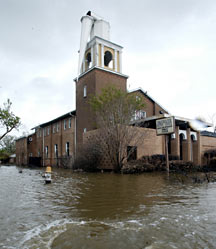 |
| Floodwaters deluge the neighborhood around New Orleans' Edgewater Baptist Church on Paris Avenue following Hurricane Rita. |
The point, Carpenter emphasized, was that “God really is going to make things clear to you, all kinds of things.”
Through the decades, scholars say, this notion of the saved as knowledgeable in all things godly has allowed little room for divine mystery.
But evangelical leaders today increasingly are admitting a lack of answers.
Jerry Falwell recently wrote in his newsletter, Falwell Confidential: “What is the biblical significance of all these global disasters which have befallen us recently? The honest answer is, I do not know.”
Falwell's open befuddlement is a shift for a fundamentalist Baptist preacher who infamously said the Sept. 11, 2001, attacks were divine judgment for “throwing God out of the public square.”
Perhaps the days are fading, Carpenter suggested, when evangelicals “think they have power to convince and persuade (only) as long as they have power to explain.”
Meanwhile, hunger for the mysterious seems to be growing, scholars say, especially among young adult evangelicals. They flock to the simple chanting of Taize-style services and inhale incense in the Orthodox, Roman Catholic and Anglican churches they've joined.
And they welcome books pondering God's mysterious side from writers such as Donald Miller and James Emery White, according to Jana Riess, religion book review editor at Publishers Weekly magazine.
“I certainly think,” said Riess, “some of the younger generation (of evangelicals) are interested in letting God be mysterious and are comfortable with that.”
As they ponder life's uncertainty in a post-Sept. 11, disaster-prone world, evangelical leaders are daring to speak of mystery even beyond the weather.
“All evangelical leaders today are dealing with much more sophisticated clienteles and are themselves theologically more nuanced” than in decades past, said David Edwin Harrell, professor emeritus of history at Auburn University in Auburn, Ala., and an expert on evangelical leaders of the 20th century.
“Neither for their own personal theologies nor for their customers are they going to offer the old-time, one-dimensional view of God and of truth. … There is something afoot, clearly, and that is that these are people who are looking in a broader and different way at God and his working from what many early evangelicals (in the 1940s and '50s) would have.”
In prior times, evangelicals wouldn't have hesitated to interpret a hurricane as God's judgment on sin or God's last-chance call to repentance, Harrell said. By contrast, leaders who have made such comments beyond the walls of their churches this year have generated headlines and unwanted publicity.
Those who desire a better way, therefore, must either rethink their beliefs or embrace the mystery of a loving God who somehow allows the innocent to suffer, said Richard Mouw, president of Fuller Theological Seminary in Pasadena, Calif.
“There's an embarrassment over the glibness of the past in which some of our leaders were so sure, you know, why 9/11 hit or so sure New Orleans got it because of its decadence and lifestyle,” Mouw said. “In many ways, these leaders, in order to really have the respect of the rank and file, need to not sound so glib and sound wiser in their willingness to encourage people to live with the mystery.”
For O'Brien, the irony of doing so has been sweet. By admitting he lacks answers to certain questions, he says, his authority as a trustworthy source in the eyes of church members actually seems to grow.
In this, he gets rewarded for forgoing the posture of “father who knows best” and instead embracing his role as an equal, that is, as “brother, sister, fellow struggler … pilgrim on the way.”
Still, Carpenter expects resistance to the doctrine that God is vastly mysterious, especially from the worlds of Christian commerce and para-church ministries. That's because quick answers attract more of an audience than those who marvel without immediate clarity, he commented.
“There's less market for that kind of expression out there in the world of religious consumption,” Carpenter said. “American culture isn't wired for that. It's wired for self-help.”
Mouw expects December's The Chronicles of Narnia film, marketed to Christians by Disney, to further fuel the still-burgeoning evangelical affair with wonder. But, he predicts, some will grow uneasy along the way.
“Insofar as the attraction of evangelicalism is that we've provided easy answers and allowed people to feel very comfortable in a universe where they have things pretty well figured out, it takes a much more mature faith (to live with mystery) and fewer probably will be able to handle it,” Mouw said.