BAPTIST BRIEFS: Rankin discusses private prayer language

Posted: 3/03/06

BAPTIST BRIEFS

Birmingham church named national landmark. 16th Street Baptist Church in Birmingham, Ala., the site of a 1963 bombing that killed four girls, has become a national historic landmark. The bombing brought national attention and outrage, speeding passage of the 1964 Civil Rights Act. Three former Klansmen were convicted in the bombing. U.S. Secretary of Interior Gale Norton signed a proclamation that gives the church building the nation’s highest historic distinction. National status protects the church from being destroyed for any federal project and could make it easier to raise money to maintain and restore the building. A church foundation has raised just under $3.3 million in a $3.8 million restoration campaign.

Yemeni executed for killings of Baptist medical workers. The Yemeni gunman who killed three Southern Baptist medical workers in 2002 was executed by firing squad Feb. 27, according to wire reports. Abed Abdul Razak Kamel was shot in the central prison of the southern Ibb province as judicial officials observed, Yemen’s Saba state news agency reported. Kamel was convicted for the Dec. 30, 2002, shooting deaths of Jibla Baptist Hospital director William Koehn, physician Martha Myers and purchasing agent Kathleen Gariety. A pharmacist was seriously wounded but later recovered. Kamel admitted in court to coordinating the attack with Islamic militant activist Ali al-Jarallah. Al-Jarallah was executed Nov. 27 for plotting the medical workers’ deaths and for assassinating a prominent national politician. The Jibla Baptist Hospital provided care for thousands of people in the impoverished Middle Eastern nation for more than 30 years after it was started in the Ibb province by Southern Baptist workers. It was reopened in 2003 by the Yemeni government’s health ministry.

LifeWay names VP. Trustees of LifeWay Christian Resources named Tom Hellams vice president and executive associate to newly installed President Thom Rainer. Hellams will be chief coordinating staff member of the executive management team. Since 1997, he was executive assistant to President Al Mohler at Southern Baptist Theological Seminary in Louisville, Ky.

Mission Center names building for McWhorter. A new building for Houston’s Gano Mission Center has been named for home missionary Mildred McWhorter, who retired in 1992 after 30 years as director of the Houston Baptist Centers. The Mildred McWhorter Missionary Building will provide dorm rooms for short-term volunteers, three private apartments for long-term volunteers, two conference rooms, dining and kitchen facilities, offices and a prayer room. The 7,400-square-foot facility is scheduled for completion in May. The Gano Mission Center, just north of downtown Houston, is one of three Baptist mission centers in the city.

CBF council approves $17 million budget. At its February meeting, the Cooperative Baptist Fellowship’s Coordinating Council approved a $17.05 million budget for 2006-2007—a 3.5 percent increase over the previous year’s $16.47 million budget. The council also adopted a motion to give the CBF’s Advisory Council more oversight over the planning of the annual CBF general assembly. Bo Prosser, CBF’s coordinator for congregational life, reported the 2006 general assembly will begin with a summit on HIV/AIDS, featuring keynote speaker David Beckmann, president of Bread for the World, a Christian citizens’ group that advocates for reduction of hunger and poverty.

New Oklahoma editor named. The Baptist General Convention of Oklahoma board of directors named Ray Sanders editor of the Baptist Messenger. He succeeds John Yeats, who now works as communications director for the Louisiana Baptist Convention. Sanders, 42, led the state convention’s communications staff seven years. He will continue in that role in addition to his new task as executive editor of the Baptist state paper. He holds an undergraduate degree in broadcast journalism and mass communications from the University of Oklahoma, and he has worked in broadcast news, corporate communications and public affairs in Oklahoma and Washington, D.C. He is a member of Council Road Baptist Church in Bethany, Okla., where his wife, Stephanie, is minister to young adults. They have six children.

South African Methodist keynote speaker at CBF. A Methodist minister from South Africa will address the Cooperative Baptist Fellowship General Assembly June 22-23 at the Georgia World Congress Center in Atlanta, Ga. Trevor Hudson of Northfield Methodist Church in Benoni, South Africa, will be the keynote speaker at the assembly. Other program highlights include presentations by CBF Moderator Joy Yee and Coordinator Daniel Vestal and a commissioning service for new Global Missions field personnel. For more information, visit www.thefellowship.info.

News of religion, faith, missions, Bible study and Christian ministry among Texas Baptist churches, in the BGCT, the Southern Baptist Convention ( SBC ) and around the world.


Cartoon

Posted: 3/03/06

“I can get you into this location for the low cost of 10% of your income. This little number is located conveniently near the Sunday schools and previously was used only by little old ladies on Sundays.”

News of religion, faith, missions, Bible study and Christian ministry among Texas Baptist churches, in the BGCT, the Southern Baptist Convention ( SBC ) and around the world.


Partnership yields church building for Chinese Christians

Posted: 3/03/06

Partnership yields church
building for Chinese Christians

By Lance Wallace

Cooperative Baptist Fellowship

YANTING, China—Seventy Christians in a Chinese city of 200,000 people have a new place to worship, thanks to an unusual partnership between Chinese Christians, a Houston Baptist church and Anglican relatives of one of Cooperative Baptist Fellowship’s Global Missions field personnel.

CBF Global Missions field personnel Bill and Michelle Cayard brought together these partners to play a crucial role in the life of a small church that had sought their help to make their dream of a church building a reality.

“They’ve dreamed, they’ve invested, they’ve stretched as far as they can,” Cayard said. “So we committed the funds to get them the rest of the way there.”

In late November 2004, an English-speaking Chinese pastor told the Cayards about a small congregation in Yanting that had purchased an old factory building for their church.

The State Administration for Religious Affairs, the arm of the Chinese government that relates to churches in the country, helped provide old chairs for the group to begin meeting in the facility.

As the members celebrated having their new facility, the government also stipulated that the church look like a church. That’s when the pastor went to Cayard, a former construction manager, for help.

Although the Cayards are just completing language school and settling into their place of ministry in Chengdu, the opportunity arose for them to involve CBF. Members of their home church, South Main Baptist in Houston, contributed $5,000 for the project.

By March 2005, the construction began on a new roof, windows, gables and a cross to begin the factory’s transformation.

When Cayard’s aunt and uncle, Bev and Ben Sibley of Orlando, Fla., came to China for a visit, the Cayards took them to the facility and showed them the progress. Despite having no connection to CBF, the Anglican couple rallied friends and family to put forward an additional $5,000 to purchase pews.

The actual cost of the church benches was about $2,500, leaving the remainder to be used for scholarships for Chinese students to attend seminary and for subsidies for pastors’ salaries throughout the province.

Now, Yanting Christian Church has a more visible witness to their community.

“It brought tears to my eyes when we drove into Yanting and saw the construction progress,” Cayard said.

The construction project recently was completed.

“This is the first place of worship for the Yanting Christian Church,” Mrs. Cayard said. “This is a significant step for this church and this community.”

Throughout the process, the Cayards have been grateful for the cooperation and support of the local State Administration for Religious Affairs and the Sichuan Provincial Christian Council.

“We were encouraged that the local government leader met us at the church upon our arrival to thank us, along with the church leaders,” Cayard said.

“With the church leaders, we prayed together both in Chinese and English. It was very moving. The government official then joined us for a celebratory banquet lunch.”

Yanting Christian Church will have to grow into the facility. The small congregation doesn’t come close to filling the facility, which will seat 600. The Cayards can’t wait to visit when the place is packed.

“The way the Chinese church works is that by this time next year, it will be standing-room-only,” Cayard said. The building is equipped with a small kitchen that the members are using as a base for a ministry of feeding those in poverty.

“It is so encouraging to see them reaching out beyond their doors to engage the needs in their community,” Mrs. Cayard said. “We were blessed to be a small part of their growth.”

News of religion, faith, missions, Bible study and Christian ministry among Texas Baptist churches, in the BGCT, the Southern Baptist Convention ( SBC ) and around the world.


Down Home: Grace & patience, or a big ol’ crash

Posted: 3/03/06

Down Home:
Grace & patience, or a big ol’ crash

Road construction ought to be labeled Texas’ State Business. You know, like the mockingbird is the State Bird and the monarch butterfly is the State Insect.

Almost anywhere you go across the Lone Star State, particularly in the cities and suburbs and along the interstate highways, you confront road construction. We’re growing so fast, and our roads are so run-down, we can’t build them or repair them fast enough. (Note to parents: If you want your children to be employed all their lives, set them up as paving contractors.)

All this road building has prompted a singular desire: Just one day before I retire, I will drive all the way to and from work without taking a construction detour or passing a construction cone. When I describe this dream, my spiritually sensitive friends stammer in wonder: “You really do believe in miracles, don’t you?” Most lack such faith. “It’ll never happen,” they predict.

Usually, road construction is simply annoying. We live by the clock, and time is precious. So, creeping through a construction zone at 5 miles per hour gets on the ol’ nerves. Worst of all, unless you can afford a helicopter, you can’t do much about it. But wait, and wait, and wait.

Sometimes, however, road construction is plain dangerous. Take the intersection of Interstate 30 and Loop 12 in far west Dallas, or Irving, or Grand Prairie. (Who knows exactly where the city limits are out there?)

Since I-30 between Dallas and Fort Worth used to be a tollway, the interchanges are, in precise engineering terminology, goofy. If you haven’t been on them, I can’t describe them so you’ll understand.

Now, in an effort to widen the interstate and simplify the interchanges, the Texas Department of Transportation is laying miles of rebar and pouring tons of concrete. Meanwhile, the engineer who designed the I-30/Loop 12 interchange has given northbound drivers who want to go to Fort Worth and southbound drivers headed for Dallas about, oh, 17 inches to swap lanes.

Judging by the looks on faces, driving from Loop 12 to I-30 will improve your prayer life. Or make you cuss like a sailor.

Panic sets in when a driver in the next lane—frustrated by crawling through construction delays—hugs the bumper of the car just in front of her. It’s the closest normal drivers ever get to NASCAR, only without all that high-tech safety equipment.

Unexpectedly, this insane interchange between two too-busy roads has taught me lessons about the spiritual qualities of grace and patience. Although we’re both headed in different directions, we’re crossing paths in dangerous territory, and we have more in common than we have apart. If we’re both bound-and-determined to get our spot, the results would be disastrous. But when we show respect and allow the other a little room, we swap lanes easily.

This highway interchange is like a lot of other “intersections” of life, even in church: When we respect the image of God in fellow travelers, our journey is safer and more pleasant. Even if it’s still scary.

–Marv Knox

News of religion, faith, missions, Bible study and Christian ministry among Texas Baptist churches, in the BGCT, the Southern Baptist Convention ( SBC ) and around the world.


Fairview church discovers: ‘A little child shall lead them’

Posted: 3/03/06

Pastor Paul Wrightsman says an influx of children has brought an additional energy to Fairview Community Church, which was recovering from the effects of changing demographics in the surrounding community. The church, primarily made up of senior adults, now boasts many children, especially on Wednesdays.

Fairview church discovers:
‘A little child shall lead them’

By George Henson

Staff Writer

COPPERAS COVE—The aptly named Fairview Community Church sits well off the main drag in Copperas Cove, next to an elementary school and in the midst of houses.

It’s what Pastor Paul Wrightsman calls a neighborhood church—a church built primarily to reach people in its immediate vicinity.

“I’ve grieved over the loss of neighborhood churches,” he said. “Even though I wasn’t a Christian, my childhood memories were of neighborhood churches—a Vacation Bible School here, a Sunday school visit from time to time, and it was always with friends who lived close by, and we’d walk on down to the little neighborhood church.”

Fairview Community Church is being revitalized as just such a neighborhood church. And consistent with Wrightsman’s memories, it’s children who are doing a lot of the inviting.

When the church began in 1959, most of its members lived in the surrounding neighborhood. As their incomes increased, however, many homeowners moved, and most houses in the area became rental properties, Wrightsman said.

The neighborhood began changing ethnically, as well, and Fairview began to decline, he continued.

“The church hadn’t really realized that and hadn’t really tried to reach out,” Wrightsman observed.

The congregation dwindled to the point that when Wrightsman was called as pastor in 2002, “they spent two weeks calling people and looking under bushes for people to come and vote, and they found 29.”

Their number had increased to around 50 about a year ago when the church decided to invite the neighborhood to a Wednesday-night meal.

A sign in front of the church offered an open invitation for soup and sandwiches. The offer of food was all the enticement some children in the neighborhood needed.

“But even hungry kids don’t get too excited about soup and sandwiches on a regular basis,” Wrightsman said.

So, the Wednesday night meal was transformed into a potluck dinner brought by the congregation, “and then it really took off,” he said. “Kids started bringing kids. That’s what kids do, and now we sometimes have 40 here.”

And it’s not just the children who are coming.

Wrightsman recalled that two of the boys got into a fistfight before the meal one Wednesday night. He separated them, but they wouldn’t calm down and continued to threaten each other.

After the police were summoned, the boys calmed down, and Wrightsman allowed them to stay to eat. Before the meal was served, one of the boys asked if he could go get a friend.

“I told him, ‘Go get him, your mother, your daddy; bring anybody you want.’ And he did,” Wrightsman said.

The boy’s mother and father stood in line to be served when the father asked Wrightsman if he called the police on his boy.

“I told him yes, and if I had to, I would do it again,” Wrightsman recalled. “He didn’t seem too happy with that response, but three weeks later, I saw that same daddy in the kitchen helping wash the dishes.”

The influx of so many children also has been an adjustment for a congregation that had been composed primarily of older adults.

“It’s gotten a lot louder around here,” Wrightsman said. “But like I told a couple of our ladies last week, it sure does sound sweet.”

One of the things that has made the volume more bearable is seeing the children and their parents also become more regular in Sunday attendance. One of the children—a recognized leader—recently accepted Christ as her Savior and was baptized.

“That has given us an additional responsibility, because now everybody wants to be baptized, and I want to baptize them, but I want to make sure that they are making legitimate faith commitments and not just following her lead. I want it to be real for them,” Wrightsman said.

The congregation also is adjusting its facilities, and the church is considering enlarging the room where the Wednesday meal is served.

The congregation—both longtime members and newcomers—have been an encouragement, Wrightsman said.

“This church has been a real eye-opener for me,” said the 69-year-old pastor, who still rides a Harley-Davidson motorcycle. “It has reinforced for me the power of prayer.

“God listens, and God answers. The only time God has not answered my prayers for this church is when he’s had a better idea.

“God is attentive to our hearts, our prayers and our work, and he always, always outgives you.”

One thing God gave Fairview Community Church before the children arrived was an influx of younger adults such as Terry Dunn, Wrightsman noted. Dunn grew up in the neighborhood, but he did not attend the church. After a career in the Navy, he returned with his wife to live in his childhood home.

One day, they took a walk and happened by Fairview. Wrightsman and his wife, Sue, were working outside on the church grounds. As the Dunns passed, Mrs. Wrightsman stopped working and asked the couple if they attended church. When they said they did not, she invited them to Fairview. They visited the next Sunday, and now Dunn serves the church as minister of education and administration. He delights in what the neighborhood children have brought to his church.

“These children have definitely raised the noise level, but with that comes a new level of energy and anticipation,” Dunn said. “And it’s also good when your comfortable routine gets shaken up and you get a fresh perspective on things.”

One person changed by the arrival of the children is Joy Baker. She leads a choir, ages 4 to 15—recently numbering 36 in rehearsal.

While the music is important, she said, the relationships she has developed are far more vital.

She recalled a conversation with a child who was baptized. The girl told Baker about how many hugs she had received.

“I asked her if that was a good thing or a bad thing, and she said it was a very good thing. But then her cousin piped up and said the church was the only place they got hugs,” she recalled.

“It doesn’t really matter what I’m able to accomplish with these kids musically, but what matters is that in the church, they know they have a place to go and know they will be loved.”

And it’s right in the neighborhood.

News of religion, faith, missions, Bible study and Christian ministry among Texas Baptist churches, in the BGCT, the Southern Baptist Convention ( SBC ) and around the world.


Technology enables hearing-impared to experience worship

Posted: 3/03/06

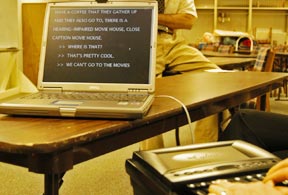
Michelle Varner watches as Susan Jones translates for Esther Kelly, while John Palmer and Eddie Jones also participate.

Technology enables hearing-impared to experience worship

By George Henson

Staff Writer

RICHARDSON—A Texas Baptist church is using technology to make worship more accessible to hearing- impaired members and guests.

Through the use of Computer Access Real-Time—CART—translation, hearing-impaired worshippers at The Heights Baptist Church in Richardson can read the words of songs and sermons from a computer screen.

While many churches use sign interpretation, Esther Kelly of the Deaf Action Center in Dallas said that reaches only a small segment of the population.

“Of all people who are hearing impaired, only 6 percent to 8 percent know sign language. That means that there’s a huge population who need this type of help,” she said.

Susan Jones translates during a recent committee meeting of the CART ministry at The Height Baptist Church in Richardson.

CART is federally mandated for the hearing impaired in many arenas, such as college classrooms, to give equal access.

Churches are exempt from that law, but it points out the need for such a ministry, she said.

“I always joke that if you see someone falling asleep in church, it’s probably because they are not hearing, not because they are bored,” Kelly said.

She knows from personal experience. Kelly’s hearing loss came as an adult. For six years, she continued to teach Sunday school with the help of another teacher but then went home before the worship service because she couldn’t hear the sermon or read sign language.

“There are a lot of people like me who just stop going (to church). They don’t say anything because many, many people with hearing loss hide it,” she said

“I wish churches would get a vision here and see the mission field that’s out there. Churches won’t be overwhelmed with people because they have CART, but it has to be looked at as missionary work. How many people have to be reached before it’s worth doing?”

To keep up with the pace of speech, CART volunteers need training as court reporters, said John Palmer, senior adult minister at The Heights Baptist Church.

“It is not for people who have minimal skills in that area, because the words can come fast and get rather long,” he explained.

The Heights Baptist Church has two volunteers who meet the criteria—Michelle Varner and Susan Jones. Varner translates the 9:15 a.m. service, and Jones serves at the 10:50 a.m. service.

While Varner’s job requires her to take legal depositions, Jones works primarily as a CART operator for the hearing impaired in college classrooms and training sessions for corporations.

Many of her clients have cochlear implants and can hear well in small-group situations, but they still struggle in larger gatherings, she said.

The ministry at The Heights began when Jones noticed a man with a cochlear implant. On impulse, she asked him if he would be interested in her providing CART translation for him, and he said he would.

Sam Sewell, a 30-year member of the church who serves as usher chairman, is grateful Jones started the ministry. His 28-year-old daughter, Amanda, was born hearing impaired.

“Reading lips, she can get about 80 percent of what’s said,” he explained. “With CART, she gets 100 percent.”

That type of testimony energizes Jones.

“It’s just so satisfying, and it makes me feel like I’m really contributing to kingdom work,” she said.

Four or five people read the sermon from laptop computers most Sundays at The Heights, Palmer said.

But as congregations continue to age, the need may become greater, he pointed out.

“Growing old is a progressive series of little events that gradually isolate you, so anything we can do to prevent that, we want to do it,” he said.

Anyone involved with court reporting would have the equipment needed to perform the service, Jones and Palmer stressed. That means any expense to the church would be minimal if that person was a part of the congregation.

If the church needed to hire someone to do the translation, the cost could run as much as $125 per hour, depending on the location.

But as Sewell said, “That might not make it cost effective, but we’re not in the business of being cost effective.”

News of religion, faith, missions, Bible study and Christian ministry among Texas Baptist churches, in the BGCT, the Southern Baptist Convention ( SBC ) and around the world.


Executive Board approves Texas/Missouri partnership

Posted: 3/03/06

Baptist General Convention of Missouri Executive Director Jim Hill shakes hands with BGCT Executive Director Charles Wade.

Executive Board approves
Texas/Missouri partnership

By Ken Camp

Managing Editor

DALLAS—At its inaugural meeting, the reconstituted Baptist General Convention of Texas Executive Board ap-proved a three-year partnership linking Texas Baptists with the Baptist General Con-vention of Missouri.

The board ratified a strategic partnership agreement with the Baptist General Con-vention of Missouri, a fellowship of 125 churches formed when fundamentalists gained control of the Missouri Baptist Convention.

According to the agreement, staff from the Missouri and Texas state conventions will meet for annual joint strategy-development sessions, where they will collaborate on program initiatives and resource development.

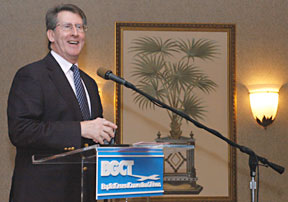
Baptist World Alliance President David Coffey underscores the importance of Texas Baptist involvement in the global Baptist fellowship.

“We value this relationship with Texas Baptists. Not everybody wants to have a relationship with us,” said Missouri Executive Director Jim Hill.

The Southern Bap-tist Convention refused contributions from the fledgling Missouri convention, cutting it off from representation at the SBC annual meeting, and the institutions affiliated with the Baptist General Convention of Missouri have been embroiled in a prolonged legal dispute with the Missouri Baptist Convention.

However, Hill noted, the Baptist General Convention of Missouri has been received into the North American Baptist Fellowship and will seek full membership in the Baptist World Alliance, following in the steps of the BGCT and the Baptist General Association of Virginia.

During a two-day board meeting, directors also approved budget reallocations to fit the revamped BGCT organizational structure, named committees and subcommittees for the revamped Executive Board and heard a challenge from Baptist World Alliance President David Coffey.

The 90-member Execu-tive Board met for the first time since BGCT annual meeting messengers granted final approval to governing documents that reduced the board’s size by more than half and granted it greater decision-making authority.

“This Executive Board has the opportunity to shape the decisions for which it is accountable,” said BGCT Executive Director Charles Wade, who told directors they were “making history.”

The Executive Board’s five standing committees—Executive Committee, Audit Committee, Administration Support Committee, Institu-tional Relations Committee and Church Missions & Ministries Committee—met for the first time.

The committees appointed subcommittees composed entirely of Executive Board directors, as well as councils, commissions and groups that also include Texas Baptists not on the board.

BGCT Chief Operating Officer Ron Gunter introduced the staff operations team and presented an update on restructuring. Congregational strategists and church starters have been deployed to nine service areas around the state, and affinity group strategists are in place to serve African-American, Hispanic, intercultural and Western heritage churches, he reported.

The board approved a recommendation from its Administration Support Committee authorizing budget transfers and reallocations within the approved $49.4 million budget to conform to the reorganized staff structure.

The board also approved a $1.77 million advance budget for the reorganization, with funding to come from income and unrealized gain on trust funds and any Cooperative Program receipts exceeding the approved budget.

BWA President David Coffey underscored the importance of Texas Baptist involvement in a global Baptist fellowship that seeks to become known as “good news people” and “living water people” who are committed to meeting both physical and spiritual needs.

“We need Texas Baptists, and I dare say Texas Baptists need the world family,” he said.

Through the BWA, Texas Baptists have an opportunity to join Baptists worldwide in evangelism and holistic missions, addressing the problems of human trafficking and HIV/AIDS, combating poverty, working for peace and standing for religious liberty and human rights, Coffey said.

In other business, the BGCT Executive Board approved:

• Engaging the Grant Thornton accounting firm to conduct the 2005 financial audit.

• Bylaws revisions for the Baptist Foundation of Texas to bring terminology into compliance with the reorganized BGCT structure.

• Routine bylaws revisions for the Baptist Health Foundation of Texas.

• Using $750,000 in unrestricted funds for contingency to meet missions and ministry needs in 2006.

News of religion, faith, missions, Bible study and Christian ministry among Texas Baptist churches, in the BGCT, the Southern Baptist Convention ( SBC ) and around the world.


On the Move

Posted: 3/03/06

On the Move

Henry Adrion to Iola Missionary Church in Iola as interim pastor.

Bruce Ammons has resigned as pastor of ministry development at First Church in Katy to teach the Conquering Debt God’s Way seminar full-time. He can be contacted at (806) 780-7615.

Bobby Atwell to First Church in Joshua as transitional pastor.

Malcolm Bane to First Church in Navasota as interim pastor.

Wes Barnet has resigned as pastor of First Church in Pettus.

Mac Brunson to First Church in Jacksonville, Fla., as pastor from First Church in Dallas.

Raymond Butler to Second Church in Lampasas as pastor.

Ron Cooper to Calvary Church in Quinlan as pastor.

Eddy Curry to Pioneer Drive Church in Abilene as minister of education from First Church in Plainview.

Cecille Davis to First Church in Burleson as minister of worship/creative arts.

Stephanie Gates to First Church in Cleburne as minister of children.

Dan Gilmore to Second Church in La Grange as minister of music and education, where he had been interim minister of music.

Matt Killough to First Church in Grand Prairie as youth pastor from Oak Knoll Church in Fort Worth.

Paul Lemon to First Church in Lillian as minister of music.

Kay Nimitz to First Church in Lillian as minister to children.

Ric Owens to Nolan River Road Church in Cleburne as minister of music.

Harvey Patterson to First Church in Luella as pastor.

Gary Redding to Buel Church in Cleburne as interim pastor.

Kevin Steger has resigned as associate pastor at First Church in Burleson so that he can work full-time for Light Over Europe Ministries.

Charles Wisdom to Waller Church in Waller as pastor.

News of religion, faith, missions, Bible study and Christian ministry among Texas Baptist churches, in the BGCT, the Southern Baptist Convention ( SBC ) and around the world.


Panhandle-Plains conference taps changing demographics

Posted: 3/03/06

Jesse Rincones, pastor of Alliance Baptist Church in Lubbock, addresses a point about reaching the Hispanic population in a panel discussion to kick off the Panhandle-Plains Pastors’ and Laymen’s Conference at Wayland Baptist University. With Rincones are (from left) Stacy Conner, pastor of First Baptist Church of Muleshoe, Mateo Rendon, a consultant for West Texas with the BGCT, and Charles Davenport, a retired Tulia pastor and a BGCT congregational strategist.

Panhandle-Plains conference
taps changing demographics

By Teresa Young

Wayland Baptist University

PLAINVIEW—Reaching the changing West Texas populations with the gospel will require intentional efforts, a worker mentality and an attitude of acceptance, panelists told participants at the 85th annual Panhandle-Plains Pastors’ and Laymen’s Conference at Wayland Baptist University.

Panelists invited participants to examine changing demographic trends—particularly the explosive growth of the Hispanic population, as noted by Jesse Rincones, pastor of Alliance Baptist Church in Lubbock. He pointed out 1,300 of the 5,700 Baptist churches in Texas are Hispanic, and within the next decade, half of the Hispanic population in Texas will be age 25 or under.

Newly elected officers of the Panhandle-Plains Pastors’ and Laymen’s Conference are President David Lowrie (center), pastor of First Baptist Church in Canyon; President-elect Richard Laverty (right), pastor of First Baptist Church in Perryton; Secretary/Treasurer Charles Bassett (left) of Wayland Baptist University; (not pictured) First Vice President Ackey Martinez, youth director at First Baptist Church in Brownfield, and Second Vice President Carl Williams, layman at Colonial Hill Baptist Church in Snyder.

Steve Vernon, pastor of First Baptist Church in Levelland and president of the 2006 conference, served as moderator for the panel discussion, which also included Stacy Conner, pastor of First Baptist Church in Muleshoe; Mateo Rendon, a Hispanic strategist with the Baptist General Convention of Texas; and Charles Davenport, a retired pastor from Tulia now serving as a BGCT congregational strategist.

Texas Baptists need to return to the command of Jesus to become workers in the harvest, Rendon said. Quoting Matthew 9:37, “The fields are white to harvest, but the workers are few,” he emphasized that congregations must develop a worker mentality in order to reach not only the Hispanic population in West Texas but all populations.

“The question to ask is how many of the workers are out there working? I would venture to say that a third of these congregations are what we’re counting on,” Rendon said. “What we need to see is that percentage of workers doing the will of God increase.”

Rendon and Rincones pointed out that knowing how to reach the Hispanic population first involves defining the population and its subsets.

For instance, Rendon said, the recent immigrants who speak little English and come from a primarily Roman Catholic background will be a different audience altogether than the third- and fourth-generation Hispanic young families whose children speak little to no Spanish and who may be further removed from Catholic influence.

“You are probably closer to reaching Hispanics than you think,” Rincones said. “The language barrier is not there as much as it used to be, but the cultural differences remain. The question is how we embrace this change biblically and with a Christian view.

“The only way to reach Texas is not through a Hispanic perspective or a white perspective but a Christian perspective and a realization of the need for the gospel.”

The key to reaching any population is to be relational and meet the needs of people, Rincones stressed. New strategies like cowboy churches, college worship services and other efforts are examples of how churches are reaching different populations by focusing on common interests, and reaching different cultures has the same principle, he said.

Churches need to be intentional in their partnership efforts, he em-phasized. Planning combined services or activities between the traditionally Anglo churches and the Hispanic churches in a neighborhood can build the camaraderie and trust levels needed to work together and really reflect the body of Christ, he said.

Taking it one step further, Rincones said the two churches could even share members with each other in order to make both churches blended and benefit from the shared experience.

Blending of communities, even in the congregations, is likely to happen by chance and time, Rincones said. But churches would be better served to pursue those efforts intentionally and build trust and bonds between the cultures. Cooperation with other churches also is essential, he added.

“We’re going to have to redefine how we’re doing church,” Rendon said. “We must get away from the spirit of competition and get back to a spirit of companionship.”

Davenport said the changing population during his ministry has proved that models of the past likely need tweaking if the church is going to be effective at reaching its entire community, regardless of culture.

“Years ago, the idea was to build or buy a building and start a Mexican mission, and we thought we’d done our duty. But that wasn’t really the case,” Davenport said.

“We have problems in reaching other populations as well, even the Anglo population. I think we’re going to have to realize that we’re going to have do something different and distinct or we’re going to lose this world for the gospel.”

Intentionality also in-volves welcoming guests at church, Davenport said.

“We assume that everybody knows they’re welcome at our churches, but they may not know that,” he said.

“We have to be more assertive in making people know they’re welcome here, regardless of ethnicity.”

In an example of meeting needs and relating to people, Conner described an after-school program hosted by his church at which children play games, do crafts and study the Bible in the church one day each week.

“The group at that program looks like our local elementary schools, but those children are not available to us on Sunday mornings” be-cause they are in other churches, Conner said. “We’re just investing in the lives of these children and hoping it pays dividends later.”

The Pastors’ and Laymen’s Conference also featured messages by Joel Gregory, preaching professor at Baylor University’s Truett Seminary; Don Sewell of Texas Baptist Partnerships; David Wilson of Lubbock; Gil Ramirez of Levelland; and Michael Evans of Mansfield.

News of religion, faith, missions, Bible study and Christian ministry among Texas Baptist churches, in the BGCT, the Southern Baptist Convention ( SBC ) and around the world.


Rankin discusses private prayer language

Posted: 3/03/06

Rankin discusses private prayer language

By Trennis Henderson

Kentucky Western Recorder

BANFF, Alberta (ABP)—Acknowledging he has practiced a private prayer language for more than 30 years, Jerry Rankin candidly shared his views about the Southern Baptist International Mission Board trustees’ recent action on the issue.

Rankin, president of the mission board since 1993, addressed the topic during a question-and-answer session with Baptist editors meeting in Banff, Alberta, Canada, for the 2006 Association of State Baptist Papers annual meeting.

“I do have a private prayer language,” Rankin told the editors. However, “I don’t consider myself to have a gift of tongues. I’ve never been led to practice glossolalia publicly.

“I’ve never viewed personally my intimacy with the Lord and the way his Spirit guides me in prayer time as being the same as glossolalia,” he added. “I just want God to have freedom to do everything that he wants to do in my life, and I’m going to be obedient to that.”

The issue of a private prayer language, generally considered a form of glossolalia or speaking in tongues, came to a head in November when IMB trustees adopted a policy banning the future appointment of missionaries who practice a private prayer language. The mission board’s policy already excludes people who speak in tongues in public worship from serving as missionaries.

Although the new policy specifies it is not retroactive, some trustees expressed concern that the action is a slap at Rankin’s leadership. He confirmed prior to his 1993 election that his private prayer life included occasional experiences of “praying in the Spirit.”

Detailing his personal views on the issue, Rankin said, “I’m certainly not a cessationist”—someone who believes certain spiritual gifts recorded in Scripture, such as speaking in tongues, no longer function.

“I believe … as long as the Holy Spirit is operable in our lives and in the church and in the world, what the Bible tells about the work and functioning of the Holy Spirit is applicable,” he noted. “Now that may change historically, but I certainly don’t think we have the latitude to just disregard it.

“I just don’t see how you can be an inerrantist and be a cessationist,” Rankin said. But he acknowledged others hold the view that someone can’t be an inerrantist without being a cessationist.

Insisting that “I don’t consider myself a charismatic,” Rankin said his private prayer language remains just that—private. “No one’s ever heard me pray in anything other than English, so I think it is still very private and it will remain so,” he said, “but it’s nothing to deny.”

Rankin insisted he has been “very open with the board” about his personal prayer life. “I don’t advocate it. I don’t see it as normal or that I should propose that anyone ought to pray in tongues. It’s just what God has chosen to do in my life.”

News of religion, faith, missions, Bible study and Christian ministry among Texas Baptist churches, in the BGCT, the Southern Baptist Convention ( SBC ) and around the world.


Red River senior adult VBS sparks mission trip

Posted: 3/03/06

Red River senior adult VBS sparks mission trip

By George Henson

Staff Writer

PARIS—Senior adults in Red River Valley Baptist Association decided they weren’t too old for Vacation Bible School, and that led them to realize they weren’t too old to participate in missions, either.

Last August, Gloria Parker—whose husband, Don, was pastor of First Baptist Church in Roxton—was upset when her church elected not to have Vacation Bible School for its children.

“I was grieved before the Lord that not only were our children not going to have Vacation Bible School, but neither would their families have the experience,” she recalled.

About that time, Parker’s fibromyalgia interrupted her sleep, and she was impressed in prayer that even if there were no Vacation Bible School for children, there could be one for senior adults.

No one in the association recalled a senior adult Vacation Bible School conducted in the past, but Parker was determined.

On a trip to a Christian bookstore in Dallas, she found a single kit left for adult Vacation Bible School, and “I thought that one probably had my name on it,” she recalled.

The Vacation Bible School was held five consecutive Mondays from 11 a.m. until 1 p.m.—90 minutes for missions and Bible study, with the last 30 minutes reserved for a meal. The first session was at First Baptist in Roxton, but the next four sessions rotated among other churches in the association.

The Monday afternoon sessions averaged more 50 participants, and a couple of weeks drew more than 70 people.

At one meeting, Parker asked participants for ideas for the future.

“One lady said she wanted us to do something outside ourselves, something that would benefit others,” Parker recalled.

That was the starting point for a mission trip to Alabama next month. A group of senior adults from the association will travel to Alabama to work with the E.L. Hodges ministry there.

The ministry collects excess Bible study materials and ships them around the world to ministries that cannot afford to pay for them.

The Texas group will sort the materials, and volunteers who are physically able will shrinkwrap and load them up for shipping, said Mike Cosgrove, director of missions for Red River Valley Association.

“It’s going to be a way for senior adults to do international missions without the expense of going overseas,” he said.

The trip will meet several needs for parti-cipants, he added.

“A lot of senior adults like to travel, but many also want to make a difference. This will also be a great time of fellowship for us,” Cosgrove said.

“I just wish they could be on the other end to see the joy on the faces when the containers are opened up,” he continued.

Playing a part in seeing that literature is used rather than being a thrown away especially addresses a desire for Parker, who is now a member at First Baptist Church in Paris after her husband’s retirement last September.

“I had a burden for years about literature that was thrown away, and I was thrilled that someone not only had a burden about it, but also was doing something about it,” she said.

And doing something is the job of everyone, regardless of age, Parker believes.

“The Lord will be coming back soon, we believe, and we all have a lot of work to do before he does,” she said.

News of religion, faith, missions, Bible study and Christian ministry among Texas Baptist churches, in the BGCT, the Southern Baptist Convention ( SBC ) and around the world.


Sri Lanka ministries continue despite political unrest

Posted: 3/03/06

A Texas Baptist Men volunteer assists as Andrew Bentley, from Baptist Child & Family Services, removes a wooden splinter from the leg of a tsunami victim in Sri Lanka.

Sri Lanka ministries
continue despite political unrest

By Craig Bird

Baptist Child & Family Services

BATTICALOA, Sri Lanka—Texas Baptist ministries in Sri Lanka continue despite ongoing political tensions.

Two Baptist General Convention of Texas-related groups—Baptist Child & Family Services and Texas Baptist Men—have worked in the Indian Ocean island-nation since January 2005. Both groups have based their ministries in the east coast town of Batticaloa, which straddles the uneasy ceasefire line between government troops and their adversaries for the past 23 years, the Tamil Tigers.

A foster care program, operated by the Baptist Child & Family Services overseas arm—Children’s Emergency Relief International—now has 70 tsunami orphans in care, and the six Sri Lankan staffers are “in the field each week and have reported no concerns or incidents,” an agency spokesman said.

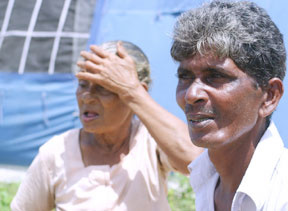
Baptist Child & Family Services provides counseling to help people, like this couple still living in a refugee camp, deal with post-traumatic shock.

A Texas Baptist Men construction team has been on standby several months. Volunteers with TBM, who also drilled numerous water wells and built temporary houses in the immediate aftermath of the tsunami, plan to complete the last building of a Gospel for Asia training center when the parachurch organization gives the go-ahead, said TBM Executive Director Leo Smith.

First Baptist Church in Corpus Christi has partnered with the Cooperative Baptist Fellowship effort to build houses and drill water wells. CBF reports its work also is advancing, but some trips into Tamil territory have been postponed in recent weeks.

CBF volunteer teams continue to travel and work in Sri Lanka, said Grace Powell Freeman, associate coordinator of CBF Global Missions. Career field personnel, redeployed to Sri Lanka after the tsunami, are concentrating on housing as well as training locals in well drilling because, as one field representative said, “if fighting does break out again, war and no-water are not good companions.”

A recent increase in reported violence and some major road closings during the weeks prior to a Feb. 22 meeting in Geneva between the sides was not much different than what the country has experienced for almost 25 years.

“Nothing is any more dangerous now than it’s been for the last four to five years,” said Basil Fonseka, national director of the Children’s Emergency Relief International program. “I contacted Samaritan’s Purse, World Vision and Habitat for Humanity, and all of them said things were relatively calm, and they had no big concerns.”

Batticaloa experienced a one-week curfew just before Christmas, and in late January, 10 people working for other relief agencies were kidnapped along with three policemen. The policemen and three of the workers have been released, and “positive negotiations are being held for the others” sources said.

Recently, two bombs were discovered in Colombo, the nation’s capital, located on the west coast, but neither detonated. In Batticaloa, government military posts and checkpoints are conspicuous every few blocks—normal for the past several years.

Occasional skirmishes and political assassinations have been standard since a 2002 truce halted an all-out war. Ongoing peace talks broke off in April 2003.

Fears that the truce might give way to open warfare again escalated in late 2005 but eased with the Jan. 25 announcement that the two sides would resume talks in Geneva Feb. 22. A major incentive for the resumption was the threat of Western nations, including the United States, to withhold $4.5 billion in aid unless there was progress toward a peace settlement.

The 2002 truce put a stop to most of the fighting that has claimed an estimated 65,000 lives since the civil war began in 1983. It pits the government, dominated by the country’s majority ethnic group, the Sinhalese, who are overwhelmingly Bud-dhist, against the predominately Hindu Tamils. Tamils make up less than 20 percent of the island’s population of 20 million but are concentrated in the northern and eastern areas.

Both the Muslim and Christian populations are estimated at less than 3 percent each.

In Geneva Feb. 22-23, the two sides “agreed to uphold their existing cease-fire … committed to respecting and upholding the cease-fire agreement … and agreed to reopen peace negotiations April 19-21,” the Associated Press reported.

In addition to its expanding foster care program, Children’s Emergency Relief International plans to put more volunteer teams in Sri Lanka in the coming months, concentrating on medical/dental efforts and providing post- traumatic shock counseling.

“I hope Texas Baptists, who responded with incredible compassion and zeal after the tsunami, will continue to pray for Sri Lanka,” said Baptist Child & Family Services President Kevin Dinnin, who led the first Children’s Emergency Relief International team that started the work with tsunami orphans.

“We covet the support for our staff and volunteers who do such a great job in difficult circumstances. But also remember to keep praying for those Sri Lankans who bore the brunt of the tsunami’s fury and have also been in the middle of civil war all these years.”

News of religion, faith, missions, Bible study and Christian ministry among Texas Baptist churches, in the BGCT, the Southern Baptist Convention ( SBC ) and around the world.