Page elected SBC president in upset of establishment

Posted: 6/23/06

Page elected SBC president
in upset of establishment

By Greg Warner

Associated Baptist Press

GREENSBORO, S.C. (ABP)—In a major populist upset, Frank Page of South Carolina was elected president of the Southern Baptist Convention over two candidates closely tied to the SBC’s fundamentalist power structure.

Page, who described his election as a victory for grassroots Baptists, was elected with 50.48 percent of the vote on a first ballot over two high-profile leaders in the fundamentalist-dominated SBC.

Frank Page

Jerry Sutton, pastor of Two Rivers Baptist Church in Nashville, Tenn., received 2,168 votes, or 24.08 percent. Ronnie Floyd, pastor of First Baptist Church of Springdale, Ark., received 2,247 votes, or 24.95 percent. Page, pastor of First Baptist Church in Taylors, S.C., and former pastor of Gambrell Street Baptist Church in Fort Worth, received 4,546 votes—just 65 more than necessary for a first-ballot victory.

Page’s election signaled a defeat for the SBC’s powerbrokers, who have hand-picked all but one president since 1979. Only Jim Henry of Orlando—elected in 1994 and 1995—lacked the endorsement of the SBC’s leaders.

Floyd lost despite the endorsement of three SBC seminary presidents, including Paige Patterson, the SBC’s most powerful leader. Sutton reportedly had the support of Paul Pressler, another SBC fundamentalist architect.

The surprise election also reflected grassroots dissatisfaction with officers who direct the SBC’s work but offer little financial support to its central missions budget, the Cooperative Program. Page’s church contributes 12.1 percent of its 2005 undesignated receipts to the Cooperative Program. Floyd’s church gave 0.27 percent of undesignated receipts to the Cooperative Program in 2005 and an additional 1.6 percent to other SBC causes. Sutton’s church gave nothing to the CP in 2005 but sent 2.7 percent to SBC causes.

After his election, Page, 53, said he would seek to create a more open Southern Baptist Convention, but added: “I’m not trying to undo a conservative movement that I have supported all these years.”

He said he would continue the trend of appointing leaders who believe in the inerrancy of the Bible but who also have “a sweet spirit.”

“I’m an inerrantist. I believe in the word of God. I’m just not mad about it,” Page said in a post-election news conference.

Page’s supporters said their candidate benefited from the participation of messengers previously uninvolved in convention life. “This election is about the people being heard,” said Wade Burleson, pastor of Emmanuel Baptist Church in Enid, Okla.

“It’s no longer kingmakers; it’s the people,” he said.

Burleson, a trustee of the International Mission Board who has argued against exclusivistic tactics of that agency, was himself considered a possible candidate for president. But his influence, plus that of other Southern Baptist bloggers, was credited with energizing support for Page and for a broadening of SBC leadership.

Page agreed the bloggers, a new phenomenon in SBC politics, made a difference. While the bloggers are few in number, he said: “I think there are a large number of leaders who do read those blogs. I think they played a role beyond their number—perhaps an inordinant amount of influence given their number—but they are a growing phenomenon in Southern Baptist life.”

Page is a graduate of Gardner-Webb University in North Carolina and Southwestern Baptist Theological Seminary.

Other officers elected were first vice president, Jimmy Jackson of Huntsville, Ala.; second vice president, Wiley Drake of Buena Park, Calif.; recording secretary John Yeats of Monroe, La.; and registration secretary, Jim Well, of Nixa, Mo.
News of religion, faith, missions, Bible study and Christian ministry among Texas Baptist churches, in the BGCT, the Southern Baptist Convention ( SBC ) and around the world.


Rice urges SBC to support U.S. efforts to spread freedom

Posted: 6/23/06

Rice urges SBC to support
U.S. efforts to spread freedom

By Robert Marus

Associated Baptist Press

GREENSBORO, N.C. (ABP)—In an address received like a campaign stump speech, Secretary of State Condoleezza Rice spoke to the Southern Baptist Convention annual meeting, exhorting her listeners to support the United States in spreading freedom around the globe.

After a standing ovation upon being introduced—during which one man on the convention floor yelled, “You’ve got my vote!”—Rice touched briefly on her faith background as the daughter and granddaughter of Presbyterian ministers.

She then thanked Southern Baptists for their faith-motivated social work and disaster relief, saying, “Whenever tragedy brings people to their knees, Southern Baptists have been there to help people get back on their feet.”

U. S. Secretary of State Condoleezza Rice

Rice spent most of the remainder of her remarks casting a missionary-like vision of the United States’ role on the world stage—as a liberator and spreader of freedom and justice.

“President Bush and I share your conviction that America can, and must, be a force for good in the world,” she said. “Human dignity is not the grant of governments. … It is God’s endowment to all humanity.”

Some people throughout the world are denied that dignity regularly by poverty, by the lack of political and religious freedom, and by human trafficking and other forms of subjugation—and those situations are ultimately in America’s best interest to ameliorate, she said.

“These are tragedies, but they are also threats in the making,” Rice said.

The United States has a keen interest in promoting religious freedom abroad, stopping oppression in places like Darfur, fighting AIDS and poverty and ending human trafficking worldwide, be-cause oppression, poverty, and suffering produce instability, she asserted.

“If America does not serve great purposes—if we do not rally other nations to fight intolerance and to support peace and to defend freedom … then our world will drift towards tragedy,” she said.

“The strong will do what they please, the weak will suffer most of all. And inevitably—inevitably—sooner or later, the threats of the world” will come to U.S. shores as they did on Sept. 11, 2001, she said.

America has both the moral authority and the ability to lead the world, Rice insisted.

“Let us resolve to deal with the world as it is, but never to accept that we are powerless to make it better than it is—not perfect, but better,” she said.

“America will lead the cause of freedom in our world not because we think ourselves perfect. To the contrary, we cherish democracy and champion its ideals because we know we are not perfect.”

Rice acknowledged the United States has a history of not living up to its own ideals of freedom.

“After all, when our Founding Fathers said, ‘We the people,’ they didn’t mean me,” she said. “My ancestors in Mr. Jefferson’s Con-stitution were only 3/5 of a man.”

But times have changed, said Rice, whose predecessors in office were an African-Ame-rican man and a white woman.

“If I serve to the end of my term as secretary, it will be 12 years since a white man was secretary of state,” she quip-ped to loud applause.

The Southern Baptists saved their most enthusiastic ovation for a section of the speech where Rice discussed the wars in Iraq and Afghanistan. The SBC was one of the few denominations whose leaders publicly supported the Iraq war. The day before Rice spoke, the denomination’s resolutions committee quashed a South Carolina messenger’s proposed resolution “on the Southern Baptist Convention’s support for the unjust war in Iraq.”

Rice acknowledged the war has ended up being “far more difficult than many of us expected it would be.” But she said the price was worth it—to fight terrorism and to give Iraqis and Afghans “a chance—not a guarantee” of freedom with security.

“When possible, we are bringing terrorists to justice, and when necessary, we are bringing justice to the terrorists,” she said, to an enthusiastic standing ovation.

After her speech, SBC President Bobby Welch led the messengers in prayer for Rice.

“We thank you now for this sweet lady whom you have protected and guided and blessed,” Welch prayed. “You know how we have longed and yearned for such leadership as this, and we are grateful, Lord.”

At the end of a final standing ovation, a group of messengers broke into a spontaneous chorus of “God Bless America,” which quickly spread around the Greensboro Coliseum. As Rice exited the building, Welch led attendees in repeating the song’s first verse.

News of religion, faith, missions, Bible study and Christian ministry among Texas Baptist churches, in the BGCT, the Southern Baptist Convention ( SBC ) and around the world.


SBC gives IMB first crack at solving its own problems

Posted: 6/23/06

SBC gives IMB first crack
at solving its own problems

By Marv Knox

Editor

GREENSBORO, N.C.—The Southern Baptist Convention’s International Mission Board will get a chance to resolve its own trustee dispute, despite a plea for outside arbitration.

Trustee Wade Burleson asked SBC messengers to authorize the convention’s Executive Committee to create a special committee to study conflict at the mission board. The panel would have been charged with reporting its findings and proposing steps to “effect reconciliation” among IMB trustees.

But messengers instead affirmed the SBC order-of-business committee’s proposal to refer the issue to the board’s trustees themselves.

Wade Burleson, pastor of Emmanuel Baptist Church in Enid, Okla., and a trustee of the International Mission Board, introduces a motion calling for an Executive Committee inquiry into the possibility of improper pressure being exerted on IMB staff, missionaries and trustees. (BP Photo by Van Payne)

The conflict surfaced last fall, when IMB trustees narrowed the qualification for appointment as missionaries. They disallowed candidates who practice “private prayer language” and candidates who have not received “biblical baptism.”

Burleson, pastor of Emmanuel Baptist Church in Enid, Okla., protested, claiming the board shouldn’t impose requirements more stringent than the SBC’s 2000 Baptist Faith & Message doctrinal statement.

On his Internet blog, he also criticized some IMB trustees for conducting secret caucuses to orchestrate the board’s formal sessions. Other trustees accused him of violating confidentiality rules.

Subsequently, the trustees suggested Burleson be removed from the board. To take effect, messengers to the SBC annual meeting in Greensboro would have had to concur. The action would have been the first such impeachment of a trustee in the SBC’s 161-year history.

Later, trustees backed down and decided not to ask for Burleson’s ouster. But they placed limitations on his involvement with the board, barring him from executive sessions and committee meetings.

As he announced prior to the annual meeting, Burleson called for the Executive Committee to create an ad hoc committee to report back to the convention in 2007.

He asked the committee to investigate several concerns. They included manipulation of the IMB trustee-appointment process, attempts by heads of other SBC agencies to “influence and/or coerce IMB trustees, staff and administration,” secret trustee actions, implementation of narrow doctrinal requirements for missionary service, and suppression of dissent by trustees who take a minority position on board matters.

The order-of-business committee countered that traditional convention practice indicates an entity impacted by a motion has “first authority” to respond, noted Allan Blume, the committee’s chairman and pastor of Mount Vernon Baptist Church in Boone, N.C.

Burleson told SBC messengers the convention needed to call for the ad hoc study committee in order to break an IMB stalemate over the issue.

“The only reason we are at this point is there was an impasse over selection of (an IMB) committee” that would seek resolution to the dispute, Burleson said.

He and outgoing IMB Chairman Tom Hatley were to have appointed the mission board’s study committee, but they could not agree on how it should be composed.

“I offered suggestions; the chairman declined,” he said.

Messengers lined up on both sides of the issue as they debated how the study committee should be created.

Steve Jacobson of Jonesboro, Ark., stressed outside help is needed to achieve reconciliation.

“It’s clear that, regardless of motives, the trustees have had six months to deal with this, and they have not,” Jacobson observed. “It does not seem that they have been particularly forthcoming.”

But Robin Hadaway, a missions professor at Midwestern Baptist Theological Seminary in Kansas City, Mo., contended the new policies Burleson protested are necessary and proper.

“International Mission Board trustees deserve commendation, not investigation,” he said.

In a related motion, Clif Cummings, pastor of First Baptist Church in Duncan, Okla., proposed that messengers request new IMB Chairman John Floyd restore to Burleson the “full duties and responsibilities of a duly elected trustee of the International Mission Board.”

Cummings’ motion was ruled out of order, since the IMB study committee is expected to address Burleson’s involvement in the trustee board.

The IMB is to report its actions on the issue at the 2007 SBC annual meeting.

News of religion, faith, missions, Bible study and Christian ministry among Texas Baptist churches, in the BGCT, the Southern Baptist Convention ( SBC ) and around the world.


Multiple motions referred to SBC Executive Committee

Posted: 6/23/06

Multiple motions referred
to SBC Executive Committee

By Marv Knox

Editor

GREENSBORO, N.C.—Taking aim at issues ranging from convention executives’ perks, to Calvinism, to pandemics, to what homosexuals should be called, messengers to the Southern Baptist Convention annual meeting presented a flurry of motions.

In fact, 29 motions proposed during the June 13-14 meeting in Greensboro, N.C., constituted an SBC record, reported Allan Blume, chairman of the convention’s order-of-business committee.

Messengers’ motions most significantly impacted the Executive Committee, which received 15 referrals during the two-day meeting.

"It is beyond the scope of the convention’s authority to direct churches to use a specific vocabulary."
Committee Chairman Allan Blume, on using the word “gay” when referring to homosexuals in sermons.

The referred motions called for:

• An “administrative expense analysis” of all SBC agencies and institutions. The motion seeks examination of agency presidents’ travel, housing, office and residential expenses.

• Examination of the impact of Calvinism on Southern Baptist life. Calvinism is a theological system named for 16th century Swiss reformer John Calvin. Most notably, it emphasizes the sovereignty of God over human free will.

• Development of contingency plans if the SBC annual meeting could not be held due to an influenza pandemic or some other disaster.

• The SBC to meet in New Orleans in 2008. David Crosby, pastor of First Baptist Church in New Orleans, issued the invitation. An attempt to require messengers to vote on the invitation failed after Jack Wilkerson, the convention’s business manager, explained the SBC already is committed to meet in Indianapolis in 2008, and changing now would mean breaking contracts, costing the convention thousands of dollars; he also noted the convention could not guarantee messengers’ safety in New Orleans.

• Amending SBC policies to require that convention officers be members of churches that give 10 percent of their budgets to the SBC Cooperative Program unified budget. This issue surfaced this year when the church of one candidate for president, Ronnie Floyd, contributes less than one-half of 1 percent, and the church of another presidential candidate, Jerry Sutton, contributes less than 5 percent.

• A study of the way SBC boards of trustees function. The study is to include the size, purpose, scope of responsibility and frequency of meetings, as well as the minimum qualifications for trustees.

• A new policy that would require the full convention to vote on “any doctrinal position or practical policy” of an SBC entity “which goes beyond or seeks to explain” the convention’s Baptist Faith & Message statement.

The policy would stipulate that any such statement approved by an SBC entity would be presented to messengers attending the convention’s next annual meeting, and if not approved, it would be rescinded.

• Amending SBC bylaws so that a simple majority of messengers at an annual meeting could force a vote on a motion that would deal with the internal operation or ministries of convention entities. Currently, bylaws require a two-thirds majority to force such a vote.

• Revising SBC bylaws so that a simple majority of convention messengers can decide to consider a resolution that is not proposed by the SBC Resolutions Committee. The present policy requires a two-thirds majority vote to consider such a resolution.

• Changing the rules governing the terms of SBC trustees, so that each trustee would serve one seven-year term. Current policies stipulate trustees can serve two consecutive terms. Seminary terms are five years, and other trustee terms are four years.

• Altering the policy that regulates when messengers may submit resolutions for consideration at annual meetings. Currently, proposals must be submitted to the Resolutions Committee at least 15 days prior to the annual meeting. The motion would allow presentations up to the beginning of the afternoon session of the first day of the meeting.

• Counting “any and all verifiable giving from a local Southern Baptist church to legitimate SBC causes” toward that church’s “total giving to Southern Baptist missions causes.” This would include funds spent on mission trips, church starts and disaster relief, as well as SBC Cooperative Program contributions.

• Instructing the SBC nominating committee to appoint at least one person under age 40 to each SBC committee and board.

• Improving accommodations to make the SBC annual meetings accessible to disabled messengers. A second part of this motion, which asked the SBC North American Mission Board to hire a disabled staff member to “accelerate disability awareness,” was referred to that board.

• Appointing a committee to research the “emergent-church movement” and its impact upon the SBC.

Other referred motions included:

• An external audit of all funds handled by the International Mission Board’s Central Asia region from 1999 through 2005. Ron McGowin of First Baptist Church in Fairfield claimed a 2002-03 IMB internal audit on work in the region “at best could only account for $372,831.62 of embezzled monies.” The motion was referred to the IMB.

The order-of-business committee declared several motions out of order. They included requests that the convention:

• Endorse the Missional Network, which includes “the next generation of leaders in the SBC,” and allow the network to report to the convention each year.

• Encourage all SBC presidential candidates and other elected officers to “demonstrate both verbally and financially a strong history of intentional commitment” to the Cooperative Program.

• Stop using the word “gay” when referring to homosexuals in sermons, publications and the media. The motion, presented by retired pastor William Gay of Washington, N.C., also asked other pastors to stop referring to homosexuals as “gay” in their sermons and publications. Blume explained this motion was not in order, because “it is beyond the scope of the convention’s authority to direct churches to use a specific vocabulary.”

News of religion, faith, missions, Bible study and Christian ministry among Texas Baptist churches, in the BGCT, the Southern Baptist Convention ( SBC ) and around the world.


Baptists teetotally—but not unanimously—against alcohol

Posted: 6/23/06

Baptists teetotally—but not
unanimously—against alcohol

By Trennis Henderson

Western Recorder

GREENSBORO, N.C.—Southern Baptist Convention messengers declared “total opposition to the … consuming of alcoholic beverages,” in a strongly worded resolution on the issue at their annual meeting.

Messengers adopted 15 resolutions presented by the SBC Resolutions Committee on issues ranging from genocide in Darfur, Sudan, to “human species-altering technologies.” But the resolution on alcohol was the only one to spark extended debate.

Benjamin Cole of Arlington cautioned that abstinence is “not an essential for unity and not an essential for the proclamation of the gospel.” Cole, one of the more prolific Internet bloggers among younger pastors, insisted abstinence “is not a matter to die on.” His views echoed previous online posts by fellow blogger Wade Burleson of Oklahoma.

In a June 14 blog entry after the resolution was adopted, Burleson wrote that “some of my blogging friends believe the resolution on alcohol use in America … is an attempt to embarrass me, or possibly remove me” as an International Mission Board trustee.

“I wholeheartedly support all believers who have an abstinence conviction,” Burleson noted, adding, “However, I believe the authoritative, inspired word of God forbids drunkenness, not necessarily the drinking of an alcoholic beverage.”

Committee member Dwayne Mercer insisted Southern Baptists “have always stood for total abstinence.”

Warning that some believers advocate drinking alcohol “under the guise of freedom in Christ,” Mercer added that committee members “feel that the SBC ought to address this and be aware of what is going on all across America.”

Jim Richards, executive director of the fundamentalist Southern Baptists of Texas Convention, proposed an amendment urging no one be elected as a Southern Baptist entity trustee or committee member who “is a user of alcoholic beverages.”

Citing the need to “stand for holiness and purity in our walk,” Richards said, “The use of alcohol as a beverage can and does impede our testimony for the Lord Jesus Christ. Our leaders should take the high road in our walk with the Lord Jesus.”

Tom Ascol of Fort Myers, Fla., spoke against the amendment. “I do not think that we can be more holy than Jesus Christ,” he said, adding that “Christ turned water into wine.”

After approving Richards’ amendment on a show of ballots, messengers continued to debate the amended resolution. They approved the measure on a show of ballots.

Messengers also adopted resolutions that:

• Voiced concern about public schools and urged churches to solicit members to seek election to their local school boards and exert “their godly influence upon these school systems.”

• Urged the U.S. House of Representa-tives “to vote affirmatively on the Marriage Protection Amendment at the earliest possible moment and to represent the convictions of the vast majority of Americans, who believe that marriage should be only the union of one man and one woman.”

• Encouraged President Bush “to continue nominating strict constructionist judges” and called on the U.S. Senate “to vote without delay” on current and future judicial nominees.

• Decried China’s treatment of North Korean refugees. Chinese officials return the refugees to North Korea “where they face certain imprisonment, beatings and even death,” the resolution said.

• Affirmed the U.S. government for steadfastly pursing a resolution to a humanitarian crisis in Darfur, Sudan. It also urged the president and government of Sudan to disband the Janjaweed militia and allow the United Nations peacekeeping force unlimited access to the Darfur region.

• Urged the U.S. government to “enforce all immigration laws, including the laws directed at employers who knowingly hire illegal immigrants.” The resolution also called on Christians to “follow the biblical mandate of caring for the foreigners among us.” It also encourages churches to “meet the physical, emotional and spiritual needs of all immigrants.”

• Repudiated “in strongest possible terms human species-altering technologies.” The measure called on Congress “to pass as soon as possible a comprehensive ban on all human species-altering technologies.”

• Pledged to “resist alliances with extreme environmental groups whose positions contradict biblical principles.” The resolution urged “all Southern Baptists toward the conservation and preservation of our natural resources for future generations while respecting ownership and property rights.”

• Called on “all boards of education in all school districts to recognize and accommodate those parents, churches and faith-based organizations that wish to provide off-campus biblical education during the school day.”

• Affirmed bivocational or volunteer ministers as “servants (who) function faithfully in the model of Christ the carpenter and Paul the tentmaker.”

Messengers also adopted resolutions expressing appreciation for Southern Baptist disaster relief workers in the wake of hurricanes Katrina and Rita, pledging to pray for President Bush and the U.S. military, and recognizing LifeWay Ridgecrest Conference Center’s 100th anniversary next year.

In other action, messengers rejected an appeal by Tom Ascol to consider his proposed resolution on integrity in church membership. The vote came after the Resolutions Committee declined to act on his proposal, which affirmed the practice of church discipline.

Messengers also rejected a request to consider a resolution on prayer for and support of Israel.

The committee also declined to recommend proposed resolutions addressing Baptist dissent, support for “the unjust war in Iraq,” a call for an external financial audit of the International Mission Board’s Central Asia region, the IMB’s adopted policies on baptism and private prayer language, doctrinal parameters of cooperation, and the exercise of religious freedom and freedom of speech.

News of religion, faith, missions, Bible study and Christian ministry among Texas Baptist churches, in the BGCT, the Southern Baptist Convention ( SBC ) and around the world.


Election could prove troubling to Calvinists in SBC

Posted: 6/23/06

Election could prove troubling to Calvinists in SBC

By Ken Camp

Managing Editor

When Southern Baptist Convention messengers elected dark-horse candidate Frank Page of South Carolina as president, they not only sent a populist message to the powerbrokers who backed other candidates, but also—at least in the eyes of some observers—may have dealt a blow to resurgent Calvinism in SBC ranks.

Page, pastor of First Baptist Church in Taylors, S.C., wrote a book published six years ago critiquing five-point Calvinism—belief in total depravity, unconditional election, limited atonement, irresistible grace and perseverance of the saints.

“It is most grievous to see a large number of individuals accept without question the doctrine of John Calvin in regards to salvation,” Page writes in Trouble with the Tulip: A Closer Examination of the Five Points of Calvinism. “This acceptance of his manmade system of logic has led many to say things about God which are simply unbelievable!”

Calvinism distorts the biblical picture of God as a loving Father who wants to see all people brought into relationship with him, he asserts.

“The true nature of God is not shown by a Calvinistic theology that presents a God who selects one to be saved and another to be lost,” Page writes.

Page calls for “a scripturally based understanding of salvation” rather than reliance on “manmade doctrines” such as Calvin’s systematic theology.

“Rather than accepting a belief system which is based upon a reformer’s beliefs or teachings, I propose that we adopt God’s teaching on salvation,” Page writes.

Page affirms the eternal security of believers—“perseverance of the saints” in Calvinist terms—and presents election as a biblical concept but refuses to categorize it as “unconditional.”

Furthermore, he argues grace can be resisted by a rebellious human free will and insists Christ’s atonement is unlimited.

Calvinism—at least when pressed to its logical conclusion—undercuts evangelism, he concludes.

“If one follows the logic of Calvinism, then a missionary or evangelistic spirit is unnecessary,” he writes. “If irresistible grace is truth, then there is no need to share Christ with anyone, since those persons whom God has elected are irresistibly going to be drawn into his kingdom anyway.”

Ironically, at many points, Page’s criticism of Calvinism align with positions presented by Paige Patterson during a Southern Baptist Pastors’ Conference breakout session “dialogue” on the subject. Patterson—an architect of the fundamentalist movement in the SBC—publicly endorsed Arkansas pastor Ronnie Floyd in the contested SBC presidential race.

“I do not find in Scripture any case for irresistible grace,” said Patterson, president of Southwestern Baptist Theological Seminary in Fort Worth, who also argued against limited atonement. During the breakout session, Al Mohler, president of Southern Baptist Theological Seminary in Louisville, Ky., spoke in favor of five-point Calvinism.

Page’s call for a doctrine of salvation based solely on the Bible rather than a human system of logic also was echoed by former SBC President Ed Young of Houston at the Southern Baptist Pastors’ Conference.

“Our theology is biblical, it is not systematic. Therefore we as Baptists, we are not Calvinist; we are not Arminian; we are Baptists,” Young said. “That’s who we are, and we always come down somewhere in the middle.”

At his presidential news conference during the SBC annual meeting, Page seemed to express willingness to work with Southern Baptist Calvinists. When asked if he’d be willing to appoint someone to a denominational board who is an inerrantist but might otherwise differ theologically, Page said he’d have to decide such situations on a “case-by-case” basis.

Page noted that while he has spoken against what he called “hyper-Calvinism,” he “works wonderfully” with Calvinists and charismatics in his church.

Two leaders of Founders Ministries—a Baptist group devoted to promoting the “doctrines of grace” as expressed in Calvinism—expressed high regard for Page as a likeable person, but—predictably—took strong exception to his theological position.

Tom Nettles, professor of historical theology at Southern Baptist Theological Seminary in Louisville, Ky., praised Page as a “reasonable man” who showed “courage in a willingness to run in opposition to a candidate widely endorsed by convention leaders.” But he insisted Page’s book was based on “a flawed historiography and inadequate exegesis.”

Prior to the convention, Founders Ministries Executive Director Tom Ascol posted a review of Page’s book on his Internet blog. Ascol praised the “gracious” tone of Page’s book, but he questioned his expressed commitment to work with—and appoint to SBC committees—committed Calvinists. Kindness and civility are commendable, but theological convictions cannot be ignored, he insisted.

“Is Page saying that he is willing to work with people who follow ‘manmade doctrines,’ whose religion is ‘without biblical support,’ whose theological convictions mean ‘there is no need to share Christ with anyone’ and encourage ‘a slackening of the aggressive evangelistic and missionary heartbeat of the church?’” Ascol asked in his blog entry.

“I would not work with such people, and I would not want a president of the SBC who would either. … If Dr. Page genuinely believes what he has written about Calvinism, then no amount of kindness can justify his willingness to work with the kinds of people described in his book!”

After he met Page at the SBC annual meeting, Ascol said, “He strikes me as a humble, godly man,” whom he liked.

“I don’t think his election will have any sort of profound impact on the resurgence of reformed theology in the SBC. I would say that no matter who became president,” he concluded. “The kind of reformation that we need in the SBC cannot be attained by presidential elections or denominational politics.”

Nettles agreed, saying: “His election will make no difference in the resurgence of Baptist confessional Calvinism negatively. This resurgence has had little if any encouragement from denominational officers for 25 years, and continued opposition will make little if any difference. He could help by broadening participation as he has promised and give some notable leaders of the Calvinist resurgence responsible tasks through his appointive prerogatives.”

News of religion, faith, missions, Bible study and Christian ministry among Texas Baptist churches, in the BGCT, the Southern Baptist Convention ( SBC ) and around the world.


Church’s sports camp scores with Corsicana children

Posted: 6/23/06

Church’s sports camp scores
with Corsicana children

By Laura Frase

Communications Intern

CORSICANA—Instead of becoming couch potatoes this summer, Northside Baptist Church youth are teaching children the Bible between hoops and high kicks.

Mega Sports Camp offers children from first to sixth grade the opportunity to play a variety of sports and to learn about God at the same time.

This marks the first year the church has offered the camp. Unlike many summer camps, it only meets once a week, Wednesdays from 6 to 7:30 p.m.

Northside Baptist created the camp as a replacement summer program for the Awana program, Youth Minister Gary Welch said.

Teenagers in the church’s student ministry, ranging from seventh grade through high school, teach the campers. “This is their mission project,” Welch said.

The teens were excited about the chance.

“The youth minister talked to us about it, and we all jumped at the opportunity,” said 16-year-old Britney Wigley, head of registration for the camp.

The camp offers football, soccer, basketball, cheerleading and music, led by one head coach and three assistant coaches. Campers register for a sport each week.

Along with sports drills and playing, the coaches lead Bible studies for the children. And at the end of the night, campers and coaches come together for music and a final Bible story.

“I thought this was a good way to use my athletic abilities to teach younger kids and to teach them about God,” said 17-year-old head basketball coach Mark Burns.

At a youth camp in Lufkin, the church’s student ministry tried out the Mega Sports Camp for children in a low-income housing development, Welch said. There were about 50 to 60 children each night, and seven professed faith in Christ during the camp, he said.

“This has been successful, because you’re doing sports,” Wigley said. “You’re more involved with them, so it builds relationships.”

Burns agreed, adding: “The kids are having fun, and the sports give them an incentive to come, and they learn about why they are here. It gives them something to look forward to.”

Mega Sports Camp has proven to be a success at the church, and Welch hopes to involve more children.

“We’re ecstatic with what’s going on here,” he said.

News of religion, faith, missions, Bible study and Christian ministry among Texas Baptist churches, in the BGCT, the Southern Baptist Convention ( SBC ) and around the world.


Laredo church offers water

Posted: 6/23/06

Laredo church offers water

By Elizabeth Staples

Texas Baptist Communications

LAREDO—Not even 110-degree summer heat can stop United Baptist Church in Laredo from reaching its community.

“We’re always looking for other ways to reach people,” said Pastor Mike Barrera.

Each day, as thousands of people come into the United States via a walking bridge south of Laredo, members of United Baptist Church are present to greet them.

“Many mothers bring their dehydrated children across the bridge, and the first thing they do is buy them a Coke, which is the worst thing they could do,” Barrera said. “This is an incredible need for the people that we have been working to fill for the past four years.”

United Baptist Church’s Living Water Ministry not only hands out about 50,000 bottles of water to help keep the people healthy and hydrated; volunteers also hand out 50,000 tracts. This summer, church members also distributed thousands of extremely sought-after schedules of the World Cup soccer tournament, along with Spanish tracts to nearly 10,000 men.

Every summer, United Baptist Church holds one of the community’s largest Vacation Bible Schools, typically drawing about 250 children. Sixty-five adults from the congregation volunteer and help serve the children.

Laredo is 93 percent Hispanic, but many of the local college students speak Mandarin. To serve the entire community, United Baptist Church holds Sunday school classes in Chinese, Spanish and English, and it holds worship services in both Spanish and English.

“We are the only church in Laredo that has Mandarin, English and Spanish—the languages spoken by 60 percent of the world,” Barrera said.

The area needs new kinds of churches, Barrera said. And with the help of the Mary Hill Davis Offering for Texas Missions, United Baptist Church is starting Gateway Community Church to reach more people in the area.

News of religion, faith, missions, Bible study and Christian ministry among Texas Baptist churches, in the BGCT, the Southern Baptist Convention ( SBC ) and around the world.


Calvary Waco bridges gap between church, community

Posted: 6/23/06

A student leads volunteers and children in a “get to know you” game.

Calvary Waco bridges gap
between church, community

By Laura Frase

Communications Intern

WACO—Sharyn Dowd drives down a street lined with debilitated and deteriorating houses, testifying to the neighborhood’s poverty. But three houses particularly stand out, marked by perfectly clipped lawns, white picket fences, sidewalks and streetlamps.

A woman smiles and waves at her. The woman works a rather rough-looking yard in an attempt to beautify it.

This is North Waco, a work in progress with help from Calvary Baptist Church of Waco and the Community Development Corporation, which is affiliated with Mission Waco.

The church always has been involved with the community and neighborhood, said Dowd, ministry associate for neighborhood outreach at Calvary Baptist.

The area around Calvary Baptist has been marked by transition. As the city grew, longtime residents moved away, and the neighborhood’s ethnic and socio-economic make-up changed, Dowd said.

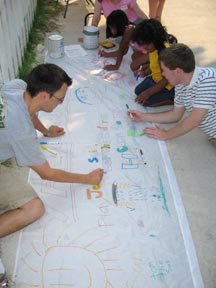
Student volunteers from Calvary Baptist Church in Waco color with a child at a neighborhood Bible club.

Waco’s Community Development Corporation is a faith-based organization focused on providing housing for people in need and teaching them skills to care for a house and manage money.

“We help people who are renters become homeowners,” said Darrel Abercrombie, the organization’s program administrator.

While Abercrombie stresses the importance of owning a home, he said: “Renting is not a bad thing. It’s just a temporary thing.”

The organization offers classes every Thursday night in six-week intervals that teach about down payments, credit counseling, loans and other aspects of home buying.

Even after a house has been purchased, the faith-based group offers a post-purchase program, where “we teach them how to maintain the property and to take care of their investment,” Abercrombie said.

After the new family moves into a house, Calvary members and workers with the Community Development Corporation throw a “welcome to the neighborhood” party.

“We want to create a place where people know their neighborhood and neighbors,” Abercrombie said.

His group’s vision is to have well-taken- care-of homes, sidewalks and street lamps provided by the city—“because light dispels problems; the Scripture says that,” he said.

While the vision of a well-kept neighborhood is set, “a house is not a home until you bring God into the midst of it,” Abercrombie said.

In 2001, when the Community Development Corporation started, Calvary Pastor Julie Pennington-Russell preached a sermon titled, “Fools for Christ.” She talked about how Christians do things other people think are weird, but asked, “What could be more foolish for Christians to do than to move into the neighborhood surrounding the church?”

Since then, several members have moved into the area near the church.

“The idea is to choose an urban neighborhood, and this is about as urban as you can get in a city this size,” Dowd said.

Meg and Ralph Cooper were among the first members of Calvary Baptist to call North Waco their new home. He is an attorney who works out of his home, and she is a student at Baylor University’s Truett Seminary.

The Coopers always had wanted to renovate a house, but they never thought about it as missionary work. Cooper said they were attracted to the house through the Community Development Corporation.

“The community has potential, but it needed people with skills to come in and help,” Mrs. Cooper noted.

Drugs and prostitution plague North Waco. “When we first moved out here, no pizza places would even deliver here,” Cooper said.

Even though the area wasn’t “exactly a low-crime rate area,” the couple knew they wanted to focus on the neighborhood.

“One of the ways to change the world is to change a house, a block, a neighborhood,” Mrs. Cooper said.

The Coopers provide out-of-the-ordinary ministry from their home—a bologna sandwich ministry.

“If people ask for money, we don’t give it to them. If they ask for money for food, I give them a bologna sandwich and an apple—the same thing I have for lunch,” Cooper said.

Mrs. Cooper had an unusual request one day as she was working in her front yard. A woman, who probably had not showered in two days, asked to use her shower.

“I would never have had somebody ask to use my shower before, but this was like an everyday Matthew 25 kind of thing,” she said. “What if that were Jesus asking to use my shower?”

After their first shower request, Cooper said, they’ve started thinking about turning a room in the basement into temporary lodging and making a shower available.

The Coopers are hosting a neighborhood Bible club this summer, one of several held in the neighborhood near Calvary Baptist Church.

Calvary introduced the neighborhood Bible club to give children a chance to have fun and learn about God.

“The church has always been involved with the community and neighborhood,” Dowd said.

“One of the ways we get the people involved with the community is we started out having people walk to lunch after church. We would walk to neighborhood restaurants so people would see that you won’t get mugged just walking to lunch.”

Even though Calvary has had two opportunities to move to the suburbs, the church voted to stay both times to continue ministering and bonding with the people of the neighborhood. “It’s easy to preach about it, but they are choosing to live out the Scripture in front of people. Some people don’t read Scripture, but they will read your life as you live it,” Abercrombie said.


News of religion, faith, missions, Bible study and Christian ministry among Texas Baptist churches, in the BGCT, the Southern Baptist Convention ( SBC ) and around the world.


Well-drilling innovation brings water to Kenyan villages

Posted: 6/23/06

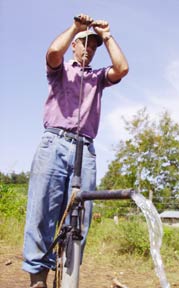
Volunteers and local Kenyan water technicians manually drill a bore-hole well.

Well-drilling innovation
brings water to Kenyan villages

By Matthew Waller

Special to the Baptist Standard

RABONDO, Kenya—A Baptist missionary’s new drilling technique has been cutting the cost of water wells in third-world countries from several thousand dollars to $100, all while teaching the people there how to drill for themselves. And now the technology has come to Kenya.

Terry Waller, a missionary to Bolivia through World Concern and Southland Baptist Church of San Angelo, went to Kenya recently at the request of Lifewater International, a Chris-tian organization addressing water issues in developing countries. With five other volunteers, Waller drilled two wells and trained eight local water technicians in Rabondo, a community in western Kenya.

He developed the technology on the field in Bolivia in the early ’90s. “We wanted (the drilling technique) to be manual,” Waller said. “We purposely designed it so that local people could drill their own wells. Our idea from the beginning was that we didn’t want it to be something where highly trained technicians had to do the drilling. We wanted either locally trained boys to be the well service providers or have the families themselves be able to drill wells.”

Terry Waller pumps at a finished well.

The system uses locally made materials. Drill bits are made locally with a sample bit that Waller takes with him, and the rig uses mostly PVC pipe for the drill stem to keep the process lightweight and inexpensive.

Four to eight people use a rope and pulley to quickly lift and release the rig into a water-filled hole, so that the ball-and-dart bit, which acts as a one-way valve, can churn the ground and force the water and cuttings up the pipe and into a settling pond.

Cathy Fitzgerald, the Life-water volunteer who invited and accompanied Waller, has been visiting Rabondo biannually since 2001 to drill with a motorized, mud-rotary rig.

“When we go over with a group, we’re able to drill, but it’s not really self-sustaining,” Fitz-gerald said.

“People can’t afford a truck to move it around; they can’t afford the gas or the oil to run the engine. … We thought that doing the manual well-drilling technique and training some of the water technicians that already know how to drill would enable them not only to do cheaper wells, but also to do it on a year-around basis.”

Peter Midodo, the pastor of a nondenominational church in the Ndhiwa community about 30 miles from Rabondo, said many families in his area walk a mile to haul water.

“They can only carry a small bucket, maybe 15 or 20 liters, and by the time they go and come back, it’s all used up,” Midodo said. “Some children cannot go to school because they have to get water.”

Rabondo Baptist Church Pastor Joseph Owaga said people in the community near his church walk more than a mile to get water from the river, used for bathing and polluted by chemicals used in farming.

“We do not have one well,” Owaga said. “When the rains stop, probably next month, we’ll have a real problem with water.”

Well service providers can charge several thousand dollars for their services.

In February 2006, the African Research and Medical Found-ation spent almost $35,000 on seven wells for about 2,000 people. A Catholic school in nearby Rapogi paid $24,000 for its water system. Fitzgerald’s motorized rig costs $2,000 to drill. Hand-dug wells also cost about $2,000 around Rabondo.

“I don’t think anyone is cheating anybody,” Waller said. “Well drillers have to charge for the risk, they have to transport the machinery. They’re just giving the market price.”

Waller said an experienced crew in his area of Bolivia can dig two 50-foot wells at 60 cents per foot, complete with homemade pumps, in one day. Rabondo’s rocky hills, however, presented more of a challenge.

“Everything that could go wrong did go wrong,” Waller said. An improperly threaded bit broke off after it had passed through a rock layer. Another bit broke from using too much weight to unintentionally drill through bedrock. The local glue occasionally gave out, detaching couplings from plastic pipe and leaving the crew to fish the rig out of the hole.

Despite these problems and others, Rabondo water technician Paul Okelo, who has been with Lifewater since its first visit, said he was impressed with having finished two wells—40 feet and 27 feet—in one trip.

Melchizedeck Okello, a Rabondo technician who professionally makes hand-dug wells, also liked the completion time.

“I found this method very good because it’s saving time,” Okello said. “With this, I can drill a well in three days.” Okello said he takes about three weeks to drill a 20- to 40-foot well.

The manual technique has worked drilling through Bolivia’s Altiplano desert at 12,000 feet; through Nicaraguan hills’ volcanic pumice; through coral and gneiss rock near Sri Lankan beaches; on the sides of hills in Chiapas, Mexico; through the Brazilian Shield’s laterite-rock hills; and through the sand and hard clay of Bolivia’s eastern river valleys, where Waller lives.

On average, wells reach down between 150 and 175 feet, and 1,700 to 2,000 wells have been drilled in Bolivia, Waller said. The deepest manually drilled well went to 250 feet, and a rig using a motor to replace rope pullers went to 350 feet.

Waller organizes the drilling in Bolivia, not only through individual training, but through informal “water well clubs,” people who come together to borrow a rig after learning how to drill and shop for materials. Clubs make a well for each party in the group, handle their own finances and promise to return the rig as received.

“We do clubs so that it’s still neighbors helping neighbors,” Waller said. “Our vision is to empower people to solve their own water problems.”

Water, however, has only been one facet of the Wallers’ ministry. During the day, Waller and his wife, Kathy, help homesteaders develop ways to make a living, and they do church work in the evening.

“We want to minister holistically … to the physical side and the spiritual side,” Waller said. “Families need more than just water to prosper. They also need to have a love relationship with God. … That’s the most important thing.”

Matthew Waller is a Baylor University journalism student who recently accompanied his father, a Baptist missionary with World Concern, to Kenya and Ethiopia.

News of religion, faith, missions, Bible study and Christian ministry among Texas Baptist churches, in the BGCT, the Southern Baptist Convention ( SBC ) and around the world.


Offering of Letters addresses hunger

Posted: 6/23/06

Offering of Letters addresses hunger

By Kelly Knox

Special to the Baptist Standard

WACO—Two-thirds of the people in the world live in extreme poverty, and Lake Shore Baptist Church in Waco wants lawmakers to alleviate their suffering.

For 20 years, Lake Shore has teamed up with Bread for the World, a faith-based advocacy organization seeking justice for the world’s hungry and impoverished.

Lake Shore recently took part in Bread for the World’s Offering of Letters, an event in which church members wrote legislators to express their opinions about international poverty.

Lake Shore Baptist Church member Jo Pendleton writes a letter to a legislator, expressing her views on how the United States should respond to issues of hunger and poverty.

“Bread for the World has provided a way for Lake Shore members to actively participate in policy change, a level of change that could potentially affect large groups of people worldwide,” church member Kate Brennan Homiak said.

“Bread for the World’s letter writing campaign engages church members of all ages to get involved. Children who cannot even write yet draw pictures to send to their representatives in Congress. Youth, alongside the adults, advocate through writing letters.”

Jon Singletary, assistant professor in Baylor University’s School of Social Work and director of Baylor’s Center for Family and Community Ministries, said one of Bread for the World’s goals includes encouraging Congress and President Bush to keep the promises agreed on during the 2000 United Nations’ Millennium Summit.

During the summit, 189 countries—including the U.S.—agreed upon a set of poverty-focused developmental goals to be reached by 2015.

“These letters are symbolic of a tithe to God. They will help to shape Congress’ decisions, and they show our country’s legislators where our hearts and minds are,” Singletary said. “We must be mindful that we are part of a global economy.”

Singletary, who has been a member of Bread for the World 10 years, led a group of Lake Shore youth to move from thinking about poverty to acting upon it.

“What are the small things we can do here that could help make a difference over there?” he asked the teenagers. “We could give food away, but we’d find the same people would keep coming back. So what can we do in the long run?”

Last year, the United States had a federal budget of almost $3 trillion. A large percentage was spent on federal defense, Social Security and health care, he said.

“But can you guess what percentage we spent addressing matters of international poverty?” he asked the teens.

Guesses of 20 and 10 percent shot across the room until Singletary’s solemn voice broke the chatter.

“We gave less than half of 1 percent,” he said. “In fact, of the 23 wealthiest countries in the world, we are 22nd or last when it comes to providing poverty-focused developmental assistance.”

Singletary proposed the youth join with other Lake Shore members in writing Congress to encourage a $5 billion increase in foreign operations spending for fiscal year 2007.

The $5 billion would go a long way toward establishing infrastructures such as clean water, basic sanitation, roads, schools and hospitals in the world’s poorest countries, he said. As a result, he continued, people in poor nations can strengthen their own economy and meet their own needs.

Singletary discovered adults in the church also were concerned about poverty and injustice.

“We have a mandate to care for the poor, and in that, there is no political boundary. Our country is so free at waving the flag, but sometimes we’ve forgotten that waving the Christian banner is a mandate too,” member Emily Fau said.

Fau noted Lake Shore’s members long have supported Bread for the World’s Offering of Letters campaign.

“The congregation is deeply invested in this project and ask about it if they think that the time is getting near but haven’t yet heard any information about it,” Pastor Dorisanne Cooper said. “And just when you think it might have slipped under people’s radar, you walk in to see the letter basket in our hallway filled with letters.”

Since Lake Shore first began partnering with Bread for the World, members have noticed Christians are doing more to look at issues of global poverty and sustainable development.

“We’re doing things in that we’re having these kinds of conversations and acting on them,” Singletary said. “People are coming together in new and exciting ways like with the ONE Campaign. Diverse peoples who wouldn’t want to be in the same room with one another are signing the same document to say, ‘Let’s make poverty history.’”

Seth Wispelwey, regional organizer for the ONE Campaign for Bread for the World, said he has seen a tremendous increase in efforts to eradicate poverty since he came to work for Bread in November 2004.

“People who participate find hand-writing letters empowering and exciting. It’s great to see the energy sparked so much last year continue in so many places rather than just fizzle out,” Wispelwey said. “It was really exciting at the end of last year to see Bread letters help turn the tide in stopping seemingly inevitable cuts to food stamp programs for the 2006 budget.”

Cooper believes addressing international poverty is the church’s responsibility.

“We don’t see it as partisan work, but simply as one piece of our attempt to try and follow Jesus’ unmistakable call to care for the poor,” she said.

For more information about Bread for the World’s 2006 Offering of Letters, visit www. bread.org.

Knox is a senior social work major and journalism minor at Baylor University.

News of religion, faith, missions, Bible study and Christian ministry among Texas Baptist churches, in the BGCT, the Southern Baptist Convention ( SBC ) and around the world.


Texan places first at national tournament

Posted: 6/23/06

Texan places first at national tournament

By Elizabeth Staples

Communications Intern

Jessica Jones of Prestonwood Baptist Church in Plano won first place in the National Invitational Speakers Tournament in Birmingham, Ala., the fourth consecutive year the winner of the Baptist General Convention of Texas Speakers Tournament took top honors at the national level.

Jones represented the BGCT at the national tournament, along with Iwalani Caines from Westside Baptist Church in Killeen, who won first place in the state junior high Bible Drill division, and Jacob Eunice, a member of Northside Baptist Church in Del Rio, who won first in the senior high Bible Drill division.

“Preparing for this competition really helped to develop my leadership skills. I feel more grounded (in the Bible) because of what I’ve learned,” Eunice said.

All high school drillers and speakers who participate in the state finals are eligible for scholarships to Texas Baptist universities.

More than 1,500 Texas Baptist students participated in Bible Drill/Speakers Tournaments across the state. More than 85 Texas Baptist churches took part in the competition.

Competitors ranged in age from fourth to 12th grade. They began early in the fall working with leaders in their local churches.

Bible drillers pass through three levels of participation. The church drill is held each spring one or two weeks before the associational drill. Children who make no more than 12 mistakes are eligible to participate in the associational drill. At the associational drill, a child who makes no more than 16 mistakes advances to the state drill.

The BGCT offered state drill sites for qualifiers in Abilene, Dallas, San Antonio Arlington, Austin, Pasadena and Plainview.

Every participant received a certificate from the BGCT Bible Study/Discipleship team and a seal corresponding with their score. The 207 participants who did not make a mistake received a certificate with the seal of “State Perfect.” They also received the Bible with which they drilled with an inscription from the BGCT.

See the complete list of children who qualified as “state perfect” participants here.

News of religion, faith, missions, Bible study and Christian ministry among Texas Baptist churches, in the BGCT, the Southern Baptist Convention ( SBC ) and around the world.