Religion shaped 2008 in big, dramatic ways

WASHINGTON (RNS)—Barack Obama chose Joe Biden, and John McCain turned to Sarah Palin, but in the end, the most sought-after running mate in the 2008 campaign never appeared on a single ballot.

God, it seems, couldn’t be entirely wooed by either party.

The unprecedented and extraordinary prominence of religion in the 2008 election was easily the year’s top religion story. Both parties battled hard for religious voters, and both were forced to distance themselves from outspoken clergy whose fiery rhetoric threatened to become a political liability.

In the end, the top prize went to Obama, the Christian son of a Muslim-born father and an atheist mother, who spent much of the campaign fighting off persistent—and untrue— rumors that he was a closet Muslim. His party, after years of consistently losing churchgoers to Republicans, decisively won Catholics, Jews and black Protestants and made small but significant inroads among some evangelicals.

Presidential candidates John McCain (left) and Barack Obama (right) join Pastor Rick Warren (center) at the Saddleback Civil Forum at Saddleback Church in Lake Forest, Calif. (Photo/Ann Johansson/RNS)

McCain, meanwhile, managed to shore up his dispirited base of religious conservatives, winning three out of four born-again or evangelical voters, but his troubled campaign could not overcome an onslaught of negative economic news that, in the end, trumped all other issues.

“It’s very tempting, but a bit dangerous, to over-interpret what happened,” said Luis Lugo, executive director of the Pew Forum on Religion & Public Life. “Clearly Obama improved across all religious groups, but the economy just overwhelmed every other issue.”

Still, the 2008 campaign was remarkable for the ways religion—or religious figures—played such a prominent role. Obama was forced to sever ties with his fiery pastor of 20 years, Jeremiah Wright of Chicago’s Trinity United Church of Christ, for sermons deemed racist, anti-American and at times downright bizarre. McCain, in turn, was forced to reject the endorsements of Texas mega-church pastor John Hagee and Ohio’s Rod Parsley.

Focus on the Family founder James Dobson tried to play kingmaker by first saying he would not vote for McCain “under any circumstances” and later calling the Palin pick “God’s answer” to prayer. Former Arkansas Gov. Mike Huckabee, the candidate who proved most popular among religious conservatives and who won the Iowa Republican caucuses in January, failed to gain traction despite ads that dubbed him a “Christian leader.”

Obama and Biden both faced strong opposition from Catholic leaders over their support of abortion rights. One American cardinal, James Stafford, called Obama’s election “apocalyptic,” and a South Carolina Catholic priest told Obama supporters to head to confession before receiving Communion.

All of that, Lugo said, shows that voters want their politicians to be at least somewhat religious—but prefer to make up their own minds, without the interference of politically outspoken clergy.

“People still do not want religious institutions or religious leaders to weigh in on politics,” said Lugo. “There’s strong opposition to it, and a strong consensus against it.”

Yet one religious leader whose politics are fairly well known—and not always embraced by the American public—received a 21-gun salute when he arrived at the White House in April for a six-day U.S. tour.

When Pope Benedict XVI arrived for his first U.S. visit, many Catholics still clung to fond memories of his predecessor. But by the time he wrapped up his whirlwind spin around New York and Washington, Benedict left with higher approval ratings than when he arrived.

“What I saw in the faces of the people who waited to greet him, who had a chance to hear his message, was more than just happiness. It was a sense of profound joy,” said David O’Connell, who hosted the pope as president of Catholic University in Washington.

The pope surprised his U.S. flock with an unexpected attention to the clergy sex-abuse crisis. He told American bishops the scandal had “sometimes been badly handled” and said they had a divine mandate to “bind up the wounds … with loving concern to those so seriously wronged.” He met privately with a small group of abuse victims and told a stadium Mass of 46,000 “no words of mine could describe the pain and harm inflicted by such abuse.”

“There was an expectation and a hope that the pope would say something comforting and consoling to a wounded church, and I think he accomplished that,” O’Connell said.

Other top issues 

Despite their loss at the polls, conservatives continued their winning streak on the volatile question of gay marriage in California (where the state Supreme Court voted to allow same-sex marriages in May), Arizona and Florida. The high-stakes and expensive California fight, which still is being battled in the courts, reflects conservatives’ ability to rally the troops at the ballot box in opposition to gay marriage.

A related fight over homosexuality continued to roil the Episcopal Church, which saw dioceses in Fort Worth, Quincy, Ill., and Pittsburgh secede to realign with a more conservative Anglican province in Argentina. Related big-ticket legal fights resulted in a $2.5 million deficit for the national church.

In August, Episcopalians emerged from a once-a-decade summit of Anglican bishops in England relatively intact despite calls for discipline from conservative Anglican bishops, most of whom boycotted the three-week Lambeth Conference.

That fragile unity will be tested in 2009, however, as conservatives move to establish a separate-but-equal province on U.S. soil.

Conservatives have launched a new branch of the Anglican Communion—the Anglican Church of North America. The Common Cause Partnership, as the conservatives’ umbrella group is known, still needs to gain recognition from leading Anglican archbishops, win the favor of the Archbishop of Canterbury and overcome serious theological discord among its own members.

The United Methodist Church voted to keep its traditional stance on homosexuality, maintaining rules that call homosexual activity “incompatible with Christian teaching.”

The Presbyterian Church (USA), meanwhile, voted to remove a constitutional rule that requires clergy to maintain “fidelity in marriage … or chastity in singleness.” However, a majority of local presbyteries must approve the amendment, which may prove too high a hurdle.

Religion and secular law collided at a fundamentalist Mormon polygamist compound in Texas and controversial sect leader Tony Alamo’s compound in Arkansas over charges of sexual abuse of minors. In Oregon and Wisconsin, three sets of parents were charged in the faith-healing deaths of children who were denied routine medical treatment.

In November, the small, Utah-based Summum sect asked the U.S. Supreme Court for the right to erect monuments to its “Seven Aphorisms” alongside existing Ten Commandments markers in a case that could decide how much government can—or should—memorialize religious tenets.

Interfaith relations continued their difficult dance in 2008 as several high-level attempts at dialogue—by the United Nations, Saudi King Abdullah, the Vatican and former British Prime Minister Tony Blair—sought tentative common ground between the Muslim world and the largely Christian West.

The world lost some leading religious figures in 2008, including Mormon President Gordon Hinckley and philanthropist Sir John Templeton, both 95; Lutheran theologian Krister Stendahl at age 86; Transcendental Meditation guru Maharishi Mahesh Yogi, thought to be 91; and W. Deen Mohammed, who broke with the racially tinged teachings of the Nation of Islam founded by his father, at age 74.


Christians have opportunities to shape lives through foster care

While Scripture advocates taking care of orphans and widows, the church has abdicated that responsibility to the state, some Christian child-advocates insist.

“It shortchanges people and the church,” said Robbi Haynes of marketing and recruitment for Missouri Baptist Children’s Home & Family Ministries, a corporation of the Missouri Baptist Children’s Home.

With more than half a million children in the foster care system, according to the Adoption and Foster Care Analysis and Reporting System, the church has an opportunity and a responsibility to minister to children and their families, Haynes said.

The need is great, she emphasized. “There are never enough foster homes—ever.” Often, one foster parent will have around eight children, because the system is desperate, she said. Many foster families get overloaded and quit completely.

“Many are willing, but they don’t know about the opportunity,” Haynes said. And the church can help with that.

Church needs to be in forefront 

“The church needs to have at the forefront that foster care is a ministry,” she said. “Missions doesn’t have to be on the other side of the world. It can be down the hall—in a bedroom at your house.”

John Marshall, pastor of Second Baptist Church in Springfield, Mo., regularly addresses the need for foster parents from the pulpit.

“People are allowed to indicate on their information cards if they would like to be contacted by MBCH to find out more about it,” Haynes said.

“Also, they have volunteers in the church who encourage and support foster parents by prayer and encouragement, child care, camp scholarships, help with birthday and Christmas, etc.”

The cost to a church wanting to be involved is minimal, she said. Training and licensing are available at no cost. Churches only need to provide space and publicity. “The cost is in annoyance,” she said. “These are not easy kids, but they need a church family, and the church will benefit.”

Studies have found that families who have a connection with a church do a better job at fostering than those not in church, Haynes noted.

How to help 

Churches can assist foster families in a variety of ways. Simply be an encourager to a family and give them a pat on the back, Haynes suggested. Provide childcare or respite care. Involved individuals will need to go through background checks, but the process isn’t difficult, she said.

Churches can help with financial obligations such as school supplies, class rings, prom dresses, sports uniforms and summer camps. “Foster parents are reimbursed, they are not paid,” Haynes said. “Most don’t break even.”

Churches also can present a welcoming environment for foster children. “Most have never been in church,” Haynes said. “They have no training in how to behave.”

It’s important for the church to let foster parents know they are on the same team—not an “Oh, there they are again,” mentality, she said.

Churches can provide space for foster parent training by letting organizations that place foster children know the church is available.

Other ideas include organizing a support group for parents or hosting the county appreciation dinner for foster families. “Most counties have a dinner and need to find a place,” Haynes said.

“Foster care is not glamorous,” she said. “It’s not like getting to jet off to India. It’s just hard work, but it’s worth it. I think it’s what Jesus would want us to do.”


Merton’s legacy looms large four decades after his death

TRAPPIST, Ky. (RNS)—This month, many contemplative Christians—including an ever-growing number of evangelicals—are remembering the life of Trappist monk Thomas Merton, who died 40 years ago in a freak accident.

Merton, who influenced generations of believers with both his monastic lifestyle and his prodigious writings—some 60 books were published during his lifetime, and about as many in the 40 years since his death—is especially noted for bringing spirituality to the laity.

“The essence of Merton’s spirituality is, I think, the humanity of it, that he really speaks to ordinary people,” said Paul Pearson, director and archivist of the Thomas Merton Center at Bellarmine University in Louisville, Ky.

Thomas Merton

“He knows so well the great classics of Christian spirituality, but he can interpret them in a way that people in our world today can understand and relate to.”

At the time Merton rose to prominence, the Roman Catholic Church did not encourage personal study of Scripture and meditation on it apart from the church.

“Spirituality really belonged to the monks and nuns and bishops and what have you,” Pearson said, “whereas your ordinary lay person went to Mass on Sundays, the Mass was in Latin, they said the rosary, and that was the extent of it. And Merton, I think, really opened up the whole realm of contemplation and spirituality for people.”

Merton’s own spiritual journey was complex. He was an aspiring writer and had—by his own account—lived a rootless and hedonistic life.

He converted to Catholicism in 1941 and shortly thereafter arrived at the Trappist Abbey of Gethsemani in the hills outside Louisville. In 1948, when he was 33, he published his autobiography, The Seven Storey Mountain, an overnight bestseller now considered a Christian classic.

Merton’s fame allowed him to correspond with presidents, popes and Nobel Prize winners. But as his public reputation grew, he retreated further and further into solitude and silence. Later, his abbot gave Merton permission to live for lengths of time as a hermit in a small cottage about a half-mile from the monastery.

In the 1960s, Merton’s spiritual journey found him taking on the issues of the day—civil rights, materialism, the nuclear arms race and the Vietnam War.

His superiors blocked the publication of some of his most strident anti-war writings.

“As he changed from the world-denying monk to the world-embracing monk of the ’60s, people began to think: ‘Why should he be writing on these issues? He’s away in a monastery. What does he know about them?’” Pearson said.

In 1968, Merton was electrocuted in a Bangkok hotel room after touching a fan with faulty wiring. Since then, Merton’s reputation and influence have continued to grow. Scholars have published about 60 more of his books, including seven volumes of his personal journals.

As a monk, Merton left behind just a few personal possessions—his work shirt, a cup, boots and his eyeglasses.

“With the death of Thomas Merton,” Pearson said, “we lost … one of the great prophetic figures within the Catholic Church, and I think that’s why his books are still selling, why they’re still being translated, because that message is as relevant today as when he wrote it.”


At 72, gospel music’s best-selling artist won’t slow down

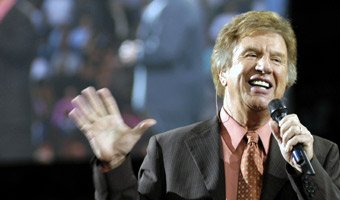
WASHINGTON (RNS)—Bill Gaither may not be an A-list celebrity in some circles, but over a half century he has sold 20 million recordings and 20 million DVDs—more than any other gospel performer. And his impact exceeds mere sales figures.

He and his wife, Gloria, have written more than 600 songs, including many published in hymnals used in churches around the world, such as “Because He Lives.”

If he wanted to rest on his laurels, Gaither certainly has enough accolades and money to do so. But at 72, he’s still busy writing, recording and traveling with his current 32-city Homecoming tour. Friends ask Gaither if he plans to slow down any time soon.

Bill Gaither has sold more albums than any other Christian recording artist and, at age 72, shows no signs of slowing down. (RNS PHOTO/Courtesy Lobeline Communications)

“Retire? And do what?” he asks in his signature soothing baritone voice. “If I had to sing high C’s every night, or play keyboard at a high level, it would be better to back off. By myself, I’m not really that fantastic. But what I do is bring together talent. And I’ll continue to do that gladly.”

Gaither was a college student in 1956 when he formed the Bill Gaither Trio with a brother and sister.

After he married, Gloria became his primary partner in life, songwriting and performing. The Trio recorded more than 40 albums and filled arenas nationwide.

In 1980, he founded the Gaither Vocal Band. The quartet’s 30 albums feature everything from old-time Southern gospel chestnuts to pop-based contemporary songs.

No one has been more successful than Gaither at bridging the often-contentious divide that separates Christian music’s traditionalists from its harder-rocking contemporary fans.

“Christian music is about a theology and a message and can’t be pinned down by any one style,” he said.

“Over the centuries, that message has been wrapped in a lot of different styles. The wrapper is always changing, but the basic message is always going to stay. I don’t think God really cares about the wrapper, but he cares very much about the content.”

Through the Vocal Band and other activities, Gaither also has promoted and mentored some of the most popular Christian artists of the past four decades, including Sandi Patty, Larnelle Harris, Carman, Steve Green, Don Francisco, Michael English, David Phelps, Russ Taff and Mark Lowry.

“It sounds (like a) cliche, but he really is in a category all by himself,” said John W. Styll, president and CEO of the Gospel Music Association, who credits Gaither with “single-handedly re-energizing” Southern gospel, the genre he’s called home for the most recent phase of his career.

Gaither was working on Homecoming, the Vocal Band’s 1991 album, when he stumbled across the formula that has proved remarkably—and unexpectedly—successful.

He invited about a dozen gospel music pioneers to join in on the classic song, “Where Could I Go But to the Lord.”

After the recording session, the singers ate fried chicken and gathered around a piano to shoot a music video. Before they knew it, someone started playing the piano and the singers all joined in.

Three hours had passed before the singing finally stopped, Gaither recalled, and he realized the video camera had captured nearly an hour of the impromptu session. Four minutes were used for the music video.

The remaining footage gave birth to a Homecoming phenomenon that has spawned dozens of CDs, more than 60 DVDs, broadcasts on more than a dozen cable outlets like TNT and a popular concert tour that in 2004 outsold tours by Rod Stewart, Elton John and Fleetwood Mac.

Homecoming’s success has provided steady work for a revolving roster of musicians and singers.

And Gaither has plowed some of his earnings into the Gospel Music Trust Fund, which supports aging or ailing artists. In 1991, the fund had about $20,000 in its bank account; today, it is worth nearly $3 million.

Gaither is surprised by the popularity of the Homecoming franchise, which he attributes to the sense of community and shared collective memory the music creates among both the artists and fans.

“The Christian church has often been guilty of neglecting its history,” Gaither said. “But if you show me a person who does not know where he’s been, I’ll show you someone one who does not where he is going. The result is spiritual arrogance.

“What we’re trying to do with the music we sing at the Homecoming concerts is salvage the best of the past.”


Faith Digest: Lutheran publisher announces cutbacks

Lutheran publisher announces cutbacks. Augsburg Fortress, publishing arm of the Evangelical Lutheran Church in America, is cutting back operations, closing nine bookstores in the United States, laying off more than 50 employees and declining to publish new books in its consumer-oriented line. The publisher will concentrate on congregational resources and academic texts, said Sheryl Burmaster, Augsburg’s director of customer care. The publisher will retain 242 full- and part-time employees, according to the ELCA. 

 
Judge orders Arizona to allow pro-life plates. A federal court has ruled the Arizona License Plate Commission must approve an anti-abortion group’s “Choose Life” specialty license plate. The Arizona Life Coalition applied for the specialty license plate in 2002, but the Arizona License Plate Commission rejected its application. Attorneys with the Alliance Defense Fund and the Center for Arizona Policy filed suit in 2003. Last January, the 9th U.S Circuit Court of Appeals ruled the commission had violated the Arizona Life Coalition’s First Amendment right to free speech by rejecting its application. The commission appealed to the U.S. Supreme Court to reverse the decision, but the high court refused to hear the case. U.S. District Judge Paul G. Rosenblatt ordered the commission to convene by Jan. 23 and approve the license plates.
 

Disney corrupts children, Catholic Brit charges. A top Roman Catholic cleric in England has accused Disney of corrupting children, encouraging greed and turning its make-believe world—as embodied at its theme parks—into a latter-day pilgrimage site. Christopher Jamison, the abbot of Worth Abbey, in southern England, charges Disney with “exploiting spirituality” and helping to generate a culture of materialism while pretending to provide movie, book and theme park stories with a moral message. Jamison, a candidate to succeed Cardinal Cormac Murphy O’Connor as leader of Catholics in England and Wales, lodged the accusations in his new book, Finding Happiness.
 

Bob Jones University apologizes for racist policies. Bob Jones University, a fundamentalist Christian school in Greenville, S.C., that did not admit African-American students until 1971 and banned interracial dating until 2000, has apologized for its past racial policies. The school posted a statement about race at Bob Jones University on its website, saying the school’s past policies were shaped “for far too long” by “the segregationist ethos of American culture” rather than by biblical principles. “Though no known antagonism toward minorities or expressions of racism on a personal level have ever been tolerated on our campus, we allowed institutional policies to remain in place that were racially hurtful,” the statement said. Five university alumni launched a website, Please-Reconcile.org, to collect signatures for an open letter to Bob Jones leaders saying they were “troubled” by the school’s racist reputation. They collected more than 500 signatures. The statement by the university was released before the group sent its signed open letter to the administration.


History’s most notorious rude host gets a bum rap

WASHINGTON (RNS)—’Tis the season for Christmas pageants everywhere to dramatize one of Scripture’s most familiar scenes and cast a cold-hearted innkeeper, who shoos away the holy family to a lowly stable.

But pageants and sermons castigating the infamous innkeeper give him an underserved bad rap, scholars say, and feed dangerous misconceptions about how Jesus’ contemporaries received him.

“We’re so brainwashed into this idea of the mean old innkeeper and no room at the inn, we don’t even notice that this is a violation of the text that we’ve just read,” said Kenneth Bailey, a Bible scholar and author of Jesus Through Middle Eastern Eyes.

The stained-glass nativity scene at New York Avenue Presbyterian Church in Washington shows the baby Jesus in a manger. Scholars agree Jesus’ birth in such humble surroundings offers evidence of divine humility, but some are calling into question traditional views about the inhospitable innkeeper. (PHOTO/RNS/David Jolkovski)

The innkeeper’s reputation stems from a single, oblique reference in Luke 2:7. The verse says Mary wrapped the newborn Jesus in cloth “and laid him in a manger, because there was no room for them in the inn.” From this text, Christian communities through the centuries have inferred that their Savior was rebuffed at birth.

The reality possibly was much different. The “inn” (or “lodgings” in some translations) was not a hotel or hostel but perhaps a guest room in the private residence of one of Joseph’s relatives, according to Mikeal Parsons, a Baylor University New Testament scholar who’s writing a commentary on Luke.

Because that room already was occupied, Parsons suggests, hosts may have made room for Mary and Joseph within their own family quarters and cleaned up an animal feeding trough—a manger—to serve as a crib.

Such details are important, scholars say, in part because the birth narrative is rich with symbolism. The divine infant’s portrayal in modest circumstances suggests, for instance, God humbled himself to join the commonest of humankind. Hence for later generations to conjure a fictitious innkeeper and make him into something of a villain may be to read a new, unwarranted and potentially misleading significance into the story.

“It’s kind of a ‘gotcha’ moment to recognize there is no innkeeper or reason to castigate an innkeeper, but that’s what we tend to do,” said Thomas Stegman, associate professor of New Testament at Boston College School of Theology and Ministry. “It’s an easy thing to cast judgment on this figure, (but) anything that gives us an out from examining ourselves first is not a good thing in the spiritual life. … We need to consider instead, ‘How hospitable have we been?’”

Surrounding the innkeeper’s image is the question of who welcomed Jesus and who rejected him. Bailey cautions that Christians need to be careful not to let presuppositions about an innkeeper perpetuate harmful stereotypes about Jews.

“It’s important for us as Christians to look at our text and say, ‘We have read an anti-Jewish undercurrent into a lot of stories where it’s not there, and here’s one of them’,” Bailey said.

Scholars continue to press for a new image of an anonymous host who never hesitated to show respect—and who now deserves a little reciprocity.

“Luke is highlighting the hospitality of the anonymous householder (friend or relative) and not condemning the inhospitality of an insensitive innkeeper,” Parsons said.


Global downturn necessitates increased U.S. anti-poverty efforts

WASHINGTON (ABP)—The global financial crisis makes it even more urgent that the United States not only take care of its own economy, but also redouble efforts to aid the world’s poorest, according to a new report and several development experts.

The 2009 edition of the Christian anti-poverty group Bread for the World’s annual hunger report calls for the government to streamline international development efforts through renewed focus and a series of reforms—despite, and because of, the international economic downturn.

“At a time like this, we ought to use our foreign assistance effectively, and we ought to distribute more of our aid to struggling families around the world who are trying to overcome hunger and poverty,” said Bread for the World President David Beckmann. “This crisis has been a huge setback in the world’s progress against hunger, poverty and disease.”

Massive increases in food costs

Massive increases in the cost of basic food items in many places around the globe have driven approximately 100 million more people into extreme poverty in the last two years, Beckmann said. The report estimates 75 million more people are malnourished than two years ago.

The United States should not use its own economic woes as a reason to cut back on foreign aid, Beckmann insisted.

“It would just be wrong for us to be so preoccupied with our own problems that we forget the nearly billion people in the world who do not get enough to eat,” he said.

The report calls for several reforms in the way U.S. development and aid work is conducted, including:

• Elevating development and poverty reduction “as specific goals in U.S. foreign policy, distinguished from political, military and security goals, with distinct and secure funding.”

• Coordinating development assistance with recipient nations “to meet their long-term development goals and focus on outcomes with measurable goals and objectives.”

• Maintaining civilian leadership in U.S. development-assistance efforts, with the U.S. military’s role “limited to its operational strengths in logistics and stabilization.”

• Creating one “effective, streamlined agency” to channel all U.S. development assistance, now spread across 12 Cabinet departments and dozens of federal agencies and offices.

“We need to have a consolidated agency that is separate from AID,” said Peter McPherson, president of the National Association of State Universities and Land Grant Colleges, referring to the U.S. Agency for International Develop-ment. McPherson was the agency’s administrator during the Reagan administration.

Polls show the majority of voters want to increase the aid the United States provides to the world’s poor, Beckmann noted.

“Their main motive is humanitarian,” he said. “People know that people on the other side of the world are desperately poor, and so that if Americans think that they can really help, they are willing to help.”

World hunger threatens national security 

Another motive is national security, because Americans know after 9/11 that misery in far-off places can breed terrorism at home, he added.

Beckmann noted the food and economic crises will increase instability in the world if not addressed properly.

“We’ve seen economic progress in many poor countries—and then suddenly a disappointment,” he said. “That’s an explosive situation.”

Several Baptist organizations—the American Baptist Churches in the U.S.A., Cooperative Baptist Fellowship and Baptist World Aid—cosponsored the report along with several other Christian denominational and parachurch groups. The report includes a Bible study guide for church groups to use in exploring what Scripture has to say about hunger and caring for the poor.


Studies show rise in greenhouse gases in 2007

ATLANTA (ABP) — Greenhouse-gas emissions continued to rise in 2007, according to two new studies. But Southern Baptists are still divided over what, if anything, to do about it.

The World Meteorological Organisation said Nov. 26 that concentrations of carbon dioxide and nitrous oxide reached new highs in 2007, and methane had its largest annual increase in a decade. 

smokestacksThe gases are thought to contribute to the "greenhouse effect" that the vast majority of climatological scientists believe is causing a gradual warming of the planet.

A government study released Dec. 3 showed that, despite increased public awareness about global warming and numerous policy changes, 2007 greenhouse-gas emissions in the United States increased 1.4 percent over the 2006 total.

CO2, methane and nitrous oxide

The WMO report found that levels of carbon dioxide (CO2), the single most important gas thought to affect global temperatures, increased 0.5 percent from 2006 to 2007. That growth rate is consistent with recent years.

Methane, another gas created by both natural and human activities, increased last year at the highest rate since 1998.

A third gas, nitrous oxide, also reached record levels in 2007.

The study says Earth's greenhouse-gas levels were fairly consistent for 10,000 years until the beginning of the Industrial Revolution. Atmospheric carbon dioxide, which accounts for 63 percent of greenhouse gases, has increased 37 percent since the late 1700s, primarily due to emissions from fossil fuels and, to a lesser degree, because of deforestation.

According to Reuters, WMO expert Geir Braathen told a news briefing in Switzerland there is no sign that carbon dioxide and nitrous oxide are leveling off, and it is too early to tell if methane would keep rising.

Scientists warn that the gradual warming of Earth's atmosphere caused by greenhouse gases will lead to rising sea levels, more damaging severe weather and increased heat waves and droughts.

Kyoto Protocol 

The current international pact curbing greenhouse-gas emissions, the Kyoto Protocol, expires in 2012. World leaders hope the United States, which did not ratify the accord, will sign on to a new pact, and that developing nations like China and India will commit to emissions targets.

The Energy Information Administration study blamed increased U.S. carbon-dioxide emissions on two factors: unfavorable weather conditions — which increased demand for heating and cooling in buildings — and a drop in hydropower availability that led to greater reliance on coal and natural gas for generating electricity.

In the United States, evangelicals remain divided over how seriously to regard rising levels of atmospheric gases linked to climate change.

Jonathan Merritt, spokesperson for the Southern Baptist Environment and Climate Initiative, said the new data is significant not only from a climate standpoint, but for theological reasons.

"Keep and tend the earth"

"As Southern Baptists, we believe in the truth of God's word, which includes the command to keep and tend the Earth and see it flourish," Merritt said. "Regardless of one's stance on climate change, everyone can agree that pumping record levels of gas into our atmosphere isn't a good idea and certainly wouldn't be consistent with the idea of stewardship."

A number of prominent Southern Baptists, including current Southern Baptist Convention President Johnny Hunt, signed a declaration in March urging increased action to reduce greenhouse-gas emissions. So far a total of 550 individuals have endorsed "A Southern Baptist Declaration on the Environment and Climate Change." 

Those signers don't include the convention's official representative for moral and public-policy concerns, who maintains the globe is actually getting colder instead of warmer.

Global warming called a "hoax"

Richard Land, head of the SBC Ethics & Religious Liberty Commission, called global warming a "hoax" and a "scam" on his weekly radio program Nov. 22.

Land attributed fluctuations in global temperature to "cycles of nature that God has allowed in the cosmos" and labeled human activity "a minor contribution to global warming."

"The sunspots have faded, the solar cycle has peaked, the sun is going into a quiescent period and everybody but [former Vice President and anti-global warming activist] Al Gore is cooling off," Land said

Merritt said people who selectively quote data to support a contrarian view on the evidence for global warming "are driven more by an ideology than a theology."

Merritt said he has spoken to Southern Baptist missionaries around the world who thanked him for speaking out on the issue.

"They say that they use the creation as a starting point for sharing the gospel," he said. "Furthermore, they say that the Western world's witness is hurt by our wasteful and consumptive habits. When we speak with a unified moral voice and put feet to our faith, the gospel is stronger both at home and around the world."


–Bob Allen is senior writer for Associated Baptist Press.


Atheists sue Kentucky for requiring crediting homeland security to God

LEXINGTON, Ky. (ABP) — An atheist-rights group and 10 Kentucky citizens are suing the commonwealth to remove a requirement that the state's Homeland Security office credit God for keeping residents safe from terrorism.

The religious language, largely unnoticed when inserted into homeland-security legislation in 2006, made news lately when its sponsor complained the department did not mention God in its mission statement, on its website or in its 2008 Homeland Security report.

Rep. Tom Riner, D-Louisville, inserted language into a floor amendment that called for "stressing the dependence on Almighty God as being vital to the security of the Commonwealth" and affirmed that security "cannot be achieved apart from reliance upon Almighty God."

Former Republican Gov. Ernie Fletcher, an ordained Baptist minister, obeyed the law, which includes posting a plaque with the 88-word statement at the entrance to the state Emergency Operations Center.

A 56-page report released Oct. 31 by the current Democratic governor, Steve Beshear, the son of a Primitive Baptist preacher, however, omitted the religious language.

"We certainly expect it to be there, of course," Riner told the Lexington Herald-Leader.

After learning the God requirement was there, American Atheists recruited 10 Kentuckians to sue to have it removed.

The lawsuit called it an unlawful attempt to "endorse belief over non-belief, set up a religious test, indoctrinate Kentucky citizens and state employees in theistic religious beliefs, and diminish the civil rights, privileges or capacities of Atheists and others who do not believe in a god, or who believe in a different god or gods than the presumed supernatural entity unconstitutionally endorsed by the legislation." 

It denounced the law as "grossly and outrageously at variance "with both the U.S. and Kentucky constitutions and "retrograde to the very purposes of protecting American freedoms for which the Kentucky Office of Homeland Security was established."

American Atheists President Ed Buckner called actions by the legislature "illegal and un-American" and "unconstitutional on their face." 

Paul Simmons, chairman of Americans United for Separation of Church and State, urged lawmakers to overturn the legislation. Simmons, a former professor at Southern Seminary, told the Louisville Courier-Journal the Office of Homeland Security "is not in the business of promoting religion" but instead "securing all citizens against harm from enemies."

AU's Rob Boston, described the God requirement as an example of "meaningless civil religion" similar to the prayer that opens every session of Congress usually delivered before a nearly empty chamber. "It has become by-rote ritual, a thing to be gotten through so we can get to work, a mere formality," said Boston, assistant director for communications. "I'd like Rep. Riner or one of his supporters to explain exactly how this helps religion."

In a telephone interview, Riner called the lawsuit "frivolous" and said the disputed language is no different than religious references in inaugural addresses or proclamations made by every U.S. president or in the constitutions of all 50 states.

An ordained minister and pastor of Christ is King Baptist Church in Louisville, Ky., Riner attended Southern Baptist Theological Seminary in the 1960s but quit short of earning a divinity degree.


–Bob Allen is senior writer for Associated Baptist Press.


A ‘Simple Christmas’ suggestion box

Here are some suggestions to reduce and reallocate Christmas spending habits.

• Draw names instead of giving to everyone.

• Let others help; tell them your intention to give less

and ask them not to buy an expensive gift.

• Give family gifts instead of individual gifts.

• Give gifts only to children.

• Don’t give children money to give you a gift.

• Design and make your own gifts.

• Set a spending limit with spouse and family.

• Don’t buy a gift that simply will be returned.

• Bake something.

• Go caroling.

• Create a homemade gift certificate for a favor or service.

• Give to mission and benevolent projects in someone’s honor.

• Give and wrap gifts in a way that cares for the environment.

• Give the gift of your time, talents and involvement—more presence, fewer presents!

• Teach someone a skill you possess.

• Make cards or postcards on your computer.

• Send electronic cards—often free.

• Write a story or poem, make a song or create art as a gift.

• Write a letter of love and/or appreciation.

• Adopt a family in the community. Names are available through churches and community

agencies.

• Support church missions around the world.


From www.simplechristmas.org, including suggestions from Unplug the Christmas Machine: A Complete Guide to Putting Love and Joy Back into the Season by Jo Robinson and Jean Coppock Staeheli.


Tough economic times don’t dim lights on Living Christmas Trees

HUNTSVILLE, Ala. (ABP)—Rather than cutting back on lavish Christmas programs this year due to the economy, some church leaders insist hard times make them more valuable than ever.

Billy Orton, minister of music and worship at First Baptist Church in Huntsville, Ala., said his church did not even consider cutting back its annual Living Christmas Tree performance, now in its 24th year.

“The message of hope, peace, joy and love is needed now more than ever,” Orton said.

While a major investment of resources, Orton said, the church views the Living Christmas Tree—with free admission and no offering taken—as a gift to the entire community.

First Baptist Church in Hunstsville, Ala., builds a pageant around its Living Christmas Tree every year. (2007 Michael Misianowycz Harvest Action Photo)

“We are thinking there might be even larger crowds due to the fact that folks will hold back on purchasing tickets to other holiday concerts and presentations in the area and instead choose to attend one of our six performances,” he said.

Steve Poole, minister of music and worship at Oak Grove Baptist Church in Bel Air, Md.,—a congregation born during hard economic times in 1932—said he volunteered to trim his music budget along with other expenses being reduced in 2009, but so far many members have remained faithful to support missions and ministries of the church.

It costs Oak Grove about $15,000 each year to present 11 performances of the Living Christmas Tree, Poole said. The church collects a free-will offering, with any money received over expenses going to a benevolence ministry to help needy families in Harford County.

“If the tough financial times we are in now bring about a reduction in the free-will offerings, then we may need to cut back on some of our plans for the 2009 program,” he said.

The idea of lining up choir members on risers stacked cone-shape to resemble a Christmas tree has been around for decades.

The outdoor Singing Christmas Tree at Bellhaven College in Jackson, Miss., thought to be the oldest, has been a tradition since 1933.

The advent of the mega-church in the 1970s, however, introduced cavernous worship centers large enough to accommodate bringing such massive structures indoors.

While it’s unclear where the idea got started, one of the early pioneers was Bill Shadle, longtime music minister at First Baptist Church in Denton, who asked Millard Heath, a heating-and-air-conditioning contractor, about building a tree-shaped platform out of metal pipe for his 103-voice choir in 1972.

Figuring pipe would not handle the load, Heath instead designed a platform using structural steel.

He patented the design and started a company that since has since sold more than 200 trees for churches in 30 states and overseas.

M.H. Specialties in Bertram, northwest of Austin, now offers custom-built models ranging from 18 feet to 48 feet accommodating from 30 to 450 singers or more. Packages cost from $12,000 to nearly $100,000, but according to the company website some churches cover the initial cost with free-will offerings within two years.

Jeffrey Smith, who purchased the company in 2003, said he hasn’t seen any downturn in business due to the economy.

“Ninety percent of our trees this year are replacement trees,” Smith said.

Smith said he just finished putting a tree stage up in Knoxville, Tenn., in a church that has been performing a Living Christmas Tree for 35 years, but just now is upgrading from a wooden stage to steel.

A church in Bradenton, Fla., he said, had one tree taken down and replaced it with two. A church in Ormond Beach, Fla., is considering purchase of a 60-foot tree to go outdoors on the beach, possibly in 2009.

In addition to its impact on the community, Orton said the Living Christmas Tree also is important in the life of the church.

In addition to a chorus and orchestra more than 200 strong, he said, the program involves a wide cross-section of the congregation, from construction workers, technical people and decorators to car parkers. This year’s program also features the church’s children’s choirs.

“I am praying that the impact of the 2008 Living Christmas Tree is significant and eternal,” Orton said.


Whose birthday are we celebrating?

JEFFERSON CITY, Mo.—It’s time to “Unplug the Christmas machine,” states a book with the same title by Jo Robinson and Jean Coppock Staeheli. And members of First Baptist Church in Jefferson City, Mo., are challenged to do just that.

Simple Christmas, the church’s Advent theme, is a plan to “take back Christmas,” so it isn’t driven by consumerism, commercials or the material, Pastor Doyle Sager said.

Creating simple and meaningful gifts is one way to counter the renaway materialism that surround the Christmas holidays.

“It’s to help place the focus on the spiritual meaning, to be set free. The things that mean the most don’t cost anything.”

The idea for the churchwide emphasis began last October at a Central Baptist Theological Seminary Advent planning workshop. Holly McKissick, senior pastor at St. Andrew Christian Church in Olathe, Kan., led a breakout session on simplifying Christmas.

Sager and his wife, Janet, had been leading their own extended families to simplify gift-giving, from adopting families in need to gifts to charitable organizations in honor of the recipient.

As he toyed with the ideas McKissick presented, Sager knew he wanted to bring it to the church. “I told the staff, ‘I already have the Advent ’08 theme,’” he said.

Why is a simple Christmas necessary? “It’s about focusing on the real meaning of Christmas,” said Laurel Dunwoody, the church’s administrator.

“So many are at the stage where they don’t really need anything,” Sager said.

Children admire a life-size Nativity Scene at First Baptist Church in Jefferson City, Mo.

“Instead of feeling guilty for buying things no one needs,” share a more relational holiday and give funds to people and organizations that can use them.

Plans started long before the economic downturn, he added.

“It made us look genius, but it is really the Lord at work,” he said.

The church featured a “Christmas Made Simple as ABC” event to give members an opportunity to make Christmas gifts and collect a recipe book of gift, gift-wrapping and food ideas. According to Dunwoody, more than 90 people attended, including 33 children.

Some of the thoughts garnered from Unplug the Christmas Machine emphasize thinking through favorite Christmas memories from years past, and finding ways to create similar memories for children.

Taking back Christmas for its orginal meaning involves creating new family traditions.

Very rarely are those memories material gifts, Sager said. Instead, it’s “the year we got snowed in” or “the time a homeless man intruded at church and didn’t have anywhere to go, so we invited him home.”

Sager recognizes simplifying the season and focusing on the meaning of Advent is counter-cultural.

“It is a challenge, and it is countering the culture if we do it right—rather than raging (over a so-called war on Christmas), do positive things,” he said. “People love rituals and simplicity. The church has an open door if it stops complaining and whining. We have a responsibility of stewardship to take back holy days, to redeem time.”

Sager will address simplicity from the pulpit during Advent, focusing on “simple justice,” “simple holiness” and “simple humility.”

The church also has created a website—simplechristmas.org—with resources on simplifying the season, including alternative Christmas gifts, a budget sheet and links to other helpful sites.

“The website is simple—and purposefully so,” Dunwoody said.

The church will continue to maintain the website with new resources, links and personal stories beyond Christmas.

And the church will continue the emphasis next year, Sager added.