Prayer opened door for colonia church to build

Posted: 9/29/06

Pastor Omar Chavarria rests his hands on a cross that normally hangs in the church’s baptistry. Volunteers were renovating the baptistry at Iglesia Bautista Manantial de Vida in Penitas.

Prayer opened doors for Rio Grande Valley church

By Scott Collins

Buckner Benevolences

PENITAS—If seeing is believing, Omar Chavarria has 20/20 vision.

When Chavarria became pastor of Iglesia Bautista Manan-tial de Vida in Penitas three years ago, the 15-member congregation met in a garage and prayed for the day when they could buy a little piece of land.

But Chavarria, who also serves as a missions coordinator for Buckner Border Mini-stries in the Rio Grande Valley, had another vision. Where church members saw a small parcel of land and limited growth, their new pastor saw five acres and unlimited possibilities.
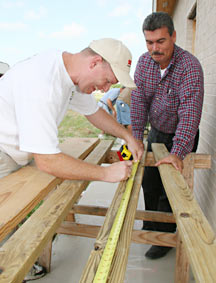
Chavarria works alongside a volunteer from First Baptist Church in Garland.

Today, a brand-new building sits on five acres, and more than 230 people are involved in the church’s ministries every week. Working with Buckner, church members are reaching out to a nearby colonia where thousands of low-income residents live.

But between the garage and the five acres was a journey of faith and belief for Chavarria and the congregation.

It started when Chavarria located a vacant piece of property to which he believed God led him. He discovered an oil company owned it, so he called the oil company to ask about purchasing the land. A month later, Chavarria got a return call from the president’s assistant saying the company was not interested in selling the land.

“I told her: ‘My Lord that I am serving wants that land, and he needs that land to reach out to this community. Tell him (the company president) I’m going to be praying for him,’” Chavarria said. The assistant told Chavarria he should write a letter to the company president, which he did.

On May 10, 2004, the assistant called Chavarria and said the oil company president had changed his mind and was willing to sell the land to the church. Chavarria set out immediately trying to find financing for the $100,000 the church needed. But banks and the Baptist General Convention of Texas told him it was too much money for the small congregation.

And while members of the congregation wanted to buy the land, they expressed doubt and fear about the money. “I told them we needed a bigger vision,” Chavarria said.

In the meantime, before the church could find funding, Chavarria received a call from the oil company saying 15 percent of the land was owned by another individual, and everything was on hold four to five months. The individual wanted to know who was going to buy the land and how it would be used.

“I prayed for that man, too,” Chavarria said.

Finally, on Sept. 30, 2004, everything was finalized. The land owners had decided to give the land to the church—but with a catch.

“They told me we had only two years to begin building, or we would have to return the land,” Chavarria said.

That’s when Chavarria literally took the first step in getting a building built. He started prayer-walking around the five acres—every day for three hours; he walked from one end of the property to other praying that God would provide a building. He put four stones on each corner of the lot and walked inside the stones.

“I thanked God for giving us this place,” Chavarria said.

For three months, Monday through Friday, Chavarria walked the lot, three hours every day. At the same time, he was also putting his faith to work by seeking help from the local Baptist association and other resources.

That’s when he met Jorge Zapata, director of Buckner Border Ministries. Zapata explained Buckner’s colonia work in the Valley and learned Iglesia Bautista Manantial de Vida also was working in the colonias. The church and Buckner began working together.

Chavarria explained the church’s predicament—needing to start construction on a building or return the land. Zapata said Buckner could help by recruiting church groups wanting to do mission work in the Valley.

By spring break 2005, Living Hope Baptist Church in College Station showed up with 60 volunteers to lay the foundation for the building and erect the frame. First Baptist Church in Madisonville followed in June with a team and $16,000 to finish the framing.

Unknown to Chavarria, the oil company had sent a worker to watch the church’s progress. The man took photos of the volunteers working on the building. Three weeks later, a check for $50,000 arrived in the mail with a letter from the people who owned the land, stating they wanted “to support the ministry because we can see that you are serious about your work.”

Six months later, in December 2005, a second $50,000 check arrived bringing the donation to $100,000 cash in addition to the five acres. To this day, the benefactors remain ano-nymous to Chavarria and the church.

“The Lord was talking to them every day because of our prayers,” Chavarria said. “We didn’t do anything. We just asked, and we received it from the Lord. I don’t know the person, but the Lord knows them, and their hearts belong to the Lord. People like these God uses for the enlargement of his kingdom.”

With the money in hand, the church was able to continue work on the building. And when other needs arose, Chavarria said, finances always seemed to arrive just in time—$7,000 for concrete, $5,000 for architectural work and $5,000 for a septic system.

For the past several months, Chavarria has been working with Buckner, first in a part-time position funded by the Cooperative Baptist Fellowship and now in a full-time role as a mission coordinator, working with groups coming to the Valley from all over the United States.

The dual responsibilities as pastor and Buckner employee enable Chavarria to continue as pastor of the church because of the income he earns from Buckner.

“It’s a blessing, because the church income was too low,” he said. Between his work with Buckner and the ministries of the church in the colonia, Chavarria has become known throughout the neighborhood as the “colonia’s pastor,” a role he gladly accepts.

Along with providing mission teams to perform light construction on dilapidated homes, Buckner also offers food, clothing and other help to families living in poverty. With the growth of Iglesia Bautista Manantial de Vida, much of Buckner’s ministry is funneled through the congregation.

“The church and Buckner are working together, and we are seeing many more blessings,” he said.

“It’s a great blessing for me to be working with Buckner, and it’s a big blessing for Buckner to be involved with the church.”

Clarification, added 10/13/06: Our original article in the Oct. 2 issue of the Baptist Standard stated Iglesia Bautista Manantial de Vida in Penitas applied for a $100,000 loan to the Baptist General Convention of Texas and was turned down. The BGCT loaned the church $50,000 on July 21, 2005. Also, the BGCT Church Starting office has approved $18,000 in program support money to help the church with early payments on the loan.


News of religion, faith, missions, Bible study and Christian ministry among Texas Baptist churches, in the BGCT, the Southern Baptist Convention ( SBC ) and around the world.


Pro-SBC young leaders’ group emerges

Posted: 10/13/06

Pro-SBC young leaders' group emerges

By Robert Marus

Associated Baptist Press

WINTER PARK, Fla. (ABP)—A group of young Southern Baptist conservatives has issued a statement to counter the influence of a rival conservative group that has been critical of the use of power by recent Southern Baptist Convention leaders.

According to some observers, the dueling groups may be harbingers of more intramural disputes to come within the Southern Baptist Convention’s fundamentalist ranks.

Meeting near Orlando Sept. 25-26, about 40 pastors and seminary professors calling themselves the Joshua Convergence presented a set of seven “Principles of Affirmation” and heard several speakers well connected in Southern Baptist life.

According to a “purpose statement” on the Joshua Convergence website, the event’s organizers convened “to give a voice to younger leaders across the Southern Baptist Convention who are strongly committed to biblical inerrancy, who support the goals and leadership of the conservative resurgence, and who unashamedly embrace biblical standards of separation and morality.”

“Conservative resurgence” is the term that the inerrantists who control the Southern Baptist Convention use to describe their efforts, culminating in the late 1980s and early 1990s, to wrest control from the moderates who had led the SBC for decades.

While virtually all of the moderates have left Southern Baptist life for the Cooperative Baptist Fellowship or other groups since then, conservatives have begun to argue among themselves. In the months prior to the June SBC annual meeting, debates surfaced about how tightly SBC leaders need to hold control of the denomination.

Much of the debate was fueled by younger SBC bloggers. Several dozen of them gathered in Memphis, Tenn., last May to issue a declaration repenting for Southern Baptists’ “triumphalism” and “narcissism” and promising to be more attentive to holding denominational leaders accountable.

Their support of South Carolina pastor Frank Page helped elect him as SBC president over two other candidates, even though Page was opposed by the SBC power structure.

In the Florida meeting, the participants heard speakers who praised the small group of leaders who have controlled much of the denomination’s direction since ridding it of moderates.

The principles participants in the Joshua Convergence affirmed were:

–Truth.

The group affirmed “the inerrancy of Scripture” and asserted the “battle for the Bible must be renewed in every generation. We take our stand to continue in that battle.”

–Gratitude.

They expressed “deep thankfulness for those who have taken our convention back to its theological and spiritual moorings.”

–Service.

Participants noted they “are aware that—as with any human organization—the mechanisms of the Southern Baptist Convention can be manipulated. We commit to refrain from such practices.”

–Holiness.

They affirmed “personal purity and separation from worldliness” and singling out “the sale and consumption of alcoholic beverages.” The affirmation said the denomination “has stood against the evils of alcohol. The present generation can in good conscience do no other.”

At least one leader of the “Memphis Declaration,” Oklahoma pastor Wade Burleson, has been criticized for not enforcing total abstinence on his congregation. The Orlando group also said it is “unequivocally opposed to the antinomian attitude in some Christian circles concerning unwholesome and immoral language, cynicism and profanity. We feel strongly that the Bible condemns such actions.”

–Unity.

They noted that within the group there are diverse positions on Calvinism, eschatology, worship, and outreach, “we reject all attitudes of mean-spiritedness, personal attacks, or intellectual and spiritual arrogance in these debates.”

–Identity.

The group affirmed Baptist ecclesiology and “the fundamental principles which constitute a Baptist church are the very ones which made up a New Testament church.” Among those principles listed was the separation of church and state.

–Mission.

They voiced support for the denomination’s unified budget.

Among the speakers at the conference, held at Aloma Baptist Church in Winter Park, Fla., were several with close ties to Paige Patterson, president of Southwestern Baptist Theological Seminary and often acknowledged as the center of power in modern SBC life.

The conference’s organizers and speakers included professors and other employees from the three educational institutions Patterson has led, such as North Carolina pastor Stephen Rummage, who was a protégé of Patterson’s at Southeastern Baptist Theological Seminary.

One popular moderate Baptist blog, written by Baylor graduate student Aaron Weaver (bigdaddyweave.blogspot.com), said the meeting was a sign that fundamentalists in the SBC have finally begun to turn on each other in earnest.

“It’s rally-the-troops time,” Weaver wrote in a Sept. 25 post. “Patterson’s minions are putting on their war paint, digging the trenches and preparing for guerilla warfare…. The SBC wars won’t stop until the ‘other side’ is in a body bag. Rather, the SBC wars won’t stop until the Fundamentalists stomp out all dissent and the ‘other side’ ceases to exist.”

An anonymous blog written by a Southwestern Seminary student, identified only as “SWBTS Underground” (swbtsunderground.blogspot.com), similarly interpreted the rival meetings as the beginnings of another battle.

“No one has been inactive in this battle over leadership and authority in the SBC. It is about to flesh out into an all-out war,” he wrote Sept. 24. “It is going to be a rehash of the conservative resurgence, but with one key distinction—both sides feel like they are taking the true conservative position, both sides feel God is on their side, and both sides now have vendettas and past wounds to avenge. This is a scary time in the SBC.”

But a Joshua Convergence participant named “Steve,” who describes himself as a layman from the meeting’s host church, said in a Sept. 26 entry on his Kerussopolis blog (www.kerussopolis.com) the group was not seeking to make war.

“I can say with absolute certainty that the Joshua Convergence is not a war-like, combative, forceful movement,” he wrote. “But while it is not combative, it is reactionary…. They are concerned that those who do not share their beliefs are speaking for them, and they want to be identified apart from these ‘other young leaders.’“


News of religion, faith, missions, Bible study and Christian ministry among Texas Baptist churches, in the BGCT, the Southern Baptist Convention ( SBC ) and around the world.


‘Blue like Jazz’ buzz continues

Posted: 10/13/06

‘Blue like Jazz' buzz continues

By Hannah Elliott

Associated Baptist Press

DALLAS (ABP)—Reactions among evangelical Christians to Donald Miller’s best-selling book Blue Like Jazz are about as diverse as reactions to the idea of postmodern Christianity itself.

Although the book debuted three years ago, its steadily growing popularity has made it a bona fide phenomenon in evangelical circles and spurred debates about the direction of Christianity as a whole.

Blue Like Jazz: Nonreligious Thoughts on Christian Spirituality, Miller’s second book, uses the medium of a spiritual memoir to deconstruct and analyze much of what many evangelicals take for granted about the Christian lifestyle.

Miller—who grew up as a Southern Baptist in Texas—uses the book to chart his own spiritual journey alongside Texas Baptists, Oregon hippies, atheists, folk singers, liberal college students and even penguins.

According to Scott Wenig, a Denver pastor, author and seminary professor, it’s Miller’s honesty about his sometimes-awkward growth toward spiritual maturity that attracts readers. The “experiential” approach Miller uses resonates with people who need exposure to faith not defined by analytical study or obscure points of theology, he said.

“Academics have the tendency to live out of their heads,” Wenig said. The average person, we live out of our hearts. That doesn’t mean we’re not using our heads, (but when we) happen to experience someone writing (from the heart), what happens is they’re touching something in people that most academics don’t touch.”

For instance, Miller recounts in the book how he often felt he couldn’t interact with God—or God’s people—freely. Then he read Anne Lamott’s Traveling Mercies, and his perspective changed.

“When I started writing, I just wanted to end up with something like Anne Lamott’s Traveling Mercies, because in Traveling Mercies it felt like she was free, free to be herself, to tell her story, to just vent, to rant, to speak as if she were talking to a friend,” Miller wrote.

That honesty is what has endeared Blue Like Jazz to its fans—an antidote to the syrupy facade many people associate with the Christian subculture.

Since the book’s release in 2003, it has sold more than 550,000 copies worldwide. Christian groups have tried to tap into that appeal, using the book in outreach efforts like Campus Crusade kits for college students. Wenig often reads from it during his sermons at Aspen Grove Community Church, located in suburban Denver. And seminary students nationwide are devouring Miller’s writing.

Some critics, however, wonder whether this literary marriage between a memoir and theology is ideal. Douglas Groothuis, a well-known Christian blogger and professor of philosophy at Denver Seminary, wrote in a Feb. 26 blog post that Miller’s habit of addressing “titanic issues” with little more than “a smirk and a shrug and a pose” belies the need for solid intellectual analysis when it comes to practicing Christianity.

“He finds no need to be serious intellectually or to pursue subtleties,” Groothuis wrote on theconstructivecurmudgeon.blogspot.com, adding that Miller’s desire to tell his personal story trumped all else in the book.

“Miller is cavalier and glib about the rational foundations for Christian faith,” Groothuis said in an interview. “This is ironic, given the tremendous renewal of Christian philosophy and apologetics in our day. True spirituality is a rational and biblical faith that tenaciously defends the objective, absolute, and universal truths of Christianity.”

In fact, Groothuis said, it’s important to analyze books like Blue Like Jazz not because of what they say, but because of what they indicate about the world. Unfortunately, he said, pop culture is dominated by image, style and glamour rather than character and truth.

“We must ‘attune’ our communication of Christian truth to diverse people but never compromise the truth and virtue of the faith by dumbing it down or making it flippant, as does Miller, to my mind,” he said. “People can handle far more biblical meat than they are given credit for.”

Nonetheless, conservative leaders have publicly deplored Miller’s social activism, occasional use of profanity and alternative style. Miller, who worked in campus ministry at liberal Reed College in Portland, posts links to groups like Greenpeace and the American Civil Liberties Union on the website www.bluelikejazz.com.

Other leaders simply can’t agree with his theology, especially the individualist approach iconoclastic authors like Miller and Lamott take to Christianity. For Groothuis, that doesn’t add up to biblical theology.

“It is all too easy to lob criticisms of the church when you are not part of it, not part of making the church better,” he said. “One must be a critic from within the church if one is to be a Christian.”

But Wenig countered that such fears are what cause “a lot of academics to really struggle” with authors like Miller and Lamott—because academics are paid to deal with the question of truth. Some Christians think that if people begin to “go off the road doctrinally,” they’ll become heretical and “go to hell,” he said.

“Sometimes we’re driven by fear because we’re afraid that certain things will send people off the deep end,” he said. Fortunately, though, Christianity has a “built-in self-correction mechanism” through the dual roles of the Bible and God’s grace, Wenig added.

“Eventually, I think most groups in Christianity self-correct,” he said. In fact, although Wenig himself disagrees with some parts of Blue Like Jazz, he said Miller is orthodox in much of his theology and would put him “clearly within the historic Christian camp.”

Miller, for his part, said in a Relevant magazine interview that he has not flourished in churches with “consumer-oriented Christianity” and “self-help, formulaic kind of stuff—the moralist and political angles on our faith tradition.” Yet he said he loves his Portland, Ore., church, Imago Dei, and believes the worldwide church reflects God’s presence.

That dichotomy—between the church universal and local churches—is how Miller differentiates between Christianity and spirituality. According to Wenig, Miller uses the word “Christianity” to mean the combination of Christian thinking with the practice of the church, culture and subculture over the centuries. When Miller talks about spirituality, Wenig said, he means the way of life that Jesus came to teach.

“See, the pressure to be a certain kind of person in the context of the church culture I was living in was intense,” Miller said in Relevant. “When the pressure was taken off, and I was surrounded by people who would describe themselves as pagans, there was suddenly no pressure for me to perform or be like anything. They didn’t care, and that allowed my faith to grow for real.”

That attitude is reflected in Miller’s book, which says institutionalized religion can inhibit true spirituality.

Wenig agrees, for the most part. “I wouldn’t say it’s primarily that, but sometimes (religion) … does get in the way of experiencing what we might call genuine spirituality,” he said. “Sometimes structures or institutional aspects … get in the way of really connecting with Jesus. Sometimes even Christian religion is the enemy of the gospel.”

Like him nor not, Miller’s work continues to attract many evangelical readers—even if they disagree with some of his doctrinal or political stances.

Michael Spencer, campus minister at Oneida Baptist Institute in Oneida, Ky., wrote on his blog, internetmonk.com, that Miller’s honesty about “depravity, evangelical nonsense, Christian excuse-making and the truth of the words of Jesus” challenges him.

“I don’t know what I was doing reading these books,” he wrote. “There were moments in Blue Like Jazz that … I would feel like anyone who knew I was reading such a book would laugh at me, like finding out that your pastor reads middle-school romance novels. And then I would come across one of those ‘wow’ paragraphs. Whatever the price to get to those paragraphs, they are worth the trouble.”


News of religion, faith, missions, Bible study and Christian ministry among Texas Baptist churches, in the BGCT, the Southern Baptist Convention ( SBC ) and around the world.


Chinese pastor leads international mission

Posted: 10/13/06

Chinese pastor leads international mission

By Barbara Bedrick

Texas Baptist Communications

STAFFORD—When Peter Leong was a boy in Malaysia, he never imagined he would end up in Texas. Now, as pastor of a Houston-area church, he is leading a team of Baptists back to Asia to help 82 pastors and their families spread the gospel.

The international mission trip is the second in three months for Southwest Chinese Baptist Church in Stafford, and it highlights growth in the Asian Baptist global community. In September, the 300-member church and Cross Pointe Baptist of San Jose, Calif., partnered with sister churches in Taiwan, Malaysia and Hong Kong on their third joint mission to Thailand.

Peter Leong

This time, the church is partnering with Ching Mei Baptist Church in Taipei, Taiwan, to sponsor the first Northern Thailand Pastor Family Retreat for pastors, spouses and children. Members of the Stafford church collected funds to pay for travel, lodging, meals and books for the weeklong project.

“We were blessed by God’s provision,” Leong, 61, said. “This is the first-ever pastor retreat for these Thai ministers. Our classes will be held in a remote mountain area. Some of the pastors and their families will even have to make the trip on foot.”

The 36-member team has chosen to work in Thailand because Leong grew up in Malaysia and was pastor of a Hong Kong church before he moved to Texas. Four years ago he delivered the keynote speech at the Chinese Global Baptist Mission Conference in Thailand, and it changed his life, he said.

“God spoke to me, saying you must not only have a mission in China but also in Thailand, so I decided to invite church members to go there on a mission,” Leong said.

Ministering to the needs of the Thai people has opened doors to new relationships in a country where most residents practice Buddhism. The Chinese Baptist mission team has worked to train pastors, teach parents and help children develop new job skills, conduct vacation Bible schools, and run camps in Asia. They have reached hundreds who are non-Christians.

Focusing on youth evangelism has been another goal of the Thai mission, “including efforts to reach young girls and their families who believe their only means of survival is through human trafficking,” Leong said.

He uses Kung Fu demonstrations to help open doors for a Bible study on campus. One principal was so impressed that he invited the mission team to bring in a preacher and Bible study every week, Leong said.

The team’s understanding of the Thai culture, he added, has encouraged people to experience and learn about Christian love and beliefs. “We’ve found the Thailand people are more accepting of us because we’re of similar ethnic backgrounds. We can do this great thing because they view us as more accessible,” he said. “We’re doing God’s work through our own cultural understanding.”

One of the best parts of the work, Leong said, is the special joy in his heart when he hears about people who have received Jesus—a joy that can’t be squelched by politics or fear.

The mission team will return to Thailand just weeks after tanks rolled down the streets of Bangkok and a military coup ousted the prime minister. That turmoil doesn’t worry Leong, though. He’s just happy to be making the trip.

“I am totally committed to the Lord, and I don’t worry about going back there,” said Leong. “We’ve made a strong commitment to reach the Thai people, and this will not deter us.”


News of religion, faith, missions, Bible study and Christian ministry among Texas Baptist churches, in the BGCT, the Southern Baptist Convention ( SBC ) and around the world.


Pendleton church rebounds from disaster

Posted: 10/13/06

High winds destroyed the framework for Pendleton Baptist Church. At right, Pendleton Baptist Church begins to rebuild.

Pendleton church rebounds from disaster

By George Henson

Staff Writer

PENDLETON—Pendleton Baptist Church has rebounded quickly after high winds recently blew down the framework of what would have been the congregation’s first building, but Pastor Tom Adams acknowledged the event took the wind out of his sails.

“It didn’t bother me on Saturday when I went out there to see it right after it happened, and it didn’t bother me on Sunday when we had a really good worship service. But on Monday, when we took it back down to the foundation—that bothered me a bit,” he admitted.

The 2,800-square-foot structure had the walls and trusses up before the winds brought it all crashing into a heap. Adams estimates the event cost the church about $16,000, and it was not insured.

“We have insurance now, but I guess the cow’s already out of the barn,” he said.

Still, Adams and his congregation are looking to the future with great expectation.

“It’s a trial and a speed bump, but we’re just going to get on with it,” he said, matter-of-factly.

One of the most gratifying aspects of the ordeal has been the way other churches and individuals have helped with the building project—both times.

The church building’s collapse also grabbed the attention of the community, even people not among the church’s 48 members.

“It’s pulled the whole community together,” Adams said. “They’ve been watching us all along, because this little community hasn’t had a church in 40 or 50 years, so this is the greatest thing for this little community since sliced bread.”

Adams came from Oregon in April 2003. Since starting the church, it has met in a three-bedroom home.

The congregation hopes to move into a new building by the end of the year—not for their own comfort, but because the education rooms and larger auditorium will enable them to reach more people in the community.

“I have a determination to make the church the center of the community like it was years ago,” Adams said.

Plans also include adding a basketball pavilion, a community center where groups can gather.

Adams also wants to be sure an underground shelter is incorporated so residents will have a place to escape the tornados prevalent in the area.

“I think if we make it available, people will use it. They can say ‘We’re meeting at the church,’ and everybody will know where it is.

“They can get comfortable there, and maybe it will lead to people coming to know Christ, which is the whole reason for us being here,” he said.

News of religion, faith, missions, Bible study and Christian ministry among Texas Baptist churches, in the BGCT, the Southern Baptist Convention ( SBC ) and around the world.


Community sees schoolhouse attack as ‘Amish 9/11’

Posted: 10/13/06

Community sees schoolhouse attack as ‘Amish 9/11’

By Daniel Burke

Religion News Service

WHITE HORSE, Pa. (RNS)—The boys walked home from their one-room schoolhouse just across the fields and groaned to their mother that a substitute teacher would be leading the next day’s lessons.

“Well, boys, I’m in no position to hear complaining about schools,” Mary R. told her four young sons.

An Amish family arrives to pay their respects at the White Oak farm of Chris and Rachel Miller, who lost two daughters when a gunman killed five girls at an Amish school. (RNS photo by Robert Sciarrino/The Star-Ledger of Newark, N.J.)

Then the 42-year-old Amish woman told her boys that students at a nearby school needed their prayers. There had been a hostage-taking earlier that day at an Amish school 15 miles down the road in Nickel Mines, Mary said, and several children had been hurt.

In an attack some in this tight-knit Christian community began calling “the Amish 9/11,” an armed man burst into an Amish schoolhouse in Lancaster County Oct. 2 and shot 10 young students before killing himself. Five students died and five others were critically wounded. The gunman, identified as Charles Carl Roberts IV, shot and killed himself at the scene.

“That’s exactly what this is—the Amish 9/11,” said Sam S., an Amish carpenter from Gordonville, a town about five miles from Nickel Mines.

“We’ve never experienced anything like this before here.” Like many Amish men and women, Sam and Mary asked that their full names not be printed because they didn’t want to stand out from other members of their community.

Among the Amish, who honor a humble lifestyle modeled on the Gospels, such provocative statements are rare. But as Lancaster County’s estimated 25,000-member Amish community struggled to make sense of the shooting—the shocking violence, the chaotic search for loved ones, the conflicting and confusing news reports—many said it carried unmistakable echoes of the terrorist attacks of Sept. 11, 2001.

Although they are friendly with outsiders—whom they call “English”—the Amish keep to themselves. Forgoing modern conveniences, such as electricity, cars and computers, they live in close settlements, where family and friends are seldom more than a buggy ride away.

See Related Articles:
• Community sees schoolhouse attack as ‘Amish 9/11’
How will the Amish cope with school shooting?
Amish remember gunman as good neighbor, family man
Amish isolated but still vulnerable to violence

The lessons of the shooting, always grounded in the understanding that earthly events are driven by a divine hand, will be imparted in the living rooms and kitchens of the large, inseparable Amish families.

After the evening’s chores were done—the horses fed and the barn swept—Mary R.’s family gathered for dinner around a large kitchen table at their farm in White Horse.

The conversation quickly turned to the shooting.

“This is our 9/11,” said Mary’s husband, Ben, 41, as his wife and their young sons picked at their hamburgers and soup. “Out here, this is just so uncommon.”

Mary’s pregnant cousin—the mother of the Nickel Mines teacher—was visiting the school and was taken hostage, but she was released before the shooting began.

As Mary and Ben explained the day’s violence to their sons, they emphasized the importance of forgiveness and trusting in God.

“I just feel bad for the gunman,” Ben said. “He had a mother and a wife and a soul, and now he’s standing before a just God.”

While outsiders might be surprised at the forgiveness immediately extended to Roberts, Donald Kraybill, an authority on Amish culture, said that reaction is typical of the nonviolent Christian community.

“That theme of forgiveness really comes from the example of Jesus, who carried that spirit even to the cross,” said Kraybill, a professor of Anabaptist studies at Elizabethtown College in Lancaster County.

In Gospel lessons, hymns and prayer books written in German dialect, those teachings are passed down through generations in Amish settlements.

“I think the Amish are much better prepared to cope with something like this than most Americans,” Kraybill said. “They see things as having a higher purpose, there’s a higher good, so they are more able to absorb and accept things in a spirit of humility.”

But as their family gathered beneath a gas lamp in their living room after dinner, Ben and Mary struggled to explain why a gunman would want to hurt Amish children. They told their sons he had a “little problem in his head that made him do mean things.”

One of the boys stared at his plain black pants, fingered his suspenders and again asked, in a respectful tone: Why?

Settling her hands on her lap, Mary said: “Sometimes we don’t understand. I understand that the Lord does let this happen, but I do not know why.”

“Really, the only way to answer this is to toss it in the Lord’s lap and say, ‘You take care of it; I can’t,’” Ben said after turning to the boy.

“But you may ask him to please carry us through,” Mary said.

As the night grew long and the boys began to yawn, Ben pulled a little black prayer book from the shelf.

He pointed to a prayer often read at Amish funerals and provided an English translation.

“Glory Father, we thank thee for all the blessings which thou has bestowed upon the departed one, especially now that thou has redeemed him from this wicked world and brought his sorrows to an end, and as we trust, has taken his soul home to thee.”

News of religion, faith, missions, Bible study and Christian ministry among Texas Baptist churches, in the BGCT, the Southern Baptist Convention ( SBC ) and around the world.


How will the Amish cope with school shooting?

Posted: 10/13/06

A group of local Amish men gather near the scene of fatal shootings at a one-room Amish schoolhouse in Nickel Mines, Pa. (RNS photo by Tony Kurdzuk/The Star-Ledger of Newark, N.J.)

How will the Amish cope with school shooting?

By Tom Feeney

Religion News Service

NICKEL MINES, Pa. (RNS)—Five schoolgirls are murdered in their quaint, quiet hamlet. A community that shuns attention as a matter of religious principle suddenly finds itself in the media glare.

How will the Amish cope?

That question hangs in the air over Nickel Mines as the Amish take up the ritual of grieving the deaths of the five young girls and the process of forgiving the man who shot them, all while under the curious gaze of more than 100 print, TV, Internet and radio journalists.

“This is difficult,” said Jacob King, an Amish farmer, as he passed through the country crossroads just up the hill from the West Nickel Mines Amish School. King was on his way to pay respects to one of the families who had lost a daughter there. He nodded toward the satellite trucks and the power cords and the tripods. “This makes it more difficult.”

See Related Articles:
Community sees schoolhouse attack as ‘Amish 9/11’
• How will the Amish cope with school shooting?
Amish remember gunman as good neighbor, family man
Amish isolated but still vulnerable to violence

As difficult as it might be for the camera-shy Amish to have to stare down dozens of cameras at their darkest hour, they may be better equipped culturally and religiously than other communities to deal with the mayhem Charles Carl Roberts IV sowed in one of their one-room schoolhouses.

One thing that works in their favor is a long history of coming to the aid of families in need, said Donald Kraybill, a sociology professor at Elizabethtown College and an expert on the Lancaster Amish.

Another is their huge support system. The average Lancaster County Amishman has between 75 and 80 cousins, most of whom live very close by, Kraybill said.

“They will just surround them with love and care,” he said as he stood on Mine Road, just up the hill from the schoolhouse.

Furthermore, the Amish will find some comfort in their religious beliefs. They will see the murders as God’s providence, Kraybill said. They may not understand why the killings happened, but they will accept it was God’s will.

The first public signs of mourning rituals were found the day after the shooting on farms surrounding the country crossroads known as the village of Nickel Mines. Not far from the school, the family of Mary Liz and Lina Miller received callers. The sisters, 7 and 8, lived through the shooting but died overnight in the hospital.

Hours later, a flat, horse-drawn wagon arrived at the farm with chairs that would be used for a funeral service later in the week. Relatives, friends and neighbors drove out to comfort the girls’ parents. They lined up their horses and buggies on the front lawn and carried food down to where the family was gathered.

Most of the Amish kept away from the media. When a reporter and photographer stood out by Mine Road and watched the Millers’ guests arrive, a non-Amish friend was sent out to ask them to leave.

“By cultural understanding, they’re not inclined to speak,” Kraybill said. “Their grief is nobody else’s business. That would be their position.”

For all the efforts of the Amish to wall off the outside world, they have strong connections to the non-Amish towns that contain their communities. They are friends and neighbors to the non-Amish people whose homes line the streets around their farms.

They knew Charlie Roberts as the friendly-enough truck driver who came around every night to collect the milk from their cows.

“These children knew the man very well,” Jacob Fisher Jr., a 23-year-old dairy farmer, said through the screen door of his home across the street from where Roberts lived. “They knew who it was. It’s hard for us to believe he could do something like this.”

Those existing ties are likely to keep the shooting from causing fissures in the relationship between the Amish and the “English,” as the Amish tend to call non-Amish of all nationalities.

“We are a very close community,” said Douglas Hileman, pastor of the Middle Octorara Presbyterian Church, where Roberts’ wife was leading a prayer group Monday morning while her husband was making last-minute preparations for taking over the schoolhouse.

“We know our English and Amish neighbors. Many people know each other very well, and we share each other’s pain.”

Tom Feeney writes for The Star-Ledger in Newark, N.J. Ralph Ortega contributed to this report.

News of religion, faith, missions, Bible study and Christian ministry among Texas Baptist churches, in the BGCT, the Southern Baptist Convention ( SBC ) and around the world.


Amish remember gunman as good neighbor, family man

Posted: 10/13/06

Amish remember gunman
as good neighbor, family man

By Carrie Cassidy & T.W. Burger

Religion News Service

BART, Pa. (RNS)—It’s difficult for many to imagine that the man who opened fire in a one-room Amish schoolhouse Oct. 2 is the same man who took his sons to soccer practice and his daughter shopping.

Marie Roberts, the wife of gunman Charles Carl Roberts IV, said it wasn’t the same man.

“The man that did this today was not the Charlie I’ve been married to for almost 10 years,” Marie Roberts said in a statement read to the media by a family friend. “My husband was loving, supportive and thoughtful—all the things you’d always want and more.”

See Related Articles:
Community sees schoolhouse attack as ‘Amish 9/11’
How will the Amish cope with school shooting?
• Amish remember gunman as good neighbor, family man
Amish isolated but still vulnerable to violence

State Police Commissioner Jeffrey Miller said the rambling letters Roberts left for his children and his wife at their home just a mile or two from the schoolhouse show a side of him unknown to his family or friends.

In the days before the shooting, Miller said, Roberts became angry with his life, angry with God. Roberts apparently picked the Amish school because he wanted to molest and kill young girls as a way of “acting out in revenge for something that happened 20 years ago,” Miller said.

As police surrounded the school house, Roberts called his wife and told her he had been tormented by dreams of two relatives he claimed he molested long ago.

“It’s very possible that he intended to victimize these children in many ways prior to executing them and killing himself,” Miller said. But Roberts “became disorganized when we arrived,” and shot himself in the head after shooting 10 school girls, five of them fatally.

At home after her husband’s call, Marie Roberts found rambling suicide notes, Miller said.

Roberts wrote in one of his suicide notes that he had been dreaming about the incidents of molestation and thought he would act again, Miller said.

He also wrote that he continued to be troubled by the death of the couple’s first daughter, Elise, who died about 20 minutes after she was born prematurely in 1997. She is buried not far from their home.

“He said he was angry with God for taking Elise,” Miller said. “He said it had changed his life forever.”

The revelations added more questions about the shooting rampage.

Authorities said Roberts backed a borrowed truck filled with the items he brought up to the West Nickel Mines Amish School. He entered the school with a gun and talked with the students, at times incoherently.

With the gun in his hand and a stun gun on his hip, Roberts separated the girls and the boys. He allowed the boys to leave, along with a female student, their teacher and three other women. He lined the remaining girls in front of the chalkboard before binding their feet with plastic ties.

Roberts had pieces of lumber with 10 eye-bolts inserted in them, which Miller theorized he planned to use to restrain the girls. The girls were never attached to the devices.

Authorities believe his plans were interrupted by the relatively quick response of police, summoned by the teacher from a nearby farm.

As the police were breaking into the barricaded schoolhouse, Miller said, Roberts shot all 10 girls, five of them fatally, before turning the gun on himself. Police found him face down with a gunshot wound to the head.

The Roberts family said the gunman wasn’t a vengeful man. He was a mild-mannered milk-tanker driver who lived in this tight-knit Amish community. Police said he had no prior record.

“He was never a problem. He was a family man,” said Roberts’ grandfather, speaking at the home of Roberts’ parents. “We’re shocked. It doesn’t make any sense.”

Overcome by emotion, Roberts’ grandmother seemed to gaze into the distance looking for answers. Then she let go of her emotions when reality set in. “He was a good son and a good father,” she said. “He did that. He killed kids.”

Although Roberts was a hunter, Jim Brubaker, his cousin by marriage, said Roberts never used a gun for anything but shooting game. Brubaker also never saw Roberts angry.

Roberts was the picture of the consummate family man to those who watched him take his children to the bus stop every morning.

An Amish woman who did not want to identify herself said it’s hard for her to reconcile the stories she’s heard about what Roberts did with her fond memories of him. “He was a good man,” she said, declining to say more.

A 23-year-old Amish man walked near Roberts’ home in the hours after the shooting. He characterized Roberts as “very dependable.”

Roberts picked up the milk at the man’s dairy farm, as he had done routinely for several years. The last time he saw Roberts was about 11:30 p.m. Sunday, Oct. 1. “He was a terrific milk-tanker driver,” the man said. “He was a very nice man,” he added. “I never thought any shooting out of him.”

Morgan Erb, a 15-year-old girl who baby-sat Roberts’ kids, said he was a quiet man, someone who “stuck to himself.”

“He never looked you in the eye when he talked to you,” she said. “He seemed nice enough.”

Carrie Cassidy and T.W. Burger write for The Patriot-News in Harrisburg, Pa.

News of religion, faith, missions, Bible study and Christian ministry among Texas Baptist churches, in the BGCT, the Southern Baptist Convention ( SBC ) and around the world.


Community sees schoolhouse attack as ‘Amish 9/11’

Posted: 10/13/06

Amish isolated but still vulnerable to violence

By Mary Warner

Religion News Service

HARRISBURG, Pa. (RNS)—The Amish teach their children that a gun is for hunting wild game, and any other use is a sin. They do not serve in the military. They reject the use of violence, even in self-defense.

Amish girls talk to a state trooper at the scene of the Georgetown school shootings in Nickel Mines, near Lancaster, Pa. (REUTERS Photo by Tim Shaffer)

They organize their community around their church and draw sharp boundaries around it—keeping out the violent and sexual images from television and movies.

“We imagine the Amish more immune,” said David Weaver-Zercher, religion professor at Messiah College, hours after a gunman burst into a one-room school in Lancaster County and killed five Amish girls.

“It underscored—as if we needed it underscored—that even the communities that appear to be the most isolated and most immune from violence are nevertheless vulnerable.”

The Amish began migrating to the United States from Europe in the 18th century, largely to avoid religious persecution and compulsory military service. Lancaster County has one of their largest communities—about 25,000 to 30,000 people, supporting themselves with farming and small businesses.

The Amish often own hunting rifles. Peter Siebert, director of the Lancaster Heritage Center, said some Amish businesses close on the first day of deer season. But a gun to the Amish is like a plow, he said: It’s a tool.

See Related Articles:
Community sees schoolhouse attack as ‘Amish 9/11’
How will the Amish cope with school shooting?
Amish remember gunman as good neighbor, family man
• Amish isolated but still vulnerable to violence

There have been rare occasions when “disturbed Amish people did violent things to their families,” said Weaver-Zercher. “But to respond violently is so out of character, so far from the Amish worldview … that it never occurred to me” to wonder if the gunman was Amish. He was not.

The terrible news was no doubt traveling quickly, he said, via the efficient Amish grapevine.

The Amish don’t have phones at home, but sometimes a few families share a phone in a shed between farms. Many Amish businessmen have phones in their shops. And there are non-Amish (“English”) friends with televisions.

Eventually, the Amish might entertain questions about how their schools might be made safer, said Weaver-Zercher. That sounds difficult, given how numerous they are, and “you’re not going to have an Amish bishop with a shotgun out in front,” he said.

Still, he predicted in coming weeks Amish leaders will gather and invite some “English” civic leaders whom they trust for a conversation about safety.

In the meantime, the days following the killings were filled with funerals—at homes or in barns or large shops, because the Amish have no separate houses of worship, said Donald Kraybill, an Elizabethtown College sociologist and expert on the Amish.

“The focus will be on accepting it, and on forgiveness,” he said, adding the Amish “take seriously the words of Jesus to love enemies and not to respond to violence with violence.”

Mary Warner writes for The Patriot-News in Harrisburg, Pa.

News of religion, faith, missions, Bible study and Christian ministry among Texas Baptist churches, in the BGCT, the Southern Baptist Convention ( SBC ) and around the world.


Around the State

Posted: 10/13/06

Around the State

• Thirteen faculty members began teaching at the University of Mary Hardin-Baylor this fall. They include Colin Wilborn, assistant professor of exercise and sport science; Kelda McMullen-Fix, assistant professor of nursing; Cheryl Rowder, associate professor of nursing; Aida Sapp, associate professor of nursing; John McLean, associate professor of music; Randall Brown, assistant professor of business information technology and systems; Doyle Eiler, associate professor of management and marketing; Paul Stock, assistant professor of accounting, economics and finance; David Howard, associate professor in Christian studies; Derek Davis, dean of humanities and interim dean of graduate programs and research; Yolanda Forero-Villegas, associate professor of modern languages; Diane DiClemente, associate professor in psychology; and Stacy Stoll, visiting instructor in chemistry.

• Jeanie Pinkston, registrar at East Texas Baptist University, has retired after 19 years of service.

First Baptist Church in Bishop recently honored Harold Hickman for 40 years of service as an adult Sunday school teacher. In 1966, he agreed to teach a men’s class on a temporary basis. Four decades later, the “temporary teacher” is retiring. He was honored with a breakfast and a certificate of appreciation. He is pictured holding his certificate with Wes Barnett, who now is teaching the class.

• James Steen has been named vice president for enrollment management at Houston Baptist University. He will oversee admissions, recruitment, financial aid and scholarships, registration and retention.

• Travis Avenue Church in Fort Worth has raised money to have one of the suites in the new Hall of States hotel at the Glorieta Conference Center named for its pastor, Michael Dean.

• Eleven people were honored by Howard Payne University at its alumni awards banquet. They included H.B. Ramsour, distinguished alumnus; Christy Anderson and Tom Collins, outstanding young graduates; Mickey and Linda Eddins, Randy Johnson, Wayne McAfee and LaNita Richmond, medals of service; Patsy Landry Weeks, coming home queen; and Gary and Leta Berry and grand marshals.

• Lynnette Geary has been named Baylor University’s university carillonneur. As carillonneur, her primary instrument will be the 48-bell McLane Carillon in the tower of Pat Neff Hall. It weighs more than 22 tons.

• Dean Daniel, currently dean of Wayland Baptist University’s campus in Altus, Okla., has been named dean at the Wichita Falls campus, effective Nov. 1.

• New faculty at Dallas Baptist University include Juan Baldor, professor of Spanish; Ron Bowles, assistant professor of communication and music; Todd von Helms, assistant professor of history and Christian studies; and Beverly Powell, assistant professor of English.

• Eleven people with Texas ties have been appointed as missionaries by the International Mission Board of the Southern Baptist Convention. Jason and Kelli Frealy will work in community outreach and devlopment in South America. LifePoint Church in Longview is their home church. He was a police officer in Longview. They have a 1-year-old daughter, Daniela. Daniel and Tiffany Kilcoyne will serve in western Europe as church starters. Travis Avenue Church in Fort Worth is their home church. He previously served as youth minister at First Church in Watauga. Both graduates of Hardin-Simmons University, they have one daughter, Kaylie, 2. Jeremy and Angela Newton will serve in central, eastern and southern Africa, where he will be a strategy coordinator. Immanuel Church in San Angelo is their home church. They have three boys, Jared, 5; Grant, 3; and Zachary, 1. Deron and Beth Peterson will serve as church starters in South America. Their home church is First Church in Dallas, where he has served as pastor for junior high youth and missions associate. They have two boys, Samuel, 9; and Isaiah, 3. Joe Vaughn Jr. will be a university minister in central and eastern Europe. He formerly was youth minister/assistant pastor at Calvary Church in Brenham. Jeff and Amy Williams will work as church starters in central and eastern Europe. Travis Avenue Church in Fort Worth is their home church.

Anniversaries

• David Wilson, 15th, as pastor of Southcrest Church in Lubbock, Sept. 17.

• Mitch Wilson, 10th, as pastor of First Church in Shallowater, Oct. 1.

• Fred Culbertson, fifth, as minister of music at First Church in Taft, Oct. 1.

• Balde Alvarado, fifth, as pastor of Iglesia La Esperanza in George West, Oct. 14.

• Bryan Price, 50th, in the ministry, Oct. 15. To commemorate the occasion, Price and his family conducted a concert at First Church in Pittsburg, where he served almost 20 years. He also was the first audio/visual director of the Baptist General Convention of Texas.

• Craig Vire, 20th, as pastor of Bethesda Church in Burleson, Oct. 15.

• Congress Avenue Church in Austin, 115th, Oct. 15. George Tuthill is pastor.

• Gary Hall, fifth, as minister of music as Monterey Church in Lubbock, Oct. 24.

• Scott Steggs, fifth, as pastor of Oakwood Deaf Church in Lubbock, Oct. 28.

• Valley View Church in Longview, 65th, Oct. 29. Former Pastor Jimmie Barksdale will preach, and Paul Tapp will lead music during the morning service. A lunch and afternoon program will follow. Kenneth Bowden is pastor.

• Chris Briggs, fifth, as minister of students at Hillcrest Church in Bryan.

• Scott Adams, fifth as minister of education at Hillcrest Church in Bryan.

• First Church in Friends-wood, 50th, Nov. 11-12. A meet-and-greet reception will be held from 4 p.m. to 8 p.m. Saturday. Tables will be available for sharing memorabilia from the church’s past. Sam Broughton will be the primary speaker Sunday morning. Several former staff members also will participate. For more information, call (281) 482-7573. David Belk is pastor.

Deaths

• Ruth Ann Foster, 59, Sept. 28 in Hewitt. She had been battling cancer. Foster was one of two founding faculty members of Baylor University’s Truett Theological Seminary and was associate professor of Christian Scriptures at the time of her death. Prior to joining the seminary faculty in 1994, she served as minister of education at Manor Church in San Antonio. She is survived by her mother, Alice.

• John Kiwiet, 81, Oct. 2 in Fort Worth. Born in The Netherlands, Kiwiet joined the faculty of Southwestern Semin-ary in 1967. He taught theological French and German, systematic theology and historical theology until his retirement in 1990. He was chairman of the department of theology five years and the author of 17 books. He is survived by his wife of 55 years, Margaret; five children, Eva, Talitha, Nicoline, Henry and Pieter; brothers, Joop and Wim; and 10 grandchildren.

• Lee Hemphill, 98, Oct. 7 in Abilene. Hemphill, a graduate and trustee of Hardin-Simmons University, served the school as vice president for development from 1959 to 1968 and as vice president for deferred giving until 1975. He was pastor of Silver Valley Church in Novice, First Church in Dayton and Plainview Church in Colorado City before accepting the call of First Church in Littlefield in 1943, where he remained until he left to aid his alma mater. Hemphill and his first wife, Lunelle Nix Hemphill, also supported the school financially, dedicating the assets from an array of businesses to the school. Nix Hall was built with gifts from her, her husband and other relatives. Following her death in 1987, the family created an endowment to encourage students to serve in mission outreach projects. Following his marriage to his second wife, Koreen Logsdon Hemphill, the couple made a $1 million naming gift to the school for the Hemphill Music Building. He served the Baptist General Convention of Texas as a member of the Executive Board and as second vice president. He also was vice chairman of Texas Baptist Children’s Home in Round Rock and was a trustee of Wayland Baptist University 14 years. He is survived by his son, Hilton; daughter, Rosa Lee Prichard; sister, Ruth Wittenburg; six grandchildren; and 10 great-grandchildren.

• Fred White, 93, Oct. 9 in Dallas. He served numerous churches before being called as pastor of First Church in Duncanville in 1948. In 1955, he was named pastor of First Church in Carrollton. White recruited the inaugural freshman class of Dallas Baptist College in 1965. He was appointed chairman of the religion and philosophy department, a post he held 20 years. While he officially retired from Dallas Baptist University in 1985, he maintained an office on campus and continued to work as an adjunct professor of Christian faith until 2002. He also was a competitive runner until the age of 85. He was inducted into the Texas Senior Games Hall of Fame. He won approximately 500 medals in local, state, national and international competitions; almost 300 of those medals were gold. In 2001, he received the Baptist General Convention of Texas’ Elder Statesman award. DBU gave him an honorary doctorate of divinity degree in 2002. He was preceded in death by his son, Fred Jr., and wife of 67 years, Mary Lou. He is survived by his son, Bill; daughter, Mary Helen Atkins; three grandchildren; and four great-grandchildren.

• Robert McGinnis, 86, Oct. 9 in Dallas. He was a former executive director of Dallas Baptist Association and a longtime pastor. A Howard Payne University graduate, he was licensed at First Church in Blanket in 1945 and later ordained at Coggin Avenue Church in Brownwood. Prior to his 15 years of service to the association, he was pastor of Casa View and Fernwood churches in Dallas, First Church in Royse City, First Church in Rowlett, and Calvary Church in Mineral Wells. After his retirement from the association in 1985, he was pastor of Prestonwood and Westglen churches in Dallas. He was preceded in death by his wife of 53 years, Joyce. He is survived by his son, Joe Bob; daughter, Brenda Bradford; sister, Jean Murphree; five grandchildren; and six great-grandchildren.

• Fran Porter, 74, Oct. 10 in Waco. She served as a hospital chaplain, hospice chaplain, director of Sanctuary Home in Waco, and as minister of senior adults and pastoral care at Calvary Church in Waco, where she was ordained in 1995. She was preceded in death by her brother, Albert Booth, and sister, Doris Berglund. She is survived by her husband of 54 years, Nathan; daughters, Becca Hollaway and Leslie Smith; son, Joel; sister, Jean Foor; and five grandchildren.

Events

• A leather-bound history of First Church in Seminole has been published in conjunction with the church’s 100th anniversary. It is available for $20. For more information, call (432) 758-3291.

Revivals

• Shady Shores Church, Shady Shores; Oct. 15-18, evangelist, Don Piper; music, Shout120; pastor, Bob Joyce.

• First Church, Devers; Oct. 22-26; evangelist, Paul Cherry; music, The Cherry Family; pastor, Harry McDaniel.

News of religion, faith, missions, Bible study and Christian ministry among Texas Baptist churches, in the BGCT, the Southern Baptist Convention ( SBC ) and around the world.


Book Reviews

Posted: 10/13/06

Book Reviews

The Windshield is Bigger Than the Rearview Mirror by Jeff Wickwire (Chosen)

Jeff Wickwire writes as if he were sitting at your breakfast table, having a cup of coffee with you. His relaxed style flows with insight and optimism. Through great insight into human nature and the understanding that God has a purpose for each Christian’s life, Wickwire reveals how many of them are “robbed of joy, achievement, meaning and God’s best” because they are trapped in the past.

Part 1 of his book focuses on the six “chains” Satan uses to hold Christians captive—inordinate attachments to someone or something, past successes, heartbreak, failure, trauma and bitterness. In each chapter, he presents biblical examples to illustrate and validate these causes of imprisonment.

What are you reading that other Texas Baptists would find helpful? Send suggestions and reviews to books@baptiststandard.com.

Part 2 centers on how captives can become free (through the power and work of the Lord Jesus) and achieve God’s purpose in our lives—to help others through the testimonies God has given us. By focusing attention through the “windshield,” Christians begin to see opportunities the Father places before us, as well as how others depend upon our response.

A wonderful book filled with optimism, faith and love, The Windshield is Bigger Than the Rearview Mirror should be required reading. It is a wonderful book that can be used by pastors to help deliver their people from the chains of the past to being victorious in their daily walk and service to the Lord. The minister also will gain insight and understanding into the lives to whom he ministers.

A book worth reading, Jeff Wickwire has written a book worth keeping!

Randall Scott, pastor

Immanuel Baptist Church

Paris


A Texas Baptist Power Struggle: The Hayden Controversy by Joe Early (University of North Texas Press)

Religion has an important and interesting role in the development and discussion of Texas history. From very early times, Roman Catholicism has played an important and dramatic part in Texas history and culture, even as the religious beliefs of the ancient inhabitants of the region have contributed to the richness and culture of the state. Through the years, other faiths have come to play significant and substantial roles in how the state is shaped socially and religiously. One group that emerged in the early part of the 19th century was the Baptist faith.

Leon McBeth, along with others, has presented studies of the rich heritage and often-dramatic controversies that have shaped and shaken Texas Baptists. A student and scholar trained and mentored by McBeth at Southwestern Baptist Theological Seminary has contributed a significant and important volume to that history. In A Texas Baptist Power Struggle: The Hayden Controversy, Joe Early has presented the full and insightful story of that important struggle among Texas Baptists late in the 19th and early 20th centuries.

Early sets the struggle involving Samuel Augustus Hayden and the powerful leaders of the Baptist General Convention of Texas in the late 1890s and opening years of the 20th century in the context of Baptist growth and rivalry. This was a struggle that involved two important newspapers in Baptist life—the Texas Baptist and Herald and the Baptist Standard. Early explains how this conflict was not unique for Baptists or other religious groups. He describes how the Methodists struggled with holiness and perfectionist theology and how the Churches of Christ and Christian Churches split over mission strategy, musical instruments and biblical interpretation. He carefully establishes the historical and religious setting for the controversy that developed among Baptists in East Texas and in time separated Baptists across Texas.

Early has produced a very readable, accurate, balanced story of an important controversy that helped shape two Baptist movements. He draws from the story some good, practical insights into how controversy can be handled.

This is a book worth reading and certainly valuable for those interested in the religious development of Texas. It provides insight into the nature of religious controversy and how it has shaped the important Baptist movements in Texas.

Jerry Hopkins, professor of history

East Texas Baptist University

Marshall

News of religion, faith, missions, Bible study and Christian ministry among Texas Baptist churches, in the BGCT, the Southern Baptist Convention ( SBC ) and around the world.


Baptist Briefs

Posted: 10/13/06

Baptist Briefs

American Baptists move collection south. The American Baptist Historical Society, which claims the world’s largest collection of Baptist resources, is moving to Mercer University’s Atlanta campus. While the history-rich collection is a treasure trove for researchers, it has been inconveniently divided between two sites 350 miles apart—Valley Forge, Pa., where American Baptists have their national office, and the Samuel Colgate Library in Rochester, N.Y. “The history of Baptists is the history of religious freedom in America,” Mercer President Bill Underwood said, “and the American Baptist Historical Society is the single most significant depository of that history.” Relocating the historical collection to Mercer’s Atlanta campus serves to “preserve the collection, … foster the examination of this history by future generations of students, scholars and others, and … establish Mercer as the leading center for Baptist scholarship in North America.” Mercer’s McAfee School of Theology and the Cooperative Baptist Fellowship's main national offices are on the Atlanta campus as well. The university's main campus is in Macon, Ga.


Coalition urges SBC policy on clergy sexual abuse. Members of the coalition that fought the Roman Catholic Church’s hierarchy over sexual abuse by priests are asking the Southern Baptist Convention to prevent similar clergy abuse in the denomination’s churches. Members of the Survivors Network of those Abused by Priests, or SNAP, recently delivered a letter to the SBC Executive Committee at its Nashville headquarters. It asks convention leaders to form an independent review board to receive and investigate charges of clergy abuse in Southern Baptist congregations. Part of the difficulty the SBC faces in taking aggressive action involves the autonomous nature of local churches in Baptist polity. Since individual congregations have full control over their decision-making and governing processes, the SBC can’t dictate rules or punishment to them.


Cooperative Program giving tops $200 million. For the first time, Southern Baptist giving through the Cooperative Program surpassed $200 million for national causes during the fiscal year that ended Sept. 30, according to an announcement by SBC Executive Committee President Morris Chapman. Churches gave $200,601,536 in the recently ended fiscal year—a 2.37 percent increase over the previous year.


Embattled NAMB presidential search committee chair resigns. Terry Fox—who resigned as pastor of Immanuel Baptist Church in Wichita, Kan., following charges of financial impropriety—has resigned as chair of the Southern Baptist North American Mission Board’s presidential search committee. Bill Curtis, chairman of the NAMB board of trustees, named Greg Faulls, pastor of Bellevue Baptist Church in Owensboro, Ky., as the committee’s new chair. Fox’s resignation as chair—but not as a member of the search committee—came soon after some members of his former church issued a statement linking his departure from Immanuel Baptist to accusations that he had reallocated the church’s Cooperative Program contributions to a radio program without authorization. Fox—co-host of a satellite radio program—has denied the charges and started a new church 10 miles away from Immanuel Baptist.


N.C. Baptists propose bylaws changes. Directors of the Baptist State Convention of North Carolina recommended changes to the convention’s bylaws that would give North Carolina Baptist institutions a greater say in choosing their trustees and directors. The board also implemented a motion excluding from the convention churches that “affirm, approve, endorse, promote, support or bless” homosexuality. The board approved specific guidelines for determining if a church is too approving of gays. Both changes are subject to a vote by messengers to the convention’s annual meeting in November.


Tennessee Baptists sue Belmont. The Tennessee Baptist Convention filed a lawsuit aginst Belmont University, citing breach of contract and seeking damages equal to all contributions the convention has made to the school since 1951—more than $58 million, without factoring inflation. The convention’s Executive Board filed the suit, pointing to an official repayment agreement reached by the convention and Belmont in 1951 that said if the school ever passed from Baptist control, it would repay the convention the value of any assets transferred to it. Last November, Belmont filed a request with the state to change the school’s charter without convention approval, establishing a self-perpetuating governing board that could be 40 percent non-Baptists. Executive Board President Clay Austin said he hoped the convention and the school could reach an amicable resolution through mediation. Belmont Board Chairman Marty Dickens said trustees were “astonished” to learn about the lawsuit, which he characterized as “meritless.”

News of religion, faith, missions, Bible study and Christian ministry among Texas Baptist churches, in the BGCT, the Southern Baptist Convention ( SBC ) and around the world.