Prayer mats and yarmulkes in workplace

WASHINGTON (RNS)—Complaints of religious discrimination in the workplace are on the rise, but civil rights advocates say that may not be such a bad thing.

That’s because a likely reason for a steady rise in reported incidents has nothing to do with intolerant corporate cultures but rather religious minorities who are more aware of their rights and more willing to exercise them.

“Before, somebody might have prayed kind of quietly at work and hoped nobody would stop them and didn’t really want to ask permission,” said Ibrahim Hooper, spokesman for the Washington-based Council on American-Islamic Relations. “Now they state openly: ‘Yes, I’d like permission. Is there an open room where I could pray?’”

Claims more than doubled

Between 1992 and 2007, claims of religious discrimination filed with the Equal Employment Opportunity Commission more than doubled, from 1,388 to 2,880. Among the contributing factors: a growing U.S. population and tensions precipitated by an increasingly diverse workforce.

But recent years also ushered in a new era of assertiveness, especially among members of minority faiths that require specific codes of dress, diet or behavior, said David Miller, director of Princeton University’s Faith & Work Initiative.

“They’re not the kind of complaints you would have seen 10 or 15 years ago,” Miller says.

In analyzing EEOC claims, Miller finds relatively few incidents of religious bullying, such as proselytizing managers who insist all employees attend Bible study sessions. More commonly, he sees cases in which employees demand a right to religious expression on the job.

And when their bosses say no, workers increasingly file formal complaints.

Proving discrimination an uphill battle 

Proving religious discrimination on the job can be an uphill battle. Under the amended Civil Rights Act of 1964, employers must practice “reasonable accommodation” of an employee’s religion unless doing so would pose “undue hardship” for the organization.

“The Courts have defined ‘undue hardship’ to mean anything above a … (minimal) cost or inconvenience,” said Barry Bussey, associate director of the Seventh-day Adventists’ office of Public Affairs & Religious Liberty. “So any inconvenience of accommodation of religious practice is thereby enough to allow employers off the hook.”

The proposed Workplace Religious Freedom Act would provide greater protections but has languished in Congress more than a decade, despite broad bipartisan support and support from an unusually diverse range of religious groups.

Even so, America also has some of the world’s most robust religious freedom laws. Wearing an Islamic headscarf, or hijab, might be prohibited in French schools or Turkish government buildings, but they are permitted in U.S. public institutions. Now religious minorities are exploring which other aspects of their faiths they’re entitled to bring to work with them under the protection of the First Amendment.


Pick Pepsodent or Presbyterian? American Protestants equally loyal

PHOENIX (ABP)—Protestants in the United States are about as loyal to their brand of toothpaste as their denomination, according to one research firm.

A new poll by Ellison Research asked churchgoers who attend worship services at least once a month the denomination of the church they most often attend. Instead of broad terms like Baptist or Methodist, the survey asked for specific denominational brands, like “Southern Baptist” or “Free Will Baptist.”

Researchers then asked respondents what role that denomination would play if they had to find a new church.

Just 16 percent of Protestants surveyed said they are loyal exclusively to one denomination, while half—51 percent—preferred one denomination but would be open to another. By comparison, 22 percent of Protestants said they would use only one brand of toothpaste, and 42 percent indicated a preference for one brand while being open to others.

Similar levels of brand loyalty exist for bathroom tissue, with 19 percent who would consider only one brand and 40 percent with a preferred brand; pain reliever, with 16 percent and 42 percent, respectively; and soft drinks, with 4 percent and 56 percent.

Ron Sellers, president of Ellison Research, said religious denominations face what most companies face in trying to develop brand loyalty—consumers with many different options who may not perceive strong differences among them.

“Church denominations certainly are not the same as hotels or soft drinks, but some of the same rules apply,” Sellers said.

“The brands that develop stronger loyalty tend to do a better job of differentiating themselves from other brands and demonstrating key elements of the brand very clearly.”

Bill Leonard, dean of the divinity school at Wake Forest University, called the research a “bizarre, yet telling, illustration” of what scholars have known for decades.

“Fewer religious Americans think of their primary religious identity in terms of a denominational identity,” Leonard said. “Loyalty to local congregations as the primary source of religious identity seems to be increasingly normative. … Many folks can switch denominations as readily as toothpaste, I suspect.”

Six in 10 active Catholics said they would attend only one denomination, but researchers said the gap between Protestants and Catholics on the issue might be due less to brand loyalty than the number of choices.

Unlike Catholics, Protestants in the United States can choose from many denominational groups similar in doctrine and practice.

People who worship at non-denominational churches show higher loyalty to remaining nondenominational than other Protes-tants show to their mother church.

Twenty-nine percent of current nondenominational worshipers said they would attend only a non-denominational church, while 32 percent said they had a preference but would consider joining a church affiliated with a denomination.

Evangelicals were a little more sectarian than Protestants in general. Nineteen percent said they would consider only one denomination, 50 percent have a preference but wouldn’t rule out a different choice, and 11 percent said they don’t really pay attention to the denomination when they consider what church to attend.

Overall, 11 percent of Americans said they have a small number of denominations they would consider, with no particular preference among them.

Another 6 percent said they had no particular preference, but there are some denominations they would avoid. Nine percent said the denomination doesn’t matter.

Ellison said denominational leaders “face many of the same challenges as do the leaders of brands such as Coke, Chevrolet or Home Depot” in attracting worshippers.


Christian social entrepreneurs measure success by a different yardstick

A growing number of Christian businesspeople—who see entrepreneurial ventures as missional opportunities—believe doing good and doing well don’t have to be mutually exclusive.

These Christian social entrepreneurs are committed to using their business skills to organize, create, manage and monetize a venture to improve society in a holistic way—doing what they call “kingdom work.”

Baptist layman and social entrepreneur Sam Say started Bolaven Farms—a for-profit organic coffee-growing business.

“A motivating factor for me was that I was involved in bringing together a team in the United Kingdom to create a campaign to address the demand side of human trafficking called The Truth Isn’t Sexy,” said Shannon Hopkins, co-founder of Sweet Notions, a business in England that sells used fashion accessories donated by individuals and stores around the world.

“We were very successful impacting both government and the culture. But finding seed money for innovative new ventures is very hard. So, that is the kind of work Sweet Notions wants to support—seed money primarily for new work that can be leveraged to bring big change.”

About 10 years ago, Hopkins served on the team that helped start Soul Café, a postmodern Christian community in Kerrville. Later, she worked in student ministry at Schreiner College and as a consultant with the Baptist General Convention of Texas.

Hopkins launched Sweet Notions with Jessica Stricker last year out of a “desire to see both personal and community transformation,” she said.

“Our faith has been a motivating factor in starting Sweet Notions. But along with faith, there is actually a recognition that social enterprise offers a unique opportunity for kingdom work today,” Hopkins said.

{youtube}oiz3Gmpy97s{/youtube}

“We are measuring our impact on a quadruple bottom line—measuring our success not only through the economic capital we create, but also measuring the environmental, social and spiritual capital that is generated through Sweet Notions.”

For Sam Say, a Baptist layman in Hong Kong, the starting point in launching a social venture enterprise was asking how to “capture kingdom dollars for kingdom purposes.” In his case, the answer was simple. Christians buy coffee. His plan focused on developing a way they could buy a product they already planned to purchase from a provider who could help poor farmers in his native Laos improve their lives.

During a two-year residency on Bolaven Farms, landless farm families learn sustainable agricultural skills while earning a living wage. Graduates of the program qualify for matching loans to start their own family farms.

Less than two years ago, he launched Bolaven Farms—an organic coffee farm that markets its product to churches and individuals in the United States who subscribe to the service. Subscribers receive two half-pound bags every month.

The farm is located on 410 acres of fertile land on the Bolaven Plateau of southern Laos, bordered by mountain streams on the north and southwest. About 100 acres are devoted to grasses and legumes to restore nitrogen to the soil and provide fodder for livestock. The remainder is devoted to coffee growing.

Bolaven-grown coffee beans are hand-sorted to ensure quality before they are roasted, packaged and shipped.

Bolaven Farms is “a for-profit business with the mandate to act justly, to love kindness and to walk humbly with God,” Say explained.

He also has created a companion nonprofit organization—Just Grounds—that relates directly to churches and recruits short-term missions volunteers and prayer partners.

“We want people not just to buy our coffee but to adopt Laos and to commit to praying that God will do amazing things there,” he said.

Say hopes Just Grounds can directly benefit sustainable community development through loans, village school construction, scholarships, mobile clinics and water purification projects.

About 110 people—80 adults and their children—participate in Bolaven Farms’ resident program that allows landless families to work on a demonstration farm two years. Graduates of the program can qualify for matching loans to establish their own small-scale family farms.

A nonresident program at Bolaven Farms offers short-term training for farmers who already work their own land but need to learn additional skills to maximize crop production in a sustainable way.

{youtube}fwASy94CijQ{/youtube}

Sam Say, an ethnic Laotian from the US, founded Bolaven Farms, a project that aims to reach out to the farming poor in Laos by teaching them farming techniques and providing them with microloans to start their own coffee farms on the fertile Bolaven Plateau.

Christian social entrepreneurs who launch legitimate businesses with missional objectives are qualitatively different than missionaries who use business as a “cover” to enter countries closed to traditional missions outreach, said Bill Tinsley, leader of WorldconneX, the missions network launched by the Baptist General Convention of Texas.

“In recent years, Christian missionaries attempted to enter closed countries posing as legitimate businesses while, in fact, having no business expertise or interest. This has proven to be unfortunate in most cases and counterproductive to the gospel. Honesty and integrity cannot be discarded, even when the ends seem to justify the means by giving Christians a foothold in a hostile country,” Tinsley writes in Finding God’s Vision: Missions and the New Realities.

In contrast, many countries “offer an open door” to Christians who have entrepreneurial ability and genuine skills to create successful businesses that benefit society, he notes.

“This may be the most revolutionary missions development in the 21st century,” Tinsley writes. “Professional, fully funded missionaries are still needed and will still be sent by existing denominational and parachurch mission boards and agencies. They might even add to their numbers. But the missions impact of entrepreneurial Christians who capitalize on the global economy and the new realities could be exponential by comparison.”


Chick-fil-A’s Cathy honors commitment to give

ATLANTA (BP)—When Truett Cathy, founder of the Chick-fil-A restaurant chain, was named the winner of the William E. Simon Prize for Philanthropic Leadership, it recognized not just a year of extraordinary charitable giving but a lifestyle devoted to giving.

Cathy, an 87-year-old Southern Baptist layman, has led his company to donate more than $100 million since 1967, when the first Chick-fil-A opened in Atlanta, with an emphasis on educational scholarships and foster care.

“Giving is one of the privileges we have,” Cathy said. “The more I give, the more I have. Very few people recognize the pleasure of giving—especially when you don’t expect anything in return.”

Business based on Christian principles 

Cathy has based his business on Christian principles from his first days of running a 24-hour-a-day restaurant in south Atlanta 61 years ago. He and his brother owned that restaurant and decided from the beginning to close on Sundays.

His 1,400 Chick-fil-A restaurants, including the mall sites, all close on Sundays, even though fast-food restaurants traditionally do 20 percent of their business on that day.

“Everybody needs a day of rest and a day to worship if they choose,” Cathy said. “That’s the best business decision I ever made. We do more business in six days than our competition does in seven days.”

Since teenagers comprise a major part of his workforce, Cathy believes part of his mission is to train them to be good employees.

“For a lot of our employees, we give them their first job. We want to help them establish good work habits and good attitudes,” Cathy said. “It’s a mission field.”

Kindness and courtesy 

He teaches kindness and courtesy to his workers. When a customer says “Thank you,” he asks his employees to respond, “My pleasure.” He also requires employees to do all kinds of jobs—including the less desirable ones.

“Clean restrooms are important in the restaurant business. If people see a dirty restroom, they’ll think other parts of the building might be dirty. No one is above cleaning a restroom,” said Cathy, who also has invested himself in training children.

Last year, he retired from 51 years of teaching Sunday school to 13-year-old boys at his church, First Baptist Church in Jonesboro, Ga.

While Cathy is known for awarding $1,000 scholarships to Chick-fil-A employees—$24 million so far—he also established WinShape Foundation, which seeks to foster winning leadership qualities in young people. He also has built 12 WinShape foster homes that provide quality care for children. Chick-fil-A has donated $100 million to foster care, marriage enrichment and camp retreats.


At this church, there’s always room at the inn

PORTLAND, Ore. (RNS)—Eric Bahme no longer apologizes for being a preacher who keeps his eye on the bottom line. He is both a pastor and a businessman, he says, because that’s how God made him.

“Within every single person, God plants a desire,” said Bahme, 45. “I was created entrepreneurial. I love business. But I also love the church.”

Dressed in slacks and a button-down shirt, Bahme is hunched over a table in Sacred Grounds, the coffee shop next to two chain motels his church runs near Portland International Airport.

Elena Rodriguez finishes clean-up on one of the motel rooms owned by Eastside Foursquare Church in Portland, Ore.

Bahme’s 600-member church, Eastside Foursquare Church, operates two hotels, a Quality Inn & Suites and a Rodeway Inn. The church itself meets in a converted banquet room above the coffee shop.

Bahme’s goal, when he started the church in 2002, was to create a successful business that could support Christian ministries. He calls his approach mission-based entrepreneurship and believes it’s the key to financially sustainable ministry. He hopes his new book—Does the Church Own All This?—will allay doubts about mission-based entrepreneurship.

Many churches—aside from the occasional coffee shop or clothing thrift store—generally steer clear of business for philosophical reasons. Succeeding in business offers too many temptations to compromise religious values, said Steve Rundle, co-author of Great Commission Companies: The Emerging Role of Business in Missions and an economics professor at Biola University in California.

“All this,” Bahme said, his gesture taking in the coffee shop, church and motels, “is about mission and money. But money will always be second.”

Pastor Eric Bahme leads Sunday services at Eastside Foursquare Church in Portland, Ore., which runs a coffee shop and holds services at two church-owned hotels near the city's airport.

In June 2004, Eastside Foursquare Church plunked down $3.8 million and became an instant innkeeper. The church couldn’t afford to shut the motels during remodeling. Leaders identified a few usable rooms, tried to rent them and worked on the rest.

Bahme’s wife, Rita, shudders when she remembers those early days.

“You’d take five steps into a room and take 15 steps out,” she said. The rooms reeked. The foil wallpaper was in tatters. Chunks of the ceiling had been ground to dust on the floors, which were covered with filthy carpet.

The three to six months set aside for remodeling became a two-year, $5 million process. Church volunteers and professional contractors ripped walls back to the studs, replumbed rooms, installed granite countertops and moved in big-screen televisions and pillow-top mattresses.

The only overtly religious item in each room is a Bible lying on the nightstand. Church volunteers write welcome notes inside the covers and invite guests to take the books with them. In the lobby, the soft background music is Christian pop. When the weather’s good, the church baptizes new members in the outdoor swimming pool.

Other than that, Bahme said, no one mentions Christianity unless a guest asks about it. He encourages the motel staff—and his congregation—to let their actions speak for their values.

Eastside’s di-verse congregation includes some of the drug users and prostitutes who once rented motel rooms by the hour before the church bought the properties.

Bahme believes the church is about transformation—of the people inside and the surrounding community outside. The external transformation has been welcomed by the local Parkrose Business Association.

Each room in the motel complex owned by Eastside Foursquare Church in Portland, Ore., contains a Bible personalized by a church member. (RNS PHOTOs/Randy L. Rasmussen/The Oregonian)

“The police were constantly at that corner,” said Parkrose board member Marsha Lee. “It had become practically a house of ill repute.”

Today, both motels related to the church serve an often secular public. About 33,500 guests checked in last year. Last summer, business turned the corner financially, and they’ve made a profit since then.

Like all churches, Eastside is tax-exempt and self-supporting. Technically, the motels belong to Eastside’s denomination, the International Church of the Foursquare Gospel. As the sole member of Eastside Community Care Corp., the church can’t keep profits but must disperse them to other nonprofits. The corporation pays income, lodging and other taxes, and about 60 percent of property taxes. The corporation has a partial exemption because nonprofit programs occupy several motel rooms, Bahme said.

Even before the motels made a profit, the church found ministries to support by offering motel rooms as office, residential and meeting space. A Christian counseling center, a jobs-training program, an outreach for breast cancer survivors and a residential addiction-recovery program all operate out of Eastside motel rooms. The church also has made significant contributions to a new shelter for homeless families.

“The idea is not to reinvent the wheel,” Bahme said of the ministries. “We want to find good wheels, partner with them and make sure they keep working.”


Evangelicals, progressives announce common agenda

WASHINGTON (RNS)—An evangelical-progressive coalition has developed an agenda aimed at moving beyond past divisions on hot-button social issues to seek common-ground policy changes.

After two years of discussion, they have concluded their “Come Let Us Reason Together” agenda will include reducing abortion, protecting employment rights of gays and lesbians, renouncing torture and immigration reform.

“We offer (President Obama) … and leaders of Congress on both sides of the aisle a road map on how to put an end to the culture wars, to move the country beyond the ugliness and stagnation of distrust and divide,” said Rachel Laser, culture program director of the Third Way, a Washington progressive think tank, which spearheaded the coalition.

Evangelical leaders who do not condone gay marriage said they could support greater workplace protections for gays.

“Though I focus on the ideal for marriage as between one man and one woman, … I also believe that each American citizen has the right to earn a living without discrimination,” said Joel Hunter, a Florida evangelical megachurch pastor.

The abortion reduction component of the agenda includes preventing unintended pregnancies, supporting pregnant women and expanding support for adoption. Opposition to torture includes a call for the United States to forbid any interrogation methods it does not want used against Americans.

The immigration reform component calls for secure borders, an “earned path to citizenship” and a guest worker program that fills jobs but doesn’t create a disadvantage for American workers.


At prison church, inmates find faith behind the razor wire

ONIA, Mich. (RNS)—Dressed in blue-and-orange prison suits and tennis shoes, the men came forward for Holy Communion singing a spirited gospel song.

“Hallelujah, we’re going to see the King,” they sang in deep baritone voices. “Soon and very soon, we are going to see the King.”

Richard Rienstra gave each a small wafer, saying, “The body of Christ, broken for you.” Carol Muller offered cups of grape juice: “The blood of Christ, shed for your sins.”

The inmates smiled at each other, shook hands. They began clapping in time, and their voices grew stronger.

Inmates bow their heads in prayer during a worship service at Celebration Fellowship, a prison church at Ionia Bellamy Creek Correctional Facility in Ionia, Mich. (RNS PHOTOS/T.J. Hamilton/The Grand Rapids Press)

“No more crying there, we are going to see the King. No more dying there, we are going to see the King.”

For two hours, in a cinder-block classroom, two-dozen inmates found faith behind the razor wire.

For Dave Payne, serving a life sentence for murder, this new congregation is making a real difference at the 1,800-inmate Ionia Bellamy Creek Correctional Facility.

“When there’s a strong Christian presence, it changes the very atmosphere of the prison,” said Payne, 38, a slender inmate from Kalamazoo, Mich. “It has a very transformative effect. We’ve already begun to experience some positive fellowship.”

That is one of the aims of the first prison congregation in Michigan, recently launched as Celebration Fellowship.

An official emerging congregation of the Christian Reformed Church, in partnership with the Reformed Church in America, the church held its first service in November. Inmates help plan worship, assist in the service and, in time, will be elected elders and deacons.

Three-dozen pastors and volunteers from several churches support them.

The congregation is different from the other religious services and worship gatherings offered at the prison. Celebration Fellowship gives inmates the opportunity to form and nurture a community of believers, said Rienstra, pastor and developer of the prison church.
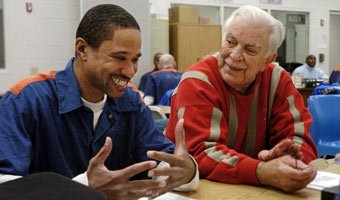
Inmate Dave Payne shares a story with visitor Rich Eppinga during Bible study at Celebration Fellowship, a prison congregation at Ionia Bellamy Creek Correctional Facility sponsored by the Christian Reformed Church and the Reformed Church of America.

“We say: ‘You are now an organized church within our denomination. You have a responsibility to grow and develop your own disciples here, and we’ll help you do that,’’’ Rienstra said. “‘We’re not just going to come in once a week, provide religious services and leave. This church is yours.’’’

Inmates will be expected to adopt a mission statement and form support programs for fellow prisoners. Those released back into communities will be paired with mentors to help them make the adjustment.

State officials approved the church as a pilot program of its Michigan Prisoner Re-entry Initiative to help ex-offenders move back into civilian life, said Michael Martin, head of chaplains for the Michigan Department of Corrections.

“The MDOC’s primary interest was basically filling a void that they viewed as essential for the successful re-integration of prisoners paroling back into the communities,” Martin said. “The prison congregation with the mentoring component offers a wonderful opportunity for that bond of a shared faith to continue outside the walls of the prison.

“I think it has the potential to do some great things.”

Eric Jewell insists he has experienced great things since the church started. The Muskegon inmate finds strength in the weekly Monday night services with outside church volunteers.

“They treat us like human beings,” said Jewell, 41, with a broad smile. “You can feel the sincere love they have for us.”

Rich Eppinga, a member of a local church who attended a recent service, said he’s impressed by the sincerity of the “residents.”

Real true Christianity

“There’s some real true Christianity, and guys who are witnessing for Christ regardless of where they are,” said Eppinga, 81, who helps lead a 12-step recovery program at the prison. “The scriptural knowledge of some of these guys is mind-boggling.”

Eppinga is one of the volunteers whom organizers hope will maintain relationships with inmates after they leave prison. But even those who never leave will benefit from a church within the walls, organizers maintain.

Jim Tuinstra sits on the national board of Prison Congregations of America, based in Sioux Falls, S.D. At a prison church council meeting there, a man with a life sentence told him how church volunteers used to come each week inviting them to accept Jesus.

“The guy says to me, ‘I do believe in Jesus Christ,’” Tuinstra recalled. “‘I’ll spend the rest of my life in prison. How can I live a redeemed life in prison?’ “

Improve behavior 

Prison congregations help inmates do that and improve their behavior, Tuinstra said. About 14 prison churches operate in 10 states, including Cornerstone Prison Church in Worthing, S.D.

Tuinstra, Rienstra and others visited that congregation in 2006, and they returned resolved to start one in Michigan. They formed a team of faith leaders that lay the groundwork for a prison, approved in October by a state prison chaplains advisory council.

The project was fueled in part by Richard and Carol Rienstra’s son, Troy, who is serving a life sentence for attempted murder and armed robbery. His conversion behind bars led him to form Christians for Prisoners-Prisoners for Christ, a ministry supported by a Christian Reformed Church congregation in Grand Rapids, which also called Rienstra as pastor of Celebration Fellowship.

His son’s dedication to prison ministry stoked “fire in the belly” for the Ionia congregation, Rienstra said.

“The more we became acquainted with the prison system, the more we were aware of the fact there may not be an opportunity to develop the gifts (inmates) have in Christ under normal circumstances,” Rienstra said. “They had to have the support of a church itself within the prison congregation.”



Anti-abortion forces seek government funding cuts for Planned Parenthood

WASHINGTON (RNS)—Undeterred by solid Democratic gains in November’s national elections, religious conservatives who oppose abortion are going on the offensive with a new weapon—a sick economy.

In its largest-ever state-based initiative, the Family Research Council is contacting every state lawmaker in the country with a plea to eliminate funding for Planned Parenthood , one of the nation’s largest providers of family planning and abortion services.

The anti-abortion advocates’ argument is fairly simple. Lots of organizations need public money now, but Planned Parenthood—with a $1 billion budget and a $114 million operating surplus—isn’t one of them.

Tom McClusky, chief lobbyist for the Washington-based Family Research Council, has launched a plan to defund Planned Parenthood in cash-strapped state legislatures. (PHOTO/RNS/Courtesy of Family Research Council)

“Planned Parenthood has proven that they don’t need federal or state handouts,” said Tom McClusky, vice president for government affairs at the Washington-based Family Research Council.

“During these economic times, when states are rethinking their investments, subsidizing abortion is probably not the kind of thing that they want to be known for.”

Planned Parenthood long has been a favorite target for abortion opponents, who chafe at the $337 million the organization receives from public sources to help run 880 clinics nationwide.

States are the center of the action because 17 state legislatures permit their funds to be used for abortions. Federal funds, by contrast, can support only non-abortion services, such as counseling and birth control.

Basing the defunding argument on a dour economy represents a new wrinkle in a long-term strategy, according to Ted Jelen, a political scientist at the University of Nevada, Las Vegas, who studies attitudes toward abortion.

Critics of abortion increasingly seek allies by appealing to other value systems—outrage over the grotesque image of a late-term abortion, for example, or now, a belt-tightening eagerness to purge unnecessary spending during an economic crisis, he said.

“Most people are pro-choice under at least some circumstances,” Jelen said. “So the idea that, ‘Maybe we can’t afford this in tough economic times,’ might be fairly plausible.”

Planned Parenthood, meanwhile, is tuning up an economic argument of its own.

“Public funding of family planning services is an investment in prevention care that has numerous dividends,” said Tait Sye, spokes-person for the Planned Parenthood Federation of America, in an e-mailed statement. “Cutting public funding of family planning is bad public policy, will leave even more women without access to vital health care services, and will lead to increased health care costs for the state.”

The Family Research Council recently launched its lawmaker outreach campaign after staffers noticed cash-strapped local governments in Florida, Georgia and Texas cutting funds for Planned Parenthood. If budget concerns could prevail in those locales, activists figured, then maybe the same could happen in statehouses from coast to coast.

Other conservative Christian groups are mobilizing, too. The American Life League of Stafford, Va., has re-ordered its political priorities this year to focus primarily on defunding Planned Parenthood, said Jim Sedlak, director of the organization’s Stop Planned Parenthood project.

In his view, the GOP’s steep losses in November do not necessarily suggest Americans have warmed to abortion rights.

“This (election) battle wasn’t about abortion, or pro-life or moral values. This election was all about the economy,” Sedlak said.

“I don’t think you can take a message from the election in terms of the moral fight over abortion. … Things are going our way, and this election was an aberration for other reasons.”

Still, anti-abortion activists face logistical and political hurdles. State funding often gets channeled through agencies or local governments, which then may subcontract with Planned Parenthood affiliates for services. That means cutting money for Planned Parenthood isn’t as simple as dropping a single line item in a state budget bill.

“We’re trying to understand exactly how much funding in the Commonwealth of Kentucky is going to Planned Parenthood,” said David Edmunds, policy analyst at the Family Foundation of Kentucky in Lexington.

“We have to determine that first before we have any kind of action strategy to try to defund it.”


For filmmaker Pelosi, Haggard downfall became personal

LOS ANGELES (RNS)—Filmmaker Alexandra Pelosi never imagined her 2007 documentary about evangelical America would give her a front-row seat to the downfall of one of its biggest stars, megachurch pastor Ted Haggard.

She also couldn’t have predicted just how closely her life would become intertwined with Haggard’s.

The two met in 2006 as Pelosi—a cradle Catholic and daughter of House Speaker Nancy Pelosi—was working on her sophomore documentary, Friends of God, in which Haggard served as her “tour guide” through American evangelical life.

Former evangelical leader Ted Haggard recounts his fall from grace with filmmaker Alexandra Pelosi in a new HBO film, The Trials of Ted Haggard.

Months later, Haggard resigned his pulpit at New Life Church in Colorado Springs and as head of the National Association of Evangelicals when a male escort went public with lurid allegations of gay sex and drug use.

Her new documentary, The Trials of Ted Haggard, airs on HBO Jan. 29 and tracks Haggard’s attempts to rebuild his life, come to terms with his downfall and restore the frayed bonds of his family.

The documentary is as much about the church as it is about the Haggard family, Pelosi said.

“The story is about a church that preaches forgiveness,” she said. “He, as a pastor, preached forgiveness and redemption. But he was not forgiven, and he was not redeemed. They cast him out, and they exiled him.

“It was very biblical in a way. Not that I even read the Bible, so I wouldn’t know. But the people who go to church get told every Sunday, ‘We forgive.’ He was not forgiven. That, to me, is what is interesting about it.”

New Life Church de-clined comment beyond a blog post from Pastor Brady Boyd, stating that Haggard’s family received more that $300,000 in severance payments and is working toward reconciliation with Haggard.

The film follows Haggard, his wife, Gayle; adult daughter, Christy; and adult son, Marcus, as they leave Colorado Springs in search of a new life in Arizona and Texas. The film avoids the Haggards’ two younger sons and special-needs son, who receives financial support from New Life.

Due to his notoriety and his lack of training in anything other than the ministry, Haggard has a difficult time finding employment. “I essentially have a high school education in the market,” he told reporters.

Throughout the film, Haggard wrestles with his faith and his attempts to reconcile his same-sex attractions with his understanding of Scripture. He discloses childhood sexual abuse and recalls his struggles as a youth as he battled his attraction to other boys.

In the film, Haggard shows moments of hope in his faith, as well as times of deep despair. It’s in those dark times when his relationship with Pelosi and her husband, Michael Vos, became much more personal.

“They were so helpful to us,” Haggard explained. “Michael called one day when I was in the back yard, sobbing, by myself crying. And he was alarmed because he thought we were being taken care of. Alexandra’s sister lived not far from where we were in Phoenix, so when they would come down and visit, they would come and help. They helped us move.

“One time I was just dying in despair of loneliness, and Michael went and sold health insurance with me for two or three days.”

Pelosi’s first encounter with Haggard came when she attempted to understand and translate evangelical life.

“It’s so everything that I’m not. It’s foreign to me,” Pelosi said. “The whole Christian evangelical world is so foreign to me. Ted was my tour guide through it. He introduced me to this whole world. I’m from San Francisco, and I live in New York (and) where we come from, it’s ‘Gay? So what?’”

The new documentary has the same no-holds barred ethos as Friends of God as Haggard delves into his sexuality, his grief, his loss of purpose and his hope for the future.

However, people looking for a clear explanation of his sexuality or a neat resolution to the scandal will be disappointed.

“This is the problem with Ted,” Pelosi said. “The gay community is not going to embrace him because he’s not going to say, ‘I’m gay.’ The Christian community is not going to embrace him because he is saying: ‘I have gay issues. I have issues with my sexuality.’ So, he’s fallen through the crack in between this cultural divide in America. He can’t answer the questions. Go try for a few hours. He can’t answer them.”

Haggard, who recently moved his family back to Colorado Springs, was until recently barred by contracts with New Life from speaking to the media. He explained his decision to bare his soul to millions through Pelosi’s camera.

“Well, we had to answer the questions,” he said. “For the sake of our kids going to school. For the sake of me trying to build a business. And just a message, our life message. So, we moved back home to finish the story. If we would have stayed away, the story would have just ended with that. And we moved back home to finish the story.”


Faith Digest: Judges uphold weddings by clergy ordained online

Pennsylvania county judges have ruled in three cases that marriages performed by ministers who do not have congregations and obtained ordination on the Internet are legal, rejecting a contrary 2007 ruling. All three suits were brought by the American Civil Liberties Union of Pennsylvania, which argued York County Judge Maria Musti Cook was wrong to invalidate a marriage in 2007 because the minister who performed it was ordained online and did not have a physical church or congregation. The officiating minister, a friend of the couple, was ordained by the Seattle-based Universal Life Church, which offers instant no-questions-asked ordinations online. Even though Cook’s ruling was limited to York County, registrars of wills across Pennsylvania began warning couples that their marriages may not be valid. In Bucks County, in suburban Philadelphia, for example, 36 couples remarried as a result of the York decision, County Clerk Barbara Reilly said.


Gospel music pioneer dies at 75. Willa Mae Dorsey, whose gospel-singing career lasted 56 years, filled five albums, won her a Grammy nomination and introduced black gospel music to many white congregations, has died at age 75. Dorsey began singing professionally when she was 19. During her career, she sang at Lincoln Center, performed with Mahalia Jackson and shared the stage with Billy Graham, singing in about 40 countries for presidents, princes and ordinary people of faith. She was a regular on Lawrence Welk’s television show, insisting she would sing only gospel and patriotic songs.


Saddleback offers shelter for breakaway Anglicans. Saddleback Church Pastor Rick Warren has offered to open the campus of his Southern California megachurch to conservative Anglicans who have broken with the Episcopal Church. Warren, best-selling author of The Purpose Driven Life, wrote to 30 Anglican leaders a few days after California’s Supreme Court ruled Episcopal churches that break with their denomination are not entitled to keep church property. “We stand in solidarity with them and with all orthodox, evangelical Anglicans,” Warren wrote. “I offer the campus of Saddleback Church to any Anglican congregation who need a place to meet, or if you want to plant a new congregation in south Orange County.”


Court warns Orissa: Zero toleration for religious persecution. India’s Supreme Court has told the state government of Orissa it will not tolerate persecution of religious minorities, and it criticized the state government for failing to stop the violence sooner. A three-judge panel of the Supreme Court issued the warning following a petition filed by Roman Catholic Archbishop Raphael Cheenath, who requested protection for his flock in Orissa and compensation for church properties damaged in the ongoing violence between Hindus and the minority Christian population that began after the Aug. 23 murder of Swami Laxmanananda, a Hindu religious leader, in Orissa’s Kandhamal district.


Obama reaches out by picking Warren to pray at inauguration

WASHINGTON (RNS)—President-elect Barack Obama’s choice of megachurch Pastor Rick Warren to deliver the invocation at his inauguration shows one man reaching out and the other reaching new heights.

The choice demonstrates that Warren is the next Billy Graham, succeeding the evangelist who prayed at many previous Republican and Democratic inaugurations, according to some evangelicals. Other observers say it shows Obama is serious about evangelical outreach.

“Aside from the chief justice, Billy Graham was the mainstay at the inauguration,” said Michael Lindsay, a sociologist at Rice University in Houston. “This is sort of seeing … the baton being passed in a very significant way.”

Obama outreach to evangelicals 

Dan Gilgoff, religion correspondent for U.S. News & World Report and author of its God & Country blog, said it is significant Obama chose someone so closely tied to the Bush administration, just weeks after Warren honored President Bush with an award.

And it shows Obama is willing to sideline questions about how Warren treated the then-candidate at a forum at his Saddleback Church during the presidential campaign. Some Obama supporters argued the forum was tilted to favor the Republican candidate, Sen. John McCain.

“Despite all this, the fact that Obama still went with him I think shows that … the Obama administration is really committed to evangelical outreach,” Gilgoff said.

But many prominent supporters of gay rights aren’t happy to see Warren given the spotlight.

“In honoring Mr. Warren, the president-elect confers legitimacy on attitudes that are deeply contrary to the all-inclusive love of God,” said Episcopal Bishop John Chane of Washington. “He is courting the powerful at the expense of the marginalized, and in doing so, he stands the gospel on its head.”

Criticism over gay marriage stand 

Leaders of gay rights organizations have asked Obama to drop Warren and, in at least one case, declined an invitation to the inauguration because the pastor vocally supported Proposition 8, the ballot measure that banned gay marriage in California.

Warren, like Obama, has made attempts to reach out to politicians of both parties, inviting liberals and conservatives to discuss public policy at Saddleback. While he has taken strong stands against abortion and same-sex marriage, Warren has led efforts to combat poverty, illiteracy and AIDS in Africa.

“He’s a very magnanimous guy, who every time he comes to Washington meets with Democrats and Republicans,” said Michael Cromartie, director of the Evangelical Studies Program at the Washington-based Ethics and Public Policy Center.

“He’s a post-partisan pastor who, in light of Billy Graham’s failing health, has sort of become American’s new symbolic pastor.”


Controversy over inaugural prayer nothing new

WASHINGTON (ABP)—President-elect Barack Obama’s surprise pick of Purpose Driven Life author Rick Warren to give the invocation at his inauguration Jan. 20 isn’t the first time the ceremonial prayer has created controversy.

Kirbyjohn Caldwell, senior pastor of Windsor Village Methodist Church in Houston, drew criticism eight years ago for closing the benediction at President Bush’s first inauguration with: “We respectfully submit this humble prayer in the name that’s above all other names, Jesus, the Christ. Let all who agree say, ‘Amen.’”

At Bush’s second inauguration in 2005, Caldwell was more inclusive, modifying his closing to: “Respecting persons of all faiths, I humbly submit this prayer in the name of Jesus Christ. Amen.”

President-elect Barack Obama appeared with with Pastor Rick Warren at a forum hosted by Warren’s Saddleback Church during the presidential campaign. Obama invited Warren to deliver the invocation at his inauguration. (PHOTO/RNS/Ann Johansson)

Franklin Graham also offered the invocation at the 2001 inauguration in Jesus’ name, drawing rebuke from non-Christians.

Harvard Law School Professor Alan Dershowitz called it “particularistic and parochial language” that “excluded tens of millions of American Muslims, Jews, Buddhists, Shintoists, Unitarians, agnostics and atheists from his blessing.”

Graham said the backlash was evidence that “there are factions of society today that hate God and everything that he stands for.”

Atheist Michael Newdow, best known for his fight against the phrase “under God” in the Pledge of Allegiance, sued unsuccessfully in 2005 to block prayer at Bush’s second inauguration, claiming that inaugural prayers violate the Establishment Clause of the First Amendment. He has filed suit again.

Invoking God’s blessing has been a part of the presidential inauguration ceremony since 1789, when George Washington took the oath of office and proceeded to St. Paul’s Chapel, where the Senate chaplain read from the Book of Common Prayer.

The prayer was moved from the church to the Senate chamber for the 1937 inauguration of Franklin D. Roosevelt. Every inauguration since has included prayers by one or more clergymen invited by the president-elect.

For years, Billy Graham was a fixture of inaugural prayers, befriending every president since Eisenhower. Unable to attend the first inauguration of George W. Bush because of illness, Graham sent his son as a substitute to deliver the invocation in 2001.

Joseph Lowery, an icon of the civil rights movement and co-founder of the Southern Christian Leadership Conference, is scheduled to pronounce the benediction at Obama’s inauguration.

But Obama’s selection of Warren, pastor of Saddleback Church in Lake Forest, Calif., for the invocation has garnered the most attention.

The high-profile invitation particularly upset supporters of gay rights. Warren has compared homosexuality to incest, pedophilia and polygamy. He also spoke on behalf Proposition 8, a California referendum to ban gay marriage, which homosexuals regard as a civil right.

Rep. Barney Frank, D-Mass., one of three openly gay members of the House of Representatives, said he was “very disappointed” by the choice.

“Religious leaders obviously have every right to speak out in opposition to anti-discrimination measures, even in the degrading terms that Rev. Warren has used with regard to same-sex marriage,” Frank said.

“But that does not confer upon them the right to a place of honor in the inauguration ceremony of a president whose stated commitment to … (lesbian, gay, bisexual and transgender) rights won him the strong support of the great majority of those who support that cause.”

Joe Solmonese, president of the Human Rights Campaign, wrote in the Washington Post that inviting Warren “sends a chilling message to lesbian, gay, bisexual and transgender Americans” and “makes us uncertain about this exciting, young president-elect who has said repeatedly that we are part of his America, too.”

Rea Carey, executive director of the National Gay and Lesbian Task Force, called it “a divisive choice, and clearly not one that will help our country come together and heal.”

Obama defended Warren’s selection by saying there will be a “wide range of viewpoints” presented at the inauguration.

“We’re not going to agree on every single issue,” he said, “but what we have to do is be able to create an atmosphere where we can disagree without being disagreeable and then focus on those things that we hold in common.”

Warren commended the president-elect for “courage to willingly take enormous heat by inviting someone like me, with whom he doesn’t agree on every issue” and called it an effort “to model civility in America.”

While Warren differs with Obama on homosexuality and abortion rights, they share values like fighting AIDS in Africa.

Warren took heat from fellow religious conservatives for inviting Obama to speak at a conference on the subject at his church in 2006.

Joseph Farah of World Net Daily expressed “profound and abject revulsion” at Warren’s acceptance of the invitation to ask God’s blessing on Obama’s policies, which he called “evil.”

“Yes, we are commanded to pray for our leaders,” Farah said. “But there is no suggestion in the Bible that we are ever to be used as political pawns by praying at their events—especially when they are promoting the wholesale slaughter of innocent human beings.”

Warren’s selection also disappointed the religious left, who say his non-partisan image belies a social agenda in lockstep with the Religious Right.

Rob Boston of Americans United for Separation of Church and State called Warren “a kinder, gentler Jerry Falwell in a Hawaiian shirt.”