Court hears arguments on partial-birth abortion ban cases

Posted: 11/21/06

Court hears arguments on
partial-birth abortion ban cases

By Robert Marus

ABP Washington Bureau

WASHINGTON (ABP)—The man who may cast the deciding vote in the Supreme Court’s first major abortion cases in six years tipped his hand little during oral arguments Nov. 8.

Justice Anthony Kennedy asked a series of highly technical questions of attorneys for each side in the two related cases, Gonzales v. Carhart and Gonzales v. Planned Parenthood. Calmly and methodically, he inquired about the medical and legal specifics of a subject that has provoked heated political and social debate in recent years—a procedure opponents label “partial-birth abortion.”

The cases involve the Partial-Birth Abortion Ban Act of 2003. Kennedy and his colleagues will consider whether the ban is unconstitutional because it does not contain an exemption designed to protect the health of the mother, because it is unconstitutionally vague, or because it places too heavy a burden on women seeking abortions.

Federal appeals courts ruled the law unconstitutional in both cases. Attorney General Alberto Gonzales appealed those decisions.

With the ban, Congress ostensibly targeted an abortion procedure, known medically as “intact dilation and extraction,” that involves the partial delivery of a fetus. Its skull is then punctured and its contents evacuated to make it easier to pass the head through the birth canal. Doctors say it is used only in exceedingly rare circumstances.

Statistics about the procedure are difficult to come by. However, the Chicago Sun-Times estimated partial-birth abortions represent about 2,500 to 3,000 of the 1.25 million abortions performed each year—or about 1 out of every 500.

The last time the Supreme Court dealt with a similar law—a Nebraska state ban on the procedure—was in 2000. In Stenberg v. Carhart, the justices ruled 5-4 that the law was worded so vaguely as to possibly ban more common abortion procedures and that it violated the Constitution because it did not include a health exception.

The federal partial-birth ban does not provide a health exception, in violation of federal law. Instead, it cites congressional findings determining that the procedure is never medically necessary to protect a woman’s health.

The decision will come from a Supreme Court different in ideological make-up than the one that found Nebraska’s ban unconstitutional in 2000. The justice who decided that case by casting her vote with the five-member majority— Sandra Day O’Connor—voted frequently in favor of abortion rights.

Since then, she has retired and been replaced by Justice Samuel Alito, who was nominated by President Bush, who is anti-abortion. Much of the controversy over Alito’s appointment centered on whether he would vote to uphold abortion rights or restrict them.

In the 2000 case, Kennedy was in the minority and wrote a dissenting opinion describing his vehement distaste for partial-birth abortion.

However, in recent arguments, the justice seemed concerned with whether the congressional findings were correct: that intact dilation and extraction is never necessary to protect a woman’s health.

“Do you have any idea in how many of those instances (there is) serious health risk to the mother that requires the procedure, as opposed to simply being an elective procedure? Are there any statistics on that?” Kennedy asked Priscilla Smith, who argued the case on behalf of Leroy Carhart. Carhart is a Nebraska abortion provider who challenged the ban. He also challenged the state statute that led to the earlier Stenberg v. Carhart decision.

Kennedy and his colleagues asked virtually no questions about the broader legal issues often raised in abortion cases—the constitutional right to privacy on which legalized abortion rests, for instance. But they seemed extremely concerned with what, exactly, the procedure being banned is, if the procedure is ever medically necessary to protect a woman’s health, and if the law’s language effectively bans that procedure without curtailing a woman’s right to other forms of abortion.

Solicitor General Paul Clement, arguing on behalf of the federal government in both cases, said the procedure being banned is so barbaric that Congress has a right to prohibit it.

“The evidence (from medical professionals in hearings) before Congress was clear that partial-birth abortions were never medically necessary, and that safe alternatives were always available such that no woman would be prevented from terminating her pregnancy,” Clement told the justices. “As a result, Congress was entitled to make a judgment in furthering its legitimate interests that they were going to ban a particularly gruesome procedure that blurred the line between abortion and infanticide.”

But Smith and her colleagues said the congressional findings were politically motivated to satisfy people opposed to abortion. While medical opinion is divided, she said, there is a “significant body” of medical experts who believe that the procedure is sometimes necessary to prevent complications that could have “catastrophic” results for the mother’s health.

“The only course here that preserves independence of the judiciary, that exemplifies the importance of stare decisis (the legal doctrine that a court’s previous opinion on a subject should stand unless there is a strong reason to overturn it), not to mention the only course that will protect women from needless risks of uterine perforation, infertility, sepsis and hemorrhage, is to hold this act unconstitutional,” she told the justices.

New Chief Justice John Roberts, whose precise abortion views are unknown but who was strongly supported in his confirmation hearings by anti-abortion groups, seemed eager to find ways that the federal law in question differed from the Nebraska law overturned in the Stenberg decision.

Alito, for his part, asked no questions during the two-hour argument sessions. While anti-abortion groups also supported his nomination, he appeared disengaged during the hearings, at times staring into his lap, at other times seeming to study the ornate courtroom’s ceiling.

However, in an indication of the extreme emotions the subject of abortion raises, the argument session featured the first major disruption in recent memory at the high court. A few minutes into Smith’s argument, a man began shouting anti-abortion slogans.

The man, later identified by court officials as Rives Miller Grogan of Los Angeles, was quickly restrained by Supreme Court Police officers, removed from the courtroom and charged with resisting arrest and violating a federal law that bans disruptions of the court’s sessions. But, before he could be removed from the courtroom, he shouted to the justices: “Repent or you will perish!”

His screams were audible in the courtroom for several seconds after officers dragged him out.

News of religion, faith, missions, Bible study and Christian ministry among Texas Baptist churches, in the BGCT, the Southern Baptist Convention ( SBC ) and around the world.


Wade still has support despite anger, sadness at scandal

Posted: 11/21/06

Wade still has support despite
anger, sadness at scandal

By Greg Warner

Associated Baptist Press

DALLAS (ABP)—Rank-and-file Texas Baptists are sad and angry about the financial scandal in the Rio Grande Valley that has marred their reputation. But most say they still trust their leaders—including Executive Director Charles Wade—to correct abuses and restore confidence in the Baptist General Convention of Texas.

That was the message that emerged from the BGCT’s annual meeting Nov. 13-14 in Dallas, as messengers turned back several attempts to take the matter out of the hands of Wade and the convention’s Executive Board.

“I think Dr. Wade is going to come out of this alright, and I think he should,” said Lou Balenton, pastor of New Trinity Baptist Church in Plainview, as he left the convention hall. “He’s a man of integrity. I believe there should be some reprimands for staff members, but not for Dr. Wade.”

See complete list of Valley funds scandal articles

An investigative team hired by the Executive Board reported Oct. 31 that more than $1.3 million in start-up funding and monthly support was given to three Hispanic pastors in the Rio Grande Valley who reported 258 church starts between 1999 and 2005. Investigators presented evidence that up to 98 percent of those churches no longer exist—and some never existed except on paper.

Other revelations suggest that an alleged pattern of deception by one of them—Otto Arango—was repeated south of the border in Mexico and even South America , where he also peddled his church-planting expertise and training materials. Other organizations besides the BGCT donated to the work of Arango’s church-planting institute.

The BGCT investigation also revealed the convention’s staff was aware of some of those allegations years ago but ignored or downplayed them, prompting some critics to accuse Wade and others of a cover up. One staff member named in the investigators’ report resigned and another took early retirement. Some BGCT insiders expected the scandal to force Wade to announce his retirement sooner than planned —perhaps even at this year’s convention.

But most of the messengers to the Dallas convention accepted the apologies offered by Wade and the remedies initiated by him and the Executive Board. Wade asked Texas Baptists for a chance to “fix what has been broken,” and he promised, “Your trust will not be breached.”

“I believe Charles Wade is a man of principles and integrity,” said Nancy Pannell of Denton after hearing Wade speak to the issue. “He trusted these people, and his trust has been betrayed. … He has already started what needs to be done to rectify the situation and make it right.”

“I think he’s going to try to make the best of the situation,” added Mark Anthony, a student at Truett Theological Seminary in Waco. “I trust his leadership, and I trust that they will discern the right course of action.”

David Montoya, a blogger and pastor who has led the chorus of critics against Wade, remained unconvinced.

Montoya asked the convention to amend its constitution to give messengers the authority to terminate the executive director without Executive Board approval. And he called for the BGCT to pursue immediate legal action and criminal charges against the church-planters who allegedly falsified reports and benefited from the diverted funds.

“In a crisis like this, it should be the will of the convention that is heard,” said Montoya, pastor of Calvary Baptist Church in Mineral Wells. He said the Executive Board was biased and guilty of shielding Wade.

“The Executive Board is intended to be a tool that exists for the body, but through this scandal we see it seems as if the body exists for the will of the tool.”

According to the original investigation, in 2000 the FBI explored fraud allegations in connection with church-starting in the Valley, but the agency dropped its investigation because the aggrieved party—the BGCT—did not pursue it.

Montoya accused Wade of being “a possible accessory to an attempted cover up” and “a personal friend of the main player in this scandal”—church-planter and accused ringleader Arango.

BGCT President Michael Bell stopped Montoya in the middle of his speech and ruled him out of order.

“That’s not appropriate,” said Bell, a pastor in Fort Worth. “We are Christians and don’t do personal attacks. Thanks for sharing your heart in the spirit of Christ, but you are attacking an individual. It doesn’t take a rocket scientist to know that. In the opinion of the chair, the motion is out of order.”

Bell also ruled out of order Montoya’s motion for the convention to initiate immediate legal action in the case. The Executive Board has asked for more time to examine those options.

Since the investigation was initiated by the Executive Board, the convention cannot take it out of the board’s hands, Bell said, citing the advice of BGCT parliamentarian Bart Tichenor.

“The Executive Board is the entity with the sole authority to act in the interim [between annual meetings],” Bell said. The board’s investigation “has pre-empted any action by the convention.”

Not all messengers were satisfied with that interpretation, however.

“Are you saying the convention does not have authority to act independently of the Executive Board?” asked messenger Joe Caldwell.

Bell did not answer the question but referred Caldwell to the parliamentarian for an explanation.

Throughout the debate, people on both sides voiced concern for Baptists in the Rio Grande Valley, who reportedly were embarrassed and felt tainted by the scandal.

“I was personally damaged as a Christian by Otto Arango,” said Eloy Hernandez, one of the people listed by Arango as a pastor of a BGCT-funded church start, even though he was not. “My church was humiliated,” said Hernandez, a messenger from Iglesia Bautista Getsemani in McAllen.

Hernandez briefly addressed messengers before Bell ruled his comments out of order. He later told a reporter the scandal already is hurting the reputation of Baptists in the Valley. “We’re not able to witness because (people) laugh in our face,” Hernandez said.

He and others were disheartened when their warnings about Arango went unheeded by the BGCT. “It’s wrong these people don’t want to hear from pastors in the Valley,” he said. To help repair his and the church’s reputations, Hernandez urged Wade to come to Iglesia Bautista Getsemani and make a public apology.

“I forgive Charles Wade and Otto Arango…,” he added.

Other messengers sympathized with Baptists in the Valley. “The Lord will see us through, but we must not dismiss these Valley pastors,” said Jack Hulsey, pastor of Woodlake Baptist Church in San Antonio. “This has already done damage to the BGCT.”

While many Texas Baptists are ready to put the Valley scandal behind them, others fear more revelations will follow, particularly if law enforcement and tax officials get involved.

“I don’t think this investigation has ended. It’s going to continue,” Hiram Shore of Levelland said. “They’ll find more things. More things will come out.”

But Shore said he is willing to trust Wade and the Executive Board to get to the bottom of it.

“I think that Wade can be trusted. Some people let him down. Accountability was built into the system, but it failed. … You can’t micromanage an organization that big, at least successfully. Charles Wade didn’t do anything wrong. People below him did, and they have resigned.”


Hannah Elliott and Barbara Bedrick contributed to this story.

News of religion, faith, missions, Bible study and Christian ministry among Texas Baptist churches, in the BGCT, the Southern Baptist Convention ( SBC ) and around the world.


Arkansas OKs bingo despite Baptist opposition

Posted: 11/21/06

Arkansas OKs bingo despite Baptist opposition

By Charlie Warren

Arkansas Baptist Newsmagazine

LITTLE ROCK, Ark., (ABP)—An Arkansas constitutional amendment legalizing charitable bingo and raffles passed Nov. 7, despite the efforts of Baptists to defeat it.

Amendment 1, which passed with 69 percent of the vote, will allow non-profit organizations to raise funds through bingo and raffles. It lifts a ban on such games, which were illegal under Article 19, Section 14 of the state constitution. The Arkansas Constitution also prohibits lotteries.

The new ruling will restrict bingo and raffles to authorized organizations like religious, educational, veteran and civic groups that have existed at least five years. Proceeds from the games must go to charitable or philanthropic purposes.

Messengers to the Oct. 31-Nov. 1 Arkansas Baptist State Convention annual meeting had unanimously passed a resolution urging Baptists to reject the amendment.

“If there is lax law enforcement of the restrictions on the operations of charitable bingo, large commercial bingo could be conducted … under the guise of charitable bingo,” the resolution said, adding the ballot could lead to casino-like “high-stakes Native American bingo parlors.”

Larry Page, executive director of the Arkansas Faith and Ethics Council, said his goal will be to influence legislators to write tight legislation to avoid commercial bingo and Indian “bingosinos” and assure that “charitable bingo is really charitable bingo.”

“Let’s make it the best charitable bingo law in America (so) a lot of the problems won’t exist here,” he said.

Rep. Shirley Borhauer, (R), who sponsored the amendment, told the Arkansas News Bureau the measure was worded narrowly enough to stop for-profit groups from exploiting it.

“This is not going to open the door to casino gambling,” Borhauer said. “You can’t come down here and open up a storefront and say, ‘I think I am going to open up a bingo hall for my own financial gain.’”

The amendment will take effect Jan. 1.

News of religion, faith, missions, Bible study and Christian ministry among Texas Baptist churches, in the BGCT, the Southern Baptist Convention ( SBC ) and around the world.


RIGHT or WRONG? The ethics of blogging

Posted: 11/17/06

RIGHT or WRONG?
The ethics of blogging

Blogging, particularly by Baptist pastors, has been in the news this year. It seems as if some of the bloggers are ignoring important ethical standards that should be applied to this technology. What would you suggest?

The web-log, or blog as it has become known, has risen in popularity over the past few years as more and more Internet-savvy individuals use this service as a medium of communication and expression. Sometimes bloggers use their sites as an online diary, sharing the various events of their lives with their readers. An increasing number of bloggers, however, are using their space on the Internet to disseminate their opinions on various topics, including politics and religion.

More and more ministers are acquainted with this phenomenon. Many ministers are using blogs for ministerial purposes. Devotional blogs or cyber newsletter columns are among the more common uses of this technology among ministers. Many church websites have a page devoted to their pastor’s use, including sermon teasers for next Sunday’s message or other writing projects. When used in this manner, blogs can be an effective way for ministers to enhance their communication with church members and others.

However, clergy and nonclergy alike are beginning to use the Internet blog system as a means to spread their theological and political ideologies. These blogs often perpetuate false claims and intolerant beliefs that bring about more division than education. Over the past six months, I have read blog posts, mostly written by ministers, that: (1) maintain that all Muslims are hateful, dangerous people, (2) condemn people of faith who are not aligned with a particular political agenda, (3) justify the lack of ministry to the underprivileged and (4) share potentially sensitive information concerning inter-church conflicts.

Yes, clearly important ethical considerations are being ignored by some bloggers. While there is no official code of conduct for blogs, talk of “the ethics of blogging” is not new. In an April 2003 Washington Post article titled “The Great Blogging Ethics Debate,” Cynthia Webb quotes Professor Larry Pryor of the University of Southern California saying, “Like it or not, (bloggers) have to follow ethics.”

In a certain sense, bloggers are on the cutting edge of journalism and should adhere to basic journalistic standards. Among the more basic ethical considerations bloggers should keep in mind are: (1) check sources and facts; (2) be collegial—don’t fly off the handle; (3) present differing perspectives or at least allow feedback comments on posts and engage in dialogue with those who hold various opinions; and (4) never, ever, plagiarize someone else’s material.

Blog readers should read blogs, as well as other material from the Internet, with a critical eye. When reading a blog or website, ask yourself: (1) Is this person giving me the complete story? or (2) Could there be another perspective on this topic? Most blogs allow reader comments; take advantage of this by asking questions and raising alternative views. We can do very little to control the speech and opinions of others; we can, however, offer a different perspective.

Remember, anyone with Internet access can open a website or blog, and just because someone said it on their website does not mean it is entirely true.

J.C. Baker, post-graduate student

Brite Divinity School

Texas Christian University

Fort Worth

Right or Wrong? is sponsored by the T.B. Maston Chair of Christian Ethics at Hardin-Simmons University’s Logsdon School of Theology. Send your questions about how to apply your faith to btillman@hsutx.edu.

News of religion, faith, missions, Bible study and Christian ministry among Texas Baptist churches, in the BGCT, the Southern Baptist Convention ( SBC ) and around the world.


Executive director committed to ‘clean up the mess’

Posted: 11/17/06

Executive director committed to ‘clean up the mess’

By Teresa Young

Wayland Baptist University

DALLAS—Drawing inspiration from the story of Jesus’ baptism and subsequent time of temptation, Charles Wade, executive director of the Baptist General Convention of Texas Executive Board, urged Texas Baptists to listen to God’s voice and discern his will for churches and individuals.

Wade acknowledged failures at some points—particularly addressing the scandal regarding misused church starting funds in the Rio Grande Valley.

Executive Director Charles Wade brings a report to the Baptist General Convention of Texas annual meeting. (Photo by Eric Guel)

He assured the messengers and visitors at the annual meeting that steps were being taken both to alleviate the damage done by the misappropriation of church starting funds in the Rio Grande Valley and to prevent future damage from occurring.

He also expressed a desire to support South Texas church leaders who suffered from the incident and its fallout.

“I want to state how much we admire the pastors in the Rio Grande Valley Association. They face an incredible challenge,” Wade said.

“The failures identified by the report are limited to a very few and do not reflect the faith, integrity and passion for the gospel shared by many of the pastors in the Valley.

“I am committed to leading the staff and the Executive Board in righting the wrongs and taking responsibility to make sure we don’t forget our main priorities while we clean up the mess.”

Wade committed to respond to the challenges the state faces, both in the Valley and beyond.

“Everything I do will be prayed over, designed to hold us together … and assist our churches in being transforming communities of faith,” he said. “Together, with God, we are and we will do more.”

Wade noted Jesus obeyed God’s command to be baptized and was able to hear his Father’s voice of affirmation. Likewise, while being tempted in the wilderness by Satan, Jesus leaned on God for guidance and followed his will during those rough days.


See complete list of convention articles

“When you tie yourself to Jesus and commit yourself to follow him, ‘Thy will be done’ is not an empty phrase,” Wade said. “What you learn when you follow him is to listen to the voice so you will know his purpose in your life and his will for your life.”

Even from their early days, Wade said, “Texas Baptists have heard that voice.”

“We have said in more recent days, ‘We are the presence of Christ.’ Wherever there is a local congregation, the body of Christ is present and real, and we become the arms of Jesus, touching people and hugging them up close to God,” Wade said. “Most recently, we have said our goal, our mission, our commitment is to facilitate, connect and encourage churches. We are about helping every single church be the best it can be in being the presence of Christ.”

Citing population data, Wade said the changing makeup of the state is being reflected in the Texas Baptist churches, and the convention as a whole is learning to work with groups they may not have encountered previously. A meeting with ethnic leadership across the state was a good example of those lessons.

“I can tell you that when you never talk to each other, you don’t offend each other, but when you sit down and talk, the chance of offense goes up,” Wade said.

“When people work together, listen to one another and pray together, you understand better. We watched as Texas Baptists became more aware of truly who we are in Christ.”

Wade said the changing picture of Texas has led the BGCT into five areas of ministry previously uncharted. The state convention now has two theological seminaries, a Bible study curriculum for use by churches that Wade said is also finding an audience in other parts of the nation and a chaplaincy endorsement program that has more than 300 active participants.

The BGCT also has a relationship with Baptist ministries globally through the Baptist World Alliance, and it has developed a strategy for connecting mission entities and other ministry opportunities “that move beyond Texas to touch the nation and the world.”

Giving by Texas Baptists to the Cooperative Program, the Mary Hill Davis Offering and the world hunger fund is up due to those efforts, he said.

News of religion, faith, missions, Bible study and Christian ministry among Texas Baptist churches, in the BGCT, the Southern Baptist Convention ( SBC ) and around the world.


Texas WMU reschedules annual meeting

Posted: 11/17/06

Texas WMU reschedules annual meeting

By Barbara Bedrick

Texas Baptist Communications

DALLAS—Woman’s Missionary Union of Texas’ board of directors voted to move the organization’s 2008 annual meeting to April instead of its traditional date scheduled in conjunction with the Baptist General Convention of Texas annual meeting.

Board members said the move will enable WMU of Texas to better emphasize its role in missions. The organization has had a one-day meeting before the BGCT annual meeting. In 2008, a two-day meeting will enable WMU of Texas to communicate more effectively what it is doing, proponents argue.

Woman prays during the Woman's Missionary Union meeting.

The 2008 annual meeting will be at Columbus Avenue Baptist Church in Waco, April 18-19.

“This move allows us more time and opportunity to do our annual meeting and to focus on our work,” Texas WMU Executive Director Carolyn Porterfield said. “We plan to combine our annual meeting with training opportunities, fellowship and inspiration in a two-day event instead of two hours so we can be better stewards of our financial resources.”

Porterfield noted the change in schedule likely would increase attendance. Leaders want to bring women together to celebrate what is happening in the church, in the associations and in missions, she said.

The BGCT investigation into misuse of convention church-starting funds in the Rio Grande Valley and its impact on the Mary Hill Davis Offering for Texas Missions surfaced when BGCT Executive Board Executive Director Charles Wade held a dialogue with WMU of Texas board directors.

“I know that many of you have been shocked and saddened by what the investigation has revealed,” Wade said. He explained he “feels so personally betrayed” by those he trusted. Wade also addressed questions about their concerns over the distribution of funds from the Mary Hill Davis Offering.


See complete list of convention articles

WMU directors expressed concern about what safeguards will be implemented. Wade explained the BGCT is developing a new policy on how checks are released.

A called meeting of the BGCT Executive Board addressed issues stemming from the independent BGCT Valley investigation, and Wade said further recommendations will be made at the board’s February meeting.

“They’re my boss, and I’m accountable to them,” Wade said.

“The devil was against us in the Valley, but we will not let him have victory.”

Porterfield reported that Texas WMU may, as it plans its next budget, allocate more of the Mary Hill Davis Offering to its own budget.

In other business, Texas WMU Endowment Team Chair Joy Fenner discussed the 2007 endowment campaign.

“When 1,000 people give $1,000 to WMU of Texas, we will increase our endowments by $1 million,” said Fenner, who was elected first vice president of the BGCT. The campaign began Nov. 1 and will run through 2007.

During the board’s dinner, Porterfield honored Mary Lou Serratt of Amarillo with a special tribute for her decades-long role in multicultural missionary work.

News of religion, faith, missions, Bible study and Christian ministry among Texas Baptist churches, in the BGCT, the Southern Baptist Convention ( SBC ) and around the world.


Unity emphazised at Texas Baptist Hispanic Fellowship rally

Posted: 11/17/06

Unity emphazised at Texas
Baptist Hispanic Fellowship rally

By Craig Bird

Baptist Child & Family Services

DALLAS—There is one reason to think Christians can successfully obey Jesus’ command to “be brought to complete unity,” Robert Rodriguez reminded the annual Texas Baptist Hispanic Fellowship rally at Cockrell Hill Baptist Church in Dallas.

“Unity doesn’t begin with us, and it is not the result of external efforts,” said Rodriguez, pastor of Primera Iglesia Bautista in Harlingen.

Those attending the Hispanic Fellowship meeting worship at Cockrell Hill Baptist Church in Dallas.

“It is only the spirit of God dwelling in us that makes unity possible. And the spirit of God dwells inside us only because Jesus is praying for us constantly.”

Rodriguez, who later was elected second vice president of the Baptist General Convention of Texas, preached from John 17, stressing that Christ’s prayer was not a one-time expression on behalf of his disciples at that time, but an ongoing commitment Jesus made to all his followers throughout time.


See complete list of convention articles

“Who am I, and who are you,” he asked, “that the Son of God is concerned about us enough to pray for our protection and that we be faithful witnesses? The reason is simple—we are his creation.

“People don’t get excited about their faith anymore, but how awesome is it that Almighty God is praying for us by name? We serve an active God. Jesus isn’t just sitting around waiting for time to end. No, my friend, he’s praying for his church.”

The unity Jesus yearns for in the church results directly in evangelism, he added.

“Jesus also prayed that we would be faithful witnesses. The only way people can be saved is if the message is preached. We must open our mouths and preach the gospel, and the world will listen if they see that we love one another, if we have unity of heart and purpose,” Rodriguez said.

“God has deposited his glory in us, and that’s powerful, and when that glory grows in us—when we walk differently and when we talk differently—it has an impact on those around us,” he explained.

Rodriguez also pointed out that Jesus not only prays for people as they live out faith day to day, but also that “he is praying so you and I can get to heaven.”

No doubt heaven is a beautiful place, “but not because of golden streets or pearly gates,” he said. “It’s beautiful because the church of God is there—all of us as brothers and sisters.”

News of religion, faith, missions, Bible study and Christian ministry among Texas Baptist churches, in the BGCT, the Southern Baptist Convention ( SBC ) and around the world.


Ministry awards presented to Texas Baptist innovators

Posted: 11/17/06

Baylor University President John Lilley (left) and Paul Powell (right), dean of Baylor’s Truett Seminary, presentsTexas Baptist Ministry Awards on behalf of the seminary and the Baptist Standard to Shirley Madden, founder of My Father’s House, Lubbock; Dick Maples, former associate executive director of the Baptist General Convention of Texas; and Jimmy Dorrell, executive director of Mission Waco. (Photo by Robert Rogers/Baylor University)

Ministry awards presented
to Texas Baptist innovators

By Marv Knox

Editor

DALLAS—Three innovators received the 2006 Texas Baptist Ministry Awards during the Baptist General Convention of Texas annual meeting in Dallas Nov. 13.

Dick Maples accepted the W. Winfred Moore Award for lifetime ministry achievement. Jimmy Dorrell took the George W. Truett Award for ministerial excellence. And Shirley Madden received the Marie Mathis Award for lay ministry.

Baylor University and the Baptist Standard confer the awards annually to recognize excellent ministers and to highlight role models for ministry. They present the awards during Truett Theological Seminary’s banquet at the BGCT meeting.

Maples built upon more than three decades of pastoral experience when he founded the BGCT’s Minister/Church Relations Office in 1995. The program has served hundreds of churches, ministers and families, often at times of crisis or conflict.

He began his ministry as assistant pastor at First Baptist Church in Abilene. Later, he was pastor of First Baptist churches of Texas City; Waynesville, N.C.; El Paso; and Bryan. He also was associate executive director of the BGCT Executive Board.


See complete list of convention articles

Maples has been president and first vice president of the BGCT. He also has been a member of the BGCT Executive Board, Administrative Committee and Christian Life Commission, as well as a trustee of East Texas Baptist University, Hardin-Simmons University and the University of Mary Hardin-Baylor. Beyond Texas, he was a member of the Southern Baptist Convention’s Home Mission Board, Committee on Boards and Committee on Committees, and the North Carolina Baptist Convention’s General Board and Christian Life Commission.

He also has served in Baptist associational capacities and on the boards of numerous local civic and service organizations.

In retirement, Maples has been an interim pastor. He now is pastor emeritus of First Baptist Church in El Paso, special assistant to the president and adjunct professor at Dallas Baptist University, Intentional Interim Ministry trainer, Sunday school teacher and chair of the T.B. Maston Foundation board of directors.

He is a graduate of Mississippi College and Southwestern Baptist Theological Seminary, where he earned both master’s and doctoral degrees. Baylor University, the University of Mary Hardin-Baylor and Dallas Baptist University have awarded him honorary degrees.

His wife, Mary Jo Maples, retired as assistant professor of English at Dallas Baptist University, where she still teaches adjunctively. They are the parents of two children and eight grandchildren.

Dorrell’s Mission Waco and Church Under the Bridge ministries impact the spectrum of society, from Waco’s homeless and underprivileged populations, to Baylor University students who see poverty and injustice through new lenses, to laypeople who find in his guidance an opportunity to incarnate the gospel.

Dorrell and his wife, Janet, founded Mission Waco, a nonprofit ministry with three goals—operating relationship-based, holistic programs among the poor and marginalized; mobilizing middle-class Christians toward “hands-on” involvement; and addressing systemic issues that disempower the poor. Dorrell is executive director of Mission Waco, which now operates 15 ministry programs.

Church Under the Bridge, which he founded, meets under Interstate 35 between Fourth and Fifth streets in Waco. The church serves homeless people and others who would not enter the door of a “typical” church but who need the saving grace of the gospel.

Last year, Mission Waco transformed the facilities of a former downtown Waco church into the Meyer Center for Urban Ministries, an accessible service center for Waco’s poor. Earlier this year, Mission Waco sponsored a broad-based conference on multicultural churches. Dorrell’s new book is Trolls & Truth: 14 Realities About the Church We Don’t Want to See.

Dorrell earned undergraduate and master’s degrees from Baylor University, a master’s from Southwestern Baptist Theological Seminary and a doctorate from Eastern Baptist Theological Seminary.

He has served on various community boards and has received numerous honors and awards, including the Abner V. McCall Humanitarian Award from the Baylor Alumni Association.

The Dorrells have four children.

Madden’s grace, compassion and tenacity have improved the lives and brought salvation to scores of women and children on the South Plains. Madden was the first director of Woman’s Missionary Union’s Christian Women’s Job Corps program in Lubbock. Through that program, she helped numerous women—most of them single mothers—develop job skills and parenting ability, as well as come to know Christ as Savior.

But four years ago, her vision expanded. She envisioned My Father’s House, Lubbock, a residential center where women in need could learn how to become self-supporting. Mothers would develop job skills and life skills through Christian Women’s Job Corps, and their children would be able to live with their mothers in a safe, nurturing Christian environment.

With the help of the Texas Baptist Men Builders—who provided volunteer labor valued at $1.5 million—Madden’s dream became reality. My Father’s House, Lubbock, built its 45,000-square-foot Living and Learning Center on donated land.

The center houses 20 women and 22 children. Its child development center is recognized as one of the top facilities in the region. Programs of My Father’s House, Lubbock, and its Living and Learning Center are staffed by more than 150 volunteers and 35 paid employees, including childcare providers.

Most important to her, Madden has seen more than 85 women come to know Christ as Savior and become role models for their children.

She has been a member of First Baptist Church in Lubbock 47 years. Her husband, O.C., is a CPA who has served on numerous BGCT committees. They have two sons, one daughter and two grandchildren.

News of religion, faith, missions, Bible study and Christian ministry among Texas Baptist churches, in the BGCT, the Southern Baptist Convention ( SBC ) and around the world.


Around the State

Posted: 11/17/06

Around the State

• The University of Mary Hardin-Baylor campus newpaper, The Bells, won first place overall in its division and five other awards at the Baptist Press Excellence in Journalism competition in Nashville, Tenn. The UMHB yearbook, The Bluebonnet, placed second overall.

• Mark Yates has been named Baptist Student Minis-tries director at East Texas Baptist University. Yates had been named interim director in August. He has been at ETBU 10 years, working as an admissions counselor as well as assistant director of international education.

Adamsville Church in Adamsville recently held a celebration to kick off the re-organization of its Women on Mission program. Clowns Sugarfoot and Sugarpie greeted the women, including Director Wenona Conley, who celebrated her 83rd birthday at the event. The use of clowns indicates the women plan to be fresh and fun in their ideas for ministry, leaders say.

• Pamela Bryant, associate professor of chemistry and chair of Howard Payne University’s department of physical sciences, is one of 150 higher education professionals featured in College Faith 3. Bryant’s testimony in the book details the financial challenges she faced as a sophomore at Augusta College in Georgia when all the money she earned during the summer was stolen from her purse—at church. Her parents could not afford to pay the tuition she had saved for, but “God’s love, poured out to me through the gifts of his people,” allowed her to receive the funds needed, she said.

• Clairene and Fred Herold have pledged a $100,000 gift for the campus building fund of Dallas Baptist University.

Anniversaries

• Butch Foster, 25th, as minister of education at First Church in Goldthwaite, Nov. 12.

• Bill Swinney, fifth, as minister of education/music at First Church in Floydada, Nov. 12.

• First Church in Ranger, 125th, Dec. 2-3. The celebration will begin with a dinner at 6:30 p.m. Saturday. The 125th anniversary quilt, containing names of present members and pictures of former pastors since 1950, will be on display along with the anniversary scrapbook and photo albums from past years. Former Music Director Eliezar da Silva will sing. Sunday morning’s guest speaker will be former Pastor Franklin Krause. Former Music Director Stan Hanes will lead the music. Richard Waters is pastor.

Deaths

• Pete Fast, 88, Oct. 27 in Dallas, Ore. He was a minister of music and education 60 years, serving Texas churches in Sweetwater, Abilene, Fort Worth, Odessa, San Benito, Port Arthur and Houston 30 years. He is survived by his wife of 63 years, Naomi; daughter, Renee Heathcott; one granddaughter; and three great-grandchildren.

• Anne Davis, 69, Nov. 9 in Waco. She was a pioneer in church social work. She directed the Baptist Community Center in Lexington, Ky., and then the Portland Baptist Center in Louisville, Ky., before joining the faculty of Southern Seminary. She led the seminary to become the first non-university to be accredited for the master of social work degree. She retired from the seminary in 1995 and moved to Waco in 1998, when she became director of operations for the Advocacy Center for Crime Victims and Children. She is survived by her sisters, Janice Crutchfield and Carolyn Davis; and brother, Mike.

• Paul Smith, 88, Nov. 14 in Waco. A minister more than 60 years, he was pastor of Jonesboro Church in Jonesboro, Speegleville, Oak Lawn and North Waco churches in Waco, Old Time Church in Riesel, First Church in China Spring, First Church in Elm Mott and Park Temple Church in Fort Worth. He also was administrator of Alto Frio Encampment. He was on the executive board of Latham Springs Encampment more than 40 years. He recently retired after 25 years as jail chaplain and director of Operation CRISIS for Waco Regional Baptist Network. He was preceded in death by his first wife, Syble. He is survived by his wife, Polly; son, Fred; and a granddaughter.

Events

• Recording artists Point of Grace will be at The Heights Church in Richardson Dec. 9. All seats are reserved. Tickets are $10 to $25. For more information, call (972) 238-7243.

• North Pointe Church in Hurst will present its Christmas music Dec. 1-3. Times will be 7:30 p.m. Friday; 2 p.m. and 7 p.m. Saturday; and 10 a.m. and 2:30 p.m. Sunday. An offering will be taken following each performance.

News of religion, faith, missions, Bible study and Christian ministry among Texas Baptist churches, in the BGCT, the Southern Baptist Convention ( SBC ) and around the world.


Book Reviews

Posted: 11/17/06

Book Reviews

Whose Bible is it? by Jaroslav Pelikan (Penguin)

In the recent century, we saw two World Wars but also a crest in exploration of the Bible. Jaroslav Pelikan, professor emeritus of history at Yale University, published this “short history of the Scriptures” last year. It is a reverent and incisive interpretation. Unfortunately, he died May 13 at 82.

Preachers and Sunday school teachers like to get background information for their presentations, and this would be an excellent source. For example, do we let the whole message of the Christian faith rise and fall on the doctrine of inerrancy? And where does the Koran fall into the procession of sacred Middle Eastern documents?

What are you reading that other Texas Baptists would find helpful? Send suggestions and reviews to books@baptiststandard.com.

There is a whole seminar in less than 300 pages in Pelikan’s sweep through origins and relationships in the word of God.

Bob Beck, intentional interim pastor

Fort Worth


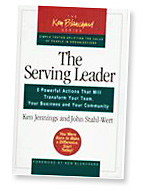
The Serving Leader: Five Powerful Actions That Will Transform Your Team, Your Business and Your Community by Ken Jennings and John Stahl-Wert (Berrett-Koehler Publishers)

The Serving Leader is a brief but powerful book that simplifies tangible actions you can take to transform your workplace. However, if this book were only a how-to book, it would not be as impressive as it is. Jennings and Stahl-Wert also probe the relational aspect of leadership in a surprising way.

There are really two story lines beyond the five how-to’s in this book. There is the story of the researcher and his professional work, but there also is the story of the researcher and his father. The researcher’s story line takes him to some of the best organizations to learn what they do best. He explores the concept of building on strengths, trailblazing, raising the bar, upending the pyramid and running to great purpose. He provides nuanced definitions for all these actions that may surprise you.

If you have looked for a book on leadership that provided some tangible principles in the context of mercy, grace, healing, restoration, redemption, life purpose and the Christian message, The Serving Leader is the book you want to read.

Albert Reyes, president

Baptist University of the Americas

San Antonio


Making the Blue Plate Special: The Joy of Family Legacies by Florence Littauer, Marita Littauer and Lauren Littauer Briggs

Bible teacher and popular author Florence Littauer joins her equally gifted daughters in writing a book that speaks to the “heart” of family tradition and legacy.

The writers underscore what many of us often feel—that in many ways families and individuals are in danger of losing contact with the past and the deep, emotional meaning of events and relationships. While I usually am not drawn to such topics, the Littauer “gang” grabbed my attention in the introduction (“Pork with Panties”) and refused to allow me to escape until the final sentence in the last chapter, “What Will You Do?” (The appendix isn’t bad, either!)

Lauren Littauer Briggs does an admirable job in Chapter 7, “Holiday Traditions With Children,” encouraging family traditions that focus on “giving” instead of “getting.” The added recipes and holiday ideas are significant contributions to the book. She shows us how to make Christmas and other holidays something better than “it’s all about me.”

Lest you think the book is nothing more than emotional “fluff,” Marita Littauer provides a biblical foundation in Chapter 1.

The focus is on how Scripture reveals purpose and how purpose is amplified in family traditions that can remain powerful influences for good the rest of our lives.

The authors remind us that tradition and legacy are not built on occasional large, expensive events. Instead, families pass on real values by doing small “special” things really well.

Lauren Littauer Briggs reminds us, “The reward for surviving your children’s troublesome teenage years—when they hate you for no reason and wouldn’t talk to you if your hair was on fire—is that someday those same children will grow up, get married, come to realize you are wonderful after all and present you with grandchildren!” Take it from a grandparent, that’s when tradition and legacy mean the most.

Get this book. Parents will learn from it. Grandparents will celebrate it.

Charles Walton, pastor

First Baptist Church

Conroe

News of religion, faith, missions, Bible study and Christian ministry among Texas Baptist churches, in the BGCT, the Southern Baptist Convention ( SBC ) and around the world.


Baptist Briefs

Posted: 11/17/06

Baptist Briefs

CBF names disaster-response coordinator. The Cooperative Baptist Fellowship named Charles Ray, a long-time Little Rock, Ark., resident, the first coordinator for the Fellowship’s U.S.-based disaster-response team. He’ll begin his new position Jan. 1. The two-year position was created through a partnership between national CBF and CBF of Arkansas, who are jointly funding the position. Other state and regional CBF organizations are funding operational expenses for the position. Based on the disaster-response assets and capabilities of CBF state and regional organizations, Ray will develop a national disaster-response plan for the Fellowship. He also will work with governmental and non-profit agencies to respond quickly to disasters, especially in the formation and dispatch of an initial response team.


N.C. Baptists reject bylaw changes. Messengers to the annual North Carolina Baptist state convention meeting struck down proposed bylaw changes that would have given convention-related institutions more influence over the appointment of trustees and directors. The proposed amendments, more than a year in the making and supported by convention officials, received just 38 percent of the 2,198 ballots cast in the Nov. 14 meeting. Some observers say the move could trigger an exodus of N.C. Baptist colleges and other convention-related entities, which have sought more control over selection of trustees. Even before the convention, one institution signaled it will exercise more autonomy over trustee elections. Wingate University in Wingate, N.C., announced a plan to use an option in convention and university bylaws that allows it to appoint up to 50 percent of its trustees.


More than half in United States see Southern Baptists favorably. Southern Baptists were viewed favorably by 57 percent of adults interviewed as part of recent research conducted by the North American Mission Board’s Center for Missionary Research through Zogby International. The positive outlook toward Southern Baptists, United Methodists and Roman Catholics was about equal in the survey. Mormons and Muslims received less-favorable ratings—32 percent and 27 percent, respectively. Southern Baptists received unfavorable impressions from 17 percent of the people who responded, and 24 percent said they were unfamiliar with Southern Baptists. Researchers polled 1,210 American adults across the country.


Seminary honors church historian. Southwestern Baptist Theological Seminary has dedicated the Robert A. Baker Church History Room at its Roberts Library, honoring the memory of the longtime church history professor. The room houses Baker’s desk, several photos taken during his tenure at the seminary, his oral memoirs from the Texas Baptist Oral History Consortium and a large collection of books on church history—many of which he wrote. Baker earned two degrees from Southwestern Seminary and a doctorate from Yale University. He joined the church history faculty in 1943, teaching until 1981. Baker died Nov. 15, 1992. The seminary also honored Baker and his wife, Fredona, by giving them the L.R. Scarborough Award, named for the school’s second president.


Virginia Baptists increase budget. Virginia Baptists adopted a $14.2 million budget to fund their ministries in 2007—a $100,000 increase over this year’s budget goal. Messengers attending the annual meeting of the Baptist General Association of Virginia in Virginia Beach elected Boyce Brannock, a Staunton, Va., attorney and member of First Baptist Church in nearby Waynesboro, Va., president without opposition. Also elected were Joe Lewis, pastor of Second Baptist Church in Petersburg, Va., as first vice president, and Steve Pollard, pastor of Abingdon (Va.) Baptist Church, as second vice president. Brannock, Lewis and Pollard were endorsed by Virginia Baptists Committed, the state’s powerful network of moderates, whose slate of nominees for office has been unopposed for nearly a decade. This year, for the first time since 1997, a candidate not on the organization’s slate was nominated—Ken Barnes, pastor of Woodland Heights Baptist Church in Chesapeake, Va., who was nominated for first vice president. He lost to Lewis, 275-386 (41 percent to 58 percent).

News of religion, faith, missions, Bible study and Christian ministry among Texas Baptist churches, in the BGCT, the Southern Baptist Convention ( SBC ) and around the world.


Endowments provide churches a financial safety net

Posted: 11/17/06

Endowments provide
churches a financial safety net

By Michael Tomberlin

Religion News Service

BIRMINGHAM, Ala. (RNS)—Endowments long have been a source of income for colleges and charities. Now, more churches are getting in on the act.

Churches have begun setting up foundations or have started turning to denominational officials to help them prepare for the moment when generous members name them in a will.

“It’s almost like it’s a new discovery, but it’s simply about stewardship,” said Barry Bledsoe, president of the Baptist Foundation of Alabama, whose foundation administers more than $200 million from some 2,000 church gifts and endowments.

While most church members still view tithing in the light of weekly offerings, Bledsoe said, more of them are starting to think about leaving a portion of their estate to their church.

The business side of religion:
Pastors face stresses, challenges of corporate CEOs
Congregations embrace the business side of religion
• Endowments provide churches a financial safety net

“We’re seeing more and more people having what I call an ‘aha!’ moment,” Bledsoe said.

Actually, church foundations have been around for a while. In some cases, income from an endowment has been used to offset a drop-off in contributions. Southside Baptist Church in Birmingham, for example, has used money donated decades ago to supply operating funds during recent membership slumps.

The church’s endowment, established in the 1960s, produces about 25 percent of the annual budget, Pastor Steve Jones said.

There are now as many as 40 endowments at the church, most of them smaller and dedicated to specific ministries such as the church’s food bank for the poor, scholarships for youth and a Boy Scouts program.

Some of the larger endowments generate income to the church’s budget, and another aids in maintaining the building.

“We are not dependent on it for the life of the church, but it is a nice extra thing for projects that we might have,” Jones said. “Our congregation is very good about supporting the church through its tithes and offerings.”

But without the endowment, Jones says, the church budget would have to be cut.

“If there was no trust, we would not be able to do some of the things we do.”

Greg Ring, head of PhilanthroCorp in Colorado Springs, Colo., says endowments will become a major part of church finance. Ring works with churches and denominational groups like Bledsoe’s to educate them on endowments.

“There are somewhere between 350,000 and 400,000 congregations in America. I only know of a handful—literally, I’m talking about less than a dozen churches—that have a systematic, disciplined planned-giving program in place,” Ring said. “I believe we are going to see this trend grow dramatically over the next decade.”

The rise of megachurches, with their multimillion-dollar budgets and their many members with business-world expertise, has accelerated the trend, he said. These churches have shown they can handle large sums of money to expand their campuses and ministries.

“Typically, those churches have more sophisticated people who more readily understand endowments and how they might impact God’s ministry,” Bledsoe said.

This type of giving, though, is no longer restricted to the wealthy. Ring said most church endowment gifts are in the tens of thousands, not in the millions.

“Often people associate endowment gifts with millionaires and, of course, those make the headlines,” he said. “But it’s not uncommon to be talking about a gift of $25,000 on a relatively modest estate.”

Church finance experts, however, caution that, like winning the lottery, big endowments can lead to a sense of complacency where regular contributions by parishioners are seen as unnecessary. As a result, vitality can wither.

“Endowments can play the same role that we can observe in Europe with state funding (of religion)—that is, you have funding whether anyone cares or not,” said Sylvia Ronsvalle, executive vice president of empty tomb inc., a Christian service and research group based in Champagne, Ill., that monitors church giving.

Bledsoe says churches are poised for an endowment boom.

“I really believe that it’s going to be a revolutionary discovery or a missed opportunity,” he said. “Time is going to tell which one of those it is. I believe it’s going to be a revolutionary discovery for the church.”

News of religion, faith, missions, Bible study and Christian ministry among Texas Baptist churches, in the BGCT, the Southern Baptist Convention ( SBC ) and around the world.