Amish response to violence rated top ’06 newsmaker

Posted: 1/05/07

An Amish family arrives to pay their respects at the White Oak farm of Chris and Rachel Miller, who lost two daughters when a gunman killed five girls at an Amish school. (RNS photo by Robert Sciarrino/The Star-Ledger of Newark, N.J.)

Amish response to violence
rated top ’06 newsmaker

By Jason Kane

Religion News Service

WASHINGTON (RNS)—The Amish community that inspired the world with acts of forgiveness after a Pennsylvania schoolhouse shooting has been named the newsmaker of the year for 2006 by the Religion Newswriters Association and Beliefnet.

The multi-faith spirituality website Beliefnet.com noted the Amish community topped its list of newsmakers for demonstrating “courage, forgiveness, self-sacrifice and love” after a gunman entered an Amish schoolhouse in October and shot 10 girls before taking his own life. The Amish community reached out to the killer’s family, offering monetary and emotional support. Several attended his funeral.

The Amish also were rated the year’s top newsmaker in a separate poll of 149 religion reporters. They voted on their picks as the 10 most important stories of the year and the single biggest newsmaker.

The Religion Newswriters Association top 10 stories were:

1. Muslims throughout the world react violently after the publication of Muhammad cartoons in several European nations. Christians and Muslims are killed when riots erupt in Nigeria.

2. Pope Benedict XVI touches off more Muslim anger by referencing a centuries-old quote linking Islam and violence during a speech. He apologizes and calms the uproar during a trip to Turkey.

3. The Episcopal Church infuriates conservatives during its general convention by electing Katharine Jefferts Schori—who supported the consecration of an openly gay bishop—as the first woman to its top post. Several dioceses throughout the nation adopt measures that set the stage for secession from the denomination.

4. Evangelical Ted Haggard resigns as president of the National Association of Evangelicals and is dismissed as pastor of his Colorado Springs, Colo., megachurch after he is accused of engaging in gay sex and using drugs.

5. Many Republican candidates backed by the religious right are defeated in the fall elections, with a significant number of voters claiming morality was one of the strongest motivators in their decision-making at the polls.

6. Religious voices grow louder for peace in Iraq as conflict between Sunni and Shiite Muslims rises. Israeli incursions in Lebanon aimed at curbing attacks by Hezbollah ignite more strife in the Middle East, and Christian churches reconsider efforts to pressure Israel on the Palestinian question.

7. The schoolhouse murder of five Amish girls in Nickel Mines, Pa., highlights the Amish community’s ethic of forgiveness when several Amish attend the killer’s funeral.

8. (tie) The film The Da Vinci Code hits theaters, prompting more outrage over Dan Brown’s novel. Religious critics cite controversial plot lines, including Jesus marrying Mary Magdalene and conceiving a child.

8. (tie) Same-sex marriage bans pass in seven of eight states voting on the issue during the midterm elections. Arizona becomes the first state to defeat such a ban. New Jersey’s Supreme Court decides same-sex marriage couples deserve the same rights as heterosexual couples.

10. President Bush vetoes a bill calling for expanded stem-cell research. Progress is reported in efforts to create stem-cell lines without destroying embryos.


News of religion, faith, missions, Bible study and Christian ministry among Baptist churches, in Texas, the BGCT, the nation and around the world.


DRINK TO THAT? Have Baptists watered down their objections to alcohol?

Posted: 1/05/07

DRINK TO THAT?
Have Baptists watered down
their objections to alcohol?

By Ken Camp

Managing Editor

A growing number of Baptists may have brought in the New Year by raising a glass of something a bit stronger than iced tea, some cultural observers speculate. Baptist attitudes toward alcohol consumption seem to be in transition, they insist.

Consider the spirited debate—and debate about spirits—sparked last summer when messengers to the Southern Baptist Convention annual meeting approved a resolution opposing the consumption of alcoholic beverages—and an amendment disqualifying imbibers from service as trustees of SBC entities.

Messengers passed resolutions on such volatile issues as same-sex marriage, illegal immigration and genocide in Darfur with little discussion, but the call for total abstinence prompted debate on the convention floor and ongoing dialogue on Internet blogs.

“The Southern Baptist Convention is committed to drawing boundaries. It was inevitable this would be one of them,” said Bill Leonard, dean of the Wake Forest Divinity School. “Each year, Southern Baptists try to find ways to set themselves off as different than the prevailing culture. But this time, they discovered that even inerrantists may take a drink every now and then.”

Indeed, some self-described inerrantists and Calvinists kept the issue alive long after the annual meeting, arguing on Internet chat rooms that the Bible condemns drunkenness but does not present a compelling case for total abstinence.

Wade Burleson, pastor of Emmanuel Baptist Church in Enid, Okla., recently wrote on his blog a satirical list of 10 reasons why tea and coffee drinkers should be excluded from Southern Baptist leadership and missions service.

Burleson—whose earlier blog postings nearly led to his removal as an International Mission Board trustee—poked fun at many of the arguments traditionally used to promote total abstinence from alcohol by applying them to the use of tea and coffee.

“Drinking tea leads a person to addition to caffeine,” he wrote. “There might be some who allege that drinking just one or two glasses of tea does not lead to caffeine addiction. This is technically true, but unfortunately, not all Christians who partake in moderate tea drinking can stop with just a couple of glasses.

“It is not uncommon for Christian men and women to progress from tea, to coffee, to 64-ounce colas or Mountain Dews. Where does it stop? How does one know when the line of addiction has been crossed? If caffeine is addictive, then why play with fire?”

Preaching total abstinence

Burleson’s satire is a far cry from the position fundamentalist icon W.A. Criswell took. In a 1968 sermon he preached at First Baptist Church in Dallas, Criswell pointed to the Old Testament prophet Daniel as an example for Christians because Daniel “purposed in his heart that he would not defile himself” by drinking the king’s wine.

“We’re not talking about moderation. That’s not in the book, and I preach what’s in the book,” Criswell said. “We’re talking about abstination—total abstinence.”

Criswell countered the argument that Jesus turned the water into wine at a wedding in Cana by insisting Christ made a divinely different drink.

“It was the celestial drink that we shall share together when we sit down to the table of the Lord at the marriage supper of the Lamb, some glorious and final day,” Criswell said. “Do you think that God made in that cup what it is that makes men stagger, that makes men beasts, that makes men drunk? It is unthinkable. It is unimaginable.”

Today, some Baptists insist modern-day problems associated with alcohol abuse present a compelling argument for abstinence, but few appeal to Scripture for an absolute prohibition—or argue that Jesus made unfermented grape juice at the wedding in Cana.

“The Bible does not put forward just an abstinence perspective. John the Baptist apparently took a Nazarite vow of abstinence. But Jesus made wine,” said Bill Tillman, T.B. Maston Chair of Christian Ethics at Hardin-Simmons University’s Logsdon School of Theology.

Tillman insists Baptist attitudes toward beverage alcohol have been influenced both by culture surrounding the church and by a culture that developed within many churches.

“It’s more of a church culture that has been imposed than one operating out of seeking and asking, ‘What would the gospel have us do?’ The church culture tends toward more of a law-and-order approach,” he said.

Baptists who have taken Scripture seriously have differed over how Christians should balance their freedom from the law that grows out of God’s grace and their need to give up some privileges for the sake of other people, Tillman noted.

“For many, the guide has been: If it’s a hindrance to your Christian witness, stop it,” he observed.

An honest appraisal of Baptist attitudes toward alcohol consumption also must acknowledge a fair measure of hypocrisy, he acknowledged.

“There’s long been a pattern running through our history of Baptists publicly forbidding the consumption of alcohol but privately consuming it. There’s a lot of duplicity that has gone on,” Tillman said.

History shows mixed attitudes

Baptist attitudes always been “mixed on drinks,” said church historian Leonard of Wake Forest.

“We’ve always had some who have repudiated alcohol,” he said. However, many early Baptists in the United States drank moderate amounts of beer, wine and even hard liquor.

Elijah Craig, a Kentucky Baptist minister who founded both the Baptist-related Georgetown College and a distillery, generally has been credited as the inventor of bourbon whiskey, Leonard noted.

As Baptists—along with Methodists and other revivalist Protestant groups—moved to the American frontier, they saw breakup of families and the general lawlessness that accompanied easy access to open saloons.

Consequently, the conservative revivalists joined forces with social gospel liberals in launching a temperance movement that ultimately developed into an abstinence movement, Leonard observed.

“In revivals, preachers invited sinners to accept Jesus and at the same time sign a pledge not to drink alcohol,” he said. “It was a truly ecumenical movement. The social gospel people saw what alcohol abuse did to the poor, and they viewed it as the root of much urban social evil. The personal salvation people saw it as detrimental to the individual Christian’s body, and they believed the body is the temple of the Holy Spirit.”

It also became a way for Protestants to set themselves off as different from—and in their minds, morally superior to—immigrant Catholics who drank socially, he added.

Baptist enthusiasm for the anti-liquor crusade in the late 19th and 20th centuries was fueled by genuine concern over the damaged lives, fractured families and financial heartache associated with alcohol abuse—as well as a tendency among some believers to equate Christianity with a set of prohibitions, Tillman added.

“It appealed to those who essentially practiced Christianity out of a ‘thou-shalt-not’ perspective,’” he said.

That viewpoint influenced the way they read and interpreted Scripture, he added, noting, “You see what you want to see.”

Wine or grape juice?

It led to debates over whether the drink at Christ’s Last Supper was fermented or not—and whether churches observing the memorial meal should use wine or grape juice.

Herschel Hobbs, the renowned pastor-theologian who chaired the committee that drafted the 1963 Baptist Faith & Message, maintained the cup taken at Christ’s Last Supper and instituted as one of the elements of the Lord’s Supper was filled with grape juice, not wine.

“Some interpret ‘fruit of the vine’ as wine. However, as the bread was unleavened, free of bacteria, was the cup also not grape juice?” he asked in his church study course book he wrote to explain the Baptist Faith & Message.

“Wine is the product of the juice plus fermentation caused by bacteria. Since both elements represented the pure body and blood of Jesus, there is reason to ponder. The writer sees ‘fruit of the vine’ as pure grape juice untainted by fermentation.”

But until Thomas Welch—a Methodist minister-turned-dentist and leader in the temperance movement—developed the pasteurization process for nonfermenting grape juice, Baptist churches consistently used wine in communion, Leonard said.

“I’ve always found it ironic that Baptists have insisted on a literalist approach to Scripture when it comes to baptism by immersion, but when the temperance movement came along, they fell off the wagon and gave up wine in communion at the drop of a hat,” he noted.

However, he noted, a few churches “argued as biblical literalists that they couldn’t give up wine in favor of the grape juice that the liberals used.” Some backcountry churches in the Southeast have continued to make elderberry wine in their basements for the Lord’s Supper, he added.

Divided by geography

Baptist attitudes toward beverage alcohol also have been influenced by geography, Leonard noted. West of Mississippi and in the Deep South, abstinence has been strong, but churches on the East Coast—particularly in Kentucky, Virginian and North Carolina—generally have been more accepting of social drinking.

Robert Prince has seen “definite regional differences” on alcohol consumption firsthand. Next month, Prince will mark his fourth anniversary as pastor of First Baptist Church in Waynesville, N.C. Before that, he was pastor of First Baptist Church of Vernon in North Texas.

“Probably 80 percent of the church in Vernon would have been against the use of alcohol. At our church here in Waynesville, it’s probably more like 40 percent,” he said.

Ironically, Prince sees little difference between incidents of problem drinking and the social problems associated with alcohol abuse in the two communities.

“It’s a real problem both places,” he said.

In addition to geography, Prince believes generational differences also account for varying attitudes among Baptists toward beverage alcohol.

“Among the 35-and-younger crowd, they seem more open about alcohol—even conservative evangelicals,” he said.

Ken Hugghins, pastor of Elkins Lake Baptist Church in Huntsville, agreed many younger Baptists seem less adamant in opposition to alcohol consumption.

“Most of the hard-core reaction against it is from the older generation,” he said.

But the younger generation may be influenced less by Baptist tradition and more by non-Baptist evangelicals who write and talk freely about meeting friends in bars or drinking wine at meals, he observed.

“A lot of them come from non-Baptist backgrounds, and there is a lot of cross-pollination” with other traditions, he noted.

And as they move upward socio-economically, social drinking also loses much of its stigma, he added.

Words of caution

Both Hugghins and Prince agreed a less hard-line approach toward alcohol consumption seems to reflect a more honest approach to Scripture, but both quickly added the Bible clearly condemns drunkenness.

“We should quit overselling it and quit over-stating the case. We should quit making absolutes out of cultural preferences,” Hugghins said.

Still, Prince noted, it “could be a double-edged sword” if some people interpret a less-than-absolute position against alcohol as an excuse to indulge.

Bobby Broyles, pastor of First Baptist Church in Ballinger, fears that’s exactly how many young people interpret their parents’ permissive attitudes toward alcohol—and their apathetic attitude toward underage drinking.

“It’s a pervasive problem, but too many people don’t think it’s a problem,” he said, noting underage drinking may be even worse in fairly isolated rural communities than in metropolitan areas usually associated with substance abuse.

In fact, he noted, the problem has become so significant in Ballinger the school district is considering a range of responses, including possible mandatory drug tests.

If that happens, the school district first will have to schedule a series of public hearings on the issue. Broyles sees that as an opportunity for First Baptist Church members to educate their neighbors about the dangers of drugs and alcohol.

“We have about 400 family units in our junior high and high school. What if we trained 40 people or 40 couples about drugs and alcohol, and then we went them into the community to make 400 home visits?” he asked. “We could invite people to the public hearings, and use it as an occasion to talk with them about the problem.”

Knowing how to take a firm stand against something destructive without making it into “forbidden fruit” that seems irresistibly attractive can be challenging, Broyles noted. Even so, he hopes Baptists don’t water down their views on alcohol consumption too much.

“I’d hate to think we’re softening our stand on this issue when it’s causing such untold problems in families—when it’s at the root of so much physical abuse, emotional abuse and sexual abuse,” he said.


News of religion, faith, missions, Bible study and Christian ministry among Baptist churches, in Texas, the BGCT, the nation and around the world.


Alcoholism: No easy fix or single remedy

Posted: 1/05/07

Alcoholism: No easy fix or single remedy

By Jennifer Sicking

University of Mary Hardin-Baylor

BELTON—Alcoholism presents a multifaceted problem—too varied for one all-purpose remedy or a single approach to ministry for those who battle the disease, said Ty Leonard, psychology professor at the University of Mary Hardin-Baylor and director of the school’s Community Counseling Center.

For churches that want to help the wounded in their congregations and communities battle addictions, Leonard offered words of advice.

He cautioned that church-based ministries must avoid fostering what he called the biggest danger—shame.

“Shame can cause an alcoholic to retreat back to their natural defense mechanism, which is alcohol,” he said.

Because of the shame many alcoholics already feel about their addiction, churches should recognize the importance of protecting anonymity, he added.

Leonard believes strongly in the value of 12-step programs, like Alcoholics Anonymous.

“The first step in the process of the recovery process is for the alcoholic to admit their loss of control and to turn over their need for control to his or her higher power,” he said.

“I feel that church-based ministries could be very helpful in both helping recovering addicts in getting to know their higher power (God) and also in providing a supportive social network of people who care.”

News of religion, faith, missions, Bible study and Christian ministry among Baptist churches, in Texas, the BGCT, the nation and around the world.


Around the State

Posted: 1/05/07

Around the State

Houston Baptist University will hold a three-day expression of faith through the arts Jan. 25-27. “Credo: The Arts as Expressions of Belief” will include a concert in Jones Hall with the HBU Choral Union and the Houston Symphony conducted by Krzysztof Penderecki, the Polish composer of “Credo;” an evening vespers service with new musical works; an art exhibit hosted by the Museum of Printing History; and lectures by Marilynne Robinson, Pulitzer Prize-winning author of Gilead, and Gregory Wolfe, founder and editor of Image, a national literary quarterly. All events are open to the public and free. For more information, visit www.hbu.edu/credo.

• One hundred and nine students graduated from East Texas Baptist University during fall commencement ceremonies last month. George Mason, pastor of Wilshire Church in Dallas, delivered the charge to the graduates.

• Two hundred seventy-three students earned academic honors at Howard Payne Uni-versity during the fall semester. One hundred and six students maintained perfect grade-point averages, while 96 were named to the Dean’s List and 67 to the Honor Roll.

• Marilyn Edwards has been named the 2006 Faculty Member of the Year at Dallas Baptist University. The award corresponds with her 10-year anniversary of service at the school. She is an assistant professor of psychology and a member of Park Cities Church in Dallas.

• Thirty-two student teachers and and three interns received the education pin marking the completion of the teaching certification program of the University of Mary Hardin-Baylor. Keri Cave was presented the Preservice Educator of the Year award.

• John Voholetz of Houston was among the fall graduates of Southeastern Theological Seminary.

Retiring

• Marvin Donnell, as pastor of West Robinson Church in Waco, Jan. 28. He started the church 17 years ago. His ministry encompasses more than 25 years, with service as pastor of Eastside Church in Comanche and Gholson Church in Waco. He will be available for supply and interims as well as gospel music concerts. He can be contacted at (254) 741-0959.

Deaths

• Clarence Howell, 98, Dec. 3 in Hemphill. He was a longtime Baptist minister, serving as pastor of Sunnyside Church in Dimmitt, Vilott Church in Whitesboro, Custer City Church in Gainesville, First Church in Kress, First Church in Hemphill and First Church in Boling, Yellowpine Church in Hemphill, First Church in Pineland and First Church in Bronson during more than 50 years of ministry. He continued to preach at the Hemphill Care Center and Pineland Nursing Home until he was 95. He was a member of First Church in Hemphill at the time of his death. He was preceded in death by his wife of 52 years, Leta, and his daughter, Clareta Sue. He is survived by his daughters, Mary Howell, Jane Creech and Clara Murphy; brother, Bonnie Joe; five grandchildren; and 14 great-grandchildren.

• C.O. Herchenhahn Jr., 64, Dec. 4 in Houston. He was pastor of Spring Woods Church in Houston at the time of his death, where he had served since 1991. He died from complications of multiple myeloma. Ordained in 1979, he also had been pastor of Valley Grove Church in Stephenville and Pleasant Grove Church in Pensacola, Fla. He served on the Executive Board of the Baptist General Convention of Texas and on the board of the Baptist Mission Centers of Houston. He is survived by his wife of 42 years, Charlotte; daughters, Chantelle, Candice and Crisla Herchenhahn; son, C.O.; sisters, Miriam Norton and Melleen Moore; and three grandsons.

• Leroy Summers, 74, Dec. 13 in Dallas. Summers had served five years with the Baptist Foundation of Texas, maintaining donor relationships. Previously, he served 18 years at Park Cities Church in Dallas in ministry to people more than 50 years old, and he continued to assist in that ministry while with the Baptist Foundation. He also had a wide-ranging music ministry, serving churches in Arizona, Tennessee, Missouri, Florida and Texas. He was ordained as a minister in 1957. He is survived by his wife, Carolyn; daughter, LeCarole Moore; and two grandchildren.

• C.B. Hastings, 90, Dec. 18 in Austin. After feeling that call to ministry, he enrolled at Southwestern Seminary. After serving a church in Illinois for a short time, he enlisted as an Army chaplain during the war. After the war, he became pastor of Central Church in Marshall for two years and then became chaplain of Buckner Children’s Home. He later helped establish and was the first director of the Baylor University extension division. From 1960 to 1970, he was minister of education at Park Cities Church in Dallas. He then became the liason to Catholics for the Southern Baptist Home Mission Board for 11 years. In retirement, he was director of the northwest center in Portland, Ore., for Golden Gate Seminary, was an adjunct professor of missions at Southeastern Seminary and Greek at Memphis Seminary. He was preceded in death by his wife, Jeanette, and grandson, Ryan. He is survived by his sons, John, Larry and Roger; daughters, Nancy Sehested and Abagail Hastings; eight grandchildren; and one great-grandson.

• Ray Fleet, 78, Dec. 22 in Dallas, after a seven-year battle with cancer. He was pastor of Woods Chapel Church in Arlington, First Church in Seagoville, First Church in Mansfield and Beech Street Church in Texarkana, before being appointed by the Foreign Mission Board to serve in Brazil. He served 30 years developing leaders and pastoring churches there. He retired in 1994 and returned to Dallas, speaking and singing in churches until illness intervened. He is survived by his wife of 61 years, Ruby; daughters, Vivian Swilley and Patricia Coit; son, Ray Jr.; and two grandchildren.

• Huis Egge, 95, Dec. 24 in Houston. She was president of Texas Woman’s Missionary Union from 1976 to 1980 and was affiliated with the missions organization most of her life. A charter member of Broadway Church in Houston, she also was a member of First Church in Corsicana from 1978 to 1997 and most recently was a member of First Church in Friendswood. She was preceded in death by her first husband, Clarence Coy, and her second husband, Elvis Egge. She is survived by her sons, Jon and Ford Coy, daughters, Ann Fantozzi and Martha Prince; and her sisters, Marcy Jackson and Linda Presley.

Event

• Robert Dunston, Old Testament and Hebrew professor at the University of the Cumberlands, will lead Calder Church in Beaumont’s scholar-in-residence meeting Jan. 7-11. For more information, call (409) 892-4251.

Revival

• Ferguson Road Church, Dallas; Jan. 14; evangelist, David Allen; music, Michael Bridges; pastor, Wayne Wible, Jr.

News of religion, faith, missions, Bible study and Christian ministry among Baptist churches, in Texas, the BGCT, the nation and around the world.


Exhibits feed the public’s hunger for biblical history

Posted: 1/05/07

The traveling “From Abraham to Jesus” exhibit walks visitors through the story of 2,500 years in the Holy Land using a combination of antiquities from biblical times and multimedia special effects. (RNS photo courtesy of A. Larry Ross Communications)

Exhibits feed the public’s
hunger for biblical history

By Rebecca U. Cho

Religion News Service

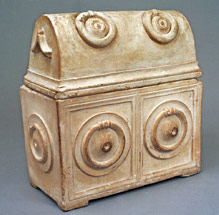
WASHINGTON (RNS)—A box believed to contain the remains of the son of Simon of Cyrene—the man the Bible says carried Jesus’ cross to his crucifixion—is traveling the United States. Meanwhile, curators are preparing the earliest-known manuscript of the Ten Commandments for display next year in San Diego. At the same time, archaic writings testifying to the status of Scripture throughout centuries lie behind glass in Washington, D.C.

With simultaneous exhibits of biblical artifacts on display or in the works across the nation, the museum world and the general public cannot seem to get enough of the Bible.

“I think the museum world is burgeoning in this area,” said Hershel Shanks, founder of the Biblical Archaeology Society and editor of the Biblical Archaeology Review magazine, which tracks exhibits throughout the country.

An ossuary, or bone box, dating from the Roman period is part of the traveling “From Abraham to Jesus” archaeological exhibit. (RNS photo courtesy of Hebrew University of Jerusalem Institute of Archaeology)

The seeming escalation in the number of biblical archaeological exhibits in the United States may be coincidence, but there are several theories.

Shanks said popular interest in Christianity’s foundations, fueled by Dan Brown’s The Da Vinci Code and Mel Gibson’s The Passion of the Christ, is playing a part in creating a cross-fertilization in interest between the academic and lay worlds.

“Archaeologists are digging things up, scholars are writing and so are the fiction writers,” Shanks said.

Cary Summers, CEO of The Nehemiah Group, a consulting firm that has helped build exhibits in Israel, said public interest in the Holy Land is greater now than in previous years, in part due to a greater curiosity about religion following the Sept. 11, 2001, terrorist attacks.

Summers collaborated with the Hebrew University of Jerusalem on an exhibit touring the United States called “From Abraham to Jesus” that walks visitors through the story of 2,500 years in the Holy Land using a combination of antiquities from biblical times and multimedia special effects.

The success of Dead Sea Scrolls exhibits last year in Grand Rapids, Mich., and Mobile, Ala., convinced him public interest was high and the timing was right to bring the show to the United States, Summers said.

“We’ve certainly hit a hot button,” he said.

Through the traveling exhibit, the ossuary—or burial box—believed to contain the bones of Simon of Cyrene’s son is making its public debut.

The oldest artifacts in the show have been dated to 3250 B.C.—the time of Noah’s Ark, according to Summers. The show is touring 27 U.S. cities and Toronto until December 2008.

In Washington, the Smithsonian’s Arthur M. Sackler Gallery exhibition “In the Beginning: Bibles Before the Year 1000” tracks the progress of the Bible from centuries-old scraps of parchment to the familiar codified form in use today.

A Seattle museum exhibit focuses on the more-than-2,000-year-old Dead Sea Scrolls. Similar exhibits will open next year in Kansas City, Mo., and San Diego.

The scrolls are believed to be the oldest surviving copies of the Old Testament and are considered by many to be the greatest archaeological find of modern times. The writings have been dated between 250 B.C. and 68 B.C.

The Dead Sea Scrolls exhibits indicate a greater willingness of Israeli authorities to allow the artifacts to travel outside Israel, Shanks said.

The exhibits are part of Israeli efforts to raise funds for the scrolls’ conservation, said Risa Levitt Kohn, curator for the San Diego Natural History Museum’s “Dead Sea Scrolls” exhibit.

“Antiquities authorities are primarily interested in (the scrolls’) conservation, and conservation is very expensive,” Kohn said.

Seattle’s Pacific Science Center’s exhibit, “Discovering the Dead Sea Scrolls,” drew 14,000 people in its first week, compared to the usual 30,000 visitors to all museum exhibits in the entire month of September. A similar exhibit drew large crowds in Charlotte, N.C., last spring.

In February, a Dead Sea Scrolls exhibit will open at Union Station in Kansas City. The San Diego Natural History Museum is set to open a similar exhibit of 24 scrolls, including parts of Psalms, Job and Deuteronomy, in June.

The scrolls exhibits feature other artifacts from Qumran, the small village near the northwest shore of the Dead Sea where a shepherd looking for a stray goat discovered the scrolls in caves in 1947. The Israeli Antiquities Authority, an Israeli government agency, is responsible for releasing the scrolls for public viewings.

News of religion, faith, missions, Bible study and Christian ministry among Baptist churches, in Texas, the BGCT, the nation and around the world.


Documentary explores faith of televangelists’ son

Posted: 1/05/07

Documentary explores
faith of televangelists’ son

By Shona Crabtree

Religion News Service

WASHINGTON (RNS)—After a year of being closely shadowed by a camera crew, Jay Bakker—the tattooed and body-pierced son of televangelists Jim and Tammy Faye Bakker—finally is getting his private life back.

But viewers across the country have a chance to watch his year in review on the Sundance Channel in One Punk Under God, a six-part documentary that began airing in December and ends Jan. 17.

Jay Bakker, son of televangelists Jim and Tammy Faye Bakker, is the subject of a Sundance Channel documentary series, One Punk Under God.

One Punk Under God takes a close look at Bakker’s life and his unconventional ministry, Revolution Church, almost 20 years after the implosion of his parents’ PTL ministry and television network. Although born to parents who helped create the definition of televangelist, the younger Bakker, 31, took some convincing before agreeing to participate in the documentary.

Bakker, with his arms and torso covered in tattoos, a hipster beard and multiple piercings, said his motivation was giving more people a chance to hear his message.

“Not many people see, for lack of a better term, more liberal Christians,” he explained.

Randy Barbato, executive producer of One Punk Under God, said the younger Bakker has embraced his mother’s vision of nonjudgmental, inclusive Christianity. He first met Jay Bakker when making the documentary, The Eyes of Tammy Faye, six years ago and knew he wanted to delve deeper.

“This is a series about quiet moments,” Barbato said. “It was meant to follow Jay’s church, and it turned into a series that tracks him becoming a man.”

Initially, Bakker tried to hide from the crew. Over time, he became more comfortable, enough for the cameras to capture what turned out to be an unexpectedly eventful year, including a long-awaited reconciliation with his estranged father, emotional conversations with his mother as she battles cancer, his decision to support same-sex marriage and his move from Atlanta to Brooklyn so his wife, Amanda, can go to medical school.

Although close to his mother, Bakker’s relationship with his father was rocky. The elder Bakker now lives in Branson, Mo., and is remarried with five adopted children. Jay Bakker said their estrangement was a gradual process of losing touch and lacking common ground.

When they did talk about religion, his father focused on the Book of Revelation and the end times, while the son wanted to discuss the meaning of grace and restoration. Their awkwardness eventually caused conversation to cease. That distance ended, however, when his mother’s cancer returned this year. Now remarried as Tammy Faye Bakker Messner, she has battled lung and colon cancer for several years and recently started hospice care.

Jay Bakker reached out to his father, eventually visiting him and appearing on The New Jim Bakker Show.

“This was a really healing time. We really respect each other as men, as individuals,” the younger Bakker said, adding that when he had a hard day recently, the first person he called was his dad.

When Jay Bakker decided to support same-sex marriage, his father expressed concern about his future as a preacher.

“He was worried that the church was going to destroy me,” Bakker said. “Finally I had to say, I don’t want the same things. … I minister to different people.”

While his mother has long been an icon in the gay community as one of the first to reach out to people with HIV, Jay Bakker said his childhood was defined by traditional evangelical beliefs. At times, he even felt like God hated him for sinning; smoking a cigarette once earned him a seven-day suspension from school. Eventually, conversations with a close friend led him to embrace a more expansive view of grace, salvation and God’s love.

The last thing Bakker said he wants to be is a “TV preacher.” But just as his parents pioneered television, Bakker has embraced online technology for his Revolution ministry. His website, www.revolutionchurch.com, started as a “side thing,” but now Revolution gets most of its funding from online donations and sales of his sermons on CD. Sermons also can be downloaded for free.

Revolution, which meets in bars in Brooklyn, Atlanta and Charlotte, N.C., reaches more people online than in person. The website gets 250,000 hits a month. Since the documentary started airing, attendance at his Brooklyn gathering has jumped to 50 people, compared to the usual 15 to 30 attendees.

Revolution is “just a church for people who are looking for Christ. It’s a place to come and be loved, and we’re not going to judge you. We’re not about promotion; we’re about attraction,” Bakker said.

News of religion, faith, missions, Bible study and Christian ministry among Baptist churches, in Texas, the BGCT, the nation and around the world.


Book reviews

Posted: 1/05/07

Book reviews

Reimagining Evangelism: Inviting Friends on a Spiritual Journey by Rick Richardson (InterVarsity Press)

“Evangelism as closing the deal on a sales call” is an approach that will become less prevalent as the days progress, according to Rick Richardson. Even Christians find this approach a hindrance in their quest to follow Christ. Instead, normal conversation is the best way to share your faith. Investing in another person’s life provides the opportunity for them to hear and observe your everyday life and fall in love with Jesus through your expressions and example.

What are you reading that other Texas Baptists would find helpful? Send suggestions and reviews to books@baptiststandard.com.

Reimagining Evangelism’s premise is that each believer is a missionary sent by God. The task is not delegated to a special few. A missionary understands and applies the gospel within a person’s culture. All church members are to assist others on their spiritual journey. The unfocused spiritual journey of each nonbeliever can become a beginning point for you, as a Christian, to engage others in a lifetime of Christ-likeness.

Fred Ater

Congregational strategist

Baptist General Convention

of Texas

San Antonio


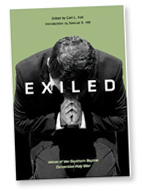
Exiled: Voices of the Southern Baptist Convention Holy War edited by Carl L. Kell (University of Tennessee Press)

The reality of the conflict within the Southern Baptist Convention is that this struggle not only removed from the rank-and-file those who were on the “wrong” side of the battle, but that the convention lost godly men and women.

This book comprises short essays, letters and autobiographical statements about how the people were removed from power and the extreme pain and suffering that resulted from such a conflict.

There are always two sides to every story, and this book presents not only the other side of the story but allows the reader who is unfamiliar with the story to understand just how painful splits, conflicts and power struggles can be. Kell’s book focuses on the convention level, but the reader comes to understand that people not only have experienced this in the SBC, but also in many local congregations. It brings to the forefront the dangers of engaging in such a conflict in the name of God.

The reader would do well not only to read these accounts, but also take to heart that in every conflict there is a winner and a loser and that the loss may impact the spiritual far greater than the physical.

Jeremy Johnston, pastor

Preston Highlands

Baptist Church

Dallas


Learning to Pray Through the Psalms by James W. Sire (InterVarsity Press)

Christians ready to move beyond “wish list” prayer should go to school in the Psalms. They preserve generations of inspired prayers touching every emotion and angle of life. James Sire has assembled a guidebook anyone can pick up and immediately put into practice.

The author is well known for books aimed at giving college students support for a Christian worldview. With this book, he has provided a useful tool for all kinds of adults.

Each chapter reprints a whole psalm (or two) and then walks the reader through a series of steps to understand, absorb and follow the psalm in prayer. Sire offers helpful examples of finding both the logical flow of a psalm and its emotional structure as well. Then the reader gets step-by-step direction for praying through the psalm as an individual or in a small group.

The book is peppered with Sire’s own experiences and personal insights. Readers who like Dallas Willard and Eugene Peterson will appreciate this companion to praying the Psalms.

Rick Willis, pastor

First Baptist Church

Lampasas


News of religion, faith, missions, Bible study and Christian ministry among Baptist churches, in Texas, the BGCT, the nation and around the world.


Baptist Briefs

Posted: 1/05/07

Baptist Briefs

African Baptist leader dies. Frank Adams, general secretary of the All Africa Baptist Fellowship, died Dec. 27 in Kumasi, Ghana, after several months of chronic illness. Adams, who also served as Baptist World Alliance regional secretary for Africa, was previously general secretary for the Baptist Convention of Ghana. Adams was a graduate of Baptist Theological Seminary in Rüschlikon, Switzerland, and the Oxford Center for Mission Studies in the United Kingdom. He is survived by wife Selina, two sons and one daughter.


Deadline nears for China pen-pals. The Fellowship of Baptist Educators is seeking about 2,000 students in grades 7 to 12 to answer letters and become pen-pals with young people in China. Jan. 15 is the deadline for requesting letters through the Christian Corresponders project, now in its 16th year. For more information, write John Carter with the Fellowship of Baptist Educators at Samford University, Box 292305, Birmingham, Ala., 35229, e-mail j-fcarter@juno.com or call (205) 822-4106.


Former first lady ordained as deacon. Maranatha Baptist Church in Plains, Ga., ordained former First Lady Rosalynn Carter as a deacon Dec. 10. Though raised a Methodist, Carter, 79, has been active in Baptist congregations since her marriage more than 60 years ago to former President Jimmy Carter, a longtime Baptist deacon. She is the second woman elected as a deacon at Maranatha. “She is very shy and doesn’t like the spotlight,” said Maranatha Pastor Jeff Summers. “But people have seen her leadership and compassion.” Carter often is involved in behind-the-scenes ministries, such as working with children and delivering meals to the homebound, he added.


Former missionary named university president. A Japanese university founded by Southern Baptist missionaries named one as its new president. Trustees of Seinan Gakuin University in Fukuoka, Japan, elected Gary Barkley as the school’s ninth president. Barkley is the university’s third American-born president. A graduate of Samford University in Birmingham, Ala., Barkley earned a doctorate from Southern Baptist Theological Seminary in 1984 and immediately moved to Japan to work as a missionary for the Southern Baptist Convention’s Foreign Mission Board. Barkley joined the school’s faculty in 1987 and went on to become dean of religious affairs.


Noted African-American pastor dies. George O. McCalep Jr., pastor of Greenforest Community Baptist Church in Atlanta and a popular speaker at African-American Baptist events, died Dec. 23. He was 67. He was a past president of the Southern Baptist African-American Fellowship and a prolific author. Under McCalep’s leadership, Greenforest Community Baptist grew from 25 members to more than 4,000, and the church’s annual budget increased from $13,000 to $2.1 million.


LifeWay VP announces retirement. Mike Arrington, vice president of the corporate affairs division at LifeWay Christian Resources, has announced his retirement effective Feb. 1. Arrington, who will continue to serve as a consultant to the president, was an executive with Texas Utilities before he joined the Southern Baptist publishing house staff in December 1991.


News of religion, faith, missions, Bible study and Christian ministry among Baptist churches, in Texas, the BGCT, the nation and around the world.


Cartoon

Posted: 1/05/07

“Backsliding, no doubt.”

News of religion, faith, missions, Bible study and Christian ministry among Baptist churches, in Texas, the BGCT, the nation and around the world.


2nd Opinion: Six tips for building better sermons

Posted: 1/05/07

2nd Opinion:
Six tips for building better sermons

Every weekend, bold Christians stand up in church and do something many parishioners wish they wouldn’t do: They preach.

They stand inside lofty pulpits, behind lecterns or out among the people. Some hold a Bible; some hold a remote control for advancing electronic slides.

Some have spent hours in preparation; others “phone it in” and hope it doesn’t show.

It’s a strange activity, preaching. Jesus nearly got tossed off a cliff when his first sermon offended his audience. Early preachers Peter and John converted thousands by their preaching—and also got arrested and imprisoned. Stephen was stoned to death after a sermon calling his audience a “stiff-necked people.”

Preachers have been chased out of town, burned at the stake, celebrated as heroes and broadcast to audiences numbering in the millions. Preachers also have been endured, scorned, treated to scathing reviews in the parking lot and fired for “meddling.”

Over the years, as listening skills and attention spans have changed, sermons have gotten shorter—although some would say not short enough. The 60-minute oration of the 19th century might be a 12-minute homily now. Stories have replaced theological discourse. Some preachers use multimedia tools such as slides, film clips and music to deal with attention deficits.

Preachers traditionally focus on Bible passages being read in worship, although some venture into cultural and moral issues, and many, despite the Internal Revenue Service, tackle political issues. Even the boldest preacher, however, is unlikely to abide by the model set by Jesus, who devoted two-thirds of his teaching time to wealth and power and the need to give both away. Every preacher knows that even the devout tend to stone their prophets.

As one who either preaches or listens to sermons every Sunday, I’d like to offer “Six Tips for Preachers”:

Show your passion. People need to see that this matters to you, that you aren’t just doing a duty. Show your passion for God. Your faith must be on display. Show your passion for your people, that you genuinely care about them and God’s place in their lives.

Keep it short. Long sermons are an irritant. Jesus’ parables were invariably short. A few well-chosen words will have more impact than many words. Consider Lincoln’s “Gettysburg Address.” Short is harder, of course. Short requires focus and discipline.

Be bold. Preaching is about life and death. It isn’t idle chatter. So what if your words offend? The gospel is offensive. So were the words of the prophets. God’s ways are rarely our ways, and God’s standards exceed our own. We must not sell God or our people short by preaching a safe and harmless word.

Preach from Scripture to the world. Hold the Bible in one hand and the world in the other. Each needs and informs the other. The prophets spoke not only to ancient Israel but to our world today. The gospel transformed first-century lives in ways God needed them transformed, and the same happens today. The preacher cannot simply explain Bible passages but also must read and explain people’s lives in light of Scripture.

Tell stories. Definitions, wordplays and cleverly connecting the assigned lessons show that the preacher studied Greek and Hebrew and knows theology. But it is stories that connect. Stories build bridges between life and faith. That’s why Jesus told stories.

Preach about faith and life. Faith isn’t about theories, doctrines, logic or facts. Faith sees God in life, and life in God, and then faith looks beyond what it sees to imagine the “more” of God. Preaching builds a bridge between faith and life. Preaching walks both directions on that bridge and remembers that the point is a journey of discovery.


Tom Ehrich is a writer, consultant and leader of workshops. His website is www.onajourney.org, and his column is distributed by Religion News Service.


News of religion, faith, missions, Bible study and Christian ministry among Baptist churches, in Texas, the BGCT, the nation and around the world.


Baptists in the House of Representatives

Posted: 1/05/07

Baptists in the House of Representatives

29 Democrats:

Barbara Lee, D-Calif.

Juanita Millender-McDonald, D-Calif.

Corrine Brown, D-Fla.

Kendrick Meek, D-Fla.

Sanford Bishop, D-Ga.

John Lews, D-Ga.

John Barrow, D-Ga.

David Scott, D-Ga.

Jesse Jackson Jr., D-Ill.

Danny Davis, D-Ill.

Julia Carson, D-Ind.

William Jefferson, D-La.

Albert Wynn, D-Md.

Steny Hoyer, D-Md.

Elijah Cummings, D-Md.

Carolyn Kilpatrick, D-Mich.

John Conyers, D-Mich.

Donald Payne, D-N.J.

Gregory W. Meeks, D-N.Y.

Edolphus Towns, D-N.Y.

G.K. Butterfield, D-N.C.

David Price, D-N.C.

Heath Shuler, D-N.C.

Stephanie Tubbs Jones, D-Ohio

Chaka Fattah, D-Pa.

Lincoln Davis, D-Tenn.

Eddie Bernice Johnson, D-Texas

Alan Mollohan, D-W. Va.

Gwen Moore, D-Wis.

31 Republicans:

Terry Everett, R-Ala.

Mike Rogers, R-Ala.

Spencer Bachus, R-Ala.

Trent Franks, R-Ariz.

John Boozman, R-Ark.

Kevin McCarthy, R-Calif.

Dana Rohrabacher, R-Calif.

Duncan Hunter, R-Calif.

Vern Buchanan, R-Fla.

Lynn Westmoreland, R-Ga.

Nathan Deal, R-Ga.

Donald Manzullo, R-Ill.

Ron Lewis, R-Ky.

Geoff Davis, R-Ky.

Harold Rogers, R-Ky.

Rodney Alexander, R-La.

Roger Wicker, R-Miss.

Chip Pickering, R-Miss.

Sam Graves, R-Mo.

Roy Blunt, R-Mo.

Steve Pearce, R-N.M.

Frank Lucas, R-Okla.

Henry Brown Jr., R-S.C.

J. Gresham Barrett, R-S.C.

David Davis, R-Tenn.

Zach Wamp, R-Tenn.

Louie Gohmert, R-Texas

Mike Conaway, R-Texas

Randy Neugebauer, R-Texas

Randy Forbes, R-Va.

Virgil Goode Jr., R-Va.


News of religion, faith, missions, Bible study and Christian ministry among Baptist churches, in Texas, the BGCT, the nation and around the world.


New Congress displays America’s religious diversity

Posted: 1/05/07

New Congress displays America’s religious diversity

By Jonathan Tilove

Religion News Service

WASHINGTON (RNS)—The new Congress will, for the first time, include a Muslim, two Buddhists, more Jews than Episcopalians and the highest-ranking Mormon in congressional history.

Roman Catholics remain the largest single faith group in Congress, accounting for 29 percent of all members of the House and Senate, followed by Baptists, Methodists, Presbyterians, Jews and Episcopalians.

See Related Articles:
Baptists in the House of Representatives

Religious affiliations of Texas congressional delegation

While Catholics in Congress are nearly 2-to-1 Democrats, the most lopsidedly Democratic groups are Jews and those not affiliated with any religion. Of the 43 Jewish members of Congress, there is only one Jewish Republican in the House and two in the Senate. The six religiously unaffiliated members of the House all are Democrats.

The most-Republican groups are the small band of Christian Scientists in the House (all five are Republican), and members of the Church of Jesus Christ of Latter-day Saints (12 Republicans and three Democrats)—though the top-ranking Mormon in the history of Congress will be Nevada Sen. Harry Reid, the incoming Democratic majority leader.

Baptists divide along partisan lines defined by race. Black Baptists, like all African-American members of Congress, are Democrats, while most white Baptists are Republicans. Notable exceptions include incoming House Majority Leader Steny Hoyer, D-Md., and Sen. Robert Byrd, D-W.Va., who will serve as president pro tem in the new Senate, making him third in succession to the presidency after the vice president and House Speaker-elect Nancy Pelosi, D-Calif.

Because 2006 was such a good year for Democrats, they have regained their commanding advantage among Catholics, which had slipped during an era of GOP dominance. In Pennsylvania alone, five new Democrats, all Catholics, were elected to Congress in November, including Bob Casey, who defeated Sen. Rick Santorum, a far more conservative Catholic.

In the new Congress, two-thirds of all Catholic members will be Democrats. By contrast, after big Republican gains in 1994, 44 percent of Catholic members of Congress were Republican, noted Albert Menendez, a writer and researcher who has been counting the religious affiliation of members of Congress since 1972.

“It’s a thankless task, but somebody’s got to do it,” said Menendez, 64, who lives in North Potomac, Md., and has published his counts and analysis first with Americans United for Separation of Church and State and more recently in Voice of Reason, the newsletter of Americans for Religious Liberty.

Menendez bases his count on how members of Congress identify themselves. When he did his first tally after the 1972 election, Congress still was much in the sway of a few mainline Christian faiths.

At the time, three mainline Protestant denominations—Methodists, Presbyterians and Episcopalians—accounted for 43 percent of all members of Congress, including 51 senators.

As this Congress convenes, those three will account for just a fifth of Congress, including 32 senators.

Still, all three—especially Episcopalians and Presbyterians—continue to be better represented on Capitol Hill than among the general population.

Through it all, Lutherans have maintained. Menendez said they were underrepresented relative to their population in 1972, with 16 members of Congress, and remain underrepresented today with 17. While their total numbers have held steady, their political allegiance has flipped from 2-to-1 Republican to 2-to-1 Democrat.

Evangelical Christians—a category that cuts across denominational lines—are even more underrepresented, said Furman University political scientist James Guth, all the more so after this year’s defeat of Republican incumbents like Reps. John Hostettler of Indiana and Jim Ryun of Kansas.

Meanwhile, Jews have continued to gain representation in Congress (8 percent in the new Congress) even as their share of the national population has waned (1.3 percent in 2001).

But Jewish numbers in Congress also tend to fluctuate with Democratic fortunes. In a year in which Democrats did well in unexpected places, new Jewish members of Congress were elected from Tennessee, Kentucky, Arizona and New Hampshire, as well as more familiar terrain like Florida and Wisconsin.

News of religion, faith, missions, Bible study and Christian ministry among Baptist churches, in Texas, the BGCT, the nation and around the world.